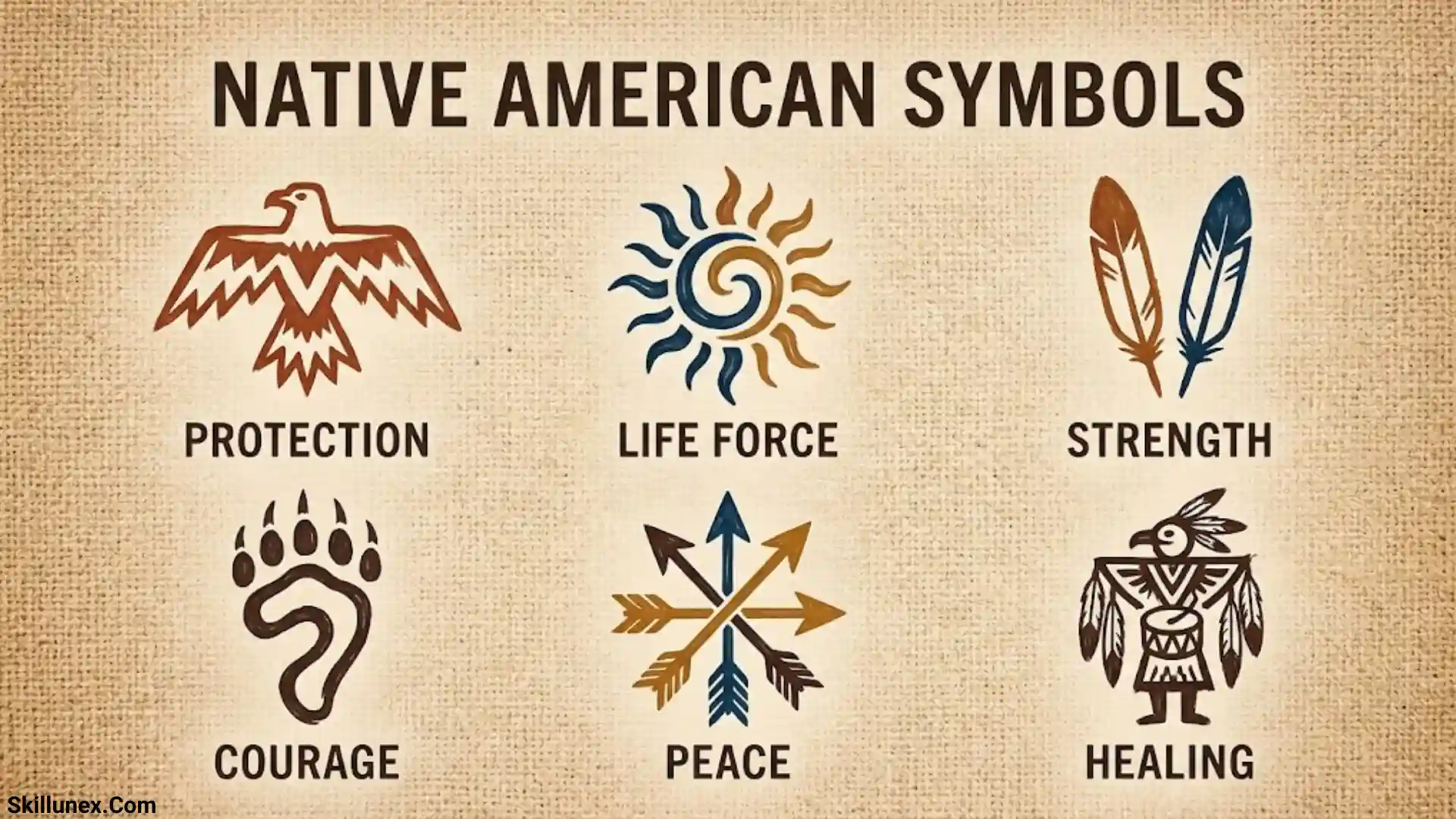
Native American symbols are meaningful visual designs, patterns, and images found in the art, traditions, stories, and cultural practices of Indigenous peoples across North America. They may appear in pottery, beadwork, textiles, baskets, jewelry, rock art, clothing, and ceremonial objects. Depending on the community and context, these symbols can communicate relationships with the natural world, family and community identity, spiritual beliefs, historical experiences, and cultural teachings.
However, there is no single collection of symbols shared by every Native American nation. Hundreds of distinct Indigenous nations have their own languages, histories, artistic traditions, and ways of understanding the world. A design that carries one meaning in one community may have a different meaning or no established symbolic meaning—in another.
This guide explores the history, common motifs, regional differences, artistic uses, and cultural significance of Native American symbols. It also explains how to interpret these designs responsibly, avoid common misconceptions, and learn from Indigenous sources.
What Are Native American Symbols?
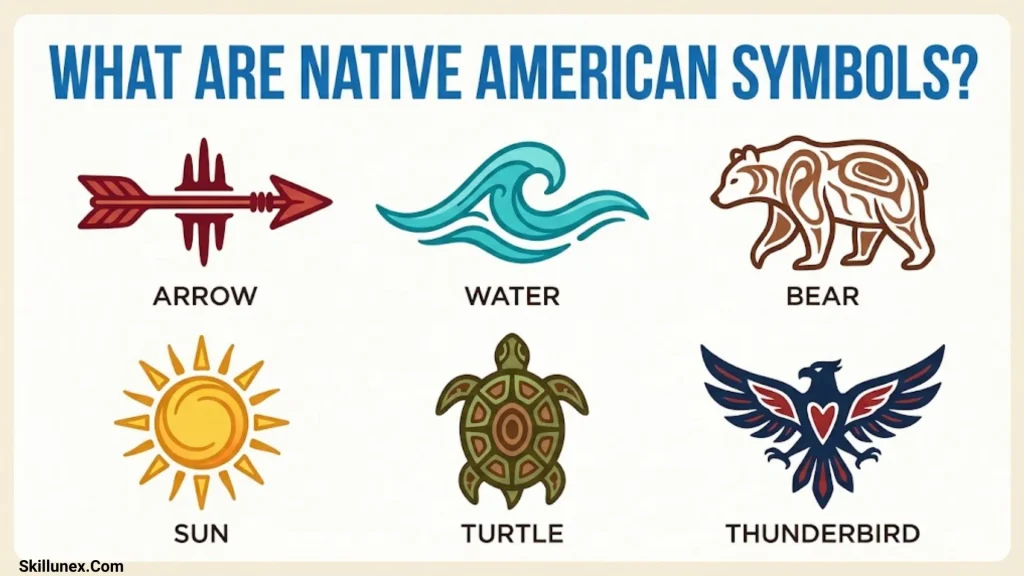
Native American symbols are visual elements used by Indigenous peoples of North America to express ideas, preserve knowledge, represent relationships, and communicate cultural meanings. Their significance depends on the people who create and use them, the materials involved, and the setting in which they appear.
Some designs represent identifiable animals, plants, natural features, or celestial objects. Others are geometric patterns, family or community designs, artistic conventions, or elements associated with particular stories and practices.
The Purpose of Native American Symbols
Symbols can serve several purposes within Indigenous cultures. They may communicate knowledge, express belonging, record experiences, or connect artistic work with a community’s history.
Common purposes include:
- Cultural identity: Designs can reflect a particular community, family tradition, artistic style, or place.
- Connection with nature: Animals, plants, landscapes, and weather may feature in art and storytelling.
- Spiritual significance: Certain images may relate to religious teachings, ceremonies, or relationships with the sacred.
- Historical expression: Visual designs and rock art can preserve evidence of past activities, experiences, and cultural traditions.
- Artistic communication: Patterns, colors, shapes, and materials can carry aesthetic and cultural significance.
Not every design has a fixed symbolic meaning. Some are primarily decorative, while others have meanings understood through community knowledge and lived tradition.
Why Meanings Differ Between Indigenous Nations
The phrase “Native American symbols” is a broad umbrella term. It includes visual traditions associated with many different peoples, such as Diné (Navajo), Hopi, Haudenosaunee, Anishinaabe, Lakota, Cherokee, Pueblo communities, and numerous other Indigenous nations.
These communities do not share one universal symbolic language. Even when two groups use similar shapes or animal imagery, the meanings and appropriate uses may differ.
For this reason, it is more accurate to ask which nation, community, artwork, or historical period a symbol belongs to than to assume that a particular design has one meaning throughout Indigenous North America.
Common Native American Symbols and Their Possible Meanings
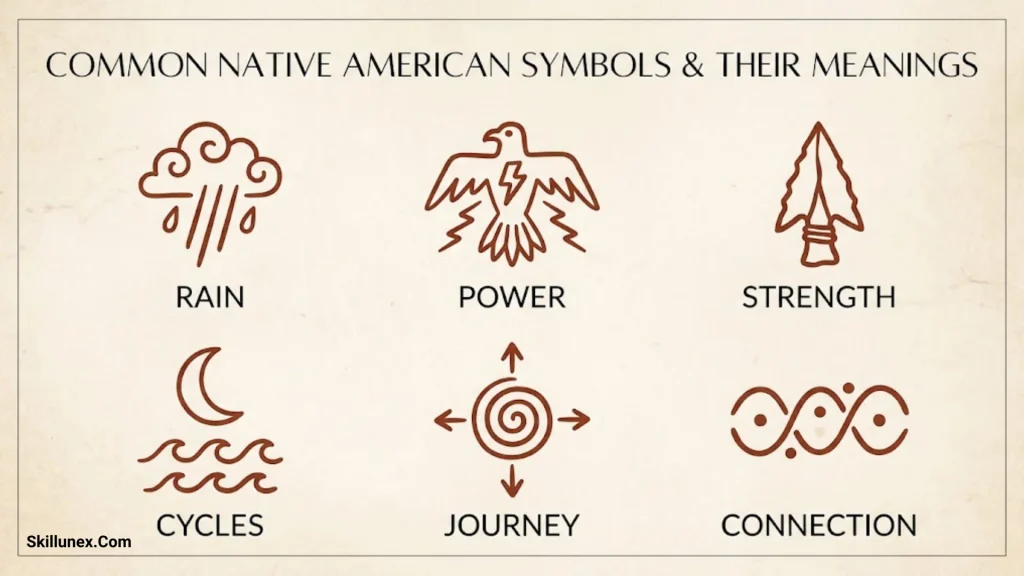
Many Indigenous artistic traditions incorporate animals, plants, celestial forms, geometric patterns, and representations of the natural world. The meaning of each motif depends on its cultural context rather than a universal dictionary.
The examples below describe broad associations that may be relevant in particular traditions. They should not be treated as definitive meanings for every Native American community.
Eagle Symbolism
<AsyncImage query=”Indigenous North American eagle feather traditional artwork museum collection” aspectRatio=”16:9″ width=”100%” />
Eagles appear in the artistic and spiritual traditions of various Indigenous nations. In some communities, eagles and their feathers are associated with prayer, honor, responsibility, strength, or relationships with the sacred.
The eagle’s significance varies by nation and context. Eagle feathers may have specific ceremonial, cultural, and legal considerations, so they should not be treated as ordinary decorative objects in every setting.
An eagle image on a contemporary artwork may also reflect an artist’s personal interpretation rather than a single traditional definition.
Bear Symbolism
<AsyncImage query=”Northwest Coast Indigenous bear formline art carved wood traditional artwork” aspectRatio=”16:9″ width=”100%” />
Bears feature in the stories and visual traditions of several Indigenous peoples. Depending on the community, they may be connected with strength, protection, healing, family relationships, or knowledge of the natural world.
In some traditions, bears have important roles in origin stories, ceremonial practices, or teachings about relationships between humans and other living beings.
A bear motif should therefore be interpreted through the particular community’s stories and artistic conventions rather than assigned one universal meaning.
Turtle Symbolism
<AsyncImage query=”Indigenous North American turtle motif traditional pottery museum collection” aspectRatio=”16:9″ width=”100%” />
Turtles are significant in some Indigenous creation stories and cultural traditions. Among certain Haudenosaunee communities, for example, the story of Sky Woman and Turtle Island explains the formation of the land on the back of a turtle.
This connection makes turtle imagery meaningful in some cultural contexts. However, the story and its interpretation are not identical across all Indigenous nations.
Turtle designs can also appear in contemporary art, jewelry, and educational materials, where their significance depends on the artist and the tradition being represented.
Thunderbird Symbolism
<AsyncImage query=”Northwest Coast Indigenous Thunderbird design carved wood traditional art” aspectRatio=”16:9″ width=”100%” />
The Thunderbird appears in the traditions of several Indigenous peoples, particularly in parts of North America where thunder, storms, and powerful sky beings feature in cultural narratives.
In some communities, the Thunderbird is associated with extraordinary power, storms, protection, or relationships between the sky and the earth. Its appearance and meaning can differ considerably between nations.
The Thunderbird is also an important figure in some Northwest Coast art traditions. It should not be assumed that every winged or bird-like design represents the same being.
Sun and Moon Motifs
<AsyncImage query=”Indigenous North American sun moon motifs traditional geometric artwork museum” aspectRatio=”16:9″ width=”100%” />
The sun and moon appear in many Indigenous artistic traditions, but their meanings depend on the cultural context.
The sun may be connected with warmth, seasonal cycles, life, or particular ceremonial and cosmological teachings. The moon may be associated with timekeeping, seasonal changes, stories, or other culturally specific relationships.
These are possible areas of significance rather than universal definitions. A circular design, for example, might represent the sun, another object, a geometric pattern, or an artistic choice.
Water, Rain, and Cloud Motifs
<AsyncImage query=”Hopi Pueblo pottery traditional rain cloud geometric designs museum collection” aspectRatio=”16:9″ width=”100%” />
Water-related imagery can be especially important in communities whose histories, agricultural practices, and ceremonial traditions are closely connected with rainfall and water sources.
In some Pueblo artistic traditions, cloud, rain, and water motifs appear in pottery and other forms of art. Their interpretation may connect to place, agriculture, community teachings, or ceremonial knowledge.
Not every zigzag, wavy line, or stepped pattern represents rain or water. Identifying a motif accurately requires attention to the artwork’s origin and the artist’s explanation.
Geometric Patterns in Native American Art
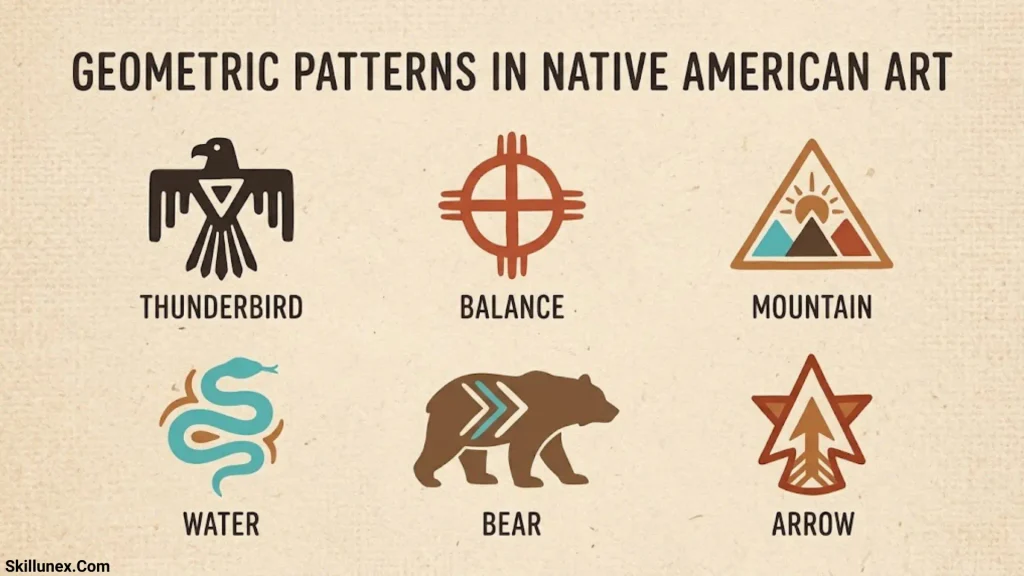
Geometric designs are prominent in many Indigenous art forms, including pottery, woven textiles, beadwork, basketry, and painted objects. They can consist of lines, diamonds, triangles, spirals, stepped shapes, bands, and repeating patterns.
Although modern guides sometimes assign a specific meaning to every geometric shape, that approach can be misleading. A pattern may have cultural significance, but it may also reflect the techniques, materials, artistic preferences, or traditions of its maker.
Diamond and Triangle Patterns
<AsyncImage query=”Native American traditional geometric diamond triangle woven textile museum collection” aspectRatio=”16:9″ width=”100%” />
Diamond and triangle patterns appear in different Indigenous weaving, pottery, and beadwork traditions. Their arrangements can distinguish particular styles or reflect the artistic choices of individual makers.
Online symbol guides sometimes claim that diamonds always represent protection or that triangles always represent mountains. Such explanations are not reliable as universal rules.
The meaning of a particular design should be established through its cultural source, historical documentation, or the knowledge of the artist or community.
Spiral and Circular Designs
<AsyncImage query=”Ancestral Puebloan pottery spiral geometric designs museum collection” aspectRatio=”16:9″ width=”100%” />
Spirals and circles occur in numerous forms of Indigenous art, including archaeological objects and contemporary artwork. In some contexts, they may be associated with movement, cycles, growth, or particular cultural narratives.
However, visual similarity does not prove shared meaning. A spiral in one archaeological setting may have a different significance from a spiral used by a contemporary artist.
It is important to distinguish documented interpretations from possibilities proposed by researchers or modern observers.
Repeating Lines and Stepped Patterns
<AsyncImage query=”Native American Southwestern pottery stepped geometric patterns museum collection” aspectRatio=”16:9″ width=”100%” />
Repeating lines and stepped patterns are found in several regional artistic traditions. In Southwestern pottery and textiles, geometric arrangements may reflect established artistic practices, local materials, and the distinctive visual language of a particular community.
Some patterns may have recognized cultural associations, but not every repeated line or stepped shape represents a sacred concept or a natural feature.
When studying these designs, consider the medium, place of origin, period, and artistic tradition before assigning meaning.
Native American Symbols Across Different Regions
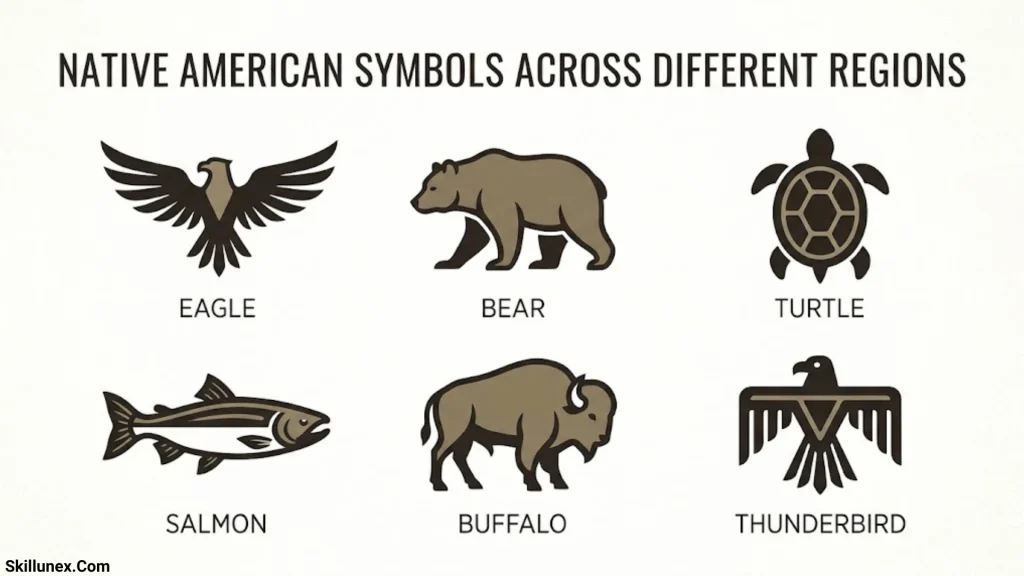
Indigenous North America encompasses diverse environments, languages, and cultural histories. Artistic traditions developed in deserts, forests, plains, coastal regions, mountains, and Arctic environments. These differences influence the materials, imagery, and techniques used by artists.
Southwestern Indigenous Symbols and Art
<AsyncImage query=”Hopi Pueblo Acoma Zuni traditional pottery and woven textiles museum collection” aspectRatio=”16:9″ width=”100%” />
The American Southwest is home to many Indigenous nations and Pueblo communities, including Hopi, Zuni, Acoma, and others, as well as Diné communities.
Regional artistic traditions include pottery, weaving, basketry, silverwork, and beadwork. Designs may incorporate geometric patterns, plant and animal imagery, and motifs connected with local environments or community traditions.
Pueblo pottery traditions are not interchangeable, and Diné weaving has its own history and artistic conventions. A design should be connected to the specific nation or community when that information is available.
Plains Indigenous Symbols and Art
<AsyncImage query=”Northern Plains Indigenous beadwork quillwork traditional museum collection” aspectRatio=”16:9″ width=”100%” />
Indigenous peoples of the Great Plains have developed varied traditions of beadwork, quillwork, clothing, painted objects, and other forms of art.
Geometric patterns and animal imagery may appear in clothing and personal objects. Some designs have family, community, spiritual, or historical significance, while others reflect the individual artist’s style.
It is inaccurate to treat every Plains nation as sharing one artistic vocabulary. Lakota, Dakota, Nakota, Cheyenne, Blackfeet, and other peoples have distinct histories and traditions.
Northwest Coast Indigenous Symbols and Art
<AsyncImage query=”Northwest Coast Indigenous formline art carved totem pole museum collection” aspectRatio=”16:9″ width=”100%” />
Northwest Coast art includes distinctive visual traditions developed by Indigenous peoples along the Pacific Northwest coast, including Tlingit, Haida, Tsimshian, and other nations.
In several of these traditions, formline design uses flowing, organized shapes to depict beings and figures in culturally recognizable ways. Carved poles, masks, painted objects, and other artworks may communicate family histories, inherited rights, stories, or community identity.
These works should be understood within their specific cultural and social settings. A carved pole, for example, is not simply a generic collection of symbols; its meaning can depend on the people who commissioned it, the figures represented, and the history associated with the work.
Eastern Woodlands Indigenous Symbols and Art
<AsyncImage query=”Haudenosaunee wampum belt museum collection traditional Indigenous art” aspectRatio=”16:9″ width=”100%” />
Eastern Woodlands Indigenous peoples have diverse traditions that include beadwork, basketry, carving, textiles, and the creation and use of wampum.
Among the Haudenosaunee, wampum belts can preserve and communicate agreements, relationships, and important historical or diplomatic understandings. Their significance goes beyond decorative beadwork.
Other Eastern Woodlands communities have their own artistic traditions and cultural histories. These should be studied individually rather than combined into a single regional symbol system.
Native American Symbols in Rock Art and Archaeology
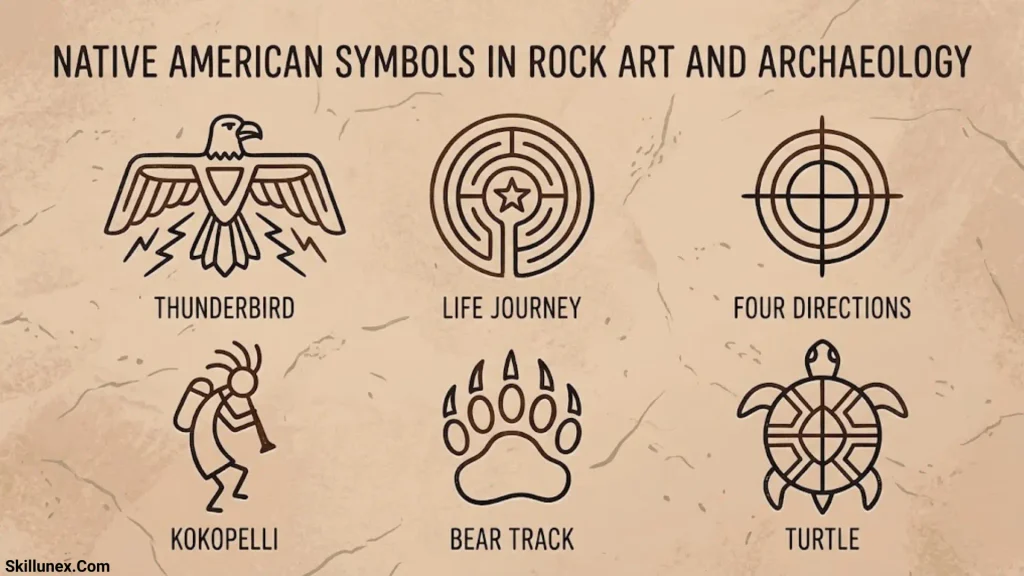
Rock art is an important source of evidence about the visual and cultural histories of Indigenous peoples. It includes petroglyphs, which are images made by carving or pecking into rock, and pictographs, which are images painted onto rock surfaces.
These images may depict human figures, animals, geometric shapes, handprints, or other forms. Some sites have been studied by archaeologists, historians, and Indigenous knowledge holders, while others remain difficult to interpret.
Petroglyphs and Pictographs
<AsyncImage query=”American Southwest Indigenous petroglyphs carved rock panel archaeological site” aspectRatio=”16:9″ width=”100%” />
Petroglyphs and pictographs occur across many parts of North America. Their dates, purposes, and cultural relationships vary by location.
Some images may be associated with travel routes, community histories, ceremonial activities, or observations of the natural world. Others have uncertain interpretations because the original cultural context is no longer fully known or has not been publicly shared.
It is important not to treat every rock-art image as a decipherable message. A responsible interpretation identifies what can be observed, distinguishes evidence from speculation, and acknowledges Indigenous perspectives where available.
Why Archaeological Symbols Can Be Difficult to Interpret
A symbol’s appearance alone rarely establishes its original meaning. Archaeologists may consider the location, nearby artifacts, dating evidence, environmental context, and comparisons with other sites.
Indigenous oral histories and community knowledge can provide essential perspectives that material evidence alone may not reveal. However, some cultural knowledge is private or restricted and may not be appropriate for public interpretation.
For that reason, responsible writing should explain uncertainty rather than present an unverified theory as established fact.
Native American Symbols in Jewelry, Clothing, and Crafts
Indigenous artists use a wide range of materials and techniques to create objects that can be practical, artistic, ceremonial, or culturally significant. These include silver, turquoise, shells, beads, feathers, plant fibers, animal hides, clay, and woven materials.
A design’s meaning often depends on the object in which it appears and the person who made it. A similar-looking motif may function differently in jewelry, a woven textile, a ceremonial object, or a contemporary painting.
Jewelry and Beadwork
<AsyncImage query=”Native American artisan beadwork and silver turquoise jewelry museum collection” aspectRatio=”16:9″ width=”100%” />
Jewelry traditions differ across Indigenous nations and individual artists. In the Southwest, Diné silversmithing and turquoise jewelry have a distinctive history, while beadwork traditions in other regions use different techniques and materials.
Patterns may express an artist’s creative vision, family tradition, regional style, or cultural affiliation. Turquoise is important in some Indigenous artistic traditions, but its significance should not be reduced to one universal spiritual meaning.
When purchasing Indigenous jewelry, consider the artist’s identity, the work’s provenance, and whether the seller provides credible information about its origin.
Clothing, Textiles, and Woven Designs
<AsyncImage query=”Diné Navajo woven rug traditional geometric design museum collection” aspectRatio=”16:9″ width=”100%” />
Textiles, garments, and woven objects can reflect sophisticated artistic traditions passed between generations. Patterns may be shaped by weaving techniques, available materials, local histories, artistic innovation, and community preferences.
Diné weaving, for example, has its own regional history and recognizable artistic developments. Other Indigenous communities maintain different textile and clothing traditions.
Not every pattern on a textile is a coded spiritual message. Some designs have documented cultural associations, while others are primarily artistic or reflect an individual maker’s approach.
Pottery and Basketry
<AsyncImage query=”Native American Pueblo pottery and Indigenous basketry museum collection” aspectRatio=”16:9″ width=”100%” />
Pottery and basketry combine practical knowledge with artistic skill. Materials, shapes, surface treatments, and decorative designs can reflect the local environment and traditions of particular communities.
Some pottery designs are closely associated with specific makers or regional styles. Basket patterns may also be influenced by the materials and weaving techniques used.
When possible, learn about the artist and community behind an object instead of relying on a generic list of supposed symbol meanings.
Colors and Their Cultural Significance
Color can contribute to the meaning and visual character of Indigenous art. Artists may use natural pigments, dyes, mineral materials, beads, fibers, or other substances to create particular effects.
However, there is no universal Native American color code. A claim that red always means courage, black always means death, or blue always means healing is too broad unless it is supported by evidence from a specific cultural tradition.
Red, Black, White, and Other Colors
Red, black, white, blue, yellow, and other colors appear in different Indigenous artistic traditions. Their associations can vary according to community, design, object, ceremony, and historical period.
Some communities have established teachings relating particular colors to directions, elements, seasons, or other concepts. Those teachings should be attributed to the relevant community rather than presented as rules for all Indigenous peoples.
Artists may also choose colors for aesthetic reasons, material availability, contrast, or personal expression.
How to Interpret Color Responsibly
When researching the colors in a particular Indigenous design, ask:
- Which nation or community created the artwork?
- Is the color association documented by a reliable source?
- Is the interpretation provided by the artist or an Indigenous cultural institution?
- Does the source explain the context, or does it claim a universal meaning without evidence?
These questions help distinguish cultural knowledge from simplified explanations repeated across websites.
How to Understand Native American Symbols Respectfully
Learning about Indigenous symbols involves more than memorizing images and definitions. It requires attention to cultural diversity, historical context, Indigenous authority, and the difference between public knowledge and restricted cultural practices.
Learn From Indigenous Artists and Communities
Whenever possible, prioritize information from Indigenous artists, tribal cultural centers, museums working with source communities, tribal historic preservation offices, and Indigenous-led educational projects.
Look for sources that identify the nation, artist, place, or cultural tradition associated with an image. If an explanation comes from a specific community, preserve that context instead of applying it to all Native American peoples.
Community perspectives are especially important when interpreting ceremonial objects, sacred designs, and traditions that may not be fully described in public sources.
Avoid Universal Symbol Dictionaries
A list that assigns one meaning to every animal, line, shape, or color can make Indigenous traditions seem more uniform than they are.
For example, a turtle may be connected with a particular creation story in one tradition, while a turtle design elsewhere may have another meaning. Likewise, a circle may be a recognizable cultural motif in one context and a general geometric element in another.
Use symbol dictionaries as a starting point only when they provide reliable, specific sources. Do not treat unsupported online definitions as established Indigenous teachings.
Respect Sacred and Restricted Designs
Some Indigenous designs and objects are connected with ceremonies, spiritual responsibilities, inherited rights, or knowledge that is not intended for unrestricted public use.
Not every cultural practice is secret, and Indigenous communities differ in what they choose to share. Nevertheless, it is respectful to avoid reproducing or commercializing a design when its use is restricted or when the source community has expressed concerns about misuse.
If the status of a design is unclear, seek guidance from a credible source connected to the relevant community.
Distinguish Indigenous Art From Generic Imitations
Commercial products sometimes use broad labels such as “Native-inspired” without identifying an Indigenous artist or nation. Such labels can obscure the cultural origins of designs and make it difficult to distinguish Indigenous-made work from imitation.
When buying art or crafts, look for artist attribution, information about the community and materials, and transparent provenance. Where relevant, seek products sold directly by Indigenous artists, cooperatives, or reputable Indigenous-owned businesses.
Avoid assuming that a product is authentic merely because it includes an animal motif, geometric pattern, or turquoise-colored decoration.
Common Misconceptions About Native American Symbols
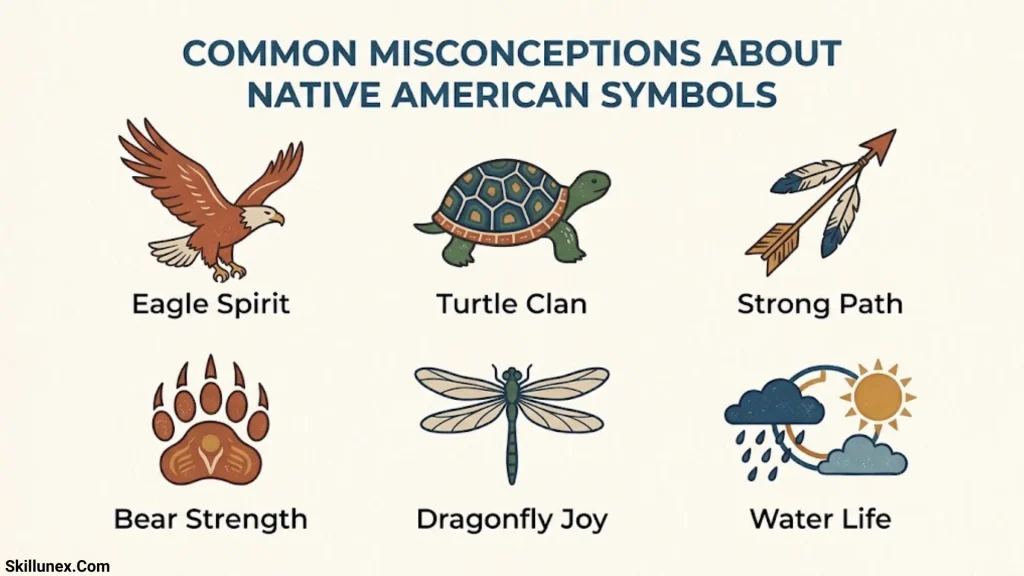
Misunderstandings often arise when diverse traditions are reduced to a small set of universal meanings.
Every Symbol Has One Fixed Meaning
This is incorrect. A design may have several meanings, depend on its setting, or have no symbolic meaning beyond its decorative role. Some interpretations are well documented, while others remain uncertain.
All Indigenous Nations Share the Same Symbols
Indigenous peoples across North America have distinct languages, histories, and cultural traditions. Some themes or forms may be shared, but similarities do not establish identical meanings.
Every Animal Image Is a Spiritual Symbol
Animals may appear in stories, cultural teachings, everyday imagery, and contemporary art. An animal image should not automatically be interpreted as a spiritual emblem or assigned a personality trait such as courage, wisdom, or healing.
Ancient Rock Art Can Always Be Decoded
Many archaeological images cannot be interpreted with certainty. Some have well-supported explanations, while others have multiple possible interpretations or cultural meanings that are not publicly available.
A Generic Online Guide Can Establish Authenticity
A website may repeat popular claims without citing Indigenous sources. Reliable research should identify the community, distinguish evidence from speculation, and explain the limits of what is known.
Frequently Asked Questions About Native American Symbols
What are the most common Native American symbols?
Commonly discussed motifs include eagles, bears, turtles, celestial imagery, water-related designs, and geometric patterns. However, their prevalence and meaning vary by Indigenous nation and artistic tradition. There is no single list that accurately represents all Native American cultures.
What does the eagle symbolize in Native American culture?
In some Indigenous traditions, eagles or eagle feathers are associated with prayer, honor, responsibility, strength, or relationships with the sacred. The precise meaning and appropriate use depend on the community and context.
What does the turtle symbolize?
The turtle is significant in certain Indigenous stories and traditions. Among some Haudenosaunee communities, the turtle is associated with the story of Turtle Island. Other communities may have different interpretations, and a turtle image does not automatically carry this meaning.
What do Native American geometric patterns mean?
Geometric patterns can reflect regional artistic styles, weaving or pottery techniques, individual creativity, and sometimes specific cultural teachings. Their meaning cannot be determined from shape alone. The artist, community, medium, and historical context all matter.
Do Native American colors have specific meanings?
Some Indigenous communities associate particular colors with culturally specific concepts, but there is no universal color system shared by all Native American nations. Reliable explanations should identify the community and context behind each association.
Are Native American symbols religious?
Some symbols are connected with spiritual beliefs, ceremonial practices, or sacred stories. Others are historical, social, artistic, practical, or decorative. It is important not to assume that every Indigenous design is religious.
Can anyone use Native American symbols in art or tattoos?
It depends on the design and its cultural context. Some motifs are widely shared in public art, while others may be sacred, restricted, or associated with specific communities and responsibilities. Before using a design, research its origins, seek guidance when appropriate, and avoid copying culturally restricted imagery or presenting a design as your own Indigenous heritage.
How can I identify the meaning of a Native American symbol?
Start by identifying the artwork’s nation or community, artist, location, medium, and approximate date. Then consult Indigenous artists, tribal cultural resources, reputable museums, or well-documented scholarly sources. If the meaning is uncertain or not publicly shared, acknowledge that uncertainty rather than guessing.
Where can I learn more about Indigenous symbols?
Useful starting points include tribal museums and cultural centers, Indigenous-led educational resources, museum collections with documented provenance, tribal historic preservation offices, and publications written by Indigenous scholars and artists. Choose sources that explain the specific community and cultural context rather than offering unsupported universal definitions.
Conclusion
Native American symbols represent a rich and diverse range of artistic traditions, histories, relationships, and cultural knowledge. Animals, geometric patterns, celestial imagery, rock art, textiles, pottery, and jewelry can all provide insight into the communities and artists who create them.
Their meanings, however, cannot be reduced to one universal dictionary. A design’s significance depends on its Indigenous nation, historical period, medium, intended use, and the knowledge associated with it. Some interpretations are well documented; others require caution or may not be appropriate for public explanation.
The best way to understand Native American symbols is to learn from Indigenous artists and communities, consult reliable cultural sources, acknowledge uncertainty, and respect traditions that are sacred or restricted. This approach makes it possible to appreciate Indigenous art while recognizing the distinct identities and living cultures behind it.

Isla Kensington
I’m Isla Kensington, a writer with a passion for research, culture, nature, and the fascinating meanings behind everyday things. I enjoy taking topics that may seem simple at first and discovering the history, facts, and ideas that make them more interesting.
I write with readers in mind. My aim is to provide clear explanations, useful information, and interesting details without making a topic unnecessarily complicated.
I believe learning should feel like discovering something rather than simply reading facts. That philosophy guides the content I create and the topics I choose to explore.
## Books by Isla Kensington
* Symbols Around the World: A Guide to Meaning & Culture
* Nature’s Beautiful Places: Lakes, Landscapes & Natural Treasures