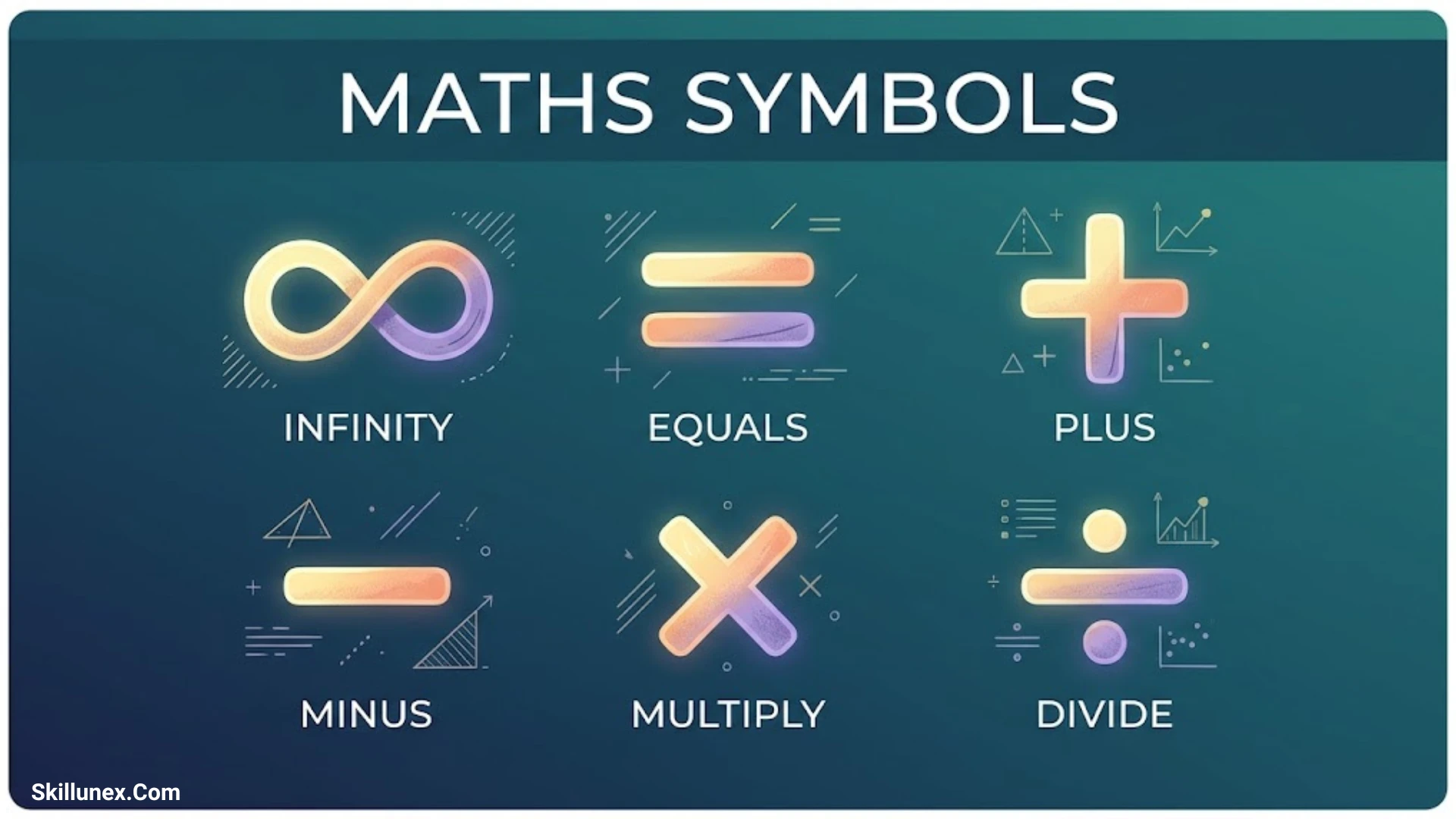
Maths symbols are important signs that help you solve problems, understand equations, and express mathematical ideas easily. From basic addition (+) and subtraction (−) to advanced symbols like infinity (∞) and square root (√), each symbol has a specific meaning. If you are learning mathematics, knowing these symbols can make your studies easier and help you solve problems with confidence.
When you learn maths symbols, you can understand formulas, equations, and calculations more quickly. You may already use common signs in everyday math, but there are many other symbols used in algebra, geometry, statistics, and calculus. This guide will help you explore their names, meanings, and examples so you can learn how to use them correctly.
If you are a student, teacher, or simply interested in mathematics, this collection of maths symbols is designed to help you. You can use it as a quick reference whenever you need to identify a symbol or understand its purpose. By exploring these symbols, you can build your mathematical knowledge and make even complex concepts easier to understand.
What Are Maths Symbols?
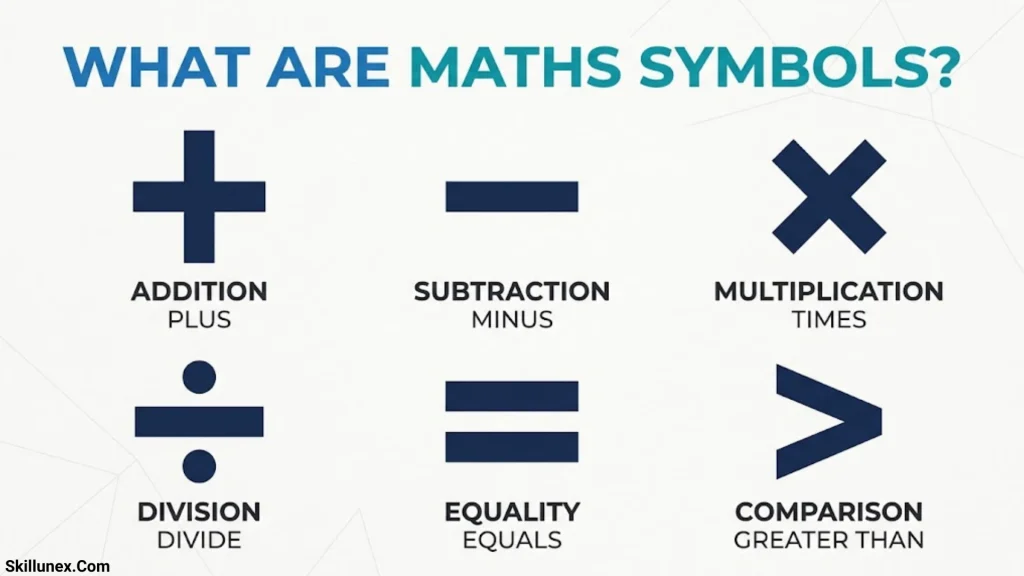
Maths symbols are signs, letters, and special characters used to represent mathematical operations, values, quantities, and relationships. They allow complex ideas to be expressed in a concise and standardized form.
For example, the expression (8 + 4 = 12) uses the plus sign to indicate addition and the equals sign to show that the two sides have the same value.
Mathematical notation includes operation signs, comparison symbols, Greek letters, grouping marks, and specialized characters used in different branches of mathematics.
Why Are Maths Symbols Important?
Maths symbols make mathematical communication more precise and efficient. They help students understand formulas and allow professionals to express complex calculations without writing lengthy explanations.
The main benefits of maths symbols include:
- Clear communication: They help people express mathematical ideas accurately.
- Faster calculations: Symbols make numerical operations easier to write.
- Consistent notation: Standard symbols allow mathematical expressions to be understood across languages.
- Better problem solving: Symbols help organize information and identify relationships between quantities.
- Advanced learning: Algebra, calculus, statistics, and other subjects depend on mathematical notation.
How Maths Symbols Work in Equations
A mathematical expression combines numbers, variables, and symbols to communicate a calculation or relationship.
For example:
[
6+3=9
]
This expression means that adding six and three produces nine.
Another example is:
[
x+5=12
]
Here, (x) represents an unknown value. Subtracting five from both sides gives (x=7).
Understanding each symbol helps you interpret the expression correctly and determine which mathematical operations are required.
Basic Maths Symbols and Their Meanings
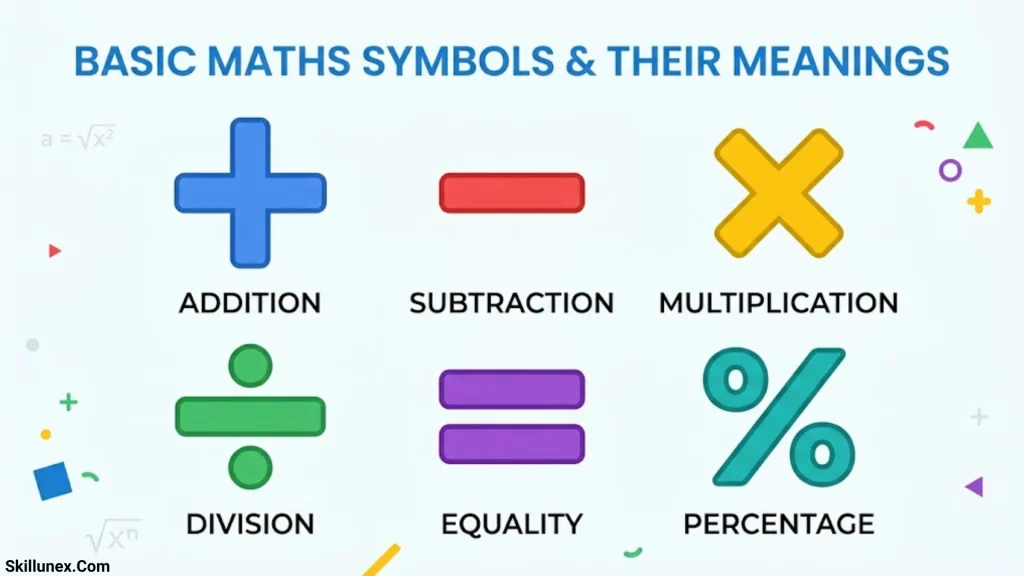
Basic maths symbols are used in everyday calculations, classroom exercises, and many practical situations. These include addition, subtraction, multiplication, division, and comparison signs.
Arithmetic Symbols
The following table lists the most common arithmetic symbols.
| Symbol | Name | Meaning | Example |
| + | Plus | Addition | (5+3=8) |
| − | Minus | Subtraction | (9-4=5) |
| × | Multiplication sign | Multiplication | (4\times3=12) |
| ÷ | Division sign | Division | (15\div3=5) |
| / | Forward slash | Often represents division | (12/4=3) |
| ± | Plus-minus | Indicates positive and negative possibilities | (x=\pm4) |
| ∓ | Minus-plus | Represents the paired opposite sign | (a\pm b) and (a\mp b) |
| · | Multiplication dot | Multiplication in some contexts | (3\cdot5=15) |
Example: If you have 15 apples and give away six, the subtraction operation tells you how many remain.
[
15-6=9
]
Multiplication represents repeated groups. For example, four bags containing three apples each hold (4\times3=12) apples in total.
Division splits a quantity into equal groups or determines how many times one quantity fits into another. For example, (20\div5=4).
Equality and Comparison Symbols
Comparison symbols show whether two values are equal, different, greater, smaller, or approximately equal.
| Symbol | Name | Meaning | Example |
| = | Equals | Both sides have the same value | (4+3=7) |
| ≠ | Not equal to | Values are different | (5\ne8) |
| > | Greater than | Left side is larger | (9>4) |
| < | Less than | Left side is smaller | (2<7) |
| ≥ | Greater than or equal to | Left side is larger or equal | (x\ge6) |
| ≤ | Less than or equal to | Left side is smaller or equal | (x\le10) |
| ≈ | Approximately equal to | Values are close but not necessarily identical | (\pi\approx3.14) |
| ≡ | Identically equal or congruent modulo, depending on context | Meaning depends on the topic | (2\equiv8\pmod6) |
For example, (x\le5) means that (x) can be five or any number smaller than five.
Remember that the equals sign and approximately equal sign are different. The number 3.14 is an approximation of pi, not its exact value.
Maths Symbols for Fractions, Percentages, Powers, and Roots
Fractions, percentages, exponents, and roots help represent parts of a whole, proportions, repeated multiplication, and inverse operations.
Fraction and Percentage Symbols
| Symbol | Name | Meaning | Example |
| / | Fraction or division slash | Represents division | (3/5) |
| % | Percent sign | Means per hundred | (25%=25/100) |
| ‰ | Per mille sign | Means per thousand | (8‰=8/1000) |
| : | Ratio symbol | Expresses a ratio in some contexts | (2:5) |
A fraction represents a part of a whole or one quantity divided by another. In (\frac35), three is the numerator and five is the denominator.
A percentage expresses a quantity out of 100. For example:
[
40%=\frac{40}{100}=0.4
]
Ratios compare quantities. A ratio of (2:5) means that for every two parts of one quantity, there are five parts of the other.
Exponents and Powers
An exponent tells you how many times a base is multiplied by itself when the exponent is a positive integer.
| Symbol or notation | Name | Meaning | Example |
| (a^2) | Squared | Base multiplied by itself | (5^2=25) |
| (a^3) | Cubed | Base multiplied three times | (3^3=27) |
| (a^n) | Power | Base raised to an exponent | (2^4=16) |
| (a^0) | Zero exponent | Equals 1 for nonzero (a) | (7^0=1) |
| (a^{-n}) | Negative exponent | Represents the reciprocal of a positive power for nonzero (a) | (2^{-3}=1/8) |
For example, (4^3) means:
[
4^3=4\times4\times4=64
]
Exponents are widely used in algebra, scientific notation, geometry, and calculations involving very large or very small numbers.
Square Root and Other Root Symbols
| Symbol | Name | Meaning | Example |
| √ | Square root | A number whose square gives the original value | (\sqrt{36}=6) |
| ∛ | Cube root | A number whose cube gives the original value | (\sqrt[3]{27}=3) |
| (\sqrt[n]{a}) | nth root | A number that gives (a) when raised to the nth power | (\sqrt[4]{16}=2) |
The square root symbol appears frequently in algebra and geometry. For example, the principal square root of 64 is 8 because (8\times8=64).
For real numbers, the principal square root is nonnegative. However, when solving (x^2=64), both (x=8) and (x=-8) are solutions.
Algebra Symbols and Their Meanings
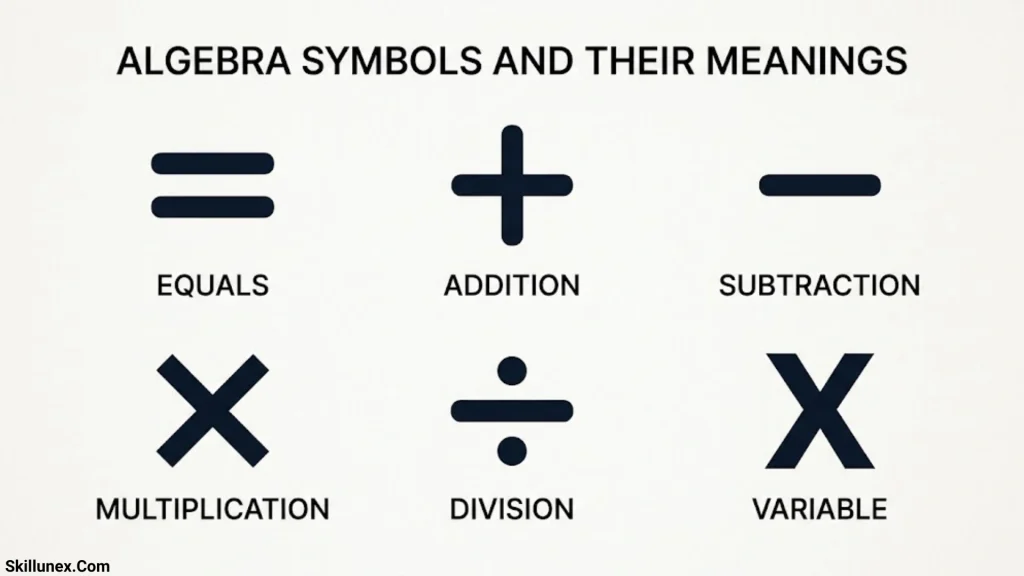
Algebra uses letters, numbers, and mathematical symbols to represent unknown values and describe relationships between quantities.
Variables, Constants, and Coefficients
| Symbol or notation | Name | Meaning | Example |
| (x,y,z) | Variables | Represent unknown or changing values | (x+3=10) |
| (a,b,c) | Variables or constants | Represent quantities depending on the problem | (ax+b=0) |
| (k) | Constant or parameter | Represents a fixed value in a given context | (y=kx) |
| (5x) | Coefficient and variable | Five is the coefficient of (x) | (5x=20) |
| (f(x)) | Function notation | Represents the output of a function for input (x) | (f(x)=x+2) |
A variable represents a value that may be unknown or may change. For example, in (x+3=10), subtracting three from both sides gives (x=7).
A coefficient is a number multiplying a variable. In (5x), the coefficient is five.
A constant is fixed within a particular problem. The same letter can represent a constant in one expression and a variable in another.
Common Algebraic Symbols
| Symbol | Name | Meaning | Example | ||||
| ∝ | Proportional to | Indicates a proportional relationship | (y\propto x) | ||||
| ∴ | Therefore | Introduces a conclusion | (x=2), therefore (x+1=3) | ||||
| ∵ | Because | Introduces a reason | (x=3) because (x+2=5) | ||||
| ( | x | ) | Absolute value | Distance of a real number from zero | ( | -7 | =7) |
| ( ) | Parentheses | Group terms or operations | (2(3+4)=14) | ||||
| [ ] | Square brackets | Group expressions or represent certain intervals | ([2,6]) | ||||
| { } | Curly braces | Group expressions or represent sets | ({1,2,3}) |
Absolute value measures distance from zero on the real number line, so it is never negative.
Grouping symbols also affect the order of operations. For example, (2(3+4)) means first add three and four, then multiply the result by two.
Geometry Maths Symbols
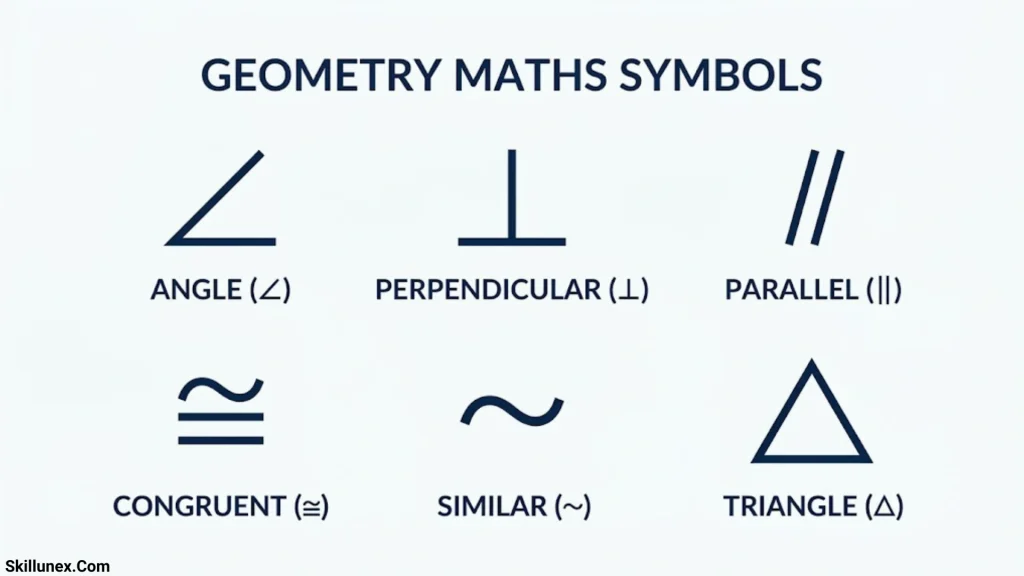
Geometry focuses on shapes, angles, lines, distances, areas, and volumes. Its symbols help describe figures and their properties.
Common Geometry Symbols
| Symbol | Name | Meaning | Example |
| ∠ | Angle | Represents an angle | (\angle ABC) |
| ° | Degree | Unit for measuring angles | (90^\circ) |
| ⟂ | Perpendicular | Lines meet at a right angle | (AB\perp CD) |
| ∥ | Parallel | Lines in a plane do not intersect | (AB\parallel CD) |
| △ | Triangle | Represents a triangular figure | (\triangle ABC) |
| ≅ | Congruent | Same shape and size in geometry | (\triangle ABC\cong\triangle DEF) |
| ∼ | Similar | Same shape, with proportional corresponding sides | (\triangle ABC\sim\triangle DEF) |
| π | Pi | Ratio of a circle’s circumference to its diameter | (C=2\pi r) |
For example, (AB\perp CD) means that line segments or lines (AB) and (CD) intersect at a right angle.
Congruent figures have matching corresponding side lengths and angles. Similar figures have matching corresponding angles and proportional corresponding side lengths.
Area, Perimeter, and Volume Notation
Many geometry formulas use letters to represent measurements.
| Symbol | Common meaning | Example |
| (A) | Area | Rectangle: (A=lw) |
| (P) | Perimeter | Rectangle: (P=2(l+w)) |
| (V) | Volume | Rectangular prism: (V=lwh) |
| (r) | Radius | (C=2\pi r) |
| (d) | Diameter or distance, depending on context | Circle: (d=2r) |
| (h) | Height | Triangle: (A=\frac12 bh) |
| (l,w) | Length and width in common formulas | Rectangle: (A=lw) |
The meaning of a letter depends on the formula. For example, (A) often represents area in geometry but may represent a matrix or set in another branch of mathematics.
Trigonometry Symbols and Their Meanings
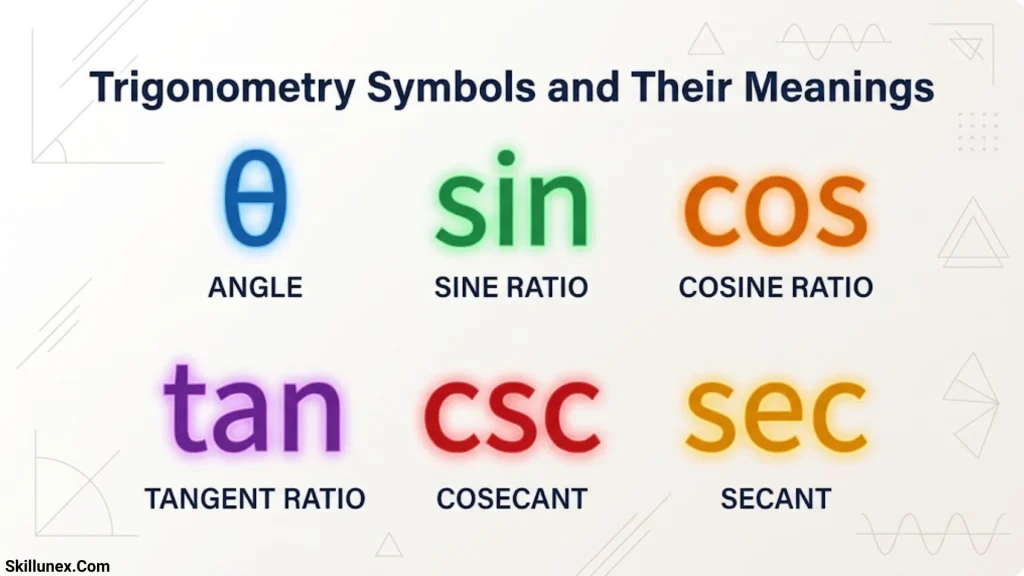
Trigonometry studies relationships between angles and sides of triangles. It is used in geometry, navigation, engineering, physics, and many other fields.
Basic Trigonometric Symbols
| Symbol | Name | Meaning | Example |
| (\sin) | Sine | A trigonometric function | (\sin30^\circ=1/2) |
| (\cos) | Cosine | A trigonometric function | (\cos60^\circ=1/2) |
| (\tan) | Tangent | Sine divided by cosine when cosine is nonzero | (\tan45^\circ=1) |
| (\csc) | Cosecant | Reciprocal of sine when defined | (\csc30^\circ=2) |
| (\sec) | Secant | Reciprocal of cosine when defined | (\sec60^\circ=2) |
| (\cot) | Cotangent | Cosine divided by sine when defined | (\cot45^\circ=1) |
| (\theta) | Theta | Commonly represents an angle | (\sin\theta) |
In a right-angled triangle, sine, cosine, and tangent can be defined using the opposite, adjacent, and hypotenuse sides.
For an angle (\theta):
[
\sin\theta=\frac{\text{opposite}}{\text{hypotenuse}}
]
[
\cos\theta=\frac{\text{adjacent}}{\text{hypotenuse}}
]
[
\tan\theta=\frac{\text{opposite}}{\text{adjacent}}
]
These relationships are especially useful when calculating missing side lengths or angles in triangles.
Set Theory Symbols and Their Meanings
Set theory studies collections of objects called sets. Its symbols are used in algebra, probability, logic, and many other mathematical topics.
Common Set Symbols
| Symbol | Name | Meaning | Example |
| (\in) | Element of | An object belongs to a set | (2\in{1,2,3}) |
| (\notin) | Not an element of | An object does not belong to a set | (5\notin{1,2,3}) |
| (\subseteq) | Subset of or equal to | Every element of one set belongs to another | ({1,2}\subseteq{1,2,3}) |
| (\subsetneq) | Proper subset | A subset that is not equal to the larger set | ({1,2}\subsetneq{1,2,3}) |
| (\cup) | Union | Elements in either set or both | (A\cup B) |
| (\cap) | Intersection | Elements shared by both sets | (A\cap B) |
| (\varnothing) | Empty set | A set containing no elements | (A\cap B=\varnothing) |
| (\mathbb{N}) | Natural numbers | Commonly denotes natural numbers; convention varies | (1,2,3,\ldots) |
| (\mathbb{Z}) | Integers | Positive and negative whole numbers, including zero | (\ldots,-2,-1,0,1,2,\ldots) |
| (\mathbb{R}) | Real numbers | Numbers on the real number line | (-2,0,1.5,\sqrt2) |
Examples of Set Operations
Suppose:
[
A={1,2,3},\quad B={3,4,5}
]
The union combines all distinct elements from both sets:
[
A\cup B={1,2,3,4,5}
]
The intersection contains only the elements that appear in both sets:
[
A\cap B={3}
]
These symbols are useful when organizing collections, solving set problems, and calculating probabilities.
Calculus Symbols and Their Meanings
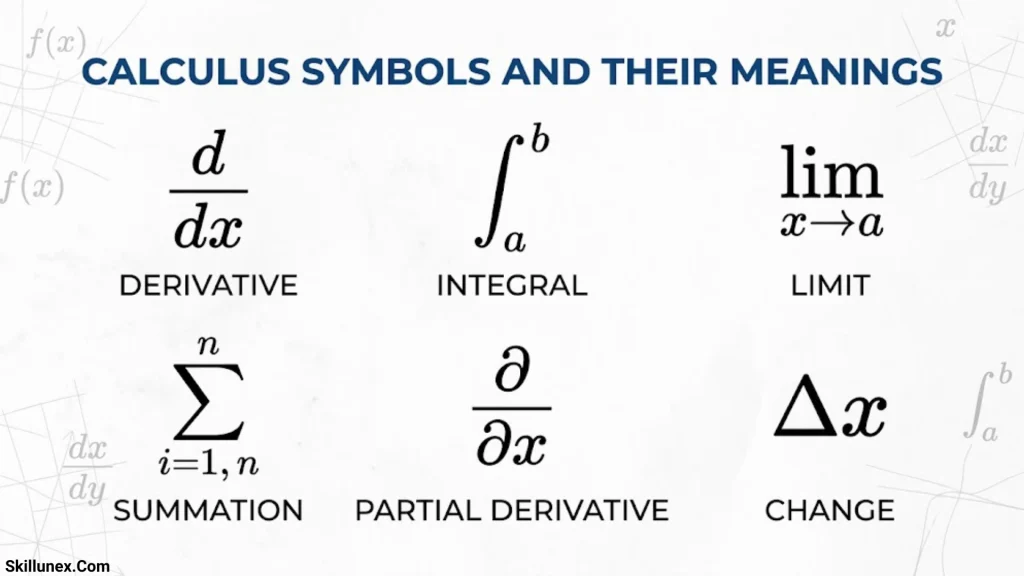
Calculus studies change, rates of change, and accumulation. Its symbols are widely used in advanced mathematics, engineering, physics, and economics.
Derivative and Integral Symbols
| Symbol | Name | Meaning | Example |
| (\frac{dy}{dx}) | Derivative notation | Rate of change of (y) with respect to (x) | If (y=x^2), then (\frac{dy}{dx}=2x) |
| (f'(x)) | Prime notation | Derivative of a function | If (f(x)=x^3), then (f'(x)=3x^2) |
| (\int) | Integral sign | Represents integration | (\int 2x,dx=x^2+C) |
| (\iint) | Double integral | Integrates over a two-dimensional region | (\iint_R f(x,y),dA) |
| (\lim) | Limit | Describes a value approached by an expression | (\lim_{x\to0}x^2=0) |
| (\partial) | Partial derivative | Differentiation with respect to one variable | (\frac{\partial f}{\partial x}) |
| (\Delta) | Delta | Often indicates a change in a quantity | (\Delta x=x_2-x_1) |
A derivative measures how quickly a quantity changes. For example, if (f(x)=x^2), its derivative is (f'(x)=2x).
An integral can represent accumulation or, under suitable conditions, the area under a curve. In an indefinite integral, (C) represents the constant of integration.
Infinity and Limit Symbols
| Symbol | Name | Meaning | Example |
| (\infty) | Infinity | Represents unbounded behavior or an infinite quantity | (x\to\infty) |
| (-\infty) | Negative infinity | Represents unbounded decrease | (x\to-\infty) |
| (\lim) | Limit | Indicates the value approached | (\lim_{x\to2}x=2) |
| (\to) | Tends to or approaches | Shows a limiting direction or relationship | (x\to0) |
Infinity is not an ordinary real number. It is used to describe unbounded behavior, infinite collections, and limiting processes.
For example:
[
\lim_{x\to\infty}\frac1x=0
]
This means that (1/x) approaches zero as (x) increases without bound.
Statistics and Probability Symbols
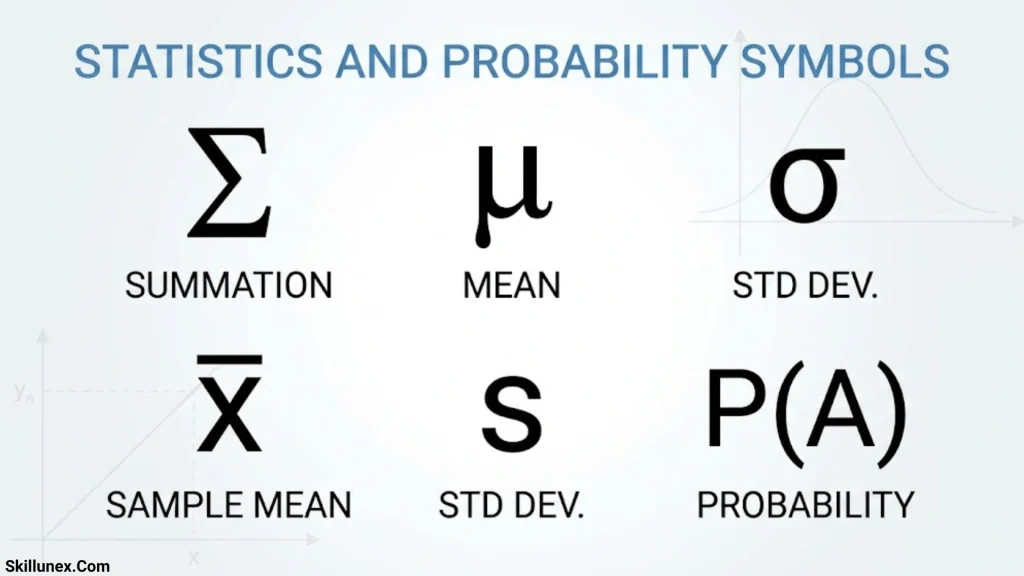
Statistics and probability use mathematical notation to describe data, averages, variation, and uncertain events.
Common Statistics Symbols
| Symbol | Name | Meaning | Example |
| (\bar{x}) | Sample mean | Average of sample observations | (\bar{x}=(2+4+6)/3=4) |
| (\mu) | Population mean | Average of a population | (\mu) |
| (\sigma) | Population standard deviation | Measures population spread | (\sigma) |
| (s) | Sample standard deviation | Measures sample spread | (s) |
| (n) | Sample size | Number of observations | (n=30) |
| (\sum) | Summation | Adds a sequence of terms | (\sum_{i=1}^{3}i=6) |
These symbols help summarize large datasets and describe the distribution of values.
For example, the mean of 2, 4, and 6 is:
[
\bar{x}=\frac{2+4+6}{3}=4
]
Common Probability Symbols
| Symbol | Name | Meaning | Example |
| (P(A)) | Probability of event A | Likelihood that event A occurs | (P(A)=0.5) |
| (P(A\mid B)) | Conditional probability | Probability of A given B | (P(A\mid B)) |
| (A\cap B) | Intersection of events | Both events occur | (P(A\cap B)) |
| (A\cup B) | Union of events | At least one event occurs | (P(A\cup B)) |
| (\sim) | Distributed as | Describes a probability distribution | (X\sim N(\mu,\sigma^2)) |
For a fair coin, the probability of heads is (1/2), because heads and tails are equally likely outcomes.
Conditional probability is useful when additional information changes the probability of an event.
Mathematical Logic Symbols
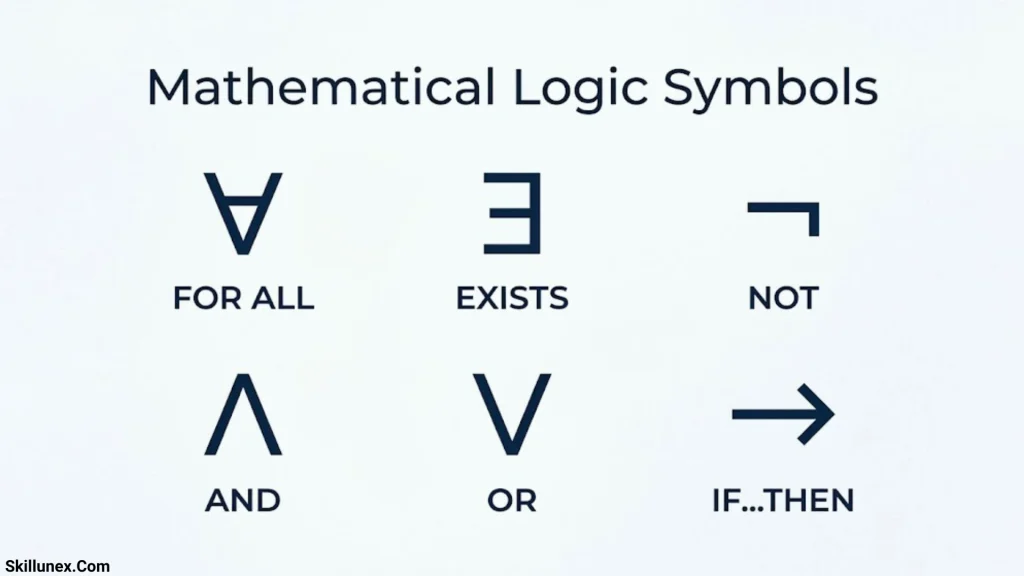
Mathematical logic uses symbols to express statements, conditions, and relationships between propositions. These symbols are particularly important in proofs, discrete mathematics, and computer science.
Common Logic Symbols
| Symbol | Name | Meaning | Example |
| (\forall) | For all | Applies to every element in a domain | (\forall x\in\mathbb{R}) |
| (\exists) | There exists | At least one element satisfies a condition | (\exists x\in\mathbb{R}^2=4) |
| (\nexists) | There does not exist | No element satisfies a condition | (\nexists x\in\mathbb{R}^2=-1) |
| (\land) | Logical AND | Both statements are true | (P\land Q) |
| (\lor) | Logical OR | At least one statement is true | (P\lor Q) |
| (\neg) | Logical NOT | Negates a statement | (\neg P) |
| (\Rightarrow) | Implies | One statement logically leads to another | (P\Rightarrow Q) |
| (\Leftrightarrow) | If and only if | Statements imply each other | (P\Leftrightarrow Q) |
For example:
[
\forall x\in\mathbb{R},\quad x^2\ge0
]
This statement means that the square of every real number is greater than or equal to zero.
The symbol (\Rightarrow) expresses implication, while (\Leftrightarrow) indicates that two statements are logically equivalent.
Greek Letters Commonly Used in Mathematics
Greek letters are frequently used for constants, angles, parameters, and statistical quantities. Their meanings depend on the subject and context.
Common Greek Maths Symbols
| Symbol | Name | Common use |
| (\alpha) | Alpha | Angles, coefficients, and parameters |
| (\beta) | Beta | Angles, coefficients, and statistical parameters |
| (\theta) | Theta | Angles and variables |
| (\pi) | Pi | Circle calculations and mathematical constants |
| (\Delta) | Uppercase delta | Change or difference |
| (\delta) | Lowercase delta | Small changes and parameters |
| (\lambda) | Lambda | Wavelengths, eigenvalues, and parameters |
| (\mu) | Mu | Population mean and other quantities |
| (\sigma) | Sigma | Standard deviation and other parameters |
| (\Sigma) | Uppercase sigma | Summation |
| (\omega) | Omega | Angular frequency and other quantities |
| (\phi) | Phi | Angles and mathematical functions |
For example, (\theta) often represents an angle in trigonometry, while (\sigma) commonly represents population standard deviation in statistics.
Greek letters do not have one fixed meaning in every mathematical field. Always use the surrounding equation to identify their intended meaning.
Commonly Confused Maths Symbols
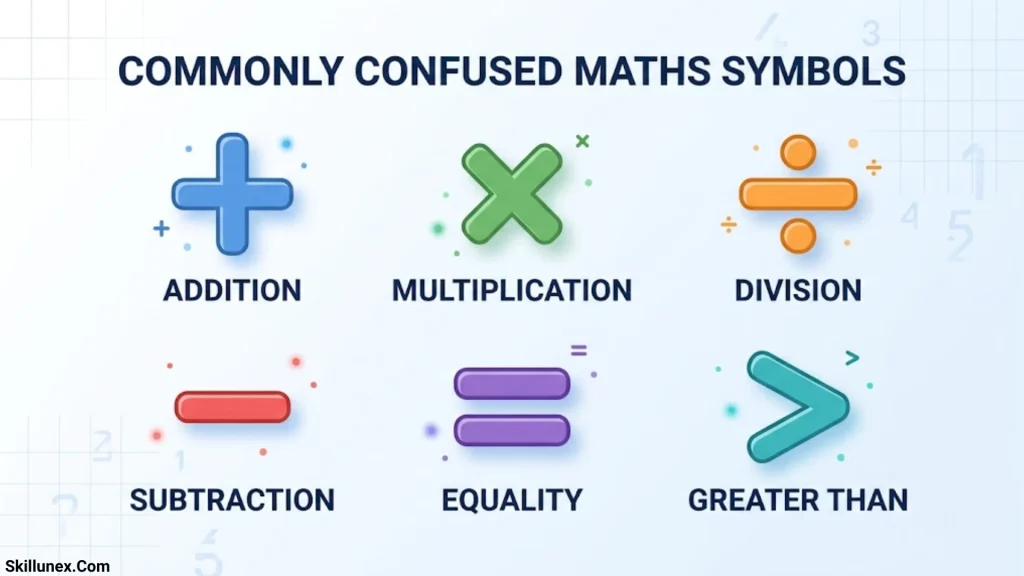
Some maths symbols look similar but have different meanings. Learning the differences can help prevent errors in calculations and examinations.
Difference Between ×, x, and ·
The multiplication sign (\times) represents multiplication. The letter (x) often represents a variable, and the centered dot (\cdot) can also indicate multiplication.
For example:
[
3\times4=12
]
[
x+4=9
]
[
3\cdot4=12
]
In algebra, the letter (x) is commonly used as a variable, so a centered dot or parentheses may be preferred when multiplication could be confusing.
Difference Between =, ≈, and ≡
These symbols express different types of relationships.
- (=) means equal to.
- (\approx) means approximately equal to.
- (\equiv) can mean identical equality, a definition-related equivalence, or congruence modulo an integer, depending on context.
For example:
[
\pi\approx3.14
]
But:
[
2+3=5
]
In modular arithmetic:
[
8\equiv2\pmod6
]
This means that 8 and 2 have the same remainder when divided by 6.
Difference Between < and >
The symbol (<) means less than, while (>) means greater than.
A useful way to remember them is that the open side faces the larger value.
For example:
[
3<8
]
[
10>4
]
The same comparison symbols are used in inequalities, where they describe a range of possible values rather than comparing only two fixed numbers.
How to Learn and Remember Maths Symbols
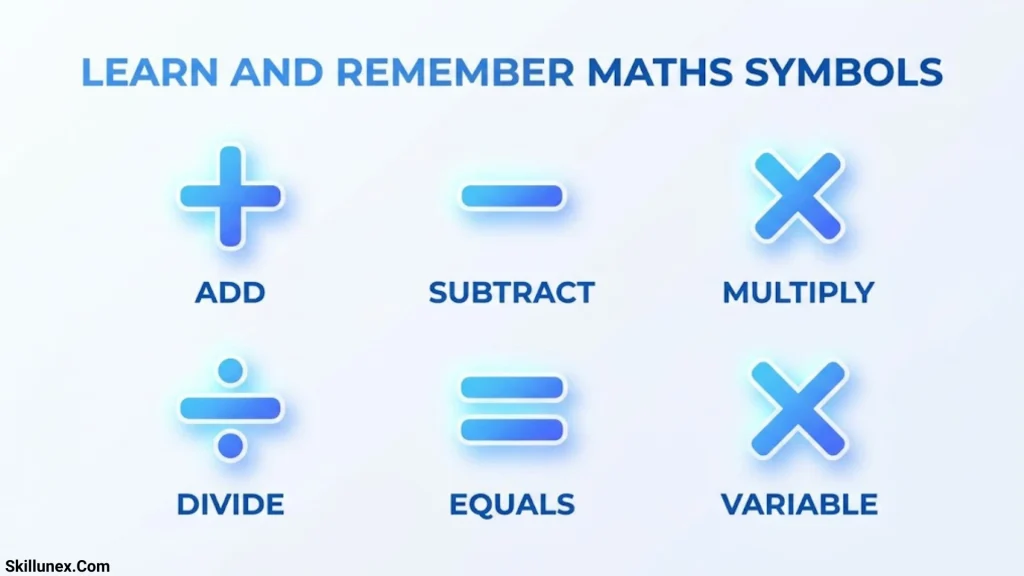
Learning maths symbols becomes easier when you study them in groups, practise with examples, and apply them to real mathematical problems.
Study Symbols by Category
Start with arithmetic symbols and comparison signs before moving to fractions, exponents, algebra, and geometry. Once you understand those, explore trigonometry, statistics, calculus, and logic.
Studying symbols by category helps you connect each sign to its purpose instead of memorizing an unorganized list.
Practise With Examples and Flashcards
Create a simple list containing the symbol, its name, its meaning, and an example. You can also make flashcards with the symbol on one side and its explanation on the other.
For example:
- (+): Plus — addition — (2+3=5)
- (\ge): Greater than or equal to — (x\ge4)
- (\sqrt{}): Square root — (\sqrt{25}=5)
- (\in): Element of — (2\in{1,2,3})
- (\sum): Summation — (\sum_{i=1}^{3}i=6)
Practise reading symbols aloud, writing them from memory, and using them to solve problems.
Understand the Context of Each Symbol
Some symbols have more than one meaning. For example, (\sim) can represent similarity in geometry or a probability distribution in statistics. Likewise, (\Delta) often indicates change, but its exact meaning depends on the expression.
Read the surrounding formula and identify the mathematical topic before interpreting a symbol.
Frequently Asked Questions About Maths Symbols
What are the most common maths symbols?
The most common maths symbols include plus (+), minus (−), multiplication (×), division (÷), equals (=), not equal to (≠), greater than (>), less than (<), percentage (%), square root (√), and pi (π). These symbols are widely used in arithmetic, algebra, and geometry.
What does the symbol ≠ mean in maths?
The symbol ≠ means “not equal to.” It indicates that two values are different. For example, (4\ne7) means four is not equal to seven.
What is the difference between ≥ and ≤?
The symbol ≥ means greater than or equal to, while ≤ means less than or equal to. For example, (x\ge5) includes five and all values above it, whereas (x\le5) includes five and all values below it.
What does ± mean in mathematics?
The plus-minus symbol indicates two possibilities involving positive and negative signs. For example, (x=\pm2) means that (x) can equal 2 or −2.
What does infinity (∞) mean?
Infinity represents an unbounded quantity or infinite behavior in mathematical contexts. It is commonly used in calculus, limits, and discussions of infinite sets. It is not an ordinary real number.
What does pi (π) mean?
Pi is the ratio of a circle’s circumference to its diameter. Its approximate value is 3.14159. It is used in formulas such as (C=2\pi r), where (C) is circumference and (r) is radius.
How many maths symbols are there?
There is no single fixed number of maths symbols. Basic arithmetic uses a relatively small group, while advanced topics introduce many more signs, letters, and specialized notations.
Which maths symbols should beginners learn first?
Beginners should start with addition, subtraction, multiplication, division, equals, greater than, less than, fractions, percentages, exponents, and square roots. They can then move on to algebra, geometry, and other topics as their mathematical knowledge develops.
Conclusion
Maths symbols provide a common language for expressing calculations, comparing values, describing shapes, analyzing data, and solving complex problems. Understanding their names and meanings is an important step toward developing strong mathematical skills.
Begin with basic arithmetic and comparison symbols, then gradually learn algebra, geometry, trigonometry, statistics, calculus, and logic notation. Use examples, practise regularly, and pay attention to the context in which each symbol appears.
With consistent practice, mathematical symbols become easier to recognize and use, helping you solve problems more accurately and understand mathematical concepts with greater confidence.

Isla Kensington
I’m Isla Kensington, a writer with a passion for research, culture, nature, and the fascinating meanings behind everyday things. I enjoy taking topics that may seem simple at first and discovering the history, facts, and ideas that make them more interesting.
I write with readers in mind. My aim is to provide clear explanations, useful information, and interesting details without making a topic unnecessarily complicated.
I believe learning should feel like discovering something rather than simply reading facts. That philosophy guides the content I create and the topics I choose to explore.
## Books by Isla Kensington
* Symbols Around the World: A Guide to Meaning & Culture
* Nature’s Beautiful Places: Lakes, Landscapes & Natural Treasures