
Transformation symbols represent change, growth, renewal, and new beginnings. They remind us that life is full of different stages and that every experience can lead to personal growth. From ancient signs to modern symbols, each one carries a unique meaning connected to transformation.
Many cultures use transformation symbols to express spiritual awakening, inner strength, rebirth, and positive change. Symbols such as the butterfly, phoenix, lotus flower, and ouroboros represent the journey of leaving the past behind and embracing a new chapter in life.
If you are looking for inspiration, spiritual meaning, or a symbol of personal growth, transformation symbols offer meaningful reminders of change, hope, and new beginnings. Each symbol tells a unique story of growth and self discovery, helping us embrace life’s changes with strength and confidence.
What Are Transformation Symbols?

Transformation symbols are mathematical signs, letters, and notations used to represent changes in geometric figures. They explain how a shape moves, flips, turns, enlarges, or reduces in size.
For example, when a triangle moves from one position to another, transformation notation helps describe its new location without changing its original identity.
Consider a point represented by A. After a transformation, its new position is commonly written as A′ (read as A prime).
Similarly:
- A represents the original point.
- A′ represents the transformed point.
- ABC represents the original triangle.
- A′B′C′ represents the transformed triangle.
Transformation notation is particularly useful in coordinate geometry because it provides a systematic way to calculate the new coordinates of points.
Four Main Types of Geometric Transformations
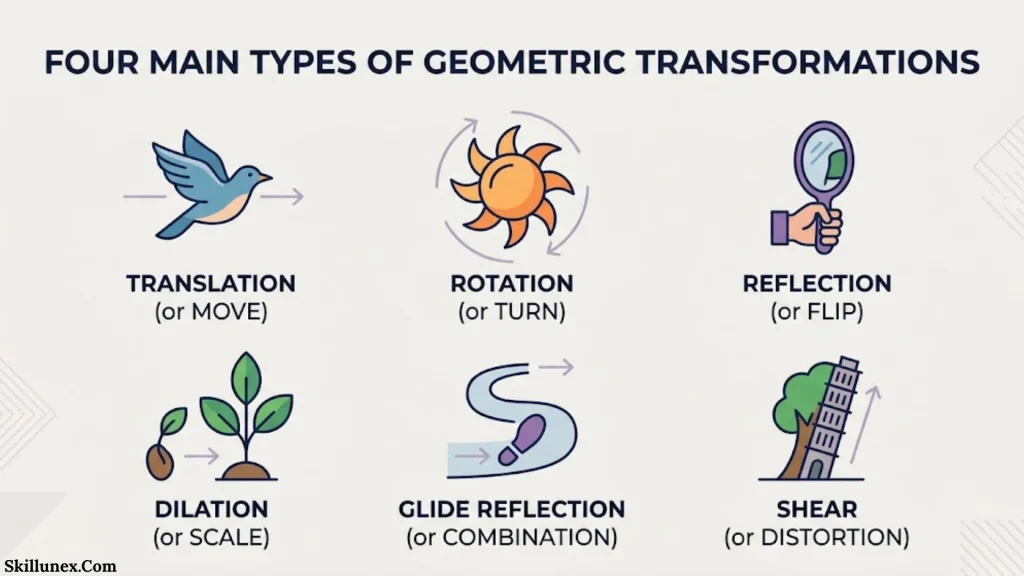
There are four fundamental geometric transformations: translation, reflection, rotation, and dilation. Each one changes a figure in a different way.
Translation
Translation is a geometric transformation that moves a figure from one position to another without turning, flipping, or changing its size.
It is similar to sliding an object across a flat surface. Every point in the figure moves the same distance and in the same direction.
Translation is commonly represented using an arrow or a vector.
Mathematical notation:
(x, y) → (x + a, y + b)
Where:
- x and y represent the original coordinates.
- a represents horizontal movement.
- b represents vertical movement.
- (x + a, y + b) represents the new coordinates.
Example:
Suppose a point has coordinates (3, 4), and it moves 2 units to the right and 3 units upward.
The new coordinates will be:
(3, 4) → (3 + 2, 4 + 3)
(3, 4) → (5, 7)
Therefore, the transformed point is (5, 7).
Important properties of translation:
- The size of the figure remains unchanged.
- The shape remains exactly the same.
- All points move the same distance.
- The orientation of the figure remains unchanged.
- Corresponding sides remain parallel and equal in length.
Translation is used in computer graphics, animation, map positioning, and other applications involving movement.
Reflection
Reflection is a transformation that flips a geometric figure across a fixed line called the line of reflection.
It produces a mirror image of the original figure. The distance of each original point from the reflection line is equal to the distance of its corresponding image point from that line.
Common reflection lines include the x-axis, y-axis, and the line y = x.
Common reflection rules:
| Reflection line | Coordinate rule |
| x-axis | (x, y) → (x, −y) |
| y-axis | (x, y) → (−x, y) |
| y = x | (x, y) → (y, x) |
| y = −x | (x, y) → (−y, −x) |
Example:
Suppose a point has coordinates (4, 3) and is reflected across the x-axis.
The transformation rule is:
(x, y) → (x, −y)
Therefore:
(4, 3) → (4, −3)
The new point is (4, −3).
Important properties of reflection:
- The size and shape remain unchanged.
- The orientation is reversed.
- Corresponding points remain the same distance from the reflection line.
- The reflection line acts as the perpendicular bisector of the segment connecting corresponding points.
Reflection is commonly used in symmetry, architecture, art, design, and geometric constructions.
Rotation
Rotation is a transformation in which a figure turns around a fixed point called the center of rotation.
The figure may rotate clockwise or counterclockwise while maintaining its original size and shape.
Rotation is usually measured in degrees (°).
Common rotation angles include:
- 90° clockwise or counterclockwise.
- 180° clockwise or counterclockwise.
- 270° clockwise or counterclockwise.
- 360° for one complete turn.
Common rotation rules around the origin:
| Rotation | Coordinate rule |
| 90° counterclockwise | (x, y) → (−y, x) |
| 90° clockwise | (x, y) → (y, −x) |
| 180° rotation | (x, y) → (−x, −y) |
| 270° counterclockwise | (x, y) → (y, −x) |
| 360° rotation | (x, y) → (x, y) |
Example:
Suppose a point has coordinates (2, 5) and rotates 90° counterclockwise around the origin.
The transformation rule is:
(x, y) → (−y, x)
Applying the rule:
(2, 5) → (−5, 2)
The new coordinates are (−5, 2).
Important properties of rotation:
- The size and shape remain unchanged.
- The distance from the center of rotation remains constant.
- The orientation is preserved.
- Every point rotates through the same angle.
- The center of rotation remains fixed.
Rotation is widely used in robotics, engineering, animation, computer graphics, and mechanical design.
Dilation
Dilation is a geometric transformation that enlarges or reduces a figure while maintaining its shape.
Unlike translation, reflection, and rotation, dilation can change the size of a figure. It is controlled by a number called the scale factor.
The scale factor is commonly represented by the letter k.
Mathematical notation:
(x, y) → (kx, ky)
This rule applies when dilation is centered at the origin.
Meaning of different scale factors:
| Scale factor | Result |
| k greater than 1 | Enlargement |
| 0 less than k less than 1 | Reduction |
| k = 1 | No change in size |
| k greater than 0 and less than 1 | Smaller image |
Example:
Suppose a point has coordinates (3, 2), and the scale factor is 2.
The transformation rule is:
(x, y) → (2x, 2y)
Applying the rule:
(3, 2) → (6, 4)
The new coordinates are (6, 4).
Important properties of dilation:
- The shape remains similar to the original.
- The size may increase or decrease.
- Corresponding angles remain equal.
- Corresponding side lengths change according to the scale factor.
- Parallel lines remain parallel under dilation.
Dilation is useful in map scaling, photography, architectural drawings, engineering models, and digital image editing.
Important Symbols Used in Geometric Transformations
Several mathematical symbols are used when describing geometric transformations. Understanding these notations helps students read transformation questions and write accurate mathematical solutions.
| Symbol | Name | Meaning |
| → | Arrow | Maps or transforms into |
| ′ | Prime | Represents a transformed point |
| ° | Degree | Measures an angle of rotation |
| (x, y) | Ordered pair | Represents original coordinates |
| (x′, y′) | Transformed coordinates | Represents new coordinates |
| k | Scale factor | Controls enlargement or reduction |
| T | Translation notation | Often represents a translation |
| R | Rotation notation | Often represents a rotation |
| r | Reflection notation | Sometimes used to represent reflection |
| D | Dilation notation | Sometimes used to represent dilation |
The letters T, R, r, and D are common descriptive abbreviations, not universal mathematical symbols. Their exact meaning depends on the notation used in a textbook or question.
What Does the Prime Symbol (′) Mean?
The prime symbol is one of the most frequently used notations in geometry.
It identifies the image of an original point after a transformation.
For example:
- A is the original point.
- A′ is the transformed point.
- B is the original point.
- B′ is the transformed point.
If triangle ABC undergoes a transformation, its resulting image is written as triangle A′B′C′.
The prime symbol does not indicate a different type of transformation. It simply distinguishes the transformed figure from the original one.
What Does the Arrow Symbol (→) Mean?
The arrow symbol represents the mapping of an original point or figure to its new position.
For example:
(x, y) → (x + 3, y + 2)
This means that the original coordinates move 3 units horizontally to the right and 2 units vertically upward.
The arrow helps communicate the transformation rule in a short and understandable format.
What Does the Degree Symbol (°) Mean?
The degree symbol measures the angle through which a figure rotates.
For example, 90° represents a quarter-turn, 180° represents a half-turn, and 360° represents one complete turn.
The direction of rotation must also be considered because clockwise and counterclockwise rotations can produce different results.
How to Perform Geometric Transformations Step by Step
Understanding transformation symbols becomes easier when you know how to apply their mathematical rules.
Identify the Original Figure
Start by identifying the original shape or point. Write down its coordinates if the question involves a coordinate plane.
For example:
A (2, 3)
Identify the Type of Transformation
Determine whether the question asks you to translate, reflect, rotate, or dilate the figure.
Each transformation has a different coordinate rule.
Apply the Correct Rule
Use the appropriate mathematical formula.
For example, for reflection across the y-axis:
(x, y) → (−x, y)
Calculate the New Coordinates
Substitute the original coordinates into the transformation rule.
If A = (2, 3), then:
A′ = (−2, 3)
Check the Result
Verify that the new coordinates follow the correct transformation rule.
If the transformation is a reflection, check the distance from the reflection line. If it is a rotation, check the angle and center of rotation.
Difference Between the Four Main Transformations
Although all four transformations change a geometric figure in some way, they do not produce the same results.
| Transformation | What happens? | Does size change? | Does orientation change? |
| Translation | Moves the figure | No | No |
| Reflection | Flips the figure | No | Yes |
| Rotation | Turns the figure | No | No |
| Dilation | Enlarges or reduces the figure | Yes, unless k = 1 | No for positive scale factors |
Translation, reflection, and rotation are known as rigid transformations because they preserve distances and angles.
Dilation is a non-rigid transformation when its scale factor is different from 1 because it changes the lengths of corresponding sides.
Real Life Applications of Transformation Symbols
Geometric transformations are used in many areas beyond mathematics classrooms.
Computer Graphics and Animation
Computer graphics software uses transformations to move, rotate, and resize objects on a screen. Animators use these operations to change the positions of characters, backgrounds, and digital objects.
Architecture and Construction
Architects use geometric transformations to create symmetrical designs, scale building plans, and position structural components accurately.
Engineering and Robotics
Engineers use transformations to calculate the position, direction, and movement of machines and robotic components.
Photography and Graphic Design
Image editing software uses translation, rotation, reflection, and scaling to adjust photographs, logos, illustrations, and other visual elements.
Maps and Navigation
Geometric transformations help represent locations, adjust map layouts, and convert spatial information between coordinate systems.
Common Mistakes to Avoid When Using Transformation Symbols

Students sometimes confuse transformation rules because different operations can produce similar looking results.
Here are some common mistakes and ways to avoid them.
- Confusing translation with rotation: Translation moves an object without turning it, while rotation turns it around a fixed point.
- Using the wrong reflection rule: Always identify the reflection line before changing coordinates.
- Ignoring rotation direction: A clockwise rotation and a counterclockwise rotation can produce different coordinates.
- Forgetting the scale factor: Dilation requires multiplying coordinates or distances by the correct scale factor, depending on the center.
- Misusing prime notation: Remember that A′ represents the transformed position of A, not another unrelated point.
- Assuming every transformation preserves size: Dilation can change size, whereas rigid transformations preserve it.
Frequently Asked Questions About Transformation Symbols
What are transformation symbols in mathematics?
Transformation symbols are mathematical notations used to describe changes in geometric figures. They represent movements and changes such as translation, reflection, rotation, and dilation.
What are the four main types of transformations?
The four main geometric transformations are translation, reflection, rotation, and dilation. Each follows specific rules for changing a figure’s position, orientation, or size.
What does the prime symbol (′) mean in geometry?
The prime symbol identifies the transformed image of an original point. For example, A′ represents the new position of point A after a transformation.
What symbol represents translation?
Translation is commonly represented by an arrow, vector, or transformation notation such as T. The arrow indicates how an original point maps to its new position.
How is rotation represented in mathematics?
Rotation is commonly represented using degrees (°), such as 90°, 180°, 270°, and 360°. The direction and center of rotation are also important.
What does the letter k represent in dilation?
The letter k represents the scale factor. It determines whether a figure becomes larger, smaller, or remains the same size.
Which transformations preserve the size of a figure?
Translation, reflection, and rotation preserve the size and shape of a figure. These are called rigid transformations.
Do transformation symbols have real life applications?
Yes. They are used in computer graphics, animation, architecture, engineering, robotics, photography, and digital design to represent and calculate changes in position, orientation, and size.
Conclusion
Transformation symbols provide a simple and organized way to describe how geometric figures change in mathematics. They help explain the movement, reflection, rotation, enlargement, and reduction of shapes through specific mathematical rules.
The four main transformations translation, reflection, rotation, and dilation each have their own properties, coordinate rules, and applications. Understanding important notations such as arrows, prime symbols, degrees, and scale factors makes it easier to solve geometry problems and interpret mathematical diagrams.
If you are studying coordinate geometry or exploring computer graphics and engineering, learning transformation symbols builds a strong foundation for understanding how objects change their position, orientation, and size.

Isla Kensington
I’m Isla Kensington, a writer with a passion for research, culture, nature, and the fascinating meanings behind everyday things. I enjoy taking topics that may seem simple at first and discovering the history, facts, and ideas that make them more interesting.
I write with readers in mind. My aim is to provide clear explanations, useful information, and interesting details without making a topic unnecessarily complicated.
I believe learning should feel like discovering something rather than simply reading facts. That philosophy guides the content I create and the topics I choose to explore.
## Books by Isla Kensington
* Symbols Around the World: A Guide to Meaning & Culture
* Nature’s Beautiful Places: Lakes, Landscapes & Natural Treasures