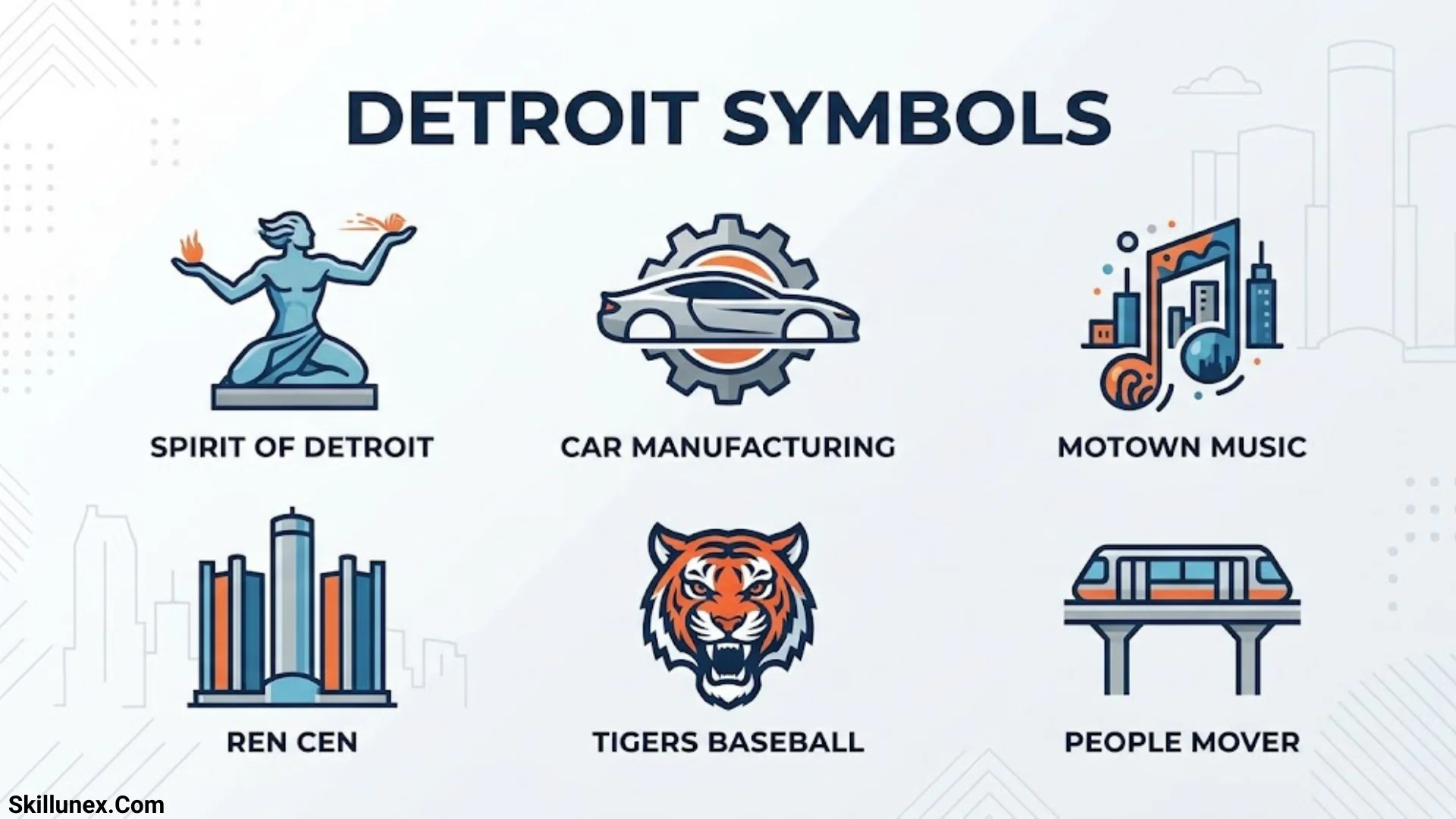
Detroit symbols represent the city’s rich history, strong identity, and unique culture. From the official city seal to the iconic Spirit of Detroit statue, these symbols reflect the pride and resilience of the people who call Detroit home. If you want to learn about Detroit’s most recognizable symbols, you can explore the designs, meanings, and stories behind each one.
When you explore Detroit symbols, you will discover how the city’s history, automotive industry, sports culture, and artistic spirit have shaped its identity. You can find symbols connected to famous landmarks, local traditions, and the city’s growth over time. Understanding these symbols helps you appreciate what makes Detroit special and why its identity stands out.
In this guide, you will learn about the most important Detroit symbols and what they represent. Whether you are researching the city’s history, looking for inspiration, or simply curious about its iconic emblems, you will find useful information to help you understand Detroit’s heritage and cultural pride.
What Are Detroit Symbols?
Detroit symbols are official emblems, historic objects, landmarks, logos, and cultural references associated with Detroit. They help communicate the city’s history, achievements, traditions, and shared identity. Some have formal civic significance, while others became recognizable through popular culture and everyday life.
For example, the Detroit city seal represents the city’s determination to rebuild after a devastating fire. The Spirit of Detroit statue reflects humanity, family, and hope. Meanwhile, the automobile represents Detroit’s manufacturing heritage, and Motown represents the city’s lasting influence on popular music.
It’s helpful to distinguish between official Detroit symbols and cultural symbols. The city flag and seal are official civic emblems. The Detroit Tigers’ Old English D, Motown, and the Spirit of Detroit are widely recognized representations of the city, but they do not all have the same official status.
Detroit’s story also reaches further back than its modern industrial identity. The Detroit River served as an important route for Indigenous peoples, trade, and cultural exchange long before European settlement. Recognizing this earlier history provides a fuller understanding of the region and the many communities that have shaped it.
Official Detroit Symbols and Their Meanings
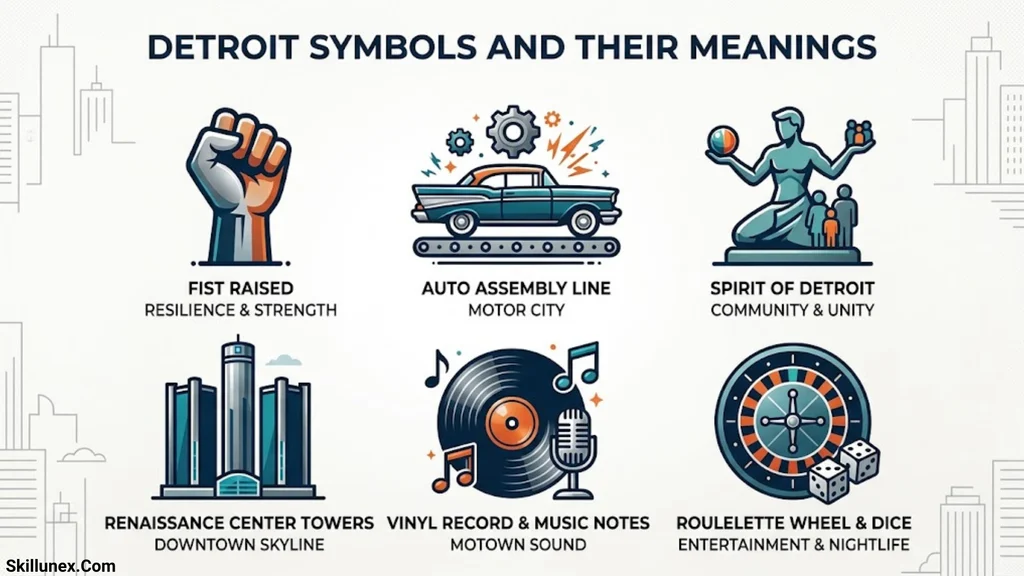
Detroit City Seal
The Detroit city seal is one of the most important official symbols of the city. Designed by artist J. O. Lewis in 1827, it commemorates the Great Fire of 1805, which destroyed much of early Detroit.
The seal features two women representing destruction and hope. One woman mourns the burning city, while the other offers comfort and gestures toward a new settlement. The imagery captures the idea that a community can recover from even devastating circumstances.
The seal also features two Latin phrases that express Detroit’s enduring outlook:
- Speramus Meliora: We hope for better things.
- Resurget Cineribus: It will rise from the ashes.
These phrases became the foundation of Detroit’s traditional motto. They communicate the belief that hardship does not have to define a city’s future.
The Detroit city seal therefore represents resilience, recovery, civic pride, and the determination to rebuild. It is particularly meaningful because the story behind it remains relevant whenever Detroit faces economic, social, or environmental challenges.
For additional historical details, see the Detroit Historical Society’s account of the city flag and seal.
Detroit City Flag
The Detroit city flag is a visual record of the different nations that controlled the city during its early history. David Emil Heineman designed the flag in 1907, and it was first flown publicly on June 12, 1908. Detroit officially adopted it in 1948.
The flag includes several sections, each associated with a period in the city’s political history.
- French fleur-de-lis: The five gold fleur-de-lis represent France, which founded Detroit in 1701.
- British lions: Three gold lions represent British control of the city.
- American stars: Thirteen stars represent the original American colonies and the early period of United States control.
- American stripes: The red and white stripes represent the United States and its continuing connection to Detroit.
- Central city seal: The seal commemorates the Great Fire of 1805 and the rebuilding that followed.
The combination of these elements makes the flag more than a decorative emblem. It reflects Detroit’s transition through different periods of colonial and American history.
The Detroit flag symbolizes historical continuity, civic identity, and the city’s ability to develop through political and cultural change. It also connects Detroit’s early history with its modern identity as a major American city.
The Spirit of Detroit Statue
The Spirit of Detroit is one of the city’s best-known landmarks and cultural symbols. Sculptor Marshall Fredericks created the monumental bronze statue, which was dedicated in 1958 outside the Coleman A. Young Municipal Center on Woodward Avenue.
The sculpture depicts a seated human figure holding a golden sphere in one hand and a family group in the other. Each element carries a particular meaning.
The golden sphere represents divinity, while the family symbolizes human relationships. Together, these elements express the relationship between spiritual belief and human life.
The statue was created to represent hope, progress, and the human spirit. Over time, it became a familiar symbol of Detroit’s civic identity.
Residents and visitors often associate the Spirit of Detroit with unity, perseverance, and community pride. The statue has also become part of Detroit’s sports culture, occasionally wearing a team jersey to celebrate major championship victories.
Its meaning extends beyond government or religion. For many people, the sculpture represents the idea that a city is ultimately defined by its people, relationships, and shared hopes for the future.
You can learn more from the Detroit Historical Society’s history of the Spirit of Detroit.
Detroit Symbols of Industry and Innovation

The Automobile
The automobile is one of the strongest symbols associated with Detroit. The city earned the nickname Motor City because of its central role in the development of the American automobile industry.
During the late 19th and early 20th centuries, Detroit became a major center for automobile design, production, and engineering. Companies such as Ford, General Motors, and Chrysler helped establish its international reputation.
The automobile represents more than transportation. It reflects industrial innovation, skilled labor, engineering, entrepreneurship, and the growth of manufacturing.
Detroit’s automotive industry also transformed everyday life. Mass production made automobiles more accessible to many American households, while factory employment attracted workers from different parts of the United States and around the world.
However, the automobile also represents the challenges associated with industrial dependence. Changes in manufacturing, economic competition, and shifts in the automotive market have affected Detroit’s workers and neighborhoods over time.
For this reason, the automobile symbolizes both achievement and adaptation. It reminds you of Detroit’s manufacturing legacy and its continuing efforts to develop new technologies and forms of mobility.
The Assembly Line
The assembly line is another important symbol of Detroit’s industrial history. Although assembly-line methods existed before the automobile industry adopted them on a large scale, Detroit became closely associated with modern mass production.
In 1913, Ford introduced a moving assembly line for automobile production at its Highland Park plant. The system moved vehicles through successive workstations, allowing workers to perform specialized tasks more efficiently.
This approach helped transform manufacturing and influenced industries around the world.
The assembly line represents:
- Efficiency and organized production.
- Teamwork and specialized skills.
- Industrial growth and technological change.
- The contributions of factory workers.
- The transformation of modern manufacturing.
The symbol also reflects the human side of Detroit’s industrial story. Behind every automobile were workers, engineers, designers, and communities whose lives were connected to factory employment.
Today, the assembly line remains a useful symbol of Detroit’s influence on modern production methods and its place in the history of American industry.
Gears and Industrial Emblems
Gears, mechanical parts, factory imagery, and industrial machinery frequently appear in artwork and designs inspired by Detroit. These are not official city symbols, but they represent the city’s manufacturing heritage.
A gear works by connecting with other mechanical parts. This makes it a natural symbol of cooperation, precision, and coordinated effort.
In Detroit-inspired designs, gears can represent the relationship between workers, technology, and production. They also evoke the automobile factories that helped shape the city’s economy.
You may encounter gear imagery in local artwork, clothing, tattoos, business logos, and automotive designs. Its meaning often centers on hard work, mechanical skill, and the idea that individual contributions help a larger system function.
For Detroit, gears offer a simple visual connection between the city’s industrial past and its interest in modern engineering and mobility.
Detroit Symbols of Music and Cultural Heritage
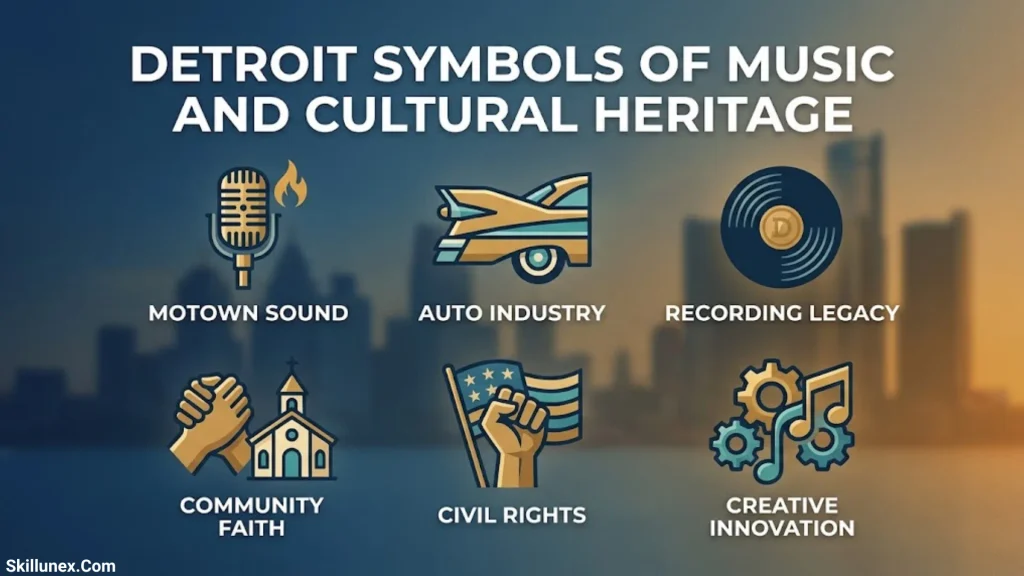
Motown
Motown is one of Detroit’s most influential cultural symbols. Berry Gordy founded Motown Records in Detroit in 1959, creating a record label that helped transform American popular music.
The label became famous for its distinctive blend of soul, pop, and rhythm and blues. Its artists reached audiences across racial and cultural boundaries during a period of significant social change in the United States.
Musicians associated with Motown include Stevie Wonder, Marvin Gaye, Diana Ross and the Supremes, and the Temptations.
Motown represents musical innovation, African American creativity, artistic ambition, and cultural influence. Its success demonstrated how music created in Detroit could reach listeners throughout the country and around the world.
The label also became part of the city’s identity because of its connection to local neighborhoods, recording studios, musicians, and songwriters.
The original Motown headquarters, known as Hitsville U.S.A., is now home to the Motown Museum. The museum preserves the history of the label and the people who helped create its sound.
For many music fans, Motown is more than a record label. It symbolizes Detroit’s creative energy and its contribution to American cultural history.
Detroit Techno
Detroit techno represents another major contribution to global music. The electronic music genre developed in Detroit during the 1980s, drawing on electronic instruments, futuristic ideas, and influences from funk, disco, and other musical traditions.
Juan Atkins, Derrick May, and Kevin Saunderson, often called the Belleville Three, played central roles in the development of Detroit techno.
The genre is known for its electronic rhythms, synthesized sounds, repetitive beats, and forward-looking atmosphere. Its early creators helped establish a sound that would influence dance music around the world.
Detroit techno symbolizes experimentation, independence, technological creativity, and the city’s ability to produce new cultural movements.
Its industrial associations also contribute to its identity. Listeners often connect the genre’s mechanical rhythms and futuristic sounds with Detroit’s manufacturing history and changing urban landscape.
Despite its local roots, techno became an international movement. This global influence demonstrates that Detroit’s cultural impact extends far beyond automobiles and traditional manufacturing.
The Fox Theatre
The Fox Theatre is a historic entertainment venue in downtown Detroit. It opened in 1928 and is recognized for its elaborate architectural design and long association with live performances.
Its richly decorated interior and distinctive exterior make it an important part of Detroit’s architectural heritage.
The Fox Theatre symbolizes entertainment, artistic expression, historic preservation, and the city’s longstanding connection to live music and performance.
The venue has hosted a wide range of shows, concerts, and theatrical productions. Its continued use connects Detroit’s entertainment history with contemporary audiences.
For visitors, the Fox Theatre offers a visible reminder that Detroit’s identity has always included more than factories and automobiles. Architecture, performance, and public entertainment have also played important roles in shaping the city.
Detroit Symbols of Sports and Community Pride
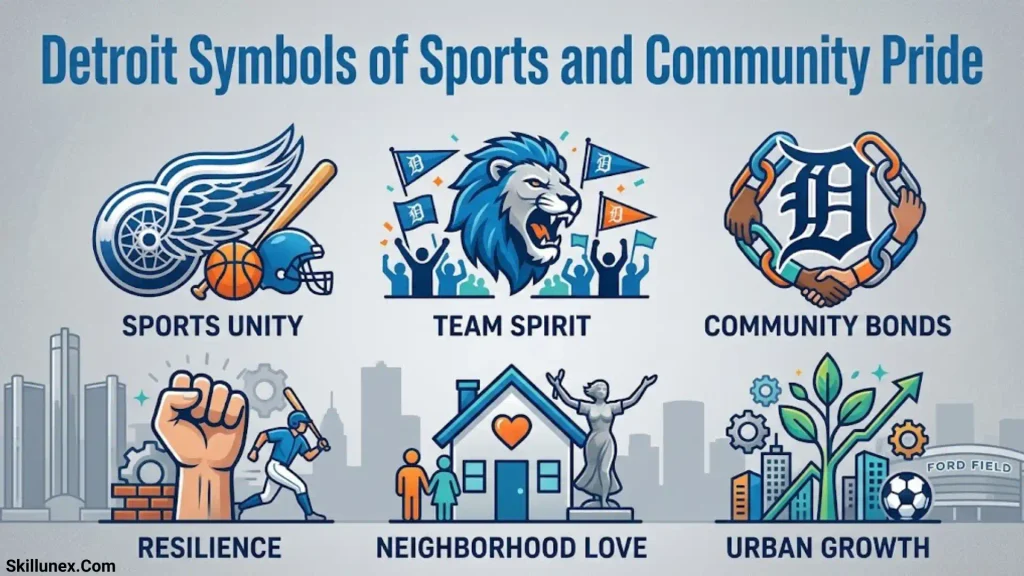
The Detroit Lions
The Detroit Lions are the city’s National Football League team. Their blue-and-silver colors and lion emblem are recognizable parts of Detroit’s sports identity.
The lion is commonly associated with strength, courage, and determination. In the team’s visual identity, it also creates a strong connection between the franchise and its supporters.
The Lions symbolize teamwork, competition, perseverance, and community loyalty. Their games bring fans together and provide opportunities for residents and former residents to celebrate their connection to Detroit.
Like other professional sports teams, the Lions also serve as a shared point of reference for people who may have different backgrounds but feel connected through their support of the same team.
For many fans, the team’s identity extends beyond football. It represents hometown pride and a continuing relationship with the city.
The Detroit Tigers’ Old English D
The Detroit Tigers’ Old English D is one of the most recognizable symbols associated with Detroit baseball. The stylized letter appears on the team’s uniforms and merchandise and has become closely connected with the city’s sports culture.
The letter D stands for Detroit, while its traditional typography reflects the team’s long history.
The symbol represents baseball tradition, local identity, and the connection between generations of fans. It can also be seen as an example of how a sports emblem can become a broader cultural symbol.
Although the Old English D is primarily associated with the Tigers, many people use it to express their connection to Detroit itself.
Its widespread recognition demonstrates how sports symbols can become part of a city’s identity, appearing on hats, shirts, jackets, and other items worn by residents and visitors.
The Detroit Red Wings’ Winged Wheel
The Detroit Red Wings are a professional ice hockey team known for their distinctive winged-wheel logo.
The logo combines a wheel with wings, creating a visual connection between hockey and Detroit’s automobile heritage. The wheel recalls the Motor City, while the wings suggest speed, movement, and athletic performance.
The emblem represents hockey tradition, competition, and the relationship between sports and local industry.
The Red Wings have a long history in the National Hockey League, and their logo is familiar to hockey fans throughout North America.
For Detroit residents, the winged wheel is another example of how the city’s industrial identity has influenced its sports imagery. It combines two major parts of Detroit’s public identity: manufacturing and professional athletics.
Detroit Symbols of Architecture, Geography, and Renewal
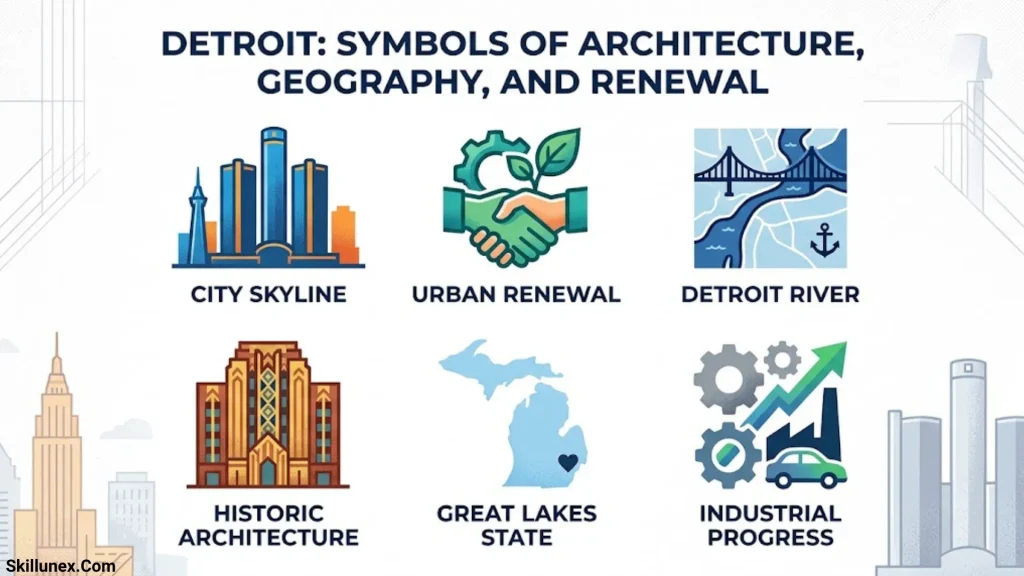
The Renaissance Center
The Renaissance Center, commonly called the RenCen, is a prominent group of skyscrapers along the Detroit River. Its towers form a distinctive part of the city’s skyline.
The complex opened in stages beginning in the 1970s and became closely associated with efforts to strengthen downtown Detroit’s commercial and economic presence.
Its name suggests renewal, making it a natural symbol of redevelopment and ambition. The towers also represent the city’s interest in attracting businesses, supporting employment, and reshaping its urban environment.
The Renaissance Center symbolizes architectural scale, economic aspiration, and urban transformation. It also reflects the complicated nature of renewal: a prominent development can represent investment and opportunity without telling the complete story of every neighborhood.
As part of Detroit’s skyline, the complex provides a recognizable visual link between the city’s industrial past and its changing economic future.
The Detroit River
The Detroit River is an important geographical and historical symbol. It connects Lake St. Clair and Lake Erie and forms part of the international boundary between the United States and Canada.
Long before Detroit became known for automobiles, the river served as a route for Indigenous travel, trade, and cultural exchange. It later supported European settlement, shipping, commercial activity, and industrial development.
The river symbolizes connection, movement, trade, and opportunity. It also reflects Detroit’s position as a border city with longstanding ties to Windsor, Ontario.
Its waterfront offers views of both countries and reminds visitors that Detroit’s history has always been shaped by its geographical location.
The river also carries environmental significance. Protecting its water quality and surrounding habitats matters to communities on both sides of the border.
As a Detroit symbol, the river represents the relationship between geography, economic development, cultural exchange, and the natural environment.
The People of Detroit
Detroit’s residents are among the most important symbols of the city’s identity. The city’s history has been shaped by Indigenous communities, French settlers, Black Americans, immigrants, factory workers, artists, entrepreneurs, and many other groups.
Their experiences have influenced Detroit’s neighborhoods, industries, music, food, architecture, and community traditions.
The people of Detroit symbolize resilience, creativity, hard work, and cultural diversity. These qualities appear in the city’s labor history, music scene, neighborhood organizations, small businesses, and community initiatives.
Detroit’s Black communities, in particular, have played a major role in shaping its cultural influence, including Motown, jazz, blues, and other musical traditions. The city’s history also includes migration, segregation, urban renewal, and struggles over economic and social opportunity.
Recognizing these experiences gives Detroit symbols a deeper meaning. A city is not defined only by its landmarks or logos. Its identity also comes from the people who live there, preserve its traditions, address its challenges, and shape its future.
A Quick Guide to Detroit Symbols and Their Meanings
The following table summarizes the major Detroit symbols and the ideas commonly associated with them.
| Detroit Symbol | Main Meaning | Historical or Cultural Connection |
| Detroit city seal | Hope and recovery | Rebuilding after the Great Fire of 1805 |
| Detroit city flag | Civic identity and heritage | French, British, and American history |
| Spirit of Detroit | Humanity, family, and hope | Public sculpture dedicated in 1958 |
| Automobile | Innovation and manufacturing | Detroit’s automotive industry |
| Assembly line | Efficiency and teamwork | Modern mass production |
| Gears | Cooperation and mechanical skill | Industrial design and engineering |
| Motown | Musical creativity and cultural influence | American soul and popular music |
| Detroit techno | Experimentation and innovation | Electronic music developed in Detroit |
| Fox Theatre | Art and entertainment | Historic performing arts venue |
| Detroit Lions | Teamwork and determination | Professional football |
| Tigers’ Old English D | Baseball tradition and local pride | Detroit baseball |
| Red Wings winged wheel | Speed and sporting heritage | Hockey and automotive imagery |
| Renaissance Center | Ambition and urban renewal | Downtown architecture and redevelopment |
| Detroit River | Connection and opportunity | Geography, trade, and cultural exchange |
| Detroit residents | Resilience and community | The people and traditions that shape the city |
Why Are Detroit Symbols Important?
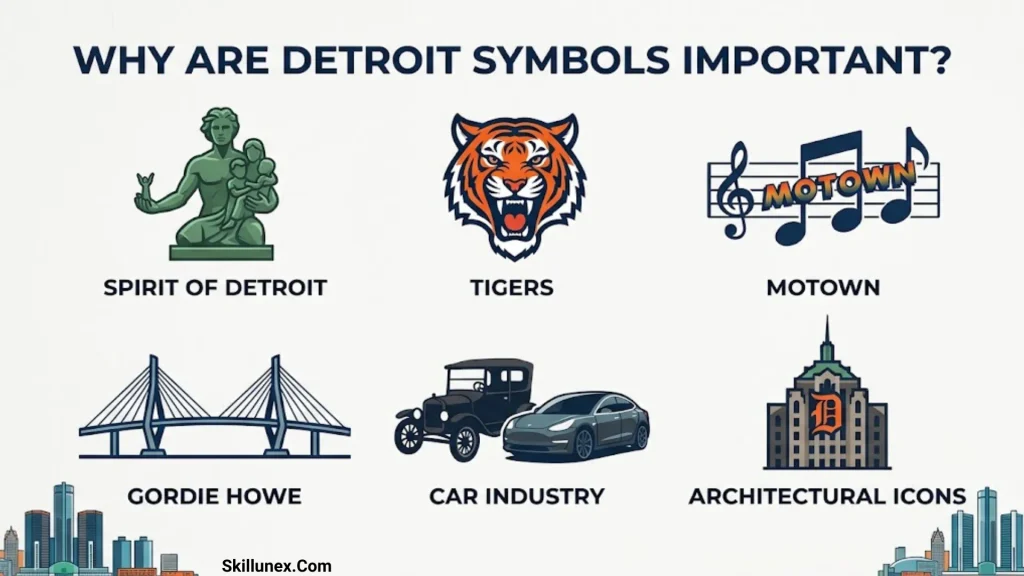
Detroit symbols matter because they preserve the city’s history and help people understand what makes it distinctive. Each emblem or landmark offers a different perspective on the city’s development.
They Preserve Detroit’s History
The city seal and flag provide visible connections to Detroit’s early history, including the Great Fire of 1805 and the city’s periods of French, British, and American control.
These symbols help people remember that Detroit’s identity developed over centuries. They also demonstrate how historical events can influence the emblems a city chooses to preserve.
They Express Local Pride
The Spirit of Detroit, the Tigers’ Old English D, and the Red Wings’ winged wheel are familiar symbols that help residents express their connection to the city.
You might see these symbols on clothing, artwork, flags, souvenirs, and other items. Their meaning often comes from shared memories, family traditions, sporting events, and experiences of living in or visiting Detroit.
They Celebrate Cultural Creativity
Motown and Detroit techno show how the city has influenced music far beyond Michigan.
These cultural symbols recognize the musicians, producers, performers, and communities that developed new sounds and brought them to international audiences. They also demonstrate that Detroit’s identity includes artistic innovation as well as industrial achievement.
They Represent Resilience and Renewal
The motto associated with Detroit’s city seal expresses hope after destruction. That message has continued to resonate through later periods of economic change and urban redevelopment.
Symbols such as the Spirit of Detroit and the Renaissance Center can also evoke ideas of renewal, although their original purposes and histories differ.
Together, these symbols remind people that Detroit’s story includes setbacks, adaptation, achievements, and ongoing efforts to create a stronger future.
How Detroit Symbols Are Used Today
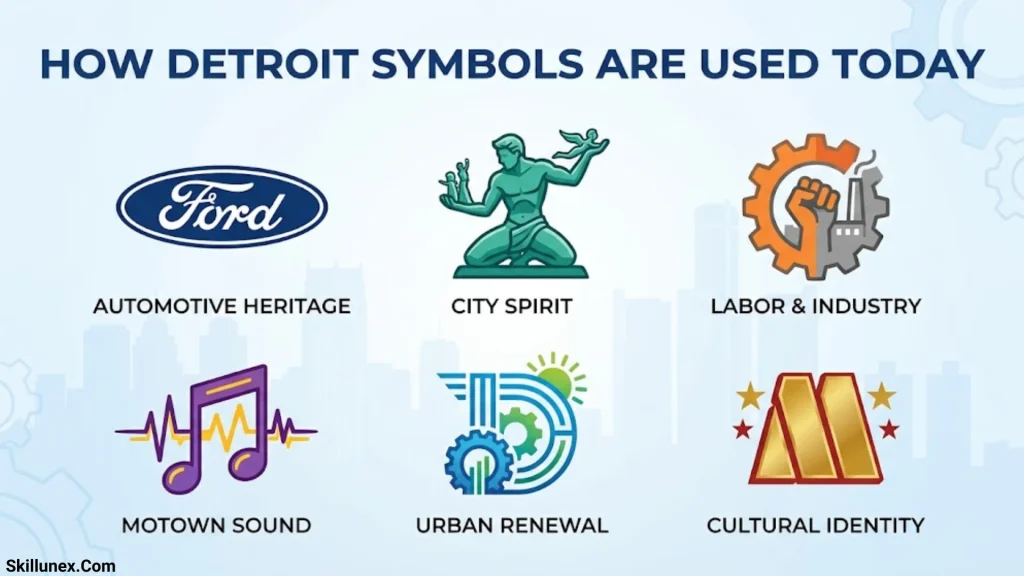
Detroit symbols appear in civic life, sports, tourism, education, art, and popular culture. Their uses vary depending on whether the symbol is an official emblem or a broader cultural reference.
- City government: The city seal and flag identify Detroit in civic and ceremonial settings.
- Sports merchandise: The Lions’ emblem, Tigers’ Old English D, and Red Wings’ winged wheel appear on team clothing and memorabilia.
- Music and tourism: Motown’s history attracts music fans and visitors interested in Detroit’s cultural legacy.
- Art and design: Industrial imagery, the Spirit of Detroit, and the city’s skyline inspire illustrations, posters, tattoos, and creative projects.
- Education: Detroit’s flag, seal, and landmarks help teachers explain local history and civic identity.
- Community celebrations: Public landmarks and sports symbols provide familiar gathering points and shared references during local events.
If you’re choosing a Detroit symbol for a school project, logo concept, souvenir, or artwork, consider the message you want to communicate. The city seal is a strong choice for historical themes, Motown works well for musical heritage, and the winged wheel connects sports with automotive history.
Remember that official city emblems and professional sports logos may have usage restrictions. If you plan to reproduce a symbol commercially, check the relevant organization’s guidelines before using it.
Frequently Asked Questions About Detroit Symbols
What is the most famous symbol of Detroit?
The Spirit of Detroit statue is one of the city’s most famous symbols. Located outside the Coleman A. Young Municipal Center, it represents humanity, family, hope, and the spirit of the community. The automobile and the Detroit Tigers’ Old English D are also widely recognized symbols.
What does the Detroit city seal mean?
The Detroit city seal commemorates the Great Fire of 1805 and the rebuilding that followed. Its two Latin phrases express hope for better things and the belief that the city will rise from the ashes. The seal symbolizes resilience and recovery.
What do the symbols on the Detroit flag represent?
The Detroit flag reflects the city’s historical periods under French, British, and American control. Its fleur-de-lis represent France, its lions represent Great Britain, and its stars and stripes represent the United States. The central city seal recalls the Great Fire of 1805 and Detroit’s subsequent rebuilding.
Why is Detroit called the Motor City?
Detroit earned the nickname Motor City because it became a major center for automobile manufacturing. Its automotive companies, engineering expertise, factories, and workers helped shape the American car industry and influence manufacturing around the world.
What does the Spirit of Detroit hold in its hands?
The Spirit of Detroit holds a golden sphere in one hand and a family group in the other. The sphere represents divinity, while the family symbolizes human relationships. Together, these elements express the sculpture’s themes of spirituality and humanity.
What does the Detroit Tigers’ Old English D represent?
The Old English D is the Detroit Tigers’ recognizable team emblem. The letter stands for Detroit and represents the team’s baseball tradition. It has also become a broader expression of local pride among residents and fans.
What is Motown’s connection to Detroit?
Berry Gordy founded Motown Records in Detroit in 1959. The label became internationally influential through artists such as Stevie Wonder, Marvin Gaye, Diana Ross and the Supremes, and the Temptations. Motown symbolizes Detroit’s musical creativity and its contribution to American popular culture.
What does Detroit techno symbolize?
Detroit techno represents electronic music innovation, experimentation, and futuristic creativity. Developed in Detroit during the 1980s, the genre grew into an international musical movement and established the city as an influential center of electronic music.
Is the Detroit River a symbol of the city?
Yes. The Detroit River is an important geographical and historical symbol. It represents trade, transportation, cultural exchange, and the connection between Detroit and Windsor, Canada. Its role in the region’s development makes it an important part of the city’s identity.
Are Detroit symbols used in tattoos and artwork?
Yes. People use Detroit-inspired imagery in tattoos, clothing, artwork, and graphic designs to express local pride or celebrate particular aspects of the city’s history. Common choices include the Spirit of Detroit, the Old English D, the city flag, automobiles, and Motown-inspired designs. Commercial use of protected logos may require permission.
Conclusion
Detroit symbols reveal the many stories behind the city’s identity. The city seal and flag preserve its civic history, while the Spirit of Detroit represents humanity and community. The automobile, assembly line, and industrial imagery recall Detroit’s influence on manufacturing, and Motown and techno celebrate its lasting contributions to music.
Sports emblems, historic theaters, the Renaissance Center, and the Detroit River add further meaning to this collection of symbols. Each represents a different aspect of Detroit’s development, from its geographical importance to its achievements in industry, entertainment, and professional sports.
Ultimately, the most meaningful Detroit symbol depends on what you want to understand or celebrate. Whether you’re exploring the city’s history, creating a design, or learning about its cultural heritage, these symbols provide a starting point for discovering Detroit’s past, appreciating its communities, and understanding its continuing influence.

Isla Kensington
I’m Isla Kensington, a writer with a passion for research, culture, nature, and the fascinating meanings behind everyday things. I enjoy taking topics that may seem simple at first and discovering the history, facts, and ideas that make them more interesting.
I write with readers in mind. My aim is to provide clear explanations, useful information, and interesting details without making a topic unnecessarily complicated.
I believe learning should feel like discovering something rather than simply reading facts. That philosophy guides the content I create and the topics I choose to explore.
## Books by Isla Kensington
* Symbols Around the World: A Guide to Meaning & Culture
* Nature’s Beautiful Places: Lakes, Landscapes & Natural Treasures