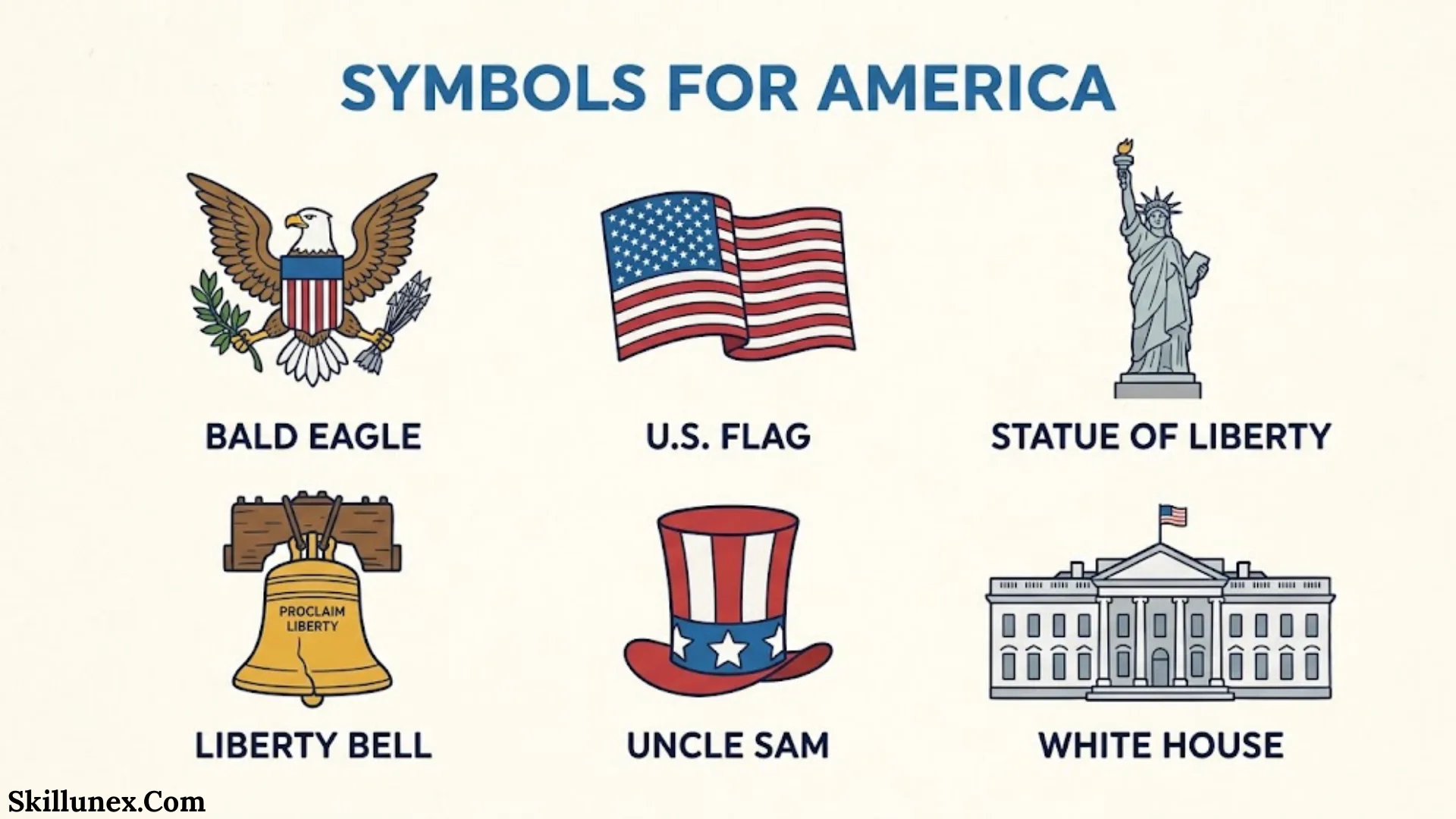
America is known for its rich history, diverse culture, and strong national identity. Symbols for America represent the country’s freedom, unity, patriotism, and values. From the American flag and bald eagle to the Statue of Liberty, each symbol tells a meaningful story about the nation’s past and present.
These famous American symbols help people understand what makes the United States unique. Some represent freedom and independence, while others reflect American history, courage, and national pride. They are recognized across the country and around the world.
In this article, we’ll explore the most popular symbols for America, their meanings, and the fascinating stories behind them. If you’re a student, teacher, or simply curious about American culture, this guide will help you discover the symbols that represent the United States.
What Are the Symbols of America?
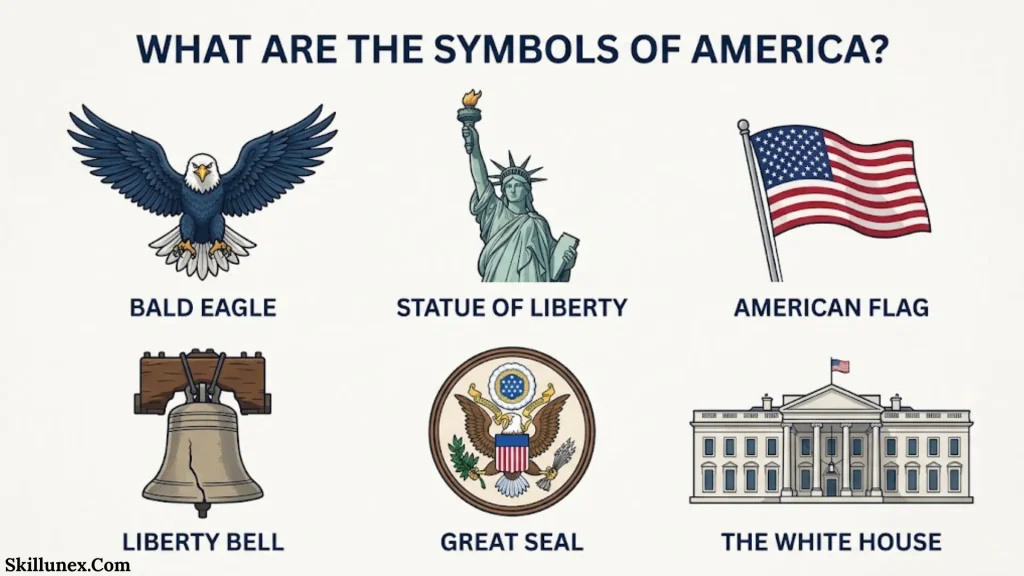
American symbols are objects, animals, landmarks, documents, images, and traditions that represent the United States and its national identity. They communicate important ideas about the country’s history, government, independence, freedom, and cultural development.
Some American symbols have official recognition. For example, the bald eagle is the national bird, the American bison is the national mammal, and the American flag is the country’s national flag.
Other symbols, including the Statue of Liberty and Uncle Sam, are widely recognized representations of American values and identity, even though they do not all have the same formal designation.
These symbols are used in different settings, including government ceremonies, educational institutions, national celebrations, public monuments, and cultural events.
Understanding their meanings provides a deeper appreciation of the history and traditions that have shaped the United States.
20 Famous Symbols for America and Their Meanings
The United States has numerous recognizable national and cultural symbols. Each has a different story and represents a particular part of American history, identity, or heritage.
Here are 20 well-known American symbols and what they represent.
The American Flag
The American flag is one of the most recognizable symbols of the United States. It is commonly called the Stars and Stripes, Old Glory, or the Star-Spangled Banner.
The flag features 13 alternating red and white horizontal stripes and a blue rectangle containing 50 white stars.
The 13 stripes represent the original 13 British colonies that declared independence from Great Britain. The 50 stars represent the 50 states that make up the country today.
The flag represents American independence, national unity, and patriotism. It is displayed at government buildings, schools, military facilities, public celebrations, and private homes.
Americans also display the national flag during important occasions, including Independence Day, Memorial Day, Veterans Day, and other national observances.
Its design has changed throughout American history as new states joined the Union, making it a visual record of the country’s development.
The Bald Eagle
The bald eagle is one of America’s most powerful national symbols. It represents strength, freedom, independence, and national pride.
In 1782, the bald eagle was adopted as the central figure on the Great Seal of the United States. Its impressive appearance and association with North American wildlife made it a fitting representation of the new nation.
The bald eagle became the official national bird through legislation signed into law in December 2024, although it had been widely recognized as a national symbol for centuries.
The bird appears on government emblems, military insignia, official documents, and American currency.
Its image is particularly meaningful because it represents the country’s natural heritage as well as its commitment to independence and national identity.
The Statue of Liberty
The Statue of Liberty is one of the most famous landmarks in the United States and an internationally recognized symbol of freedom and hope.
Located on Liberty Island in New York Harbor, the statue was a gift from France to the United States. It was dedicated on October 28, 1886.
Designed by French sculptor Frédéric Auguste Bartholdi, the monument depicts a robed woman holding a torch in her right hand and a tablet in her left.
The torch represents enlightenment, while the tablet carries the date of American independence, July 4, 1776, written in Roman numerals.
A broken chain near the statue’s feet represents freedom from oppression.
For generations, the Statue of Liberty has been associated with immigration, opportunity, and the hope of building a better future. It remains one of the most recognizable representations of American ideals.
The Liberty Bell
The Liberty Bell is an important historical symbol associated with American independence and the struggle for freedom.
Located in Philadelphia, Pennsylvania, the bell originally served as part of the Pennsylvania State House, now known as Independence Hall.
It became closely associated with American independence and later gained recognition as a symbol of abolition, civil rights, and the broader pursuit of liberty.
The bell is especially recognizable because of its large crack, which developed during its history and eventually made it unsuitable for regular ringing.
Its inscription comes from the biblical book of Leviticus: “Proclaim LIBERTY Throughout All the Land Unto All the Inhabitants Thereof.”
Today, the Liberty Bell reminds visitors of America’s founding ideals and the ongoing importance of freedom and equality.
The Great Seal of the United States
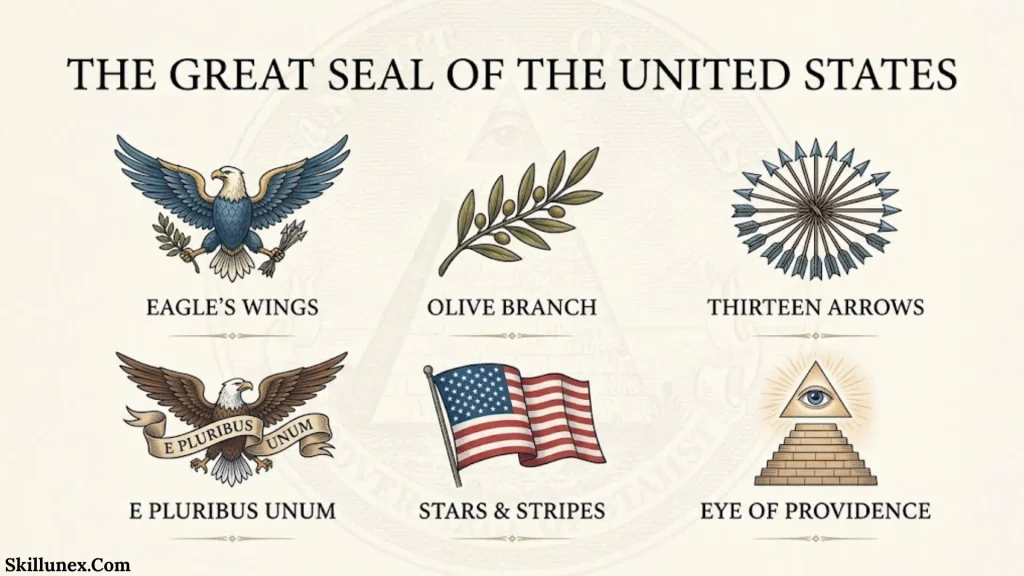
The Great Seal of the United States is an official emblem used to authenticate important government documents.
Adopted in 1782, it features a bald eagle holding an olive branch in one talon and a bundle of arrows in the other.
The olive branch traditionally represents peace, while the arrows represent the country’s ability to defend itself.
The eagle also carries a shield with 13 red and white stripes, representing the original 13 states. Above its head are 13 stars arranged in a constellation.
The reverse side of the Great Seal features an unfinished pyramid with an eye above it, along with the Latin phrases “Annuit Coeptis” and “Novus Ordo Seclorum.”
The seal represents national sovereignty, government authority, and the founding history of the United States.
The White House
The White House is the official residence and principal workplace of the president of the United States.
Located at 1600 Pennsylvania Avenue NW in Washington, D.C., it has served as the presidential residence since 1800, when President John Adams moved into the building.
The White House represents the American presidency, executive leadership, and the federal government.
It contains several important rooms used for official meetings, diplomatic receptions, public ceremonies, and presidential activities.
The building is also a recognizable symbol of American political life and national leadership.
Although it is not a formally designated national symbol like the American flag, its historical and governmental importance makes it one of the country’s most recognizable icons.
Uncle Sam
Uncle Sam is a popular personification of the United States government and American national identity.
He is usually illustrated as an older man with white hair, a pointed white beard, a tall hat decorated with stars, and red, white, and blue clothing.
The character became widely recognized during the 19th century. His name is traditionally connected to Samuel Wilson, a meat supplier during the War of 1812 whose products were marked with the initials U.S.
Over time, the name Uncle Sam became associated with the United States government.
One of the most famous illustrations appeared during World War I in a recruitment poster featuring the words “I Want YOU for U.S. Army.”
Uncle Sam continues to appear in political cartoons, advertisements, patriotic artwork, and popular culture.
The Washington Monument
The Washington Monument is a famous landmark in Washington, D.C., built to honor George Washington, the first president of the United States.
The monument is a large stone obelisk located on the National Mall. Construction began in 1848, stopped for several years, and was completed in 1884.
Standing approximately 555 feet tall, it is one of the most recognizable structures in the American capital.
The monument represents leadership, national history, and respect for the country’s founding president.
It also serves as an important part of the historical landscape surrounding the White House, the U.S. Capitol, and other major national landmarks.
The Star Spangled Banner
The Star-Spangled Banner is the official national anthem of the United States.
Its lyrics were written by Francis Scott Key in September 1814 after he witnessed the American flag flying over Fort McHenry during the War of 1812.
The words were inspired by the American defense of Baltimore against British forces.
The song was officially designated as the national anthem in 1931.
It is traditionally performed at national ceremonies, military events, sporting competitions, and other important occasions.
The anthem represents patriotism, resilience, and the historical struggle to defend American independence.
The American Bison
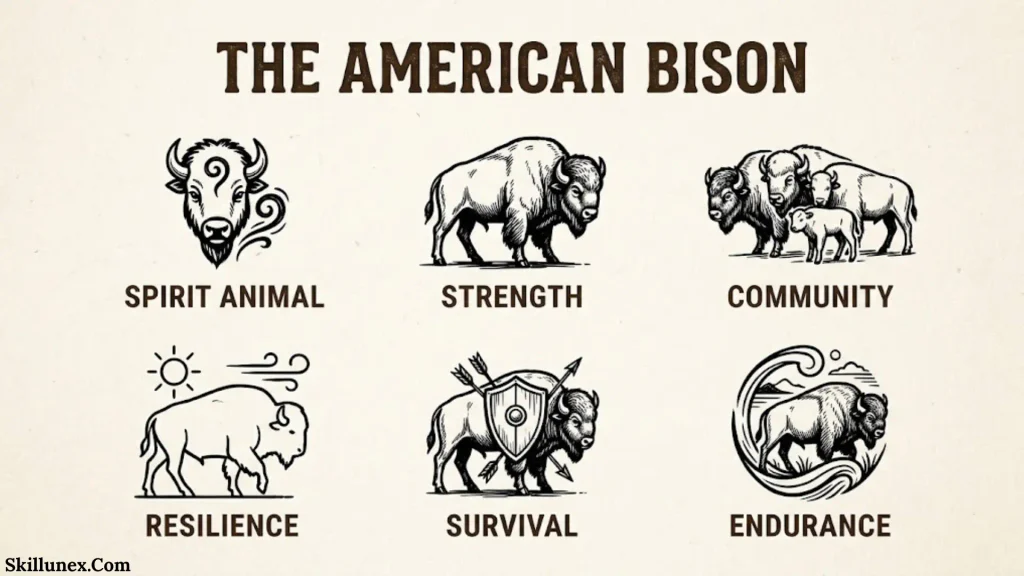
The American bison is the national mammal of the United States. It received this official designation in 2016.
Bison once roamed across enormous areas of North America and played an important role in the lives and cultures of many Indigenous peoples.
During the 19th century, their populations declined dramatically because of widespread hunting and habitat changes.
Conservation efforts later helped restore bison populations in protected areas and national parks.
Today, the American bison represents wildlife conservation, the natural heritage of the United States, and the importance of protecting native species.
The U.S. Capitol Building
The United States Capitol Building is one of the most important government landmarks in the country.
Located on Capitol Hill in Washington, D.C., it serves as the meeting place of the United States Congress, which consists of the Senate and the House of Representatives.
The building represents representative government, lawmaking, and the constitutional system of the United States.
Its recognizable dome has become an important feature of the American capital’s skyline.
The Capitol is also closely associated with major historical events, presidential inaugurations, and national political ceremonies.
Mount Rushmore
Mount Rushmore is a famous American monument located in the Black Hills of South Dakota.
It features the carved faces of four U.S. presidents:
- George Washington
- Thomas Jefferson
- Theodore Roosevelt
- Abraham Lincoln
Sculptor Gutzon Borglum led the project, which was completed in 1941.
Each president was selected to represent a particular aspect of American history, including the founding of the country, territorial expansion, national development, and the preservation of the Union.
Mount Rushmore is a popular tourist destination and a recognizable symbol of American presidential history.
Its location in the Black Hills also makes it important to understand the region’s Indigenous history and the ongoing significance of the land to Native American communities.
The American National Motto: In God We Trust
“In God We Trust” is the official national motto of the United States.
The phrase first appeared on American coins during the Civil War era. It became the official national motto through a law passed in 1956.
The motto appears on U.S. currency and is associated with the country’s historical religious and cultural traditions.
It is also a subject of public discussion because Americans hold different religious and philosophical beliefs.
As a national motto, it is an important part of the country’s official symbolism and historical identity.
The Liberty Tree
The Liberty Tree was an important symbol of resistance during the American colonial period.
In the years leading up to the American Revolution, colonists gathered around large trees to protest British policies and discuss independence.
One famous Liberty Tree stood in Boston, Massachusetts, and became a meeting place for people opposing British taxation and government measures.
The tree represented resistance, political freedom, and the desire for self-government.
Although the original Boston Liberty Tree no longer exists, its historical significance remains part of the story of the American Revolution.
The American Rose
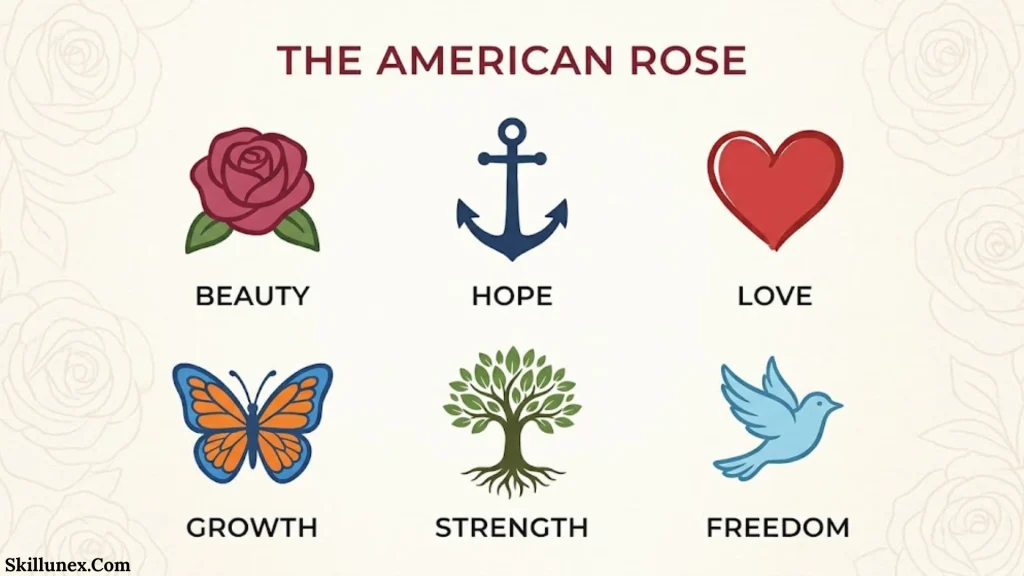
The rose is the national floral emblem of the United States.
It was officially designated as the national flower in 1986.
Roses are widely associated with beauty, love, honor, and appreciation. They also have a long history in American gardens, public celebrations, and cultural traditions.
The flower comes in many colors and varieties, making it a familiar part of American landscapes and decorative traditions.
Its national designation adds another dimension to the country’s collection of recognizable symbols.
The Oak Tree
The oak tree is another important natural symbol associated with American history and heritage.
Oak trees are found throughout many parts of the United States and are known for their strength, longevity, and ecological importance.
They provide food and shelter for wildlife, contribute to healthy ecosystems, and are commonly found in parks, forests, and residential landscapes.
Although the oak is not the official national tree of the United States, it is widely used in American cultural imagery to represent strength, stability, and endurance.
The Liberty Pole
Liberty poles were tall wooden structures erected by American colonists during protests against British rule.
They became popular meeting points for supporters of independence and political resistance.
A liberty pole was sometimes decorated with flags, banners, or other symbols representing opposition to British authority.
These structures played an important role in the political atmosphere leading up to the American Revolution.
Today, the liberty pole represents the early struggle for independence, freedom of expression, and resistance to colonial control.
The Mayflower
The Mayflower was the English ship that transported a group of English settlers, commonly known as the Pilgrims, to North America in 1620.
The passengers arrived at what is now Plymouth, Massachusetts, and established one of the earliest permanent English settlements in New England.
The ship became an important symbol in traditional American historical narratives about early European settlement.
It is also associated with the Mayflower Compact, an agreement signed by male passengers before establishing their settlement.
The Mayflower represents migration, early colonial history, and the development of English settlements in North America. It is important to distinguish this history from the much longer histories of Indigenous peoples who already inhabited the continent.
The Liberty Torch
The liberty torch is a recurring image in American patriotic artwork and national symbolism.
Its meaning is closely associated with the torch held by the Statue of Liberty.
A torch traditionally represents enlightenment, knowledge, guidance, and the spread of freedom.
In American cultural imagery, it is frequently used to express the importance of liberty, democratic ideals, and hope for future generations.
The torch is particularly recognizable because of its connection to one of the country’s most famous monuments.
The American Flag Eagle Emblem
The eagle emblem is one of the most frequently used images in American national and military designs.
It commonly features the bald eagle with outstretched wings, sometimes holding arrows, an olive branch, or a shield.
The emblem appears on government insignia, military decorations, official seals, and various patriotic designs.
Its appearance is inspired by the bald eagle featured on the Great Seal of the United States.
It represents national strength, sovereignty, freedom, and the country’s ability to protect its independence.
Official American Symbols and Their Meanings
Not all famous American symbols have the same legal status. Some are officially recognized national emblems, while others are important historical landmarks or cultural representations.
The following table highlights several official national symbols and their designations.
| Official Symbol | National Designation | Meaning or Association |
| American Flag | National flag | Unity and independence |
| Bald Eagle | National bird | Freedom and strength |
| American Bison | National mammal | Natural heritage |
| Rose | National floral emblem | Beauty and honor |
| Great Seal | Official national seal | Government authority |
| Star-Spangled Banner | National anthem | Patriotism and resilience |
| In God We Trust | National motto | Historical religious heritage |
This distinction is important when researching American national symbols. For example, the White House, Mount Rushmore, and Statue of Liberty are nationally significant landmarks, but they are not all official national emblems in the same way as the national flag or national bird.
What Do the Colors of the American Flag Represent?
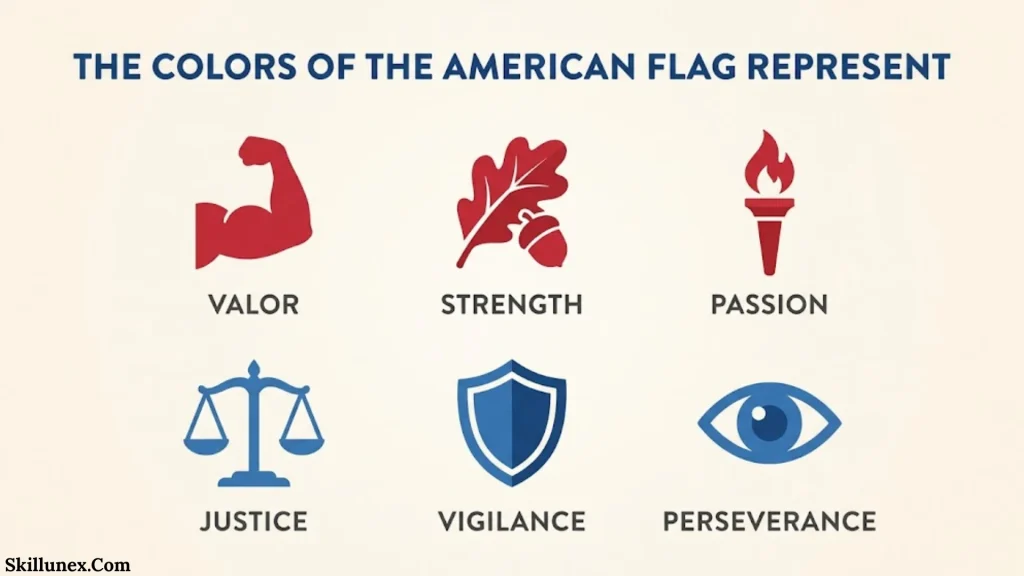
The American flag contains three main colors: red, white, and blue.
These colors are deeply associated with American national identity and appear in countless patriotic decorations, government emblems, and public celebrations.
The traditional explanations of the colors are:
- Red: Traditionally associated with valor and courage.
- White: Traditionally associated with purity and innocence.
- Blue: Traditionally associated with vigilance, perseverance, and justice.
These descriptions come from the symbolism associated with the colors of the Great Seal and are commonly used to explain the flag’s colors.
The flag itself has no separate official statutory definition assigning these meanings to each color.
Its overall design, however, has a clear historical connection to the country’s founding. The 13 stripes represent the original colonies, and the 50 stars represent the states.
Why Are American Symbols Important?
American symbols are important because they help preserve national history, communicate shared ideals, and create recognizable connections between different generations.
Their importance can be understood through several major areas.
Preserving American History
Many American symbols are directly connected to important historical events.
For example, the Liberty Bell is associated with independence and later movements for freedom, while the Star-Spangled Banner reflects the country’s experience during the War of 1812.
These symbols help students, researchers, and visitors understand important moments in American history.
Representing Freedom and Independence
Freedom and independence are central themes in many American symbols.
The Statue of Liberty, Liberty Bell, and American flag are frequently associated with these ideals.
They remind people of the American Revolution, the country’s founding documents, and the continuing historical discussions surrounding liberty and equality.
Creating National Identity
National symbols help create a recognizable identity for a country.
The American flag, bald eagle, and Great Seal appear in government institutions, public ceremonies, and official communications.
They provide visual representations of the United States and its institutions.
Celebrating Cultural Traditions
American symbols are regularly featured during national holidays, sporting events, military ceremonies, and cultural celebrations.
For example, flags, patriotic music, and images of the bald eagle are commonly seen during Independence Day celebrations on July 4.
These traditions help connect historical symbolism with modern American culture.
Educating Future Generations
American symbols are frequently taught in schools and educational institutions.
Students learn about the American flag, national anthem, historical landmarks, and important national emblems as part of their history and civics education.
Learning about these symbols encourages a better understanding of the country’s founding, government, and cultural development.
Where Can You See American Symbols?
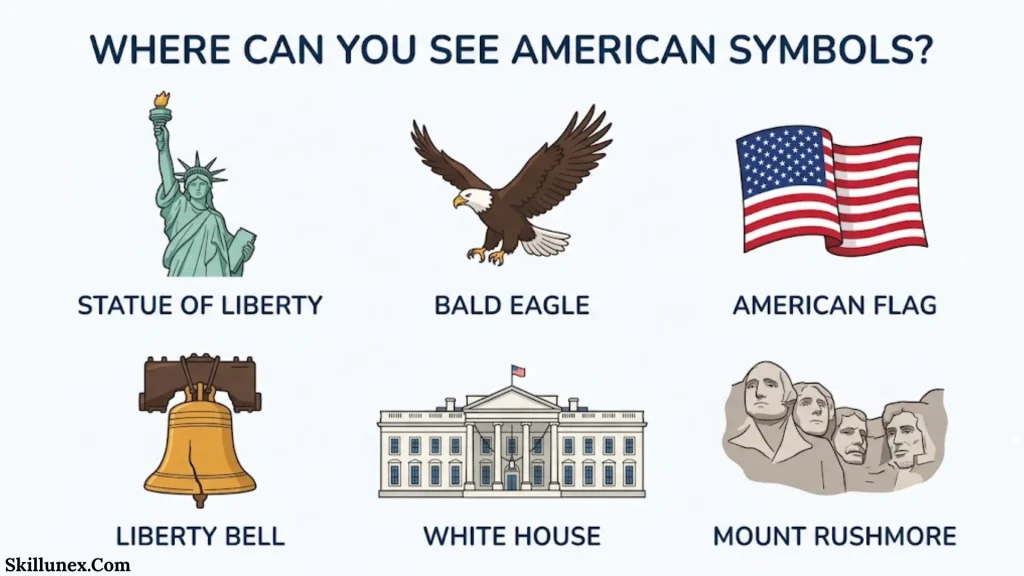
American symbols are visible throughout the United States and in many places around the world.
They appear in different settings, including government institutions, historical attractions, museums, public celebrations, and educational materials.
Government Buildings
The American flag and Great Seal are commonly displayed at federal government buildings, military installations, embassies, and other official institutions.
The U.S. Capitol and White House are also important landmarks associated with the American government.
Historical Monuments
Many American symbols can be found at famous historical locations.
Some notable examples include:
- Statue of Liberty in New York Harbor.
- Liberty Bell in Philadelphia, Pennsylvania.
- Washington Monument in Washington, D.C.
- Mount Rushmore in South Dakota.
- Independence Hall in Philadelphia, Pennsylvania.
These locations attract visitors interested in American history and national heritage.
Schools and Universities
American symbols are commonly used in educational settings.
Students may learn about the national flag, bald eagle, national anthem, and founding documents through history lessons, classroom displays, and civic education programs.
National Holidays and Celebrations
American symbols are especially visible during national celebrations.
Independence Day, Memorial Day, Veterans Day, and other public observances often feature American flags, patriotic music, military ceremonies, and historical imagery.
Currency and Official Documents
The Great Seal, bald eagle, and other national imagery appear on American currency, government publications, and official materials.
These designs help represent the authority and identity of the United States.
Frequently Asked Questions About Symbols for America
What is the most recognized symbol of America?
The American flag is generally considered the most recognizable national symbol of the United States. Its 50 stars represent the 50 states, while its 13 stripes represent the original 13 colonies. It is widely associated with independence, unity, and national identity.
What animal represents America?
The bald eagle is the national bird and national animal of the United States. It represents strength, freedom, and independence. The American bison is also an important national animal and was officially designated as the national mammal in 2016.
What flower represents America?
The rose is the official national floral emblem of the United States. It received this designation in 1986 and is commonly associated with beauty, love, and honor.
What are the three main symbols of America?
Three of the most recognizable American symbols are the American flag, the bald eagle, and the Statue of Liberty. The flag represents national unity and independence, the eagle represents strength and freedom, and the Statue of Liberty represents liberty and hope.
What does the Statue of Liberty symbolize?
The Statue of Liberty symbolizes freedom, enlightenment, hope, and opportunity. Its torch represents enlightenment, while the broken chains at its feet represent freedom from oppression.
Why does the American flag have 50 stars and 13 stripes?
The American flag has 50 stars because the United States currently has 50 states. Its 13 stripes represent the original 13 British colonies that declared independence in 1776.
Is Uncle Sam an official symbol of America?
Uncle Sam is a widely recognized cultural personification of the United States and its federal government. He is not an official national emblem in the same sense as the national flag or Great Seal, but he remains an important figure in American popular culture.
What is the national motto of the United States?
The official national motto of the United States is “In God We Trust.” It became the official national motto in 1956 and appears on American currency.
What is the national anthem of America?
The national anthem of the United States is “The Star-Spangled Banner.” Its lyrics were written by Francis Scott Key in 1814 and it became the official national anthem in 1931.
Why is the bald eagle a symbol of America?
The bald eagle was selected for the Great Seal of the United States in 1782 because of its impressive appearance and association with North American wildlife. It represents strength, independence, and freedom.
Conclusion
The symbols for America represent much more than familiar objects, animals, and historical landmarks. They tell the story of the United States, its founding, its government, its cultural traditions, and the ideals that have influenced its development.
From the American flag and bald eagle to the Statue of Liberty and Liberty Bell, each symbol has its own historical background and meaning. Some are official national emblems, while others have become important cultural icons through historical events and public recognition.
Learning about these symbols provides a better understanding of American history, national identity, and cultural heritage. If you are a student, teacher, researcher, traveler, or someone interested in American culture, exploring these 20 famous symbols is a useful way to discover what they represent and why they continue to matter.

Caleb Thornton
I’m Caleb Thornton, a researcher and content writer who loves exploring fascinating subjects and sharing what I learn with readers. My interests include natural places, lakes, symbols, culture, history, and the stories that make ordinary topics more meaningful.
When I write an article, I try to go beyond a basic answer. I look for useful facts, relevant context, and details that can help readers understand the subject more completely.
My purpose is simple: I want every article I contribute to provide genuine value, satisfy the reader’s curiosity, and make discovering new information enjoyable.
## Books by Caleb Thornton
* Symbols & Meanings: Exploring the Signs We See Every Day
* Lakes of the World: Nature, Beauty & Exploration