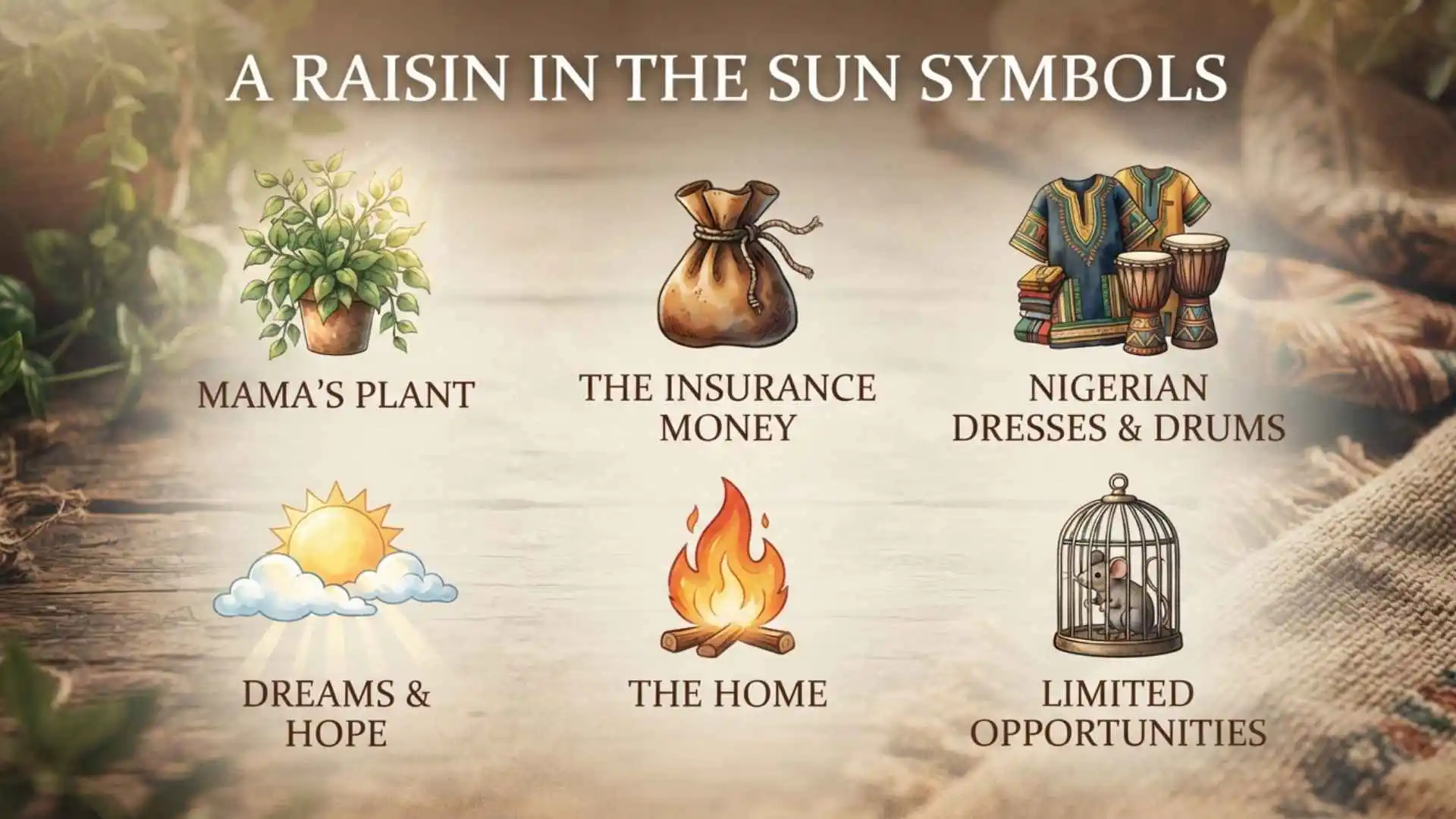
Lorraine Hansberry’s A Raisin in the Sun uses symbolism to explore dreams, family, racism, identity, dignity, poverty, and the American Dream. Objects, images, settings, and character details throughout the play carry meanings that go beyond their literal roles in the story.
The most important A Raisin in the Sun symbols include Mama’s plant, the house, the insurance money, Beneatha’s hair, sunlight, the Younger family’s apartment, African clothing and music, Walter’s liquor-store dream, and the family’s move to Clybourne Park. Together, these symbols show how the Younger family struggles to turn long-delayed dreams into reality.
One of the central ideas behind the play comes from Langston Hughes’s poem “Harlem,” which asks what happens to a dream that is deferred. Hansberry develops that idea through the dreams of Walter, Mama, Beneatha, Ruth, and Travis.
Understanding these symbols is important because they reveal that the play is not simply about a family receiving money and deciding how to spend it. It is about what people are willing to sacrifice for their dreams and how poverty, racism, family responsibilities, and questions of identity can shape those dreams.
A Raisin in the Sun Symbols at a Glance
| Symbol | What It Represents |
| Mama’s plant | Hope, growth, family, and perseverance |
| The house | The American Dream, stability, dignity, and independence |
| Insurance money | Opportunity, sacrifice, and competing dreams |
| The insurance check | The family’s possible future |
| Beneatha’s hair | Cultural identity, independence, and self-discovery |
| African clothing and music | African heritage and cultural pride |
| Sunlight | Growth, hope, and opportunity |
| The apartment | Poverty, confinement, and limited opportunities |
| Walter’s liquor-store dream | Ambition, financial independence, and ideas about success |
| Clybourne Park | Racial barriers and the unequal American Dream |
| The family’s move | Courage, dignity, progress, and resistance |
| Asagai | Beneatha’s connection to African identity and an alternative worldview |
What Does the Title A Raisin in the Sun Symbolize?
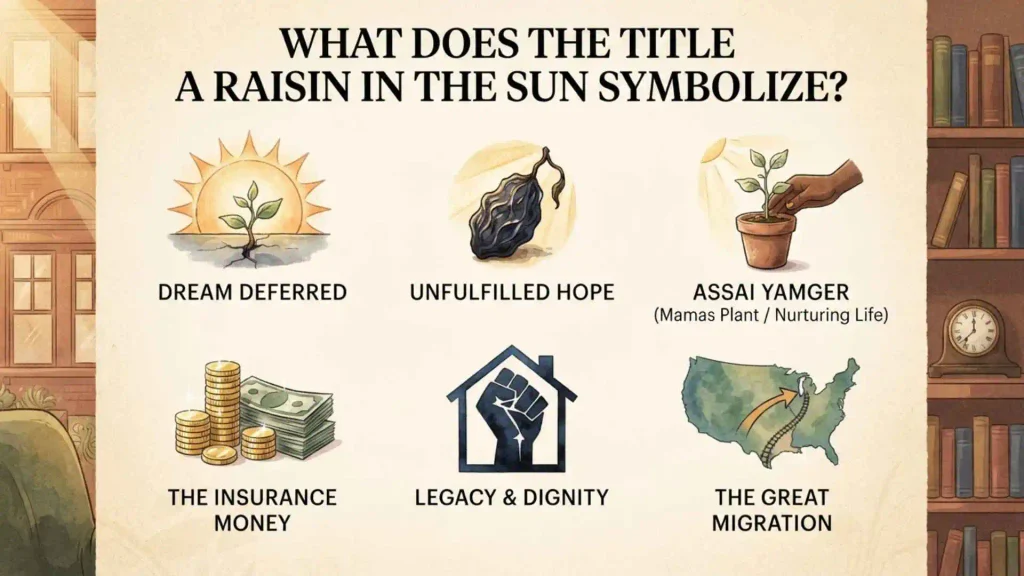
The title A Raisin in the Sun is one of the most important symbolic elements in the play.
The Connection to Langston Hughes’s “Harlem”
Hansberry takes the title from Langston Hughes’s poem “Harlem,” which considers what might happen when a dream is continually postponed.
The poem uses a series of images to explore the consequences of a deferred dream, including the image of something drying in the sun. Hansberry uses this concept as a foundation for the Younger family’s story.
The title therefore points to the central question of the play:
What happens when people are forced to postpone their dreams for too long?
Deferred Dreams in the Younger Family
Every major member of the Younger family has a dream.
Mama wants a home with a yard where her family can live with greater dignity. Walter wants financial success and independence. Beneatha wants an education and a professional future while also searching for her cultural identity. Ruth wants a more comfortable and stable life for her family.
Their dreams have been delayed by poverty, racism, family obligations, and social limitations.
The title therefore symbolizes the emotional and social consequences of deferred dreams.
At the same time, the play does not suggest that every dream must be fulfilled exactly as imagined. Instead, Hansberry shows that people can redefine their dreams while maintaining their dignity and hope.
Mama’s Plant as a Symbol
Mama’s plant is arguably the clearest recurring symbol in A Raisin in the Sun.
What Does Mama’s Plant Represent?
Mama’s plant represents hope, growth, perseverance, family, and the possibility of a better life.
Mama carefully cares for the plant even though it does not receive ideal conditions inside the family’s apartment. This parallels the Younger family’s situation.
The plant is trying to grow in an environment that is not well suited to it. Likewise, the Younger family is trying to build a meaningful future despite poverty and discrimination.
The Plant and Mama’s Character
The plant also reflects Mama herself.
Mama is a nurturing figure who continually tries to protect her family. She encourages her children, worries about their futures, and dreams of providing a better home.
Her relationship with the plant reflects this nurturing instinct.
The plant also connects to Mama’s dream of having a house with a garden. A proper home would give the plant the sunlight and space it lacks in the apartment.
The Plant at the End of the Play
When Mama takes the plant with her as the family prepares to move, the symbol becomes especially powerful.
The plant represents something that has survived difficult conditions. Taking it to the new house suggests that the Younger family’s hope will continue.
The plant therefore becomes a symbol of resilience rather than simple optimism.
The House as a Symbol
The house Mama purchases in Clybourne Park represents one of the family’s greatest dreams.
The House and the American Dream
The house symbolizes stability, independence, security, dignity, and the American Dream.
For Mama, owning a home is not simply about possessing property. It means giving her family a place where they can grow and live with greater comfort.
The house also represents the fulfillment of a dream that Mama and her late husband worked toward for years.
The House and Racism
The meaning of the house becomes more complicated when the Youngers prepare to move into Clybourne Park.
The family discovers that their dream of homeownership exists within a society where racial segregation and discrimination limit where Black families are welcome.
The house therefore represents both:
- the promise of the American Dream, and
- the barriers that prevent that dream from being equally available to everyone.
This makes the house one of the most important symbols for analyzing race and the American Dream in the play.
The House and Family Unity
The house also creates conflict within the family because different characters attach different dreams to the insurance money.
Mama sees the house as a way to protect the family. Walter initially sees the money as an opportunity to become financially successful. Beneatha sees it as a resource that could help fund her education.
The house consequently represents one vision of what the family’s future should look like.
The Insurance Money and Check as Symbols
The insurance money received after the death of Mama’s husband is the central material object around which much of the conflict develops.
What Does the Insurance Money Represent?
The money represents opportunity, sacrifice, loss, responsibility, and competing dreams.
It comes from the death of Mama’s husband, so the money is inseparable from grief and memory.
At the same time, it creates new possibilities for the family.
This combination makes the money symbolically complex: something associated with death becomes the potential source of a new beginning.
The Money and Competing Definitions of Success
The Younger family members do not agree about what should happen to the money.
Walter sees financial investment as a path toward independence. Mama prioritizes a home. Beneatha needs financial support for her education.
These differences reveal that money itself is not the family’s ultimate goal. What matters is what each person believes money can accomplish.
The insurance check therefore symbolizes different definitions of the American Dream.
Beneatha’s Hair as a Symbol
Beneatha’s hair is an important symbol of her developing identity.
What Does Beneatha’s Hair Represent?
Beneatha’s natural hair represents African heritage, cultural pride, independence, self-definition, and resistance to assimilation.
Her changing hairstyle reflects her changing understanding of herself.
Rather than simply following conventional expectations about beauty, Beneatha increasingly embraces a connection to African culture.
Hair and Cultural Identity
Beneatha’s hair becomes part of her larger search for identity.
Her interactions with Joseph Asagai encourage her to think more deeply about her African heritage. Her natural hairstyle becomes a visible expression of that exploration.
The symbolism is especially significant because Beneatha is trying to define herself on her own terms.
Her hair therefore represents the right to decide who she is rather than allowing society to define her identity for her.
African Clothing and Music as Symbols
African clothing and music contribute to Beneatha’s cultural awakening.
African Clothing and Cultural Pride
African clothing symbolizes heritage, cultural connection, pride, and identity.
Beneatha’s interest in African culture challenges the idea that she must distance herself from her ancestry to succeed in American society.
Her clothing becomes a visible expression of a cultural identity she is beginning to reclaim.
Music and Connection to Heritage
African music and dancing also help create a connection between the Younger family and a broader African cultural history.
These elements show that Beneatha’s search for identity is not merely personal. It is connected to questions of history, heritage, colonialism, and the experience of Black Americans searching for cultural roots.
Sunlight as a Symbol
Sunlight appears as an important image throughout the play.
Sunlight and Growth
Sunlight represents growth, hope, possibility, and the conditions necessary for life.
Mama’s plant struggles partly because it does not receive enough sunlight in the apartment.
This creates a parallel between the plant and the Younger family.
A plant needs suitable conditions to grow, and the Younger family needs opportunity and freedom to develop their potential.
Sunlight and the New Home
The new house provides the possibility of better living conditions.
This makes sunlight symbolically connected to the family’s movement from restriction toward greater opportunity.
Sunlight therefore reinforces one of the play’s central ideas: people need more than dreams; they need the opportunity to pursue them.
The Younger Family’s Apartment as a Symbol
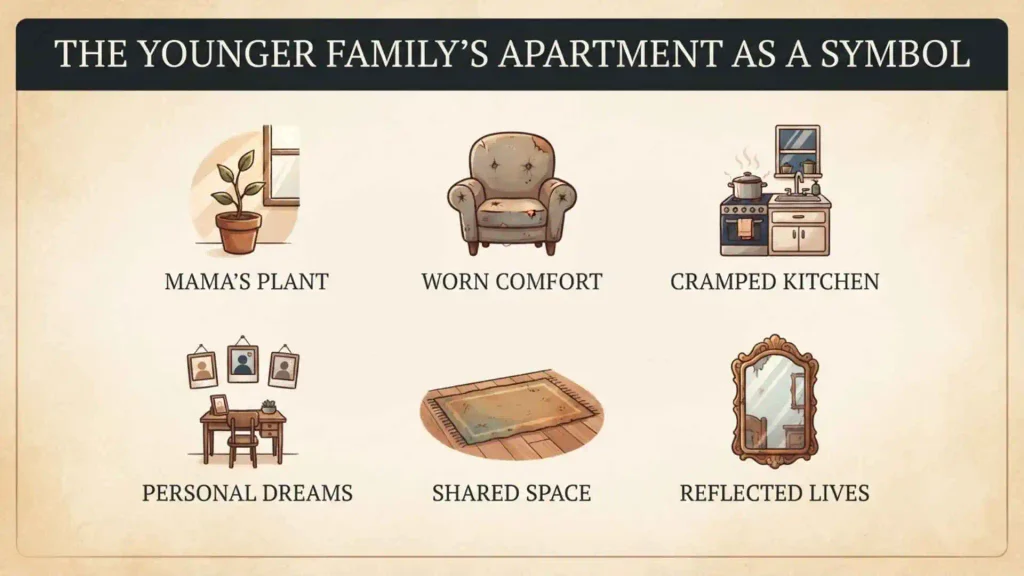
The apartment is more than a setting. It symbolizes the family’s social and economic limitations.
The Apartment and Poverty
The crowded apartment represents poverty, confinement, exhaustion, and restricted opportunity.
Several members of the Younger family must live together in limited space. This lack of privacy contributes to tension and conflict.
The apartment visually represents how difficult it is for the family to move forward.
The Apartment Versus the House
The contrast between the apartment and the new house is crucial.
The apartment represents the family’s past and the restrictions imposed by their economic circumstances.
The house represents the possibility of a different future.
The movement from one space to another therefore becomes a symbolic movement from confinement toward possibility.
Walter’s Liquor-Store Dream as a Symbol
Walter’s plan to invest in a liquor store represents his desire for economic independence.
Walter and Financial Success
Walter believes that owning a business can change his family’s financial situation.
His dream symbolizes ambition, independence, economic mobility, and his desire to control his own future.
However, Walter’s obsession with money also reveals his frustration with feeling powerless.
He wants to be recognized as a provider and believes financial success will give him the respect and authority he feels he lacks.
Walter’s Dream and Masculinity
Walter’s dream is also connected to his understanding of masculinity.
He feels pressure to provide for his family and to become financially successful. When he cannot do so, his frustration affects his relationships with Ruth, Mama, and Beneatha.
His dream therefore represents more than business ambition. It reveals his struggle with identity, pride, responsibility, and social expectations.
Clybourne Park as a Symbol
Clybourne Park represents the racial barriers surrounding the Younger family’s pursuit of a better life.
Clybourne Park and Housing Discrimination
The Youngers’ decision to move into a predominantly white neighborhood brings the reality of racism directly into their lives.
Their house is legally and financially attainable, yet their racial identity makes their move controversial to some residents.
Clybourne Park therefore symbolizes segregation, racial prejudice, exclusion, and the unequal reality of the American Dream.
Clybourne Park and Courage
The family’s willingness to move despite opposition demonstrates their determination not to let prejudice decide their future.
The neighborhood thus becomes a test of the family’s courage and dignity.
The Family’s Move as a Symbol
The decision to leave the apartment and move into the new house is one of the most significant symbolic actions in the play.
Moving Forward
The move represents change, progress, hope, courage, and independence.
The family is physically leaving one environment and entering another, but the move also represents a psychological transformation.
They are refusing to remain trapped by their circumstances.
The Move and Dignity
The Youngers’ decision to continue with the move despite racist pressure demonstrates that dignity is more important than surrendering to fear.
The move therefore becomes a symbol of resistance.
The family does not simply want a house. They want the right to determine where and how they will live.
Asagai as a Symbolic Character
Joseph Asagai is not simply a symbol in the same way that Mama’s plant is. Rather, he functions as a symbolic influence on Beneatha’s understanding of identity and culture.
Asagai and African Identity
Asagai encourages Beneatha to think more deeply about her African heritage.
Through their relationship, Beneatha is exposed to perspectives that challenge her assumptions about American society and identity.
Asagai therefore represents cultural connection, intellectual challenge, African heritage, and an alternative vision of the future.
Asagai and Beneatha’s Transformation
Beneatha’s conversations with Asagai contribute to her changing understanding of herself.
He encourages her to consider her identity beyond American social expectations.
His role is therefore particularly important when analyzing Beneatha’s hair, clothing, education, and cultural identity.
How the Symbols Connect to the Major Themes
The symbols in A Raisin in the Sun are most meaningful when they are connected to the play’s larger themes.
Dreams and Deferred Dreams
The title, plant, house, and insurance money all connect to dreams.
Each family member has a different goal, but their dreams have been delayed by economic hardship and racial discrimination.
Hansberry shows that a dream is not simply a private wish. Social conditions can determine whether a person has a realistic opportunity to achieve it.
The American Dream
The house and insurance money are particularly important symbols of the American Dream.
The Youngers want financial stability, education, homeownership, and independence.
However, the play challenges the assumption that hard work alone guarantees success. Racism and economic inequality create obstacles that cannot be overcome simply through individual effort.
Racism and Inequality
The house, Clybourne Park, and the family’s move reveal how racism affects ordinary decisions such as where a family can live.
Hansberry connects personal dreams to larger social structures.
The Youngers’ struggle demonstrates that racial discrimination can turn a basic goal such as homeownership into a major confrontation.
Family
Mama’s plant and the house symbolize Mama’s commitment to her family.
The insurance money forces the family to confront disagreements, but those disagreements also reveal how deeply each character cares about the family’s future.
The play ultimately asks whether individual dreams can survive without family responsibility.
Identity and Cultural Pride
Beneatha’s hair, African clothing, music, and relationship with Asagai symbolize her search for identity.
Her story demonstrates that achieving an education or professional career is only one part of self-discovery.
She also wants to understand her cultural heritage and decide what kind of person she wants to become.
Dignity and Self-Respect
The family’s decision to move represents their refusal to allow intimidation to determine their future.
The play suggests that success cannot be measured only in dollars.
Maintaining dignity and standing up for one’s family can be just as important as financial achievement.
How Each Major Symbol Connects to a Character
One of the best ways to understand the symbolism is to connect each symbol to the character most closely associated with it.
Mama and the Plant
Mama → plant → nurturing → hope → family resilience
Mama cares for the plant just as she cares for her family. Both need suitable conditions to flourish.
Mama and the House
Mama → house → stability → family security → American Dream
The house represents Mama’s vision of a safer and more dignified future.
Walter and the Money
Walter → insurance money → business → ambition → financial independence
Walter sees money as the means to transform his position and become successful.
Beneatha and Her Hair
Beneatha → natural hair → African heritage → identity → independence
Her hairstyle becomes an outward expression of her changing understanding of herself.
Beneatha and African Culture
Beneatha → African clothing/music → heritage → cultural pride → self-discovery
Her interest in African culture helps her challenge conventional ideas about identity.
The Youngers and Clybourne Park
Youngers → new house → Clybourne Park → racism → dignity
The family’s move demonstrates that the pursuit of a better life can require resistance to discrimination.
How to Analyze Symbolism in an Essay
If you are writing an essay about A Raisin in the Sun symbols, do not stop after identifying what an object represents. Strong literary analysis explains why the symbol matters.
Use the Symbol-Meaning-Theme Method
A useful structure is:
Symbol: Mama’s plant
Literal role: Mama takes care of a small plant in the apartment.
Symbolic meaning: The plant represents hope, growth, and perseverance.
Character connection: Mama’s care for the plant reflects her nurturing personality and her commitment to her family.
Theme: The plant supports the theme of perseverance by showing how life can continue to grow under difficult conditions.
This approach produces a stronger analysis than simply writing, “Mama’s plant symbolizes hope.”
Example of Essay Analysis
A strong interpretation could argue that Hansberry uses Mama’s plant to show that dreams require care and favorable conditions. Although the plant survives in the family’s cramped apartment, it does not have the ideal environment for growth. Similarly, the Younger family possesses dreams and potential but faces economic and racial barriers. When Mama takes the plant with her to the new home, its survival suggests that the family’s hope can continue despite the hardships they have experienced.
This type of analysis connects symbol → character → conflict → theme, making it useful for a literary essay.
Major Symbols vs. Secondary Symbolic Elements
Not every symbolic element in the play has the same importance.
Major Symbols
The most important symbols to focus on in an essay or exam are:
- Mama’s plant
- The house
- The insurance money
- Beneatha’s hair
- The title and sunlight
- The apartment
- Clybourne Park
These symbols connect directly to the play’s central conflicts and themes.
Secondary Symbolic Elements
Other elements can also support analysis:
- African clothing
- African music
- Walter’s liquor-store dream
- the family’s move
- Asagai
- the insurance check
These are useful when discussing specific characters, themes, or scenes.
Frequently Asked Questions About A Raisin in the Sun Symbols
What are the most important symbols in A Raisin in the Sun?
The most important symbols are Mama’s plant, the house, the insurance money, Beneatha’s hair, sunlight, the apartment, and Clybourne Park. They represent hope, growth, dreams, identity, economic opportunity, racism, dignity, and the American Dream.
What does Mama’s plant symbolize in A Raisin in the Sun?
Mama’s plant symbolizes hope, growth, perseverance, and family. Its struggle to survive in the apartment parallels the Younger family’s struggle to build a better life despite difficult circumstances.
What does the house symbolize in A Raisin in the Sun?
The house symbolizes the American Dream, stability, independence, security, and dignity. It also reveals racial inequality because the family’s attempt to move into Clybourne Park exposes them to discrimination.
What does Beneatha’s hair symbolize?
Beneatha’s natural hair symbolizes African heritage, cultural pride, independence, and self-discovery. Her changing hairstyle reflects her growing desire to define her identity for herself.
What does the insurance money symbolize?
The insurance money symbolizes opportunity, sacrifice, loss, and competing dreams. Different members of the Younger family see the money as a way to achieve different versions of a better future.
What does the title A Raisin in the Sun symbolize?
The title symbolizes a deferred dream. It comes from Langston Hughes’s poem “Harlem” and connects to the Younger family’s struggle with dreams that have been delayed by poverty, racism, and social limitations.
What does sunlight symbolize in A Raisin in the Sun?
Sunlight symbolizes growth, hope, opportunity, and the conditions necessary for a person or family to flourish. Its connection to Mama’s plant reinforces the idea that dreams need favorable conditions to survive.
What does the apartment symbolize?
The apartment symbolizes poverty, confinement, overcrowding, and limited opportunity. Its contrast with the new house emphasizes the family’s desire to escape economic and social restrictions.
What does Clybourne Park symbolize?
Clybourne Park symbolizes racial discrimination and the barriers Black Americans faced in pursuing housing and economic opportunities. It also becomes a test of the Youngers’ courage and dignity.
What does Walter’s liquor-store dream symbolize?
Walter’s liquor-store dream symbolizes ambition, financial independence, economic mobility, and his desire to prove himself as a successful provider. It also reveals his complicated ideas about masculinity and success.
How do the symbols in the play connect to the American Dream?
The symbols show that the American Dream means different things to different people. The house represents stability, Walter’s business represents financial success, Beneatha’s education represents professional opportunity, and the family’s move represents independence and dignity.
Which symbol is best to use in an essay about hope?
Mama’s plant is one of the strongest symbols for an essay about hope. Its ability to survive despite poor conditions mirrors the Younger family’s determination to keep pursuing a better future.
Which symbol is best for an essay about racism?
The house and Clybourne Park are especially useful for an essay about racism. They show how racial discrimination can interfere with homeownership, economic opportunity, and the pursuit of the American Dream.
Which symbol is best for an essay about identity?
Beneatha’s hair, African clothing, African music, and Asagai are strong choices for an essay about identity. Together, they show Beneatha’s developing connection to her African heritage and her desire for self-definition.
Conclusion
The symbols in A Raisin in the Sun give deeper meaning to the Younger family’s struggles. Mama’s plant represents hope and resilience, the house represents the American Dream and family stability, the insurance money represents competing visions of success, and Beneatha’s hair represents cultural identity and self-discovery.
The apartment and Clybourne Park show the restrictions created by poverty and racism, while sunlight and the family’s move point toward growth and possibility.
Most importantly, Hansberry’s symbolism shows that dreams are shaped by the conditions in which people live. Walter, Mama, Beneatha, and Ruth all want better lives, but they do not define success in exactly the same way. Their conflicts demonstrate that achieving a dream involves more than money; it can involve identity, family, dignity, cultural heritage, and the courage to resist discrimination.
The symbols ultimately reinforce the central idea suggested by the title: when dreams are delayed, they can suffer, change, or become sources of conflict—but the determination to pursue a better future can keep those dreams alive.

I’m Adrian Holloway, a writer and researcher who enjoys exploring the stories, meanings, and interesting facts behind the subjects people search for every day. I’m especially interested in symbols, nature, lakes, places, and cultural topics that help readers understand the world from a different perspective.
I believe useful content should be simple, accurate, and enjoyable to read. When I research a topic, I focus on finding meaningful details and presenting them in a way that makes information easy to understand.
My goal is to create helpful articles that answer real questions while encouraging readers to discover something new with every visit.
Books by Adrian Holloway
The Language of Symbols: Meanings, Stories & Traditions
Hidden Wonders of Nature: Lakes, Landscapes & Discovery