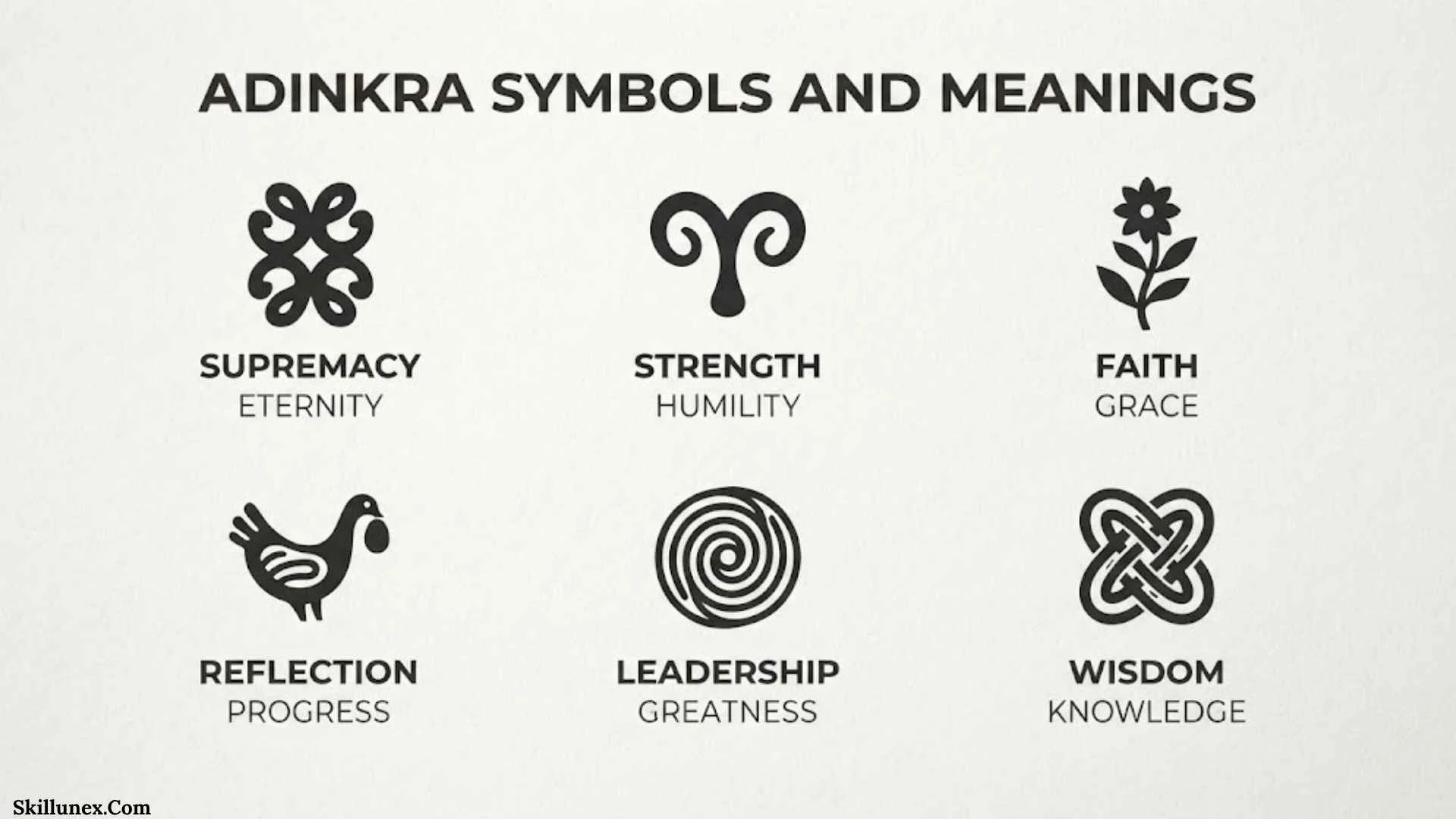
Adinkra symbols are meaningful visual designs traditionally associated with Akan culture in Ghana and Côte d’Ivoire. Each symbol can communicate an idea, value, proverb, belief, or lesson about life. If you are searching for an adinkra symbols and meanings PDF, you may be looking for more than a simple collection of images you may want clear explanations of the symbols, their meanings, cultural background, and traditional uses.
In this guide, you will discover commonly known Adinkra symbols and what they represent. Whether you are a student researching African culture, a teacher preparing classroom material, a designer exploring symbolic art, or someone looking for an Adinkra reference, this article provides an easy-to-follow overview while keeping the cultural context of these symbols in view.
What Are Adinkra Symbols?
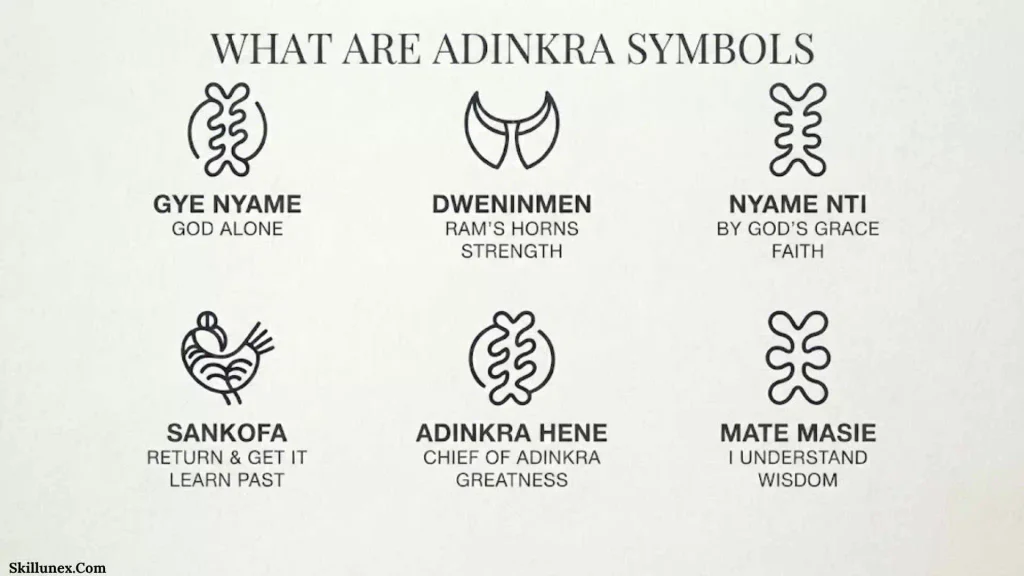
Adinkra symbols are visual representations associated particularly with Akan cultural traditions. They are used to communicate concepts, values, wisdom, proverbs, and philosophical ideas through symbolic designs.
Adinkra is especially well known for its connection with textiles. Traditional Adinkra cloth can feature repeated symbols printed onto fabric using carved stamps and dye. Over time, these symbols have also appeared in artwork, architecture, jewelry, education, clothing, and contemporary design.
Why Do Adinkra Symbols Have Meanings?
Adinkra symbols are not simply decorative patterns. Their designs are connected with particular ideas and cultural concepts.
For example, one symbol may represent wisdom, while another may communicate patience, leadership, spiritual faith, protection, or learning from the past. Understanding the meaning behind the design gives the symbol greater cultural significance.
Where Did Adinkra Symbols Come From?
Adinkra symbolism is strongly connected with Akan traditions in West Africa, particularly Ghana and Côte d’Ivoire. The symbols developed within a cultural environment where proverbs, oral traditions, art, and visual communication played important roles.
Different historical accounts describe the development and transmission of Adinkra traditions, so individual sources may provide different details about their origins and historical development.
Adinkra Symbols and Meanings PDF: Common Symbols
A useful adinkra symbols and meanings PDF normally identifies each symbol by name and explains the concept associated with it. Here are several widely recognized examples.
Gye Nyame
Meaning: Except for God; the supremacy of God.
Gye Nyame is one of the most recognizable Adinkra symbols. Its meaning expresses the supremacy and uniqueness of God.
The symbol is commonly associated with faith, spirituality, and the belief that nothing compares with divine power.
Sankofa
Meaning: Return and retrieve what has been forgotten.
Sankofa is associated with learning from the past. Its message encourages people to look back, recover something valuable that was forgotten, and use that knowledge while moving forward.
This makes Sankofa particularly relevant to education, history, cultural preservation, and personal growth.
Adinkrahene
Meaning: Leadership, authority, and greatness.
Adinkrahene is associated with leadership and authority. Its design consists of concentric forms and is commonly discussed as a symbol connected with leadership among Adinkra symbols.
It can represent the qualities and responsibilities associated with guiding others.
Dwennimmen
Meaning: Humility and strength.
Dwennimmen is inspired by the horns of a ram. The symbol combines the ideas of strength and humility.
Its message can be understood as a reminder that true strength does not necessarily require arrogance.
Nyame Dua
Meaning: God’s tree; divine presence and protection.
Nyame Dua is associated with a sacred tree or altar and has spiritual significance.
The symbol can communicate ideas of divine protection, reverence, and the presence of God.
Nyame Nti
Meaning: By God’s grace.
Nyame Nti is associated with faith and gratitude. It expresses dependence on divine grace and recognition of God’s role in life.
Wawa Aba
Meaning: Endurance, toughness, and perseverance.
Wawa Aba is associated with the seed of the wawa tree. It represents qualities such as toughness, endurance, and the ability to withstand difficulties.
Aya
Meaning: Endurance, resourcefulness, and independence.
Aya is represented by a fern and is associated with resilience. The ability of the fern to grow in challenging conditions provides a connection to endurance and adaptability.
Akoben
Meaning: Vigilance and readiness.
Akoben represents a war horn and is associated with alertness, preparedness, and vigilance.
Its message can remind people to remain attentive and ready to respond when circumstances require action.
Akoma
Meaning: Patience, tolerance, and understanding.
Akoma represents the heart and is associated with qualities such as patience, tolerance, goodwill, and understanding.
It is particularly relevant when discussing relationships, emotional balance, and peaceful interaction.
Adinkra Symbols and Meanings Chart
A simple chart can make an Adinkra reference easier to study or convert into a PDF.
| Symbol | Common Meaning | Associated Idea |
| Gye Nyame | Except for God | Divine supremacy |
| Sankofa | Return and retrieve | Learning from the past |
| Adinkrahene | Leadership | Authority and greatness |
| Dwennimmen | Humility and strength | Balanced strength |
| Nyame Dua | God’s tree | Spiritual protection |
| Nyame Nti | By God’s grace | Faith and gratitude |
| Wawa Aba | Endurance | Toughness and perseverance |
| Aya | Fern | Resilience and independence |
| Akoben | War horn | Vigilance and readiness |
| Akoma | Heart | Patience and tolerance |
Meanings may be worded differently in different references. A concise English definition should therefore be understood as a general explanation rather than the only possible translation or interpretation.
Adinkra Symbols for Strength and Resilience
Many people search for Adinkra symbols because they want designs representing strength, courage, perseverance, or resilience.
Wawa Aba
Wawa Aba is connected with toughness and endurance. It can represent the ability to remain strong during difficult circumstances.
Aya
Aya represents endurance and resourcefulness. Its connection with the fern makes it a useful symbol when discussing survival and adaptability.
Dwennimmen
Dwennimmen combines strength with humility. It can communicate the idea that physical or personal strength can coexist with modesty.
Eban
Eban is associated with a fence and commonly represents safety, security, and protection. Its meaning can also be connected with creating boundaries around what is valuable.
Adinkra Symbols for Wisdom and Knowledge
Adinkra symbolism includes several concepts associated with learning, intelligence, understanding, and experience.
Sankofa
Sankofa is one of the clearest examples of a symbol connected with learning from experience. Its central message encourages people to recover useful knowledge from the past.
Nyansapo
Nyansapo is commonly known as the wisdom knot. It is associated with wisdom, intelligence, patience, and thoughtful decision-making.
Mate Masie
Mate Masie is associated with understanding and knowledge. Its commonly explained meaning emphasizes listening, understanding, and retaining what has been learned.
Adinkra Symbols for Peace and Harmony
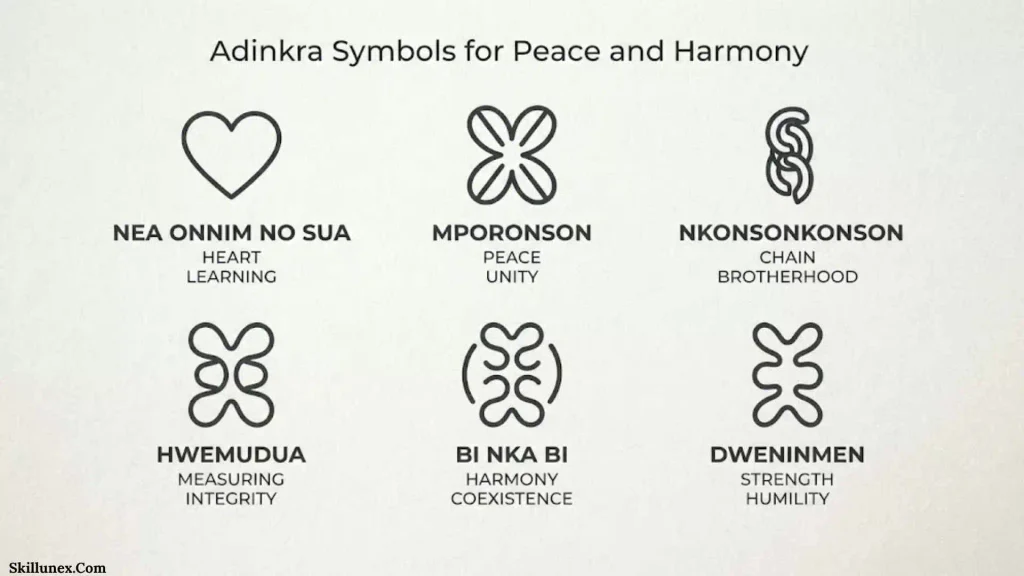
Some Adinkra symbols communicate ideas related to peaceful relationships, reconciliation, tolerance, and cooperation.
Bi Nka Bi
Bi Nka Bi is associated with peace and discourages conflict and harmful behavior between people.
Its message can be understood as an encouragement toward peaceful coexistence.
Mpatapo
Mpatapo is associated with reconciliation and the bond created when people resolve disagreements.
The symbol can therefore be connected with peace, forgiveness, and restoring relationships.
Akoma
Akoma’s association with patience and tolerance also makes it relevant to peaceful relationships.
Adinkra Symbols for Leadership
Leadership is another important theme represented in Adinkra symbolism.
Adinkrahene
Adinkrahene is associated with leadership, authority, and greatness. It is often discussed in relation to responsible guidance.
Ohene Adwa
Ohene Adwa is associated with the king’s stool and concepts of leadership and authority.
The stool has important cultural significance within Akan traditions, making this symbol particularly relevant when discussing governance and leadership.
Akoben
Akoben represents vigilance and preparedness. In a leadership context, these qualities can be connected with remaining alert and prepared to respond to challenges.
Adinkra Symbols for Love and Relationships
Adinkra symbolism does not always correspond directly to modern categories such as romantic love. Many symbols instead represent broader qualities that support healthy relationships.
Akoma
Akoma, meaning heart, can represent patience, tolerance, goodwill, and understanding.
Eban
Eban represents protection and security. In a family context, these ideas can relate to creating a safe and supportive environment.
Mpatapo
Mpatapo represents reconciliation, making it relevant to relationships where forgiveness and restored harmony are important.
Adinkra Symbols and Spirituality
Spiritual ideas are represented by several well-known Adinkra symbols.
Gye Nyame
Gye Nyame communicates the supremacy of God and is strongly associated with spirituality and faith.
Nyame Dua
Nyame Dua is connected with a sacred tree or altar and represents divine presence and protection.
Nyame Nti
Nyame Nti expresses the idea of living by God’s grace and is associated with faith and gratitude.
These symbols should be understood within their cultural and religious context rather than treated simply as generic spiritual icons.
How Adinkra Symbols Are Traditionally Used
Adinkra symbols are strongly associated with cloth and traditional textile production.
Adinkra Cloth
Traditional Adinkra cloth features symbolic designs applied to fabric. Craftspeople historically used carved stamps and dye to create repeated patterns.
Different symbols can appear together, allowing a piece of cloth to communicate multiple concepts.
Modern Uses
Today, Adinkra symbols can also be seen in:
- Clothing
- Jewelry
- Artwork
- Architecture
- Educational materials
- Graphic design
- Logos
- Home décor
- Tattoos
- Cultural exhibitions
Modern use has expanded the visibility of Adinkra symbolism while also making cultural context important when reproducing or adapting these designs.
How to Read an Adinkra Symbol
When using adinkra symbols and meanings PDF, looking at the image alone is not enough. Use three simple steps.
Start With the Name
The traditional name identifies the symbol and may provide an important clue about its meaning.
Study the Design
Look at what the visual form represents. Some symbols draw inspiration from plants, animals, objects, tools, or other recognizable forms.
Understand the Meaning
Finally, consider the concept or proverb associated with the symbol. This is what turns a decorative design into a meaningful cultural symbol.
How to Create an Adinkra Symbols and Meanings PDF
If you are preparing your own PDF for study or educational purposes, organize it so that readers can quickly identify each symbol.
Recommended PDF Structure
For every symbol, include:
- Symbol name
- Clear symbol image
- Common meaning
- Short explanation
- Cultural context
- Related proverb when appropriately sourced
- Source or reference information
A table of contents and alphabetical index can also make a longer PDF easier to navigate.
Why Sources Matter
Different websites and publications may use slightly different English translations or explanations. Providing sources helps readers distinguish established information from simplified interpretations.
It is also important not to present uncertain historical claims as established facts.
What Makes a Useful Adinkra Symbols and Meanings PDF?
Before using an online PDF for research, check its quality.
Clear Symbol Images
The symbols should be easy to recognize and reproduce accurately.
Consistent Names
The same symbol should not be given conflicting names without an explanation.
Meaning and Context
A useful reference should explain more than a single word. Cultural context can make the information much easier to understand.
Reliable References
Educational or research material should identify where its information came from.
Easy Organization
Alphabetical lists, categories, charts, and indexes can make a PDF more useful for students and researchers.
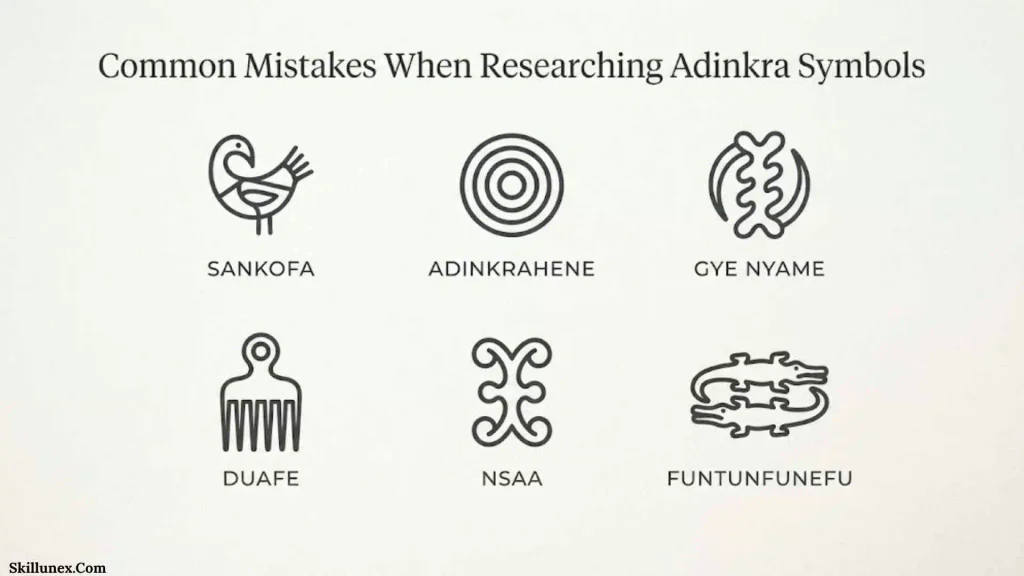
Common Mistakes When Researching Adinkra Symbols
Treating Every African Symbol as Adinkra
Africa contains many different cultures and symbolic traditions. Adinkra should not be used as a general name for every African symbol.
Assuming There Is Only One Translation
English descriptions can vary between sources. Different wording does not necessarily indicate a completely different meaning.
Using Symbols Without Understanding Them
A symbol should not be selected solely because its design looks attractive. Understanding its meaning and cultural background provides greater respect for the tradition.
Confusing Names and Designs
Some symbols can be difficult to distinguish when viewed in low-quality charts. Always compare the name, image, and explanation.
Ignoring Cultural Context
A one-line definition can be useful as a quick reference, but it cannot capture every historical or cultural aspect of an Adinkra symbol.
Adinkra Symbols vs. African Symbols
The terms “Adinkra symbols” and “African symbols” are not interchangeable.
Africa includes an enormous range of cultures, languages, societies, histories, and artistic traditions. Adinkra symbolism specifically belongs to Akan cultural traditions, particularly those associated with Ghana and Côte d’Ivoire.
Keeping this distinction clear helps prevent different African traditions from being incorrectly grouped together.
Frequently Asked Questions About Adinkra Symbols and Meanings PDF
What are Adinkra symbols and meanings PDF?
An Adinkra symbols and meanings PDF is a digital reference containing Adinkra symbols, their names, and explanations of the concepts associated with them. More detailed PDFs may also include cultural background, proverbs, historical information, and references.
How many Adinkra symbols are there?
There is no single universally accepted number that applies to every Adinkra collection. Different references document different groups of symbols, so the number can vary between sources.
What does Gye Nyame mean?
Gye Nyame is commonly translated as “Except for God” and expresses the supremacy or uniqueness of God.
What does Sankofa mean?
Sankofa is associated with returning to retrieve something valuable that has been forgotten. Its broader message encourages learning from the past while moving forward.
What is the most famous Adinkra symbol?
Gye Nyame is among the most widely recognized Adinkra symbols. Its distinctive design and association with the supremacy of God have made it particularly well known.
Can Adinkra symbols be used in modern designs?
Adinkra symbols appear in many contemporary designs, including clothing, artwork, architecture, jewelry, and educational materials. Anyone using them should understand their meanings and cultural context and check any applicable rights concerning the specific source or artwork.
Conclusion
Adinkra symbols provide a fascinating example of how visual designs can communicate cultural values, wisdom, spirituality, and life lessons. Symbols such as Gye Nyame, Sankofa, Aya, Akoma, Dwennimmen, and Nyansapo each connect a visual form with a broader concept. For anyone searching for adinkra symbols and meanings PDF, understanding those concepts is just as important as having a convenient list of names and pictures.
If you are studying Ghanaian culture, preparing educational material, creating artwork, or simply exploring African symbolism, use Adinkra references carefully and with cultural context. A well-organized PDF can make research easier, but the meaning behind each symbol is what gives Adinkra its lasting significance.

I’m Adrian Holloway, a writer and researcher who enjoys exploring the stories, meanings, and interesting facts behind the subjects people search for every day. I’m especially interested in symbols, nature, lakes, places, and cultural topics that help readers understand the world from a different perspective.
I believe useful content should be simple, accurate, and enjoyable to read. When I research a topic, I focus on finding meaningful details and presenting them in a way that makes information easy to understand.
My goal is to create helpful articles that answer real questions while encouraging readers to discover something new with every visit.
Books by Adrian Holloway
The Language of Symbols: Meanings, Stories & Traditions
Hidden Wonders of Nature: Lakes, Landscapes & Discovery