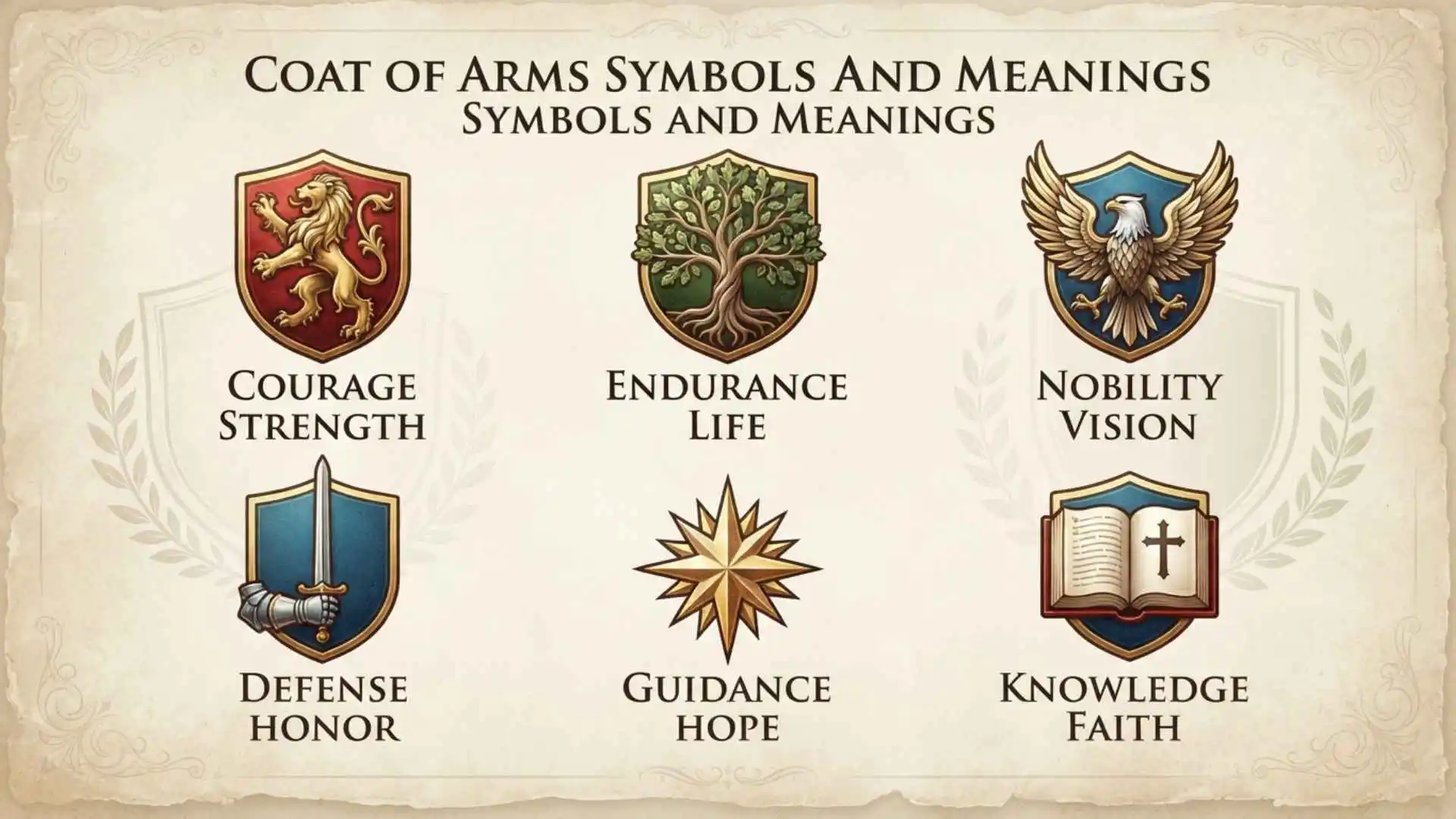
A coat of arms is a distinctive heraldic design used to represent a person, family, institution, city, organization, or other entity. It can contain animals, birds, plants, weapons, buildings, colors, geometric patterns, mythical creatures, and other elements.
If you are looking for a coat of arms symbols and meanings PDF, this guide provides a printable-style reference to the most common heraldic symbols and their traditional associations. It also explains heraldic colors, shield divisions, crests, supporters, mottos, and other parts of a complete coat of arms.
One important point is that heraldic symbolism does not work like a universal dictionary. A lion may traditionally be associated with courage and strength, for example, but a particular lion on a historical coat of arms may have been chosen for a completely different reason. The history of the specific arms is always important.
Coat of Arms Symbols and Meanings PDF
A useful coat of arms reference should make it easy to identify a symbol and understand its commonly associated meaning.
Printable Coat of Arms Symbols Chart
| Symbol | Traditional Meaning | Category |
| Lion | Courage, bravery, strength, nobility | Animal |
| Eagle | Power, leadership, vision, courage | Bird |
| Bear | Strength, protection, bravery | Animal |
| Wolf | Perseverance, loyalty, guardianship | Animal |
| Stag | Peace, harmony, wisdom | Animal |
| Horse | Readiness, speed, strength, loyalty | Animal |
| Boar | Courage and determination | Animal |
| Fox | Cunning, intelligence, adaptability | Animal |
| Dog | Loyalty, faithfulness, vigilance | Animal |
| Falcon | Nobility, determination, leadership | Bird |
| Raven | Wisdom, foresight, and sometimes darker associations | Bird |
| Dove | Peace, purity, hope | Bird |
| Dragon | Courage, strength, protection, valor | Mythical |
| Griffin | Strength, vigilance, courage | Mythical |
| Unicorn | Purity, courage, virtue | Mythical |
| Sword | Justice, defense, military honor | Weapon |
| Spear | Readiness, military service, defense | Weapon |
| Axe | Authority, execution, military strength | Weapon |
| Crown | Sovereignty, rank, authority | Object |
| Key | Authority, guardianship, responsibility | Object |
| Anchor | Hope, stability, steadfastness | Object |
| Ship | Travel, exploration, commerce, maritime identity | Object |
| Castle | Defense, security, strength | Building |
| Tower | Protection, defense, vigilance | Building |
| Tree | Growth, life, endurance | Plant |
| Oak | Strength, endurance | Plant |
| Laurel | Victory, honor, achievement | Plant |
| Rose | Beauty, grace, hope | Flower |
| Lily | Purity and innocence | Flower |
| Fleur-de-lis | Royal, religious, or regional associations | Symbol |
| Wheat | Agriculture, abundance, prosperity | Plant |
| Sun | Glory, vitality, life | Celestial |
| Moon | Illumination, change, serenity | Celestial |
| Star | Guidance, aspiration, excellence | Celestial |
| Cross | Religious, military, or institutional associations | Religious |
| Heart | Love, charity, devotion | Symbol |
| Shell | Pilgrimage or religious associations | Natural |
| Wheel | Industry, movement, or local identity | Object |
| Book | Education, knowledge, learning | Object |
This chart is designed as a quick reference. The traditional association of a symbol should not automatically be treated as the official historical explanation for every coat of arms.
Quick Reference: How to Read the Chart
When examining an unfamiliar coat of arms, first identify the main charge or charges on the shield.
For example:
- A lion may suggest courage or strength.
- An eagle may suggest power or leadership.
- An anchor may suggest hope or stability.
- An oak tree may suggest strength and endurance.
- A sword may suggest defense or justice.
- A crown may suggest authority or rank.
- A castle may suggest protection or defense.
Then look at the colors, position, arrangement, motto, crest, and historical background.
Most Common Animal Symbols in Heraldry
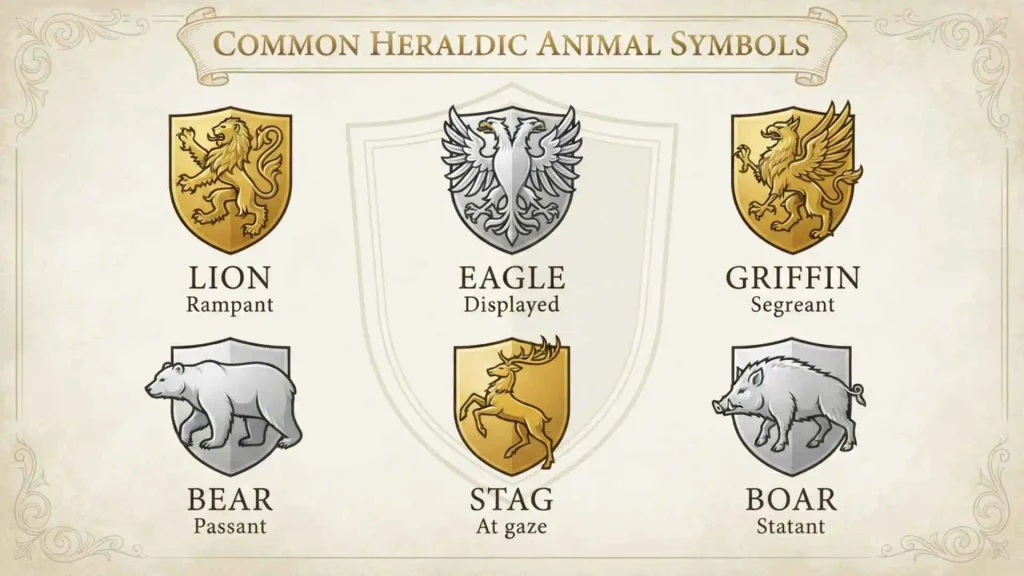
Animals are among the most recognizable elements of heraldic design. They are often chosen because their perceived characteristics can communicate qualities such as courage, loyalty, strength, speed, intelligence, or protection.
Lion
The lion is one of the most familiar animals in European heraldry.
It is traditionally associated with:
- Courage
- Bravery
- Strength
- Nobility
- Leadership
- Authority
The position of a heraldic lion also matters. Heraldry uses specialized terms to describe how an animal is displayed.
A lion standing upright on one hind leg is commonly described as rampant, while a lion walking horizontally may be described as passant, depending on the details of its presentation.
Eagle
The eagle is another major heraldic figure.
It can traditionally represent:
- Power
- Leadership
- Courage
- Vision
- Authority
- Aspiration
Eagles can be displayed in different postures and forms, and details such as the number of heads, wings, crowns, and colors can be significant.
Bear, Wolf, Stag, and Horse
Other frequently encountered heraldic animals include bears, wolves, stags, and horses.
Bear: commonly associated with strength, protection, courage, and determination.
Wolf: may represent perseverance, loyalty, guardianship, or determination.
Stag: traditionally associated with peace, harmony, wisdom, and gentleness.
Horse: can represent speed, readiness, strength, loyalty, travel, or military service.
The actual reason an animal appears on a particular coat of arms may relate to family history, geography, a name, or a historical event rather than its generalized symbolic meaning.
Dragon, Griffin, and Other Mythical Creatures
Heraldry also makes extensive use of mythical creatures.
Dragon: commonly associated with strength, courage, protection, and valor.
Griffin: combines characteristics traditionally associated with the eagle and lion and can represent strength, vigilance, guardianship, and courage.
Unicorn: is often associated with purity, virtue, and courage.
Mythical creatures can be especially important in heraldic designs because their visual characteristics can communicate power and distinctive identity.
Common Objects and Their Heraldic Meanings
Coats of arms can contain many objects that represent occupations, achievements, military service, geographical features, religious beliefs, or historical events.
Sword, Spear, and Weapons
Weapons are common heraldic charges.
A sword can be associated with justice, courage, defense, military honor, and authority.
A spear can suggest military readiness, defense, or service.
An axe may represent authority, strength, execution, or military activity depending on the context.
The exact meaning should be determined from the history of the particular arms whenever possible.
Crown, Helmet, and Key
A crown can indicate sovereignty, rank, authority, royal association, or institutional status.
A helmet is an important component of many complete heraldic achievements. Its style and placement can have heraldic significance.
A key can symbolize authority, guardianship, responsibility, or access.
Keys can also have specific religious or local associations depending on the coat of arms.
Castle, Tower, and Ship
A castle often suggests defense, security, strength, or fortification. It can also represent an actual historical castle or location.
A tower may represent protection, vigilance, defense, and strength.
A ship can be associated with travel, exploration, commerce, naval activity, or a maritime community.
If a building or ship appears on a historical coat of arms, its meaning may be directly connected to a specific place or event.
Plants, Flowers, and Natural Symbols
Plants and flowers add another important category to heraldic symbolism.
Oak, Tree, and Laurel
The oak tree is traditionally associated with strength, endurance, longevity, and resilience.
A general tree can represent life, growth, continuity, and endurance.
Laurel is commonly connected with victory, achievement, honor, and distinction.
These symbols can be particularly meaningful when a coat of arms represents a place with a strong connection to agriculture, forests, or a particular landscape.
Rose, Lily, and Fleur-de-Lis
The rose is often associated with beauty, grace, hope, and honor.
The lily can be associated with purity and innocence.
The fleur-de-lis is one of the most recognizable heraldic designs. It has strong historical associations with French royalty and has also been used by numerous cities, institutions, and families.
Its meaning therefore depends heavily on the particular heraldic tradition and historical context.
Wheat and Other Agricultural Symbols
Wheat can represent agriculture, abundance, prosperity, harvest, and the importance of farming.
Other plants, fruits, grains, and agricultural objects may identify a region’s economy or natural resources.
Heraldic Colors and Their Meanings
Color is an essential part of heraldic design. Traditional heraldry uses specific names for its main tinctures.
| Heraldic Name | Common Appearance | Traditional Associations |
| Or | Gold or yellow | Generosity, elevation, prestige |
| Argent | Silver or white | Peace, purity, sincerity |
| Gules | Red | Courage, valor, strength |
| Azure | Blue | Loyalty, truth, justice |
| Vert | Green | Hope, joy, abundance |
| Sable | Black | Prudence, constancy |
| Purpure | Purple | Dignity, sovereignty, justice |
These are traditional associations, not universal definitions.
Or and Argent
Or represents gold and is commonly shown as yellow or gold in modern artwork. It can traditionally be associated with generosity, elevation, prestige, and wealth.
Argent represents silver and is commonly shown as white or silver. It can be associated with peace, purity, and sincerity.
Gules, Azure, Vert, Sable, and Purpure
Gules is red and can represent courage, valor, and strength.
Azure is blue and can represent loyalty, truth, justice, and perseverance.
Vert is green and can represent hope, joy, abundance, and natural growth.
Sable is black and can represent prudence and constancy, although it can have other contextual associations.
Purpure is purple and can be associated with dignity, sovereignty, and justice.
The Rule of Tincture
Traditional heraldry follows an important design principle commonly called the rule of tincture.
In simple terms, heraldic metals—Or and Argent—are generally distinguished from colors such as Gules, Azure, Vert, and Sable.
This principle helps create strong visual contrast and makes heraldic designs easier to recognize.
As with many heraldic conventions, there are historical exceptions and complexities, so the rule should not be treated as an absolute description of every historical coat of arms.
Parts of a Coat of Arms Explained
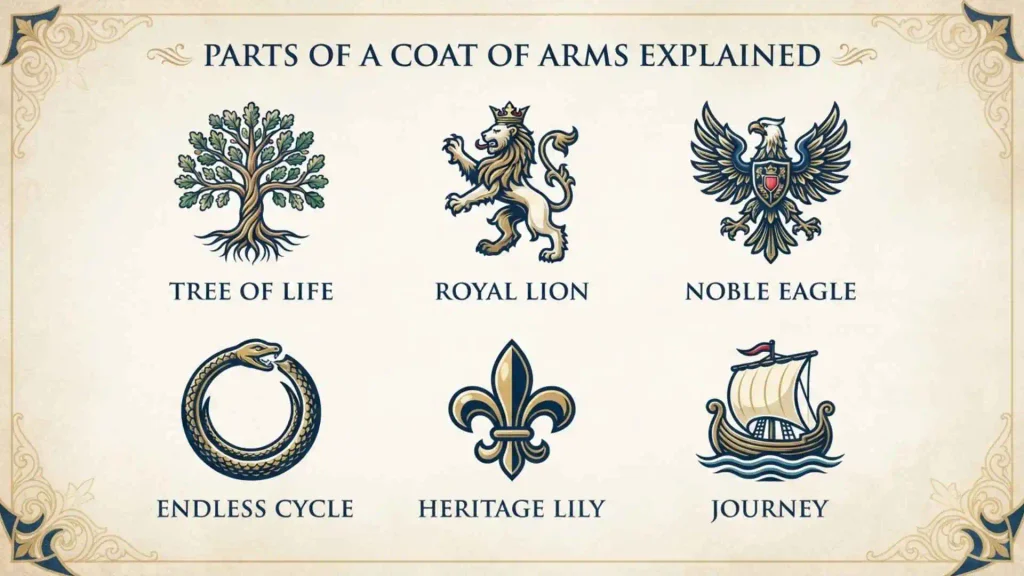
A coat of arms can be much more than a decorated shield. A complete heraldic achievement may contain several separate elements.
Shield, Field, Charges, and Ordinaries
The shield is normally the central part of the design.
The field is the background of the shield.
A charge is a figure or object placed on the field, such as a lion, eagle, rose, sword, or castle.
An ordinary is a conventional geometric form used in heraldry, such as a fess, pale, bend, or chevron.
These terms are useful when describing an actual coat of arms.
Helmet, Crest, and Mantling
The helmet is positioned above the shield in many heraldic achievements.
The crest is placed above the helmet and can feature an animal, plant, object, or mythical creature.
The mantling is the decorative cloth-like material traditionally associated with the helmet. In modern illustrations it often appears as flowing material around the upper part of the arms.
A crest is therefore only one part of a heraldic achievement. It is not technically the entire coat of arms.
Supporters, Motto, and Other Elements
Supporters are figures positioned on either side of the shield. They may be animals, people, mythical creatures, or other figures.
A motto is a phrase associated with the person, family, institution, or organization represented by the arms.
Some complete heraldic achievements may also include:
- Crowns
- Coronets
- Compartments
- Badges
- Orders
- Decorations
- Other heraldic ornaments
Not every coat of arms contains all of these elements.
How to Identify Symbols on a Coat of Arms
If you have an unfamiliar coat of arms, you can analyze it step by step.
Start With the Shield
Begin with the central shield.
Look for:
- Background color
- Shield divisions
- Geometric ordinaries
- Animals
- Birds
- Plants
- Weapons
- Buildings
- Celestial objects
- Other charges
The shield usually contains the primary visual information.
Identify Animals, Objects, and Colors
Once the main elements are identified, determine their heraldic descriptions.
For example, ask:
- Is the animal standing, walking, sitting, or flying?
- Is it facing left or right from the viewer’s perspective?
- Is the object a sword, spear, key, anchor, or another charge?
- What tinctures are present?
- Are there repeated symbols?
- Are the charges arranged symmetrically?
Specialized heraldic vocabulary can help describe these details accurately.
Common animal-position terms include rampant, passant, sejant, statant, salient, regardant, and guardant.
Research the Specific Heraldic History
Generic symbol meanings are only the beginning.
To understand a specific coat of arms, research:
- Who used the arms?
- When were they granted or recorded?
- Which heraldic authority is relevant?
- Where did the person or institution originate?
- Does the symbol refer to a place?
- Does the motto provide historical information?
- Is the design connected to a particular achievement or event?
This is especially important for genealogy and historical research.
Coat of Arms vs. Family Crest
The terms coat of arms and family crest are often confused.
Is a Family Crest the Same as a Coat of Arms?
No.
A crest is one element that can appear above the helmet in a complete heraldic achievement.
A coat of arms refers more broadly to the heraldic arms, particularly the shield and its associated design.
The phrase “family crest” is common in everyday language, but it should not automatically be treated as a technical synonym for a complete coat of arms.
Does Every Family Have a Coat of Arms?
No.
A coat of arms is not automatically assigned to every person who shares a surname.
Historically, heraldic arms are associated with particular individuals, families, institutions, or entities under the rules of the relevant heraldic tradition.
Therefore, finding a coat of arms online with the same surname does not necessarily prove that it belongs to everyone with that surname.
How to Use a Coat of Arms Symbols and Meanings PDF
A printable reference can be useful for education, research, design, and genealogy.
For Students and School Projects
Students can use a coat of arms symbols chart to understand:
- Heraldic animals
- Heraldic colors
- Shield divisions
- Crests
- Charges
- Historical symbolism
- Parts of a heraldic achievement
A one-page symbol chart can also make a useful classroom handout or study sheet.
For Genealogy and Family Research
If you are researching family history, a symbol guide can help you understand the imagery found on historical documents, seals, monuments, and heraldic records.
However, a general symbol chart cannot establish ownership of a specific coat of arms. That requires research into the actual historical record.
For Printing and Reference
A printable coat of arms chart works best when it uses:
- Clear headings
- Large symbol names
- Short meanings
- Categorized tables
- High-resolution illustrations
- Simple explanations
- A note about historical context
You can also save a well-formatted web page as a PDF through your browser’s print function when a dedicated downloadable file is not provided.
Why Coat of Arms Symbols Have Different Meanings
Heraldry developed over long periods and across different countries and traditions.
Symbolic Meaning Is Not Always Historical Meaning
A common mistake is assuming that every symbol has one official definition.
For example, a lion is often associated with courage, but a particular lion may have been included because of:
- A family name
- A place name
- A historical event
- A military achievement
- A political relationship
- A local tradition
- A visual pun
- An inherited heraldic design
The same principle applies to colors and other charges.
Therefore, a general coat of arms symbols and meanings PDF should be viewed as a reference to traditional associations, not as a universal translation key.
Heraldic Context Matters
The position, color, combination, and arrangement of symbols can change how a design is interpreted.
A lion by itself is different from a lion combined with a crown, sword, particular colors, and a historical motto.
The complete design tells the story.
Common Questions About Coat of Arms Symbols
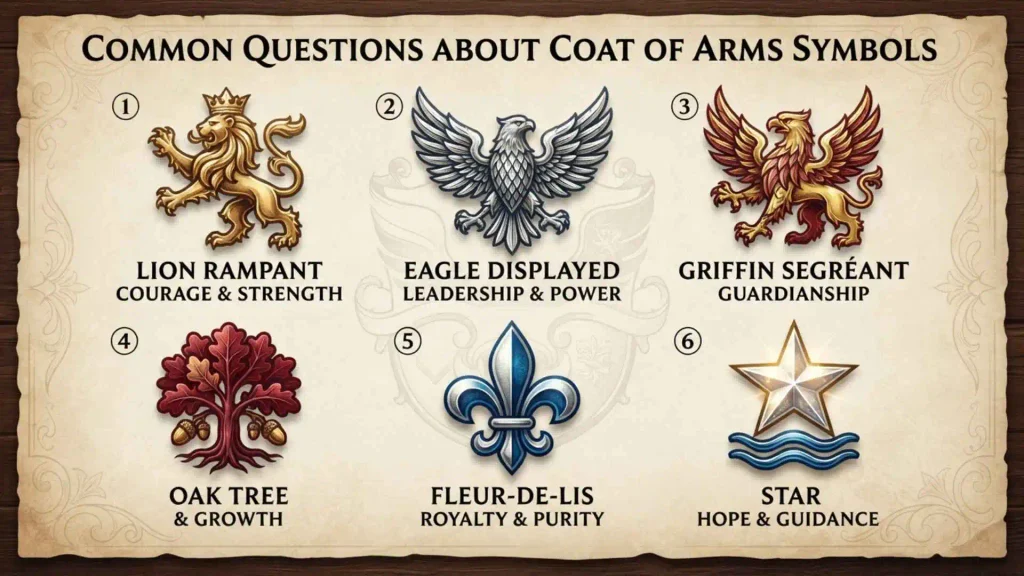
What do the symbols on a coat of arms mean?
Coat of arms symbols can represent qualities such as courage, strength, loyalty, authority, peace, or wisdom. They can also represent specific places, people, historical events, occupations, achievements, or family traditions.
What is the most common heraldic animal?
The lion is one of the most recognizable and frequently encountered animals in European heraldry. It is traditionally associated with courage, bravery, strength, and nobility.
What does a lion symbolize on a coat of arms?
A lion is traditionally associated with courage, bravery, strength, leadership, nobility, and authority. Its precise historical meaning depends on the individual coat of arms.
What does an eagle symbolize in heraldry?
An eagle can traditionally represent power, leadership, courage, vision, authority, and aspiration.
What do colors mean on a coat of arms?
Traditional heraldic colors have commonly associated meanings. For example, Gules is red and is associated with courage and valor, Azure is blue and can represent loyalty and truth, while Vert is green and can represent hope and abundance.
What does a sword symbolize on a coat of arms?
A sword can represent justice, courage, military honor, defense, authority, and readiness.
What does a crown symbolize in heraldry?
A crown can represent sovereignty, rank, authority, royalty, or institutional status. The type of crown can also have specific significance.
What does a castle mean on a coat of arms?
A castle can symbolize defense, protection, security, strength, or fortification. It may also represent a particular castle or location.
What does a rose symbolize in heraldry?
A rose can traditionally be associated with beauty, grace, hope, honor, or other meanings depending on the heraldic context.
What does a fleur-de-lis mean on a coat of arms?
The fleur-de-lis has important historical associations with French royalty and has also been used by cities, institutions, and families in different contexts. Its precise meaning depends on the specific arms.
What does a cross mean on a coat of arms?
A cross may have religious, military, institutional, or historical associations. Different forms of the cross can carry different meanings.
What is the difference between a crest and a coat of arms?
A crest is one element of a heraldic achievement, usually positioned above the helmet. A coat of arms refers more broadly to the heraldic arms and especially the shield design.
Does my surname have a coat of arms?
A surname alone does not establish ownership of a coat of arms. Historical arms were associated with particular people or entities, so determining whether a coat of arms is connected to your family requires genealogical and heraldic research.
Can I use a coat of arms symbols chart to find my family crest?
A symbols chart can help you understand the imagery, but it cannot prove that a particular crest or coat of arms belongs to your family. You need evidence connecting the arms to the relevant individual or family line.
Can I print a coat of arms symbols and meanings PDF?
Yes. A properly formatted reference page can be printed or saved as a PDF using your browser’s print or save-to-PDF function. A dedicated PDF can also be created from the reference chart.
What are the main parts of a coat of arms?
The main elements can include the shield, field, charges, ordinaries, helmet, crest, mantling, supporters, motto, crown or coronet, and compartment. Not every heraldic achievement contains every element.
What are the traditional heraldic metals?
The two principal heraldic metals are Or, representing gold, and Argent, representing silver.
What are the traditional heraldic colors?
Common heraldic colors include Gules (red), Azure (blue), Vert (green), Sable (black), and Purpure (purple).
What is the rule of tincture?
The rule of tincture is a traditional heraldic design principle concerning the placement and contrast of metals and colors. It generally helps maintain clear visual contrast between elements.
Conclusion
Coat of arms designs use a rich visual language made up of animals, birds, plants, weapons, buildings, colors, celestial objects, mythical creatures, and geometric forms. Traditional associations can help you understand what these symbols may communicate, but the historical background of a particular coat of arms is always more important than a generic symbol dictionary.
A lion may suggest courage, an eagle may suggest power, an anchor may suggest hope, an oak may suggest strength, and a sword may suggest justice or defense. Heraldic colors such as Gules, Azure, Vert, Sable, Or, and Argent add another layer of meaning and help distinguish different designs.
For anyone searching for a coat of arms symbols and meanings PDF, the most useful reference is one that combines a quick symbol chart with explanations of heraldic terminology, colors, shield components, animal positions, and historical context.
Whether you are studying heraldry, preparing a school project, researching genealogy, designing a historical presentation, or simply trying to understand an old coat of arms, learning how to identify each element can reveal much more than the individual symbols alone.

Caleb Thornton
I’m Caleb Thornton, a researcher and content writer who loves exploring fascinating subjects and sharing what I learn with readers. My interests include natural places, lakes, symbols, culture, history, and the stories that make ordinary topics more meaningful.
When I write an article, I try to go beyond a basic answer. I look for useful facts, relevant context, and details that can help readers understand the subject more completely.
My purpose is simple: I want every article I contribute to provide genuine value, satisfy the reader’s curiosity, and make discovering new information enjoyable.
## Books by Caleb Thornton
* Symbols & Meanings: Exploring the Signs We See Every Day
* Lakes of the World: Nature, Beauty & Exploration