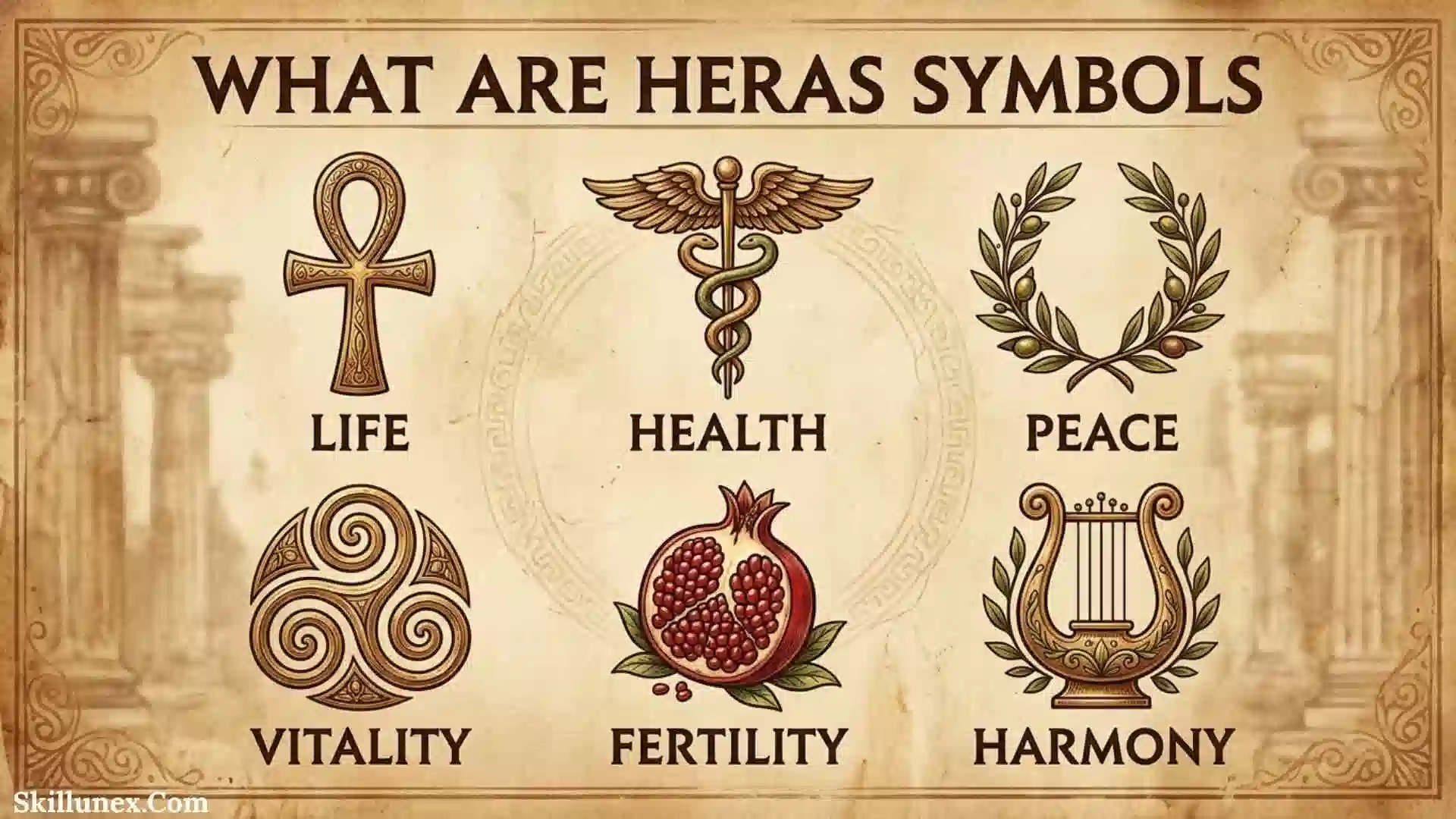
Hera is one of the most important goddesses in Greek mythology and is best known as the queen of the gods and goddess of marriage. But what are Hera’s symbols? Her most famous symbols include the peacock, cow, diadem or crown, and scepter. Other objects and images, including the pomegranate and bridal veil, can also be associated with her, especially through her connection with marriage, fertility, and womanhood.
These symbols were more than decorative details. In ancient Greek art and mythology, animals, objects, and clothing could communicate a god’s identity, powers, and social position. Hera’s symbols emphasize her beauty, queenship, authority, marriage, fertility, and connection with women.
What Are Hera’s Symbols?
The most important symbols associated with Hera are the peacock, cow, diadem, and scepter. The pomegranate and veil are also useful symbols when discussing her connection with marriage and fertility, although they are not as distinctive to Hera as the peacock.
| Hera’s Symbol | Meaning or Association |
| Peacock | Beauty, majesty, royalty, pride, and watchfulness |
| Cow | Fertility, motherhood, nourishment, and abundance |
| Diadem or crown | Queenship, dignity, authority, and divine status |
| Scepter | Power, rulership, and royal authority |
| Pomegranate | Fertility, marriage, abundance, and family |
| Veil | Marriage, brides, and womanhood |
| Floral imagery | Beauty, fertility, and femininity |
The peacock is Hera’s most recognizable symbol, while the cow, diadem, and scepter are also strongly connected with her identity.
Hera’s Primary Symbols
When identifying Hera in Greek mythology and ancient art, the safest symbols to remember are the peacock, cow, diadem, and scepter.
The peacock identifies her through its connection with her sacred bird and the mythology surrounding Argus. The cow reflects traditional descriptions of Hera and ancient associations with fertility and nourishment. Her diadem and scepter communicate her position as queen and her divine authority.
Symbols That Are More General
Some symbols associated with Hera are not exclusive to her. The pomegranate, for example, is also strongly connected with Persephone. Similarly, flowers and lions can have broader meanings in Greek and Mediterranean art.
This distinction matters because modern lists of “Hera symbols” sometimes present every possible association as though it were an equally important ancient attribute. The evidence and significance of these symbols are not always the same.
Who Was Hera in Greek Mythology?
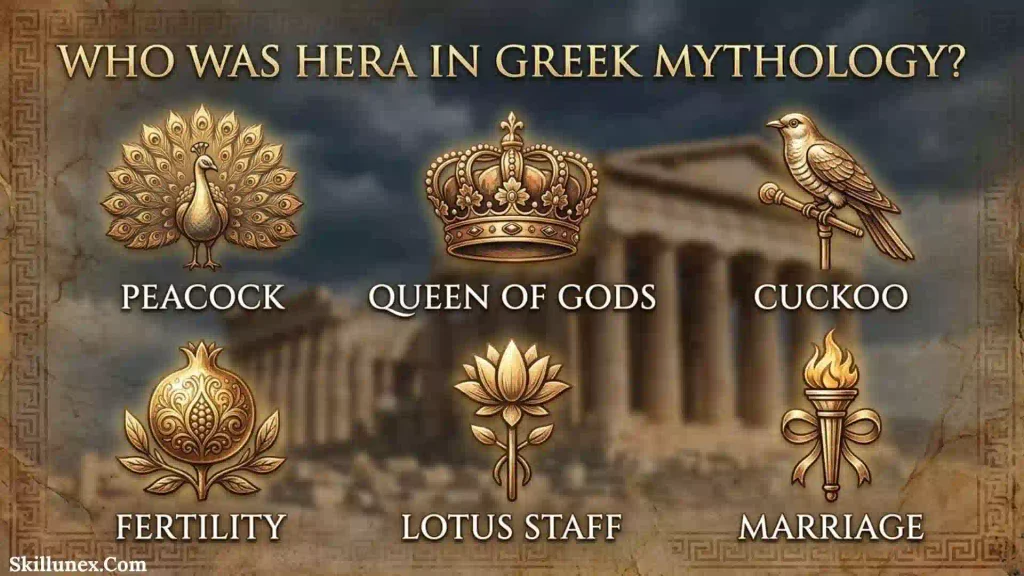
Hera was one of the major Olympian goddesses in ancient Greek religion and mythology. She was the daughter of Cronus and Rhea, sister of Zeus, and traditionally described as the wife of Zeus.
She held an especially important position among the Olympian gods and was commonly associated with marriage, married women, family, queenship, and female life.
Hera as Queen of the Gods
Hera’s position as queen of the gods explains why royal objects such as the diadem and scepter are so important in representations of her.
The diadem communicates her high status, while the scepter represents authority and rulership. Together, they present Hera as a powerful divine queen rather than simply as the wife of Zeus.
Hera as Goddess of Marriage
Hera is particularly associated with marriage and married women. This role explains why wedding-related imagery can be connected with her.
The veil, bridal imagery, and fertility symbolism can all help communicate aspects of Hera’s relationship with marriage and family.
However, Hera’s mythology is complex. Ancient stories frequently portray her as a powerful goddess who could be jealous and vengeful, particularly toward Zeus’s lovers and their children. Her myths therefore show both her importance as a protector of marriage and the complicated relationships among the Olympian gods.
The Peacock: Hera’s Most Famous Symbol
The peacock is Hera’s most famous and recognizable symbol. It is closely connected with her in ancient and later artistic traditions and is one of the easiest ways to identify her.
The bird’s magnificent appearance makes it particularly appropriate for a goddess associated with beauty, majesty, and royalty.
Why Is the Peacock Associated With Hera?
One well-known mythological tradition connects Hera with Argus Panoptes, a giant famous for having many eyes.
Hera entrusted Argus with guarding Io, a woman connected with Zeus who had been transformed into a cow. Hermes eventually killed Argus, allowing Io to escape.
In a later mythological tradition, Hera honored Argus by placing his eyes on the tail of the peacock. The eye-like markings on the bird’s feathers therefore became associated with Argus and, by extension, with Hera.
This story is one of the major reasons the peacock became such a recognizable attribute of Hera.
What Does the Peacock Symbolize?
Hera’s peacock can symbolize:
- Beauty
- Majesty
- Royalty
- Pride
- Watchfulness
- Divine status
The bird’s impressive tail also fits Hera’s role as queen of the gods. Its visual connection with eyes reinforces the idea of watchfulness and the myth of Argus.
The Cow as a Symbol of Hera
The cow is another important animal associated with Hera. Cattle had significant economic, religious, and symbolic importance in the ancient Greek world, and the cow could represent fertility, nourishment, motherhood, and abundance.
Hera is also traditionally described with the epithet “ox-eyed” or “cow-eyed,” referring to her large and beautiful eyes.
What Does the Cow Represent?
The cow can represent:
- Fertility
- Motherhood
- Nourishment
- Abundance
- Femininity
- Protection
The symbolism fits Hera’s connection with marriage, women, family, and fertility.
The cow also appears in important mythology connected with Hera, particularly the story of Io. In that story, Zeus transforms Io into a cow while attempting to conceal her from Hera, leading to a complicated sequence of events involving Hera, Zeus, Io, and Argus.
Hera’s Diadem and Crown
The diadem or crown represents Hera’s status as queen of the gods. Ancient artistic representations often emphasize her dignity and authority through her clothing and headgear.
A diadem is particularly appropriate for Hera because it communicates social and divine rank.
What Does Hera’s Crown Symbolize?
Hera’s crown or diadem can represent:
- Queenship
- Royal authority
- Dignity
- Power
- Divine status
- Marriage and social rank
Unlike an animal symbol, the crown communicates Hera’s position directly. When she is shown wearing royal headgear, viewers can recognize her elevated status among the Olympian gods.
Hera’s Scepter
The scepter is another important attribute associated with Hera. In ancient art and mythology, a scepter can represent authority, sovereignty, and rulership.
For Hera, it reinforces the idea that she is not merely a secondary figure in the Olympian hierarchy. She is a powerful goddess and the queen of the gods.
What Does the Scepter Represent?
Hera’s scepter symbolizes:
- Authority
- Leadership
- Royal power
- Rulership
- Sovereignty
- Divine status
The combination of a diadem and scepter is particularly meaningful because both are royal attributes. Together, they communicate Hera’s role as a divine queen.
The Pomegranate and Hera
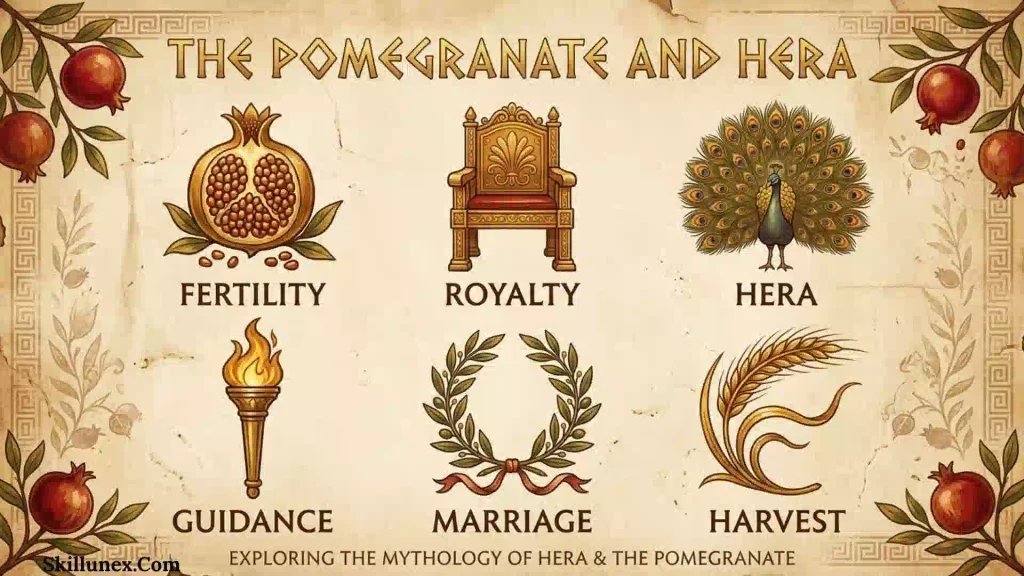
The pomegranate can be associated with Hera through themes of fertility, marriage, abundance, and family. However, this symbol needs some clarification.
The pomegranate is not exclusive to Hera. It has an especially strong role in the mythology of Persephone, whose story involves eating pomegranate seeds in the Underworld.
For Hera, the fruit is better understood as a symbol that fits themes connected with her domain rather than as her single defining attribute.
Is the Pomegranate Really Hera’s Symbol?
It can be included when discussing Hera’s broader symbolism, particularly in connection with fertility and marriage, but it should not be placed on the same level as the peacock.
If you need to identify Hera quickly in an ancient artwork, the peacock, diadem, and scepter are much more useful clues than the pomegranate.
Hera’s Veil and Marriage Symbolism
A bridal veil can symbolize Hera because of her strong association with marriage and married women.
Wedding imagery naturally connects with Hera’s role as a goddess of marriage. The veil can therefore represent:
- Marriage
- Brides
- Womanhood
- Married life
- Family relationships
The veil is best understood as a symbolic representation of Hera’s domain rather than as a unique identifying attribute comparable to the peacock.
Other Symbols Associated With Hera
Several other objects, animals, and images may appear in modern discussions of Hera. Their importance varies, so they should be treated with more caution than her primary symbols.
Floral Imagery
Flowers can represent beauty, fertility, femininity, and renewal. These themes overlap with some aspects of Hera’s symbolism.
However, there is no need to treat one particular flower as Hera’s definitive symbol in the same way that the peacock is.
The Lion and Royal Power
The lion can symbolize strength, courage, power, and royalty. These qualities are compatible with Hera’s status as a powerful goddess and queen.
However, the lion is not as uniquely associated with Hera as the peacock, cow, diadem, or scepter.
For that reason, the lion is better considered a secondary or broader symbolic association rather than Hera’s primary emblem.
What Do Hera’s Symbols Mean?
Hera’s symbols become easier to understand when they are grouped according to the major aspects of her identity.
Symbols of Royalty
The peacock, diadem, and scepter emphasize Hera’s royal position.
The diadem represents her crown and status, the scepter represents authority, and the peacock adds beauty and majesty to her royal imagery.
Symbols of Marriage
The veil and pomegranate can represent Hera’s connection with marriage and fertility.
Because Hera was closely associated with marriage, wedding imagery is particularly relevant when interpreting her symbolic meaning.
Symbols of Fertility and Womanhood
The cow and pomegranate can represent fertility, nourishment, abundance, and family.
These themes help connect Hera’s mythology with women, marriage, and family life.
Symbols of Beauty and Majesty
The peacock is especially important here. Its elaborate feathers and impressive appearance make it a natural symbol for beauty, pride, magnificence, and divine royalty.
Hera’s Symbols in Ancient Greek Art
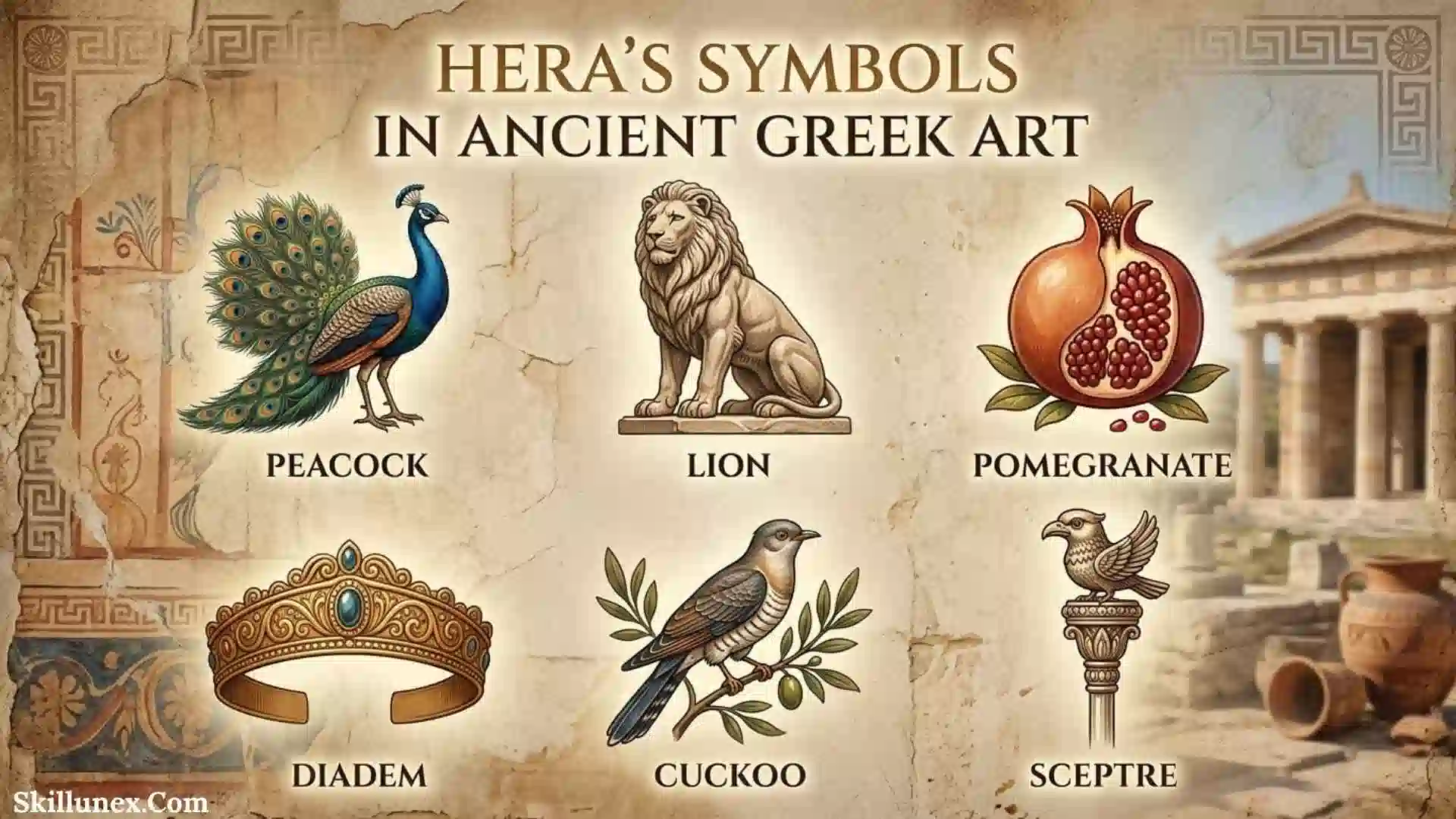
Symbols were extremely useful in ancient Greek art because they helped viewers recognize gods and goddesses.
Hera could be portrayed as a dignified woman wearing a diadem or crown and carrying a scepter. A peacock could accompany her or appear as an identifying attribute.
These details allowed artists to communicate Hera’s identity without needing written labels.
Her appearance could also distinguish her from other important goddesses. Athena might be identified through her helmet, armor, shield, or owl, while Aphrodite might be associated with imagery connected with beauty and love.
How Can You Identify Hera in Art?
When looking at a Greek artwork and trying to identify Hera, look for a combination of clues rather than relying on one symbol alone.
The strongest clues include:
- A regal female figure
- A diadem or crown
- A scepter
- A peacock
- Associations with marriage or royal imagery
A single symbol does not always prove that a figure is Hera. Ancient artistic symbolism could overlap between different gods and religious traditions.
Hera’s Symbols Compared With Other Greek Goddesses
Understanding the differences between Greek goddess symbols can make Hera easier to identify.
| Goddess | Commonly Associated Symbols | Main Associations |
| Hera | Peacock, cow, diadem, scepter | Marriage, queenship, married women |
| Athena | Owl, olive tree, helmet, shield | Wisdom, warfare, strategy |
| Aphrodite | Dove, rose, myrtle, seashell | Love, beauty, desire |
| Demeter | Grain, wheat, cornucopia | Agriculture, harvest, fertility |
| Persephone | Pomegranate, flowers, torch | Underworld, seasonal cycles, rebirth |
| Artemis | Deer, bow, moon imagery | Hunting, wilderness, young women |
This comparison also demonstrates why symbolic interpretation requires context. Some symbols, such as the pomegranate, can be associated with more than one goddess.
Common Misconceptions About Hera’s Symbols
There are several misconceptions worth clearing up when studying Hera.
The Peacock Is Not Just a Symbol of Beauty
The peacock is associated with Hera because of its connection with her mythology and royal status. Its meaning includes beauty and majesty, but the story of Argus gives the bird a deeper mythological connection.
The Pomegranate Does Not Belong Exclusively to Hera
The pomegranate is strongly associated with Persephone, especially because of her Underworld myth. It can also be discussed in connection with Hera because of fertility and marriage, but it should not be described as uniquely hers.
Not Every Modern Symbol List Is Historically Equal
Online lists sometimes place many animals, colors, flowers, and objects together without distinguishing their historical importance.
A better approach is to separate strong ancient attributes from broader modern interpretations.
Hera Is More Than the Wife of Zeus
Hera’s symbols emphasize her independent status as a major goddess. Her crown and scepter, in particular, represent her authority and queenship.
Her role in mythology includes much more than her relationship with Zeus.
Frequently Asked Questions About Hera’s Symbols
What Is Hera’s Most Famous Symbol?
The peacock is Hera’s most famous symbol. It represents beauty, majesty, pride, royalty, and watchfulness and is connected with the myth of Argus.
What Animal Represents Hera?
The peacock is the animal most strongly associated with Hera. The cow is another important animal connected with her through mythology, traditional descriptions, and fertility symbolism.
Why Is the Peacock Hera’s Symbol?
The peacock became associated with Hera through mythological traditions involving Argus Panoptes. A later tradition says that Hera placed Argus’s many eyes on the peacock’s tail after his death.
What Does Hera’s Peacock Symbolize?
The peacock symbolizes beauty, majesty, royalty, pride, and watchfulness. Its magnificent appearance also reflects Hera’s position as queen of the gods.
Is the Cow a Symbol of Hera?
Yes. The cow is associated with Hera and can symbolize fertility, motherhood, nourishment, and abundance. Hera is also traditionally described with the epithet “ox-eyed.”
What Does Hera’s Crown Represent?
Hera’s diadem or crown represents her position as queen of the gods. It symbolizes authority, dignity, royalty, and divine status.
What Does Hera’s Scepter Symbolize?
The scepter represents power, authority, sovereignty, and rulership. It emphasizes Hera’s position as a powerful divine queen.
What Does the Pomegranate Represent for Hera?
When associated with Hera, the pomegranate can represent fertility, marriage, abundance, and family. However, it is not exclusively Hera’s symbol and is particularly important in the mythology of Persephone.
What Is Hera the Goddess Of?
Hera is primarily associated with marriage, married women, queenship, and family. Her myths also portray her as a powerful Olympian goddess with authority and influence.
What Color Represents Hera?
There is no single universally established ancient Greek color that can be treated as Hera’s definitive symbol. Modern artistic representations may use colors such as white, gold, or purple to communicate ideas such as beauty, royalty, and majesty, but these should not be confused with a fixed ancient attribute.
What Are Hera’s Symbols and Their Meanings?
Hera’s main symbols include the peacock for beauty and majesty, the cow for fertility and nourishment, the diadem for queenship, and the sceptre for authority. The pomegranate and veil can also represent fertility, marriage, and womanhood.
Conclusion
So, what are Hera’s symbols? Hera’s most important and recognizable symbols are the peacock, cow, diadem, and scepter. The peacock is her best known symbol and represents beauty, majesty, royalty, and watchfulness. The cow is connected with fertility, nourishment, and motherhood, while the diadem and scepter emphasize Hera’s position as queen of the gods.
The pomegranate and bridal veil can also help represent Hera’s connections with fertility and marriage, but they are less distinctive and should not be treated as exclusively hers.

Caleb Thornton
I’m Caleb Thornton, a researcher and content writer who loves exploring fascinating subjects and sharing what I learn with readers. My interests include natural places, lakes, symbols, culture, history, and the stories that make ordinary topics more meaningful.
When I write an article, I try to go beyond a basic answer. I look for useful facts, relevant context, and details that can help readers understand the subject more completely.
My purpose is simple: I want every article I contribute to provide genuine value, satisfy the reader’s curiosity, and make discovering new information enjoyable.
## Books by Caleb Thornton
* Symbols & Meanings: Exploring the Signs We See Every Day
* Lakes of the World: Nature, Beauty & Exploration