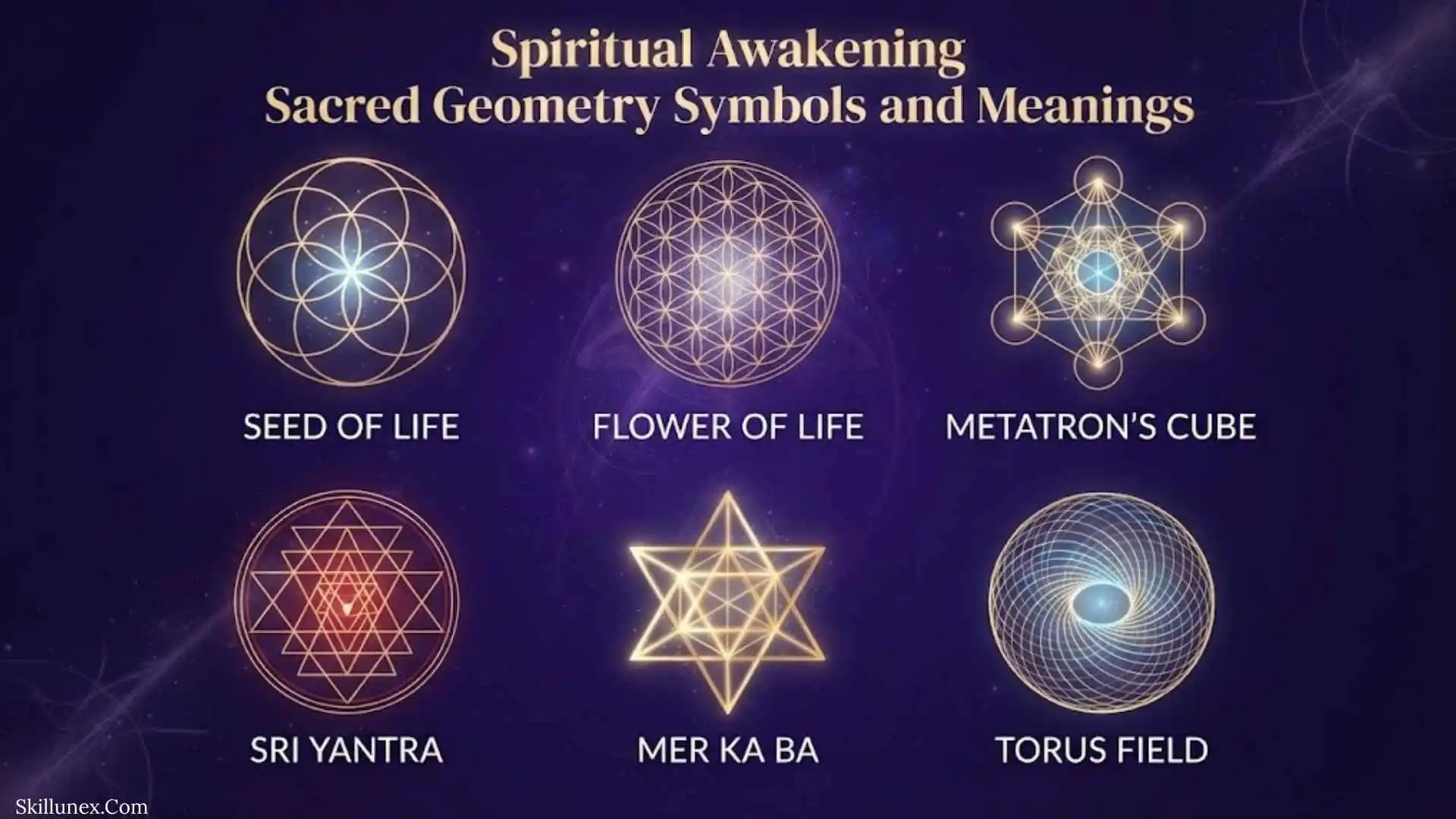
Sacred geometry has fascinated people for thousands of years. From circles and triangles to intricate mandalas and interlocking geometric patterns, these shapes appear in religious art, architecture, meditation practices, mathematics, and natural forms.
For people exploring spiritual awakening, sacred geometry can provide a visual language for ideas such as unity, balance, transformation, consciousness, creation, and personal growth. A geometric pattern may become a meditation focus, a meaningful tattoo, an artistic design, or simply a reminder of a particular spiritual idea.
However, sacred geometry does not have one universal dictionary of meanings. Some symbols have well-documented religious and historical origins, while others have acquired much of their current spiritual symbolism through modern spiritual movements.
Understanding that distinction makes it easier to explore spiritual awakening, sacred geometry symbols and meanings without confusing traditional beliefs with modern interpretations.
What Is Sacred Geometry?
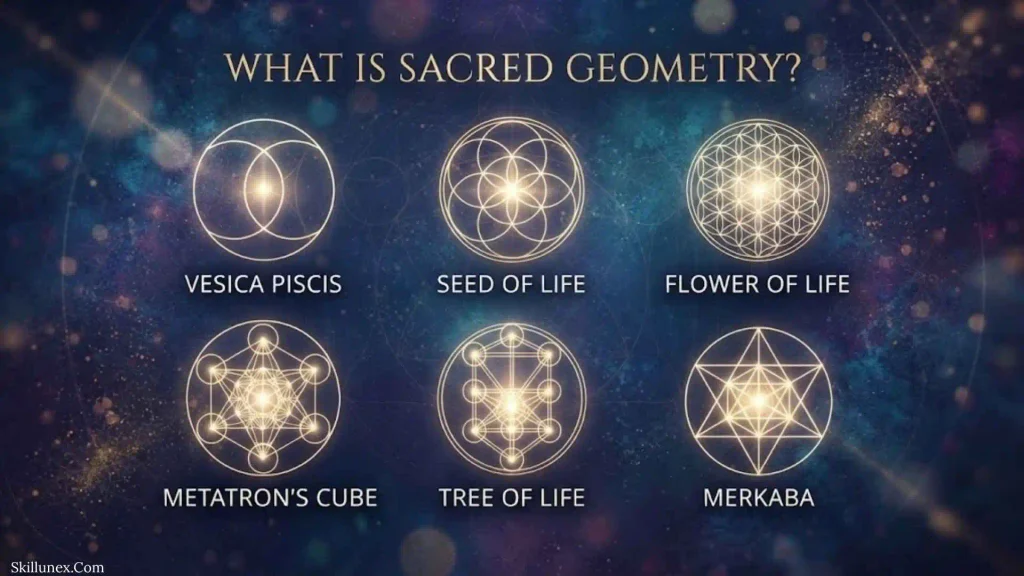
Sacred geometry is the study or use of geometric shapes, patterns, proportions, and mathematical relationships that have been given religious, philosophical, cultural, or spiritual significance.
The word “sacred” does not mean that every geometric shape is automatically religious. Instead, it describes the way certain cultures and traditions have connected geometry with ideas about order, creation, harmony, the cosmos, or the divine.
Examples include circles, triangles, squares, spirals, mandalas, the Flower of Life, the Sri Yantra, and the Vesica Piscis.
Geometry can be especially interesting in spiritual practices because geometric patterns are often highly symmetrical. Looking at a symmetrical pattern can naturally encourage attention and concentration, which is one reason geometric designs are frequently used in meditation and contemplative art.
Sacred Geometry And Mathematics
Sacred geometry is closely connected to ordinary geometry because its symbols are built from mathematical relationships.
For example, a circle has a center and a continuous circumference. A triangle has three sides and three angles. A hexagon has six sides. More complex designs can be created by repeating or overlapping these basic forms.
The mathematical properties of a shape are objective, while its spiritual interpretation is cultural or personal.
For example, the statement that a hexagon has six sides is a mathematical fact. Saying that a hexagon represents harmony is a symbolic interpretation.
Keeping these two ideas separate helps you understand sacred geometry more accurately.
Sacred Geometry In Nature
People often become interested in sacred geometry after noticing geometric patterns in nature.
Examples include:
- Honeycomb structures
- Spiral arrangements in plants
- Snowflake symmetry
- Crystalline structures
- Circular patterns
- Branching patterns
- Certain arrangements of leaves and flowers
Nature contains many forms of symmetry, repetition, spirals, and mathematical relationships. These patterns can inspire spiritual reflection, although finding a geometric pattern in nature does not by itself prove that the pattern has a supernatural meaning.
For many people, the value lies in the reflection itself: geometry can provide a way to think about order, complexity, growth, and interconnectedness.
Sacred Geometry And Spiritual Awakening
Spiritual awakening is generally used to describe a period of increased self-awareness, reflection, or a changing understanding of one’s relationship with life and existence.
There is no single definition of spiritual awakening shared by every religion or spiritual tradition. Experiences described with this phrase can range from increased mindfulness and self-reflection to profound religious or philosophical experiences.
Sacred geometry can become part of this journey because symbols give people something concrete to contemplate.
Why Geometric Symbols Can Feel Meaningful
A geometric symbol is simple enough to recognize but complex enough to invite interpretation.
Consider the circle. It has no obvious beginning or ending, so a person might use it to contemplate cycles, wholeness, or continuity.
A spiral can suggest movement and growth.
A mandala can provide a structured visual center for meditation.
An interlocking geometric pattern can inspire thoughts about relationships between individual parts and a larger whole.
The symbol does not have to produce a supernatural experience to be meaningful. It can simply act as a tool for attention, reflection, and personal symbolism.
Sacred Geometry As A Meditation Focus
Meditation often involves bringing attention back to a chosen object, sensation, word, sound, or idea.
A geometric pattern can serve the same purpose.
You might quietly observe the center of a mandala, follow the repeating circles of the Flower of Life, or study the symmetry of a geometric design.
When your mind wanders, you can gently return your attention to the pattern.
This makes sacred geometry useful as a visual concentration tool, regardless of whether you interpret the symbol religiously, spiritually, artistically, or psychologically.
Most Common Sacred Geometry Symbols And Meanings
Different sacred geometry symbols have different histories and modern interpretations. Some are connected to specific religious traditions, while others are mainly popular in contemporary spiritual communities.
Here are some of the most commonly discussed symbols:
| Symbol | Common Symbolic Associations |
| Circle | Unity, wholeness, eternity, cycles |
| Triangle | Balance, transformation, threefold relationships |
| Spiral | Growth, movement, change, development |
| Flower Of Life | Interconnection, creation, unity |
| Seed Of Life | Beginning, potential, creation |
| Metatron’s Cube | Structure, balance, interconnected geometry |
| Sri Yantra | Meditation, spiritual practice, consciousness |
| Mandala | Wholeness, concentration, contemplation |
| Vesica Piscis | Union, intersection, creation, balance |
| Hexagon | Symmetry, harmony, order |
These associations should be understood as common interpretations rather than universal definitions.
Flower Of Life Meaning
The Flower of Life is one of the most recognizable symbols associated with modern sacred geometry.
It consists of multiple overlapping circles arranged in a symmetrical pattern. The repeated circles create a visually complex design from a relatively simple geometric element.
In modern spiritual contexts, the Flower of Life is commonly associated with:
- Unity
- Interconnectedness
- Creation
- Harmony
- Life
- Consciousness
- The relationship between individual parts and the whole
Flower Of Life And Spiritual Awakening
For someone exploring spiritual awakening, the Flower of Life can represent the idea that life is interconnected.
The repeated circles can also serve as a reminder that individual experiences exist within larger relationships involving people, nature, society, and the wider world.
Some modern spiritual sources attach extensive cosmological meanings to the Flower of Life. Those interpretations vary, so they should not be presented as one universally established historical meaning.
Seed Of Life Meaning
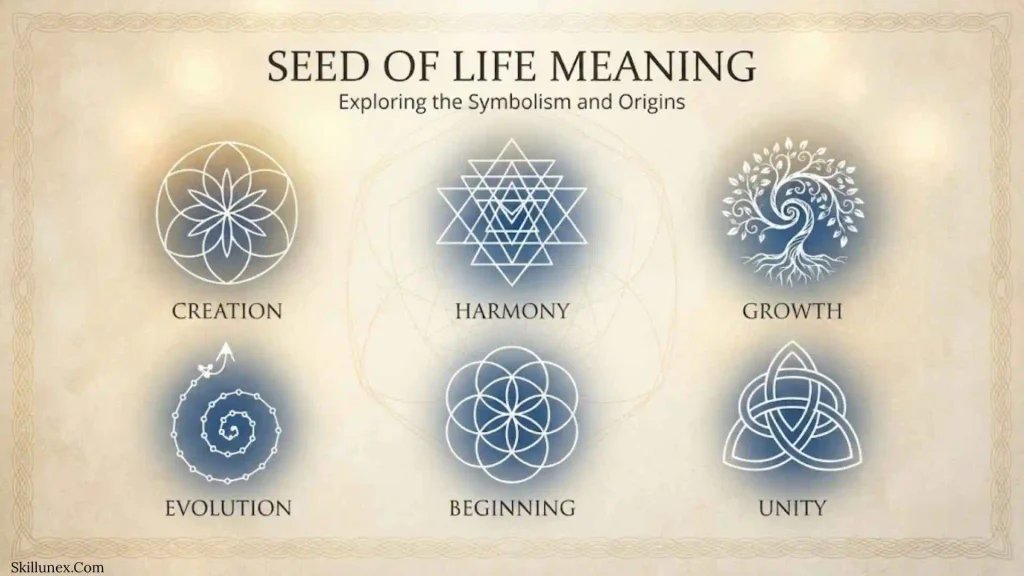
The Seed of Life is closely related to the Flower of Life. It consists of a smaller arrangement of overlapping circles and is often presented as a foundational pattern from which the larger Flower of Life design develops.
In modern spiritual symbolism, the Seed of Life is commonly connected with:
- New beginnings
- Creation
- Potential
- Growth
- Development
- Transformation
- The beginning of a spiritual journey
Seed Of Life And Personal Transformation
The symbolism of a seed is naturally connected with growth.
A seed begins as something small and can develop into something much larger. Because of this, people may use the Seed of Life as a metaphor for personal transformation.
During a period of spiritual awakening, it can represent the beginning of a new perspective or a developing awareness of one’s values and beliefs.
Metatron’s Cube Meaning
Metatron’s Cube is a complex geometric pattern made from circles and connecting lines. It is widely used in modern sacred geometry and spiritual artwork.
The symbol is often associated with:
- Balance
- Structure
- Unity
- Order
- Creation
- Interconnectedness
- Protection
The name connects the symbol with the angel Metatron in modern esoteric traditions, but the geometric figure itself should not automatically be treated as an ancient symbol with one fixed historical meaning.
Metatron’s Cube And The Platonic Solids
One reason Metatron’s Cube is popular in sacred geometry is its relationship to several geometric forms, including the Platonic solids in modern sacred-geometry presentations.
The Platonic solids are regular three-dimensional polyhedra. They include:
- Tetrahedron
- Cube
- Octahedron
- Dodecahedron
- Icosahedron
These shapes have genuine mathematical properties. Their spiritual meanings are interpretations added by particular philosophical or esoteric traditions.
Sri Yantra Meaning
The Sri Yantra is a traditional Hindu geometric diagram associated particularly with Sri Vidya traditions.
It contains interlocking triangles arranged around a central point known as the bindu.
Unlike some modern sacred-geometry symbols, the Sri Yantra has a specific religious and historical context.
It is traditionally associated with:
- Meditation
- Worship
- Spiritual practice
- The relationship between different aspects of reality
- Concentration on the divine
Sri Yantra And Meditation
The Sri Yantra can be used as a visual focus during meditation and religious practice.
The complex arrangement of triangles naturally draws the eyes toward the center. The central bindu provides a focal point for concentration.
Its meaning should be understood within the Hindu traditions in which it developed rather than separated from that cultural and religious context.
Mandala Meaning
A mandala is a symbolic geometric design traditionally used in several religious and cultural traditions, especially Hindu and Buddhist contexts.
Mandala designs commonly feature a central point surrounded by symmetrical patterns.
They can represent ideas related to:
- Wholeness
- Order
- The cosmos
- Meditation
- Spiritual concentration
- Balance
Mandalas And Spiritual Awakening
Mandalas can be particularly useful for meditation because their symmetrical structure provides a visual center.
A person may focus on the central point, gradually observe the surrounding patterns, or create a mandala as a contemplative activity.
Creating a mandala can also encourage patience and concentration because the design often requires repeated patterns and careful attention.
Vesica Piscis Meaning
The Vesica Piscis is created when two equal circles overlap in a particular way.
The shape formed in the middle resembles an almond or lens.
The Vesica Piscis appears in historical mathematical and artistic contexts and has also been used in religious art and architecture.
Modern sacred-geometry interpretations commonly associate it with:
- Union
- Intersection
- Balance
- Creation
- Duality
- The meeting of two complementary elements
Vesica Piscis And Spiritual Symbolism
The most straightforward symbolic idea comes from the two circles coming together.
Each circle remains distinct, yet they share a central space.
Because of this visual relationship, the Vesica Piscis can be used as a metaphor for connection, cooperation, relationship, or the meeting of two different aspects of existence.
Circle Meaning In Sacred Geometry
The circle is perhaps the simplest and most universal geometric symbol.
It has no corners and no obvious beginning or ending.
Because of these qualities, circles have been associated in many cultural contexts with ideas such as:
- Unity
- Wholeness
- Eternity
- Cycles
- Completion
- Continuity
- Infinity
Circle And Spiritual Awakening
A circle can represent the idea that personal development is not always a straight line.
People often revisit old questions, beliefs, relationships, and experiences from new perspectives. A circular symbol can therefore serve as a personal reminder of cycles, reflection, and continued growth.
Triangle Meaning In Sacred Geometry
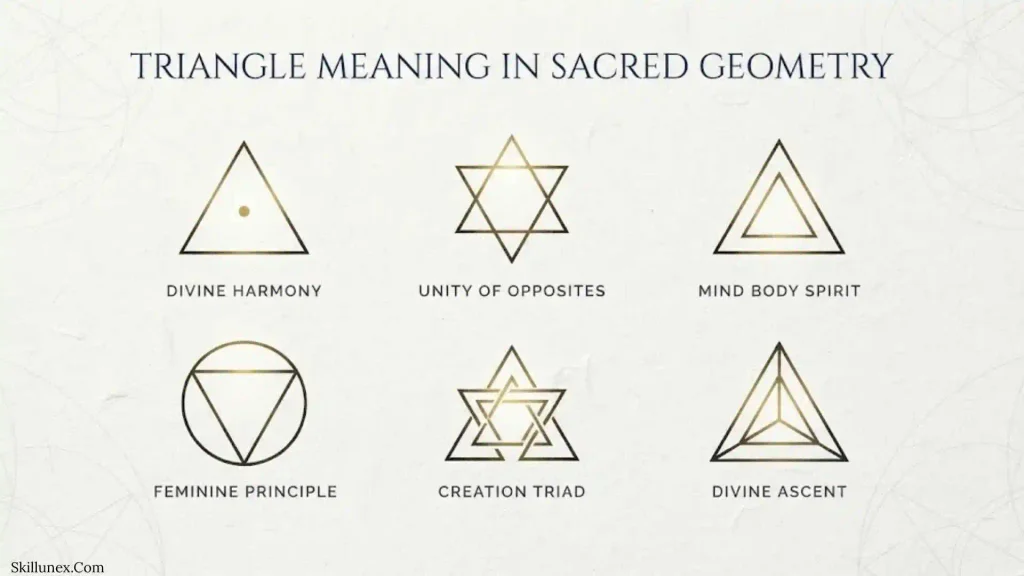
Triangles appear in religious art, architecture, mathematics, symbolism, and many spiritual traditions.
Their three sides make them particularly adaptable to symbolic interpretations.
Modern spiritual interpretations may connect the triangle with:
- Balance
- Stability
- Transformation
- Threefold relationships
- Mind, body, and spirit
- Beginning, middle, and end
The exact meaning depends on the cultural and religious context.
Upward And Downward Triangles
An upward-pointing triangle and a downward-pointing triangle can be interpreted differently in various traditions.
For example, interlocking upward and downward triangles are important in the Sri Yantra, where they form a much more complex religious diagram.
It is therefore better to interpret a triangle according to the tradition in which it appears rather than assigning one universal meaning to its direction.
Spiral Meaning In Sacred Geometry
Spirals are among the most recognizable patterns in nature and art.
They appear in shells, plant growth, weather systems, and other natural structures.
In modern spiritual symbolism, spirals are frequently associated with:
- Growth
- Movement
- Transformation
- Evolution
- Personal development
- Cycles
- Inner exploration
Spiral And Spiritual Growth
A spiral can be a useful metaphor for spiritual growth because growth rarely happens in a perfectly straight line.
A person may revisit the same questions several times while understanding them differently each time.
The spiral can therefore represent movement combined with repetition: returning to familiar ideas while continuing to develop.
Hexagon Meaning In Sacred Geometry
A hexagon has six sides and is known for its strong geometric symmetry.
One of the most familiar natural examples is the honeycomb, where hexagonal cells provide an efficient repeating structure.
In modern symbolic interpretations, the hexagon can represent:
- Harmony
- Balance
- Order
- Symmetry
- Cooperation
- Natural structure
The hexagon is also closely related to other geometric forms, including triangles and six-pointed geometric patterns.
Flower Of Life Vs Seed Of Life
The Flower of Life and Seed of Life are closely related, but they are not identical.
The Seed of Life is generally presented as a smaller foundational arrangement of overlapping circles, while the Flower of Life expands the pattern into a larger network.
| Feature | Seed Of Life | Flower Of Life |
| Basic design | Smaller circle pattern | Larger overlapping-circle pattern |
| Common symbolism | Beginning and potential | Unity and interconnectedness |
| Spiritual association | New stage or creation | Relationship and wholeness |
| Modern use | Meditation and spiritual artwork | Meditation, jewelry, tattoos, artwork |
Both symbols can be interpreted differently depending on the spiritual system or personal belief of the person using them.
Sacred Geometry Symbols For Meditation
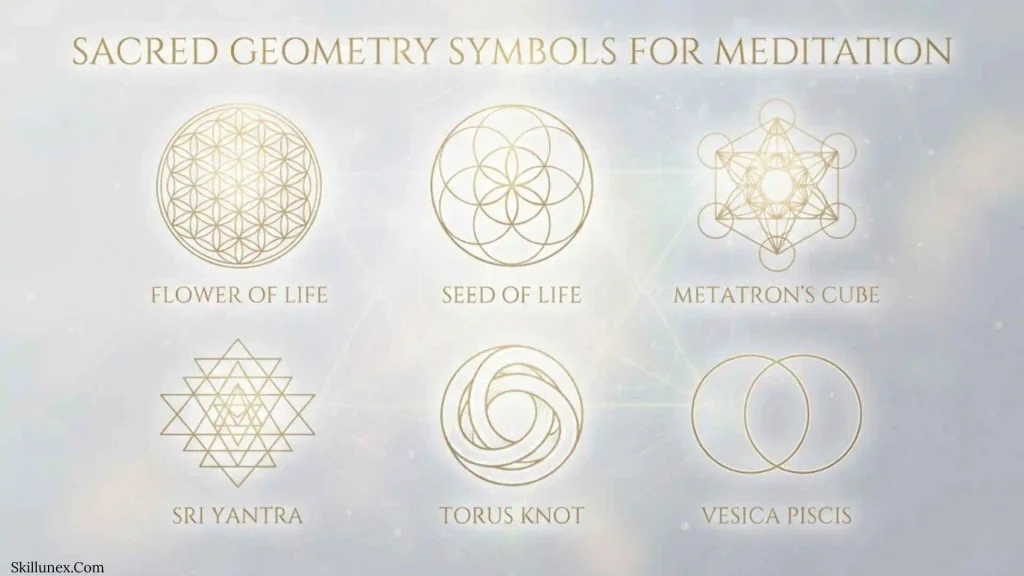
Sacred geometry can be incorporated into meditation in several simple ways.
You do not need an elaborate ritual or specialized equipment.
Choose One Symbol
Start with one symbol instead of trying to understand every sacred geometry pattern at once.
You might choose:
- Flower of Life for interconnectedness
- Circle for wholeness
- Spiral for growth
- Mandala for concentration
- Seed of Life for new beginnings
Choose the symbol based on the idea you want to contemplate.
Observe The Pattern
Place the symbol somewhere comfortable to view.
Spend several minutes simply observing it.
Notice:
- Symmetry
- Repetition
- Lines
- Curves
- The center
- Relationships between shapes
- Movement of your attention
You do not have to force a particular interpretation.
Use The Symbol As A Reflection Tool
After meditation, ask yourself questions such as:
- What does this symbol represent to me?
- Why did I choose it?
- What thoughts came up while looking at it?
- Does the pattern remind me of a current change in my life?
- What does balance mean to me?
- What area of my life needs greater awareness?
This turns the symbol into a tool for reflection rather than something that must produce a particular experience.
Sacred Geometry In Tattoos And Jewelry
Sacred geometry is also popular in tattoos, necklaces, bracelets, wall art, and other decorative objects.
People may choose a symbol because they connect with its traditional meaning, modern interpretation, visual appearance, or personal significance.
Common choices include:
- Flower of Life tattoos
- Mandala tattoos
- Sri Yantra designs
- Spiral symbols
- Geometric triangles
- Metatron’s Cube
- Seed of Life designs
- Vesica Piscis artwork
Before choosing a symbol permanently, it is worth researching its historical and religious background. This is especially important when using symbols associated with a particular religious or cultural tradition.
Sacred Geometry And Spiritual Symbols: Important Distinctions
One of the biggest problems with online sacred-geometry information is that historical traditions, mathematical facts, and modern spiritual interpretations are often mixed together.
These are not always the same thing.
Historical Meaning
Historical meaning refers to how a symbol was actually used in a particular culture or tradition.
For example, the Sri Yantra has a specific place within Hindu religious practice.
Mathematical Meaning
Mathematical meaning refers to the measurable properties of a shape.
For example, a hexagon has six sides, and a circle has a defined radius and circumference.
Modern Spiritual Meaning
Modern spiritual meaning refers to interpretations that have become popular in contemporary spiritual communities.
For example, someone may interpret a spiral as personal growth.
That interpretation can be meaningful without being an ancient universal definition.
Personal Meaning
A person may also assign a private meaning to a symbol based on an experience, relationship, belief, or period of personal change.
All four forms of meaning can coexist, but they should not be presented as interchangeable.
Does Sacred Geometry Cause Spiritual Awakening?
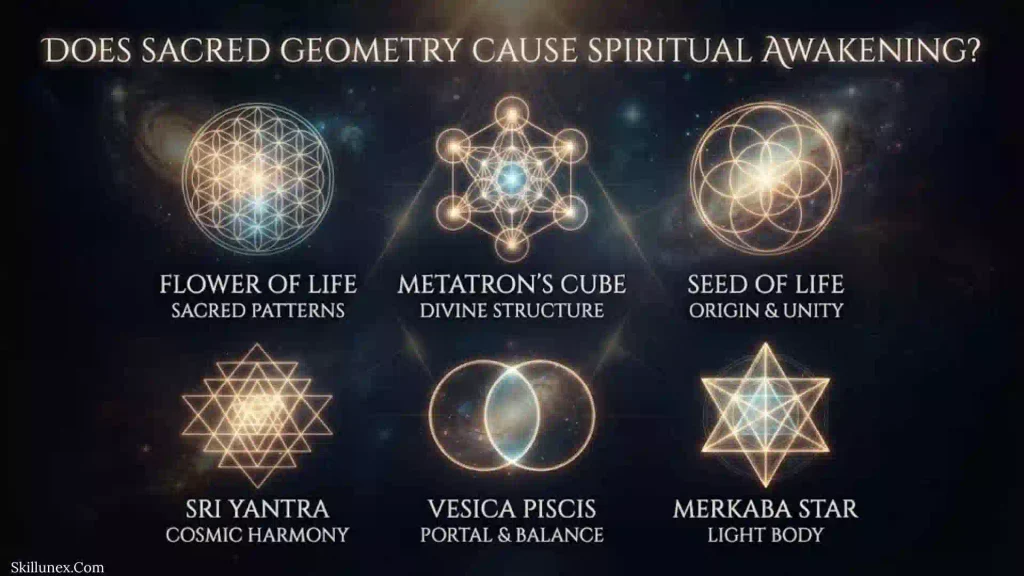
There is no universal evidence that looking at a particular geometric symbol causes spiritual awakening.
Sacred geometry can be used as a meditation or reflection tool, but a person’s spiritual experience is influenced by many factors, including their beliefs, practices, experiences, culture, and personal circumstances.
A geometric design can encourage concentration and reflection without being treated as a supernatural mechanism.
For many people, the most useful approach is to focus on what the symbol helps them notice about their own thoughts, values, and experiences.
How To Choose A Sacred Geometry Symbol
Choosing a symbol can be simple.
Start by asking what idea you want the symbol to represent.
| If You Want To Reflect On… | You Might Explore… |
| New beginnings | Seed of Life |
| Interconnection | Flower of Life |
| Growth | Spiral |
| Wholeness | Circle |
| Meditation | Mandala |
| Balance | Triangle or Hexagon |
| Traditional Hindu meditation | Sri Yantra |
| Union | Vesica Piscis |
| Geometric structure | Metatron’s Cube |
These are common associations, not fixed rules. Your personal interpretation can be different.
Frequently Asked Questions
What Is The Most Powerful Sacred Geometry Symbol?
There is no universally established “most powerful” sacred geometry symbol. Different symbols belong to different traditions and have different meanings. The Sri Yantra, Flower of Life, mandalas, Metatron’s Cube, and other designs are often described as powerful in modern spiritual communities, but “powerful” is an interpretive description rather than a measurable property.
What Symbol Represents Spiritual Awakening?
There is no single symbol that universally represents spiritual awakening. The spiral is often used as a modern symbol of growth and transformation, while mandalas can represent contemplation and wholeness. The Flower of Life is commonly associated with interconnectedness, and the Seed of Life can symbolize a new beginning.
What Does The Flower Of Life Mean Spiritually?
In modern spiritual symbolism, the Flower of Life is commonly associated with interconnectedness, unity, creation, harmony, and the relationship between individual parts and the whole. Its interpretation varies between traditions and individuals.
What Does The Seed Of Life Symbolize?
The Seed of Life is commonly interpreted in modern sacred-geometry traditions as a symbol of creation, potential, new beginnings, growth, and transformation. It is closely related geometrically to the Flower of Life.
What Does Metatron’s Cube Symbolize?
Metatron’s Cube is commonly associated with structure, balance, interconnectedness, order, and geometric unity in modern sacred-geometry traditions. Its interpretation should be distinguished from the historical and religious traditions concerning the figure of Metatron.
Is Sacred Geometry Religious?
Sacred geometry is not one religion. Some geometric symbols have important roles in specific religions, while others are used in modern spiritual practices, art, meditation, and popular culture. The meaning of a symbol depends heavily on its historical and cultural context.
Can Sacred Geometry Help With Meditation?
A geometric pattern can be used as a visual focus during meditation. Looking at a symmetrical design may help some people maintain attention and create a structured period of reflection. Its usefulness depends on the individual rather than on a guaranteed supernatural effect.
What Is The Meaning Of A Spiral In Spirituality?
A spiral is commonly used in modern spirituality as a symbol of growth, movement, transformation, cycles, and personal development. Its meaning can vary depending on the tradition and context.
What Does A Circle Mean Spiritually?
A circle is commonly associated with unity, wholeness, continuity, eternity, cycles, and completion. These associations appear in different cultural and symbolic contexts, although there is no single universal interpretation.
What Is The Difference Between Sacred Geometry And Regular Geometry?
Regular geometry describes mathematical properties, relationships, measurements, and shapes. Sacred geometry adds cultural, religious, philosophical, or spiritual significance to certain geometric forms. A shape can therefore have objective mathematical properties while also carrying symbolic meaning.
Conclusion
Spiritual awakening sacred geometry symbols and meanings cover a wide range of geometric designs, from simple circles and triangles to complex patterns such as the Flower of Life, Seed of Life, Metatron’s Cube, Sri Yantra, mandalas, and Vesica Piscis.
These symbols do not all come from the same tradition, and they do not have one universal set of meanings. Some have specific historical and religious contexts, while others are interpreted primarily through modern spiritual practices.
The most useful way to explore sacred geometry is to consider both sides: understand where a symbol comes from and then consider what it means to you personally.
If you use a geometric pattern for meditation, artwork, a tattoo, journaling, or simple contemplation, it can provide a visual way to think about ideas such as balance, growth, connection, transformation, and awareness.
Sacred geometry does not need to be treated as a supernatural formula to be meaningful. Its patterns can simply offer a beautiful and structured way to slow down, observe, reflect, and explore the ideas that matter to you.

Isla Kensington
I’m Isla Kensington, a writer with a passion for research, culture, nature, and the fascinating meanings behind everyday things. I enjoy taking topics that may seem simple at first and discovering the history, facts, and ideas that make them more interesting.
I write with readers in mind. My aim is to provide clear explanations, useful information, and interesting details without making a topic unnecessarily complicated.
I believe learning should feel like discovering something rather than simply reading facts. That philosophy guides the content I create and the topics I choose to explore.
## Books by Isla Kensington
* Symbols Around the World: A Guide to Meaning & Culture
* Nature’s Beautiful Places: Lakes, Landscapes & Natural Treasures