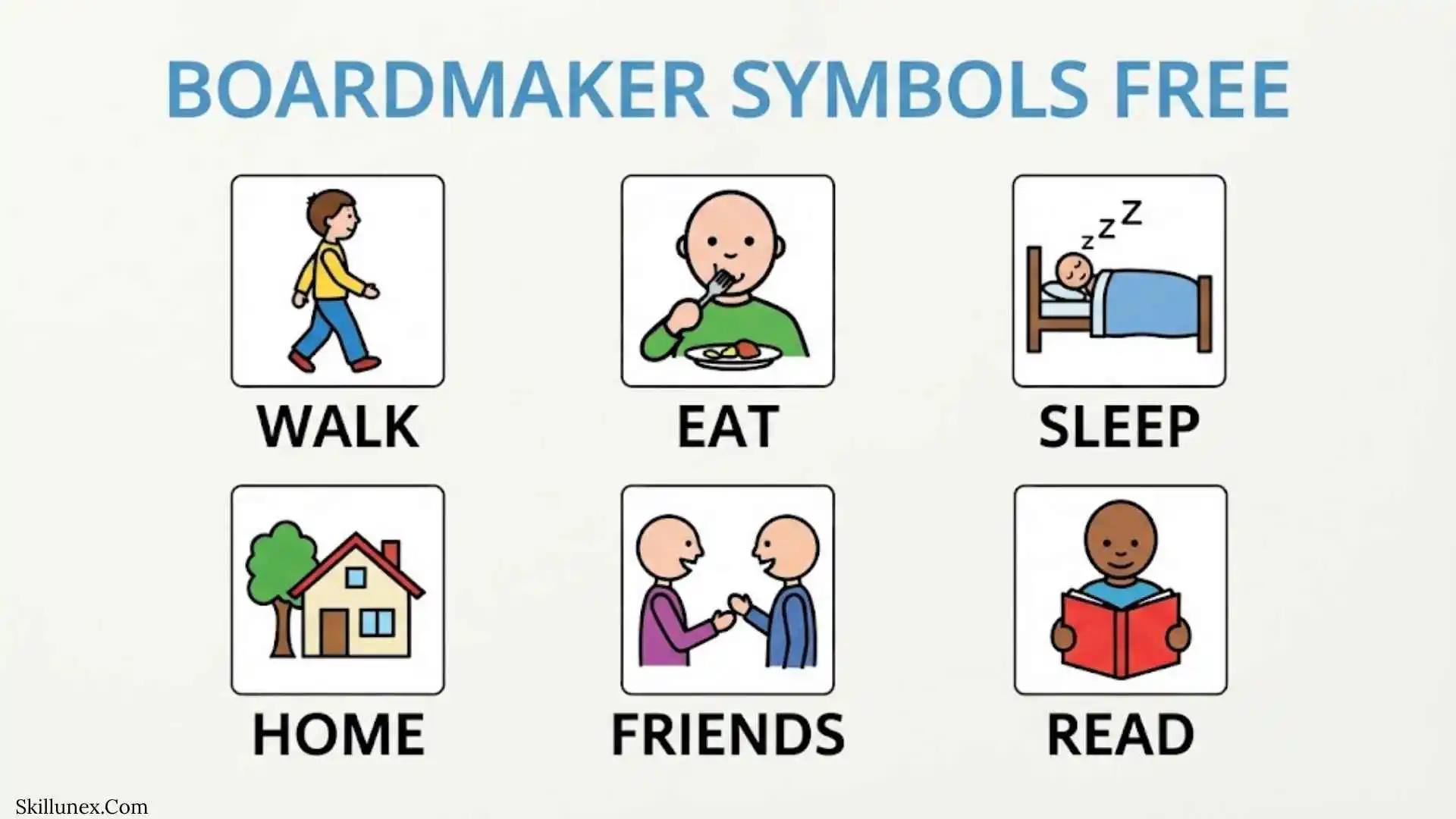
Finding Boardmaker symbols free is a common search for parents, teachers, speech language professionals, special education teams, and people creating visual communication materials. Symbols can make communication easier by turning words, actions, objects, feelings, and routines into simple pictures.
However, there is an important point to understand before downloading anything: a symbol being available online for free does not automatically mean it is an official Boardmaker symbol or that it can be used without restrictions.
Boardmaker is associated with symbol-based communication and educational materials, while many other websites provide free or open-licensed symbols that can be used for similar purposes. Some of these alternatives are particularly useful for AAC, visual schedules, communication boards, worksheets, and classroom resources.
This guide explains what Boardmaker symbols are, where free alternatives can be found, how licensing works, and how to choose symbols that are appropriate for your project.
What Are Boardmaker Symbols?
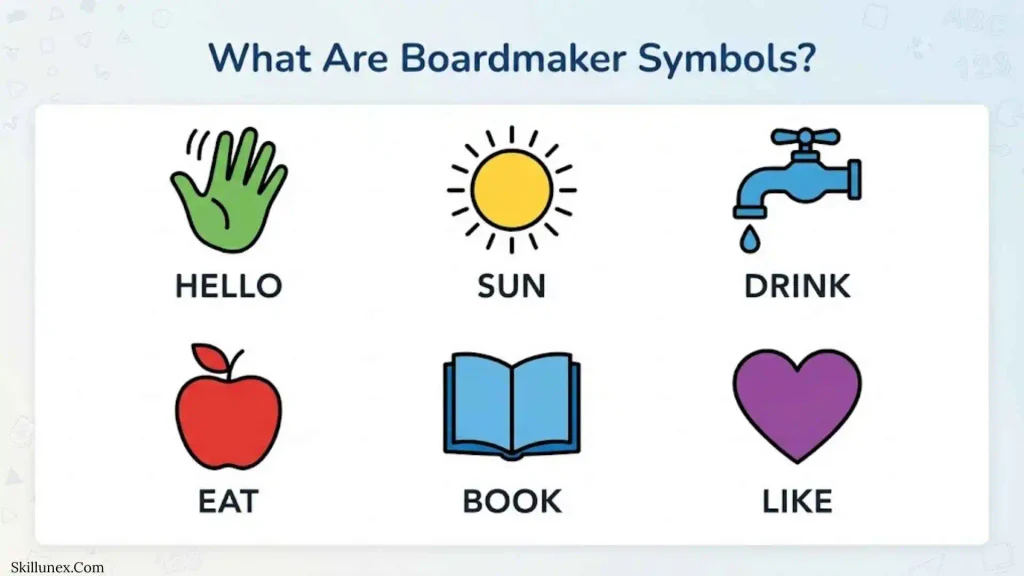
Boardmaker symbols are visual representations used to communicate concepts through pictures. Instead of relying entirely on written or spoken language, a person can use a picture to understand information or express a need.
A symbol might represent a simple word such as eat, drink, or help, or it might represent a more complex idea such as a routine, activity, feeling, or instruction.
Symbol-based communication is particularly useful when visual information is easier to understand or access than text alone.
For example, a visual routine could use symbols for:
- Wake up
- Get dressed
- Brush teeth
- Eat breakfast
- Go to school
- Lunch
- Play
- Go home
- Dinner
- Bedtime
The pictures give the user a visual sequence that can be easier to follow than a paragraph of written instructions.
What Can Boardmaker-Style Symbols Represent?
Symbols can represent almost anything that needs to be communicated visually.
Common categories include:
| Category | Examples |
| Basic needs | Food, water, bathroom, sleep |
| Actions | Eat, drink, walk, stop, go |
| People | Mom, dad, teacher, friend |
| Places | Home, school, hospital, store |
| Feelings | Happy, sad, angry, scared |
| Objects | Ball, book, phone, cup |
| Activities | Play, read, draw, watch |
| Social words | Hello, goodbye, please, thank you |
| Safety | Stop, danger, wait, help |
| Time | Today, tomorrow, morning, night |
The best symbol depends on the person’s age, language, communication system, and individual understanding.
Are Boardmaker Symbols Free?
This is where the search term Boardmaker symbols free can become confusing.
Not every free picture symbol available online is an official Boardmaker symbol. Boardmaker is a proprietary symbol and software ecosystem, while other organizations create their own symbol libraries.
Therefore, you should separate two different searches:
- Official Boardmaker symbols
- Free alternative communication symbols
If you specifically need the official Boardmaker symbol set, check the current terms provided by Boardmaker before downloading, copying, printing, or distributing the symbols.
If you simply need free visual symbols for communication or education, several open symbol projects provide alternatives.
For example, OpenSymbols describes itself as a collection of open-licensed communication symbols and currently provides access to more than 50,000 symbols and icons from several sources. However, the licenses differ between symbol collections, so each symbol’s licensing information still needs to be checked.
Why Do People Search for Free Boardmaker Symbols?
The main reason is convenience and cost.
Creating a communication board, visual schedule, classroom activity, or collection of printable cards can require many different images. Buying or subscribing to a complete commercial system may not be suitable for every person or organization.
Free symbol resources can help when someone needs:
- A few communication pictures
- Printable routine cards
- Classroom visual supports
- Simple AAC materials
- Choice boards
- Social stories
- Vocabulary cards
- Behavior or activity charts
- Visual instructions
- Home routine cards
Free resources can also be useful for testing an idea before deciding whether a larger commercial system is necessary.
Best Free Alternatives to Boardmaker Symbols
If you do not specifically require official Boardmaker symbols, open and free symbol libraries can provide useful alternatives.
Two important resources are OpenSymbols and ARASAAC.
OpenSymbols
OpenSymbols is an online collection designed around open-licensed communication symbols. Its library brings together symbols from multiple sources, including ARASAAC, Sclera, Mulberry Symbols, Tawasol, and other collections.
One important advantage is that you can search for individual concepts rather than manually browsing a huge collection.
For example, you can search for words related to:
- Food
- School
- Home
- Feelings
- Activities
- People
- Communication
- Daily routines
The licensing information is shown for individual symbol collections. For example, OpenSymbols lists Mulberry Symbols with a CC BY-SA license and ARASAAC symbols with a CC BY-NC-SA license.
This means you should not assume that every symbol on the website has identical usage rights.
ARASAAC
ARASAAC is another major resource for pictograms and AAC-related visual symbols. Its search system lets users find pictograms by word and category.
The library includes concepts covering areas such as home, education, routines, basic needs, people, places, actions, and communication.
ARASAAC materials identify its pictograms as being distributed under a Creative Commons BY-NC-SA license, which includes attribution and non-commercial requirements.
This makes ARASAAC particularly useful for people looking for free visual communication resources, but the license should always be followed when using or distributing the material.
Free Symbols for AAC
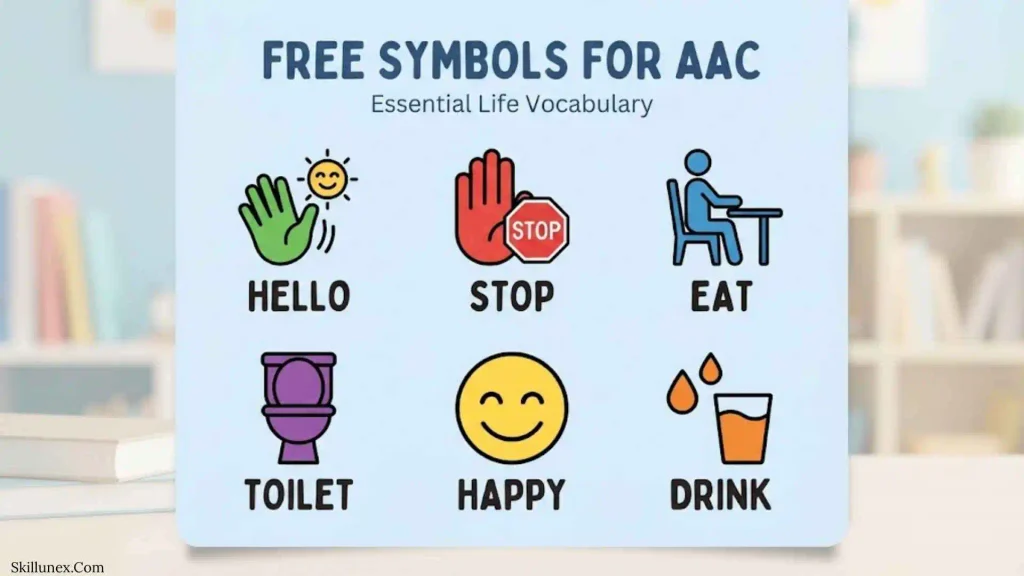
One of the most important uses of symbol libraries is augmentative and alternative communication, commonly called AAC.
AAC includes methods that help people communicate when speech alone does not meet their communication needs. Pictures and symbols can form part of a communication system.
A simple AAC board might contain words such as:
I | want | more | help | stop | go | yes | no
A more advanced system can include a much larger vocabulary.
The goal isn’t simply to put as many pictures as possible onto a page. The symbols need to be organized in a way that makes communication practical.
Common AAC Symbol Categories
A basic AAC resource may include:
- Core vocabulary
- People
- Food and drinks
- Places
- Activities
- Feelings
- Body parts
- Actions
- Descriptions
- Questions
- Social language
- Safety words
ARASAAC’s symbol collection, for example, includes categories related to core vocabulary, basic needs, education, routines, people, places, and many other concepts.
Choose Symbols Based on Meaning
A symbol should be selected based on what the person understands it to mean.
For example, a picture of a glass might be interpreted as:
- Water
- Drink
- Cup
- Glass
The accompanying word or the context can make the intended meaning clearer.
This is why symbol selection should be based on the individual rather than simply choosing the first picture returned by a search.
Free Symbols for Visual Schedules
Visual schedules are another practical use for free symbols.
A visual schedule presents activities in an ordered sequence. This can help someone understand what is happening now and what will happen next.
For example:
Morning
- Wake up
- Bathroom
- Get dressed
- Breakfast
- Brush teeth
- School
You can represent every activity with a picture and a short word or phrase.
How to Make a Simple Visual Schedule
Start by listing the activities that happen regularly.
Then find one clear symbol for each activity.
Arrange the symbols in chronological order and add short labels if appropriate.
For example:
| Step | Symbol Meaning | Text Label |
| 1 | Waking | Wake Up |
| 2 | Bathroom | Bathroom |
| 3 | Clothing | Get Dressed |
| 4 | Food | Breakfast |
| 5 | Toothbrush | Brush Teeth |
| 6 | School building | School |
Keep the design simple. Too many images or unnecessary decorations can make the schedule harder to use.
Free Symbols for Teachers
Teachers can use visual symbols in many classroom materials.
They can support instructions without replacing written language entirely.
Useful applications include:
- Classroom schedules
- Task cards
- Choice boards
- Visual instructions
- Classroom rules
- Vocabulary activities
- Matching exercises
- Routine charts
- Transition cards
- Reading activities
- Social stories
For younger students, a picture can provide an immediate visual reference. For older students, symbols can be combined with written words rather than used alone.
Classroom Routine Example
A classroom routine might use:
Arrival → Bag Away → Sit Down → Morning Work → Group Time → Break
The teacher can print each step on an individual card and place the cards where students can easily see them.
Free Symbols for Home Use
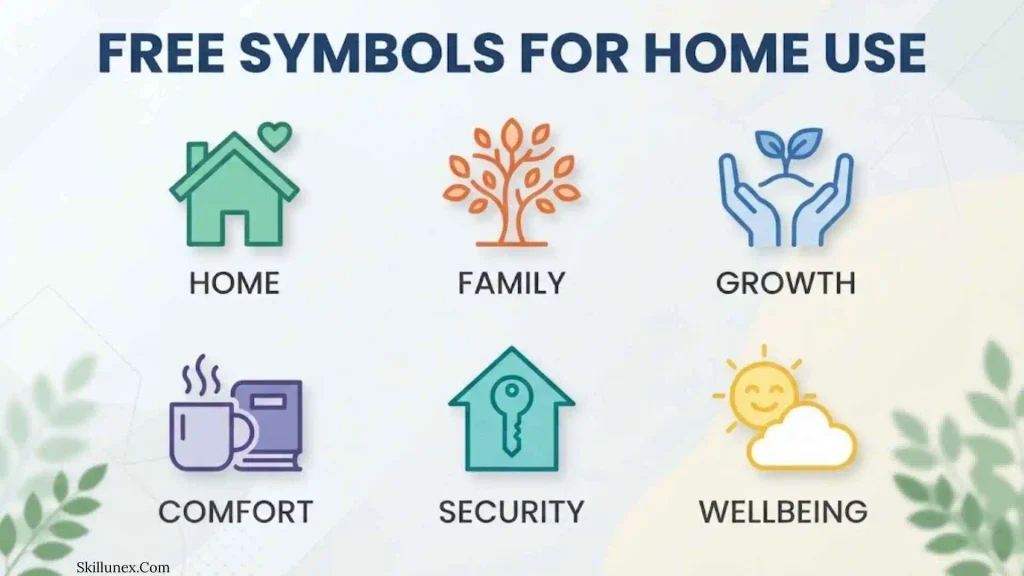
Symbol-based visual supports are not limited to schools.
Parents and caregivers can use them for everyday routines at home.
Examples include:
- Getting ready in the morning
- Mealtime
- Bath time
- Bedtime
- Cleaning
- Shopping
- Going outside
- Doctor visits
- Weekend activities
A bedtime sequence might look like:
Dinner → Bath → Pajamas → Brush Teeth → Story → Bed
The symbols can be placed on a wall, board, folder, or portable schedule.
How to Find Boardmaker Symbols Free
If you want free symbols, use a structured search process instead of downloading random images from image-search results.
Search for the Exact Concept
Start with the word you need.
For example:
- Eat symbol
- Drink symbol
- Bathroom pictogram
- Help communication symbol
- School pictogram
- Happy symbol
- Stop symbol
This is usually more effective than searching for a broad term such as “free pictures.”
Check the Source
Before downloading a symbol, identify where it came from.
A trustworthy symbol resource should provide information about:
- The symbol creator
- The symbol collection
- The license
- Whether attribution is required
- Whether commercial use is allowed
- Whether modification is permitted
Check the License
This is one of the most important steps.
A free download does not necessarily mean unrestricted use.
For example, a Creative Commons license may require attribution. Some licenses permit non-commercial use but restrict commercial use. Others may require derivative works to use the same license.
OpenSymbols demonstrates why checking the individual source matters: its library contains multiple collections with different licenses.
Understanding Creative Commons Licenses
Creative Commons licenses are commonly used for free and openly shared creative resources.
However, there are several different Creative Commons licenses.
For example:
- CC BY generally requires attribution.
- CC BY-SA generally requires attribution and sharing adaptations under the same or compatible license conditions.
- CC BY-NC restricts commercial use.
- CC BY-NC-SA combines attribution, non-commercial use, and share-alike requirements.
These terms matter if you are creating materials for a business, selling worksheets, publishing resources, or distributing materials publicly.
For instance, OpenSymbols lists Sclera’s collection as CC BY-NC, while Mulberry Symbols are listed as CC BY-SA.
So it is better to check the license for the specific symbol rather than assuming that every “free symbol” has the same rules.
Can You Use Free Symbols Commercially?
Sometimes, but not always.
This depends entirely on the symbol’s license.
If you’re creating materials for personal use, your options may be broader. Commercial projects require more care because some free symbol collections specifically prohibit commercial use.
Before selling a worksheet, communication card set, printable PDF, educational product, or app containing free symbols, verify:
- Who owns the symbol?
- What license applies?
- Is commercial use allowed?
- Is attribution required?
- Are modifications allowed?
- Are there additional terms from the original creator?
If the license does not clearly allow your intended use, choose another resource or obtain permission.
Official Boardmaker Symbols vs Free Alternatives
It is useful to understand the difference before choosing a resource.
| Feature | Official Boardmaker Symbols | Free/Open Alternatives |
| Official Boardmaker content | Yes | No |
| Designed for visual communication | Yes | Often |
| AAC applications | Yes | Yes |
| Free availability | Depends on product/licensing | Many options available |
| License | Provider-specific | Varies by collection |
| Commercial use | Check current terms | Depends on license |
| Symbol styles | Boardmaker-specific | Different styles |
| Customization | Depends on software | Depends on resource |
The important point is that free alternative symbols can serve similar communication purposes without being Boardmaker symbols.
Calling every free pictogram a “Boardmaker symbol” can create confusion about ownership and licensing.
How to Choose the Right Free Symbols
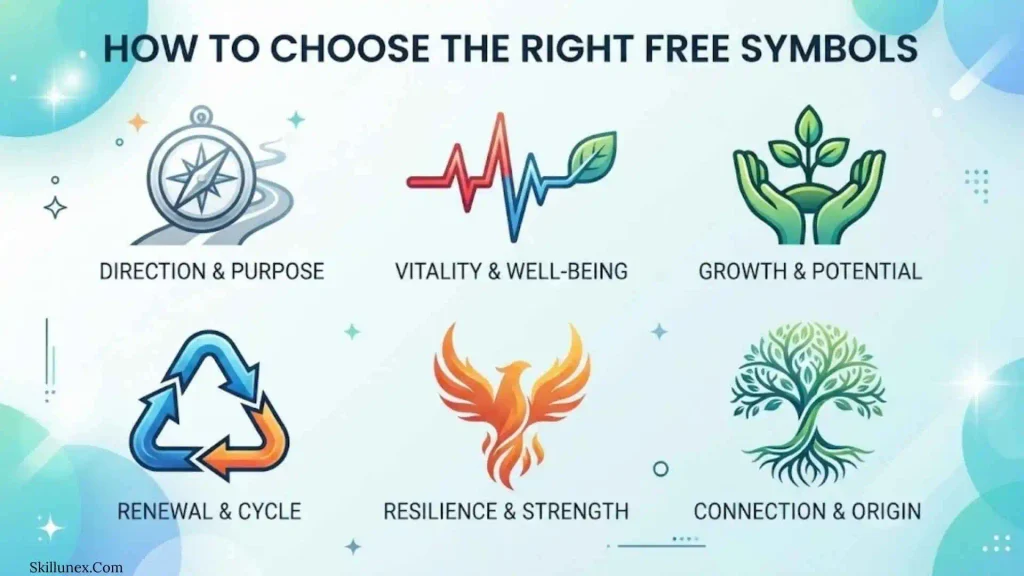
The best symbol isn’t necessarily the most attractive one.
For communication, clarity is more important than decoration.
Choose Simple Images
A simple symbol is often easier to recognize than an image containing many unnecessary details.
For example, a basic cup icon may communicate “drink” more clearly than a complicated photograph of a kitchen table containing several objects.
Use Consistent Symbols
Try to use symbols with a similar visual style within the same resource.
Mixing photographs, cartoon drawings, detailed icons, and unrelated graphic styles can make a communication board visually confusing.
Add Text When Useful
A symbol can be paired with a written label.
For example:
🍎 Apple
or a pictogram with the word Apple underneath.
Text can help reinforce vocabulary and may make the resource useful for both visual and literacy learning.
Consider the User
A symbol that makes sense to one person may not make sense to another.
Consider:
- Age
- Language
- Reading ability
- Visual preferences
- Familiarity with symbols
- Communication needs
- Cultural context
The person using the symbols should be at the center of the design.
How to Make Free Printable Symbol Cards
You can create a simple set of symbol cards with almost any document or design tool.
First, decide which words you need.
For example:
- Help
- Stop
- More
- Finished
- Yes
- No
- Drink
- Eat
Then place one symbol and its label on each card.
A basic card could contain:
[Symbol]
HELP
Keep enough space around the image so the card remains easy to see when printed.
Recommended Card Features
A useful symbol card should generally have:
- One clear concept
- A recognizable image
- A readable label
- Good contrast
- Consistent sizing
- Enough white space
- Durable printing if used frequently
You can laminate printed cards if they will be handled regularly.
Common Mistakes When Using Free Symbols
Free resources are useful, but several mistakes can reduce their value.
Downloading Symbols Without Checking the License
This is the biggest mistake.
A symbol can be free to view or download while still having restrictions on redistribution or commercial use.
Using Too Many Symbols
More symbols do not automatically create a better communication board.
A crowded page can make it difficult to find the desired word.
Start with useful vocabulary and expand gradually.
Using Inconsistent Images
If every symbol comes from a different visual style, the board may look confusing.
When possible, select a consistent collection.
Using Symbols Without Labels When Labels Would Help
Some users understand pictures immediately. Others benefit from seeing the written word as well.
Use labels when they support the person’s communication or learning goals.
Treating a Symbol as Having Only One Meaning
Context matters.
A picture may represent an object, an action, or a broader concept. The meaning should be clear to the person using the communication system.
Free Symbols for Social Stories
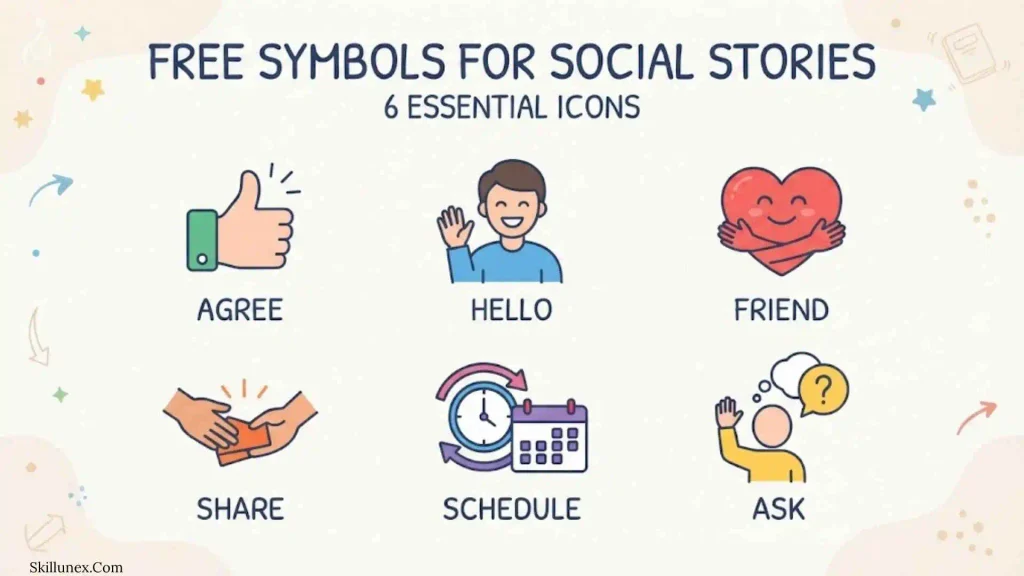
Visual symbols can also be incorporated into social stories and step-by-step explanations.
For example, a story about visiting a doctor could include:
Home → Car → Hospital → Waiting Room → Doctor → Examination → Home
Each step can have a picture and a short sentence.
The purpose is to make the sequence more predictable and understandable.
Free pictogram libraries can be especially useful here because they include symbols for people, places, activities, emotions, and everyday routines. ARASAAC, for example, provides categories covering many routine and special-education concepts.
Free Symbols for Special Education
Visual support can be incorporated into special education materials for many different purposes.
Examples include:
- Daily schedules
- Classroom instructions
- Choice making
- Transitions
- Task sequencing
- Communication
- Vocabulary development
- Social interaction
- Routine learning
The symbol itself is only one part of the resource. The way it is organized and presented can be equally important.
A clear, simple board can be more useful than a large collection of poorly organized pictures.
Boardmaker Symbols Free: What to Look For in a Resource
Before choosing a symbol website, use this checklist.
| Question | Why It Matters |
| Is the source trustworthy? | Helps identify legitimate resources |
| Is the license clearly stated? | Tells you what you can do |
| Can the symbols be printed? | Important for physical boards |
| Are symbols easy to search? | Saves time |
| Are the images clear? | Improves recognition |
| Is attribution required? | Helps you comply with the license |
| Is commercial use allowed? | Important for products and businesses |
| Can images be modified? | Useful for customized resources |
| Is the collection suitable for AAC? | Important for communication systems |
A resource that answers these questions clearly is easier and safer to use.
Frequently Asked Questions
Are Boardmaker Symbols Free?
Not all official Boardmaker symbols are necessarily free. Boardmaker content is part of a proprietary ecosystem, so you should check the current product and licensing terms. Free alternatives such as OpenSymbols and ARASAAC provide separate symbol collections with their own licensing conditions.
Where Can I Find Free AAC Symbols?
OpenSymbols and ARASAAC are two useful places to explore free or open-licensed communication symbols. OpenSymbols combines several symbol collections, while ARASAAC provides a searchable pictogram library covering many communication and educational concepts.
Can I Use Free Symbols in a Communication Board?
Often yes, but check the license for the specific symbol collection first. Some open licenses permit use with attribution, while others may restrict commercial use or require additional conditions.
Can I Print Free Symbols?
Printing may be permitted, but the exact rights depend on the symbol’s license. Always check the terms before printing materials for public distribution, resale, or other commercial purposes.
Are ARASAAC Symbols Free?
ARASAAC provides a large collection of pictograms that can be accessed online, but its symbols are distributed under a Creative Commons BY-NC-SA license. This means the applicable attribution, non-commercial, and share-alike requirements need to be followed.
Is OpenSymbols the Same as Boardmaker?
No. OpenSymbols is a separate open-licensed symbol repository. It contains symbols from multiple sources and is not the same symbol library as official Boardmaker content.
Can I Sell Materials Made With Free Symbols?
That depends on the license of the symbols you use. Some licenses permit commercial use, while others do not. For example, OpenSymbols lists ARASAAC as CC BY-NC-SA, which includes a non-commercial restriction.
Can I Modify Free Symbols?
Some licenses permit modifications, while others may impose conditions on modified versions. Check the license before editing, combining, or redistributing a symbol.
Are Free Symbols Good for AAC?
They can be. The most important considerations are whether the symbols are understandable to the individual, whether the vocabulary is appropriate, and whether the communication system is organized effectively. Free symbols can be used as part of AAC materials when their licenses permit the intended use.
How Many Symbols Should a Communication Board Have?
There is no single number that works for everyone. The appropriate number depends on the person’s communication abilities, visual needs, vocabulary, and the purpose of the board. A small board may be useful for basic choices, while a more advanced AAC system can contain a much larger vocabulary.
Conclusion
The search for Boardmaker symbols free can lead to two different solutions: official Boardmaker resources and free alternative symbol libraries.
If you specifically need Boardmaker’s proprietary symbols, check the current official licensing and product terms. If your goal is to create free visual communication materials, resources such as OpenSymbols and ARASAAC provide extensive collections of pictograms and communication symbols.
The most important thing is not simply finding the largest collection of free pictures. Choose symbols that are clear, consistent, appropriate for the user, and legally available for your intended purpose.
For AAC boards, visual schedules, classroom resources, social stories, and home routines, a carefully selected group of simple symbols can be much more useful than hundreds of unrelated images. Always check the license before printing, sharing, modifying, or selling materials, especially when using symbols from different collections.

Isla Kensington
I’m Isla Kensington, a writer with a passion for research, culture, nature, and the fascinating meanings behind everyday things. I enjoy taking topics that may seem simple at first and discovering the history, facts, and ideas that make them more interesting.
I write with readers in mind. My aim is to provide clear explanations, useful information, and interesting details without making a topic unnecessarily complicated.
I believe learning should feel like discovering something rather than simply reading facts. That philosophy guides the content I create and the topics I choose to explore.
## Books by Isla Kensington
* Symbols Around the World: A Guide to Meaning & Culture
* Nature’s Beautiful Places: Lakes, Landscapes & Natural Treasures