Cryptic symbols have fascinated people for centuries. From mysterious markings found in ancient manuscripts to coded characters used in puzzles, games, art, and digital communication, these symbols can represent ideas, words, sounds, objects, or hidden information. Their unusual appearance often creates a sense of mystery, but understanding them usually requires looking closely at their context, history, and purpose.
If you have encountered a strange collection of characters in a puzzle, discovered unfamiliar symbols in an old text, or simply want to understand what cryptic symbols mean, learning how symbolic systems work can make the subject much easier to explore.
This guide explains what cryptic symbols are, the different types you may encounter, where they are used, how they differ from codes and ciphers, and practical methods for interpreting or decoding them.
What Are Cryptic Symbols?
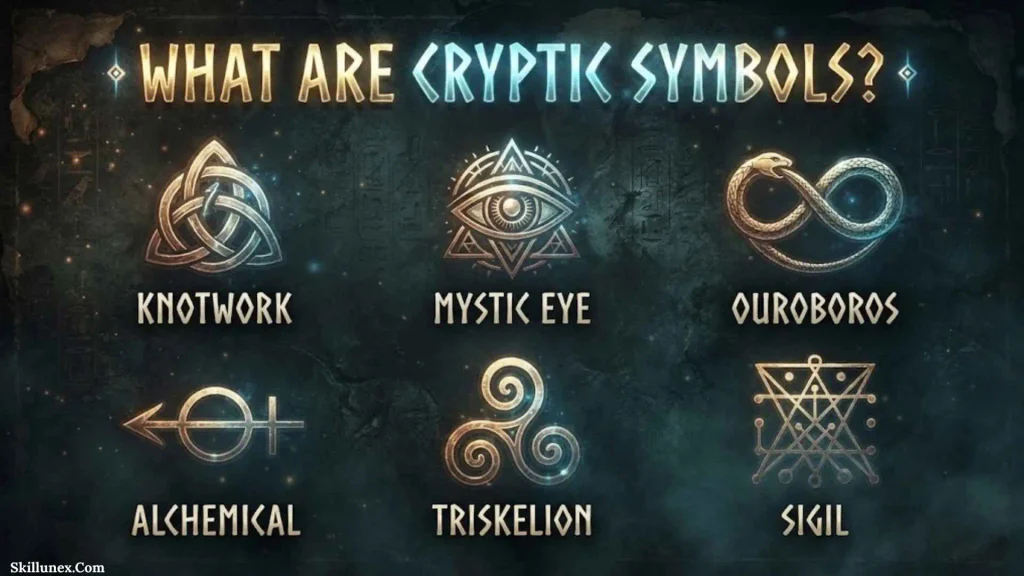
Cryptic symbols are characters, signs, or visual representations whose meaning is not immediately obvious. The term “cryptic” suggests something mysterious, concealed, obscure, or difficult to interpret.
A cryptic symbol can take many forms. It might be a simple geometric shape, an unfamiliar character, an ancient inscription, a combination of letters and numbers, or a deliberately invented mark. In some situations, the symbol has an established meaning. In others, its meaning depends entirely on the system or context in which it appears.
For example, a symbol used in an ancient religious manuscript may have cultural or spiritual significance. The same-looking shape could have an entirely different purpose in a modern puzzle or fictional story.
What Makes a Symbol Cryptic?
A symbol generally feels cryptic when its meaning is difficult to determine without additional information.
Several factors can make a symbol appear mysterious:
- It may belong to an unfamiliar writing system.
- Its meaning may depend on a specific culture or historical period.
- It may be part of a code or cipher.
- It may use abstract shapes instead of ordinary letters.
- It may have several possible interpretations.
- It may have been deliberately designed to hide information.
- It may be fictional or created specifically for a game, story, or artwork.
This means that “cryptic” does not necessarily mean “secret.” A symbol can be cryptic simply because the viewer does not recognize the system behind it.
Types of Cryptic Symbols
Cryptic symbols can be divided into several broad categories. Understanding these categories makes it easier to determine what you are looking at.
Ancient and Historical Symbols
Ancient civilizations used visual signs to record information, communicate beliefs, identify objects, and preserve cultural knowledge.
Writing systems such as Egyptian hieroglyphs demonstrate how pictures and symbols can function as a sophisticated method of communication. Other historical cultures developed scripts and symbolic systems that may look mysterious to modern readers simply because the writing system is unfamiliar.
Historical symbols should be interpreted carefully because their meanings depend heavily on archaeological, linguistic, and cultural evidence.
Symbolic and Religious Signs
Many cultures have developed symbols associated with religion, philosophy, mythology, or spiritual traditions.
A symbol may represent an abstract concept such as life, death, protection, knowledge, creation, or transformation. Its interpretation can vary significantly between cultures, so assuming that a symbol has one universal meaning can lead to inaccurate conclusions.
Puzzle Symbols
Cryptic symbols are especially common in puzzles. A puzzle creator may replace letters with unfamiliar marks so that the solver must identify the underlying pattern.
For example, a puzzle might use circles, triangles, squares, and lines in place of letters. The objective could be to determine which symbol represents each letter and then reconstruct the hidden message.
These systems are usually designed to be solvable through clues, repetition, patterns, or an accompanying key.
Secret-Code Symbols
Symbols can also form part of a secret communication system. Instead of writing ordinary letters, someone may assign different symbols to represent them.
A simple substitution system could theoretically replace every letter with another character or symbol. The resulting message may look meaningless to someone who does not know the substitution system.
However, a symbolic representation is not automatically a secure form of encryption. A simple substitution can often be analyzed using patterns and frequency analysis.
Fictional and Fantasy Symbols
Books, films, video games, comics, and other forms of entertainment frequently use invented symbols.
A fictional civilization might have its own alphabet, writing system, magical markings, or symbols. These designs are often created to make an imaginary world feel more detailed and believable.
Unlike historical writing systems, fictional symbols may have no meaning outside the story in which they were created.
Modern Icons and Digital Symbols
Modern technology has introduced millions of visual symbols into everyday life. Icons on smartphones, computers, websites, vehicles, and appliances communicate information quickly without requiring lengthy explanations.
Some digital symbols are instantly recognizable, while others may seem cryptic when first encountered. Their meanings are usually determined by design conventions, software interfaces, or the specific platform using them.
Cryptic Symbols vs. Codes and Ciphers
One of the most important distinctions to understand is the difference between a symbol, a code, and a cipher.
A symbol is a representation of something else. It may represent an idea, object, sound, word, or concept.
A code generally uses predefined representations to communicate information. For example, a particular signal might represent a particular word or instruction.
A cipher transforms information according to a rule so that the original message is concealed from people who do not know how to reverse the transformation.
These concepts can overlap. A cipher may use symbols as its output, while a code may assign symbols to particular meanings. Therefore, seeing unusual characters does not automatically mean that you are looking at an encrypted message.
Why the Difference Matters
Understanding the difference helps you choose the correct method of interpretation.
If you are looking at an ancient writing system, historical and linguistic research may be more useful than cryptanalysis. If you are examining a substitution cipher, pattern analysis may be the better approach.
Before trying to decode something, first determine what kind of system it is likely to be.
Where Are Cryptic Symbols Used?
Cryptic symbols appear in far more places than secret messages and puzzles.
Cryptic Symbols in History and Archaeology
Archaeologists and historians frequently encounter inscriptions, markings, seals, and manuscripts containing unfamiliar signs.
Some ancient writing systems were deciphered only after researchers discovered additional evidence that connected the symbols with known languages. In other cases, the meaning of an inscription remains uncertain because there is not enough evidence.
Historical interpretation requires more than matching a mysterious shape with a symbol found online. Researchers consider the location, age, surrounding text, archaeological evidence, language, and cultural context.
Cryptic Symbols in Games and Puzzles
Games often use mysterious symbols to encourage exploration and problem-solving.
A player might find a wall covered in unfamiliar markings, a sequence of symbols on a locked mechanism, or a collection of characters that appears to form a hidden message.
Good puzzle design usually provides enough information for players to recognize patterns and gradually work out the system.
Cryptic Symbols in Art
Artists may use symbols to communicate concepts that are difficult to express directly.
An abstract shape, repeated mark, or symbolic object can encourage viewers to develop their own interpretations. In some artwork, the mystery is intentional—the symbol does not have one obvious answer.
This is different from a genuine writing system, where symbols generally have specific conventions or meanings.
Cryptic Symbols in Literature and Storytelling
Writers use mysterious symbols as storytelling devices. A recurring mark might represent a secret organization, an ancient civilization, a prophecy, or an important character.
The symbol can become a visual clue that connects different parts of a story.
This technique is particularly effective because readers may notice the symbol before they understand its significance.
Cryptic Symbols Online
The internet has created new environments for symbolic communication.
Users may employ unusual characters, emojis, shorthand, ASCII art, mathematical notation, or community-specific symbols. In some online communities, symbols acquire meanings that are obvious to regular members but confusing to outsiders.
This demonstrates an important principle: meaning comes from shared understanding and context.
How to Decode Cryptic Symbols
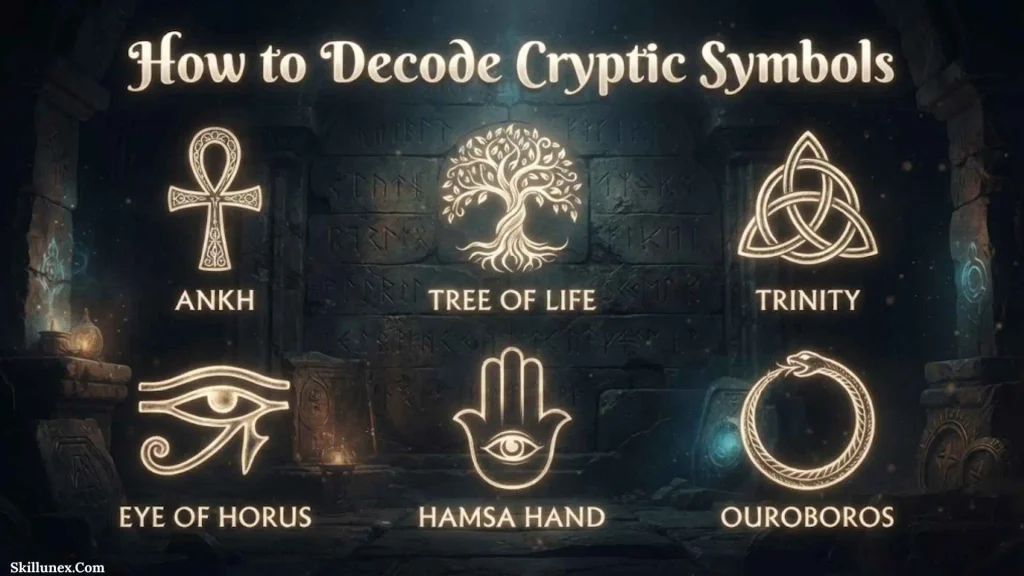
If you encounter an unexplained sequence of symbols, avoid immediately assigning meanings to individual characters. Instead, examine the entire system.
Record the Symbols Exactly
Start by copying or photographing the symbols accurately.
Small differences can matter. A line, dot, curve, or orientation may distinguish one character from another.
If you are transcribing them manually, keep the original order and spacing whenever possible.
Look for Repeated Symbols
Repetition can provide valuable clues.
If one symbol appears many times, it could represent a frequently used letter, sound, word, or grammatical element. Repeated groups can be even more informative.
For example, if the same three-symbol sequence appears at the end of several groups, it may represent a common ending or word.
Examine the Structure
Look at how the symbols are arranged.
Ask questions such as:
- How many symbols are in each group?
- Are there spaces between groups?
- Are some symbols always next to each other?
- Do certain symbols appear at the beginning or end?
- Are numbers mixed with letters?
- Are some characters mirrored or rotated?
- Does punctuation appear?
These observations can reveal how the system works.
Consider the Context
Context is one of the strongest clues.
Ask where the symbols were found and what surrounds them. A symbol on an archaeological artifact should be approached differently from a symbol inside a video game.
The date, location, language, subject matter, and intended audience can all help narrow down possible interpretations.
Search for a Known Writing System
If the symbols appear historical or linguistic, compare them with established writing systems.
However, visual similarity alone is not proof that two symbols are related. Many unrelated writing systems contain similar shapes because circles, lines, crosses, and simple geometric forms are common design elements.
Look for a Key
Some puzzles and symbolic systems provide a key, legend, inscription, or translation guide.
A key can transform the problem from open-ended interpretation into a straightforward substitution or translation exercise.
Test Possible Interpretations
Once you have a hypothesis, test it against the entire message.
A good interpretation should explain more than one isolated symbol. It should work consistently across repeated patterns and different sections of the text.
If a proposed solution only explains one small part, it may be coincidence rather than a genuine solution.
Common Mistakes When Interpreting Cryptic Symbols
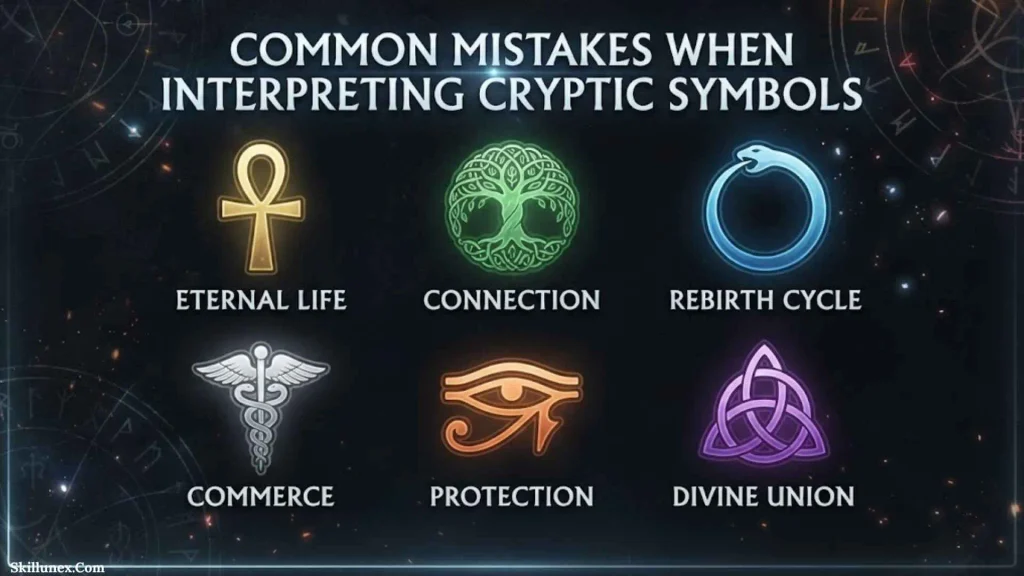
Interpreting mysterious symbols can be enjoyable, but several common mistakes can produce misleading results.
Assuming Every Symbol Has a Universal Meaning
Symbols rarely have one meaning across every culture and period.
A shape that represents one concept in one tradition may have a completely different meaning elsewhere.
Confusing Visual Similarity With Historical Connection
Two symbols can look almost identical without being historically related.
Simple shapes such as circles, crosses, triangles, and lines occur independently in many writing and artistic traditions.
Ignoring the Original Context
Removing a symbol from its original context can change its apparent meaning.
A character found on a particular artifact should be considered alongside the artifact’s origin, date, purpose, and surrounding markings.
Treating Random Symbols as a Hidden Message
Not every unusual sequence contains a secret message.
Symbols can be decorative, artistic, fictional, experimental, or meaningless. Before attempting elaborate decoding methods, establish whether there is evidence that the symbols actually encode information.
Relying on a Single Online Interpretation
Internet searches can be useful, but they can also produce inaccurate or speculative explanations.
When researching an unfamiliar symbol, compare multiple reliable sources and pay attention to the evidence behind each interpretation.
Why Do People Find Cryptic Symbols Fascinating?
The attraction of cryptic symbols is closely connected to human curiosity.
When people encounter information they cannot immediately understand, they naturally look for patterns and explanations. A mysterious symbol creates a small intellectual puzzle: What does it mean? Who created it? Why was it used? Is there a hidden message?
Cryptic symbols also connect different fields of knowledge. Understanding one mysterious inscription may involve history, linguistics, archaeology, mathematics, art, computer science, or cultural studies.
For puzzle enthusiasts, the appeal is the challenge. For historians, it may be the possibility of learning more about the past. For artists and writers, symbols provide a way to communicate ideas indirectly.
Cryptic Symbols in Popular Culture
Mystery surrounding symbols has made them a popular storytelling device.
Films and television shows often use mysterious markings to suggest ancient secrets. Video games may hide symbols throughout their environments as clues to puzzles or fictional histories. Fantasy novels frequently create imaginary alphabets and symbolic systems for fictional civilizations.
These representations can be entertaining, but they should not automatically be treated as historically authentic.
A symbol designed for a fictional universe may intentionally borrow visual features from real-world writing systems without having any genuine historical connection to them.
How Technology Helps With Cryptic Symbols
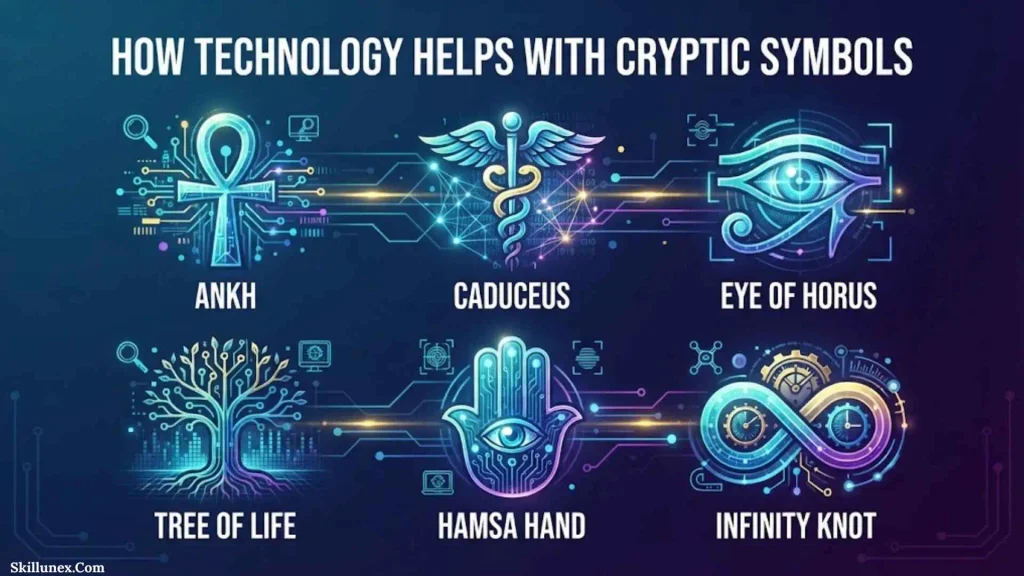
Modern technology has made symbol analysis easier.
Digital image tools can help researchers enlarge inscriptions and improve visibility. Optical character recognition can sometimes identify known scripts, although its accuracy depends heavily on the quality and type of the source material.
Search engines and digital archives also make it easier to compare unfamiliar characters with historical manuscripts, writing systems, and academic resources.
Machine learning and pattern-recognition systems can potentially assist researchers in identifying repeated structures or comparing large collections of inscriptions. However, automated identification does not eliminate the need for human expertise and historical context.
Frequently Asked Questions
What does “cryptic symbols” mean?
Cryptic symbols are unusual, mysterious, or difficult-to-understand signs whose meaning may not be immediately apparent. They can represent language, ideas, objects, codes, or concepts depending on their context.
Are cryptic symbols always secret codes?
No. A cryptic symbol is not necessarily a code. It may simply belong to an unfamiliar writing system, cultural tradition, artwork, game, or symbolic language.
How can I identify an unknown symbol?
Start by recording the symbol accurately and examining its surrounding context. Look for repetition, patterns, accompanying text, and clues about where or when it was created. If appropriate, compare it with reliable references on writing systems, symbols, and historical scripts.
Can cryptic symbols have multiple meanings?
Yes. A symbol can have different meanings depending on the culture, historical period, context, or system in which it is used.
Are all mysterious symbols ancient?
No. Cryptic symbols can be ancient, modern, or completely fictional. They appear in historical texts, puzzles, games, art, literature, technology, and online communities.
What is the difference between a symbol and a cipher?
A symbol is a representation that can communicate an idea, object, sound, or concept. A cipher is a systematic transformation used to conceal or transform information. A cipher can use symbols, but not every symbol is part of a cipher.
Why are cryptic symbols used in puzzles?
They make puzzles more challenging by hiding familiar information behind unfamiliar representations. Solvers must identify patterns, discover rules, or find a key before they can understand the message.
Can computers decode cryptic symbols?
Computers can assist with recognizing patterns and identifying known characters, particularly when good-quality digital images are available. However, interpreting an unfamiliar symbol often requires cultural, historical, or linguistic knowledge that automated tools may not reliably provide.
Conclusion
Cryptic symbols are more than mysterious-looking marks. They are part of the broader human history of communication, storytelling, art, and information exchange.
Some symbols belong to ancient writing systems, while others are used in modern technology, puzzles, games, literature, and online communities. Some have well established meanings, while others remain open to interpretation.
The most reliable way to understand cryptic symbols is to examine them systematically. Record them accurately, identify patterns, consider their context, research possible origins, and test interpretations against the available evidence. Most importantly, avoid assuming that a familiar-looking shape has the same meaning everywhere.
If you are studying an ancient inscription, solving a puzzle, researching an unusual character, or exploring symbolic language for creative purposes, cryptic symbols offer an intriguing reminder that communication does not always have to rely on ordinary words.

I’m Adrian Holloway, a writer and researcher who enjoys exploring the stories, meanings, and interesting facts behind the subjects people search for every day. I’m especially interested in symbols, nature, lakes, places, and cultural topics that help readers understand the world from a different perspective.
I believe useful content should be simple, accurate, and enjoyable to read. When I research a topic, I focus on finding meaningful details and presenting them in a way that makes information easy to understand.
My goal is to create helpful articles that answer real questions while encouraging readers to discover something new with every visit.
Books by Adrian Holloway
The Language of Symbols: Meanings, Stories & Traditions
Hidden Wonders of Nature: Lakes, Landscapes & Discovery