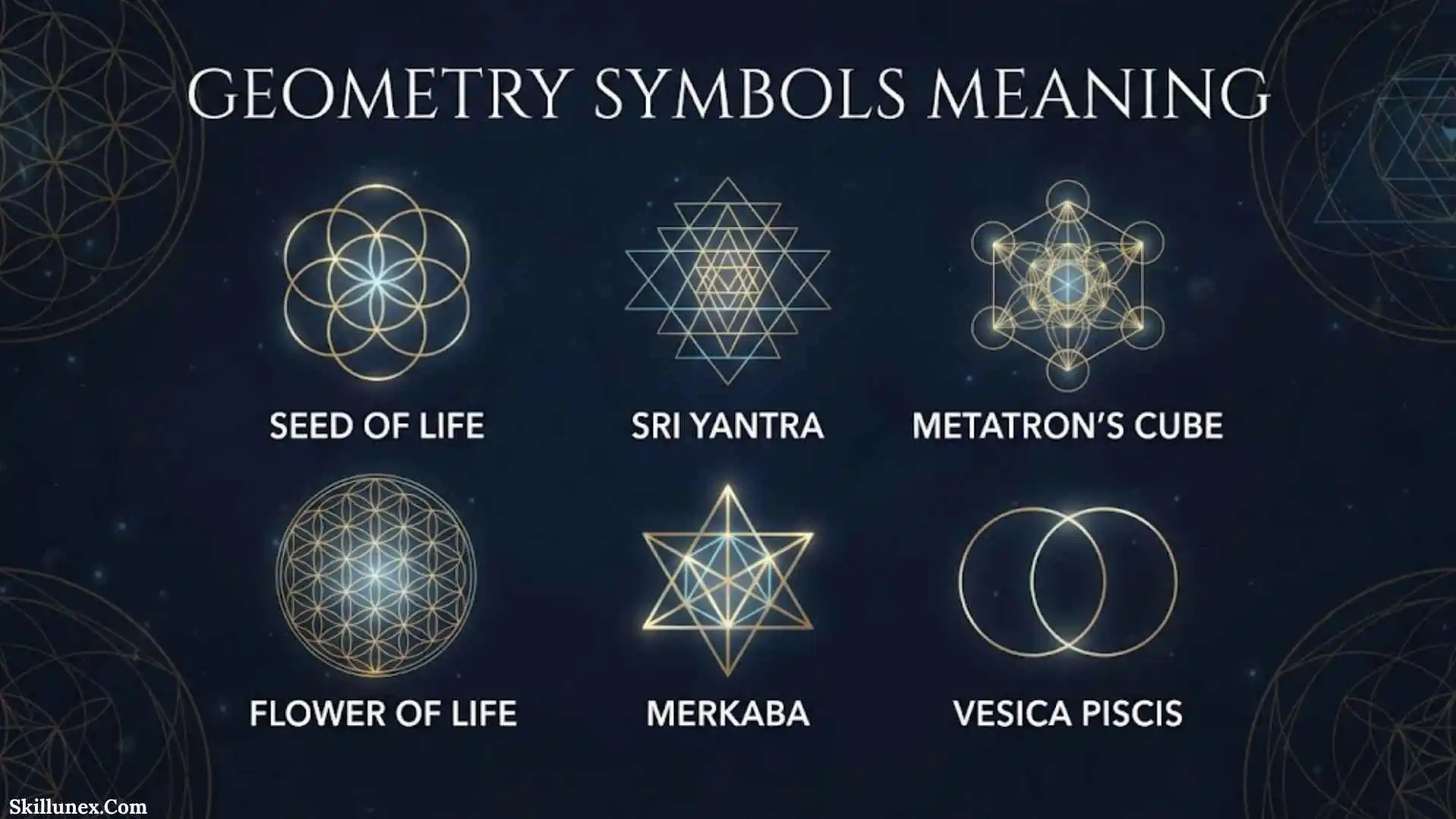
Have you ever looked at a geometry diagram and felt confused by the tiny marks, arrows, letters, and mathematical symbols? If you have, you are not alone. Geometry has its own visual language, and once you understand what each symbol means, diagrams and problems become much easier to read. I find that learning the notation first makes it much easier to understand the actual geometry behind a question.
In this complete guide, you’ll learn the geometry symbols meaning behind common points, lines, segments, rays, angles, triangles, circles, measurements, and relationships. I’ll also explain diagram markings, congruence, similarity, parallel and perpendicular lines, common formulas, proof symbols, common mistakes, and frequently asked questions so you can use these symbols confidently in your own geometry work.
Quick Answer: What Do Geometry Symbols Mean?
Geometry symbols are shorthand marks used to represent geometric objects, measurements, and relationships.
Here are some of the most common ones:
| Symbol | Meaning |
| ∠ | Angle |
| ° | Degrees |
| ⊥ | Perpendicular |
| ∥ | Parallel |
| ≅ | Congruent |
| ∼ | Similar |
| ≈ | Approximately equal |
| ≠ | Not equal |
| △ | Triangle |
| π | Pi |
| ⌒ | Arc |
| ∴ | Therefore |
| ∵ | Because |
| \overline{AB} | Line segment AB |
| \overrightarrow{AB} | Ray AB |
| \overleftrightarrow{AB} | Line AB |
The exact notation can vary slightly between textbooks and mathematical contexts, but these are among the most common symbols you will encounter.
What Are Geometry Symbols?
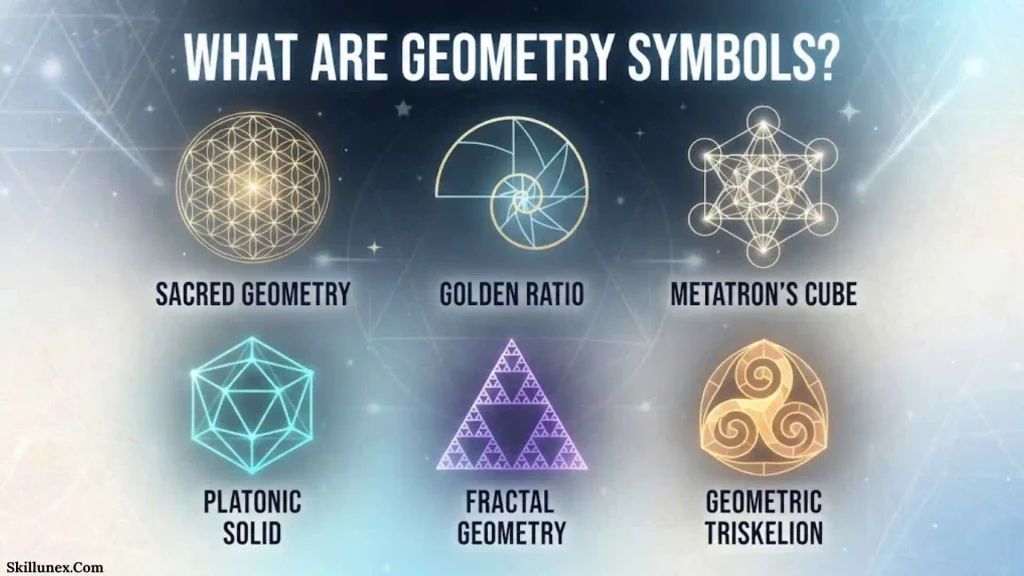
Geometry symbols are mathematical shorthand used to communicate information about shapes, measurements, points, lines, angles, and relationships.
Instead of writing:
Line AB is perpendicular to line CD.
You can write:
AB ⊥ CD
Likewise, instead of writing:
Angle ABC measures 60 degrees.
you can write:
∠ABC = 60°
This makes mathematical communication shorter and allows you to understand a diagram without reading a large amount of text.
Why Are Geometry Symbols Important?
If you are learning geometry, symbols can help you quickly identify:
- Points
- Lines
- Rays
- Line segments
- Angles
- Parallel lines
- Perpendicular lines
- Congruent figures
- Similar figures
- Equal measurements
- Circle components
- Angle relationships
Once you recognize the symbols, you can spend more time solving the actual problem instead of trying to understand what the diagram is saying.
Geometry Symbols Are Not Always Standalone Characters
One important thing to remember is that geometry information is not always represented by a keyboard symbol.
A diagram may communicate information through:
- Arrows
- Tick marks
- Angle arcs
- Right-angle squares
- Labels
- Matching patterns
For example, two sides with identical tick marks generally indicate that those sides have equal lengths.
Point, Line, Segment, And Ray Symbols
Before learning more advanced notation, you should understand the basic geometric objects.
Point Symbol And Meaning
A point represents a specific location.
It is usually shown as a small dot and identified with a capital letter.
For example:
A
means point A.
A point has a location but no measurable length, width, or thickness in ideal geometry.
Line Segment Symbol And Meaning
A line segment has two endpoints.
It can be written as:
\overline{AB}
This means the segment begins at A and ends at B.
Unlike a line, a segment does not continue forever.
You can think of it as a finite portion of a line.
Line Symbol And Meaning
A line extends indefinitely in both directions.
It can be written as:
\overleftrightarrow{AB}
The arrows indicate that the line continues beyond A and B.
So if you see:
A ←────────→ B
you are looking at a representation of a line rather than a segment.
Ray Symbol And Meaning
A ray has one endpoint and extends infinitely in one direction.
It can be written as:
\overrightarrow{AB}
Ray AB starts at A and passes through B.
This order is important.
Ray AB starts at A.
Ray BA starts at B.
Segment, Line, And Ray Comparison
| Object | Common Notation | Key Property |
| Point | A | Exact location |
| Segment | \overline{AB} | Two endpoints |
| Ray | \overrightarrow{AB} | One endpoint |
| Line | \overleftrightarrow{AB} | Extends in both directions |
If you can distinguish these four objects, you already understand an important part of geometry notation.
Angle Symbols And Their Meanings
Angles appear in almost every area of elementary and intermediate geometry.
Angle Symbol
The standard angle symbol is:
∠
For example:
∠ABC
means angle ABC.
When three letters are used to name an angle, the middle letter identifies the vertex.
Therefore, in:
∠ABC
point B is the vertex.
Degree Symbol
The degree symbol is:
°
It is used to describe the measure of an angle.
Examples include:
- 30°
- 45°
- 90°
- 120°
- 180°
If you see ∠A = 45°, the angle has a measure of 45 degrees.
Right Angle Symbol
A right angle measures exactly:
90°
In a geometry diagram, you may not see “90°” written inside the angle. Instead, a small square is placed in the corner.
That square tells you that the angle is a right angle.
Acute Angle
An acute angle measures:
less than 90°
Examples include:
- 20°
- 35°
- 60°
- 89°
Obtuse Angle
An obtuse angle measures:
more than 90° but less than 180°
Examples include:
- 100°
- 125°
- 160°
Straight Angle
A straight angle measures:
180°
It forms a straight line.
Reflex Angle
A reflex angle measures:
more than 180° but less than 360°
Understanding these classifications helps you interpret angle diagrams quickly.
Parallel And Perpendicular Symbols
Parallel and perpendicular relationships are two of the most important relationships represented in geometry.
Parallel Symbol
The symbol for parallel is:
∥
For example:
AB ∥ CD
means line AB is parallel to line CD.
Parallel lines lie in the same plane and do not intersect.
Perpendicular Symbol
The symbol for perpendicular is:
⊥
For example:
AB ⊥ CD
means line AB is perpendicular to line CD.
Perpendicular lines intersect at a right angle.
Therefore:
AB ⊥ CD → 90° intersection
Parallel And Perpendicular Comparison
| Symbol | Meaning |
| ∥ | Parallel |
| ⊥ | Perpendicular |
A simple memory trick is:
∥ looks like two parallel lines.
⊥ resembles two lines meeting at a right angle.
Equal, Not Equal, And Approximate Symbols
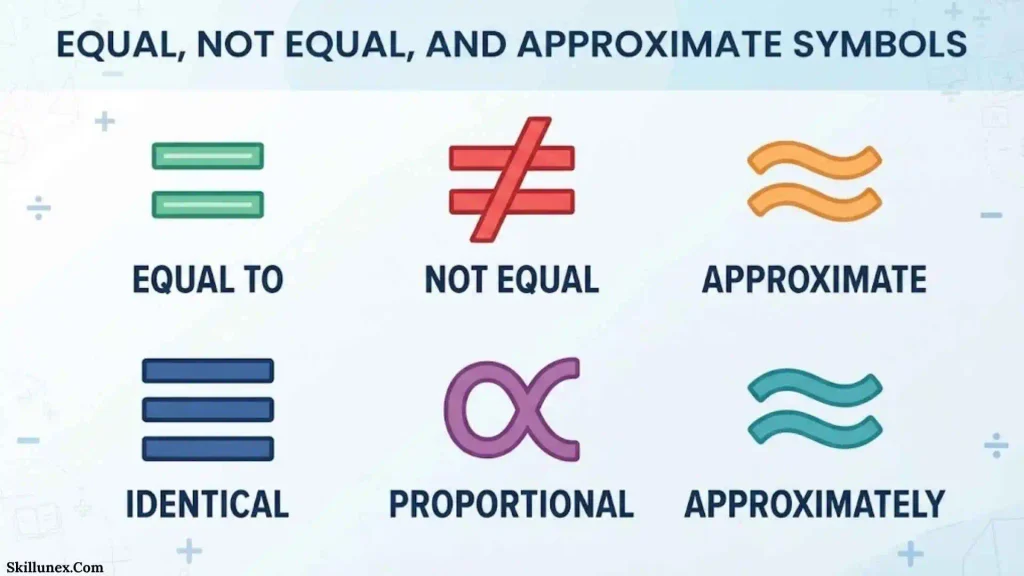
Geometry frequently compares lengths, angles, areas, and other measurements.
Equal Symbol
The equal symbol is:
=
For example:
AB = CD
means the two lengths are equal.
Not Equal Symbol
The not-equal symbol is:
≠
For example:
AB ≠ CD
means the two lengths are not equal.
Approximately Equal Symbol
The approximately equal symbol is:
≈
It means two values are approximately the same.
For example:
π ≈ 3.14159
This symbol is especially useful when a calculation has been rounded.
Congruent And Similar Geometry Symbols
Congruence and similarity are commonly confused, so understanding their symbols is important.
Congruent Symbol
The symbol for congruent is:
≅
For example:
△ABC ≅ △DEF
means the two triangles are congruent.
Congruent figures have the same shape and the same size. They can still be positioned differently because a figure may be translated, rotated, or reflected.
Similar Symbol
The symbol commonly used for similarity is:
∼
For example:
△ABC ∼ △DEF
means the triangles are similar.
Similar figures have the same shape, but their sizes may differ. Corresponding lengths are proportional.
Congruent vs Similar
| Symbol | Meaning | Size |
| ≅ | Congruent | Same size and shape |
| ∼ | Similar | Same shape, proportional dimensions |
For example, two differently sized squares are similar, while two squares with exactly the same side length are congruent.
Triangle Symbols And Markings
Triangles have several important symbols and visual markings.
Triangle Symbol
The triangle symbol is:
△
For example:
△ABC
means triangle ABC.
Triangle Side Tick Marks
You may see small marks placed across triangle sides.
Matching tick marks indicate equal side lengths.
For example, if two sides each have one tick mark, those sides are marked as equal.
If all three sides have matching markings, the triangle is equilateral.
Triangle Angle Arc Marks
Angles can also be marked with arcs.
Matching arc markings indicate equal angle measures.
For example, two angles with one matching arc each are marked as congruent.
Equilateral Triangle
An equilateral triangle has three equal sides.
Each interior angle measures:
60°
Isosceles Triangle
An isosceles triangle has at least two equal sides.
The angles opposite the equal sides are also equal.
Scalene Triangle
A scalene triangle has three sides of different lengths.
Right Triangle
A right triangle contains one 90° angle.
The right angle is usually identified by a small square.
Circle Symbols And Notation
Circles have their own collection of commonly used terms and symbols.
Circle And Center
A circle is often named by its center.
For example:
Circle O
means O is the center.
The center may be shown as a point inside the circle.
Radius
A radius is a segment from the center of a circle to a point on the circle.
The radius is commonly represented by:
r
If O is the center and A lies on the circle, segment OA is a radius.
Diameter
A diameter is a segment whose endpoints lie on the circle and which passes through the center.
The diameter is commonly represented by:
d
The relationship between diameter and radius is:
d = 2r
Circumference
Circumference means the distance around the circle.
The formula is:
C = 2πr
or:
C = πd
Circle Area
The area of a circle is:
A = πr²
These formulas are fundamental when solving circle-related geometry problems.
Arc Symbols And Meanings
An arc is a portion of a circle’s circumference.
An arc may be indicated using a curved mark over its endpoints.
For example:
⌒AB
can indicate the arc from A to B.
Minor Arc
A minor arc measures less than 180°.
It is usually named using two endpoints when there is no ambiguity.
Major Arc
A major arc measures more than 180°.
It is commonly named with three letters to make the intended arc clear.
Semicircle
A semicircle is half of a circle.
Its measure is:
180°
When naming a semicircle, three letters are often used so the intended half of the circle is clear.
Geometry Symbols For Angle Relationships
Some geometry relationships are expressed through measurements and diagram markings rather than one unique symbol.
Complementary Angles
Two angles are complementary if their measures add to:
90°
For example:
40° + 50° = 90°
Supplementary Angles
Two angles are supplementary if their measures add to:
180°
For example:
110° + 70° = 180°
Vertical Angles
Vertical angles are opposite angles formed by two intersecting lines.
Vertical angles are congruent.
Matching arcs or other markings may be used to identify them in diagrams.
Adjacent Angles
Adjacent angles share a common vertex and a common side, with interiors that do not overlap.
Their relationship is usually understood from their position in the diagram rather than from a unique symbol.
Geometry Measurement Symbols
Geometry uses different units for length, area, and volume.
Length Symbols
Common length units include:
- mm = millimeter
- cm = centimeter
- m = meter
- km = kilometer
- in = inch
- ft = foot
- yd = yard
- mi = mile
Area Symbols
Area is measured in square units.
Examples include:
- cm²
- m²
- in²
- ft²
The superscript 2 indicates square units.
Volume Symbols
Volume is measured in cubic units.
Examples include:
- cm³
- m³
- in³
- ft³
The superscript 3 indicates cubic units.
Geometry Symbols For Perimeter, Area, And Volume
Some letters are commonly used as abbreviations for measurements, although notation can vary by textbook.
Perimeter
P is often used for perimeter.
For a rectangle:
P = 2l + 2w
where:
- l = length
- w = width
Area
A is commonly used for area.
For a rectangle:
A = lw
Volume
V is commonly used for volume.
For a rectangular prism:
V = lwh
You should always check the definitions given in a particular problem because symbols can have different meanings depending on context.
Geometry Proof Symbols And Notation
If you are studying geometric proofs, you may encounter symbols that help connect statements and reasons.
Therefore Symbol
The symbol:
∴
means therefore.
It can introduce a conclusion.
For example:
AB = AC
∴ △ABC is isosceles
The exact proof format depends on the textbook or teacher.
Because Symbol
The symbol:
∵
means because.
It may be used to introduce a reason for a mathematical statement.
Given Information
Geometry problems often provide information labeled as “Given.”
For example:
AB ∥ CD
may be given at the beginning of a proof.
The diagram may also use arrows or markings to show the same relationship visually.
Geometry Diagram Markings You Should Know
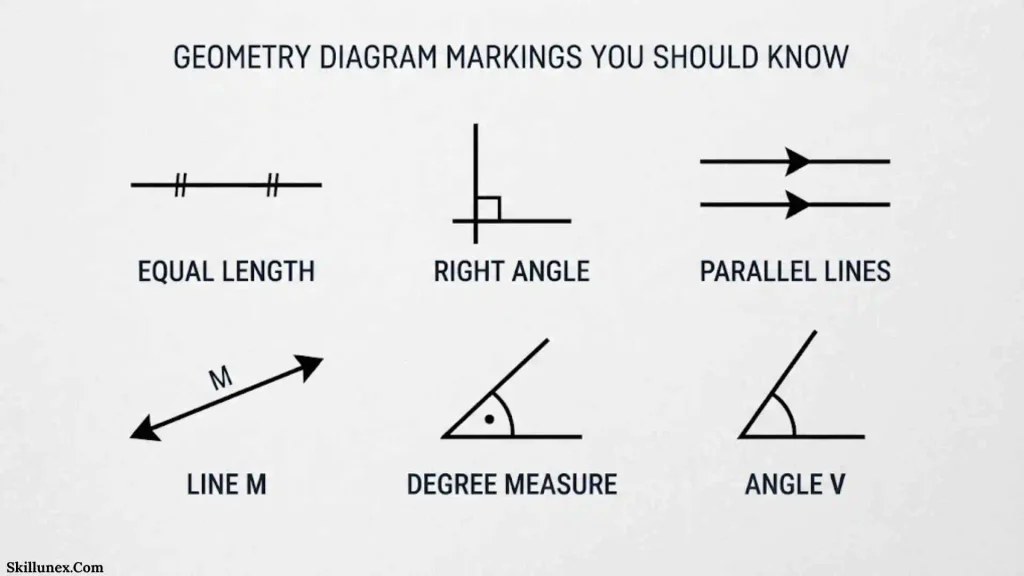
Many of the most important pieces of information in geometry diagrams are communicated through markings rather than special keyboard characters.
Matching Tick Marks
Matching tick marks on line segments indicate that those segments are congruent.
For example:
AB ≅ CD
may be represented visually by placing the same number of tick marks on AB and CD.
Matching Angle Arcs
Matching arcs indicate congruent angles.
If two angles each have one arc, they are marked as equal in measure.
If another pair has two arcs, those two angles form a separate matching pair.
Right-Angle Squares
A small square indicates a 90° angle.
This is one of the most useful markings to recognize.
Parallel-Line Arrows
Parallel lines are often marked with matching arrow patterns.
For example, two lines may each contain one small arrow.
Another pair of parallel lines may contain two arrows each.
Matching arrow markings indicate which lines are parallel.
Common Geometry Symbols Cheat Sheet
| Symbol | Meaning |
| ∠ | Angle |
| ° | Degree |
| ⊥ | Perpendicular |
| ∥ | Parallel |
| ≅ | Congruent |
| ∼ | Similar |
| ≈ | Approximately equal |
| ≠ | Not equal |
| = | Equal |
| △ | Triangle |
| π | Pi |
| ⌒ | Arc |
| ∴ | Therefore |
| ∵ | Because |
| r | Radius |
| d | Diameter |
| P | Common notation for perimeter |
| A | Common notation for area |
| V | Common notation for volume |
| \overline{AB} | Segment AB |
| \overrightarrow{AB} | Ray AB |
| \overleftrightarrow{AB} | Line AB |
How To Read Geometry Symbols In A Diagram
When I read a geometry diagram, I do not try to understand everything at once. You can make the process easier by checking the diagram systematically.
Start With The Labels
First, identify the letters.
If you see:
A, B, C, D
these labels allow you to identify specific points, segments, and angles.
Identify The Geometric Objects
Next, determine whether you are looking at:
- Points
- Segments
- Rays
- Lines
- Angles
- Triangles
- Circles
Look carefully at arrowheads because they tell you whether an object continues indefinitely.
Look For Matching Markings
After that, check for:
- Tick marks
- Angle arcs
- Right-angle squares
- Parallel arrows
These markings often provide information that is essential for solving the problem.
Check The Relationships
Finally, identify whether the diagram tells you that something is:
- Equal
- Parallel
- Perpendicular
- Congruent
- Similar
Once you identify these relationships, you can usually determine which formula, theorem, or property applies.
How To Memorize Geometry Symbols
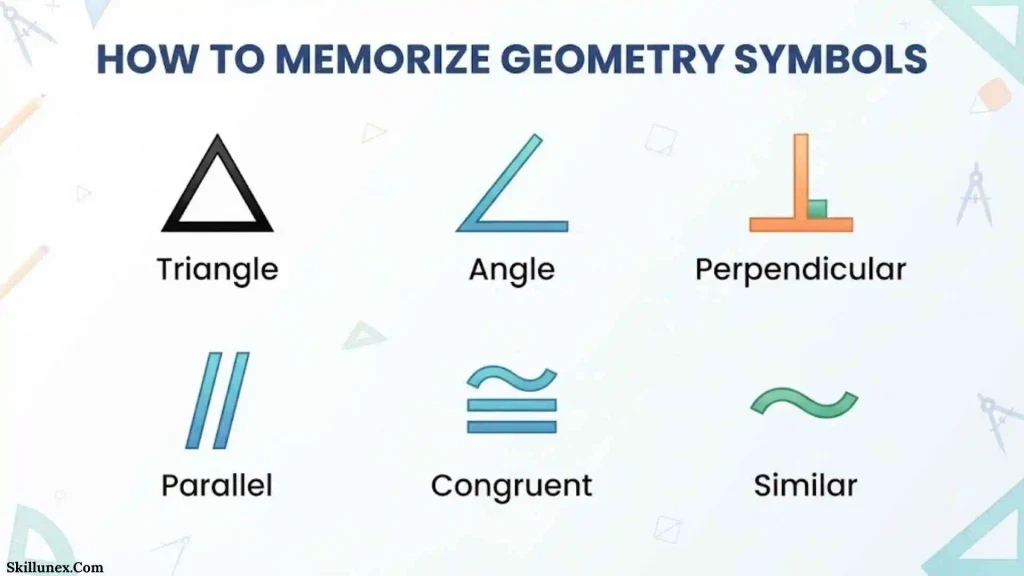
If you are struggling to remember all the symbols, you do not need to learn them in one sitting.
Start With The Most Common Symbols
I recommend learning these first:
∠ = angle
° = degree
∥ = parallel
⊥ = perpendicular
≅ = congruent
∼ = similar
△ = triangle
π = pi
Then move on to the less common notation.
Connect Symbols With Visual Ideas
Some symbols are easy to remember because they resemble what they represent.
For example:
∥ looks like parallel lines.
⊥ resembles perpendicular lines.
△ looks like a triangle.
Making these visual connections can help you recall the symbols more quickly.
Practice With Real Diagrams
Instead of memorizing a list only, practice identifying symbols in actual geometry problems.
Ask yourself:
What does this marking tell me?
Which sides are equal?
Which angles are equal?
Which lines are parallel?
Is this angle 90°?
This turns memorization into practical understanding.
Common Mistakes When Using Geometry Symbols
Understanding the symbols is important, but using them correctly is equally important.
Confusing A Line With A Segment
A line extends indefinitely in both directions.
A segment has two endpoints.
They are different geometric objects.
Confusing A Ray With A Segment
A ray has one endpoint and extends indefinitely in one direction.
A segment has two endpoints.
Reversing Ray Notation
The order matters.
\overrightarrow{AB}
starts at A and passes through B.
It is not the same as:
\overrightarrow{BA}
Confusing Congruent And Similar
Congruent means:
same shape + same size
Similar means:
same shape + proportional dimensions
Confusing Parallel And Perpendicular
Remember:
∥ = parallel
⊥ = perpendicular
Ignoring Diagram Markings
A small tick, arc, arrow, or square may contain critical information.
Always inspect these markings before beginning your calculations.
Assuming A Diagram Is Drawn To Scale
A geometry diagram is not necessarily drawn to exact scale.
For example, two lines may look equal even if the problem does not mark them as equal.
Use the given information and mathematical markings, not simply what appears visually larger or smaller.
Frequently Asked Questions About Geometry Symbols Meaning
What Is The Symbol For An Angle?
The standard symbol for an angle is ∠. For example, ∠ABC represents angle ABC, where B is the vertex.
What Does ⊥ Mean In Geometry?
The symbol ⊥ means perpendicular. It indicates that two lines or other geometric objects meet at a 90° angle.
What Does ∥ Mean In Geometry?
The symbol ∥ means parallel. For example, AB ∥ CD means AB and CD are parallel.
What Does ≅ Mean In Geometry?
The symbol ≅ means congruent. It is used when two geometric figures or corresponding parts have the same size and shape.
What Does ∼ Mean In Geometry?
The symbol ∼ is commonly used to indicate similarity between geometric figures. Similar figures have the same shape, while their sizes may differ.
What Does △ Mean In Geometry?
The symbol △ represents a triangle. For example, △ABC means triangle ABC.
What Does The Degree Symbol Mean?
The symbol ° represents degrees and is commonly used to measure angles.
What Does A Small Square In A Geometry Diagram Mean?
A small square inside an angle indicates that the angle is a right angle measuring 90°.
What Do Tick Marks Mean In Geometry?
Matching tick marks on line segments indicate that the marked segments have equal lengths.
What Do Matching Arcs Mean On Angles?
Matching arc markings indicate that the marked angles have equal measures.
What Is The Difference Between A Line And A Line Segment?
A line extends infinitely in both directions, while a line segment has two endpoints and a finite length.
What Is The Difference Between A Ray And A Line?
A ray has one endpoint and extends infinitely in one direction. A line extends infinitely in both directions.
What Is The Difference Between Congruent And Similar?
Congruent figures have the same size and shape. Similar figures have the same shape but may have different sizes.
What Does π Mean In Geometry?
π, pronounced pi, is the constant used in circle calculations. It is approximately 3.14159.
What Does r Mean In Geometry?
In circle geometry, r commonly represents the radius.
What Does d Mean In Geometry?
In circle geometry, d commonly represents the diameter.
What Is The Symbol For Approximately Equal?
The symbol ≈ means approximately equal. It is commonly used when a value has been rounded or estimated.
What Does ≠ Mean?
The symbol ≠ means not equal.
What Does ∴ Mean In Geometry?
The symbol ∴ means therefore and can be used to introduce a conclusion.
What Does ∵ Mean In Geometry?
The symbol ∵ means because and can be used to introduce a reason.
Can Geometry Symbols Have Different Meanings?
Yes. Some symbols can have different meanings depending on the mathematical context. For example, a letter such as A can represent a point, an angle label, or area depending on how it is used. Always consider the surrounding diagram, formula, and definitions provided in the problem.
Conclusion
Understanding geometry symbols meaning gives you a foundation for reading mathematical diagrams and solving geometry problems with greater confidence. Symbols such as ∠, °, ∥, ⊥, ≅, and ∼ communicate important information quickly, while tick marks, angle arcs, arrows, and right angle squares reveal relationships between parts of a diagram. Once you know what these markings mean, a complicated geometry figure can become much easier to understand.
I hope this guide helps you feel more comfortable with geometry notation. When you work on a geometry problem, start by identifying the points and geometric objects, then look for markings and relationships before calculating anything. If you practice these symbols regularly, you’ll find that you can read geometry diagrams faster and understand exactly what the problem is asking you to find.

I’m Adrian Holloway, a writer and researcher who enjoys exploring the stories, meanings, and interesting facts behind the subjects people search for every day. I’m especially interested in symbols, nature, lakes, places, and cultural topics that help readers understand the world from a different perspective.
I believe useful content should be simple, accurate, and enjoyable to read. When I research a topic, I focus on finding meaningful details and presenting them in a way that makes information easy to understand.
My goal is to create helpful articles that answer real questions while encouraging readers to discover something new with every visit.
Books by Adrian Holloway
The Language of Symbols: Meanings, Stories & Traditions
Hidden Wonders of Nature: Lakes, Landscapes & Discovery