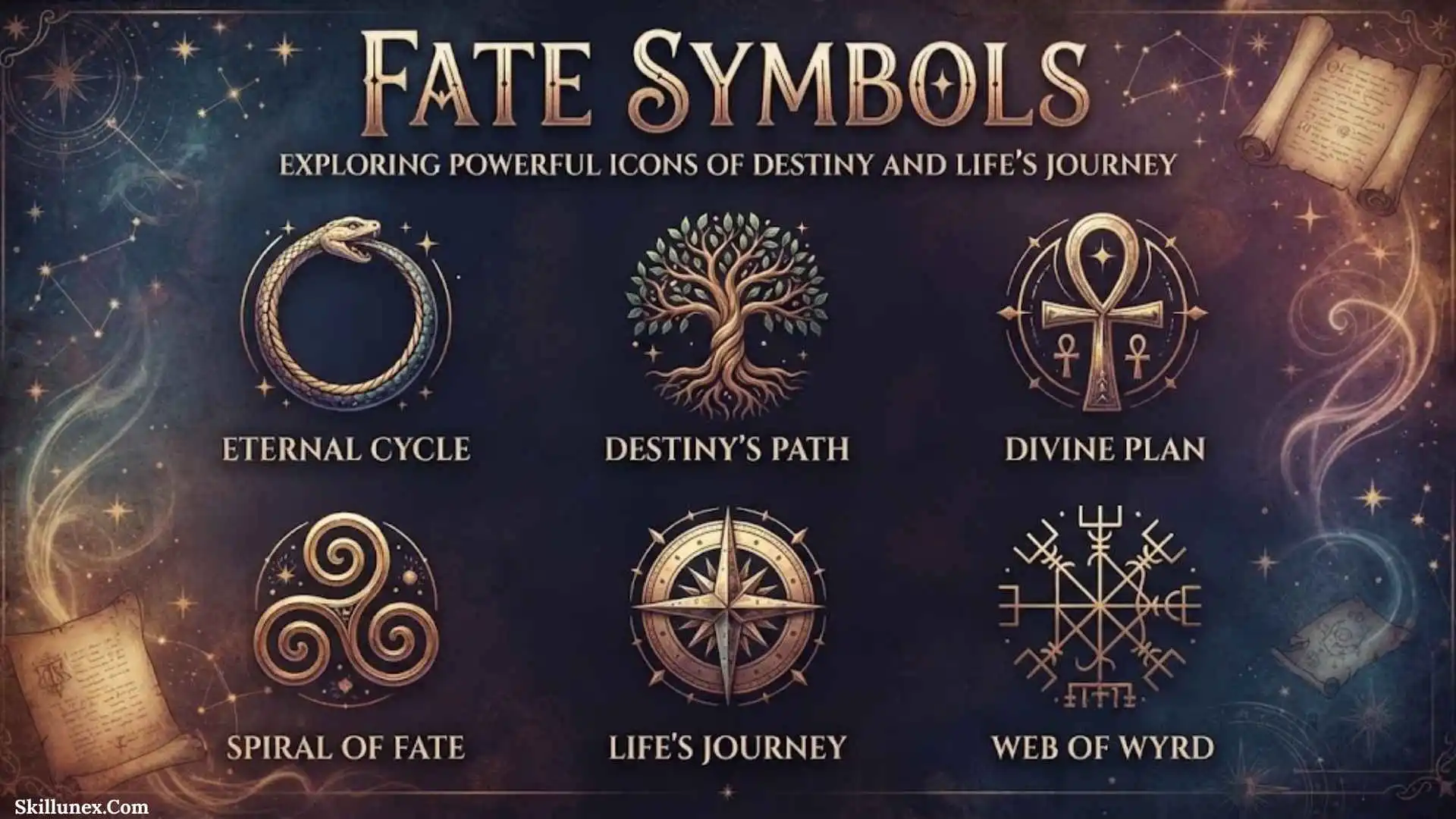
Fate has been one of humanity’s oldest mysteries. Across mythology, religion, philosophy, literature, and art, people have searched for ways to understand whether life follows a predetermined path or is shaped by personal choices. Fate symbols give visual form to these ideas, representing destiny, fortune, life’s journey, change, and the forces believed to influence what happens to us.
From the Wheel of Fortune and the thread of fate to stars, knots, the Ouroboros, and mythological figures such as the Greek Fates and Norse Norns, these symbols have appeared in cultures separated by centuries and geography.
Some fate symbols represent an unavoidable destiny, while others suggest guidance, transformation, cycles, or the possibility of changing one’s path. Their meanings can therefore be much more complex than simply representing “luck” or “destiny.”
What Are Fate Symbols?
Fate symbols are visual representations associated with destiny, fortune, predetermined events, life paths, and the uncertainty of the future. They may appear as objects, figures, celestial images, patterns, animals, or mythological motifs.
The exact meaning of a symbol depends heavily on its cultural and historical context. For example, a wheel may represent changing fortune, while a thread may represent the course of an individual’s life.
Fate symbols are often connected with three broad ideas:
- Destiny: the belief that some events are predetermined.
- Fortune: the changing circumstances of life, including luck and misfortune.
- Life’s journey: the idea that human existence follows a path from beginning to end.
Because these ideas overlap, some symbols associated with fate also represent time, transformation, chance, death, rebirth, or guidance.
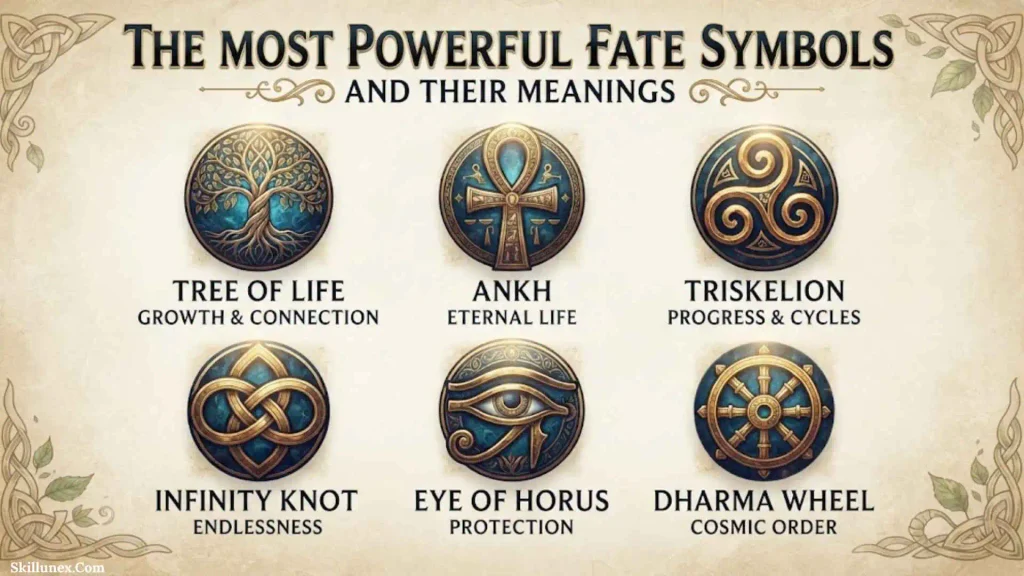
The Most Powerful Fate Symbols and Their Meanings
The Wheel of Fortune
The Wheel of Fortune is one of the clearest symbols of changing destiny. A wheel continually turns, suggesting that circumstances can rise and fall over time.
The symbolism is particularly powerful because the wheel does not remain in one position. A person experiencing prosperity may eventually face hardship, while someone going through difficult circumstances may later experience better fortune.
The wheel can therefore represent:
- Fate and destiny
- Good and bad fortune
- Change
- The cycles of life
- Uncertainty
- The temporary nature of success and failure
The concept became especially influential through medieval European imagery and the personification of Fortune, often depicted as a figure turning a wheel that raises some people and lowers others.
The Three Fates
The Three Fates are among the most famous figures associated with destiny in Greek mythology. Known collectively as the Moirai, they were traditionally associated with determining the course of human life.
They are commonly identified as Clotho, Lachesis, and Atropos.
Clotho was associated with spinning the thread of life, Lachesis with measuring or assigning it, and Atropos with cutting it. Together, they represent the progression of life from beginning to end.
The Three Fates symbolize:
- Birth
- The course of life
- Destiny
- Mortality
- The limits of human control
- The inevitability of death
Their imagery is especially important because it turns an abstract idea—fate—into something visual and understandable: a thread that is created, measured, and eventually ended.
The Thread of Fate
The thread of fate is a powerful metaphor found in several cultural traditions. It represents the idea that a person’s life can be imagined as a thread moving from its beginning toward its conclusion.
A thread may symbolize the continuity of life, while a tangled or connected thread can suggest relationships and events that become intertwined.
As a fate symbol, the thread can represent:
- A person’s life journey
- Destiny
- Relationships
- Connections between events
- The passage of time
- Mortality
Thread imagery is particularly popular in modern tattoos and jewelry because it can be personalized to represent a relationship, major life event, or personal journey.
The Norse Norns
Norse mythology also contains powerful figures connected with fate. The Norns are female beings associated with destiny and the shaping of lives.
They are often identified as Urðr, Verðandi, and Skuld, although interpretations of their roles and the broader group of Norns vary across the surviving sources.
The Norns are commonly connected with concepts such as:
- Fate
- Time
- Destiny
- The consequences of actions
- The structure of human life
Their presence demonstrates that ideas about powerful forces shaping destiny were not limited to ancient Greek culture.
Stars
Stars have been associated with destiny and prediction for thousands of years. The connection comes partly from astrology and the longstanding human practice of observing the heavens for signs about earthly events.
This association is reflected in expressions such as “written in the stars.”
As a symbolic image, a star can represent:
- Destiny
- Guidance
- Hope
- A life purpose
- Dreams
- A predetermined path
A single star may suggest personal direction, while a constellation can represent a larger pattern or interconnected destiny.
The North Star
The North Star, or Polaris, has a particularly strong symbolic connection with guidance.
Because of its position in the northern sky, Polaris has historically been useful for navigation. This practical role helped give it a deeper symbolic meaning: finding one’s direction when the path ahead is uncertain.
As a fate symbol, the North Star can represent:
- Direction
- Purpose
- Guidance
- Stability
- Finding one’s path
Unlike symbols that suggest an unavoidable destiny, the North Star can represent a more active interpretation of fate—having a guiding point while choosing how to reach it.
The Ouroboros
The Ouroboros is typically depicted as a serpent or dragon consuming its own tail. It is an ancient symbol associated with cycles, renewal, continuity, and eternity.
Although the Ouroboros is not exclusively a fate symbol, its connection with endless cycles makes it highly relevant to ideas about destiny.
It can symbolize:
- Eternal cycles
- Death and rebirth
- Renewal
- Transformation
- Infinity
- The repeating patterns of existence
For someone who sees life as a series of recurring stages, the Ouroboros can represent the cyclical nature of fate.
Knots
Knots are another meaningful form of fate symbolism. Because a knot joins things together, it can represent bonds, relationships, commitments, and connections that are difficult to break.
A knot may symbolize:
- Fate connecting people
- Eternal bonds
- Relationships
- Commitment
- Interconnected lives
- Complicated circumstances
This symbolism is one reason knot designs are common in jewelry and artwork representing relationships or lifelong connections.
The Ankh
The ankh is an ancient Egyptian symbol commonly associated with life. It is not strictly a symbol of fate, but it can become relevant to fate symbolism when used to represent the journey and continuation of life.
The ankh can represent:
- Life
- Vitality
- Existence
- Continuity
- The relationship between life and death
Its meaning should be understood within ancient Egyptian religious and cultural contexts rather than simply being treated as a generic “fate symbol.”
Hourglass
The hourglass is a strong symbol of time, mortality, and the limited nature of human life.
As the sand falls from one chamber to another, it visually represents time passing. This makes the hourglass particularly relevant to fate because human destiny is often discussed in relation to the limited time available to each person.
It may symbolize:
- The passage of time
- Mortality
- Life’s limited duration
- The inevitability of change
- The importance of the present
The Labyrinth
A labyrinth can represent a complicated journey toward an uncertain destination. Unlike a straight path, a labyrinth contains turns, obstacles, and apparent dead ends.
As a modern fate symbol, it can represent:
- Life’s journey
- Searching for purpose
- Difficult choices
- Self-discovery
- An uncertain destiny
The labyrinth is particularly useful as a metaphor for the idea that even if life has a destination, the route toward it may not be obvious.
Fate Symbols Across Different Cultures
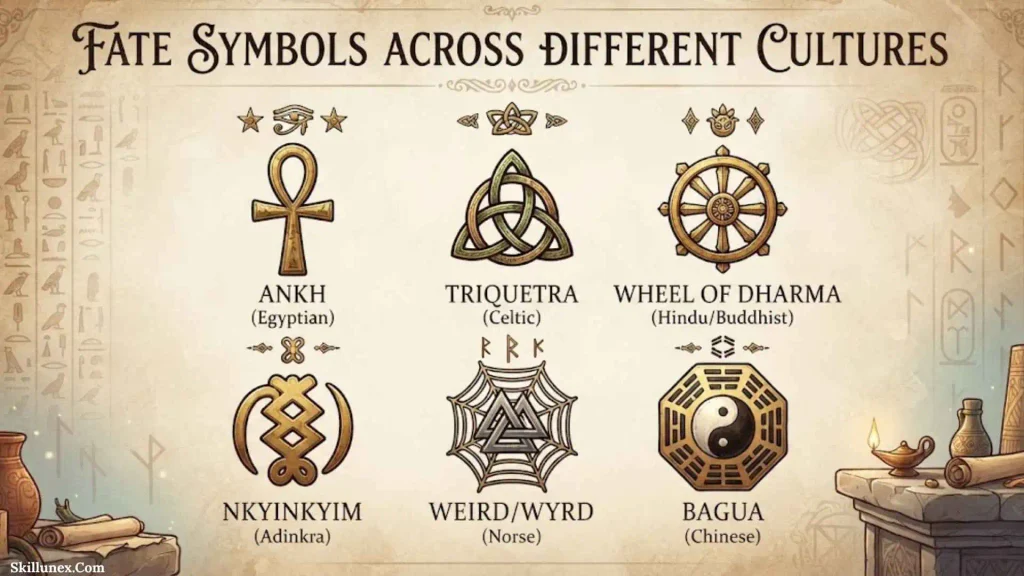
Fate in Greek Mythology
Ancient Greek mythology contains some of the most recognizable representations of fate. The Moirai were associated with the destiny of individuals, while other mythological stories explored the tension between human choices and forces beyond human control.
Greek stories frequently ask whether people can escape a prophecy or whether attempts to avoid destiny ultimately help fulfill it.
This makes Greek mythology particularly important to the modern understanding of fate symbols.
Fate in Norse Mythology
Norse mythology presents another influential view of destiny through the Norns and other traditions concerning fate.
The Norse concept of destiny is often more complex than the idea of a completely predetermined future. Stories can emphasize courage, action, responsibility, and the reality of facing difficult outcomes.
This gives Norse fate symbolism a distinctive quality: destiny may be powerful, but how a person responds to circumstances can still matter.
Fate and Celestial Symbolism
The sky has historically been one of humanity’s most important sources of symbolic meaning.
Stars, planets, constellations, eclipses, and other celestial events have been interpreted in different societies as signs connected with human affairs.
This does not mean that all cultures understood celestial symbolism in the same way. Astrology, astronomy, religion, and mythology developed differently across civilizations.
Nevertheless, the recurring connection between the heavens and destiny explains why stars remain among the most recognizable symbols of fate today.
Fate Symbols vs. Luck Symbols
Fate and luck are related concepts, but they are not identical.
A fate symbol generally concerns destiny or the course of life, while a luck symbol is more specifically associated with favorable or unfavorable chance.
For example, the Wheel of Fortune can represent both fate and fortune because it emphasizes changing circumstances. A four-leaf clover, by comparison, is more strongly associated with luck than predetermined destiny.
Understanding this distinction is important when selecting a symbol for a tattoo, piece of jewelry, artwork, or personal emblem.
Fate Symbols vs. Free Will
One of the deepest questions behind fate symbolism is the relationship between destiny and free will.
If fate determines everything, personal choices might appear insignificant. If people have complete free will, destiny may seem unnecessary.
Many philosophical and religious traditions take positions somewhere between these extremes. A person may face circumstances they cannot control while still having freedom over how they respond.
This is why a fate symbol does not necessarily have to mean “my future is already decided.” It can instead represent acceptance of uncertainty, trust in life’s journey, or recognition that some events are beyond human control.
Fate Symbols in Tattoos and Jewelry
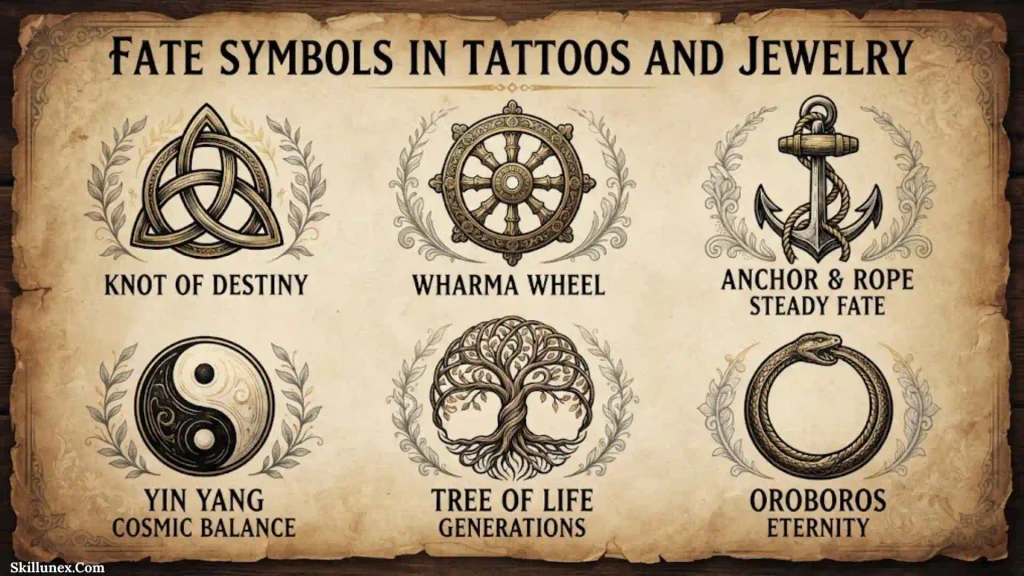
Fate symbols have become popular in tattoos and jewelry because they can communicate deeply personal ideas in a simple visual form.
Choosing a Fate Symbol for a Tattoo
When choosing a fate tattoo, consider the specific message you want the design to communicate.
A thread may represent life’s journey or an important relationship.
A star may represent guidance or destiny.
A wheel may represent changing fortune.
An Ouroboros may represent cycles and transformation.
An hourglass may represent the passage of time.
A labyrinth may represent the difficult journey toward a personal goal.
Researching the original cultural meaning of a symbol before using it can also help avoid unintentionally misrepresenting an important cultural or religious tradition.
Fate Symbols in Jewelry
Small symbols can work particularly well in necklaces, rings, bracelets, and pendants.
A person might wear a fate symbol as a reminder of a life philosophy, an important relationship, a personal transformation, or a belief that events have meaning.
The symbolism can be subtle, making it meaningful to the wearer without requiring an explanation to everyone else.
How to Choose the Right Fate Symbol
The best fate symbol depends on the meaning you want to express.
| Symbol | Common Meaning |
| Wheel of Fortune | Changing destiny and fortune |
| Three Fates | Life, destiny, and mortality |
| Thread | Life journey and connection |
| Norns | Fate and destiny |
| Star | Destiny, hope, and guidance |
| North Star | Direction and purpose |
| Ouroboros | Cycles, renewal, and eternity |
| Knot | Connection and lasting bonds |
| Hourglass | Time and mortality |
| Labyrinth | Life’s journey and uncertainty |
Rather than choosing a symbol simply because it looks attractive, consider its history and the message it communicates.
Why Are Fate Symbols Still Popular?
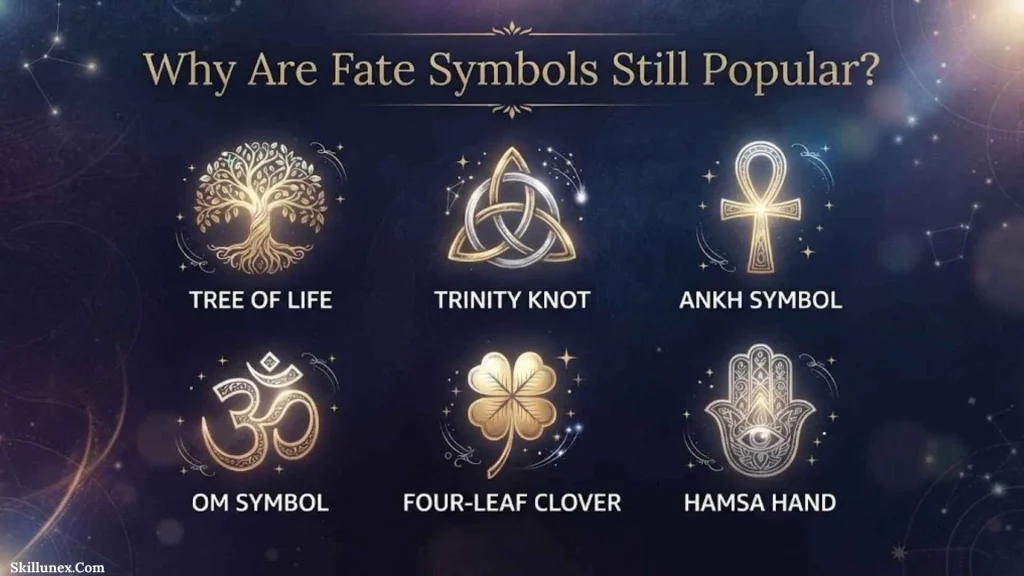
Fate symbols remain relevant because questions about destiny have never disappeared.
People continue to wonder why certain relationships happen, why unexpected events change their lives, and whether the future is predetermined or shaped through personal decisions.
Modern culture has also made these symbols highly visible through tattoos, fashion, literature, films, games, artwork, and jewelry.
Their popularity comes from their ability to communicate complicated ideas through simple images.
A small star can represent an entire philosophy of destiny. A thread can represent a lifetime. A wheel can express the unpredictable nature of fortune.
That emotional depth makes fate symbols more than decorative designs.
Frequently Asked Questions About Fate Symbols
What is the most common symbol of fate?
The Wheel of Fortune and the thread of life are among the most recognizable symbols associated with fate. The wheel represents changing fortune and destiny, while the thread represents the course of a person’s life.
What symbol represents destiny?
There is no single universal symbol for destiny. Stars, threads, the Wheel of Fortune, the Three Fates, and the Norse Norns are all strongly associated with destiny in different cultural contexts.
What symbol represents fate and free will?
A path, labyrinth, or North Star can work well as a symbolic representation of fate alongside personal choice. These images can suggest that circumstances create a framework while individuals still make decisions about their journey.
What symbolizes a predetermined fate?
The Three Fates and their thread of life are particularly strong symbols of predetermined destiny. Their mythology presents life as something connected to a thread whose course is governed by forces beyond ordinary human control.
What symbol represents changing fate?
The Wheel of Fortune is perhaps the clearest symbol of changing fate. Its rotation represents the rise and fall of circumstances, fortune, and status.
What represents fate in Greek mythology?
The Moirai, or Three Fates, are the most important Greek mythological figures associated with fate. Clotho, Lachesis, and Atropos are traditionally connected with spinning, measuring, and cutting the thread of life.
What represents fate in Norse mythology?
The Norns are among the most important Norse figures associated with destiny. They are traditionally associated with the shaping of lives and the forces of fate.
Are stars symbols of fate?
Stars can symbolize fate, destiny, guidance, and purpose. Their association with destiny is partly connected with historical beliefs about astrology and the idea that events could be reflected in the heavens.
Conclusion
Fate symbols have survived across generations because they express some of humanity’s most enduring questions: Is our future already written? How much control do we have over our lives? Why do certain events happen, and can we change the direction of our journey?
From the Wheel of Fortune and Three Fates to the thread of life, stars, Norns, Ouroboros, knots, hourglasses, and labyrinths, each symbol offers a different interpretation of destiny.
Ultimately, the meaning of a fate symbol depends not only on its historical origin but also on the meaning a person gives it. Whether used in mythology, artwork, jewelry, tattoos, or personal reflection, these symbols continue to provide powerful ways to express the mystery of life’s journey.

Caleb Thornton
I’m Caleb Thornton, a researcher and content writer who loves exploring fascinating subjects and sharing what I learn with readers. My interests include natural places, lakes, symbols, culture, history, and the stories that make ordinary topics more meaningful.
When I write an article, I try to go beyond a basic answer. I look for useful facts, relevant context, and details that can help readers understand the subject more completely.
My purpose is simple: I want every article I contribute to provide genuine value, satisfy the reader’s curiosity, and make discovering new information enjoyable.
## Books by Caleb Thornton
* Symbols & Meanings: Exploring the Signs We See Every Day
* Lakes of the World: Nature, Beauty & Exploration