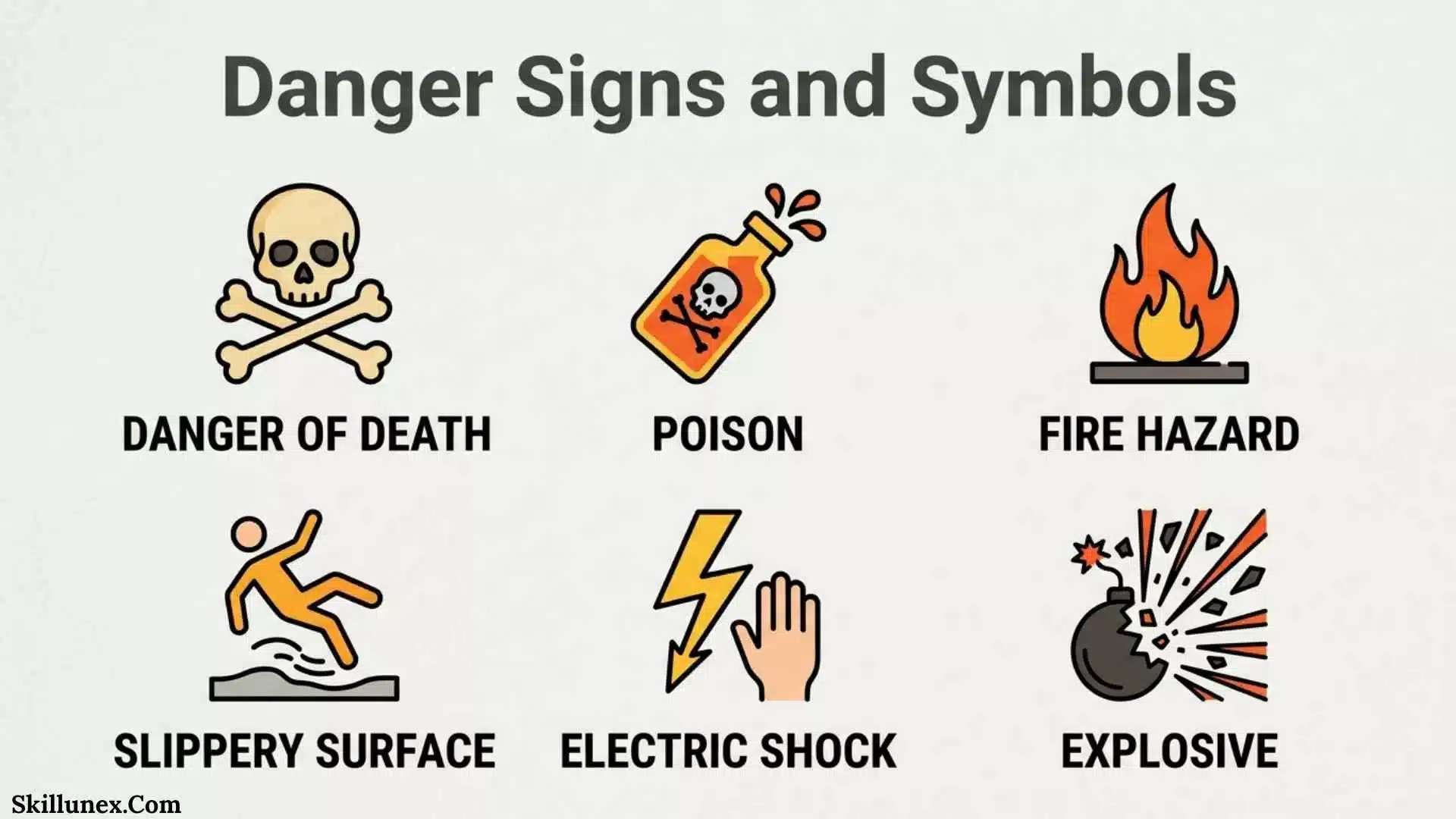
Danger signs and symbols are an important part of everyday safety. They are used to warn people about potential hazards in workplaces, roads, hospitals, laboratories, construction sites, factories, schools, and public places. These signs use recognizable colors, shapes, pictures, and words to communicate safety information quickly. By understanding common danger signs, people can identify risks before an accident occurs and take appropriate precautions.
Different danger signs and symbols represent different types of hazards. For example, a flammable symbol warns about materials that can catch fire, while an electrical hazard symbol indicates a risk of electric shock. Other symbols can warn about toxic substances, corrosive chemicals, explosives, radiation, biological hazards, high voltage, and slippery surfaces. Learning what these symbols mean is particularly important for workers and anyone who regularly enters environments where hazardous conditions may exist.
The importance of danger signs goes beyond simply displaying a warning. They help create awareness, encourage safe behavior, and reduce the possibility of injuries and accidents. However, signs alone cannot eliminate hazards; they must be supported by proper safety procedures, training, protective equipment, and responsible behavior. Understanding and respecting danger signs and symbols is therefore an essential part of maintaining a safe environment for everyone.
What Are Danger Signs and Symbols?
Danger signs and symbols are visual warnings designed to identify hazards and communicate important safety information. They may use colors, shapes, pictograms, words, or combinations of these elements.
The main purpose of a danger sign is to make people aware of a potential hazard before they are exposed to it. A well-designed symbol can communicate information much faster than a lengthy written warning.
For example, an electrical hazard symbol immediately alerts people that electrical equipment or high voltage components may be present. Similarly, a biohazard symbol indicates that biological materials may pose a health risk.
Why Are Danger Signs Important?
Danger signs are important because they help people recognize hazards before an accident occurs. They can:
- Warn people about dangerous conditions.
- Help prevent workplace and public accidents.
- Provide quick and easily recognizable information.
- Support emergency and evacuation procedures.
- Remind workers to use appropriate protective equipment.
- Restrict unauthorized people from hazardous areas.
- Improve general safety awareness.
However, signs are only one part of an effective safety system. They should be supported by proper training, procedures, equipment, and supervision.
How Do Danger Signs Communicate Information?
Danger signs commonly communicate information through color, shape, symbols, and written messages.
A symbol provides visual information, while colors and shapes can indicate the general purpose of the sign. Written instructions can provide additional details when a symbol alone is not sufficient.
This combination allows people to understand hazards quickly, even when they may not speak the same language.
Common Types of Danger Signs and Symbols
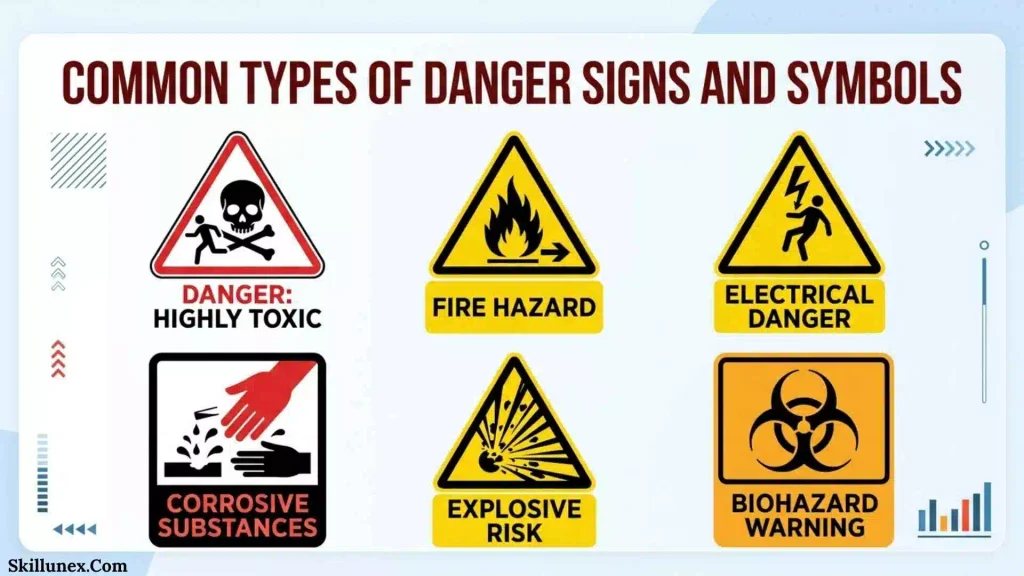
There are many types of danger signs because different environments contain different hazards. Understanding the most common symbols can make it easier to identify risks and respond safely.
Flammable Symbol
The flammable symbol warns that a material or substance can catch fire easily.
It may be found on containers holding fuels, solvents, gases, and other flammable materials. When this warning is displayed, ignition sources such as flames, sparks, and excessive heat should be kept away according to the applicable safety requirements.
Toxic Symbol
The toxic hazard symbol indicates that a substance can cause serious harm or poisoning if it is inhaled, swallowed, or absorbed into the body.
Toxic substances may be found in laboratories, industrial facilities, agricultural settings, and other specialized environments. People handling them should follow the relevant instructions and use the required protective equipment.
Corrosive Symbol
The corrosive symbol warns that a substance can damage skin, eyes, metals, or other materials.
Strong acids and bases are common examples of corrosive substances. Contact with these materials can result in serious injuries, making proper handling and protective measures essential.
Explosive Symbol
The explosive symbol warns that a material may explode under particular conditions.
Explosive hazards can be associated with certain chemicals, industrial materials, gases, or other substances. Areas displaying this warning require strict control and appropriate safety procedures.
Electrical Hazard Symbol
The electrical hazard symbol warns about the possibility of electric shock, burns, or other electrical injuries.
It is commonly displayed near electrical panels, high-voltage equipment, transformers, power installations, and industrial machinery.
People should never touch or operate dangerous electrical equipment unless they are properly trained and authorized to do so.
Radiation Symbol
The radiation symbol indicates the presence of a radiation hazard.
It may be used in medical, industrial, scientific, research, or nuclear environments. Radiation-controlled areas should only be entered by authorized people who understand the applicable safety procedures.
Biohazard Symbol
The biohazard symbol warns that biological materials may pose a risk to human or animal health.
It can be found in hospitals, laboratories, research facilities, healthcare environments, and areas where potentially infectious materials are handled.
Slippery Surface Symbol
A slippery-surface warning indicates that a floor or other surface may cause people to slip and fall.
These warnings are commonly placed near wet floors, spills, recently cleaned surfaces, or other areas where traction may be reduced.
People should slow down and walk carefully when approaching such an area.
High-Voltage Symbol
A high-voltage warning indicates the presence of potentially dangerous electrical voltage.
These signs may be found around substations, electrical cabinets, industrial machinery, and other electrical installations. Unauthorized people should stay away from restricted high-voltage areas.
Safety Colors and Shapes Used in Danger Signs
Colors and shapes make safety signs easier to recognize. Different safety standards may use specific conventions, so the exact meaning should always be considered in context.
Meaning of Safety Colors
Red is commonly associated with danger, prohibition, fire equipment, or emergency controls.
Yellow or amber is commonly used to attract attention to warnings and potential hazards.
Blue is often used for mandatory safety instructions, such as requirements to wear particular protective equipment.
Green is commonly associated with safe conditions, emergency exits, first aid, and other safety information.
Meaning of Safety Shapes
Triangles are commonly associated with warnings and hazards.
Circles can be used for mandatory actions or prohibitions, depending on the design.
Squares and rectangles are commonly used for safety information, emergency instructions, and location signs.
The color and shape should always be interpreted together with the symbol and any accompanying text.
Where Are Danger Signs and Symbols Used?
Danger signs can be found in many environments. Their design and purpose depend on the hazards present in each location.
Danger Signs in the Workplace
Workplaces may contain machinery, chemicals, electrical equipment, moving vehicles, heights, heat, pressure, or other hazards.
Common workplace signs warn about:
- Electrical hazards
- Moving machinery
- Fire risks
- Toxic substances
- Chemicals
- Radiation
- Biohazards
- Falling objects
- Slippery surfaces
- Restricted areas
- Required personal protective equipment
Employers should ensure that workers understand the relevant signs and know how to respond to the hazards they identify.
Danger Signs on Roads
Road warning signs help protect drivers, pedestrians, cyclists, and other road users.
They may warn about:
- Sharp turns
- Slippery roads
- Pedestrian crossings
- Road construction
- Railway crossings
- Falling rocks
- Animal crossings
- Narrow roads
- Steep slopes
- Merging traffic
Drivers should respond to warning signs by paying attention to road conditions and adjusting their driving appropriately.
Danger Signs in Laboratories
Laboratories may contain chemicals, biological materials, radiation sources, compressed gases, and specialized equipment.
Common laboratory hazard signs include warnings for:
- Flammable substances
- Toxic chemicals
- Corrosive materials
- Explosives
- Biohazards
- Radiation
- Compressed gases
- Oxidizing substances
Laboratory workers should understand the hazards associated with materials before handling them and should follow established laboratory safety procedures.
Danger Signs in Hospitals
Hospitals and healthcare facilities use safety signs to protect patients, visitors, and healthcare workers.
Signs may identify:
- Biohazard areas
- Radiation-controlled areas
- Infection-control precautions
- Medical gas hazards
- Electrical hazards
- Wet floors
- Restricted areas
- Emergency exits
Clear safety signs are particularly important in hospitals because many visitors may not be familiar with technical hazards.
How to Read and Respond to a Danger Sign
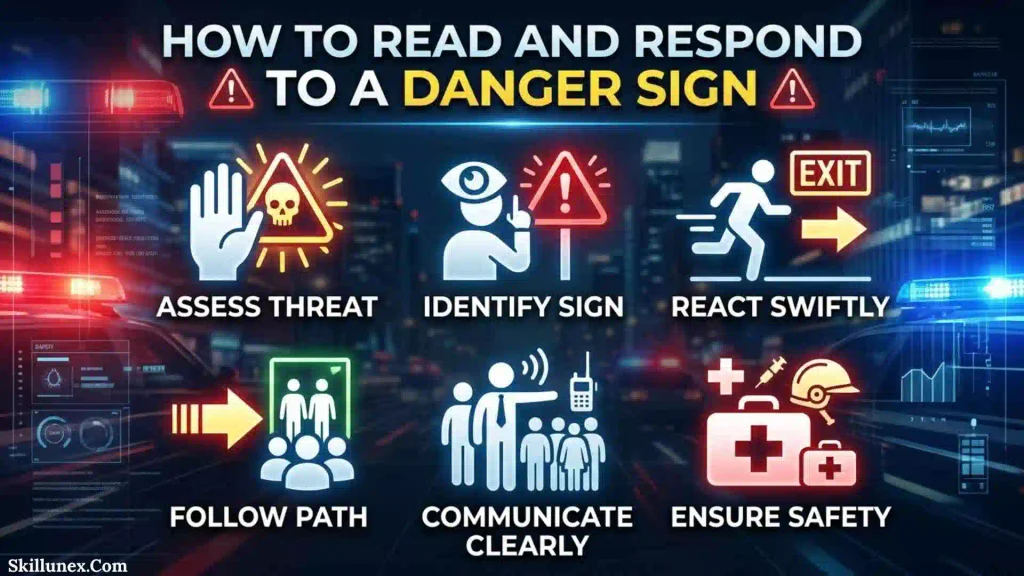
Recognizing a danger sign is only the first step. People should also know how to respond appropriately.
Stop and Identify the Hazard
When you see a danger sign, stop and pay attention. Identify what type of hazard the sign represents.
Do not assume that an area is safe simply because you cannot see an obvious danger.
Read Additional Instructions
Some symbols are accompanied by written instructions explaining what people should or should not do.
Read these instructions carefully before proceeding.
Follow Required Safety Measures
If the sign indicates that protective equipment is required, use the appropriate equipment. If it indicates restricted access, do not enter unless authorized.
Keep a Safe Distance
When a hazard is present, maintain an appropriate distance and avoid unnecessary contact with equipment, substances, or restricted areas.
Ask for Help When Necessary
If you do not understand a warning sign or are uncertain about how to respond, ask a qualified person for guidance rather than guessing.
Danger Signs and Personal Protective Equipment
Some warning signs indicate that personal protective equipment, commonly known as PPE, may be required.
Depending on the hazard, PPE can include:
- Safety helmets
- Protective gloves
- Safety goggles
- Face shields
- Protective footwear
- Hearing protection
- Respiratory protection
- Protective clothing
The correct PPE depends on the specific hazard. Wearing the wrong equipment can create a false sense of security, so people should follow the requirements established for the particular environment.
Difference Between Danger, Warning, Caution, and Prohibition Signs
Safety messages can have different purposes, and it is important to understand the difference between them.
Danger Signs
Danger signs identify serious hazards that can result in severe injury or death if the hazard is not avoided.
Warning Signs
Warning signs alert people to a potential hazard and tell them that additional care is necessary.
Caution Signs
Caution messages generally draw attention to conditions that require care to prevent injury, damage, or other problems.
Prohibition Signs
Prohibition signs tell people that a particular action is not permitted.
Examples include signs indicating No Smoking, No Entry, or other prohibited activities.
Common Mistakes When Dealing With Danger Signs
Even when warning signs are clearly displayed, people sometimes make mistakes that increase the risk of accidents.
Ignoring Familiar Signs
Seeing the same warning repeatedly can cause people to become less attentive. A familiar sign should still be taken seriously every time.
Assuming There Is No Risk
Some hazards cannot be seen, smelled, or heard. Electricity, radiation, toxic gases, and biological hazards can be dangerous even when no obvious warning is visible.
Entering Restricted Areas
A restricted area should not be entered simply because no one appears to be present. Access restrictions are usually established for a reason.
Removing or Covering Signs
Removing or covering a safety sign can prevent other people from recognizing a hazard.
Failing to Report Damaged Signs
A warning sign that is faded, broken, missing, or hidden may fail to protect people. Damaged or missing signs should be reported through the appropriate safety procedure.
How Danger Signs Help Prevent Accidents
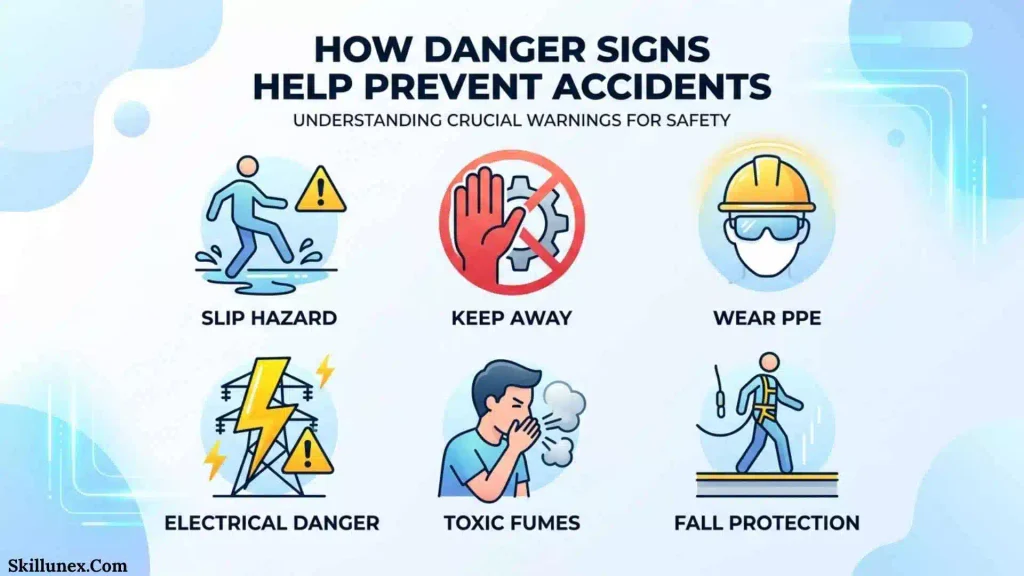
Danger signs contribute to accident prevention by making hazards visible and understandable.
For example, an electrical warning can prevent an unauthorized person from approaching dangerous equipment. A flammable-material warning can remind workers about the importance of controlling ignition sources. A biohazard symbol can alert healthcare or laboratory personnel that special precautions may be required.
In this way, signs act as an early warning system. They help people recognize hazards before they are exposed to them.
Limitations of Danger Signs and Symbols
Although danger signs are extremely useful, they cannot eliminate a hazard on their own.
A warning sign does not make dangerous machinery safe, remove a toxic chemical, or eliminate electrical risk. Effective safety requires a broader approach that may include:
- Hazard identification
- Risk assessment
- Engineering controls
- Safe operating procedures
- Worker training
- Personal protective equipment
- Equipment maintenance
- Emergency planning
- Regular safety inspections
Signs should therefore be treated as one important part of a complete safety system.
How to Teach Children About Danger Signs
Children can learn basic safety symbols through simple examples and practical explanations.
Parents and teachers can introduce signs such as:
- No entry
- Electrical hazard
- Fire warning
- Slippery surface
- Poison warning
- Road crossing signs
Children should understand that a danger sign means they need to stop, pay attention, and follow instructions from a responsible adult.
Teaching children about safety symbols at an early age can help develop good safety habits that remain useful throughout life.
Frequently Asked Questions About Danger Signs and Symbols
What are danger signs and symbols?
Danger signs and symbols are visual warnings used to identify hazards and communicate important safety information. They help people recognize risks and take appropriate precautions.
Why are danger signs important?
Danger signs are important because they provide an early warning about hazards. They can help prevent accidents, injuries, exposure to dangerous substances, and other harmful incidents.
What does a flammable symbol mean?
A flammable symbol indicates that a material or substance can catch fire easily. It should be kept away from ignition sources according to the relevant safety instructions.
What does the electrical hazard symbol mean?
The electrical hazard symbol warns that dangerous electrical energy may be present. It indicates a potential risk of electric shock, burns, or other electrical injuries.
What does the biohazard symbol mean?
The biohazard symbol indicates that biological materials may pose a health risk. It is commonly used in healthcare, laboratory, and research environments.
What does the radiation symbol mean?
The radiation symbol indicates a radiation hazard. Areas displaying this symbol may have controlled access and specific safety requirements.
What do safety colors mean?
Safety colors help communicate the general purpose of a sign. Red can indicate danger or prohibition, yellow or amber can indicate warnings, blue can indicate mandatory actions, and green is commonly associated with safe conditions or emergency information. Exact meanings depend on the applicable safety standard.
Are danger signs enough to prevent accidents?
No. Danger signs are an important part of safety communication, but they must be supported by proper training, hazard controls, safe procedures, appropriate equipment, and effective supervision.
Conclusion
Danger signs and symbols are essential tools for communicating hazards quickly and clearly. They are used in workplaces, laboratories, hospitals, roads, construction sites, factories, and public areas to warn people about potential risks.
Understanding common symbols for fire, electricity, toxic substances, corrosive materials, explosives, radiation, biological hazards, and other dangers can help people recognize unsafe conditions and respond appropriately.
However, safety signs should never be considered a replacement for proper safety practices. People must also follow instructions, use appropriate protective equipment, respect restricted areas, and seek professional guidance when necessary.
By learning to recognize and respect danger signs and symbols, individuals can make better safety decisions, reduce preventable accidents, and contribute to safer workplaces and communities.

Caleb Thornton
I’m Caleb Thornton, a researcher and content writer who loves exploring fascinating subjects and sharing what I learn with readers. My interests include natural places, lakes, symbols, culture, history, and the stories that make ordinary topics more meaningful.
When I write an article, I try to go beyond a basic answer. I look for useful facts, relevant context, and details that can help readers understand the subject more completely.
My purpose is simple: I want every article I contribute to provide genuine value, satisfy the reader’s curiosity, and make discovering new information enjoyable.
## Books by Caleb Thornton
* Symbols & Meanings: Exploring the Signs We See Every Day
* Lakes of the World: Nature, Beauty & Exploration