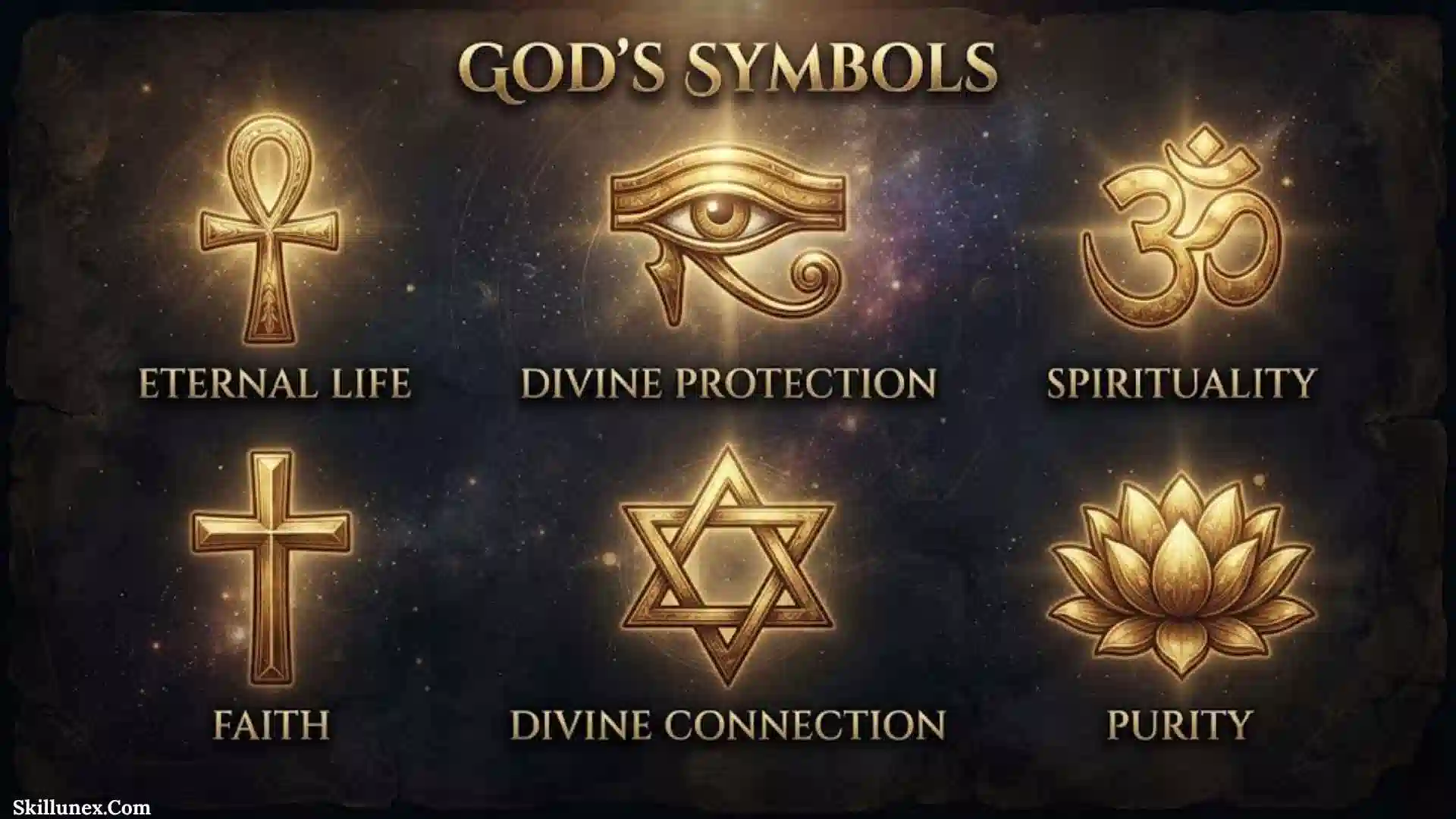
God’s symbols have played an important role in mythology, religion, art, and ancient cultures for thousands of years. Different civilizations connected their gods with specific animals, weapons, plants, celestial objects, and sacred signs. These symbols helped people recognize particular deities and understand qualities such as wisdom, protection, strength, creation, fertility, war, and divine authority.
From the Eye of Horus in ancient Egypt to Zeus’s thunderbolt in Greek mythology and Thor’s hammer in Norse tradition, gods’ symbols can tell stories without words. A single object could represent a deity’s power, personality, responsibilities, or connection with the natural world. However, the meaning of a symbol can change depending on the culture and historical period.
This guide explores gods symbols from several major traditions, including Egyptian, Greek, Norse, and Hindu traditions. It also explains animal symbols, divine weapons, sacred plants, symbols of protection and wisdom, and how these ancient signs are interpreted in modern culture.
What Are God’s Symbols?
God’s symbols are objects, animals, plants, weapons, signs, or other visual elements traditionally associated with a particular god or goddess. They can represent the deity’s powers, stories, personality, domain, or religious significance.
For example, Zeus is strongly associated with the thunderbolt, which reflects his connection with the sky and divine authority. Athena is associated with the owl, representing wisdom, while Poseidon’s trident reflects his connection with the sea.
These associations are not always simple definitions. A deity can have several symbols, and the same symbol can appear in different religious traditions with different meanings.
Why Did Ancient Gods Have Symbols?
Ancient societies used visual symbols to communicate religious ideas and identify divine figures. Symbols were especially important in temples, sculptures, pottery, jewelry, coins, manuscripts, and ceremonial objects.
Gods symbols could be used to:
- Identify a particular deity
- Represent divine powers
- Express religious devotion
- Communicate mythological stories
- Represent protection or blessing
- Connect a deity with nature
- Show divine authority
- Distinguish one god from another
How Were God’s Symbols Recognized?
Artists often gave gods distinctive attributes so viewers could identify them. A trident, for example, could identify Poseidon, while an owl could suggest Athena. Egyptian gods could be represented through particular animals, crowns, or sacred objects.
This visual language allowed religious stories and beliefs to be communicated through art even when written explanations were not present.
Famous Gods Symbols and Their Meanings
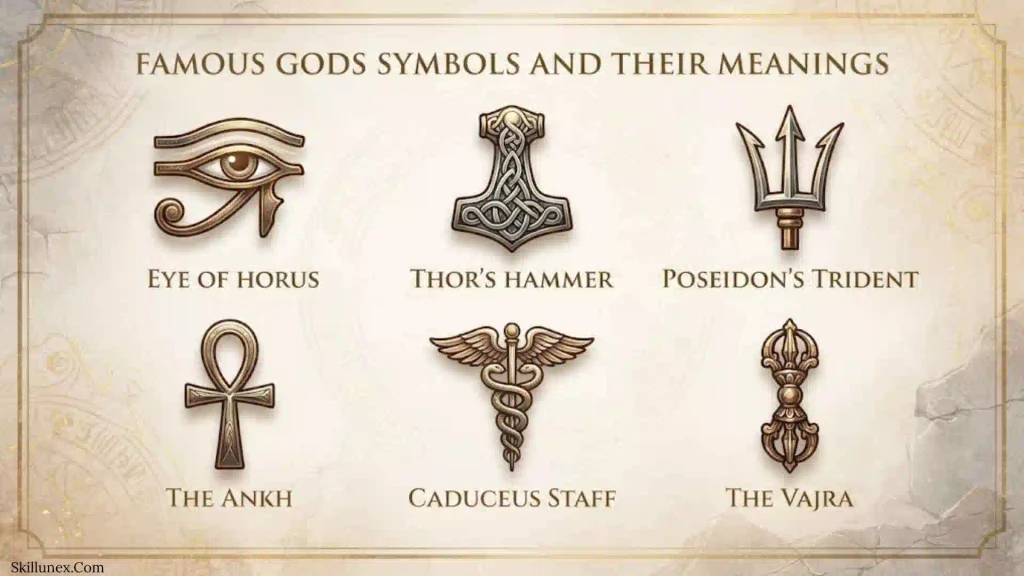
Some gods’ symbols have become recognizable around the world. Their popularity comes from ancient mythology, archaeology, literature, art, movies, games, and modern cultural traditions.
- Eye of Horus — protection, restoration, and healing
- Ankh — life and vitality
- Thor’s hammer — strength, thunder, and protection
- Zeus’s thunderbolt — divine power and authority
- Athena’s owl — wisdom and knowledge
- Poseidon’s trident — the sea and divine power
- Odin’s spear Gungnir — warfare and authority
- Odin’s ravens — knowledge and observation
- Shiva’s trident — divine power and transformation
- Vishnu’s conch — sacred sound and spiritual significance
- Vishnu’s discus — divine power and protection
- Lotus — purity, renewal, and spiritual symbolism in several traditions
The exact meaning of each symbol should always be considered within its original cultural and religious context.
Egyptian Gods Symbols
Ancient Egyptian religion contains some of the world’s most recognizable divine imagery. Gods and goddesses were represented through human forms, animal forms, crowns, sacred objects, and combinations of human and animal characteristics.
Eye of Horus
The Eye of Horus is one of the best-known symbols of ancient Egypt. It is associated with Horus, a deity connected with kingship, the sky, and protection.
Its meaning is strongly connected with the myth in which Horus loses an eye during his conflict with Seth and the eye is subsequently restored. Because of this story, the symbol became associated with restoration, healing, protection, and wholeness.
Ankh
The ankh is a distinctive Egyptian sign with a loop at its top. It is commonly associated with life and vitality.
Egyptian gods are frequently shown holding the ankh in their hands. Its appearance in religious artwork demonstrates the close connection between divine power and the concept of life.
Scarab
The scarab beetle was an important Egyptian symbol associated with Khepri, a deity connected with the rising sun and transformation.
The scarab became associated with renewal, regeneration, and the continuing cycle of life.
Feather of Ma’at
The feather of Ma’at represents concepts associated with truth, justice, balance, and cosmic order.
In ancient Egyptian funerary imagery, the heart of a deceased person was traditionally weighed against the feather of Ma’at. This imagery emphasized the importance of living according to truth and maintaining balance.
Was Scepter
The scepter was a long staff associated with power, authority, and dominion. Gods and rulers are frequently shown holding it in Egyptian art.
Greek Gods Symbols
Greek mythology includes a large collection of divine symbols and attributes. Gods and goddesses were commonly identified through specific animals, weapons, plants, and objects.
Zeus Symbols
Zeus was the chief Olympian god and was associated with the sky, thunder, storms, and divine authority.
His major symbols and associations include:
- Thunderbolt — divine power and control over storms
- Eagle — connection with the heavens
- Oak tree — an important sacred association
- Aegis — a protective divine object associated with Zeus and Athena
The thunderbolt is the most recognizable symbol of Zeus.
Athena Symbols
Athena was associated with wisdom, strategic warfare, crafts, and civic life.
Her symbols include:
- Owl — wisdom and knowledge
- Olive tree — an important association with Athens and prosperity
- Helmet — warfare and defense
- Spear — military power
- Aegis — divine protection
The owl remains one of the most recognizable symbols associated with Athena.
Poseidon Symbols
Poseidon was associated with the sea, earthquakes, and horses.
His most important symbols include:
- Trident — authority over the sea
- Horse — an important mythological association
- Dolphin — connection with the sea
- Bull — another animal associated with Poseidon
The trident is by far the most recognizable symbol of Poseidon.
Aphrodite Symbols
Aphrodite was associated with love, beauty, desire, and attraction.
Her traditional associations include:
- Dove
- Swan
- Rose
- Myrtle
- Seashell
The seashell became particularly famous through later artistic representations of Aphrodite emerging from the sea.
Apollo Symbols
Apollo was associated with music, poetry, prophecy, healing, and several aspects of solar symbolism in later traditions.
His symbols include:
- Lyre — music and poetry
- Laurel — victory and artistic achievement
- Bow and arrows — hunting and divine power
- Raven — an animal associated with Apollo in ancient traditions
Artemis Symbols
Artemis was associated with hunting, wilderness, animals, and childbirth.
Her common symbols include:
- Bow and arrows
- Deer
- Cypress
- Hunting imagery
The deer is one of the most recognizable animals associated with Artemis.
Norse Gods Symbols
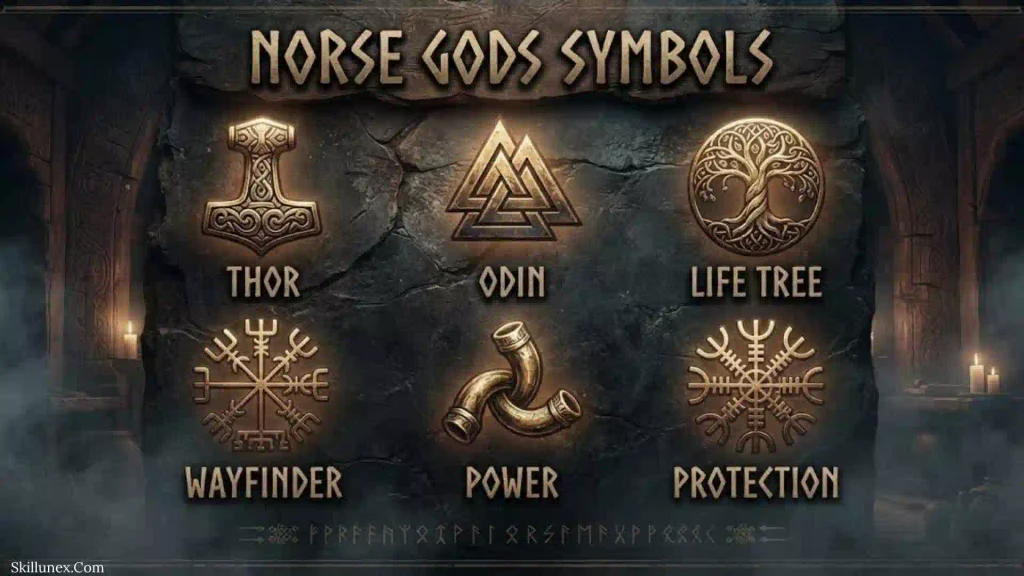
Norse mythology contains distinctive weapons, animals, objects, and magical items associated with its gods. Many of these symbols continue to appear in modern art and popular culture.
Thor Symbols
Thor was associated with thunder, storms, strength, and protection.
His most famous symbol is:
- Mjölnir — Thor’s hammer
Mjölnir is closely associated with Thor’s power and his role as a protector. Hammer-shaped pendants have also been found in archaeological contexts connected with Viking-Age Scandinavia.
Odin Symbols
Odin is associated with wisdom, knowledge, poetry, magic, warfare, and death.
Important symbols and attributes include:
- Gungnir — Odin’s spear
- Huginn and Muninn — his two ravens
- Geri and Freki — his wolves
- Sleipnir — his eight-legged horse
- One eye — associated with his sacrifice for wisdom
- Runes — connected with knowledge and magical traditions
Odin’s ravens are particularly important because they travel through the world and return with information.
Freyja Symbols
Freyja is associated with love, fertility, beauty, magic, and warfare.
Her traditional associations include:
- Cats
- Boar
- Falcon imagery
- Brísingamen, her famous necklace
- Seiðr, a form of magic associated with her mythology
Loki Symbols
Loki is a complex figure associated with trickery, transformation, shapeshifting, and disruption.
Unlike Thor’s hammer or Odin’s spear, Loki does not have one universally established symbol. His mythology is instead strongly connected with transformation and his ability to change form.
Hindu Gods Symbols
Hindu traditions contain an extensive collection of divine symbols and attributes. Meanings can vary between texts, regions, schools, and traditions, so symbols should be understood within their specific context.
Shiva Symbols
Shiva is associated with transformation, destruction, regeneration, asceticism, and several other religious concepts.
Important symbols and attributes include:
- Trishula — trident
- Damaru — small drum
- Third eye — spiritual insight
- Crescent moon — an important feature of Shiva’s iconography
- Snake — frequently shown around Shiva
- Nandi — Shiva’s sacred bull
- Shiva lingam — an important sacred representation
Vishnu Symbols
Vishnu is commonly depicted holding four important attributes:
- Shankha — conch shell associated with sacred sound
- Sudarshana Chakra — discus associated with divine power
- Kaumodaki — mace representing strength
- Padma — lotus associated with purity and spiritual symbolism
These attributes are among the defining features of Vishnu’s traditional iconography.
Ganesha Symbols
Ganesha is widely associated with wisdom, learning, beginnings, and the removal of obstacles.
His common symbols and attributes include:
- Elephant head
- Broken tusk
- Mouse
- Modak
- Axe
- Lotus
The mouse is traditionally regarded as Ganesha’s vehicle, while the broken tusk is connected with stories found in Hindu tradition.
Lakshmi Symbols
Lakshmi is associated with prosperity, fortune, abundance, and beauty.
Her common symbols include:
- Lotus
- Elephants
- Gold
- Water
- Coins
The lotus is especially prominent in representations of Lakshmi.
Gods Symbols by Meaning
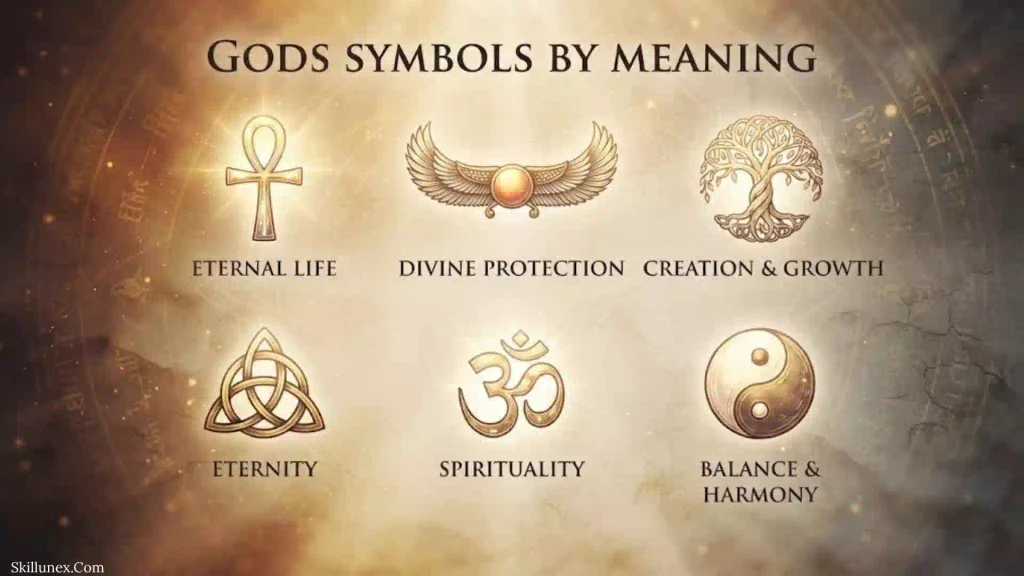
Looking at symbols according to their themes can make it easier to understand why similar imagery appears in different cultures.
Gods Symbols of Protection
Protection is a recurring theme in divine symbolism.
Examples include:
- Eye of Horus — associated with protection and restoration
- Mjölnir — associated with Thor’s protective role
- Aegis — associated with Zeus and Athena
- Divine weapons — frequently communicate protection and authority
Gods Symbols of Wisdom
Wisdom is another major theme.
Examples include:
- Owl — Athena
- Ravens — Odin’s gathering of knowledge
- Third eye — Shiva
- Sacred writings and objects — associated with wisdom in different traditions
Gods Symbols of Power
Weapons and objects of authority often represent divine power.
- Thunderbolt — Zeus
- Trident — Poseidon
- Hammer — Thor
- Spear — Odin
- Trishula — Shiva
- Sudarshana Chakra — Vishnu
Gods Symbols of Life and Renewal
Several traditions use symbols to express life, regeneration, and renewal.
- Ankh — life in ancient Egyptian symbolism
- Scarab — regeneration and renewal
- Lotus — purity, renewal, and spiritual symbolism in several traditions
- Sacred trees — life, fertility, knowledge, or divine presence in different cultures
Animal Symbols of Gods
Animals were central to the religious imagery of many ancient cultures. A deity could be represented as an animal, accompanied by an animal, or connected with a particular species.
Some well-known examples include:
- Falcon — Horus
- Owl — Athena
- Eagle — Zeus
- Dove — Aphrodite
- Deer — Artemis
- Ravens — Odin
- Wolves — Odin
- Cats — Freyja
- Elephant — Ganesha
- Bull — Nandi in connection with Shiva
- Horse — Poseidon and other deities
Animal symbolism could communicate qualities such as strength, wisdom, speed, fertility, freedom, protection, or a deity’s relationship with nature.
Weapon Symbols of Gods
Divine weapons are among the clearest examples of gods symbols because they often represent a deity’s distinctive power.
Thor’s Hammer
Mjölnir represents Thor’s distinctive weapon and is strongly associated with thunder and protection.
Zeus’s Thunderbolt
The thunderbolt is Zeus’s most famous weapon and symbolizes his authority over the sky and storms.
Poseidon’s Trident
The trident is the defining weapon and attribute of Poseidon and represents his connection with the sea.
Odin’s Gungnir
Gungnir is Odin’s famous spear and is associated with his authority and warrior aspect.
Shiva’s Trishula
The trishula is one of Shiva’s most recognizable attributes and is frequently represented in Hindu art and religious practice.
Vishnu’s Sudarshana Chakra
The discus is one of Vishnu’s four major attributes and represents an important aspect of his divine power.
Sacred Plants and Trees Associated With Gods
Plants and trees became important divine symbols because they were closely connected with food, medicine, fertility, seasonal cycles, and human survival.
Olive Tree
The olive tree is strongly associated with Athena in Greek mythology and with the story of the contest for patronage of Athens.
Laurel
Laurel is associated with Apollo and became an important symbol of victory and achievement.
Oak
The oak had a strong association with Zeus and was connected with sacred worship in ancient Greece.
Lotus
The lotus has important symbolic roles in several Egyptian and South Asian religious traditions. Its meanings can include purity, renewal, creation, and spiritual development depending on the context.
Mistletoe
Mistletoe is associated with the Norse myth of Baldr and therefore became an important plant within discussions of Norse mythology.
Sun and Moon Symbols of Gods
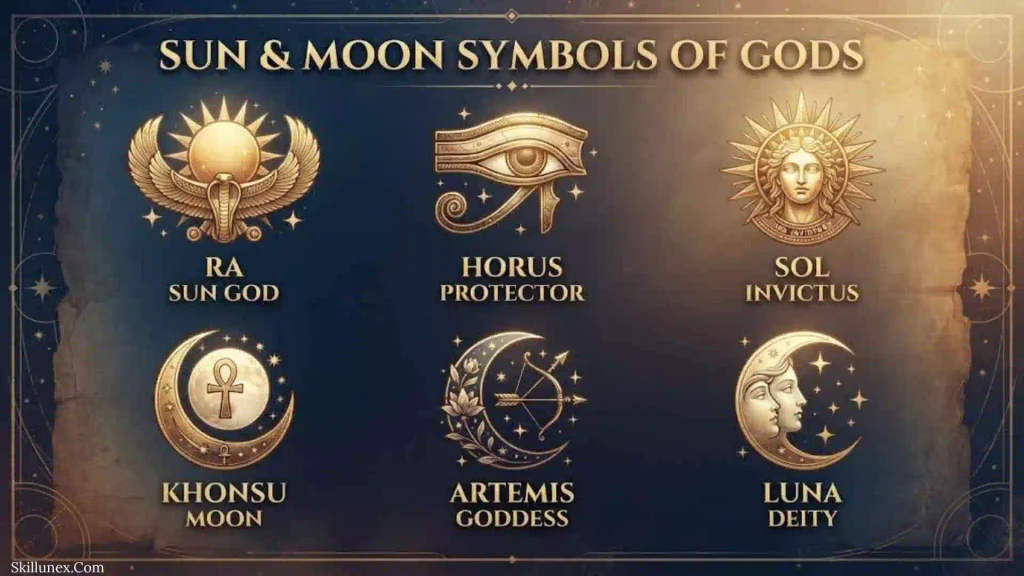
The sun and moon have been important sources of divine symbolism across many civilizations.
Solar imagery can represent:
- Light
- Life
- Creation
- Power
- Kingship
- Renewal
Lunar imagery can represent:
- Cycles
- Time
- Night
- Fertility
- Change
- Mystery
Different cultures assigned these meanings to different gods and goddesses, so a solar or lunar symbol should always be interpreted within its specific tradition.
How Gods Symbols Were Used in Ancient Cultures
Divine symbols appeared in many areas of ancient life.
Temples and Sacred Buildings
Temples often displayed statues, reliefs, inscriptions, animals, and objects connected with the gods worshiped there. These visual elements helped establish the identity and sacred character of the space.
Jewelry and Amulets
People wore religious symbols as jewelry or carried them as amulets. Some objects may have had protective or devotional purposes, although the exact purpose of an individual artifact can depend on archaeological evidence.
Coins
Ancient coins sometimes featured gods, divine attributes, sacred animals, and religious imagery. Such designs could communicate religious identity as well as messages about rulers and cities.
Art and Sculpture
Artists used divine attributes to make gods recognizable. A particular weapon, animal, plant, or object could provide an important visual clue about the identity of a figure.
God’s Symbols and Religious Symbols: What Is the Difference?
A god symbol is usually directly connected with a specific deity, while a religious symbol can represent a broader belief, tradition, community, or spiritual concept.
For example, the trident can function as an attribute of Poseidon in Greek mythology and Shiva in Hindu traditions. Although the same basic object appears in both contexts, its religious meaning is not identical.
This is why symbols should not automatically be given one universal definition.
Do God’s Symbols Have Universal Meanings?
No. The meaning of a symbol depends on its culture, deity, historical period, and religious context.
A snake, for example, can have different meanings across different traditions. It may be connected with transformation, healing, danger, fertility, wisdom, or divine power.
Similarly, the lotus can represent different concepts depending on the tradition in which it appears.
When researching a gods symbol, consider:
- Which culture used it?
- Which deity was connected with it?
- What historical period does it belong to?
- Is the interpretation supported by historical evidence?
- Is the meaning traditional or modern?
- Does the symbol have different meanings in other cultures?
Gods Symbols in Modern Culture
Ancient gods’ symbols remain popular in modern society. They appear in jewelry, tattoos, clothing, artwork, video games, films, books, fantasy stories, and decorative designs.
Modern popular culture sometimes simplifies ancient mythology. A symbol with several historical associations may be presented as having one fixed meaning.
For this reason, anyone interested in using an ancient gods symbol should research its cultural background and traditional associations rather than relying solely on modern symbolic lists.
How to Choose a Gods Symbol
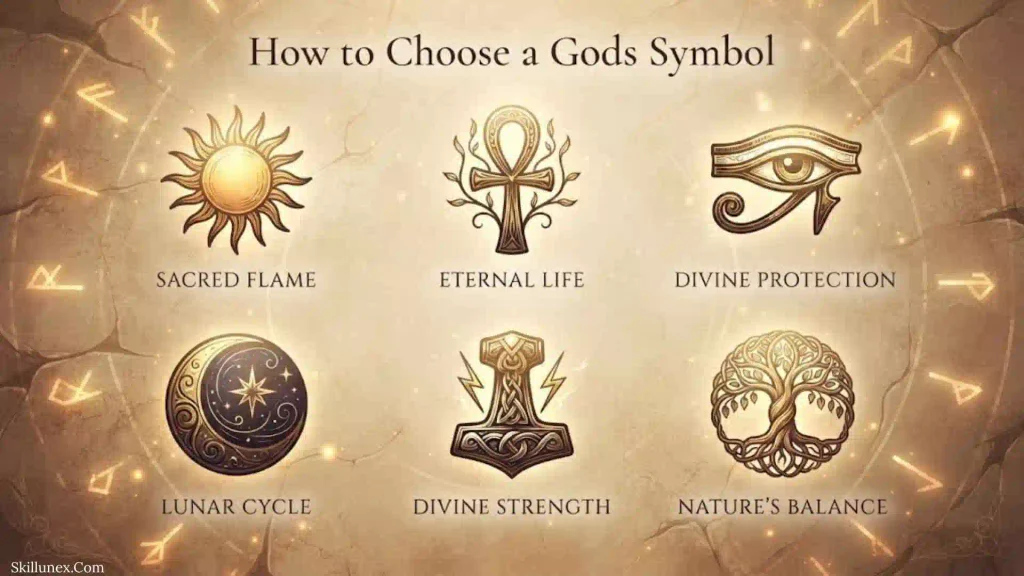
If you are selecting a gods symbol for artwork, jewelry, writing, research, or personal interest, start by identifying the deity and cultural tradition behind it.
Consider:
- The original deity
- The historical culture
- The traditional symbolism
- The time period
- Different interpretations of the symbol
- Modern meanings
- Whether the tradition is still religiously practiced today
Understanding the background of a symbol can help you use it more accurately and respectfully.
Frequently Asked Questions About Gods Symbols
What are gods symbols?
Gods symbols are objects, animals, plants, weapons, signs, or other visual elements traditionally associated with gods and goddesses. They can represent a deity’s power, personality, domain, mythology, or religious significance.
What is the most famous symbol of a god?
There is no single universal symbol for all gods. Some widely recognized examples include the Eye of Horus, Thor’s hammer, Zeus’s thunderbolt, Athena’s owl, and Poseidon’s trident.
What symbol represents divine power?
Divine power is represented differently across traditions. Zeus’s thunderbolt, Poseidon’s trident, Thor’s hammer, Odin’s spear, Shiva’s trident, and Vishnu’s discus are examples of symbols associated with divine authority or power.
What symbol represents protection?
The Eye of Horus is strongly associated with protection and restoration in ancient Egyptian symbolism. Mjölnir is also associated with Thor’s protective role in Norse mythology.
What is Zeus’s symbol?
Zeus is most famously associated with the thunderbolt. The eagle and oak are also important traditional associations.
What is Thor’s symbol?
Thor’s most famous symbol is Mjölnir, his hammer. It is strongly associated with thunder, strength, and protection.
What is Athena’s symbol?
Athena is especially associated with the owl, which represents wisdom and knowledge. The olive tree, helmet, spear, and aegis are also associated with her.
What is Poseidon’s symbol?
Poseidon’s best-known symbol is the trident, which represents his connection with the sea and his divine authority.
What is Odin’s symbol?
Odin has several important symbols and attributes, including Gungnir, his spear; Huginn and Muninn, his ravens; his wolves; and Sleipnir, his eight-legged horse.
What is Shiva’s main symbol?
Shiva has several important symbols, including the trishula, damaru, third eye, Nandi, and Shiva lingam. Their meanings depend on the specific religious and iconographic context.
Are gods symbols still used today?
Yes. Gods symbols continue to appear in religious practices, cultural traditions, art, jewelry, tattoos, literature, movies, games, and other forms of modern culture. Their modern interpretations may differ from their historical meanings.
Conclusion
Gods symbols provide a fascinating way to explore mythology, ancient religion, art, and cultural history. From the Eye of Horus and Egyptian ankh to Zeus’s thunderbolt, Athena’s owl, Poseidon’s trident, Thor’s hammer, Odin’s ravens, and the sacred attributes of Hindu deities, these symbols connect visual imagery with stories and ideas about divine power, wisdom, protection, life, transformation, and nature.
The meaning of any gods symbol depends on the tradition in which it appears. A symbol should therefore be understood through its deity, culture, historical period, and original context rather than being assigned a single universal definition. Learning these differences makes the study of gods symbols more accurate, meaningful, and useful for anyone interested in mythology and ancient cultures.

Isla Kensington
I’m Isla Kensington, a writer with a passion for research, culture, nature, and the fascinating meanings behind everyday things. I enjoy taking topics that may seem simple at first and discovering the history, facts, and ideas that make them more interesting.
I write with readers in mind. My aim is to provide clear explanations, useful information, and interesting details without making a topic unnecessarily complicated.
I believe learning should feel like discovering something rather than simply reading facts. That philosophy guides the content I create and the topics I choose to explore.
## Books by Isla Kensington
* Symbols Around the World: A Guide to Meaning & Culture
* Nature’s Beautiful Places: Lakes, Landscapes & Natural Treasures