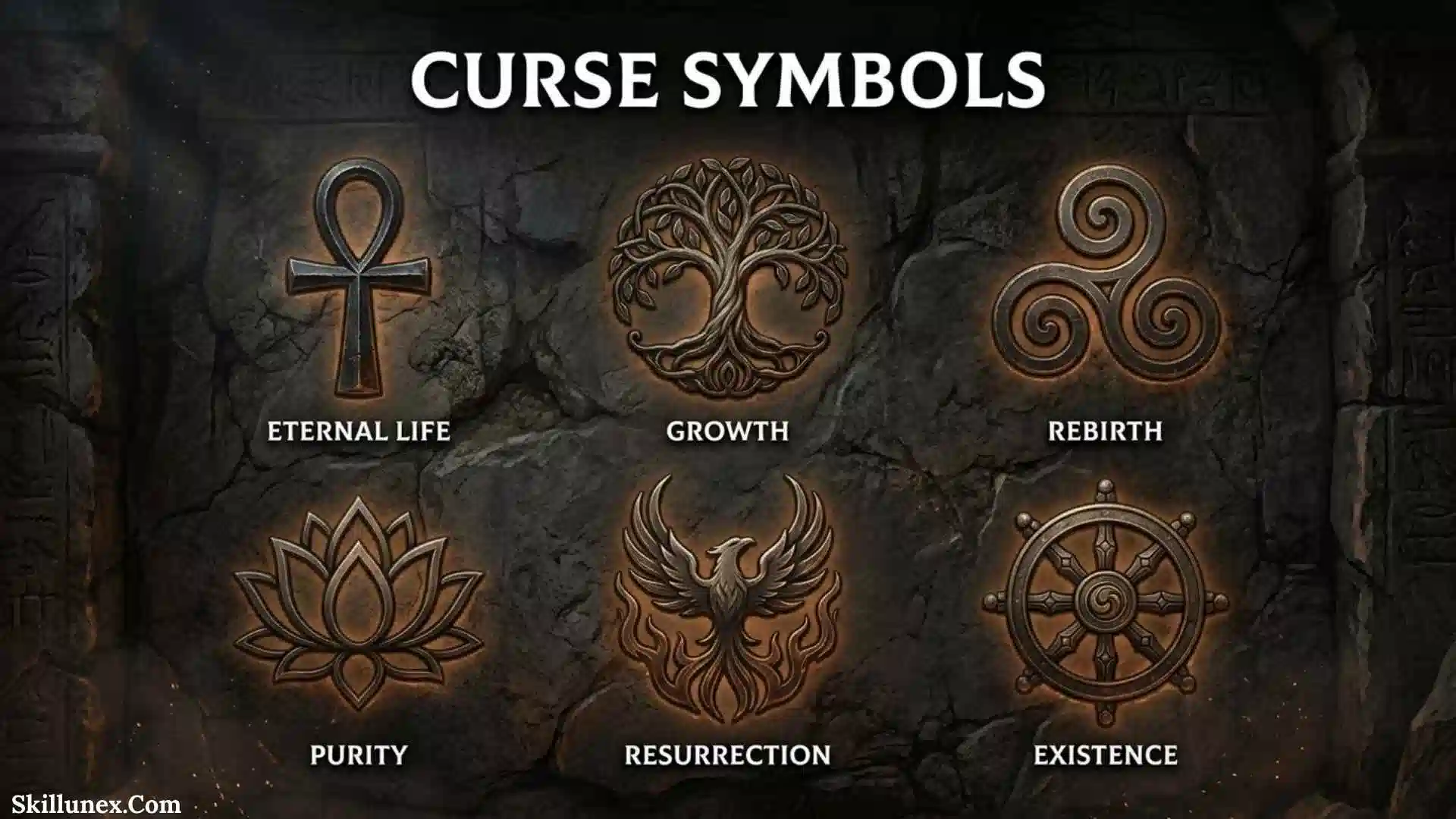
Curse symbols have fascinated people for centuries. Mysterious markings, ancient inscriptions, magical signs, and unusual symbols often appear in folklore, mythology, religious traditions, horror stories, video games, and modern art. Some are associated with curses and misfortune, while others were actually created for protection, healing, or spiritual purposes.
The term curse symbols can therefore be misleading. Not every dark-looking or mysterious symbol represents a curse, and many symbols described online as ancient curse marks have meanings that are very different from what popular culture suggests.
Understanding these symbols requires looking at their history, cultural context, original purpose, and how their meanings have changed over time. This guide explores the origins of curse symbols, the different types commonly associated with curses, their cultural significance, their use in modern entertainment, and how to distinguish historical evidence from internet myths.
What Are Curse Symbols?
Curse symbols are markings, signs, inscriptions, images, or designs that are associated with curses, harmful supernatural intentions, magical practices, misfortune, or dark supernatural forces.
There is no single universal collection of symbols officially recognized as “curse symbols.” Instead, the phrase is commonly used as a broad description for symbols connected with beliefs about curses or supernatural harm.
In historical societies, a curse could involve written words, ritual objects, figurines, inscriptions, or specific ceremonies. In modern culture, the term is also used for fictional symbols found in horror movies, fantasy books, video games, and artwork.
Curse Symbols vs. Magical Symbols
Curse symbols and magical symbols are not necessarily the same thing.
A magical symbol may be associated with protection, healing, spirituality, astrology, transformation, or other beliefs. A curse symbol, by comparison, is generally presented as having a connection with harmful intentions or misfortune.
The distinction becomes particularly important when researching historical symbols because modern websites sometimes describe almost any mysterious symbol as a curse symbol without providing evidence for the claim.
Are Curse Symbols Real?
The symbols themselves can certainly be real historical objects or markings. Ancient cultures created inscriptions, amulets, tablets, ritual objects, and other symbolic forms that have survived to the present day.
However, there is no scientific evidence that a particular symbol can produce supernatural harm simply by being viewed, drawn, or possessed.
Beliefs about curses are best understood through the history of religion, folklore, cultural traditions, psychology, and anthropology.
The History of Curse Symbols
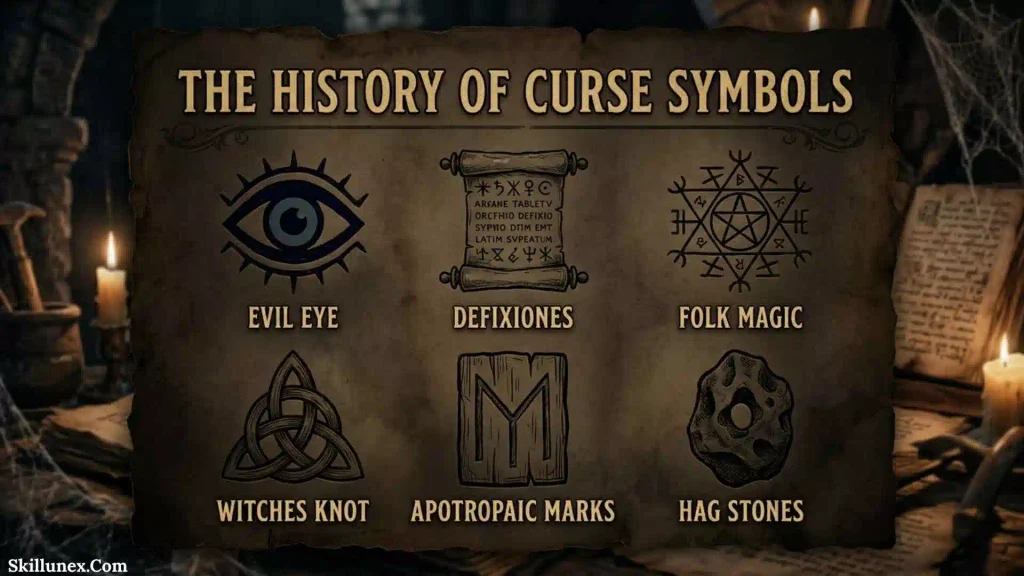
The use of symbols in magical and religious practices goes back thousands of years. Ancient societies used written words, images, objects, and rituals to communicate with gods, spirits, ancestors, or supernatural forces according to their belief systems.
Some practices were intended to protect people, while others were believed to influence enemies or settle conflicts.
Ancient Curse Tablets
One of the clearest historical examples comes from the ancient Mediterranean world, where people sometimes created written curse tablets.
These small objects could contain written requests directed toward supernatural powers. Some were connected with personal disputes, legal conflicts, competition, relationships, or other problems.
The existence of these artifacts demonstrates that some ancient people genuinely believed written language could play a role in supernatural rituals.
However, these historical practices should not be confused with the idea that particular symbols automatically possess supernatural power.
Symbols in Ancient Egypt
Ancient Egyptian culture provides another important example of how modern interpretations can differ from historical meanings.
Egyptian civilization used an enormous range of religious symbols, magical texts, protective amulets, and funerary inscriptions. Many of these are sometimes labeled “curse symbols” online because of their association with tombs, death, or ancient magic.
In reality, many Egyptian symbols were intended to provide protection, health, rebirth, or spiritual assistance.
The context of a symbol is therefore more important than its appearance.
Medieval and Early Modern Traditions
European folklore contains numerous traditions involving charms, magical markings, witches, protective signs, supernatural creatures, and curses.
People sometimes placed markings on houses, objects, or personal possessions because they believed these signs could protect them against evil or misfortune.
This creates an important distinction: a symbol associated with supernatural beliefs does not necessarily represent a curse. It may have been intended to prevent one.
Types of Symbols Associated With Curses
There is no universal classification of curse symbols, but several broad categories frequently appear in historical discussions and modern culture.
Written Curse Inscriptions
Written curses are among the most historically documented examples.
An inscription could contain the name of a person, a request directed toward a supernatural power, or language expressing a desired outcome. The writing itself could be part of a ritual.
These inscriptions demonstrate the importance of written language in ancient magical traditions.
Sigils and Magical Marks
A sigil is generally a symbolic design representing an intention, concept, name, or idea.
In some modern occult traditions, sigils have specific ritual meanings. In fiction, they are often presented as symbols that activate curses, spells, supernatural creatures, or magical objects.
There is no single universal “curse sigil.” A sigil’s meaning depends on the tradition, creator, or fictional setting in which it appears.
Runes and Runic Symbols
Runes were historical writing systems used by Germanic peoples.
Modern fantasy and popular culture frequently portray runes as magical symbols. Some historical runic inscriptions may have had religious or magical contexts, but it is inaccurate to describe runes in general as curse symbols.
A rune could simply function as a written character.
Symbols Associated With Death
Skulls, bones, graves, and other death-related imagery are frequently associated with curses in horror and fantasy.
However, death symbolism can have many meanings, including mortality, remembrance, danger, rebellion, transformation, or the temporary nature of life.
A skull, for example, does not automatically indicate that a curse is involved.
Protective Symbols Mistaken for Curse Symbols
Some of the biggest misunderstandings occur when protective symbols are incorrectly described as curses.
Many cultures created symbols specifically to guard against evil, bad luck, illness, or supernatural threats. These symbols may look mysterious or frightening to people unfamiliar with their history.
The evil eye is a particularly useful example.
The Evil Eye and Curse Symbols
The evil eye is one of the world’s best-known supernatural beliefs.
The basic idea is that a person’s envious, malicious, or otherwise harmful gaze can cause misfortune. Different cultures have developed their own beliefs and protective traditions surrounding the evil eye.
Is the Evil Eye a Curse Symbol?
The answer depends on how the term is being used.
The evil eye itself is a belief about harmful influence, but many eye-shaped objects and symbols associated with it are protective symbols rather than curses.
They are intended to guard the wearer against negative influence.
This distinction demonstrates why it is important to research the original purpose of a symbol instead of judging it by its appearance.
Curse Symbols Across Different Cultures
Curse symbols do not have universal meanings. A symbol that represents danger or misfortune in one culture can represent protection, luck, religion, or prosperity in another.
European Folklore
European traditions include extensive beliefs about witches, charms, curses, protective markings, magical objects, and supernatural beings.
Some symbols were believed to prevent evil rather than cause it.
Ancient Greek and Roman Traditions
Ancient Greek and Roman societies provide important historical evidence for curse practices, particularly through written curse tablets.
These artifacts show that some individuals believed supernatural forces could be invoked to influence conflicts and personal situations.
Ancient Egyptian Traditions
Egyptian symbolism included religious, funerary, protective, and magical imagery.
Modern horror media often emphasizes the darker side of Egyptian mythology, which can lead to ordinary religious symbols being incorrectly described as curse symbols.
South Asian Traditions
South Asian cultures contain diverse traditions involving auspicious symbols, protective markings, supernatural beliefs, ritual practices, and concepts of negative influence.
Because these traditions are highly varied, individual symbols should be interpreted according to their specific cultural and religious context rather than being grouped together as generic curse symbols.
Japanese Folklore
Japanese folklore contains numerous stories involving spirits, supernatural beings, curses, protective objects, and ritual practices.
Japanese horror has also had a major influence on modern international perceptions of curses, particularly through films, manga, anime, novels, and video games.
Why Do Symbols Become Associated With Curses?
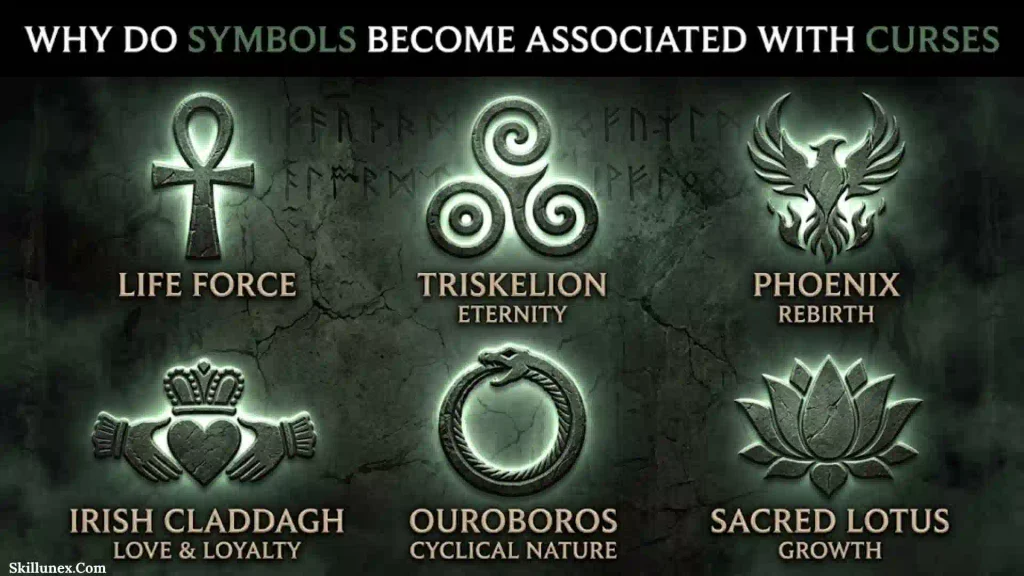
Symbols can acquire supernatural associations for several reasons.
A marking may originally have had one meaning and later develop another through folklore, religious changes, storytelling, or popular culture.
Religious and Cultural Changes
As societies change, the meanings attached to symbols can change as well.
A symbol that once represented protection may later be portrayed as sinister. A religious symbol may become a fictional representation of dark magic. A writing character may eventually be presented as an occult sign.
Popular Culture
Movies, television shows, books, and games have significantly influenced modern interpretations of mysterious symbols.
Creators often design fictional symbols by combining elements inspired by ancient writing systems, mythology, religious imagery, and occult traditions.
Once audiences repeatedly see a symbol associated with a curse, they may begin to assume that it has a historical supernatural meaning.
Curse Symbols in Movies, Books, and Video Games
Modern entertainment has played a major role in popularizing curse symbols.
Curse Symbols in Horror Movies
Horror filmmakers often use mysterious markings to create suspense.
A symbol may appear on a wall, book, artifact, photograph, or person’s body before the audience understands its meaning. As the story develops, the symbol becomes associated with the supernatural threat.
This makes symbols an effective visual storytelling device.
Curse Symbols in Fantasy Books
Fantasy authors frequently create fictional magical alphabets, markings, runes, and sigils.
A fictional curse symbol may represent an ancient spell, forbidden power, supernatural entity, secret organization, or magical object.
These designs can be inspired by historical symbols without actually being historical themselves.
Curse Symbols in Video Games
Video games often use symbols to communicate information quickly.
A particular mark might identify a cursed character, dangerous area, magical artifact, enemy faction, or forbidden spell.
Because game worlds establish their own rules, the meaning of a symbol within a fictional universe should not automatically be treated as a real-world historical meaning.
Ancient Curse Symbols vs. Modern Internet Symbols
The internet has made it extremely easy for images and claims about symbols to spread.
A symbol can be uploaded with a dramatic description, copied by other websites, and eventually appear on dozens of pages as if the claim were historically established.
Why Online Symbol Claims Can Be Misleading
A website might describe a symbol as:
- An ancient curse mark
- A forbidden magical symbol
- A symbol used by an ancient secret society
- A sign that summons supernatural entities
- A symbol that guarantees bad luck
But a dramatic description is not evidence.
The image may actually be a modern illustration, fictional design, decorative pattern, or symbol whose original meaning has been misunderstood.
How to Research a Mysterious Symbol
When investigating a symbol, consider its source, location, age, language, culture, and historical documentation.
Useful questions include:
- Where was the symbol discovered?
- What is its earliest documented appearance?
- Which culture or community used it?
- Was it writing, decoration, religious imagery, or ritual symbolism?
- Is there archaeological or documentary evidence supporting the claimed meaning?
- Do reputable historical sources agree with the interpretation?
These questions can help separate historical information from internet mythology.
Are Curse Symbols Dangerous?
There is no scientific evidence that simply viewing, drawing, or possessing a particular symbol causes supernatural harm.
Nevertheless, symbols can have cultural, religious, and emotional significance.
A symbol that appears harmless to one person may be deeply meaningful or offensive to another community. Respecting the cultural context of symbols is therefore important even when supernatural claims are not supported by scientific evidence.
Curse Symbols and Tattoos
Curse symbols are sometimes used in tattoos because of their mysterious or dramatic appearance.
Before getting an unfamiliar symbol tattooed, it is worth researching its actual meaning.
Why Research Matters Before Getting a Symbol Tattoo
A design advertised as an “ancient curse symbol” may actually be:
- A religious symbol
- A protective charm
- A modern fictional design
- A historical writing character
- An occult symbol with a different meaning
- A symbol associated with a particular cultural group
Understanding the original meaning can help prevent accidental cultural misrepresentation or an unintended message.
Curse Symbols and Psychology
The fascination with curse symbols is not only historical. It also has a psychological dimension.
Humans naturally look for patterns and meaning, particularly when confronted with unfamiliar objects or uncertain situations.
A strange marking can create curiosity because the viewer does not immediately know what it represents.
Why Mysterious Symbols Feel Frightening
A mysterious symbol can communicate danger without explaining what the danger is.
This uncertainty is particularly effective in horror.
When a character discovers an unfamiliar marking and is told that it is connected with a curse, the audience begins to associate the symbol with fear. Repeated appearances reinforce that association.
This is one reason fictional curse symbols can be so memorable.
Common Misconceptions About Curse Symbols
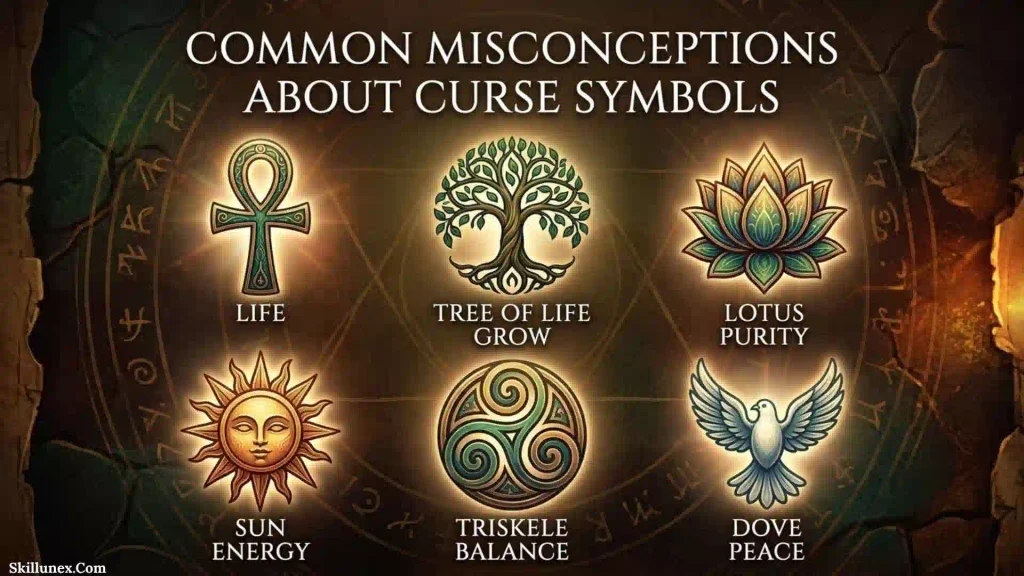
Several misconceptions appear repeatedly in discussions about curse symbols.
Every Ancient Symbol Is a Curse Symbol
This is false.
Ancient civilizations used symbols for writing, religion, administration, decoration, protection, astronomy, trade, and many other purposes.
Every Occult Symbol Is a Curse Symbol
This is also incorrect.
Occult traditions contain symbols associated with many different ideas, including spirituality, astrology, philosophy, protection, transformation, and ritual practices.
Looking at a Curse Symbol Causes a Curse
There is no scientific evidence supporting this claim.
Every Symbol Called a Curse Symbol Online Is Ancient
Many are not.
Some are modern designs created for entertainment, artwork, tattoos, games, or online communities.
Frequently Asked Questions About Curse Symbols
What is a curse symbol?
A curse symbol is a broad term for a marking, sign, image, or design associated with curses, harmful supernatural intentions, magical practices, or misfortune. There is no universally accepted list of curse symbols.
What is the most famous curse symbol?
There is no single universally recognized curse symbol. The evil eye, magical sigils, death imagery, certain occult designs, and fictional symbols are commonly associated with curses or supernatural danger.
Are runes curse symbols?
Runes are historical writing systems rather than a universal collection of curse symbols. Some individual inscriptions may have religious or magical contexts, but not every rune is associated with curses.
Is the evil eye a curse?
The evil eye is a belief concerning harmful influence through a gaze. Many symbols associated with the evil eye are protective charms intended to prevent or repel that influence.
Can curse symbols actually cause harm?
There is no scientific evidence that a symbol can produce supernatural harm. Historical cultures did have genuine beliefs and rituals involving curses, but those beliefs are different from scientific evidence that curses work.
Are curse symbols always ancient?
No. Many symbols described as curse symbols today are modern creations from movies, games, books, artwork, tattoos, or internet culture.
What is a curse sigil?
A curse sigil is a symbol presented as representing a curse, harmful intention, or supernatural force. Its meaning depends on the tradition, creator, or fictional setting in which it appears.
Why are curse symbols popular?
Curse symbols combine mystery, history, folklore, supernatural themes, and visual storytelling. Their unfamiliar appearance makes them particularly effective in horror, fantasy, artwork, games, and popular culture.
Are protective symbols the same as curse symbols?
No. Protective symbols are generally intended to prevent or repel harm, while curse-related symbols are associated with causing harm or misfortune. However, the same symbol can be interpreted differently across cultures.
How can I tell whether a curse symbol is historically authentic?
Look for information about its archaeological or historical origin, earliest documented appearance, cultural context, original purpose, and reliable scholarly sources. Avoid accepting dramatic internet claims without supporting evidence.
Conclusion
Curse symbols are a fascinating subject because they sit at the intersection of history, folklore, religion, psychology, art, and popular culture.
Throughout history, people have used inscriptions, objects, markings, charms, and rituals to express beliefs about supernatural forces. Some practices were associated with curses, while many others were intended to provide protection or healing.
Modern entertainment has added another layer to the subject by creating fictional curse symbols for movies, books, games, and artwork. As these designs spread online, fictional and historical symbols can easily become confused.
The most important thing to remember is that a mysterious appearance does not automatically make a symbol a curse symbol. Understanding its origin, cultural context, historical purpose, and supporting evidence is essential.
If you are researching ancient history, exploring folklore, designing artwork, studying mythology, or simply curious about mysterious markings, looking beyond the legend can reveal the much richer story behind these fascinating symbols.

Caleb Thornton
I’m Caleb Thornton, a researcher and content writer who loves exploring fascinating subjects and sharing what I learn with readers. My interests include natural places, lakes, symbols, culture, history, and the stories that make ordinary topics more meaningful.
When I write an article, I try to go beyond a basic answer. I look for useful facts, relevant context, and details that can help readers understand the subject more completely.
My purpose is simple: I want every article I contribute to provide genuine value, satisfy the reader’s curiosity, and make discovering new information enjoyable.
## Books by Caleb Thornton
* Symbols & Meanings: Exploring the Signs We See Every Day
* Lakes of the World: Nature, Beauty & Exploration