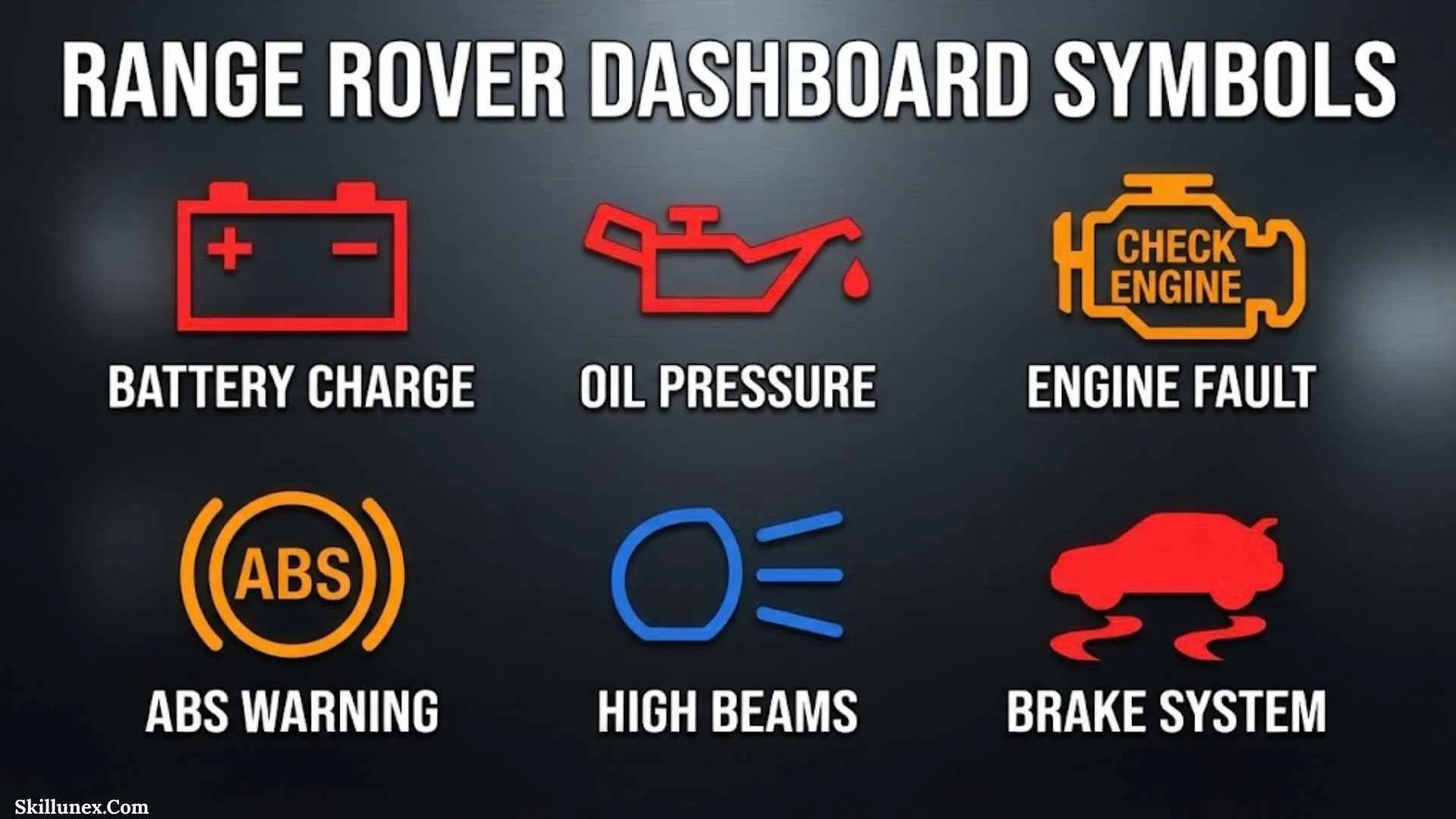
Range Rover dashboard symbols are designed to communicate important information about your vehicle quickly. Some symbols simply tell you that a feature is operating, while others warn you about a condition that requires attention. Knowing what these symbols mean can help you decide whether you can continue driving, need to check something yourself, or should stop the vehicle and seek professional assistance.
Different Range Rover models and model years can use slightly different symbols, colors, and messages. A Range Rover Evoque, Velar, Sport, and full-size Range Rover may not display every warning in exactly the same way. For that reason, the owner’s handbook for your specific vehicle should always be treated as the final reference for an unfamiliar warning.
This guide explains the most common dash Range Rover dashboard symbols, what their colors mean, which warnings are urgent, and what you should do when one appears.
What Do Range Rover Dashboard Symbols Mean?
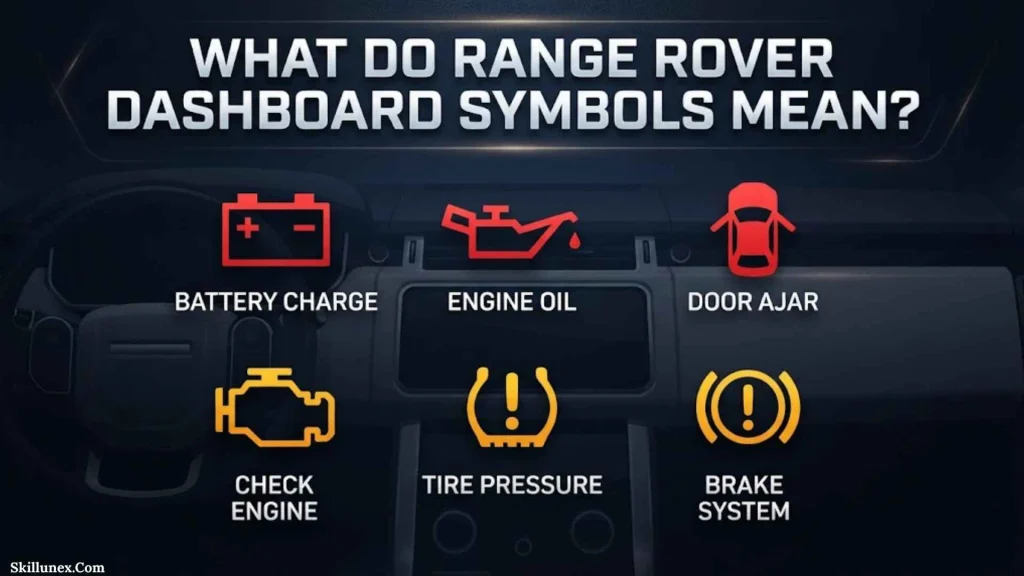
Range Rover uses dashboard warning lights and messages to communicate the status of systems throughout the vehicle. These can relate to the engine, brakes, tires, transmission, electrical system, driver-assistance features, lighting, and other components.
A dashboard symbol does not always mean that something has failed. Some indicators are simply there to confirm that a feature has been switched on or that a particular operating condition exists.
The first thing to consider when a symbol appears is its color, followed by the actual shape or accompanying message.
Red Range Rover Dashboard Symbols
Red warning lights generally indicate a condition that requires immediate attention. They can relate to critical systems such as the brakes, engine oil pressure, engine temperature, or charging system.
A red warning does not automatically mean the vehicle must never move, but it should never be ignored. Depending on the symbol, you may need to stop safely and switch off the engine.
Examples include:
- Engine oil pressure warning
- Brake-system warning
- Engine overheating warning
- Charging-system warning
- Certain restraint-system warnings
Always check the accompanying message and owner’s handbook before continuing your journey.
Amber or Yellow Dashboard Symbols
Amber or yellow warnings generally indicate that a system has detected a fault or condition that needs attention.
An amber warning is often less urgent than a red warning, but that does not mean it can be ignored indefinitely. For example, an engine-management warning may allow you to continue driving while requiring a diagnostic inspection as soon as practical.
If an amber warning is accompanied by loss of power, unusual noises, smoke, overheating, or other such as atypical behavior, stop driving and have the vehicle assessed.
Green and Blue Symbols
Green and blue indicators are commonly used to show that a particular vehicle function is active.
Examples may include:
- Exterior lighting functions
- High-beam indicators
- Certain driver-assistance functions
- Other operating-status indicators
These symbols normally do not indicate a mechanical fault.
Common Range Rover Dashboard Symbols and Their Meanings
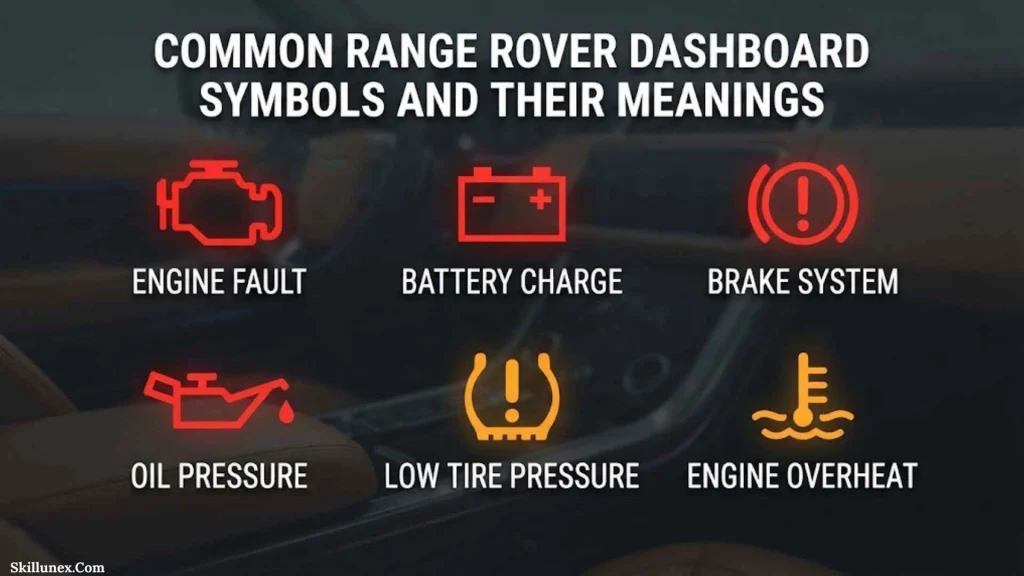
Understanding individual symbols is more useful than simply knowing their colors. The following are among the dashboard indicators Range Rover owners may encounter.
Check Engine or Engine Management Light
The check-engine light usually appears as an engine-shaped symbol.
It means the vehicle’s engine management system has detected a fault or abnormal operating condition. The cause can range from an emissions-related problem to a sensor, ignition, fuel, or engine-management issue.
A steady warning should be diagnosed promptly. A flashing engine warning can indicate a more serious problem, particularly if the engine is misfiring or running roughly.
If the vehicle begins shaking, loses significant power, produces smoke, or develops unusual engine behavior, stop safely and seek professional assistance.
Engine Oil Pressure Warning Light
The oil-pressure warning symbol generally resembles an oil can.
A red oil-pressure warning is one of the dashboard warnings that should be taken particularly seriously. It can indicate insufficient engine oil pressure, which may cause severe engine damage if the engine continues running.
If this warning appears while driving:
- Safely pull over as soon as possible.
- Switch off the engine.
- Check the oil level if it is safe and appropriate to do so.
- Do not continue driving if the warning remains illuminated.
- Arrange professional assistance if necessary.
It is important to distinguish an oil-level warning from an oil-pressure warning. They do not necessarily indicate the same problem.
Battery and Charging System Warning
The battery-shaped dashboard symbol can indicate a problem with the vehicle’s charging system.
Although it is commonly called the battery light, the problem may involve the alternator, charging circuit, wiring, drive belt, battery, or another electrical component.
If the warning appears while driving, electrical power may eventually become unavailable. Have the vehicle inspected promptly rather than assuming the battery itself is the only problem.
Brake Warning Light
A red brake symbol can indicate that the parking brake is engaged or that the vehicle has detected a brake-system issue.
If the parking brake is fully released but the warning remains on, consult the owner’s manual and have the vehicle checked.
A brake warning becomes particularly urgent if you notice:
- Reduced braking performance
- A soft or unusual brake pedal
- Grinding noises
- Fluid leakage
- Vehicle pulling to one side
Do not continue driving a vehicle if its braking performance is unsafe.
Anti-Lock Braking System (ABS) Warning
The ABS warning symbol indicates a potential problem with the anti-lock braking system.
A vehicle may continue to have normal basic braking when ABS has a fault, but the anti-lock function may not operate as intended. Because ABS is an important safety system, the warning should be diagnosed promptly.
If the ABS warning appears together with other brake warnings, treat the situation as more urgent.
Tire Pressure Monitoring System Warning
The tire-pressure warning symbol generally resembles a tire cross-section with an exclamation mark.
It can appear when one or more tires are underinflated. A significant change in outside temperature can also affect tire pressure.
When the warning appears:
- Check all four tires.
- Check the recommended pressures for your specific Range Rover.
- Inflate any underinflated tire correctly.
- Inspect the tires for visible damage.
- Check whether the warning disappears or whether the monitoring system requires a reset.
Do not rely on the maximum pressure printed on the tire sidewall as the recommended vehicle pressure. Use the vehicle manufacturer’s specified pressure.
Airbag or Restraint System Warning
An airbag warning may indicate a fault in the supplemental restraint system.
Because airbags and related restraint systems are important safety equipment, this warning should be investigated promptly.
Avoid attempting to repair airbag wiring or components yourself. Have the system inspected by a suitably qualified technician.
Seat Belt Warning Symbol
The seat-belt warning reminds the driver or passengers to fasten their seat belts.
Depending on the vehicle configuration, the warning can be accompanied by an audible alert. Make sure everyone in the vehicle is properly restrained before driving.
If the warning remains active even when the seats are apparently unoccupied, a sensor or detection system may require investigation.
Engine Coolant Temperature Warning
An overheating or high-engine-temperature warning can indicate that the engine coolant temperature is too high.
Possible causes include:
- Low coolant level
- Cooling-system leaks
- Radiator problems
- Cooling-fan problems
- Thermostat issues
- Other engine-cooling faults
If an overheating warning appears, stop the vehicle safely and allow the engine to cool as instructed in the owner’s handbook.
Never remove a coolant reservoir cap while the cooling system is hot. Hot, pressurized coolant can cause serious burns.
Low Fuel Warning
The low-fuel symbol usually looks like a fuel pump.
This is normally an information warning rather than a mechanical fault. It indicates that the remaining fuel level has reached a low point.
Refuel as soon as practical. Avoid routinely driving until the tank is almost empty, particularly when traveling in areas where fuel stations may be limited.
Glow Plug Warning on Diesel Models
Some diesel Range Rover models may display a glow-plug or preheating indicator.
It normally appears before starting the engine and indicates that the diesel engine’s preheating system is operating.
If the warning remains illuminated or flashes abnormally after the engine starts, consult the vehicle’s handbook and arrange a diagnosis if necessary.
Transmission Warning
A transmission-related warning can indicate a problem with the automatic transmission or its control system.
The vehicle may enter a restricted operating mode to protect the transmission.
If a transmission warning appears alongside harsh shifting, inability to select gears, unusual noises, or reduced performance, avoid unnecessary driving and seek professional diagnosis.
Electronic Stability Control Warning
Stability-control symbols can indicate that the electronic stability system is active or that a fault has been detected.
A flashing indicator may occur when the system is actively helping control wheel slip or vehicle stability.
A warning that remains illuminated may indicate that the system has been switched off or has detected a fault, depending on the model.
Traction Control Warning
The traction-control indicator can appear when the system is operating to reduce wheel spin.
If it stays illuminated continuously, the system may have been disabled or may have detected a fault.
Always check the accompanying message because the exact behavior differs between Range Rover models and driving modes.
Parking Brake Warning
The electronic parking brake symbol can indicate that the parking brake is engaged.
If the symbol remains illuminated after the parking brake has been released, investigate the issue according to the vehicle’s instructions.
A related brake-system warning should not be ignored.
Adaptive Cruise Control Warning
Range Rover models equipped with adaptive cruise control can display symbols showing the status of the system.
These indicators may show that adaptive cruise control is active, unavailable, temporarily interrupted, or detecting a condition that prevents operation.
A warning about a driver-assistance feature does not necessarily indicate a mechanical fault with the vehicle. Cameras, radar sensors, weather conditions, or blocked sensor areas can sometimes affect these systems.
Lane Keep Assist or Lane Departure Warning
A lane-related symbol can indicate that the lane-assistance system is active, unavailable, or has detected a condition preventing normal operation.
Heavy rain, snow, dirt, poor road markings, or an obstructed camera can affect driver-assistance features.
These systems are designed to assist the driver and should not be treated as substitutes for attentive driving.
Low Washer Fluid Warning
Some Range Rover models can display a washer-fluid warning when the reservoir is low.
This is normally a minor maintenance issue. Refill the reservoir with a suitable washer fluid and follow the vehicle manufacturer’s recommendations, particularly in cold weather.
What Should You Do When a Range Rover Warning Light Appears?
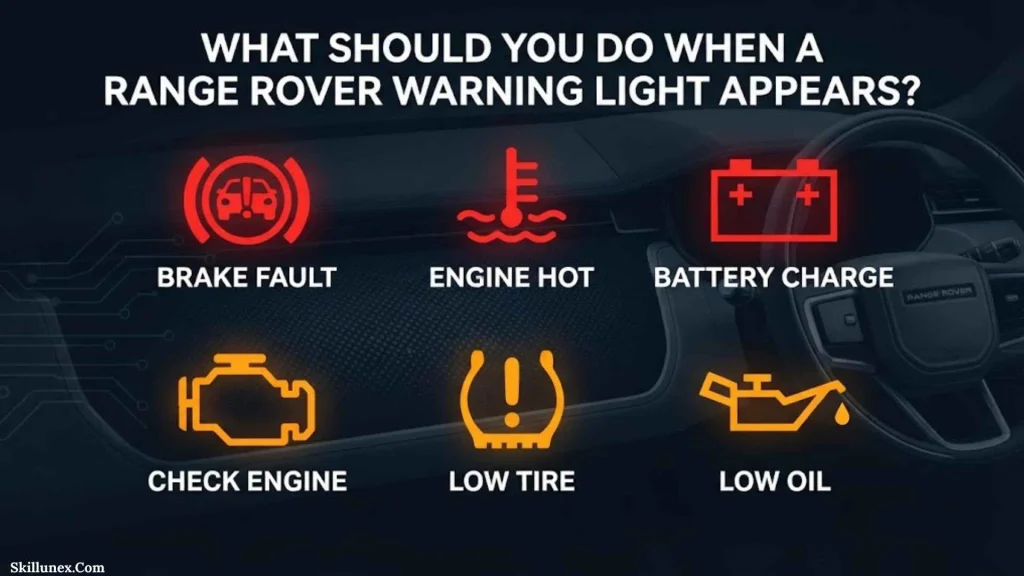
The correct response depends on the symbol, its color, and how the vehicle is behaving.
First, Identify the Symbol
Look closely at the dashboard and any accompanying text message.
If you cannot identify the symbol, consult the owner’s handbook for your exact model and model year.
Check for Other Symptoms
A warning light becomes more significant when it appears alongside symptoms such as:
- Loss of engine power
- Overheating
- Unusual noises
- Smoke
- Fluid leaks
- Poor braking
- Steering problems
- Rough engine operation
- Difficulty changing gears
The combination of a warning light and a physical symptom can help determine how urgently the vehicle needs attention.
Decide Whether It Is Safe to Continue Driving
Do not automatically assume that every warning means you must stop immediately, but do not assume that every warning is harmless either.
Red warnings involving critical systems should generally be treated as urgent. Amber warnings may allow limited driving depending on the specific fault and vehicle behavior.
If you are unsure, it is safer to stop somewhere appropriate and obtain professional advice.
Why Do Several Range Rover Dashboard Symbols Appear at Once?
Seeing several warning lights at the same time can be alarming, but multiple warnings do not necessarily mean that multiple unrelated components have failed.
Low Battery Voltage Can Trigger Multiple Warnings
Modern Range Rover vehicles rely heavily on electronic control modules. A problem with battery voltage or the charging system can sometimes cause several systems to report faults simultaneously.
This is one reason a diagnostic scan is often more useful than attempting to diagnose every warning independently.
A Single System Fault Can Affect Other Systems
Vehicle systems communicate with one another. A fault in one component can sometimes cause other systems to disable themselves or display warnings.
For example, a fault affecting a sensor or electronic control system can cause several driver-assistance or stability features to become unavailable.
Can You Drive With a Range Rover Dashboard Warning Light On?
Whether you can continue driving depends on the specific warning.
When Driving May Be Possible
A minor amber warning may sometimes allow you to continue driving cautiously to a repair facility, particularly if the vehicle feels completely normal.
However, this should not become a reason to postpone diagnosis indefinitely.
When You Should Stop Driving
Stop safely and seek assistance if you experience a serious red warning or symptoms such as:
- Overheating
- Loss of braking ability
- Very low oil pressure
- Major loss of engine power
- Serious steering problems
- Smoke
- Significant fluid leakage
- Severe engine or transmission noise
If the vehicle appears unsafe, do not attempt to drive it to a workshop.
How to Reset Range Rover Dashboard Warning Lights
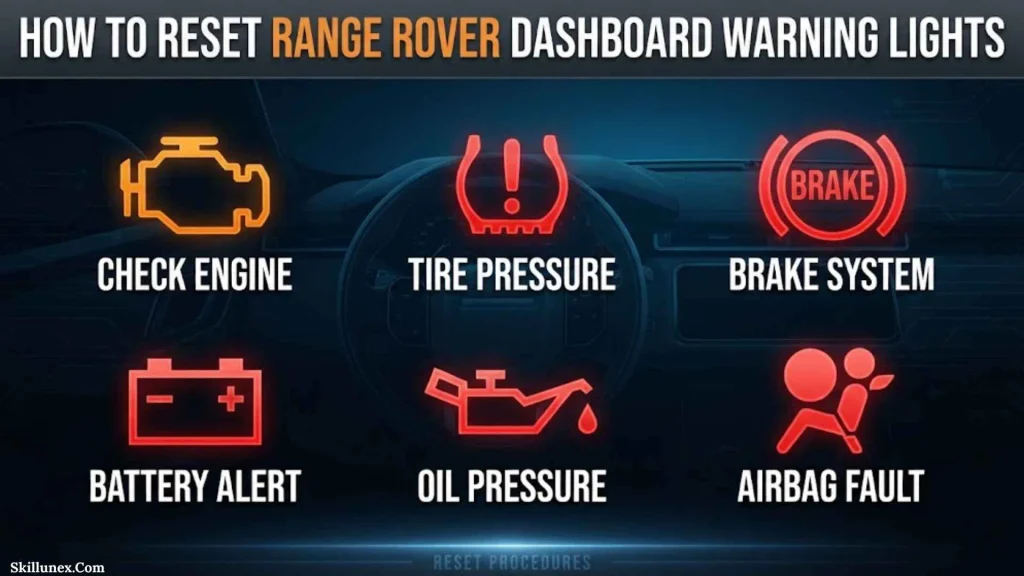
Some dashboard indicators disappear automatically when the underlying condition is corrected. Others may require a reset through the vehicle’s controls or a diagnostic procedure.
Do Not Reset a Warning Without Finding the Cause
Clearing a warning light without fixing the underlying problem does not solve the fault.
For example, if a tire-pressure warning returns after being reset, the vehicle may still have an underinflated or damaged tire. Similarly, clearing an engine-management warning does not repair the component that caused the fault.
For model-specific reset instructions, use the owner’s handbook for your exact Range Rover.
Why Do Range Rover Dashboard Symbols Differ Between Models?
Not every Range Rover uses exactly the same dashboard design.
The available warning symbols and messages can vary according to:
- Model
- Model year
- Engine type
- Equipment level
- Market
- Software version
- Optional driver-assistance systems
A symbol displayed on a Range Rover Sport may therefore look different from a similar warning on a Range Rover Evoque or Range Rover Velar.
This is why searching for a generic dashboard symbol can sometimes produce an inaccurate answer. The exact model and model year are important when identifying an unfamiliar warning.
How to Diagnose an Unknown Range Rover Dashboard Symbol
If you see an unfamiliar symbol, follow a simple process.
Check the Dashboard Message
Many modern Range Rover vehicles display a written explanation alongside the symbol.
Read the message carefully rather than focusing only on the icon.
Check the Owner’s Handbook
Find the warning-light section for your specific vehicle.
The handbook can tell you whether the warning is informational, requires attention, or requires you to stop.
Check the Vehicle’s Condition
Look for obvious symptoms such as low tire pressure, overheating, unusual sounds, fluid leaks, or changes in performance.
Get a Diagnostic Scan When Necessary
If a warning remains illuminated, a diagnostic scan can retrieve fault codes stored by the vehicle’s electronic control systems.
A fault code can provide a technician with a starting point for identifying the problem, although the code itself does not always mean that the named component is definitely defective.
Common Mistakes Range Rover Owners Should Avoid
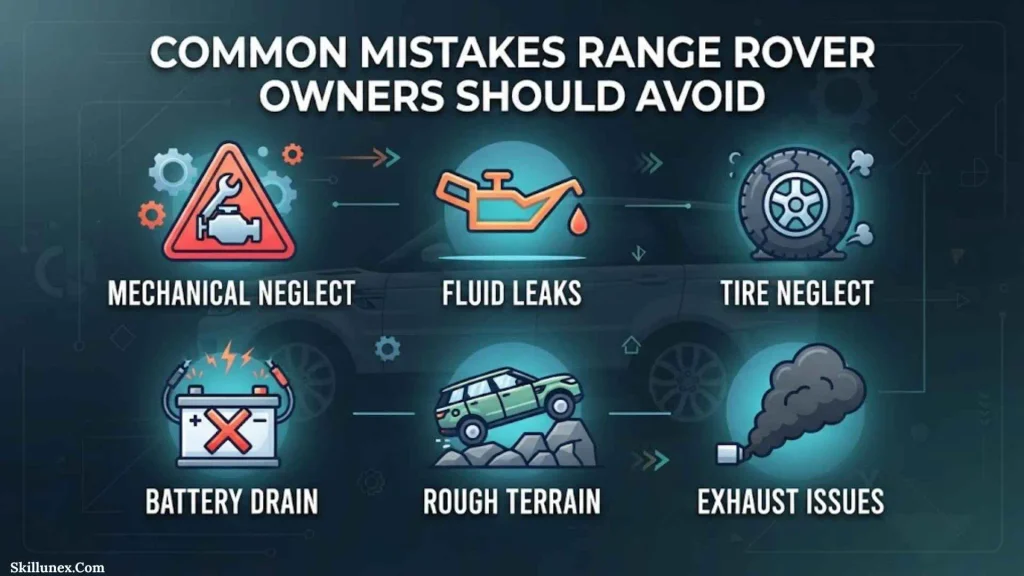
Ignoring a Warning Because the Vehicle Still Drives Normally
Some faults may not produce noticeable symptoms immediately. Continuing to drive indefinitely can allow a relatively manageable problem to become more serious.
Resetting Warning Lights Repeatedly
Repeatedly clearing a warning without diagnosis only hides the symptom temporarily.
Using the Wrong Tire Pressure
Always use the recommended tire pressure for the vehicle rather than the maximum pressure printed on the tire.
Opening a Hot Cooling System
Never open a pressurized coolant system while it is hot. Allow the vehicle to cool and follow the manufacturer’s safety instructions.
Assuming Every Red Light Means the Same Thing
Red generally signals a serious warning, but the specific symbol determines the required action. Always identify the actual warning before deciding what to do.
Frequently Asked Questions About Range Rover Dashboard Symbols
What is the most serious Range Rover dashboard warning?
Warnings involving engine oil pressure, overheating, braking, or other critical vehicle systems can be particularly serious. A red warning should be investigated immediately, and some situations require the vehicle to be stopped.
What does an amber warning light mean on a Range Rover?
An amber warning generally indicates that the vehicle has detected a condition or fault requiring attention. The exact urgency depends on the symbol and any accompanying message.
Why is my Range Rover showing a warning light but driving normally?
Some electronic and mechanical faults are detected before they noticeably affect vehicle performance. A vehicle can therefore appear to drive normally while a warning remains illuminated.
Why are several dashboard lights appearing at the same time?
Multiple warning lights can sometimes result from one underlying issue, such as low system voltage, a sensor fault, or a communication problem between electronic control modules.
Can I reset a Range Rover warning light myself?
Some indicators can be reset using the vehicle’s controls, while others require a diagnostic procedure. You should identify and correct the underlying problem before attempting to clear a fault warning.
How do I know whether a Range Rover warning light is urgent?
The warning’s color, symbol, accompanying message, and vehicle behavior all matter. Red warnings involving critical systems generally require immediate attention. If the vehicle is overheating, braking poorly, losing power, or behaving abnormally, stop safely and seek assistance.
Why does my Range Rover show a tire pressure warning after I inflated the tires?
The tire-pressure monitoring system may need time to update or may require a reset procedure, depending on the model. If the warning returns, check all tires again for pressure loss or damage.
Can cold weather cause Range Rover dashboard warnings?
Temperature changes can affect tire pressure and battery performance and may contribute to certain warnings. However, a persistent warning should not automatically be blamed on cold weather without checking the vehicle.
Do all Range Rover models use the same dashboard symbols?
No. Dashboard symbols, messages, and available systems can differ between Range Rover models and model years. Always use the handbook for the exact vehicle when identifying an unfamiliar symbol.
Conclusion
Understanding Range Rover dashboard symbols makes it easier to recognize potential problems and respond appropriately. While green and blue indicators commonly provide information about active features, amber warnings generally require attention, and red warnings can indicate conditions that require immediate action.
Common symbols relate to the engine, oil pressure, battery and charging system, brakes, ABS, tire pressure, airbags, coolant temperature, transmission, stability control, traction control, and driver-assistance features.
The most important rule is simple: do not ignore an unfamiliar warning simply because your Range Rover still appears to drive normally. Identify the symbol, read the accompanying message, consult the handbook for your exact model, and seek professional diagnosis when necessary.
A dashboard warning is your vehicle’s way of communicating that something needs your attention. Understanding that message early can help protect the vehicle, avoid more expensive repairs, and, most importantly, keep you and other road users safer.

Isla Kensington
I’m Isla Kensington, a writer with a passion for research, culture, nature, and the fascinating meanings behind everyday things. I enjoy taking topics that may seem simple at first and discovering the history, facts, and ideas that make them more interesting.
I write with readers in mind. My aim is to provide clear explanations, useful information, and interesting details without making a topic unnecessarily complicated.
I believe learning should feel like discovering something rather than simply reading facts. That philosophy guides the content I create and the topics I choose to explore.
## Books by Isla Kensington
* Symbols Around the World: A Guide to Meaning & Culture
* Nature’s Beautiful Places: Lakes, Landscapes & Natural Treasures