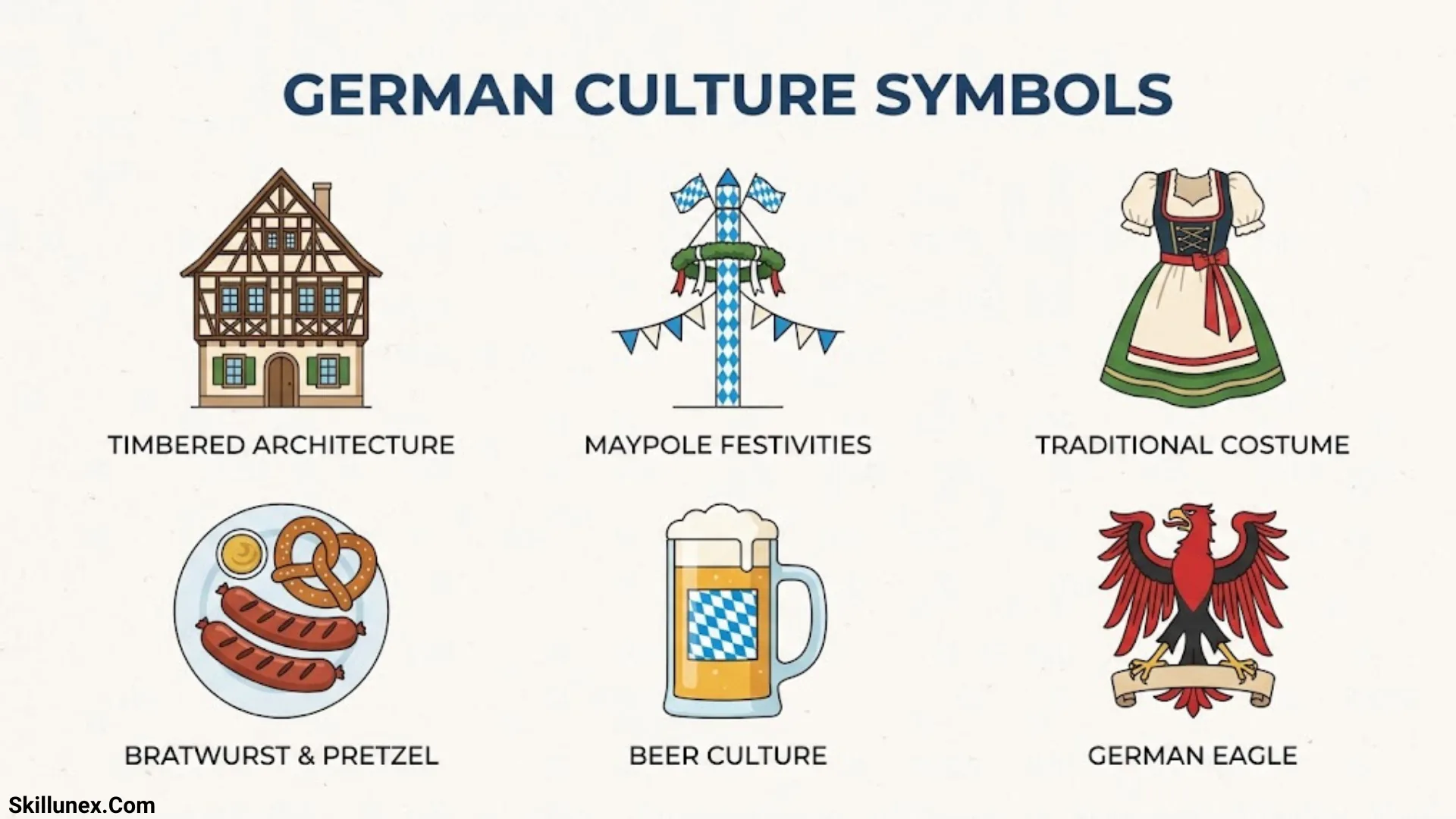
German culture symbols represent the country’s national identity, historical experiences, regional traditions, artistic achievements, and everyday customs. From the black, red, and gold German flag to the Brandenburg Gate, traditional Bavarian clothing, Christmas markets, and famous German foods, these symbols provide a window into the country’s rich and diverse cultural heritage.
Germany’s cultural identity has developed over centuries through political change, religious traditions, regional customs, literature, music, architecture, and technological innovation. Some symbols represent the modern German state, while others are connected to specific regions, festivals, or historical events. Understanding these differences helps explain why the German eagle, the Berlin Wall, a Bavarian dirndl, and a Christmas tree can all be considered German culture symbols despite having very different meanings.
This comprehensive guide explores the most recognizable German culture symbols, their origins, historical significance, and modern uses. It also explains regional differences, traditional foods, festival symbols, and the importance of interpreting German cultural imagery accurately.
What Are German Culture Symbols?
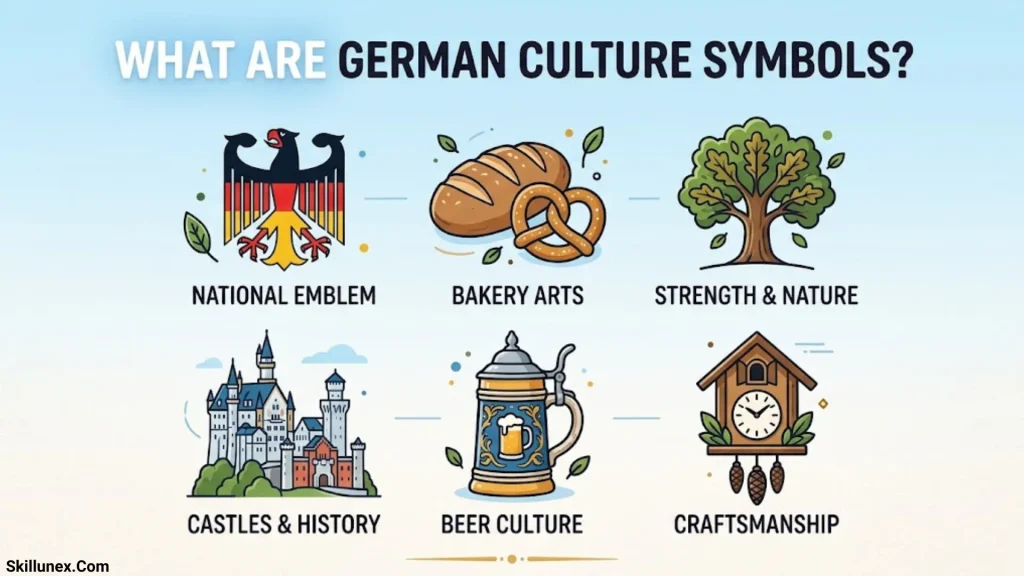
German culture symbols are objects, colors, landmarks, clothing, foods, traditions, artistic works, and customs associated with Germany and its communities. They can express national identity, preserve historical memories, represent regional heritage, or communicate shared cultural values.
Some symbols have official status, while others are recognized through popular tradition. For example, Germany’s national flag is an official national symbol, whereas pretzels and Christmas markets are cultural symbols associated with particular traditions and everyday experiences.
German culture symbols generally fall into several categories:
- National symbols: The German flag, federal eagle, and national anthem.
- Historical symbols: The Brandenburg Gate, Berlin Wall memorials, and monuments associated with reunification.
- Traditional symbols: Dirndls, lederhosen, regional crafts, and folk clothing.
- Food symbols: Pretzels, bratwurst, German bread, and Black Forest cake.
- Festival symbols: Christmas markets, decorated Christmas trees, and Oktoberfest traditions.
- Artistic symbols: Classical music, literature, Bauhaus design, and German architecture.
- Regional symbols: Bavarian blue-and-white patterns, Cologne Cathedral, and Hamburg’s maritime heritage.
- Modern symbols: Parliamentary democracy, renewable-energy technology, and contemporary German design.
These categories overlap, and no single symbol represents every German person. Germany is a diverse country with different regional identities, religious traditions, lifestyles, and cultural influences.
National Symbols of Germany and Their Meanings
National symbols represent Germany as a country and reflect its political history, constitutional identity, and public institutions. They are especially visible during official ceremonies, national celebrations, sporting events, and international gatherings.
The German Flag: Black, Red, and Gold
<text> </text>
The German flag consists of three horizontal stripes: black at the top, red in the middle, and gold at the bottom. It is one of the most recognizable symbols of German national identity.
The black-red-gold colors have historical associations with German unity, freedom, and democratic aspirations. They became particularly important during nineteenth-century movements that called for a united Germany and constitutional government.
The colors were used by democratic and national movements, including participants in the Revolution of 1848. They later became the official colors of the Federal Republic of Germany.
Today, the German flag appears on government buildings, public institutions, and at major sporting competitions. Citizens also display it during international football tournaments and other events to express national pride.
The flag is especially significant because it represents Germany’s modern democratic identity rather than a single region or historical dynasty.
The German Federal Eagle
The German federal eagle, known in German as the Bundesadler, is an official emblem of the German state. It features a black eagle with red beak, tongue, and claws against a golden-yellow shield in the federal coat of arms.
Eagle imagery has a long history in European political traditions and has been associated with authority, sovereignty, and government. In Germany, the eagle appears in different forms across historical periods and institutions.
The modern federal eagle can be seen on official documents, government buildings, coins, and parliamentary materials. Its design may vary depending on the institution and context.
The eagle is an important national symbol because it connects Germany’s historical traditions with its contemporary constitutional institutions.
The National Anthem: Deutschlandlied
Germany’s national anthem is known as Deutschlandlied, or “Song of Germany.” The melody was composed by Joseph Haydn in 1797, and the song later became associated with German national identity.
Today, the third stanza is used as the official national anthem. It emphasizes unity, justice, and freedom.
Understanding the anthem’s history is important because the song’s earlier stanzas became associated with different political periods. Modern Germany’s official use of the third stanza reflects its democratic and constitutional identity.
The anthem is performed at official ceremonies and international sporting events, where it serves as a symbol of national representation.
The Federal Colors and German Unity
Black, red, and gold are closely connected to the historical development of German national identity. Their significance extends beyond their use on the flag.
These colors became associated with movements for unity and political liberty, particularly during the nineteenth century. Their later adoption by democratic institutions reinforced their connection with constitutional government.
Today, the colors appear in public celebrations, government settings, sports events, and national commemorations. They provide a shared visual identity for people from Germany’s different regions.
Famous German Landmarks as Cultural Symbols
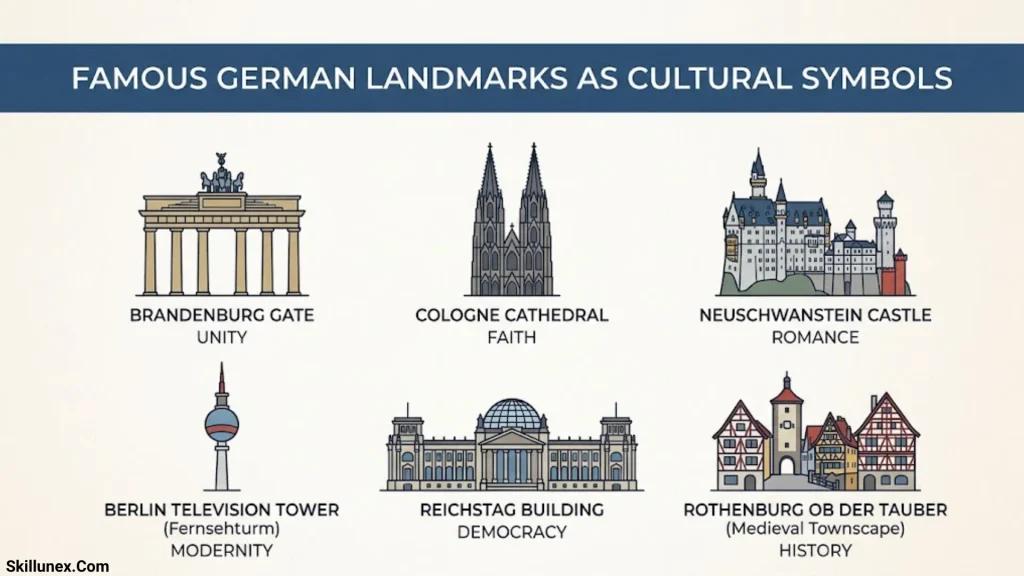
Germany’s landmarks represent centuries of architecture, political change, religious history, and cultural development. Some have become international symbols of the country, while others are especially meaningful to particular cities or regions.
Brandenburg Gate: A Symbol of Unity
The Brandenburg Gate in Berlin is one of Germany’s most famous historical monuments. Completed in 1791, it was designed in a neoclassical style inspired by classical architecture.
The gate became particularly significant during the Cold War, when Berlin was divided between East and West. Its location near the former border made it a powerful symbol of separation.
After the Berlin Wall opened in 1989, the Brandenburg Gate became closely associated with German reunification. Today, it represents unity, political transformation, and Berlin’s role as the capital of Germany.
It is also a popular gathering place for public celebrations, commemorations, and major national events.
The Berlin Wall: Division and Freedom
The Berlin Wall was constructed by East German authorities in 1961 to restrict movement between East Berlin and West Berlin. It became one of the most recognizable symbols of the Cold War and the division of Germany.
The wall separated families, friends, and communities for decades. Its opening in November 1989 became a landmark event in the peaceful revolution that led to German reunification in 1990.
Today, surviving sections of the wall, memorials, and historical exhibitions preserve the memory of political division and the experiences of people who lived under border restrictions.
The Berlin Wall symbolizes both the consequences of political separation and the struggle for freedom. Its historical meaning makes it an important symbol of modern German identity.
Neuschwanstein Castle: Romantic Architecture
Neuschwanstein Castle is located in Bavaria and is famous for its towers, mountain scenery, and romantic architectural design. It was commissioned by King Ludwig II in the nineteenth century.
Although its appearance evokes medieval castles and fairy tales, Neuschwanstein is a nineteenth-century royal project rather than a surviving medieval fortress.
The castle reflects romantic interpretations of history, royal imagination, and the architectural tastes of its period. Today, it is one of Germany’s best-known tourist attractions and an internationally recognizable image of the country.
Neuschwanstein symbolizes romantic architecture, Bavarian heritage, and the continuing appeal of Germany’s historic landscapes.
Cologne Cathedral: Religious and Architectural Heritage
Cologne Cathedral, known as Kölner Dom, is a major Gothic cathedral in the city of Cologne. Construction began in 1248, and the building was completed in 1880.
Its tall towers, elaborate stonework, stained glass, and religious art make it one of Europe’s most recognizable Gothic structures.
The cathedral reflects Cologne’s long religious history and its importance as a cultural and commercial center. It is also a UNESCO World Heritage Site.
As a cultural symbol, Cologne Cathedral represents religious architecture, craftsmanship, and Germany’s contribution to European architectural history.
The Reichstag Building: Democracy and Parliament
The Reichstag building in Berlin houses the Bundestag, Germany’s federal parliament. Its history includes the German Empire, the Weimar Republic, the Nazi period, the division of Germany, and the reunified republic.
The building’s modern glass dome, designed by architect Norman Foster during its renovation, allows visitors to view the parliamentary chamber below.
The dome is commonly associated with transparency and public access to democratic institutions. The building itself represents the relationship between Germany’s complicated political past and its modern constitutional system.
It is an important symbol of parliamentary democracy and public participation in government.
Traditional German Clothing Symbols
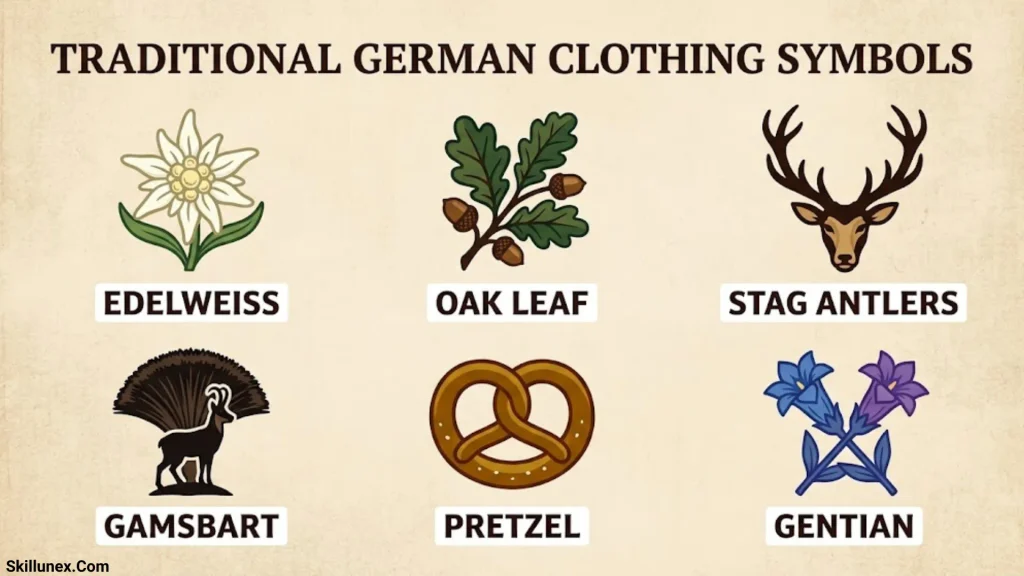
Traditional German clothing reflects regional identities, historical working practices, and folk traditions. These garments are particularly visible at festivals and cultural celebrations, although most Germans wear contemporary clothing in everyday life.
Dirndl: Traditional Bavarian Dress
The dirndl is a traditional dress associated primarily with Bavaria and the Alpine regions of southern Germany. It typically consists of a fitted bodice, blouse, full skirt, and apron.
Dirndl-style clothing developed from regional and working garments before becoming an important part of folk dress and festival fashion.
Modern dirndls vary in color, material, decoration, and design. They are often worn at Bavarian festivals, weddings, folk celebrations, and other special occasions.
The dirndl symbolizes Bavarian regional heritage and traditional craftsmanship. It should not be considered the national dress of all German women because clothing traditions differ considerably across the country.
Lederhosen: Bavarian and Alpine Heritage
Lederhosen are traditional leather shorts or knee-length trousers associated with Bavaria and parts of the Alpine region. They originally served practical purposes in working and outdoor settings.
Over time, lederhosen became an important part of regional folk clothing. Modern versions often feature embroidered details, suspenders, and decorative buttons.
They are commonly worn with traditional shirts, woolen socks, and sturdy shoes during festivals and cultural celebrations.
Lederhosen are particularly recognizable at Oktoberfest, but they represent a regional tradition rather than everyday clothing throughout Germany.
Traditional Hats and Folk Accessories
Traditional German hats vary by region and may be made from wool, felt, or other materials. Some Bavarian folk outfits include hats decorated with feathers, cords, or a Gamsbart, a traditional ornament made from hair.
Other accessories may include embroidered belts, decorative suspenders, scarves, and regional jewelry.
These items help distinguish local clothing traditions and preserve the craftsmanship associated with folk dress. Their designs and meanings vary by region, so no single hat or accessory represents all of Germany.
German Food Symbols and Their Cultural Significance
Food is an important part of German cultural life. Regional dishes, bakery traditions, seasonal treats, and festival foods reflect local ingredients, historical influences, and social customs.
Pretzels: A Symbol of German Baking
The pretzel, called Brezel or Brezn in different regions, is one of the most recognizable foods associated with Germany, especially southern Germany.
Its twisted shape, golden-brown crust, and soft interior make it a familiar sight in bakeries, beer gardens, and festival stalls.
In Bavaria, large soft pretzels are often served with butter, cheese, or traditional meals. Pretzels are also enjoyed in other German regions and have a broader European history.
As a cultural symbol, the pretzel represents baking traditions, regional food culture, and informal social dining.
Bratwurst: Regional Sausage Traditions
Bratwurst is a family of German sausages rather than a single standardized dish. Different regions have developed their own varieties, including Nuremberg-style and Thuringian bratwurst.
These sausages are commonly sold at markets, street stalls, outdoor events, and festivals. Recipes differ in ingredients, size, seasoning, and preparation methods.
Bratwurst represents the importance of regional cuisine and local food traditions. It also illustrates how a familiar dish can take different forms across Germany.
German Bread: Craftsmanship and Everyday Life
Germany has a diverse bread culture that includes rye bread, sourdough loaves, seeded breads, dark breads, and many types of rolls.
Bread is an everyday staple and an important part of the country’s bakery traditions. Different regions have their own preferred ingredients, textures, and baking methods.
German bread culture symbolizes craftsmanship, local identity, and the connection between food and daily life. It is a broader and more diverse cultural tradition than any single type of bread.
Black Forest Cake: A Famous German Dessert
Black Forest cake, known as Schwarzwälder Kirschtorte, is associated with the Black Forest region in southwestern Germany.
The classic dessert combines chocolate sponge, cherries, cream, and kirsch, a cherry spirit. Its layered construction and distinctive flavors have made it recognizable internationally.
The cake represents German pastry craftsmanship and the way a regional specialty can become an international cultural symbol.
Lebkuchen: Traditional Christmas Baking
Lebkuchen is a traditional spiced baked good particularly associated with Christmas markets and the city of Nuremberg.
It is commonly made with ingredients such as honey, spices, nuts, and citrus, although recipes vary.
Lebkuchen represents seasonal traditions, traditional baking, and the festive atmosphere of German Christmas celebrations.
German Festivals and Holiday Symbols
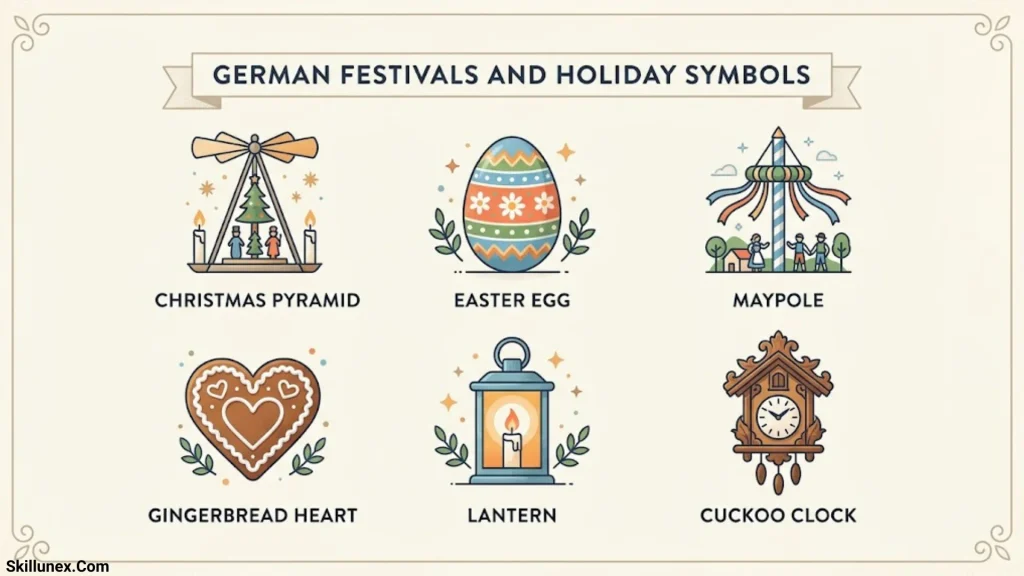
German festivals bring together music, food, regional clothing, crafts, and community traditions. Many festival symbols are associated with specific places or times of the year.
Oktoberfest: Bavarian Celebration
Oktoberfest is a major annual festival held in Munich, Bavaria. It began in 1810 as a celebration connected to the marriage of Crown Prince Ludwig of Bavaria and Princess Therese of Saxe-Hildburghausen.
Today, Oktoberfest is known for its festival tents, Bavarian music, traditional clothing, regional foods, fairground attractions, and beer served under festival arrangements.
Common symbols include dirndls, lederhosen, pretzels, decorated tents, and blue-and-white Bavarian patterns.
Although Oktoberfest is internationally associated with Germany, it is primarily a Bavarian tradition. Other German regions have their own festivals and cultural celebrations.
Christmas Markets: Seasonal Traditions
German Christmas markets, known as Weihnachtsmärkte, are seasonal gatherings featuring decorated stalls, handmade crafts, traditional foods, and festive lighting.
Markets in Nuremberg, Dresden, and Cologne are particularly well known, although many German towns and cities host their own versions.
Common sights include wooden ornaments, gingerbread, candles, handcrafted gifts, and warm seasonal drinks.
Christmas markets symbolize seasonal hospitality, community gatherings, and traditional craftsmanship. The custom has also spread to many other countries.
The Christmas Tree: A Winter Holiday Symbol
The decorated Christmas tree is closely associated with German-speaking European traditions and became popular internationally over time.
Evergreen plants had been used in winter customs before the modern Christmas tree developed into a familiar holiday tradition. By the nineteenth century, decorated trees were increasingly established in German domestic celebrations.
Today, Christmas trees symbolize seasonal celebration, family gatherings, and festive decoration. Their significance varies depending on religious beliefs, family customs, and personal traditions.
Easter Eggs and the Easter Hare
Decorated eggs and the Easter hare are familiar symbols in German Easter celebrations. Eggs are often associated with new life and renewal, while the hare is connected to traditions of bringing or hiding eggs for children.
These customs reflect a mixture of Christian observances and broader European spring traditions.
Families may decorate eggs, prepare seasonal foods, or organize egg hunts. Practices differ between households and regions, and not everyone celebrates Easter in the same way.
German Music, Literature, and Artistic Symbols
Germany has made significant contributions to music, literature, philosophy, architecture, and visual art. These achievements form an important part of the country’s cultural heritage.
Classical Music and Famous German Composers
Germany has played an influential role in Western classical music. Composers associated with its musical heritage include Johann Sebastian Bach, Ludwig van Beethoven, Johannes Brahms, and Richard Wagner.
Their works are performed in concert halls, churches, opera houses, and music festivals around the world.
Classical music symbolizes artistic achievement and Germany’s historical contribution to European musical traditions. Modern German music is also diverse, including electronic music, rock, pop, jazz, hip-hop, and many other genres.
The Brothers Grimm and German Folklore
Jacob and Wilhelm Grimm are famous for collecting and publishing traditional folktales. Their work helped preserve stories that later became influential in international storytelling.
Tales such as Cinderella, Hansel and Gretel, and Snow White are associated with their collections, although many of these stories existed in different versions before the brothers recorded them.
The Brothers Grimm symbolize folklore, storytelling, language, and the preservation of cultural traditions.
Their work also reflects the nineteenth-century interest in collecting folk stories as part of a broader effort to understand language and cultural history.
Johannes Gutenberg and the Printing Press
Johannes Gutenberg is associated with the development of movable-type printing in Europe during the fifteenth century. His work helped transform the production and distribution of books.
Printing made it possible to reproduce written materials more efficiently, contributing to the spread of ideas, education, and literacy.
The printing press is not exclusively a German cultural symbol, but Gutenberg’s historical contribution gives it a significant place in Germany’s intellectual and technological heritage.
Bauhaus: Modern Art and Design
Bauhaus was an influential art, architecture, and design school founded in Germany in 1919 by Walter Gropius.
The movement promoted functional design, geometric forms, practical craftsmanship, and a closer relationship between art and industrial production.
Bauhaus principles influenced architecture, furniture, typography, graphic design, and product design internationally.
As a cultural symbol, Bauhaus represents modernism, creative experimentation, and the integration of artistic design into everyday life.
Regional Symbols of German Culture
Germany is a federal country made up of 16 states, each with its own history, customs, landscapes, and cultural characteristics. Regional symbols are important because they show why German culture cannot be reduced to one national stereotype.
| Region or State | Recognizable Symbol or Tradition | Cultural Significance |
| Bavaria | Dirndl, lederhosen, blue-and-white patterns | Alpine heritage, folk clothing, and regional festivals |
| Berlin | Brandenburg Gate and Berlin Wall memorials | Political history, urban culture, and reunification |
| Saxony | Dresden’s historic architecture and regional crafts | Artistic heritage and craftsmanship |
| North Rhine-Westphalia | Cologne Cathedral and Carnival | Religious history, public celebration, and regional identity |
| Baden-Württemberg | Black Forest traditions and regional cuisine | Landscapes, craftsmanship, and food culture |
| Hamburg | Harbor imagery and maritime traditions | Shipping, trade, and port-city history |
| Thuringia | Regional sausage traditions and historic towns | Local cuisine and cultural heritage |
| Hesse | Frankfurt’s skyline and regional traditions | Finance, urban development, and regional identity |
| Lower Saxony | Traditional thatched buildings and North Sea coastal customs | Rural heritage and northern German life |
| Mecklenburg-Vorpommern | Baltic Sea landscapes and historic coastal towns | Maritime culture and coastal architecture |
These examples are representative rather than exhaustive. Every state contains multiple local traditions, and the cultural identity of a major city may differ from that of nearby rural communities.
Modern Symbols of German Identity
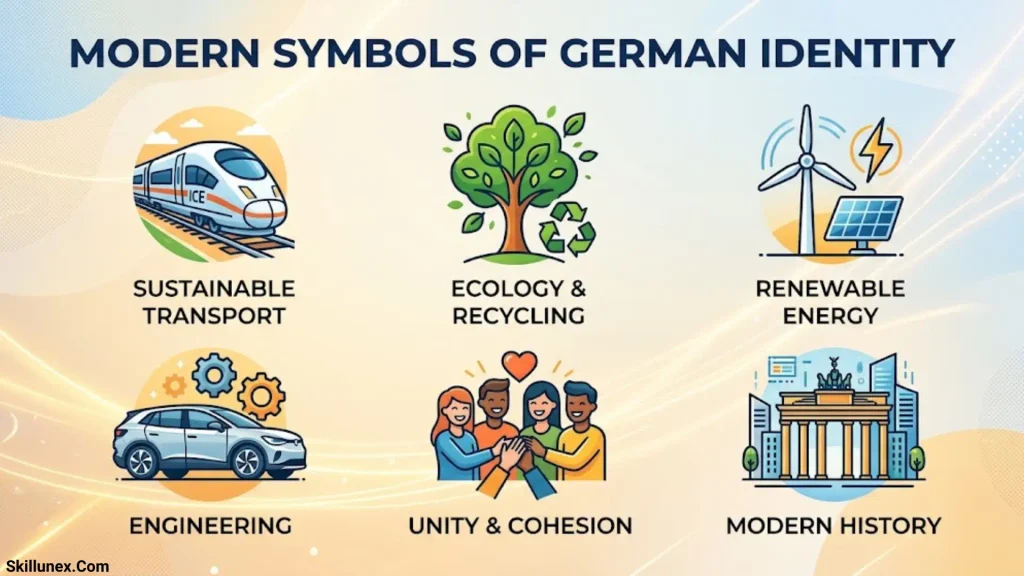
German culture is not limited to historic buildings, traditional food, or folk clothing. Modern symbols reflect the country’s political institutions, technology, environmental debates, and contemporary creative industries.
Democracy and the Basic Law
Germany’s Basic Law, adopted in 1949, provides the constitutional foundation of the modern German state. It was initially established for West Germany and remained the constitutional basis after reunification.
The Bundestag, the Reichstag building, elections, and public civic institutions are visible expressions of Germany’s parliamentary democracy.
These symbols represent constitutional government, political participation, and the country’s efforts to establish democratic institutions after the Second World War.
Engineering and Industrial Innovation
Germany is widely associated with engineering, manufacturing, automobiles, machinery, and industrial research. These associations reflect a long history of technical education, industrial development, and manufacturing expertise.
Cars, precision instruments, factory architecture, and advanced machinery may serve as symbols of German technological achievement.
However, engineering is only one part of the country’s economy and identity. Germany also has significant cultural, service, research, educational, and creative sectors.
Renewable Energy and Environmental Awareness
Wind turbines, solar panels, and recycling symbols may represent environmental protection and renewable-energy development in contemporary Germany.
Environmental policy and sustainability have been important subjects in German public debate, research, and infrastructure planning.
These symbols reflect ongoing initiatives and discussions rather than an unchanging national characteristic. Environmental priorities, policies, and public opinions can vary over time.
Contemporary Art, Fashion, and Urban Culture
Cities such as Berlin, Hamburg, Leipzig, and Cologne have active contemporary art, music, design, and fashion scenes.
Street art, galleries, music venues, independent publishers, and creative districts demonstrate the changing nature of German cultural life.
These contemporary symbols are important because they show that German identity continues to develop rather than remaining limited to historical monuments and traditional customs.
German Culture Symbols Compared: Meaning and Category
The following table provides a quick reference for choosing suitable symbols for educational projects, cultural presentations, travel articles, and research.
| Symbol | Main Meaning or Association | Category |
| Black-red-gold flag | National identity and democratic tradition | National |
| Federal eagle | State authority and government | National |
| Deutschlandlied | National representation and constitutional identity | National |
| Brandenburg Gate | Unity and historical change | Historical |
| Berlin Wall memorials | Division, freedom, and reunification | Historical |
| Neuschwanstein Castle | Romantic architecture and Bavarian heritage | Architectural |
| Cologne Cathedral | Gothic architecture and religious heritage | Architectural |
| Dirndl | Regional folk clothing | Traditional |
| Lederhosen | Bavarian and Alpine traditions | Traditional |
| Pretzel | Baking and regional food culture | Food |
| Bratwurst | Regional culinary traditions | Food |
| Christmas markets | Seasonal celebration and community | Festival |
| Christmas tree | Winter holiday traditions | Festival |
| Brothers Grimm’s tales | Folklore and storytelling | Literature |
| Classical music | Artistic heritage | Music |
| Bauhaus | Modern design and innovation | Art and design |
| Reichstag building | Parliamentary democracy | Modern national identity |
| Wind turbines | Renewable energy and sustainability | Contemporary |
The table highlights the diversity of German symbols. Some are official national emblems, while others are cultural associations shaped by history, regional practices, and modern life.
How to Use German Culture Symbols Respectfully
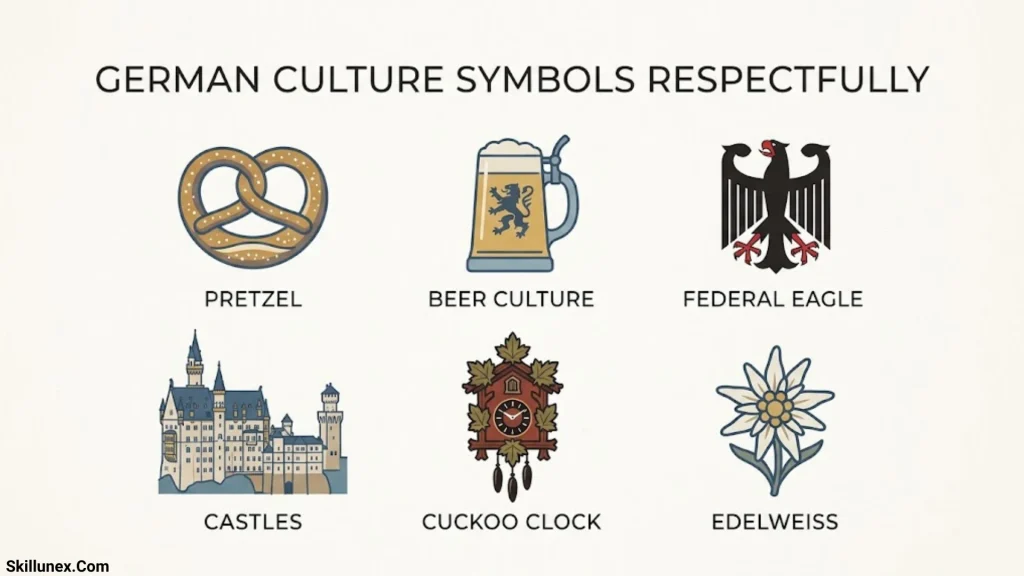
German culture symbols can enhance educational materials, travel content, graphic design, classroom projects, and cultural research. Accurate use requires an understanding of their historical background and regional significance.
Research the Symbol’s Historical Origins
Before using a symbol, find out where it originated, how it developed, and whether its meaning changed over time. This is especially important for political emblems, historical monuments, and symbols associated with periods of conflict.
For example, the Brandenburg Gate has represented different ideas during different historical periods. Understanding its connection to Berlin’s division and reunification gives it a deeper meaning than treating it simply as an attractive landmark.
Distinguish National Symbols From Regional Traditions
A dirndl or lederhosen outfit is strongly associated with Bavaria and Alpine folk traditions. It should not be presented as clothing worn by all Germans.
Likewise, Oktoberfest is an important Bavarian festival, while Germany’s other regions have their own celebrations, cuisines, and customs.
Including regional differences makes cultural descriptions more accurate and avoids oversimplification.
Avoid Stereotypes and Overgeneralizations
Pretzels, sausages, beer, and traditional clothing are familiar cultural references, but they do not represent the full diversity of German society.
Modern Germany includes a wide range of lifestyles, regional identities, religious traditions, artistic interests, and family backgrounds.
A balanced account should include both historical traditions and contemporary culture.
Choose Symbols That Match Your Topic
Different symbols suit different purposes. The German flag may be appropriate for a discussion of national identity, the Berlin Wall for a history project, and Bauhaus for a design presentation.
For a tourism article, landmarks and regional food may be more relevant. For a discussion of contemporary Germany, democratic institutions and modern cultural movements may provide a more accurate picture.
Handle Sensitive Historical Symbols Carefully
Germany’s history includes periods of dictatorship, war, persecution, and extremist political movements. Symbols connected to these periods require historical context and careful presentation.
They should not be used as ordinary decorative elements without considering their meaning and the harm associated with their historical use.
Responsible interpretation distinguishes between official modern national symbols, historical artifacts, and symbols associated with extremist ideologies.
Frequently Asked Questions About German Culture Symbols
What are the most famous German culture symbols?
Some of the most recognizable German culture symbols include the black-red-gold flag, federal eagle, Brandenburg Gate, Berlin Wall memorials, Neuschwanstein Castle, Cologne Cathedral, pretzels, traditional Bavarian clothing, and Christmas markets.
What do the colors of the German flag mean?
The black-red-gold colors have historical associations with German unity, freedom, and democratic aspirations. Their modern significance is closely connected to Germany’s constitutional and democratic traditions.
What is Germany’s national symbol?
Germany has several important national symbols. The black-red-gold flag and the federal eagle are among the most recognizable official symbols, while the third stanza of Deutschlandlied serves as the national anthem.
What is the most recognizable traditional German clothing?
The dirndl and lederhosen are widely recognized traditional garments associated particularly with Bavaria and Alpine regions. They are commonly worn during festivals and special celebrations but are not everyday clothing for most Germans.
What food symbolizes German culture?
Pretzels, bratwurst, regional breads, Black Forest cake, and Lebkuchen are widely recognized examples of German food traditions. Each has its own regional history and cultural associations.
Why is Brandenburg Gate important to Germany?
Brandenburg Gate is a historic landmark in Berlin that became associated with German division during the Cold War and later with reunification after the Berlin Wall opened in 1989.
What does the Berlin Wall symbolize today?
The Berlin Wall symbolizes the division of Germany during the Cold War, restrictions on freedom, the experiences of people separated by the border, and the reunification process that followed its opening in 1989.
Is Oktoberfest a symbol of all German culture?
No. Oktoberfest is an important Bavarian festival with international recognition, but it represents one regional tradition rather than all of Germany. Other regions have their own festivals, clothing, foods, and customs.
What are the main symbols of German Christmas traditions?
Common symbols include decorated Christmas trees, Christmas markets, wooden ornaments, gingerbread, candles, festive lights, and handmade decorations. Many of these traditions have spread beyond Germany.
What are some modern symbols of Germany?
Modern symbols may include the Reichstag building, the Bundestag, Bauhaus design, engineering, contemporary art, and renewable-energy technology. They reflect aspects of Germany’s current political, cultural, and economic life.
What is the difference between national symbols and cultural symbols?
National symbols represent the country and its institutions, such as the flag, federal eagle, and national anthem. Cultural symbols have a broader meaning and include regional clothing, foods, festivals, music, architecture, and everyday customs.
Why are German regional symbols important?
Regional symbols preserve local history and traditions. They help distinguish cultural identities across Germany’s states and cities and demonstrate that the country’s heritage is diverse rather than uniform.
Are pretzels and lederhosen uniquely German?
Neither is exclusive to Germany. Pretzels have a wider European history, while lederhosen are associated with Alpine regions beyond Germany as well. Both are strongly connected with particular German traditions, especially in Bavaria.
How can I use German culture symbols in a school project?
Choose symbols that relate directly to the project’s topic. For example, use the flag and federal eagle for national identity, Brandenburg Gate for reunification, Bauhaus for design, or Christmas markets for seasonal traditions. Include a brief explanation of each symbol’s origin and meaning.
Conclusion
German culture symbols reflect the country’s national identity, regional diversity, historical experiences, and artistic achievements. The black-red-gold flag and federal eagle represent the modern German state, while Brandenburg Gate and the Berlin Wall preserve important memories of division and reunification.
Traditional clothing, pretzels, bratwurst, Christmas markets, classical music, German literature, and Bauhaus design illustrate other dimensions of the country’s cultural heritage. Contemporary symbols, including democratic institutions, engineering, and renewable-energy technology, demonstrate how German identity continues to evolve.
No single object or tradition can represent every person or region in Germany. By understanding each symbol’s origins, context, and cultural significance, readers can appreciate Germany’s heritage more accurately and respectfully.

I’m Adrian Holloway, a writer and researcher who enjoys exploring the stories, meanings, and interesting facts behind the subjects people search for every day. I’m especially interested in symbols, nature, lakes, places, and cultural topics that help readers understand the world from a different perspective.
I believe useful content should be simple, accurate, and enjoyable to read. When I research a topic, I focus on finding meaningful details and presenting them in a way that makes information easy to understand.
My goal is to create helpful articles that answer real questions while encouraging readers to discover something new with every visit.
Books by Adrian Holloway
The Language of Symbols: Meanings, Stories & Traditions
Hidden Wonders of Nature: Lakes, Landscapes & Discovery