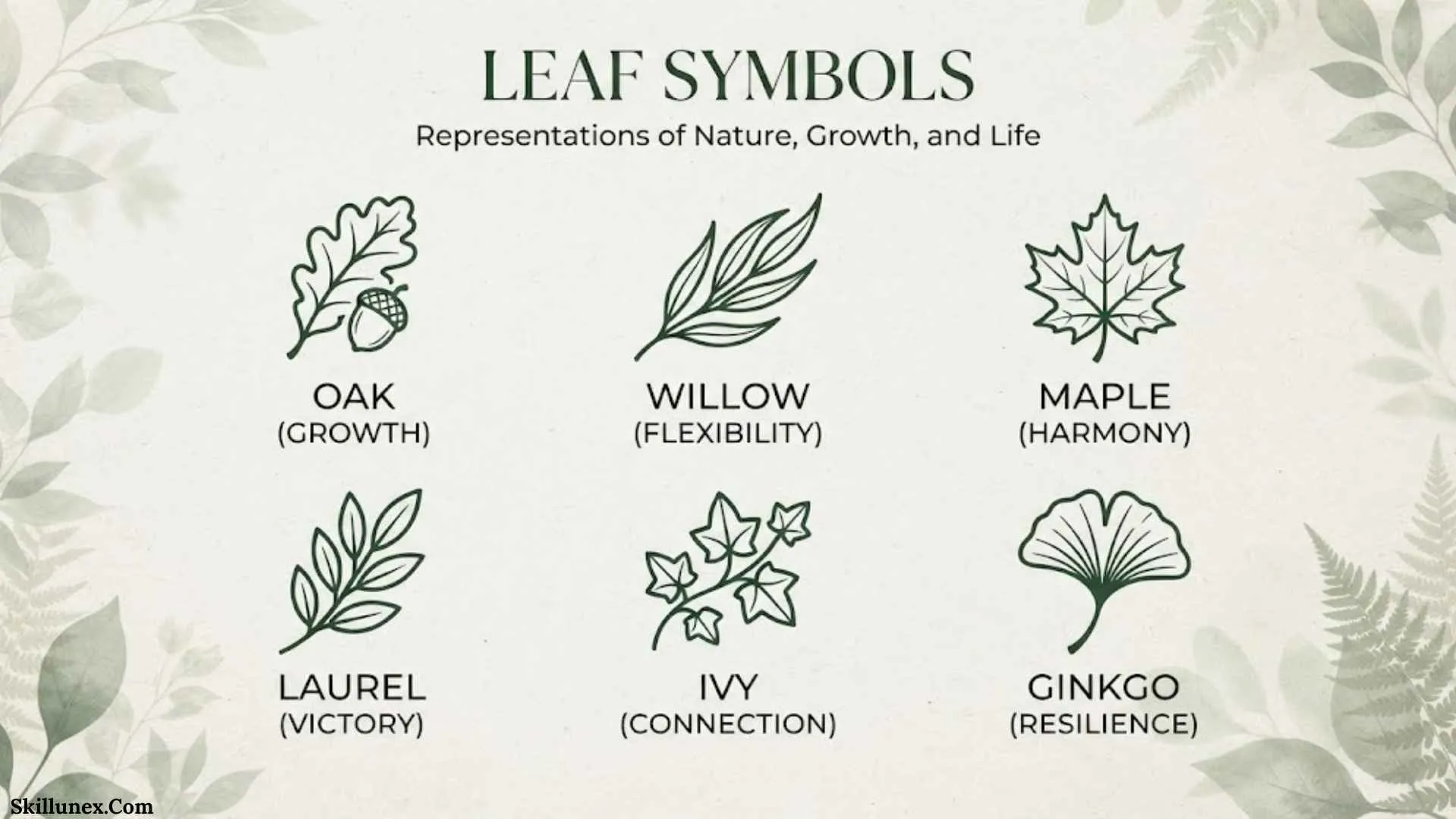
Leaves are among the simplest forms found in nature, yet they can carry surprisingly deep meanings. A fresh green leaf can suggest growth, hope, health, and a new beginning, while a falling or dried leaf may represent change, maturity, letting go, or the passing of time. Because leaves naturally grow, change with the seasons, and eventually fall, they have become powerful symbols of the different stages of life.
You may encounter leaf symbols in tattoos, jewelry, logos, artwork, spiritual designs, clothing, architecture, badges, greeting cards, and social media graphics. But the meaning is not always the same. The type of leaf, its color, condition, cultural background, and the situation in which it appears can all change the interpretation.
In this guide, you’ll learn what leaf symbols mean, what different leaves represent, and how leaf imagery is used in modern and historical contexts. Whether you are researching a leaf symbol for a tattoo, logo, artwork, jewelry, website, or personal design, you’ll find practical explanations to help you understand the message behind it.
What Are Leaf Symbols?
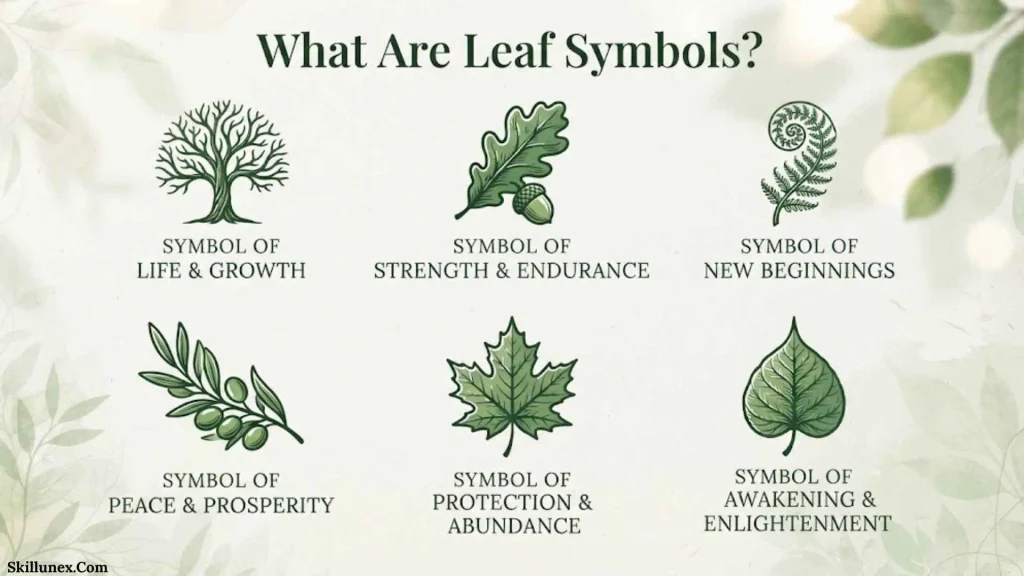
Leaf symbols are visual representations of leaves used to communicate an idea, feeling, quality, or connection. They can be realistic botanical illustrations, simple outlines, decorative patterns, or highly stylized icons.
The leaf is especially useful as a symbol because its natural life cycle is easy to recognize. A new leaf grows, reaches maturity, changes with the seasons, and eventually falls. This makes it a natural visual metaphor for growth, transformation, renewal, and the passage of time.
There is no single universal meaning for every leaf. A laurel leaf, for example, has historical associations with victory and achievement, while an olive branch is strongly associated with peace and goodwill. Oak leaves have traditionally represented qualities such as strength and endurance.
What Do Leaf Symbols Mean?
Leaf symbols commonly represent growth, renewal, life, nature, transformation, peace, strength, and change. However, the specific meaning depends on the leaf and the context.
Here are some of the most common interpretations:
| Leaf symbolism | Common meaning |
| Fresh green leaf | Growth, life, hope, renewal |
| New leaf | Fresh start, opportunity, personal development |
| Falling leaf | Change, transition, letting go |
| Autumn leaf | Transformation, maturity, seasonal change |
| Dried leaf | Aging, endings, impermanence |
| Oak leaf | Strength, endurance, courage |
| Olive leaf | Peace, goodwill, reconciliation |
| Laurel leaf | Victory, honor, achievement |
| Maple leaf | Autumn, nature, Canadian identity |
| Palm leaf | Triumph, celebration, religious significance |
| Fern leaf | Natural beauty, resilience, growth |
| Four-leaf clover | Good luck and fortune |
| Evergreen leaf | Continuity, endurance, lasting life |
These meanings are associations rather than universal rules. The same leaf can communicate something different depending on the design, culture, and personal story behind it.
What Does a Leaf Symbolize Spiritually?
Spiritually, leaves are often interpreted through the natural cycle of growth, change, decline, and renewal. A growing leaf can represent personal development, while a falling leaf can represent accepting change or releasing something from the past.
A leaf can also represent the connection between an individual and something larger. A single leaf belongs to a branch, a branch belongs to a tree, and the tree belongs to a larger ecosystem. For this reason, leaf imagery can be used to express ideas such as connection, belonging, balance, and harmony with nature.
It is important to remember that spiritual symbolism varies between traditions. A particular plant may have a specific religious or cultural meaning that should not be generalized to every leaf design.
The Main Symbolic Meanings of Leaves
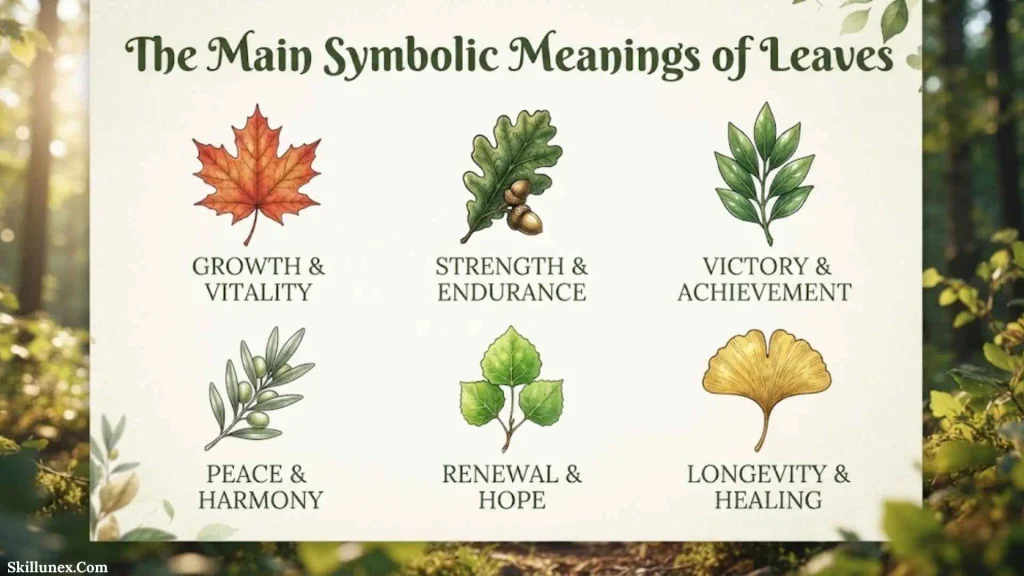
Growth and Personal Development
A new leaf is a natural image of growth. It begins small, develops over time, and becomes part of a larger plant.
Because of this, people often use leaf imagery to represent personal growth, learning, progress, and development. A leaf tattoo or illustration may therefore be meaningful to someone entering a new stage of life.
Renewal and New Beginnings
Fresh leaves appearing after winter make them an obvious symbol of renewal. They can represent starting over, recovering from a difficult period, or entering a new chapter.
A simple green leaf can communicate this idea without needing words. This is one reason leaf imagery is common in wellness, natural-living, and personal-growth designs.
Change and Transformation
Leaves do not remain the same throughout the year. They grow, mature, change color, and fall.
This visible transformation makes them a useful symbol for life changes. An autumn leaf, for example, can represent a transition from one stage to another rather than simply representing sadness or loss.
Letting Go
A falling leaf is often used as a metaphor for letting go. It separates from the branch and moves into another stage of its natural cycle.
For some people, this can represent releasing an old habit, relationship, memory, fear, or chapter of life. The symbolism can be reflective without necessarily being negative.
Life and Vitality
Green leaves are closely associated with living plants, so they can naturally represent life, vitality, energy, and health.
The connection also has a biological foundation: leaves are central to photosynthesis and help plants capture light energy to produce food.
Connection With Nature
Perhaps the most direct meaning of a leaf symbol is simply nature. Leaf imagery immediately brings plants, forests, gardens, seasons, and the outdoors to mind.
This makes leaves useful for designs that want to create a natural, organic, peaceful, or environmentally focused impression.
Peace and Harmony
Some leaf symbols have especially strong associations with peace. The olive branch is one of the best-known examples, with historical roots in Greek tradition and later widespread Western symbolism of peace and goodwill.
What Do Different Leaf Symbols Mean?
The species or type of leaf can significantly change the symbolism.
Oak Leaf Symbol
The oak leaf is commonly associated with strength, endurance, courage, honor, and longevity.
Oak symbolism has appeared in heraldry and other historical traditions, where oak leaves could represent strength and heroism.
Today, an oak leaf may work well for a design representing resilience, achievement, stability, or inner strength.
Olive Leaf Symbol
The olive leaf or olive branch is strongly associated with peace, reconciliation, goodwill, and harmony.
Its historical symbolism goes back to the ancient Mediterranean world. Olive branches were associated with peace and were also used in ancient Greek traditions connected with victory.
If your goal is to communicate peace or reconciliation, an olive branch usually provides a more specific message than a generic leaf.
Laurel Leaf Symbol
Laurel leaves traditionally represent victory, achievement, honor, distinction, and recognition.
Ancient Greek traditions connected laurel with Apollo and with crowns given to victors. The symbolism continued through later European traditions and can still be seen in medals, awards, academic imagery, and decorative wreaths.
A laurel wreath can therefore suggest that someone has achieved an important goal or earned recognition.
Maple Leaf Symbol
The maple leaf is strongly connected with autumn, seasonal change, nature, and Canadian national identity.
The maple leaf is especially recognizable because it appears on Canada’s national flag and is an important national symbol.
Outside Canada, a maple leaf may simply evoke fall foliage, forests, warmth, and seasonal beauty.
Palm Leaf Symbol
Palm leaves have associations with victory, celebration, triumph, and religious traditions.
In Christian traditions, palm branches are particularly associated with Palm Sunday. Historically, palm imagery has also been used as a sign of triumph and celebration.
Fern Leaf Symbol
Fern leaves are often associated with resilience, natural beauty, growth, and connection with the outdoors.
Their detailed shapes also make them popular in botanical artwork, home décor, tattoos, fabric patterns, and nature-inspired designs.
Unlike highly formal symbols such as laurel or olive, a fern usually creates a softer and more natural impression.
Ivy Leaf Symbol
Ivy can symbolize persistence, attachment, continuity, and lasting connection. Its climbing growth and ability to remain green in many environments have contributed to these associations.
In personal designs, ivy may therefore represent a relationship, family connection, loyalty, or persistence through difficult circumstances.
Ginkgo Leaf Symbol
The distinctive fan-shaped ginkgo leaf is often associated with longevity, resilience, hope, and endurance.
Its unusual shape makes it especially recognizable in jewelry, artwork, tattoos, and decorative designs.
Four Leaf Clover Symbol
The four-leaf clover is widely recognized as a symbol of good luck. Its rarity compared with the common three-leaf clover helped strengthen this association.
Traditional interpretations also connect its four leaves with ideas such as hope, faith, love, and luck.
Leaf Symbolism by Color
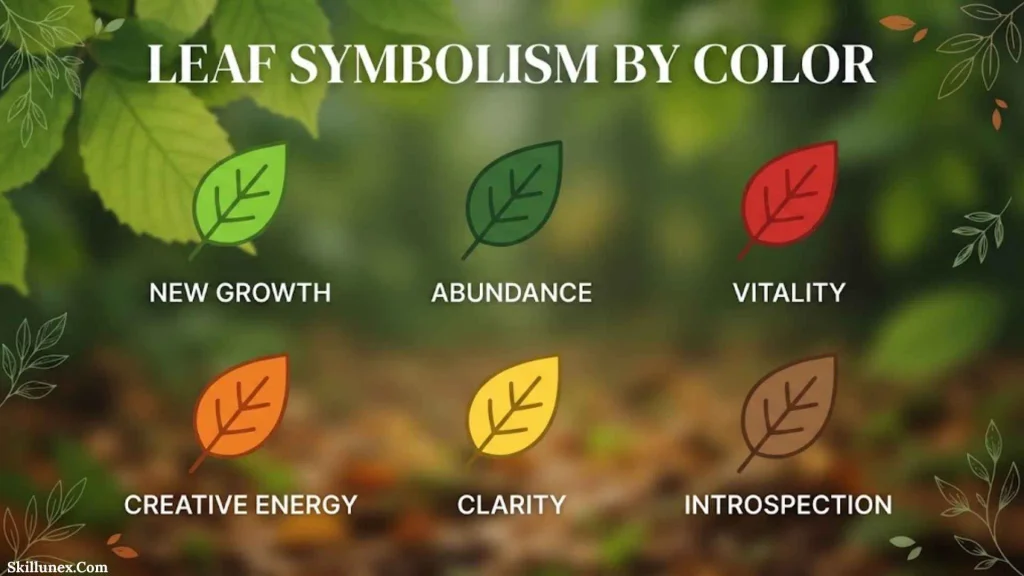
Color can completely change the mood of a leaf symbol.
Green Leaf Meaning
A green leaf commonly represents:
- Growth
- Freshness
- Life
- Renewal
- Health
- Hope
- Nature
- Vitality
Because green is the natural color of many living leaves, this is usually the easiest leaf symbolism for people to recognize.
Yellow Leaf Meaning
Yellow leaves can symbolize:
- Autumn
- Maturity
- Change
- Transition
- Warmth
- The passing of time
Yellow autumn foliage can feel joyful and beautiful, while a yellowing leaf in another context may suggest aging or decline.
Red Leaf Meaning
Red leaves can represent:
- Transformation
- Passion
- Energy
- Autumn
- Beauty
- Strong emotion
Red autumn foliage is often used in photography, artwork, and seasonal decoration because it creates a bold visual effect.
Brown or Dried Leaf Meaning
A brown or dried leaf can represent:
- Aging
- Endings
- Memories
- Impermanence
- Letting go
- The passage of time
A dried leaf does not automatically mean something negative. It can also represent acceptance, wisdom, or the completion of one stage before another begins.
Leaf Symbolism Through the Seasons
The season in which a leaf appears can influence its meaning.
Spring Leaves
Spring leaves commonly suggest new beginnings, growth, hope, and renewal.
They can work especially well in designs about starting over or entering a new stage of life.
Summer Leaves
Full summer foliage can symbolize abundance, vitality, maturity, and flourishing life.
A tree filled with healthy leaves gives a visual impression of fullness and strength.
Autumn Leaves
Autumn leaves often represent change, transformation, maturity, nostalgia, and letting go.
Their symbolism is particularly powerful because the leaves are beautiful even as they approach the end of their seasonal cycle.
Winter and Bare Branches
A bare tree or remaining leaves in winter can represent rest, endurance, loss, reflection, or waiting for renewal.
This interpretation is especially useful when a design focuses on the complete cycle of nature rather than only one stage.
Leaf Symbols in Different Cultures and Traditions
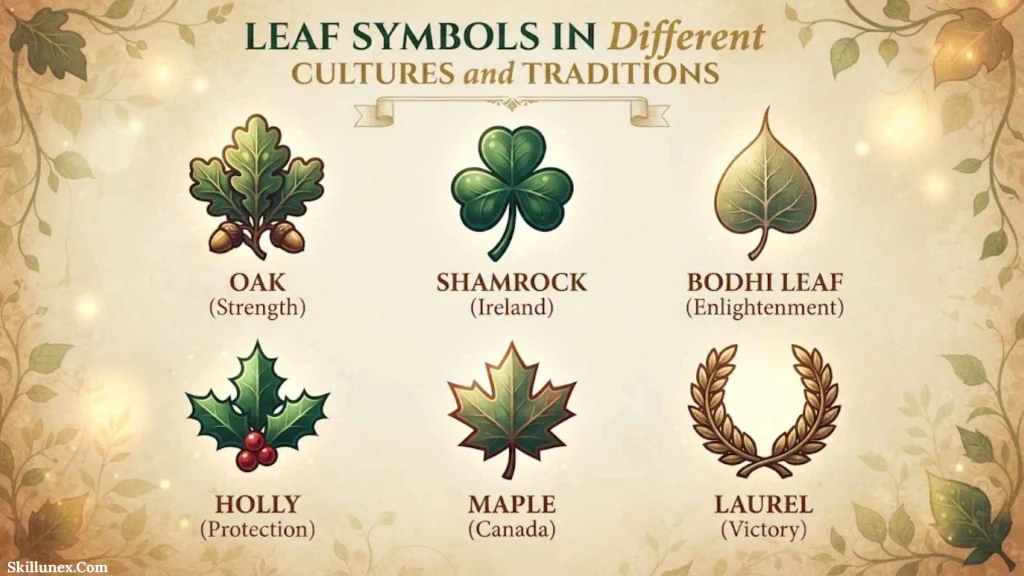
Leaf symbolism is not identical everywhere. Specific plants have developed particular meanings through history, religion, art, literature, heraldry, and national identity.
For example, olive branches have long been connected with peace and goodwill in Western culture, while laurel became associated with victory and honor. Oak leaves have represented strength and other virtues in heraldic traditions.
Chinese cultural symbolism also gives leaves broader associations. The Gemological Institute of America notes that leaves can collectively allude to people because of their great number.
Historical plant symbolism can also vary by source and period. A modern interpretation should therefore be presented as an association rather than an absolute definition.
Leaf Symbols in Art and Literature
Leaves are powerful artistic symbols because they can communicate complex ideas without words.
A green leaf may make an artwork feel alive and hopeful. A falling leaf can introduce themes of change, memory, aging, or loss. A branch filled with leaves may suggest abundance, while a single detached leaf can emphasize individuality or separation.
Writers and artists have long used seasonal foliage to explore the passage of time and the temporary nature of life. The contrast between fresh leaves and fallen leaves makes the cycle of growth and decline visually easy to understand.
Leaf Symbols in Tattoos
Leaf tattoos are popular because they can be beautiful while still carrying personal meaning.
You might choose a leaf tattoo to represent:
- Personal growth
- A fresh start
- Healing
- A major life transition
- Connection with nature
- Strength
- Peace
- A meaningful memory
- Letting go
- Family or belonging
The type of leaf can make the tattoo more specific. An oak leaf can emphasize strength, a laurel leaf can suggest achievement, an olive branch can communicate peace, and an autumn leaf can represent transformation.
A personal story can also be more important than a traditional definition. Your leaf tattoo does not have to follow a single symbolic interpretation.
Leaf Symbols in Jewelry
Leaf motifs are common in necklaces, bracelets, earrings, rings, brooches, and other jewelry because their natural shapes can be both decorative and meaningful.
A small olive branch may be chosen as a reminder of peace, while a laurel design may commemorate an achievement. A simple leaf pendant may instead represent a general love of nature or a personal connection to growth.
Leaf motifs have a long history in jewelry and decorative arts, with different leaves being used to communicate virtues, achievements, abundance, peace, and other qualities.
Leaf Symbols in Logos and Branding
Leaf symbols are frequently used in branding because they can quickly create associations with nature and freshness.
A company may use a leaf-shaped logo to communicate ideas such as:
- Natural products
- Organic ingredients
- Wellness
- Freshness
- Environmental awareness
- Sustainability
- Health
- Simplicity
However, a leaf in a logo is only a visual symbol. It should not automatically be treated as proof that a product is organic, sustainable, or environmentally friendly.
For designers, the surrounding colors, typography, plant species, and overall composition can make the branding message more specific.
Leaf Symbols in Badges and Emblems
Leaf imagery can also appear in badges, official emblems, uniforms, awards, and heraldic designs.
Oak and laurel leaves are particularly useful because their traditional associations with strength, honor, victory, and achievement fit formal visual identities. Laurel wreaths, for example, have historical connections with honoring victors, scholars, poets, and other achievers.
In a badge or emblem, the meaning may depend on the organization rather than the leaf alone. Always consider the complete design before interpreting one symbol in isolation.
Leaf Symbols in Dreams
People sometimes ask what leaves mean in dreams. There is no scientifically established universal meaning for a particular dream image, so dream interpretation is best treated as personal reflection rather than a fixed rule.
Still, the condition of the leaf may provide a useful starting point for thinking about the dream.
A fresh green leaf might remind you of growth or a new opportunity. Falling leaves could bring to mind change or transition. Dry leaves might connect with memories, endings, or something you feel ready to leave behind.
Your own experiences and emotions surrounding the dream are more important than a generic dream dictionary.
What Is the Difference Between a Leaf Symbol and a Tree Symbol?
A leaf and a tree can both represent life and growth, but they often emphasize different ideas.
A leaf can focus on an individual stage, personal change, renewal, or a specific quality.
A tree can suggest roots, family, stability, ancestry, strength, or a larger life structure.
For example, a single leaf may be appropriate for a design about personal transformation, while a family tree may better communicate ancestry and relationships.
How to Choose the Right Leaf Symbol
If you are choosing a leaf for a tattoo, logo, artwork, jewelry piece, or another design, start with the message you want people to understand.
Ask yourself:
- Do I want to represent growth? Choose a fresh or green leaf.
- Do I want to represent peace? Consider an olive branch.
- Do I want to represent achievement? A laurel leaf or wreath may fit.
- Do I want to represent strength? Consider an oak leaf.
- Do I want to represent change? An autumn or falling leaf may work.
- Do I want to represent good luck? Consider a four-leaf clover.
- Do I want a general nature theme? A simple fern or green leaf may be more appropriate.
- Does the symbol have cultural or religious meaning? Research the specific plant before using it.
This approach helps you choose a symbol based on the message rather than simply selecting the leaf that looks attractive.
Why Are Leaf Symbols So Popular?
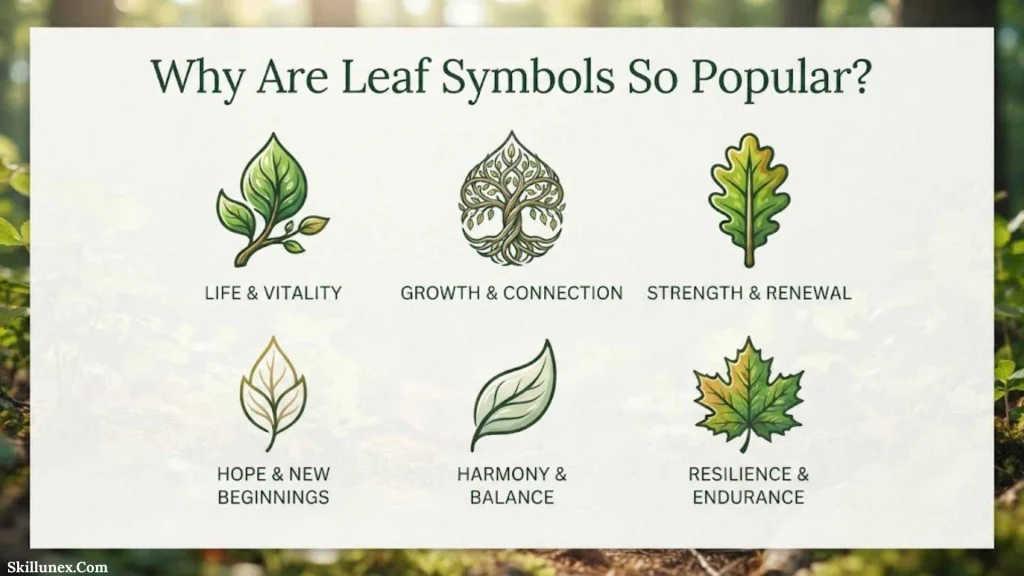
Leaf symbols are popular because they combine simplicity, beauty, and flexible meaning.
You can use a single leaf to represent something personal, or combine several leaves to create a larger visual story. They work equally well in minimalist logos, detailed botanical artwork, tattoos, jewelry, seasonal decorations, and digital graphics.
Another reason is that almost everyone understands the basic life cycle of a leaf. We see leaves grow, change color, fall, and return with the seasons. That familiar experience makes leaf symbolism easy to recognize even when no explanation is provided.
Frequently Asked Questions About Leaf Symbols
What is the main meaning of a leaf symbol?
A leaf symbol commonly represents growth, renewal, life, nature, transformation, and change. The exact meaning depends on the type of leaf, its condition, color, and cultural context.
What does a green leaf symbolize?
A green leaf usually symbolizes growth, vitality, freshness, hope, renewal, and connection with nature.
What does a falling leaf symbolize?
A falling leaf commonly represents change, transition, letting go, aging, or the passage of time. It can also symbolize the natural cycle of life rather than something negative.
What leaf symbolizes peace?
The olive leaf or olive branch is strongly associated with peace, goodwill, and reconciliation. This symbolism has historical roots in the ancient Mediterranean world.
What leaf symbolizes strength?
The oak leaf is commonly associated with strength, endurance, courage, and honor. Its symbolism is connected with the long-standing cultural importance of the oak.
What does a laurel leaf symbolize?
A laurel leaf commonly symbolizes victory, achievement, honor, recognition, and distinction. Laurel wreaths have historical associations with honoring victors and accomplished people.
What does an oak leaf symbolize?
An oak leaf commonly represents strength, endurance, courage, longevity, and honor. In historical heraldic traditions, oak leaves have also represented qualities such as heroism and victory.
What does a maple leaf symbolize?
A maple leaf can symbolize autumn, seasonal change, nature, and endurance. It also has a particularly strong national association with Canada because it appears on the Canadian flag and is an important Canadian symbol.
What does a four leaf clover symbolize?
A four-leaf clover is widely recognized as a symbol of good luck. Its unusual four-leaf form is traditionally associated with fortune and, in some interpretations, hope, faith, love, and luck.
What does a leaf tattoo symbolize?
A leaf tattoo can represent growth, renewal, change, strength, peace, nature, personal transformation, or letting go. The meaning becomes more specific when you choose a particular leaf, such as oak, olive, laurel, or maple.
What do dried leaves symbolize?
Dried leaves can symbolize aging, endings, memories, impermanence, transition, and the passage of time. They can also represent acceptance and the completion of one stage before another begins.
Are leaf symbols always positive?
No. Leaf symbols can have both positive and reflective meanings. A fresh leaf may suggest growth and hope, while a fallen leaf may suggest loss, aging, or change. Neither interpretation is automatically universal or negative.
Conclusion
Leaf symbols are powerful because they can express many ideas through one simple natural image. Fresh leaves often represent growth, life, hope, and renewal, while autumn and falling leaves can communicate transformation, maturity, change, and letting go. Specific leaves add another layer of meaning: oak is traditionally connected with strength, olive with peace, and laurel with victory and achievement.
When choosing a leaf symbol, look beyond its appearance and think about the message you want it to carry. Consider the plant, color, season, cultural context, and your own personal connection to it. If you use leaf imagery in a tattoo, logo, piece of jewelry, artwork, or personal project, understanding these details can help you choose a design that feels both beautiful and meaningful.

Isla Kensington
I’m Isla Kensington, a writer with a passion for research, culture, nature, and the fascinating meanings behind everyday things. I enjoy taking topics that may seem simple at first and discovering the history, facts, and ideas that make them more interesting.
I write with readers in mind. My aim is to provide clear explanations, useful information, and interesting details without making a topic unnecessarily complicated.
I believe learning should feel like discovering something rather than simply reading facts. That philosophy guides the content I create and the topics I choose to explore.
## Books by Isla Kensington
* Symbols Around the World: A Guide to Meaning & Culture
* Nature’s Beautiful Places: Lakes, Landscapes & Natural Treasures