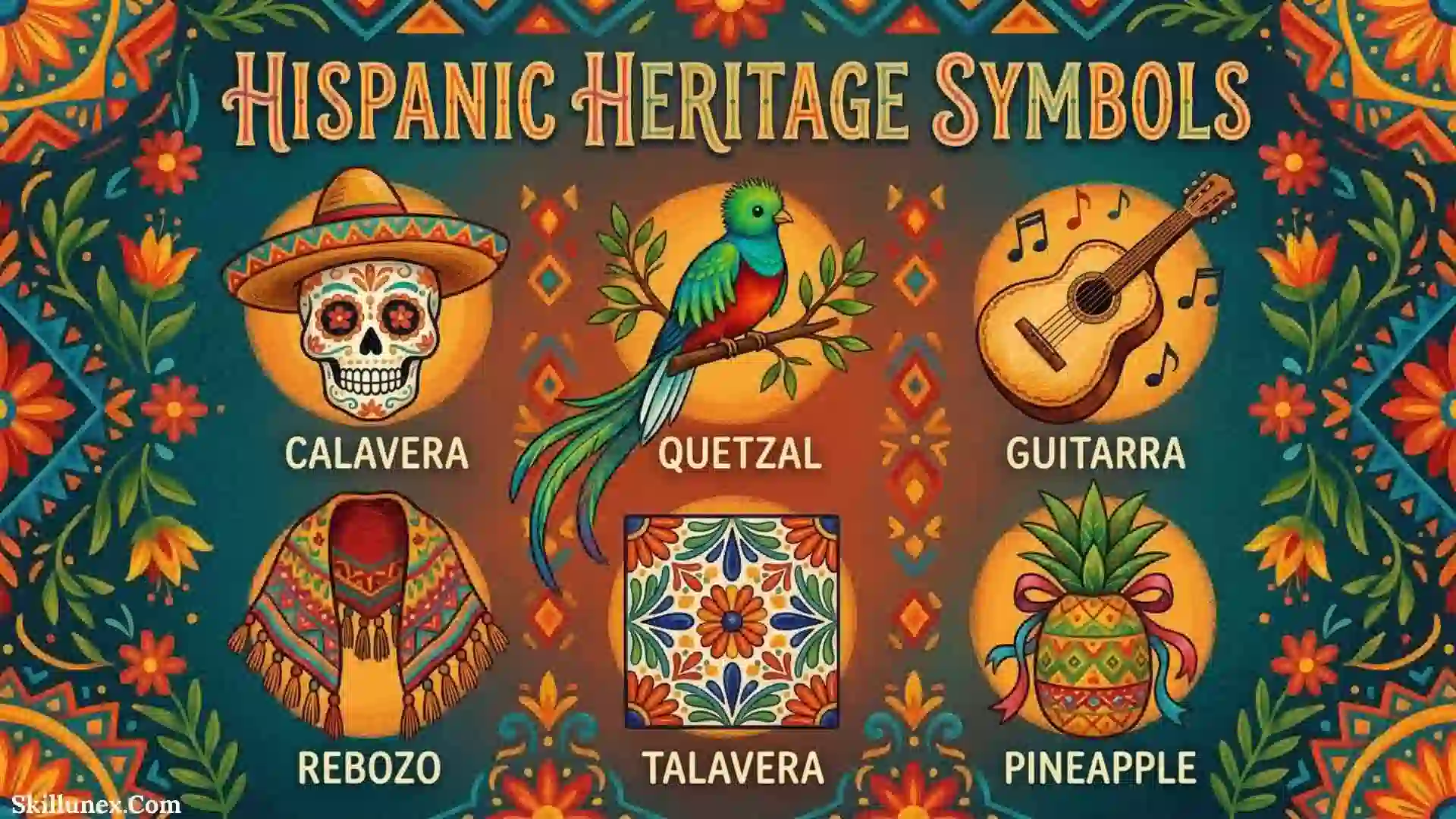
Hispanic heritage is represented by a rich collection of languages, traditions, celebrations, foods, music, art, family customs, national identities, and cultural histories. However, there is no single symbol that represents every Hispanic person or community.
The term Hispanic encompasses people with heritage connected to Spanish speaking cultures and countries, including communities across Latin America, the Caribbean, Spain, and the United States. Because these cultures are diverse, a Mexican symbol may have a very different meaning from a Puerto Rican, Cuban, Colombian, Peruvian, or Spanish symbol.
Some of the most recognizable Hispanic heritage symbols include national flags, traditional music and dance, Spanish language expressions, family gatherings, regional foods, Indigenous artwork, textiles, papel picado, marigolds, calaveras, religious imagery, and cultural celebrations.
Understanding the origin of each symbol is important. A cultural symbol becomes more meaningful when we know the people, history, and tradition behind it rather than treating every Hispanic culture as the same.
What Are Hispanic Heritage Symbols?
Hispanic heritage symbols are objects, traditions, artistic designs, foods, languages, celebrations, and cultural practices that can represent the history and identity of particular Hispanic communities.
These symbols may represent:
- National identity
- Family and community
- Language
- Historical heritage
- Indigenous ancestry
- African heritage
- Spanish influence
- Religious traditions
- Music and dance
- Food and family traditions
- Cultural celebrations
- Immigration and cultural identity
It is important to remember that a symbol can be meaningful to one community without being universal to all Hispanic people.
Why Cultural Symbols Matter
Symbols make culture easier to recognize, remember, and share. A flag can represent a nation, a traditional dance can preserve history, and a family recipe can connect generations.
For many people, cultural symbols also provide a connection to their ancestors and family history.
A symbol may appear in a school project, Hispanic Heritage Month celebration, artwork, community event, family gathering, or cultural festival. Its meaning often depends on its historical and geographic context.
Why There Is No Single Hispanic Symbol
Hispanic communities are extremely diverse. There are many countries, regional identities, languages, ethnic backgrounds, and historical experiences within the broader Hispanic category.
For example, mariachi is strongly associated with Mexico, while flamenco is associated with Spain, merengue and bachata are strongly associated with the Dominican Republic, and cumbia has important Colombian roots.
Likewise, the Mexican flag represents Mexico rather than every Hispanic country.
For this reason, it is more accurate to speak about symbols associated with Hispanic heritage rather than claiming that one object represents all Hispanic people.
Hispanic, Latino, and Latin American: What’s the Difference?
The words Hispanic, Latino, Latina, Latine, and Latin American are sometimes used interchangeably, but they do not have exactly the same meaning.
Understanding these differences helps prevent cultural confusion when discussing heritage symbols.
What Does Hispanic Mean?
Hispanic generally refers to people, cultures, or heritage connected with Spanish-speaking countries or communities.
In the United States, the term commonly includes people with family or cultural roots in countries such as:
- Mexico
- Puerto Rico
- Cuba
- Dominican Republic
- Guatemala
- Honduras
- El Salvador
- Nicaragua
- Costa Rica
- Panama
- Colombia
- Venezuela
- Ecuador
- Peru
- Bolivia
- Chile
- Argentina
- Paraguay
- Uruguay
- Spain
The term can describe a broad cultural or linguistic connection, but individual people may identify with a specific nationality, ethnicity, Indigenous identity, Afro-descendant identity, or another cultural identity instead.
What Does Latino Mean?
Latino generally refers to people connected to Latin America.
This creates some important differences.
For example, Brazil is part of Latin America but is not generally considered Hispanic because Portuguese is its dominant language.
Spain, meanwhile, is Hispanic but is not geographically part of Latin America.
The categories overlap, but they are not identical.
When discussing cultural symbols, it is therefore better to identify the specific country or community whenever possible.
Hispanic Heritage Symbols at a Glance
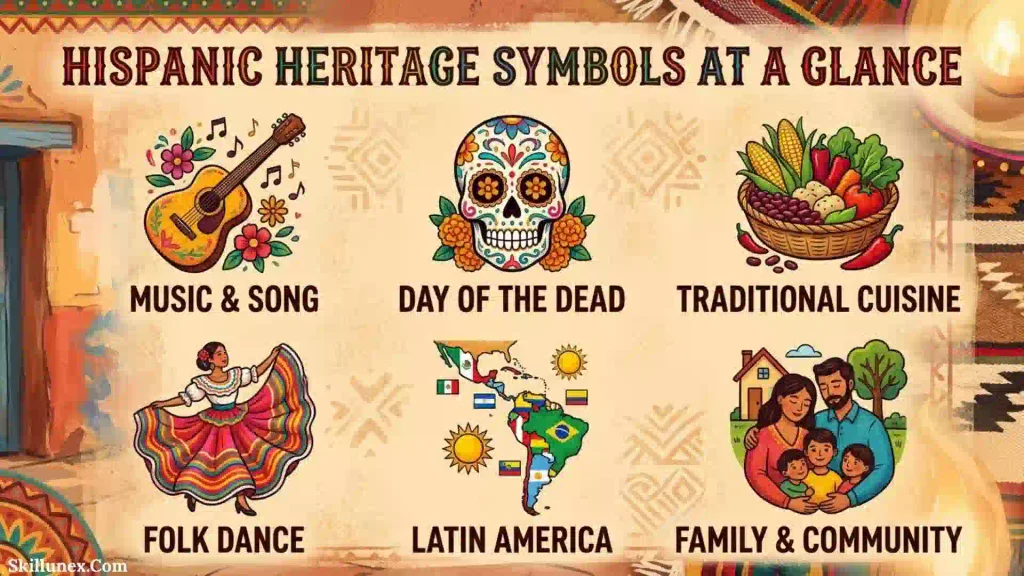
There are many symbols associated with Hispanic heritage, and their meanings depend on the culture they come from.
| Symbol or Tradition | Cultural Connection | What It Can Represent |
| National flags | Individual Hispanic countries | National identity and pride |
| Spanish language | Many Hispanic communities | Language and cultural connection |
| Family gatherings | Many Hispanic cultures | Family, belonging, and community |
| Mariachi | Mexico | Mexican musical heritage |
| Salsa | Caribbean and Latin American traditions | Music, dance, and cultural exchange |
| Merengue | Dominican Republic | Dominican cultural heritage |
| Bachata | Dominican Republic | Music, identity, and cultural history |
| Cumbia | Colombia and other Latin American regions | Musical and cultural heritage |
| Flamenco | Spain | Spanish artistic tradition |
| Papel picado | Mexico | Mexican folk art and celebration |
| Cempasúchil/marigolds | Especially Mexico | Remembrance and Día de los Muertos traditions |
| Calaveras | Especially Mexico | Día de los Muertos imagery |
| Traditional textiles | Various Indigenous and Latin American cultures | Ancestry, artistry, and community |
| Traditional foods | Individual countries and regions | Family and cultural traditions |
| Religious imagery | Some Hispanic communities | Faith and spiritual heritage |
These examples should be viewed as culturally specific symbols and traditions, not as one universal list belonging equally to every Hispanic community.
National Flags as Hispanic Heritage Symbols
National flags are among the clearest symbols of Hispanic heritage because they connect people with particular countries and national histories.
A flag may represent birthplace, ancestry, family heritage, national pride, independence, or cultural identity.
Mexican Flag
The Mexican flag is one of the most recognizable national symbols in the Hispanic world.
Its central emblem features an eagle perched on a cactus while holding a serpent. The imagery has deep historical connections to Mexica/Aztec tradition and the founding story associated with Tenochtitlan.
The green, white, and red colors have also been interpreted through Mexico’s historical development.
The Mexican flag is specifically a Mexican national symbol, not a universal symbol of Hispanic heritage.
Puerto Rican Flag
The Puerto Rican flag is an important symbol of Puerto Rican identity and heritage.
It can represent national and cultural pride, family ancestry, history, and the Puerto Rican diaspora.
Puerto Rican culture has been shaped by Indigenous Taíno heritage, Spanish colonial history, African influences, migration, and Caribbean cultural exchange.
Cuban Flag
The Cuban flag is an important symbol of Cuban national identity.
For Cuban communities around the world, it can represent ancestry, homeland, family history, and cultural connection.
Cuban heritage also includes major contributions to music, food, literature, art, and Caribbean culture.
Other National Flags
Other flags can be meaningful symbols of Hispanic heritage, including those of:
- Dominican Republic
- Colombia
- Venezuela
- Guatemala
- Honduras
- El Salvador
- Nicaragua
- Costa Rica
- Panama
- Ecuador
- Peru
- Bolivia
- Chile
- Argentina
- Paraguay
- Uruguay
- Spain
Using individual national flags is often more culturally precise than using a single generic image to represent everyone.
Language as a Symbol of Hispanic Heritage
Language is one of the strongest cultural connections shared across many Hispanic communities.
Spanish connects people across numerous countries, although Spanish itself varies greatly by region.
Spanish Language
Spanish can represent:
- Family heritage
- Ancestry
- Literature
- Music
- Storytelling
- Community
- Historical connection
- Cultural identity
Words, phrases, poetry, songs, and literature can therefore serve as cultural expressions as well as communication.
The letter Ñ is sometimes used in cultural artwork because it is strongly associated with the Spanish language. However, it should be understood as a language symbol, not an official symbol of Hispanic identity.
Bilingual and Heritage Identity
Many Hispanic people in the United States and elsewhere grow up using more than one language.
Some speak Spanish at home and English at school or work. Others may understand Spanish but not speak it fluently. Some Hispanic people may have little or no Spanish-language ability while still having strong cultural and family connections.
Therefore, speaking Spanish is not a requirement for having Hispanic heritage.
Music and Dance as Hispanic Heritage Symbols
Music and dance are among the most vibrant ways cultures preserve history and identity.
Hispanic musical traditions are extremely diverse and often reflect Indigenous, African, European, Caribbean, and regional influences.
Mariachi
Mariachi is strongly associated with Mexico and is one of the country’s best-known musical traditions.
Mariachi performances often feature string instruments and trumpets and can be connected with celebrations, family events, public ceremonies, and Mexican cultural identity.
It is a powerful Mexican heritage symbol, but it should not be presented as a symbol representing every Hispanic culture.
Salsa, Merengue, Bachata, and Cumbia
Several popular dance and music traditions demonstrate the diversity of Hispanic cultures.
Salsa developed through complex Caribbean and Latin American musical exchanges, with major Cuban and Puerto Rican influences and an important history in New York City.
Merengue is strongly associated with the Dominican Republic.
Bachata also has deep Dominican roots and has become internationally popular.
Cumbia has important Colombian origins and has developed into numerous regional forms throughout Latin America.
These traditions show that Hispanic music is not one musical style but a collection of interconnected traditions.
Flamenco and Spanish Traditions
Flamenco is associated particularly with Andalusia in Spain.
Its history reflects complex cultural influences, including Romani, Andalusian, Spanish, and other traditions.
Flamenco can therefore be used as a symbol of Spanish cultural heritage, but it should not be described as a universal representation of all Hispanic communities.
Food as a Symbol of Hispanic Heritage
Food is another important way cultural heritage is passed between generations.
Traditional recipes can carry memories of family, geography, migration, celebrations, and local ingredients.
Traditional Foods
Hispanic cuisines vary enormously by country and region.
Examples include:
- Tamales
- Tacos
- Mole
- Empanadas
- Arepas
- Plantains
- Rice and beans
- Paella
- Ceviche
- Pupusas
- Regional soups and stews
These foods do not all belong to one single Hispanic cuisine.
For example, pupusas are strongly associated with El Salvador, arepas are central to Venezuelan and Colombian cuisines, and paella is associated with Spain.
Identifying the cultural origin makes food symbolism more meaningful and avoids presenting unrelated cuisines as one tradition.
Family and Food Traditions
Food can symbolize heritage because recipes are often passed from parents and grandparents to younger generations.
Cooking together, preparing holiday meals, sharing family recipes, and gathering around a table can all become expressions of cultural identity.
For many families, a traditional dish is more than food—it can be a connection to home and ancestry.
Art, Crafts, and Visual Symbols
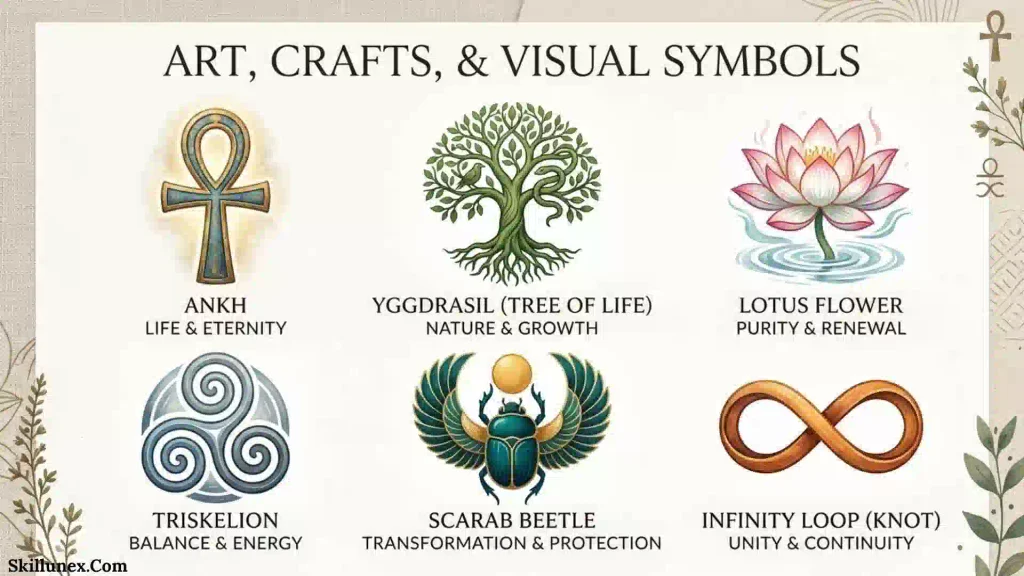
Hispanic heritage is also represented through painting, textiles, ceramics, embroidery, murals, paper art, sculpture, and other forms of visual expression.
Textiles and Indigenous Patterns
Traditional textiles can preserve stories about Indigenous communities, geography, family identity, and local craftsmanship.
Maya, Andean, Mexican, and other Indigenous textile traditions are highly diverse.
Patterns and colors may have specific meanings within individual communities, so they should not automatically be described as generic “Hispanic patterns.”
Papel Picado and Folk Art
Papel picado is a Mexican folk-art tradition involving intricate designs cut into colored tissue paper.
It is commonly used for celebrations and can be especially visible during Día de los Muertos and other Mexican festivities.
Because it has a specific cultural origin, it is best described as a Mexican cultural symbol, rather than a universal Hispanic decoration.
Murals and Traditional Artwork
Murals and public art have played important roles in various Hispanic and Latino communities.
Art can communicate:
- History
- Social experiences
- Family
- Immigration
- Indigenous heritage
- Political and community stories
- National identity
- Cultural pride
The meaning of a particular artwork depends on its artist, community, and historical context.
Indigenous and African Influences on Hispanic Heritage
A complete discussion of Hispanic heritage should not reduce the subject to Spanish or European influence.
Many Hispanic cultures have been shaped by Indigenous and African peoples and traditions.
Indigenous Cultural Heritage
Indigenous heritage remains an important part of many Hispanic communities throughout the Americas.
Examples include traditions connected to:
- Maya peoples
- Mexica/Nahua peoples
- Quechua communities
- Aymara communities
- Taíno heritage
- Numerous other Indigenous nations and communities
Indigenous influence can be seen in languages, foods, textiles, art, agricultural traditions, architecture, ceremonies, and other cultural practices.
Not every Hispanic person has the same Indigenous heritage, so these traditions should always be identified by their specific community and region.
African Cultural Influence
African heritage has also profoundly influenced many Hispanic cultures, especially throughout the Caribbean and parts of Latin America.
African influences can be found in:
- Music
- Dance
- Percussion
- Food
- Religious traditions
- Language
- Art
- Community practices
Recognizing African influence provides a more complete picture of the cultural history behind many Hispanic traditions.
Religious and Spiritual Symbols
Religion has played an important historical role in many Hispanic communities, especially through Catholic traditions.
However, religious symbols should not be treated as universal Hispanic symbols.
Crosses and Catholic Traditions
The cross, rosary, churches, saints, and other Catholic imagery may have deep meaning for some Hispanic families and communities.
These symbols can represent:
- Faith
- Family traditions
- Religious celebrations
- Spiritual identity
- Historical heritage
At the same time, Hispanic communities are religiously diverse, and not every Hispanic person is Catholic or religious.
Virgin of Guadalupe
The Virgin of Guadalupe is an especially important religious and cultural symbol for many Mexican Catholics and others throughout the Americas.
Her image can represent faith, Mexican identity, family tradition, devotion, and cultural heritage.
Because of her particularly strong connection with Mexican culture, she should not be presented as a universal religious symbol for all Hispanic people.
Día de los Muertos Symbols
Día de los Muertos, or Day of the Dead, is one of the most recognizable Mexican cultural traditions associated with remembrance and honoring deceased loved ones.
It is important to distinguish this Mexican tradition from Hispanic culture as a whole.
Marigolds and Cempasúchil
The cempasúchil, commonly known as the Mexican marigold, is strongly associated with Día de los Muertos traditions.
Its bright color and fragrance are traditionally connected with remembrance and the celebration of loved ones who have died.
Marigolds can therefore be meaningful symbols in Mexican heritage displays, especially during Día de los Muertos.
Calaveras and Ofrendas
Calaveras, or decorative skull imagery, are widely associated with Día de los Muertos.
Ofrendas, or offerings, may include:
- Photographs
- Candles
- Flowers
- Favorite foods
- Personal objects
- Decorative paper
- Religious imagery
These traditions center on remembrance and family connections.
They should not be reduced to “Halloween symbols,” because Día de los Muertos has its own cultural and historical context.
Hispanic Heritage Month Symbols
Hispanic Heritage Month is an especially important context for people searching for Hispanic heritage symbols.
In the United States, Hispanic Heritage Month is observed from September 15 through October 15.
Why Does Hispanic Heritage Month Start September 15?
September 15 is significant because it marks the independence anniversary of several Central American countries.
Costa Rica, El Salvador, Guatemala, Honduras, and Nicaragua celebrate their independence on September 15.
Mexico celebrates its independence on September 16, while Chile celebrates its independence on September 18.
This period therefore provides an opportunity to recognize the histories and contributions of people with heritage connected to many Spanish-speaking countries and communities.
Common Symbols Used in Celebrations
Hispanic Heritage Month displays may include:
- National flags
- Maps
- Traditional artwork
- Musical instruments
- Cultural clothing
- Food illustrations
- Spanish-language words
- Historical figures
- Books by Hispanic authors
- Traditional patterns
- Country-specific crafts
- Images representing music and dance
The best displays identify the specific country or community represented by each symbol.
Hispanic Heritage Symbols by Country
Because Hispanic heritage is diverse, looking at symbols by country provides a more accurate understanding.
Mexico
Examples of Mexican cultural and national symbols include:
- Mexican flag
- Eagle and serpent emblem
- Mariachi
- Papel picado
- Cempasúchil
- Calaveras
- Día de los Muertos traditions
- Traditional textiles
- Mexican folk art
Mexico has a particularly large influence on Hispanic cultural imagery in the United States, but Mexican traditions should not automatically be treated as universal Hispanic traditions.
Puerto Rico
Puerto Rican heritage can be represented through:
- Puerto Rican flag
- Coquí
- Bomba and plena
- Traditional foods
- Puerto Rican music
- Caribbean cultural traditions
- Indigenous Taíno heritage
The coquí, a small frog native to Puerto Rico, is a particularly recognizable cultural symbol.
Cuba and the Dominican Republic
Cuban cultural symbols can include:
- Cuban flag
- Cuban music
- Son traditions
- Traditional foods
- Caribbean cultural imagery
Dominican heritage can include:
- Dominican flag
- Merengue
- Bachata
- Baseball culture
- Traditional foods
- Caribbean traditions
Both cultures demonstrate the importance of African, European, Caribbean, and Indigenous historical influences.
Central America
Central American Hispanic cultures include many distinct national traditions.
Examples include:
- Guatemala’s Maya textile traditions
- El Salvador’s pupusas and folk traditions
- Honduras’s national and Indigenous heritage
- Nicaragua’s folk festivals and arts
- Costa Rica’s national traditions
- Panama’s Caribbean and Central American cultural influences
These should be studied as individual national and regional cultures rather than combined into one generic Central American identity.
South America
South American Hispanic heritage includes numerous distinctive traditions.
Examples include:
- Colombia’s cumbia and traditional crafts
- Venezuela’s arepas and musical traditions
- Peru’s Andean textiles and Indigenous heritage
- Ecuador’s Indigenous and regional traditions
- Bolivia’s Indigenous cultural traditions
- Chile’s national and folk traditions
- Argentina’s tango and gaucho traditions
- Paraguay’s Guaraní cultural influence
- Uruguay’s candombe and other traditions
These examples demonstrate how varied Hispanic heritage can be across South America.
Spain
Spain is Hispanic because Spanish is its dominant language, but Spanish culture is distinct from Latin American cultures.
Spanish cultural symbols and traditions can include:
- Flamenco
- Regional Spanish folk traditions
- Spanish language
- National and regional flags
- Traditional arts
- Regional cuisine
- Historic architecture
Spain itself contains many different regional cultures, so even “Spanish culture” should not be treated as completely uniform.
Hispanic Heritage Symbols for School Projects
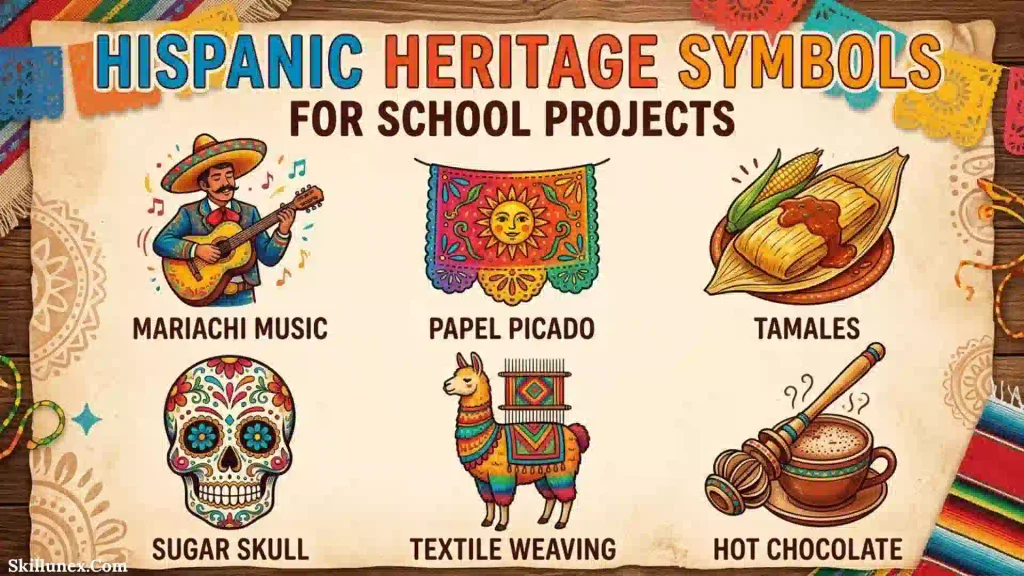
Students often search for Hispanic heritage symbols because they need ideas for a classroom assignment, poster, presentation, or Hispanic Heritage Month project.
Poster Ideas
A strong poster can combine several culturally specific elements rather than relying on stereotypes.
Ideas include:
- A map showing Spanish-speaking countries.
- Several national flags with country names.
- A timeline of Hispanic history.
- Examples of music and dance from different countries.
- Traditional foods labeled by country.
- Indigenous art and textile examples.
- Important Hispanic historical and cultural figures.
- Spanish-language words connected to family and community.
Bulletin Board Ideas
A classroom bulletin board could use a “country spotlight” format.
Each section can feature:
- Country name
- Flag
- Map
- Famous cultural tradition
- Traditional food
- Music or dance
- Important historical figure
- Interesting cultural fact
This approach teaches students that Hispanic heritage includes many different cultures.
Art and Presentation Ideas
Students can create:
- Cultural symbol collages
- Flag artwork
- Country comparison charts
- Traditional pattern-inspired artwork
- Music and dance timelines
- Cultural recipe displays
- Hispanic Heritage Month maps
- Interviews with family members about cultural traditions
When using traditional designs, students should identify their cultural origin instead of labeling every design simply as “Hispanic.”
Common Misconceptions About Hispanic Heritage Symbols
Cultural symbols are meaningful, but they can easily become stereotypes when used without context.
One Symbol Does Not Represent Everyone
There is no single object, color, food, dance, or flag that perfectly represents every Hispanic community.
Hispanic heritage includes many nationalities, ethnicities, languages, and histories.
Food and Clothing Are Not Universal Symbols
Tacos, sombreros, maracas, and other familiar images are sometimes used as shorthand for Hispanic culture.
Some are meaningful within specific cultures, but using them as symbols for all Hispanic people can create an inaccurate or stereotypical picture.
For example, the sombrero has specific cultural and historical associations and should not be treated as a universal Hispanic costume.
Hispanic Culture Is Not the Same as One Country’s Culture
One of the most common mistakes is equating Hispanic culture with Mexican culture.
Mexican culture is an enormously important Hispanic culture, particularly in the United States, but Hispanic communities also have roots in the Caribbean, Central America, South America, Spain, and elsewhere.
A more respectful approach is to identify the specific country, region, or community behind a cultural symbol.
Frequently Asked Questions About Hispanic Heritage Symbols
What are Hispanic heritage symbols?
Hispanic heritage symbols are objects, traditions, foods, artistic styles, languages, celebrations, music, national flags, and other cultural expressions associated with Hispanic communities. There is no single universal Hispanic symbol because Hispanic heritage includes many different countries and cultures.
What symbol represents Hispanic heritage?
There is no official universal symbol representing all Hispanic heritage. National flags, Spanish-language traditions, family and community imagery, music, food, art, and cultural celebrations can all represent aspects of Hispanic heritage.
What colors represent Hispanic heritage?
There are no universally official colors for all Hispanic heritage. Colors may come from individual national flags, traditional artwork, celebrations, textiles, and regional cultural traditions.
What flower represents Hispanic heritage?
There is no single flower representing all Hispanic people. The cempasúchil, or Mexican marigold, is strongly associated with Mexican Día de los Muertos traditions, but it should not be treated as a universal Hispanic flower.
What symbols represent Hispanic Heritage Month?
Common Hispanic Heritage Month imagery includes national flags, maps, cultural artwork, music, dance, traditional foods, Spanish-language expressions, historical figures, and country-specific cultural traditions.
Why does Hispanic Heritage Month start September 15?
September 15 marks the independence anniversary of Costa Rica, El Salvador, Guatemala, Honduras, and Nicaragua. Mexico celebrates its independence on September 16, and Chile’s independence celebrations include September 18. These dates help explain the timing of Hispanic Heritage Month in the United States.
Is the Mexican flag a Hispanic symbol?
The Mexican flag is a national symbol of Mexico. It can certainly be included in a Hispanic Heritage Month display, particularly when highlighting Mexican heritage, but it does not represent every Hispanic country or community.
Is Día de los Muertos a Hispanic tradition?
Día de los Muertos is a Mexican tradition centered on remembering and honoring deceased loved ones. It is part of Mexican cultural heritage and has become internationally recognized, but it should not be presented as a universal tradition shared by every Hispanic community.
What foods represent Hispanic heritage?
There is no single Hispanic cuisine. Foods associated with different Hispanic cultures include tamales, tacos, pupusas, arepas, empanadas, ceviche, plantains, rice and beans, mole, and paella. Each food should ideally be connected to its specific country or regional tradition.
What music represents Hispanic culture?
Many musical traditions represent different Hispanic cultures, including mariachi, salsa, merengue, bachata, cumbia, flamenco, and numerous regional folk traditions. Each has its own history and cultural origins.
What are Hispanic cultural symbols for school projects?
Good choices include national flags, maps, traditional art, music and dance, country-specific foods, cultural celebrations, Indigenous heritage, Spanish-language expressions, and biographies of Hispanic historical or cultural figures.
Are Hispanic and Latino the same thing?
Not exactly. Hispanic generally relates to Spanish-speaking heritage, while Latino generally relates to Latin American heritage. The categories overlap but are not identical. For example, Brazil is Latin American but is not generally considered Hispanic, while Spain is Hispanic but is not Latin American.
Conclusion
Hispanic heritage symbols represent a vast and diverse collection of cultures rather than one single tradition. National flags, language, music, dance, food, art, family customs, religious traditions, Indigenous heritage, African influences, and cultural celebrations can all provide meaningful connections to Hispanic identity.The most important thing to remember is context. A Mexican calavera, Puerto Rican coquí, Dominican bachata tradition, Colombian cumbia tradition, Peruvian textile, or Spanish flamenco performance each has its own history and meaning.
For Hispanic Heritage Month, school projects, cultural celebrations, or personal learning, the strongest approach is to celebrate this diversity rather than reducing Hispanic heritage to a handful of familiar stereotypes.When a cultural symbol is identified by its country, community, and historical meaning, it becomes more than decoration it becomes a way to learn about the people and traditions behind it.

Caleb Thornton
I’m Caleb Thornton, a researcher and content writer who loves exploring fascinating subjects and sharing what I learn with readers. My interests include natural places, lakes, symbols, culture, history, and the stories that make ordinary topics more meaningful.
When I write an article, I try to go beyond a basic answer. I look for useful facts, relevant context, and details that can help readers understand the subject more completely.
My purpose is simple: I want every article I contribute to provide genuine value, satisfy the reader’s curiosity, and make discovering new information enjoyable.
## Books by Caleb Thornton
* Symbols & Meanings: Exploring the Signs We See Every Day
* Lakes of the World: Nature, Beauty & Exploration