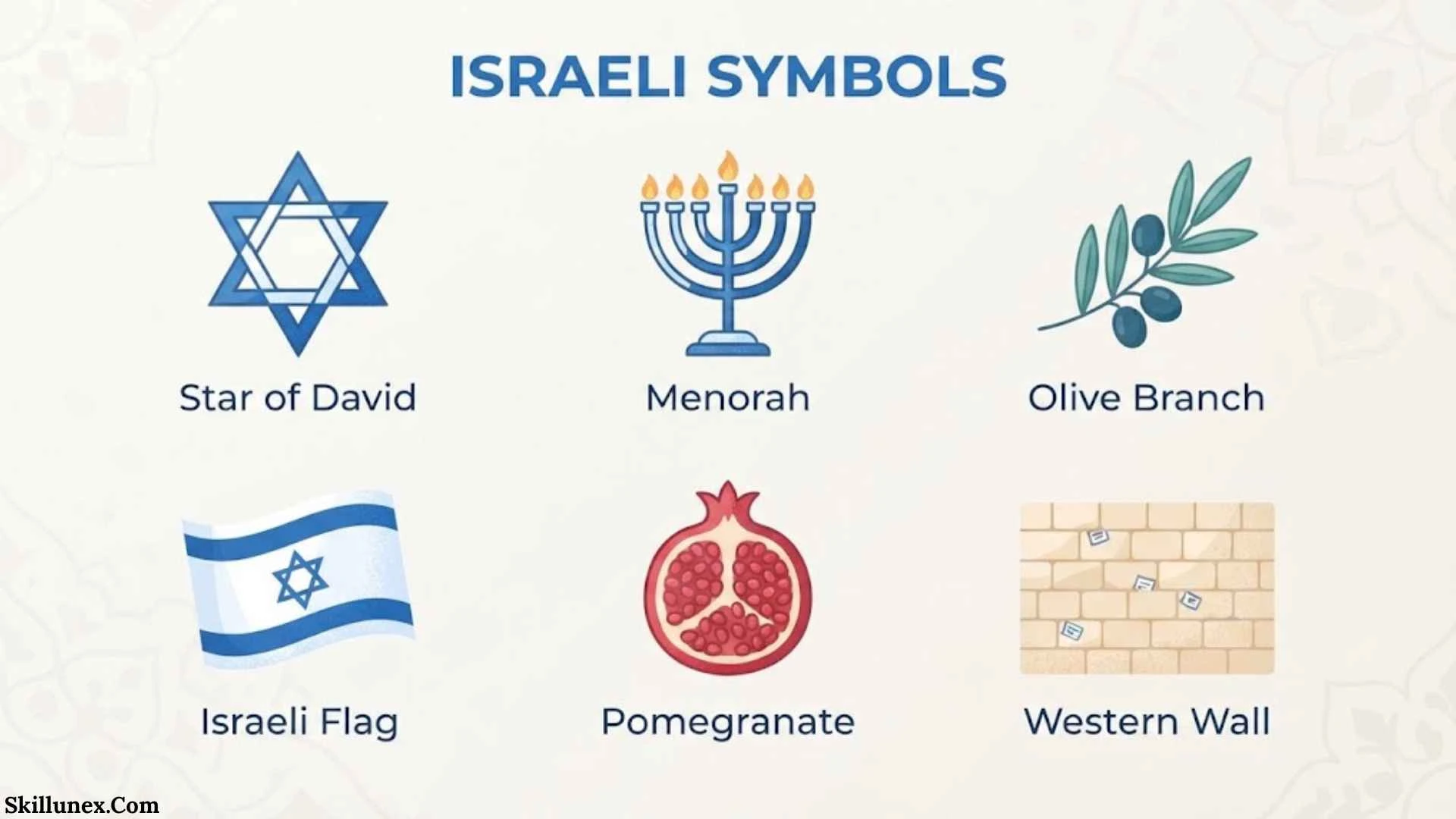
When you search for Israeli symbols, you may be looking for more than a simple list of flags, emblems, and religious images. These symbols connect modern Israel with Jewish history, cultural traditions, national identity, and ideas that have developed over many centuries.
The most important official Israeli symbols are the Israeli flag, the State Emblem, and Hatikvah, the national anthem. Israel’s Basic Law: Israel – the Nation State of the Jewish People identifies these three as state symbols and describes the main elements of the flag and emblem.
However, you will also encounter other symbols associated with Israel and Jewish culture, including the Star of David, menorah, olive branches, blue and white colors, Hebrew letters, the shofar, and the hamsa. Not all of these have official status, so understanding the difference is important.
In this guide, I’ll explain the major Israeli symbols and meanings, their history, what they represent, and how you can distinguish official national symbols from broader Jewish and Israeli cultural symbols.
What Are the Official Israeli Symbols?
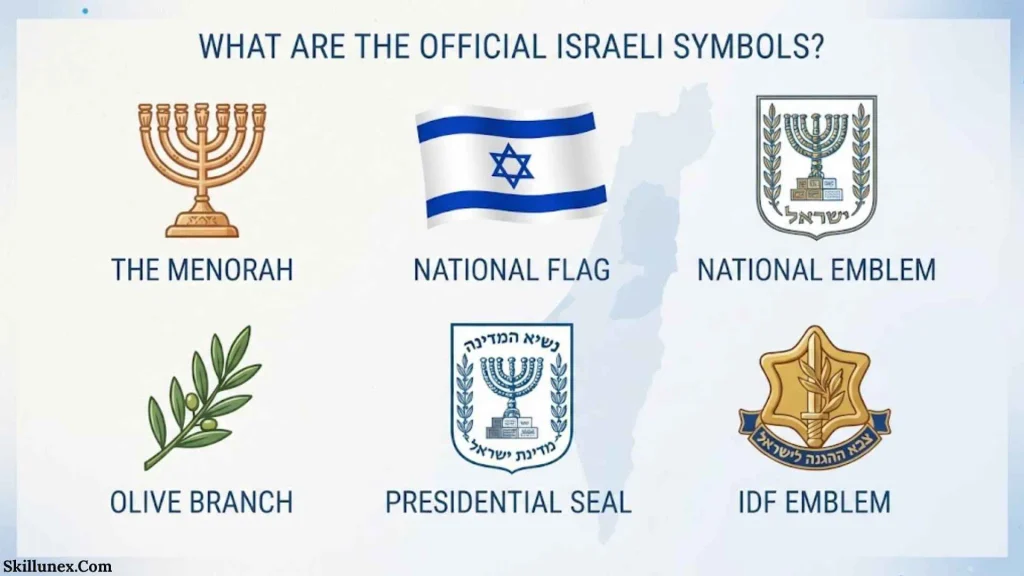
If you want the most accurate answer to “What are the symbols of Israel?”, start with the three symbols recognized as national symbols by Israeli law:
- The State Flag
- The State Emblem
- Hatikvah, the national anthem
Israel’s Nation-State Basic Law describes the flag as white with two light-blue stripes and a light-blue Star of David in the center. It describes the state emblem as a seven-branched menorah surrounded by olive leaves, with the word “Israel” beneath it. The same law identifies Hatikvah as the national anthem.
Official Symbols at a Glance
| Israeli symbol | Main feature | Main association |
| Israeli flag | Star of David, blue and white stripes | National and Jewish identity |
| State Emblem | Menorah and olive branches | Jewish history and peace |
| Hatikvah | National anthem | Hope and national identity |
| Star of David | Six-pointed star | Jewish identity |
| Menorah | Seven branches | Ancient Jewish heritage |
| Olive branches | Branches around the menorah | Peace |
| Blue and white | Flag colors | Tallit and Jewish tradition |
The first three have official national status. The others are important symbols that may be associated with Israel, Judaism, or Jewish history but do not all have the same legal status.
Israeli Flag
The Israeli flag is one of the most recognizable symbols associated with the country. It has a white background, two blue horizontal stripes, and a blue Star of David in the center.
Israel’s Basic Law specifies these main elements of the flag.
The design also has a history that reaches back to the Zionist movement before the establishment of the State of Israel. Israeli government material explains that the blue stripes were based on the tallit, the Jewish prayer shawl, while the Star of David had already become a widely recognized Jewish symbol.
What Do the Blue and White Colors Mean?
Blue and white have strong associations with Jewish tradition.
The two blue stripes on the Israeli flag are traditionally connected with the stripes found on a tallit. The white background and blue elements therefore connect the modern national flag with an older Jewish religious tradition.
You can think of the flag as combining several layers of meaning:
- Blue connects with the traditional colors of the tallit.
- White forms the background of the flag.
- The Star of David represents a widely recognized Jewish identity symbol.
- The complete flag functions as the national flag of the State of Israel.
When Was the Israeli Flag Adopted?
The modern Israeli flag emerged from the Zionist movement and became the national flag after the establishment of Israel in 1948.
Government material records that the flag design was associated with David Wolfson and the early Zionist movement, while the state formally adopted the flag after independence.
This makes the flag both a modern national symbol and a design with roots in earlier Jewish and Zionist symbolism.
Star of David
The Star of David, or Magen David, is probably the most familiar symbol associated with Jewish identity and Israel.
It consists of two overlapping triangles that create a six-pointed star. The symbol appears prominently in the center of the Israeli flag.
What Does the Star of David Mean?
The Star of David is widely associated with Jewish identity, Jewish communities, and Jewish heritage.
Its history is more complicated than simply being an ancient symbol that has always represented Judaism. Six-pointed geometric designs appeared in different cultures, while the specific use of the Magen David as a Jewish symbol developed over time.
By the modern period, it had become strongly identified with Jewish communities and eventually became a central element of the Israeli flag.
For you, the easiest way to identify it is simple: a blue six-pointed star in the center of the Israeli flag.
Is the Star of David an Official Israeli Symbol?
The distinction is important.
The Star of David is an element of the official Israeli flag, but it is also a broader Jewish symbol used by Jewish communities around the world.
So, it is accurate to call it an important Israeli symbol, but it should not be confused with the separate State Emblem, which is based on the menorah.
State Emblem of Israel
The State Emblem of Israel is another major official symbol.
It features:
- A seven-branched menorah
- Olive branches on both sides
- The Hebrew word Israel beneath the menorah
This design is explicitly identified as Israel’s state emblem in the country’s Basic Law.
The emblem is used in official state settings, including government institutions and documents. Israeli government material describes it as an officially identifying sign and notes that it appears on official institutions and documents.
What Does the State Emblem Represent?
The emblem combines two major ideas.
The menorah connects the modern state with ancient Jewish history and the Temple tradition.
The olive branches provide a symbol associated with peace.
Together, the elements create a visual connection between Jewish historical heritage and the idea of peace.
Menorah
The menorah is one of the oldest and most significant Jewish symbols associated with Israel.
The official state emblem uses a seven-branched menorah. This should be distinguished from the nine-branched hanukkiah used during Hanukkah.
What Does the Menorah Symbolize?
The menorah has ancient connections to the Jewish Temple in Jerusalem. Israeli government material describes the menorah in the state emblem as modeled after the Temple menorah and associates it with light.
Its use in the state emblem therefore gives modern Israel a direct visual connection to ancient Jewish history.
Menorah vs. Hanukkah Menorah
This is an important distinction.
| Feature | Menorah | Hanukkiah |
| Branches | Seven | Nine |
| Main historical association | Ancient Temple | Hanukkah |
| Used in Israeli state emblem | Yes | No |
| Common religious use | Jewish historical symbol | Hanukkah observance |
If you are identifying Israeli symbols, the seven-branched menorah in the official emblem is the one to remember.
Olive Branches
The olive branches surrounding the menorah are another important part of Israel’s state emblem.
Israeli government sources describe them as symbolizing the country’s yearning for peace.
The olive branch also has a much broader history as a symbol associated with peace in Mediterranean, biblical, and other cultural traditions.
Why Are Olive Branches on the Israeli Emblem?
The olive branches create a contrast with the ancient menorah.
The menorah points toward historical and religious heritage, while the olive branches communicate an association with peace.
This combination makes the emblem visually meaningful without requiring many separate elements.
Hatikvah: Israel’s National Anthem
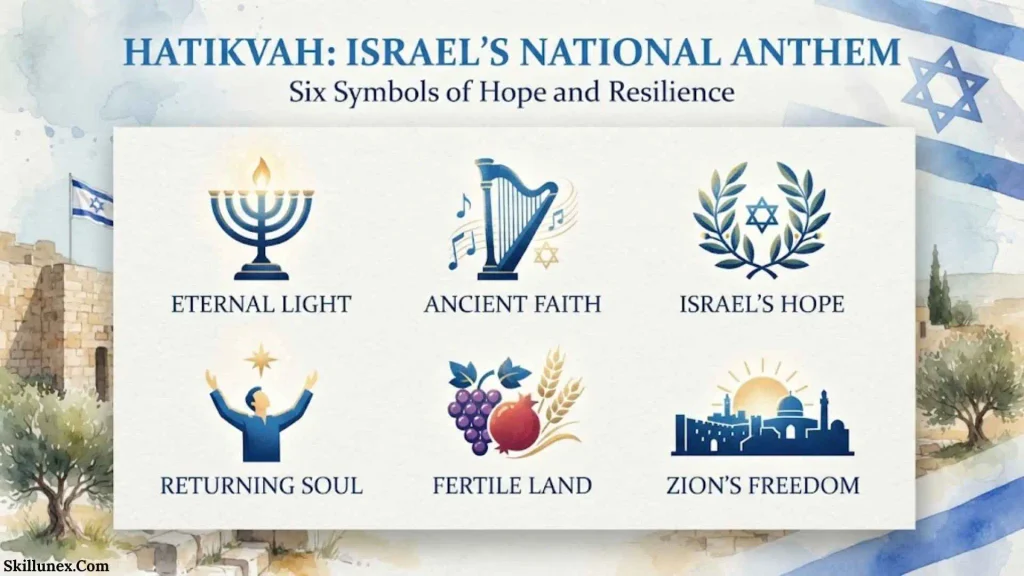
Hatikvah, meaning “The Hope,” is the national anthem of Israel.
Unlike the flag and state emblem, Hatikvah is a musical symbol rather than a visual one. Nevertheless, it has official national status under Israeli law.
History of Hatikvah
The poem that became Hatikvah was written by Naftali Herz Imber in the late 19th century. The original version was called Tikvatenu, meaning “Our Hope.”
According to the Knesset, Imber wrote the first version around 1878, and it was published in Jerusalem in 1886. The melody was later composed by Samuel Cohen, drawing on a Romanian/Moldavian folk melody.
The song became associated with the Zionist movement before becoming Israel’s national anthem.
What Does Hatikvah Mean?
The central idea of Hatikvah is hope for Jewish national freedom in the historic Land of Israel.
The Knesset explains that the anthem was inherited from the Zionist movement and that its words express the Jewish people’s hope to be a free people in their land.
Hatikvah was formally anchored as the national anthem in the 2004 amendment to Israel’s Flag, Emblem and National Anthem Law.
Jewish Symbols Associated With Israel
When you search online for Israeli symbols, you will often find symbols that are not official state symbols.
That happens because Israel’s national identity is closely connected with Jewish history and culture. However, an important distinction is needed: a symbol can be strongly associated with Israel without being an official national symbol.
Hamsa
The hamsa is a hand-shaped symbol found across Middle Eastern and North African cultures, including Jewish communities.
It is sometimes associated with protection and good fortune. However, it is not one of Israel’s three official national symbols.
You may see it in Israeli jewelry, artwork, home décor, and cultural products, but its history is broader than the modern State of Israel.
Shofar
The shofar is a ram’s-horn instrument with an important role in Jewish religious tradition.
It is especially associated with Rosh Hashanah and other Jewish religious contexts.
The shofar is therefore an important Jewish symbol that you may encounter in Israel, but it is not an official national symbol of the State of Israel.
Hebrew Script
Hebrew is another important element of Israeli cultural identity.
Israel’s Nation-State Basic Law identifies Hebrew as the language of the state and gives Arabic a special status.
Hebrew writing appears throughout Israeli public life, including official documents, signs, government institutions, media, and cultural materials.
Because of this, Hebrew letters and words are frequently used in designs intended to evoke Israeli or Jewish identity.
Israeli Symbols and Their Meanings
If you need a quick reference, this table brings together the most important symbols and their commonly documented associations.
| Symbol | Meaning or association | Official national symbol? |
| Israeli flag | National identity; Jewish historical and cultural connection | Yes |
| Star of David | Jewish identity | Element of the official flag |
| State Emblem | Jewish historical heritage and peace | Yes |
| Menorah | Ancient Jewish history, Temple tradition, light | Central element of state emblem |
| Olive branches | Peace and longing for peace | Element of state emblem |
| Hatikvah | Hope and national identity | Yes |
| Blue and white | Tallit and Jewish tradition | Elements of flag |
| Hebrew | Israeli language and cultural identity | State language under Basic Law |
| Hamsa | Broader Jewish/Middle Eastern cultural traditions | No |
| Shofar | Jewish religious tradition | No |
The legal distinction between official and associated symbols is important when you’re writing about Israeli symbols and meanings.
Israeli Symbols and Jewish History
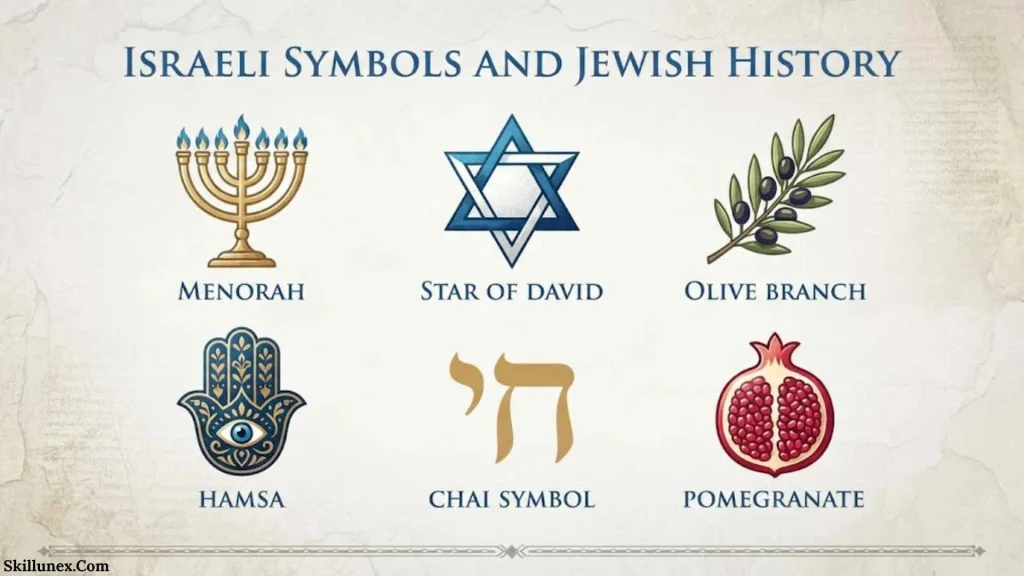
One reason Israeli symbolism can seem complex is that many symbols have histories that are much older than the State of Israel.
The modern state was established in 1948, but symbols such as the menorah and Jewish traditions represented by the tallit have roots that reach back much further.
The State Emblem makes this connection particularly clear. It uses a seven-branched menorah associated with the ancient Temple and surrounds it with olive branches.
The Israeli flag takes a different approach. It uses a modern national design while incorporating the Star of David and colors associated with the tallit.
Hatikvah provides another historical connection because it originated within the Zionist movement before becoming the anthem of the modern state.
Israeli Symbols Before and After 1948
Understanding the timeline helps explain why these symbols look the way they do.
Before the State of Israel
Before 1948, Jewish communities had many religious and cultural symbols, while the Zionist movement developed its own national symbolism.
The Star of David, Jewish colors, Hebrew language, and other elements became increasingly connected with Jewish national identity.
Hatikvah also developed during this period and became associated with the Zionist movement.
After 1948
After Israel declared independence in May 1948, these elements became part of the symbolism of the new state.
The flag became the national flag, the menorah-based design became the state emblem, and Hatikvah eventually received formal legal status as the national anthem.
This is why modern Israeli symbols often contain both older Jewish imagery and modern national symbolism.
Difference Between Israeli and Jewish Symbols
This is one of the most important points to understand.
Israeli symbols and Jewish symbols overlap, but they are not identical categories.
The Israeli flag is an official national symbol of the State of Israel. The menorah is part of the official state emblem. Hatikvah is the national anthem.
By contrast, the hamsa, shofar, Torah scroll, and many other objects can be important Jewish symbols without being official symbols of the Israeli state.
Why Do They Overlap?
The overlap exists because Israel defines itself in its Basic Law as the nation-state of the Jewish people and explicitly identifies national symbols that draw on Jewish historical and cultural traditions.
For you, the simplest rule is:
Official Israeli symbols represent the State of Israel, while broader Jewish symbols can represent Jewish religion, culture, history, or communities anywhere in the world.
Presidential Standard of Israel
There is also a separate symbol connected to the President of Israel.
The Presidential Standard is a blue square with silver borders and contains olive branches, a menorah, and the word “Israel.” The President’s official website explains that it resembles the national emblem but has important visual differences.
How Is It Different From the State Emblem?
The differences include:
- The Presidential Standard is square.
- The State Emblem has a shield-like form.
- The Presidential Standard uses white or silvery-gray elements.
- The national emblem uses gold-colored elements.
- The Presidential Standard represents the President’s presence, particularly at official ceremonies.
So, if you see a blue square containing a menorah and olive branches, you should not automatically identify it as the general State Emblem.
Israeli Symbols in Government and Public Life
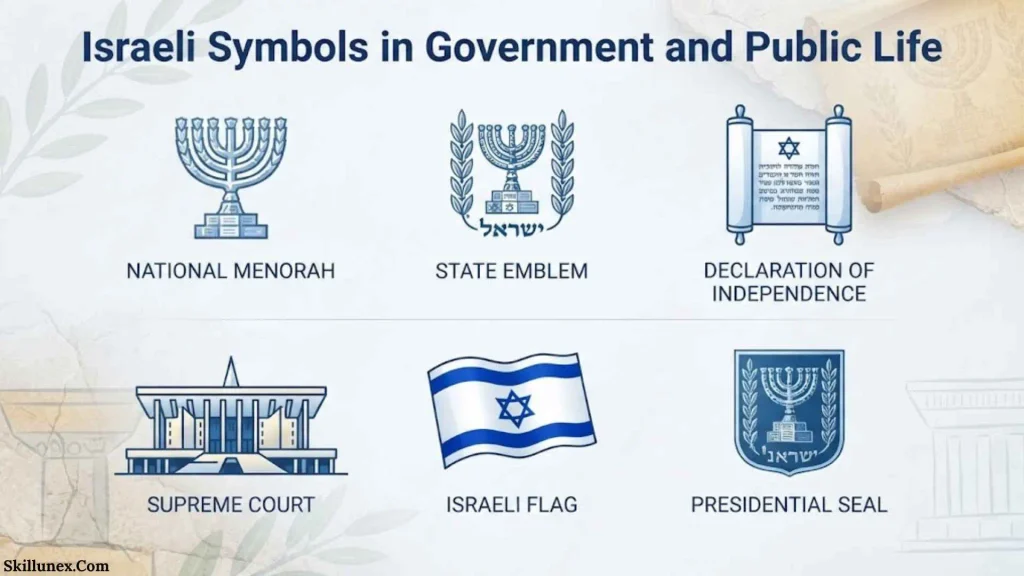
Israeli national symbols appear throughout official public life.
You can encounter them on:
- Government buildings
- Official documents
- State ceremonies
- Public institutions
- National events
- Diplomatic settings
- Official publications
- Certain government materials
The Israeli government notes that the State Emblem appears on official institutional buildings and documents and is protected by law.
The national flag is similarly used as a visible representation of the state.
Israeli Symbols in Art, Jewelry, and Design
Israeli and Jewish symbols are also common in artistic and commercial designs.
You may see the Star of David on:
- Jewelry
- Necklaces
- Pendants
- Artwork
- Clothing
- Decorations
- Cultural products
The menorah may appear in:
- Religious artwork
- Historical illustrations
- Government-related designs
- Jewish educational materials
- Architecture
- Decorative objects
The hamsa is also common in jewelry and decorative art, particularly in contexts influenced by Jewish and Middle Eastern traditions.
When using these symbols in design, it helps to identify their actual background rather than describing every Jewish symbol as an official symbol of Israel.
Israeli Symbols for Educational Projects
If you’re creating a school project, presentation, worksheet, or educational article about Israel, the easiest approach is to start with the official three.
Recommended Core Symbols
Use:
- Israeli flag
- State Emblem
- Hatikvah
Then explain the important elements within those symbols:
- Star of David
- Blue stripes
- White background
- Menorah
- Olive branches
- Hebrew word “Israel”
- Historical meaning of Hatikvah
After that, you can add broader cultural symbols such as the hamsa and shofar, but clearly identify them as Jewish or cultural symbols rather than official national symbols.
Common Mistakes About Israeli Symbols
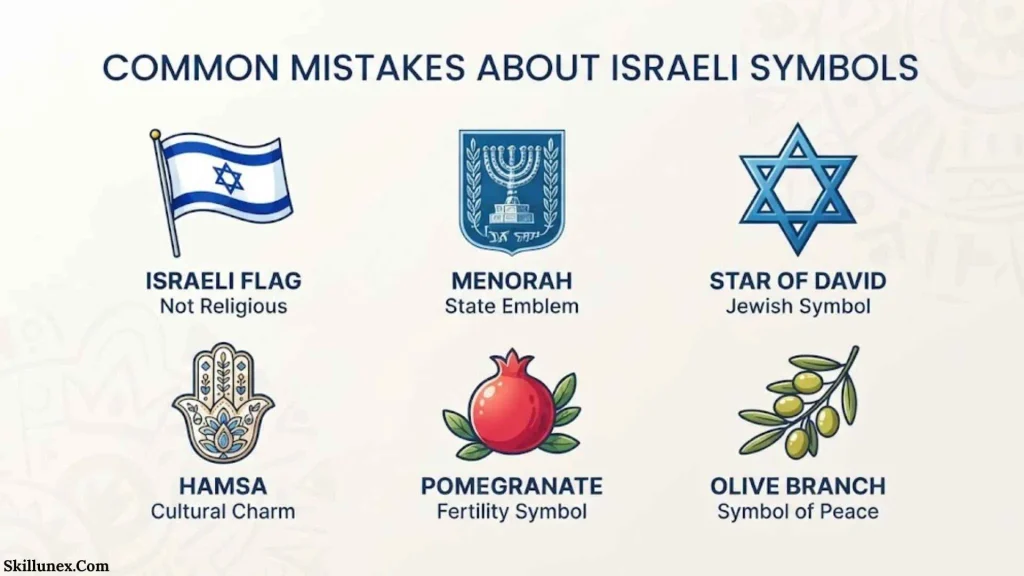
There are several easy mistakes you can avoid.
Calling Every Jewish Symbol an Israeli National Symbol
This is the most common problem.
The hamsa and shofar may be associated with Jewish culture, but they are not among Israel’s three official national symbols.
Confusing the Menorah With the Hanukkiah
The official emblem uses a seven-branched menorah.
The Hanukkah lamp has nine branches and has a different religious function.
Confusing the State Emblem With the Presidential Standard
Both contain a menorah, olive branches, and the word Israel, but the Presidential Standard has a different design and represents the President.
Treating the Star of David as Exclusively Israeli
The Star of David is prominently used by Israel, but it is also a broader Jewish symbol used around the world.
Three Main Israeli Symbols Compared
If you only need to remember the official national symbols, this comparison is enough.
| Official symbol | What you see or hear | Main role |
| Flag | Blue and white with Star of David | Represents the state visually |
| State Emblem | Menorah, olive branches, “Israel” | Official state identification |
| Hatikvah | National song | Represents national identity through music |
Israel’s Basic Law explicitly identifies all three.
Frequently Asked Questions
What are the three official symbols of Israel?
The three official national symbols are the Israeli flag, the State Emblem, and Hatikvah, the national anthem. Israel’s Basic Law identifies all three as state symbols.
What does the Israeli flag symbolize?
The Israeli flag uses blue and white, with a blue Star of David in the center. The colors are associated with the tallit, while the Star of David is a widely recognized Jewish symbol.
What is the main symbol of Israel?
There is no single official answer that replaces all others. The flag, State Emblem, and Hatikvah are the three national symbols identified in Israel’s Basic Law.
What does the Star of David represent?
The Star of David, or Magen David, is widely associated with Jewish identity and heritage. It is also the central visual symbol on Israel’s national flag.
What does the menorah symbolize in Israel?
The seven-branched menorah connects Israel’s modern state symbolism with ancient Jewish history and the Temple tradition. It forms the central image of the State Emblem.
What do the olive branches mean on Israel’s emblem?
The olive branches are associated with peace and a longing for peace. They surround the menorah in the official State Emblem.
What is Hatikvah?
Hatikvah, meaning “The Hope,” is Israel’s national anthem. It originated as a poem by Naftali Herz Imber in the late 19th century and later became associated with the Zionist movement before becoming Israel’s national anthem.
Is the hamsa an official Israeli symbol?
No. The hamsa is a broader cultural symbol found in Jewish, Middle Eastern, and North African traditions. It is not one of Israel’s three official national symbols.
Is the shofar an Israeli national symbol?
No. The shofar is an important Jewish religious symbol and is particularly associated with Jewish holidays such as Rosh Hashanah, but it is not an official national symbol of Israel.
What does the Hebrew word on the State Emblem say?
The Hebrew word beneath the menorah is Israel. The State Emblem is defined in Israel’s Basic Law as a seven-branched menorah with olive leaves on both sides and the word Israel beneath it.
What is the difference between the Israeli flag and the State Emblem?
The flag has a white background, blue stripes, and a Star of David. The State Emblem features a seven-branched menorah, olive branches, and the word Israel. Both are official state symbols but serve different visual purposes.
Conclusion
Israeli symbols bring together ancient Jewish history, religious traditions, cultural identity, and modern national symbolism. The three official national symbols are the Israeli flag, the State Emblem, and Hatikvah.
The flag combines blue and white with the Star of David. The State Emblem combines the seven-branched menorah with olive branches and the Hebrew word Israel. Hatikvah adds a musical expression of national hope and identity.
Other symbols, such as the hamsa, shofar, Hebrew script, and various Jewish religious objects, can also be associated with Israeli or Jewish culture, but they should not automatically be described as official national symbols.
When you understand that distinction, you can identify Israeli symbols and their meanings more accurately and explain the historical and cultural background behind each one.

Caleb Thornton
I’m Caleb Thornton, a researcher and content writer who loves exploring fascinating subjects and sharing what I learn with readers. My interests include natural places, lakes, symbols, culture, history, and the stories that make ordinary topics more meaningful.
When I write an article, I try to go beyond a basic answer. I look for useful facts, relevant context, and details that can help readers understand the subject more completely.
My purpose is simple: I want every article I contribute to provide genuine value, satisfy the reader’s curiosity, and make discovering new information enjoyable.
## Books by Caleb Thornton
* Symbols & Meanings: Exploring the Signs We See Every Day
* Lakes of the World: Nature, Beauty & Exploration