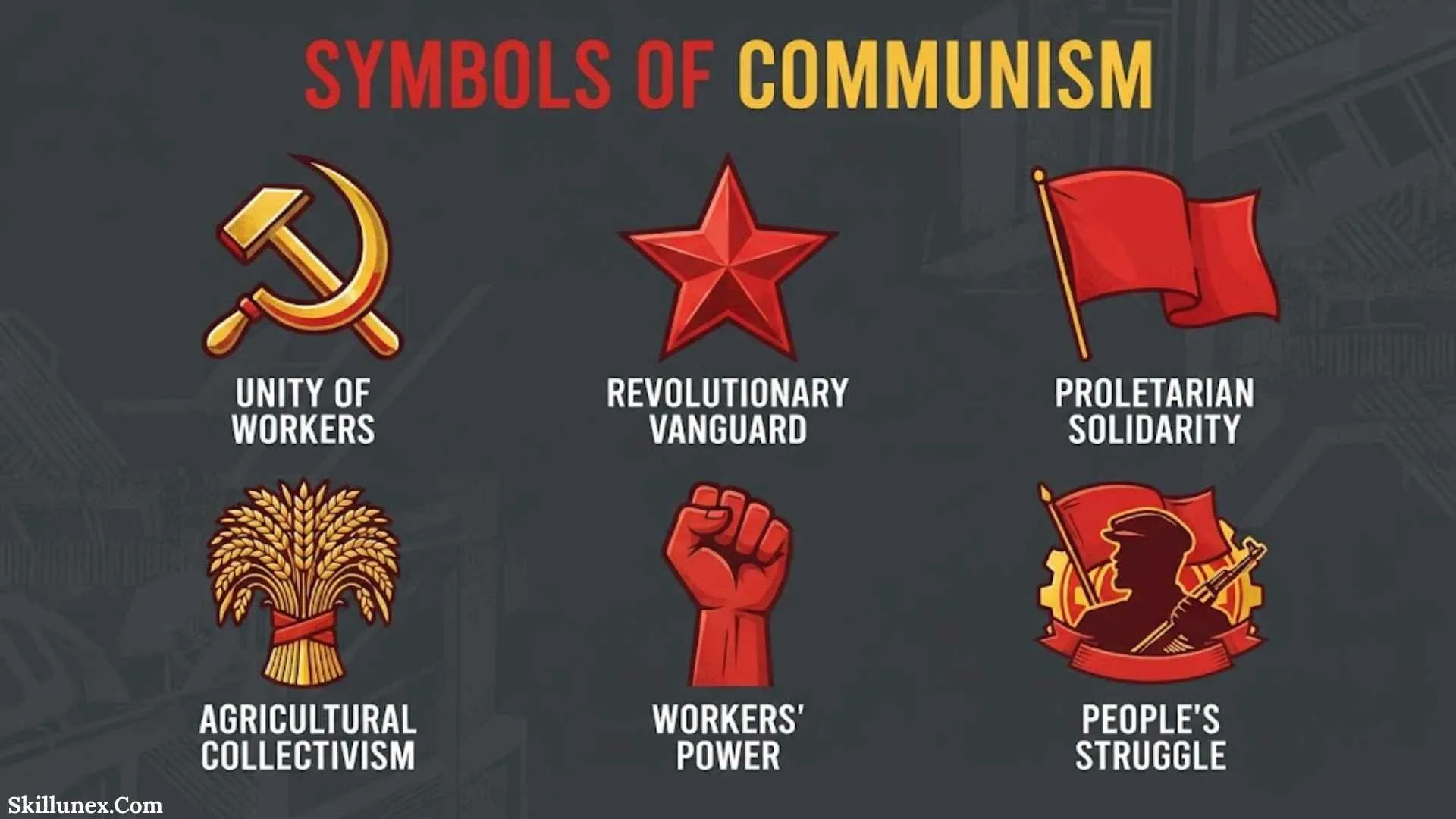
When you search for symbols of communism, you’ll find much more than the familiar hammer and sickle. Communist movements have used colors, stars, flags, tools, workers, farmers, wheat, factories, portraits, and other visual elements to communicate political ideas. Some symbols became closely connected with specific communist states, while others were shared with wider socialist, labor, or revolutionary movements.
I find the history of these symbols especially useful because the same image can mean different things depending on where, when, and by whom it was used. You may recognize a red star immediately, for example, but its exact meaning depends on the surrounding design and historical context.
This guide explains the major symbols of communism, what they represent, where they came from, and how they have been used in the Soviet Union, China, and other communist movements. You’ll also see why some symbols are specifically communist while others belong to broader socialist and workers’ traditions.
What Are the Main Symbols of Communism?
The most recognizable symbols associated with communism include the hammer and sickle, red star, red flag, red color, clenched fist, wheat, worker imagery, and industrial symbols.
These symbols did not all originate at the same time or have exactly the same meaning. Some were adopted by communist parties after the Russian Revolution, while others already had histories within labor and socialist movements.
Here are some of the most important examples:
| Symbol | Common historical association |
| Hammer and sickle | Workers and peasants |
| Red star | Revolutionary and communist identity |
| Red flag | Revolution and workers’ movements |
| Red color | Revolutionary and socialist traditions |
| Clenched fist | Solidarity, resistance, and collective action |
| Wheat | Agriculture, farming, and production |
| Factory imagery | Industrial workers and production |
| Workers | Labor and class identity |
| Peasants | Agricultural labor |
| Five-pointed star | Especially associated with Soviet and communist imagery |
| The Internationale | International socialist and communist movements |
You should remember that these meanings are contextual rather than universal. A red flag or clenched fist, for example, can appear in political movements that are not communist.
Why Are the Hammer and Sickle Together?

The combination communicated the idea that industrial workers and agricultural workers formed a united political force.
This meaning became especially important in Soviet political ideology. The symbol was not simply a picture of two tools; it was intended to represent a social and political relationship.
That is why you’ll often see the hammer and sickle placed prominently on communist flags, state emblems, monuments, posters, medals, and official documents.
Red Star
The red five-pointed star is another major symbol associated with communism.
It became especially prominent in Soviet history and was adopted as an emblem of the Red Army in 1918. It later appeared across Soviet military and political imagery.
The red star can represent:
- Revolution
- Communist political identity
- The Soviet state
- Military power
- International revolutionary movements
Red Star and the Soviet Union
The Soviet Union used the red star extensively.
You could see it on:
- Military uniforms
- Military vehicles
- Flags
- Medals
- Government buildings
- Monuments
- Political posters
- Official insignia
The star became so closely associated with Soviet identity that it remains recognizable even when the hammer and sickle are absent.
Is Every Red Star a Communist Symbol?
A five-pointed star is not automatically communist. Stars appear in national flags, military insignia, religious imagery, political logos, and many other contexts.
If you want to identify a communist symbol accurately, look at the complete design. A red star appearing with a hammer and sickle has a much stronger communist association than an ordinary five-pointed star appearing by itself.
Red Flag
The red flag has a long history within revolutionary, socialist, and workers’ movements.
It became particularly important to communist movements during the twentieth century, but its history is broader than communism itself.
The red flag can symbolize:
- Revolution
- Political struggle
- Workers’ movements
- Socialism
- Communist organizations
- Collective political action
Why Is Red Important?
Red became strongly associated with revolutionary movements and the political struggles of workers.
Communist parties and governments later made extensive use of the color. You can find red throughout communist political imagery, including:
- Flags
- Posters
- Banners
- Clothing
- Buildings
- Books
- Political publications
- Ceremonial decorations
However, you shouldn’t assume that every red political flag represents communism. Red has been used by many political movements throughout history.
Hammer, Sickle, and Red Star
When the hammer and sickle appear together with a red star, the communist association becomes particularly strong.
These elements were repeatedly combined in Soviet visual culture.
The hammer and sickle represented workers and peasants, while the red star became associated with the revolutionary and Soviet political identity.
You can find this combination in:
- Soviet state emblems
- Military insignia
- Political posters
- Monuments
- Medals
- Government decorations
- Historical photographs
This is one of the clearest examples of how communist symbolism worked as a system rather than as isolated images.
Soviet Coat of Arms Symbols
The State Emblem of the Soviet Union combined several symbols into a single political design.
It included the:
- Hammer and sickle
- Globe
- Red star
- Wheat
- Sun imagery
- Ribbons
- Text associated with the Soviet republics
Each component contributed to the larger message.
Wheat and Agriculture
Wheat represented agriculture and production.
Its inclusion complemented the sickle and reinforced the importance of farming and agricultural labor.
Globe and Internationalism
The globe communicated a broader international idea.
Communist ideology was not limited to one country, and Soviet political symbolism frequently emphasized the idea of international revolutionary solidarity.
Red Star
The red star placed above the emblem reinforced its communist and revolutionary identity.
Together, these elements created a visual representation of the Soviet political system.
Communist Symbols of Workers and Peasants
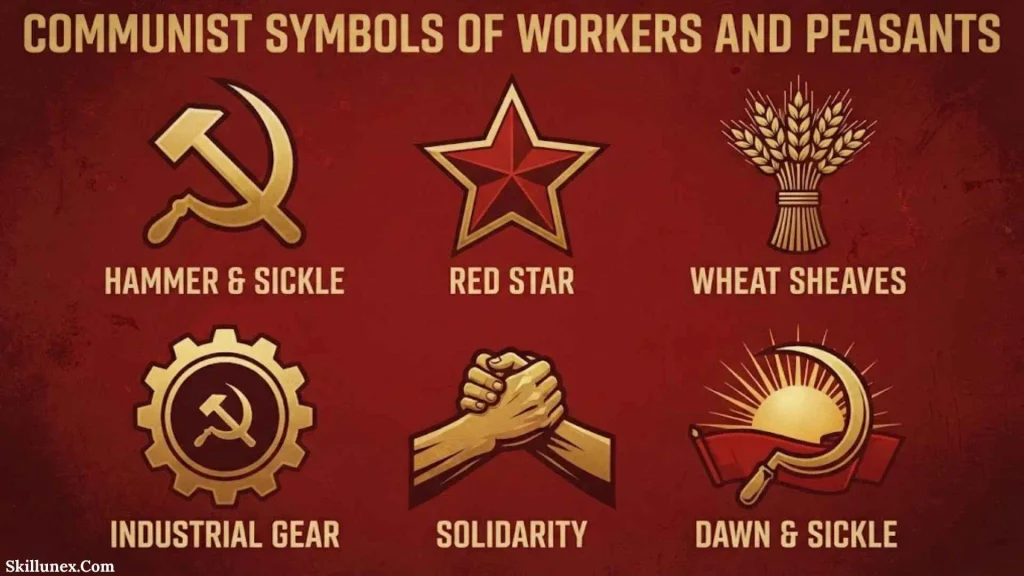
Workers and peasants are central to many forms of communist imagery.
The symbolism comes from the importance that communist theory placed on social class and economic production.
You’ll often find communist artwork showing:
- Factory workers
- Farmers
- Industrial machinery
- Fields
- Tractors
- Hammers
- Sickles
- Factories
- Agricultural harvests
These images were designed to emphasize labor, production, collective identity, and the relationship between industrial and agricultural workers.
Worker Symbolism
Workers were often shown as strong, productive, and organized.
Factories and machinery could represent industrial development, while workers could symbolize the broader working class.
Political posters frequently placed workers at the center of the composition to communicate their importance to the political system.
Peasant Symbolism
Peasants were commonly represented through agricultural tools, crops, fields, and farming activities.
The sickle became particularly effective because it could communicate the idea of agricultural labor through one simple object.
Clenched Fist
The clenched fist is sometimes included in lists of communist symbols, but its history is much broader.
You may find the clenched fist in imagery connected with:
- Communist organizations
- Socialist movements
- Labor unions
- Revolutionary groups
- Anti-fascist movements
- Protest movements
- Civil rights campaigns
- Political solidarity
The fist commonly communicates ideas such as strength, unity, resistance, and collective action.
Is the Clenched Fist Exclusively Communist?
No.
This distinction matters if you are researching symbols accurately.
A clenched fist can appear in communist imagery, but it isn’t an exclusive communist emblem in the way that the hammer and sickle is strongly associated with communist political traditions.
The surrounding colors, words, flags, and other symbols can help identify the specific political context.
Wheat and Agricultural Symbols
Wheat is another recurring element in communist and socialist state symbolism.
Wheat can represent:
- Agriculture
- Farmers
- Food production
- Harvest
- Rural labor
- Economic productivity
The imagery became particularly visible in state emblems and political artwork.
When wheat appears beside the hammer and sickle, its agricultural meaning becomes easier to understand.
However, wheat is not inherently communist. You’ll also find it in national emblems, agricultural organizations, food-related branding, and other forms of political imagery.
Factory and Industrial Symbols
Factories are another important element of communist visual culture.
Industrial buildings, smokestacks, machinery, and workers could symbolize:
- Industrial development
- Production
- Labor
- Economic modernization
- The working class
You might see these images in communist posters alongside portraits of political leaders or workers holding tools.
The factory therefore worked as a visual representation of the industrial economy and the role of workers within it.
Red Color in Communist Symbolism
If you look at communist flags, posters, and political artwork, you’ll notice one color repeatedly: red.
Red is one of the strongest visual associations with communist and socialist movements.
What Does Red Represent?
Depending on the historical context, red can communicate ideas associated with:
- Revolution
- Workers’ movements
- Political struggle
- Socialism
- Communist identity
- Collective action
Red became particularly prominent after revolutionary movements in Europe and later became central to Soviet and international communist imagery.
Is Red Exclusive to Communism?
No.
This is another important distinction.
Red is used by political parties across different ideologies, as well as by countries, military organizations, sports teams, companies, and cultural groups.
You need to examine the complete symbol before deciding what it represents.
Communist Flags and Their Symbols
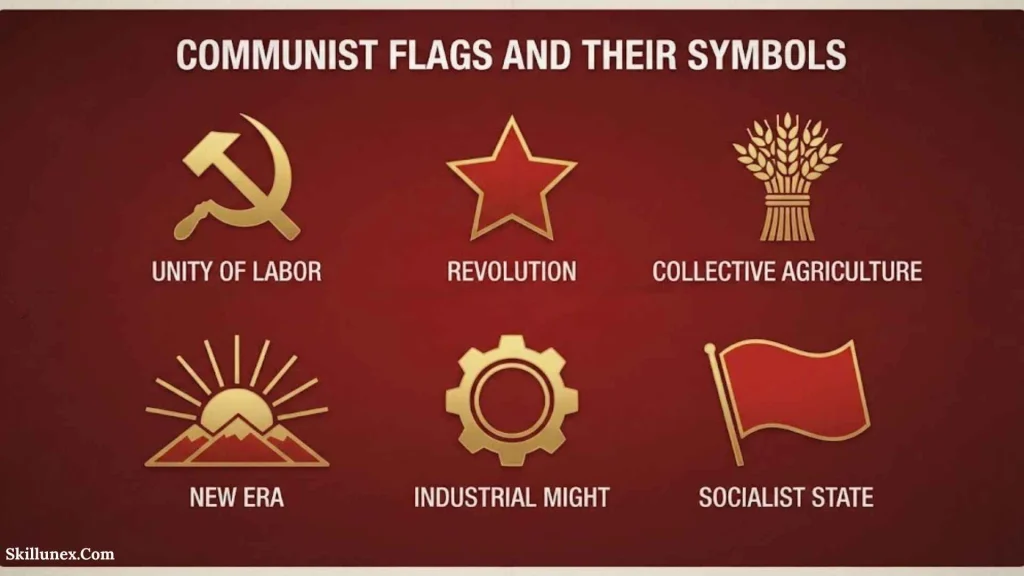
Communist flags vary considerably between countries and organizations.
The Soviet flag is one of the most recognizable examples because it combined a red field with the hammer and sickle and a red star.
Other communist states developed their own national flags and symbols.
Soviet Flag
The Soviet flag used:
- Red background
- Hammer and sickle
- Red star
The design became one of the most recognizable political flags of the twentieth century.
Chinese Communist Symbolism
China developed its own communist visual identity after the Chinese Communist Party established the People’s Republic of China in 1949.
Chinese communist imagery has included:
- Red color
- Stars
- Workers
- Peasants
- Agricultural imagery
- Revolutionary leaders
- Industrial imagery
The Chinese Communist Party’s visual culture was influenced by international communist traditions but also developed distinctly Chinese characteristics.
Other Communist States
Communist states and parties in countries such as Vietnam, Cuba, North Korea, and other regions developed their own combinations of communist and national imagery.
This is why it isn’t accurate to treat every communist flag as a variation of the Soviet flag.
Communist Symbols in Political Posters
Political posters played an important role in spreading communist symbolism.
Before digital media, posters were an effective way to communicate political messages to large audiences.
Artists could combine several recognizable elements in one image.
For example, a poster might show:
- A worker
- A farmer
- A factory
- A red flag
- A star
- Agricultural fields
- Political slogans
- A revolutionary leader
Each image added another layer to the message.
Why Were Posters So Effective?
The symbols were often simple enough to recognize quickly.
A person who couldn’t read a long political document could still recognize:
- A hammer
- A sickle
- A star
- A red flag
- A worker
- A factory
This made visual symbolism especially useful for political communication.
Communist Leaders as Political Symbols
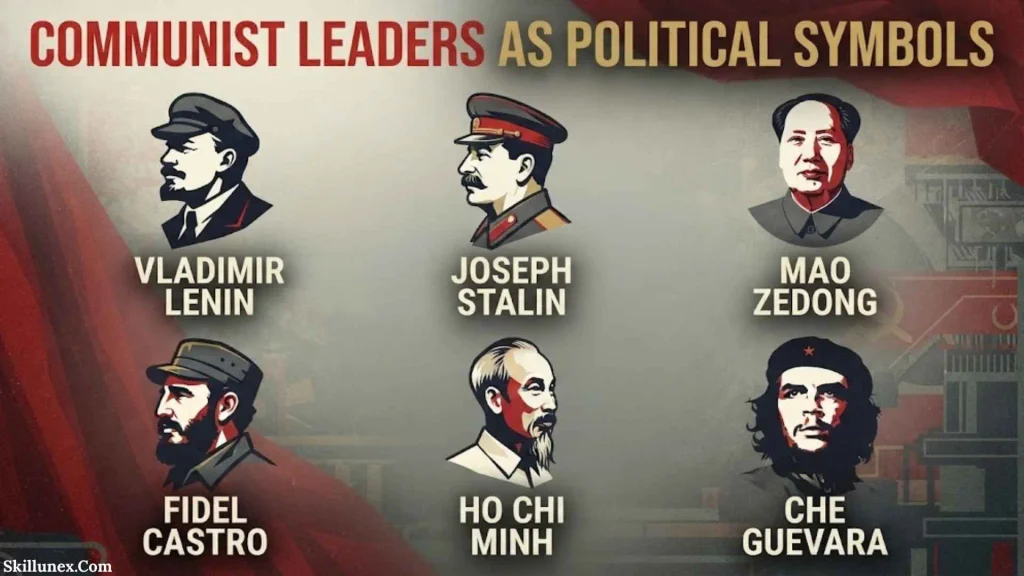
Portraits of communist leaders also became part of communist political culture.
Images of figures such as Vladimir Lenin, Joseph Stalin, and Mao Zedong appeared extensively in posters, books, public spaces, and political ceremonies during different historical periods.
These portraits served a different purpose from abstract symbols such as the hammer and sickle.
Instead of representing a social class or political idea, a leader’s portrait could represent:
- Revolutionary history
- Political leadership
- Party identity
- State authority
- Revolutionary legitimacy
The use of leader imagery varied significantly by country and period.
The Internationale as a Symbol of Communist Culture
The Internationale is not a visual symbol, but it is an important cultural symbol associated with socialist and communist movements.
The song originated within the European workers’ movement and became widely used by socialist and communist organizations.
It has been performed at:
- Political meetings
- Workers’ gatherings
- Demonstrations
- Party events
- Revolutionary ceremonies
- Historical commemorations
Its significance illustrates that political symbolism isn’t limited to visual objects. Songs, slogans, ceremonies, and colors can also become powerful political symbols.
Symbols of Communism vs. Symbols of Socialism
One of the easiest mistakes is to treat every socialist symbol as exclusively communist.
The two traditions overlap, but they are not identical.
Symbols Commonly Associated With Both
Some symbols have been used by both socialist and communist movements, including:
- Red flags
- Red color
- Clenched fists
- Workers
- Agricultural imagery
- Labor symbols
Symbols More Strongly Associated With Communism
The following have particularly strong communist associations:
- Hammer and sickle
- Soviet red star
- Soviet state emblems
- Communist state insignia
The historical context still matters. A symbol can be adopted, modified, or reinterpreted by different organizations.
Symbols of Communism Around the World
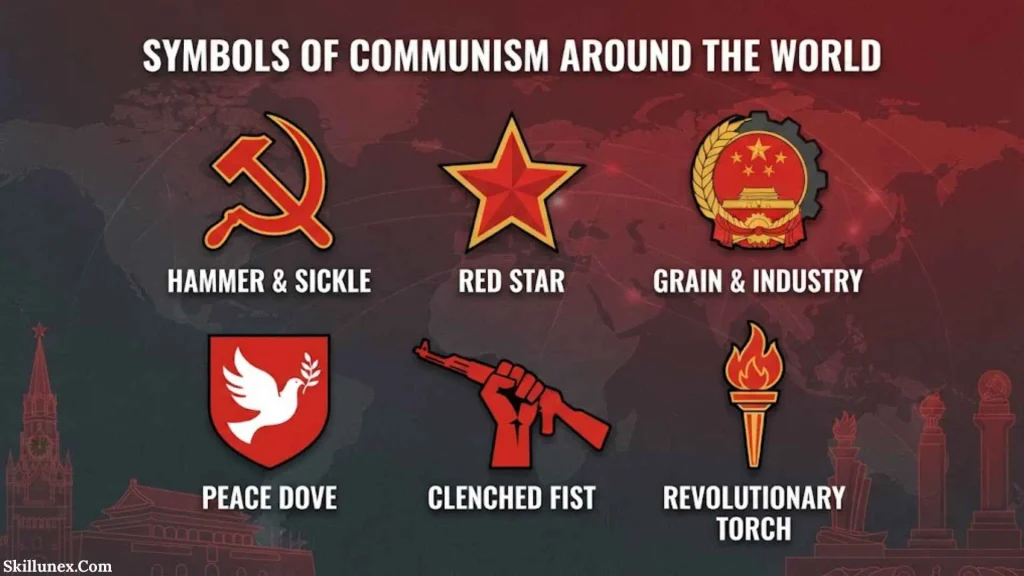
Communist symbolism spread internationally during the twentieth century.
Different countries adopted some elements while modifying others.
Soviet Union
The Soviet Union made the hammer and sickle, red star, and red color central elements of its state identity.
China
Chinese communist imagery combined international communist symbols with Chinese revolutionary and national themes.
Vietnam
Vietnamese communist symbolism uses the red flag and yellow star as central national and political imagery.
Cuba
Cuban revolutionary symbolism includes red elements and imagery associated with the country’s revolutionary history, although many Cuban symbols are specifically national rather than simply communist.
North Korea
North Korean state imagery developed its own visual tradition while retaining several elements associated with international communist and socialist symbolism.
These examples show that communist symbolism is international but not uniform.
How to Identify a Communist Symbol
If you find an unfamiliar symbol and want to know whether it represents communism, don’t rely on one feature.
Instead, examine the complete image.
Look at the Main Object
Ask what you see first.
Is it:
- A hammer?
- A sickle?
- A star?
- A flag?
- A fist?
- Wheat?
- A factory?
- A worker?
Look at the Color
Red can provide an important clue, but it isn’t enough by itself.
A red star combined with a hammer and sickle has a very different historical association from a red star appearing on a modern corporate logo.
Look for Multiple Symbols
Multiple symbols can provide stronger evidence.
For example:
Hammer + sickle + red star + red flag
creates a much clearer communist association than any one of these elements alone.
Check the Historical Context
Ask:
- Who created the symbol?
- Which organization used it?
- What country was involved?
- What year was it used?
- Was it an official emblem?
- Was it used by a political party or government?
Context can completely change the interpretation.
Common Symbols of Communism and Their Meanings
| Communist symbol | Meaning or association | Important context |
| Hammer | Industrial workers | Often appears with the sickle |
| Sickle | Agricultural workers and peasants | Represents farming and rural labor |
| Hammer and sickle | Worker-peasant unity | Strongly associated with communist movements |
| Red star | Communist and revolutionary identity | Especially associated with Soviet history |
| Red flag | Revolution and workers’ movements | Also used by broader socialist movements |
| Red color | Revolutionary and socialist traditions | Not exclusive to communism |
| Clenched fist | Unity and resistance | Used by many political movements |
| Wheat | Agriculture and production | Also used outside communist symbolism |
| Factory | Industry and labor | Common in political posters |
| Worker | Working-class identity | Often used in revolutionary art |
| Peasant | Agricultural labor | Closely connected with the sickle |
| The Internationale | Workers’ internationalism | Used by socialist and communist movements |
Why Communist Symbols Remain Recognizable
Many communist symbols remain recognizable because they were reproduced on an enormous scale during the twentieth century.
They appeared in:
- Government buildings
- Military uniforms
- Flags
- Political posters
- Textbooks
- Newspapers
- Monuments
- Medals
- Public ceremonies
- Political demonstrations
Repeated exposure made the imagery familiar across generations and countries.
The hammer and sickle, for example, became more than a political logo. It became a historical symbol associated with the Soviet Union, international communism, revolution, and twentieth-century political history.
Historical Meaning vs. Modern Interpretation
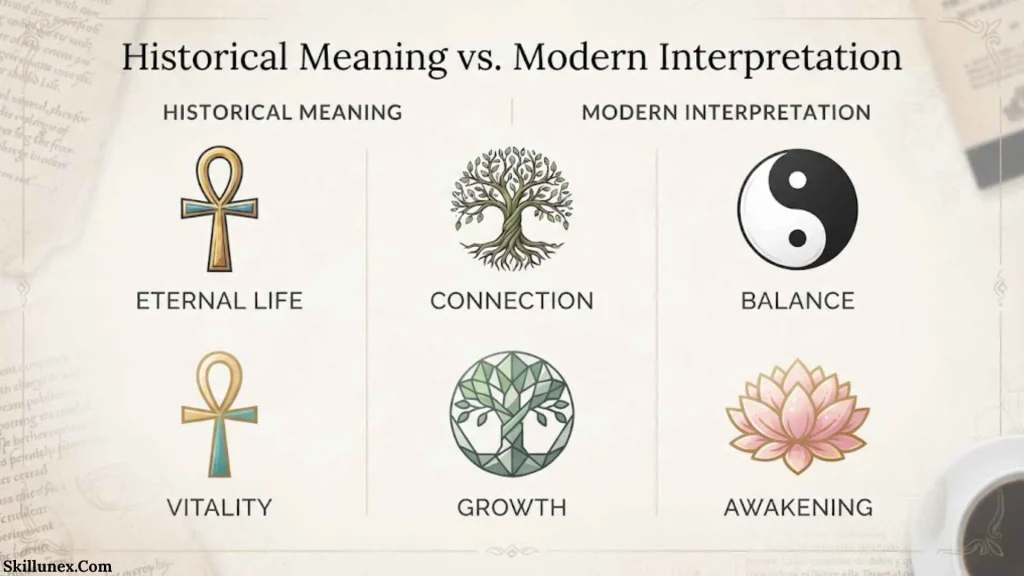
A symbol can have a historical meaning and a modern interpretation at the same time.
For example, someone studying the hammer and sickle may understand it historically as a representation of workers and peasants. Another person may associate it with the Soviet state or specific communist governments.
Neither interpretation should automatically be treated as the only possible context.
When you research symbols of communism, it helps to distinguish between:
- The original intended symbolism.
- How governments used the symbol.
- How political opponents interpreted it.
- How historians describe it today.
- How modern groups use or reinterpret it.
This distinction makes historical research much more accurate.
Frequently Asked Questions
What is the most famous symbol of communism?
The hammer and sickle is generally the most recognizable symbol associated with communism. It represents the historical idea of unity between industrial workers and agricultural workers.
What do the hammer and sickle mean?
The hammer traditionally represents industrial workers, while the sickle represents peasants and agricultural workers. Together, they symbolize the worker-peasant alliance.
What does the red star symbolize?
The red five-pointed star became strongly associated with Soviet and communist political identity. It was adopted as an emblem of the Red Army in 1918 and later appeared throughout Soviet imagery.
Why is red associated with communism?
Red became associated with revolutionary and workers’ movements and was later extensively adopted by communist parties and governments for flags, posters, banners, and official symbols.
Is the red flag a communist symbol?
The red flag is strongly associated with communist and socialist movements, but it is not exclusively communist. Its history extends to broader revolutionary and labor movements.
Is the clenched fist a communist symbol?
The clenched fist has been used by communist organizations, but it is not exclusively communist. Socialist, labor, revolutionary, anti-fascist, civil rights, and other movements have also used it.
Is a red star always a communist symbol?
No. Stars have many meanings. A red five-pointed star has a strong historical association with Soviet and communist symbolism, but a star by itself does not prove that an image is communist.
What does the sickle represent in communist symbolism?
The sickle represents agricultural labor and peasants. It is especially significant when paired with the hammer, which represents industrial workers.
What does the hammer represent in communism?
The hammer traditionally represents industrial workers and manual labor. It became internationally recognizable through its use with the sickle.
Are communist symbols still used today?
Yes. Communist symbols continue to appear in historical research, museums, political organizations, demonstrations, artwork, flags, and cultural references. Their use and legal status vary between countries.
Conclusion
The symbols of communism form a broad visual and cultural tradition that developed through revolutionary movements, labor politics, communist parties, and communist states. The hammer and sickle remains the best known example, representing the historical connection between industrial workers and agricultural workers.
The red star, red flag, red color, wheat, factories, workers, peasants, and clenched fist add other layers to communist and socialist imagery. However, not every one of these symbols is exclusively communist. You need to consider the complete design and historical setting before assigning a specific meaning.
I think the most useful way to understand communist symbolism is to look at context rather than isolated shapes.When you see a hammer and sickle alongside a red star and red flag, the historical connection is much clearer. When you see only a red flag or clenched fist, you need additional evidence.
By studying the history behind each symbol, you can better understand how communist movements communicated ideas about labor, revolution, agriculture, political solidarity, internationalism, and social organization through simple and recognizable visual elements.

I’m Adrian Holloway, a writer and researcher who enjoys exploring the stories, meanings, and interesting facts behind the subjects people search for every day. I’m especially interested in symbols, nature, lakes, places, and cultural topics that help readers understand the world from a different perspective.
I believe useful content should be simple, accurate, and enjoyable to read. When I research a topic, I focus on finding meaningful details and presenting them in a way that makes information easy to understand.
My goal is to create helpful articles that answer real questions while encouraging readers to discover something new with every visit.
Books by Adrian Holloway
The Language of Symbols: Meanings, Stories & Traditions
Hidden Wonders of Nature: Lakes, Landscapes & Discovery