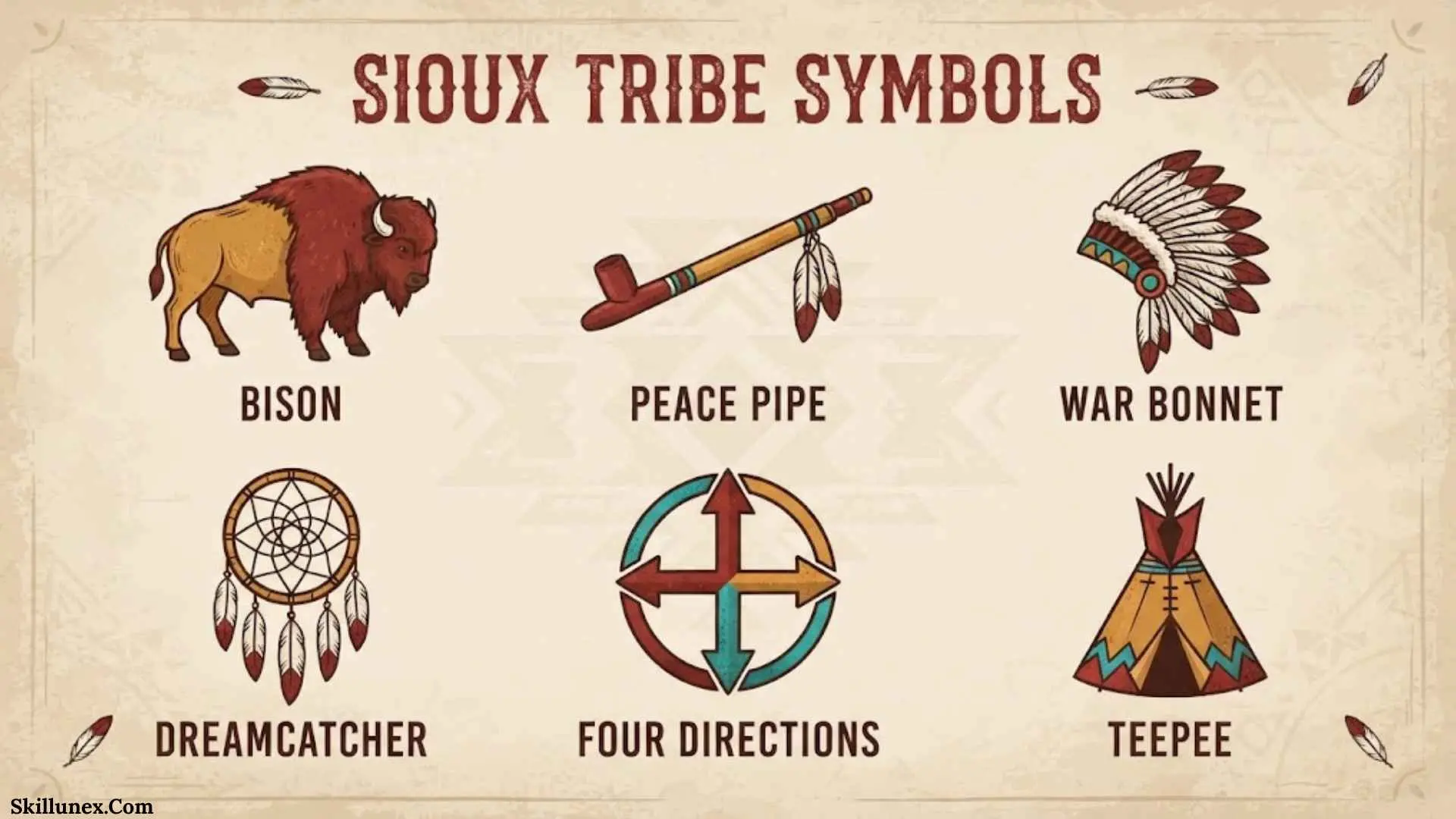
When you first look at Sioux tribe symbols, you may notice beautiful animals, geometric patterns, feathers, beadwork, and other traditional designs. But if you want to understand what these images really represent, you need to look beyond their appearance. I find that the most interesting part of these symbols is the connection they can have with nature, history, community, spirituality, and the everyday lives of Indigenous peoples.
You may have seen a buffalo, eagle, horse, bear, or geometric pattern described online as a “Sioux symbol” with one simple meaning. The reality is more complex. The term Sioux is commonly used to refer broadly to Lakota, Dakota, and Nakota peoples, and these communities have their own histories and cultural traditions. So, when you explore a particular design, you should consider where it comes from, who used it, and what the design meant in that specific context.
In this article, I’ll take you through the most commonly discussed Sioux tribe symbols and explain their cultural associations in a clear and respectful way. You’ll learn about buffalo and eagle imagery, geometric designs, beadwork, quillwork, tipi decorations, spiritual traditions, and modern uses. I’ll also show you why you should be careful with websites that claim every symbol has one fixed or secret meaning.
What Are Sioux Tribe Symbols?
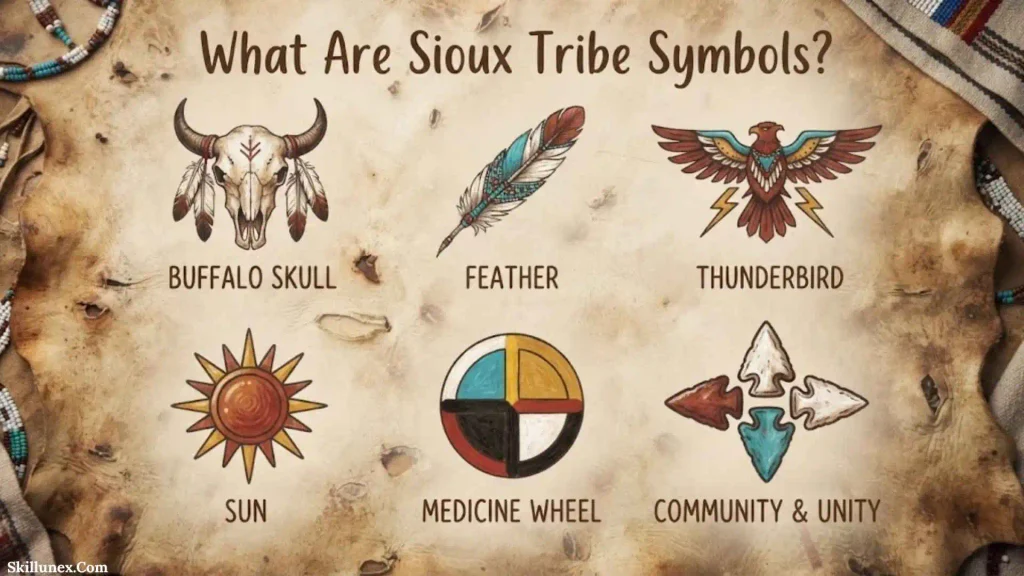
Sioux tribe symbols are visual designs, images, motifs, and artistic elements associated with the traditions of peoples historically grouped under the term Sioux. These include Lakota, Dakota, and Nakota communities.
You can find related designs in many forms of Indigenous art, including clothing, moccasins, bags, beadwork, quillwork, painted objects, tipis, and contemporary artwork. Some imagery comes from animals and the natural world, while other designs are geometric or connected with particular cultural traditions.
When I look at these designs, I think it is important not to treat them like a modern emoji dictionary where one picture always equals one meaning. The same type of image can have different significance depending on the community, artist, object, and situation.
Why Symbol Meanings Can Differ
You may find websites claiming that a particular Sioux symbol “always means” protection, strength, freedom, or good luck. You should be cautious with these claims.
A symbol’s meaning can depend on:
- The specific Indigenous community
- The artist or maker
- The object on which it appears
- The historical period
- The cultural or ceremonial context
- The story or tradition connected with it
This is why I prefer to describe these meanings as cultural associations rather than fixed translations.
Sioux, Lakota, Dakota, and Nakota: Understanding the Terms
Before you explore Sioux tribe symbols, it helps to understand the terminology.
“Sioux” is a broad historical term associated with Lakota, Dakota, and Nakota peoples. These groups are closely related, but they are not simply three names for exactly the same community.
If you are researching a specific symbol, identifying the particular community can make your research much more accurate.
Lakota Symbols
Lakota communities have rich traditions involving beadwork, quillwork, clothing, storytelling, painted objects, and other forms of cultural expression.
If you see a design specifically identified as Lakota, you should avoid automatically calling it a universal Sioux symbol. The more specific the source, the better you can understand the design.
Dakota Symbols
Dakota peoples also have their own cultural and artistic traditions. Although Dakota and Lakota traditions share historical and linguistic relationships, you should not assume that every Dakota design has exactly the same meaning as a Lakota design.
Nakota Symbols
Nakota peoples are another group historically included within the broader Sioux designation. Like Lakota and Dakota communities, Nakota people have their own histories and cultural traditions.
For this reason, I recommend using “Sioux tribe symbols” as a broad search term while being as specific as possible when discussing an individual design.
Buffalo Symbol
The buffalo, or American bison, is one of the most important animals associated with Plains Indigenous cultures.
For Lakota people, the buffalo has deep connections with food, survival, community, spirituality, and relationships with the natural world. The animal historically provided many essential resources, so its importance went far beyond simply being a beautiful creature.
If you see buffalo imagery in a Lakota cultural context, you may encounter associations with abundance, generosity, nourishment, strength, and respect for life.
White Buffalo Calf Woman
One particularly important Lakota tradition is the story of White Buffalo Calf Woman, known as Ptesan Wi. The National Park Service describes this as a sacred Lakota story connected with the sacred pipe and prayer traditions.
This is a good example of why I would not reduce buffalo symbolism to a simple phrase such as “buffalo means strength.” You get a much deeper understanding when you learn about the stories and relationships surrounding the image.
Eagle Symbol
The eagle is another powerful image frequently discussed in relation to Indigenous cultures, including Lakota traditions.
Eagles and eagle feathers can have important spiritual and cultural significance. Because of this, you should not think of an eagle feather as simply a decorative Native American accessory.
What Does the Eagle Represent?
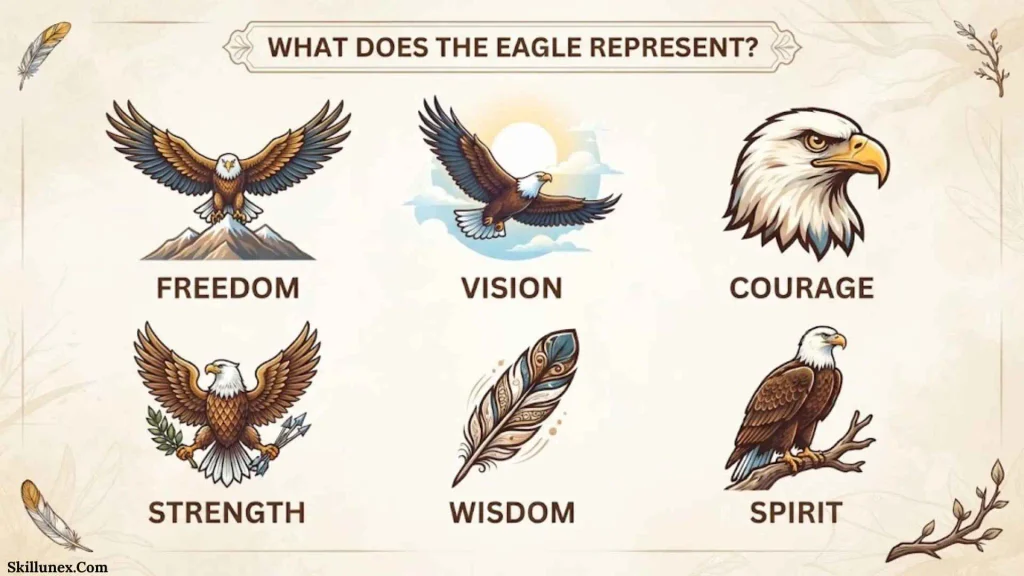
Depending on the context, eagle imagery can be associated with spirituality, prayer, honor, strength, and relationships between humans and the spiritual world.
If you are researching an eagle symbol, I recommend looking at the specific cultural source rather than relying on a generic website that assigns one meaning to every eagle image.
Horse Symbol
Horses became extremely important to Plains peoples after their introduction to North America. They transformed transportation, hunting, travel, trade, and other aspects of life.
Because of this history, horse imagery can be connected with movement, travel, strength, mobility, and Plains life.
You may see horse designs in artwork that represents freedom or movement, but I would not assume that every horse image has one universal symbolic meaning. The story behind the artwork matters.
Bear Symbol
The bear appears in the stories and artistic traditions of many Indigenous peoples.
Bear imagery can be associated with qualities such as strength, courage, protection, and power. However, these ideas are not exclusively Sioux meanings.
If you find a bear design described as a Sioux symbol, look for information about its particular Lakota, Dakota, or Nakota context. This helps you separate documented cultural traditions from generalized “Native American symbol” lists.
Thunderbird Symbol
The Thunderbird is a powerful supernatural figure found in the traditional stories of several Indigenous nations.
You may see Thunderbird designs described online as Native American symbols of power, storms, or protection. However, Thunderbird traditions vary considerably between Indigenous cultures.
That means you should not automatically assume that a Thunderbird image has one universal Sioux meaning.
Sun and Celestial Symbols
The sun, stars, moon, and other celestial elements can appear in Indigenous art and cultural traditions.
You may be tempted to assign a simple meaning such as “the sun represents life,” but that can oversimplify the actual tradition behind a particular design.
When I research a celestial symbol, I look at the community, artwork, object, and historical context before deciding how its meaning should be described.
Star Designs
Stars can appear as decorative or meaningful elements in artwork. Their significance may depend on the specific design and cultural context.
A star-shaped pattern alone does not provide enough information to determine its exact meaning.
Geometric Sioux Symbols
Geometric patterns are an important part of Plains Indigenous art, particularly beadwork and decorative work.
You may see diamonds, triangles, lines, repeated shapes, and symmetrical patterns arranged into highly detailed designs.
Diamond Patterns
Diamond shapes are common in many forms of Indigenous beadwork.
They can contribute to symmetry, repetition, balance, and visual rhythm. A particular design may also have cultural or personal significance, but you should not assume that every diamond pattern represents exactly the same idea.
Repeated Geometric Patterns
Repeated shapes can make an artwork visually striking while also demonstrating the skill of the artist.
If you find a website claiming that every triangle or line has a secret spiritual meaning, I recommend checking the claim against museum records or Indigenous cultural sources.
Sioux Beadwork Symbols
Beadwork is one of the most recognizable forms of Plains Indigenous art.
Lakota artists have created intricate beadwork for moccasins, clothing, bags, accessories, and other objects. The patterns can demonstrate remarkable patience, precision, creativity, and artistic skill.
When you look closely at traditional beadwork, you can see that it is much more than decoration. The object, materials, colors, patterns, and circumstances in which it was made can all contribute to its cultural importance.
Does Every Beadwork Pattern Have a Meaning?
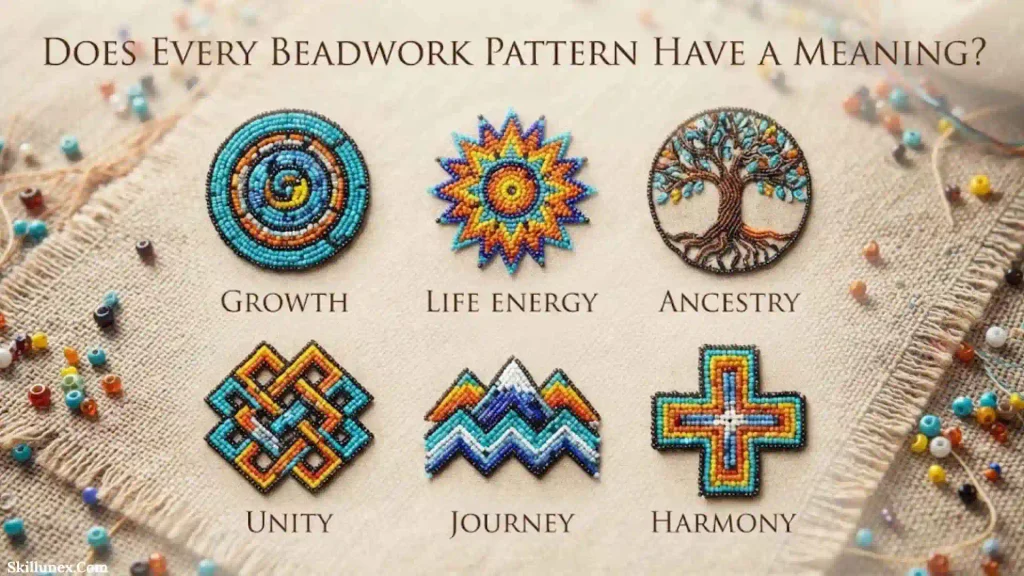
This is an important point to remember. Not every geometric arrangement should be translated into a specific symbolic definition.
Some designs may have particular cultural or personal associations, while others may primarily serve an artistic purpose.
If you want to know what a specific beadwork pattern means, you need information about the actual object and the community connected with it.
Sioux Quillwork
Before glass beadwork became widespread, porcupine quills were an important material used in Plains Indigenous decorative traditions.
Quillwork could be applied to clothing, moccasins, bags, and other objects.
Why Quillwork Matters
Quillwork demonstrates the creativity and technical knowledge of Indigenous artists.
When you see an old quilled object in a museum, you are not simply looking at a pattern. You are looking at evidence of artistic traditions, material knowledge, and cultural history passed between generations.
Sioux Tipi Symbols and Designs
Tipis are strongly associated with Plains Indigenous cultures, including Lakota communities.
Some historical tipis and tipi-related objects feature painted designs, beadwork, or quillwork. These decorations could be associated with particular people, families, experiences, stories, or traditions.
Did Every Tipi Have the Same Symbols?
No.
You should not assume that every decorated tipi used the same set of symbols or that every design had a universal meaning.
This is another reason why context matters. If you are studying a specific tipi design, try to find information about the community, owner, artist, date, and purpose of the object.
Sioux Symbols in Traditional Clothing
Clothing can provide another fascinating way to understand Indigenous artistic traditions.
Historical Lakota clothing may include beadwork, quillwork, paint, hide, and other materials. These decorative techniques required skill and could contribute to identity and cultural expression.
When you look at traditional clothing, I recommend paying attention to the entire object rather than isolating one shape and assigning it a meaning without evidence.
Sioux Symbols and Nature
Nature plays an important role in many discussions of Plains Indigenous culture.
Animals, plants, the sky, weather, land, and seasonal cycles can all appear in stories and artistic traditions. The buffalo, for example, was deeply connected with the lives of Plains peoples.
You can understand Sioux symbolism more clearly when you recognize that these animals were not merely decorative subjects. They were part of real relationships involving food, clothing, travel, survival, storytelling, spirituality, and community.
Sioux Symbols and Spiritual Meaning
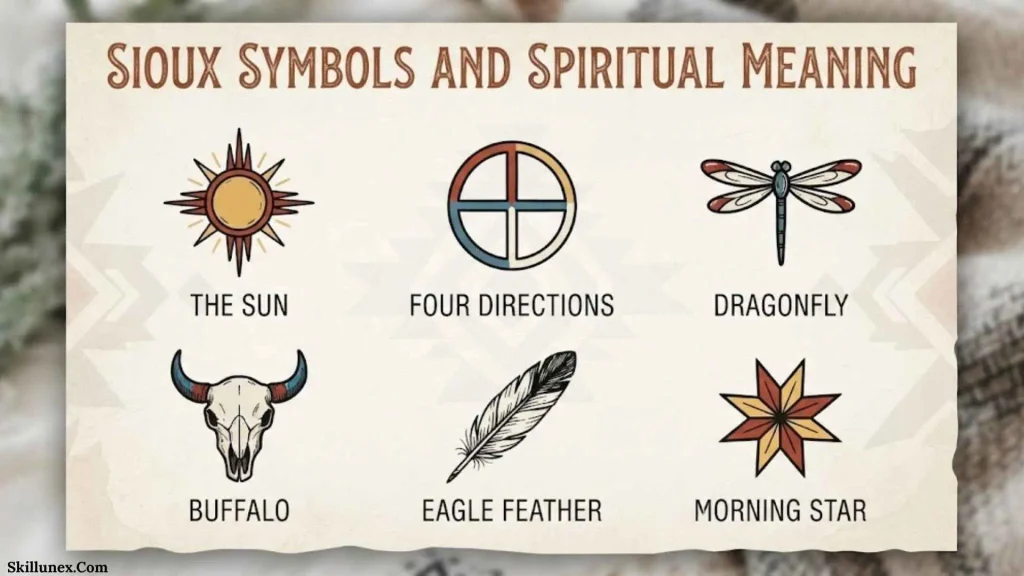
Some Sioux and Lakota cultural traditions have deep spiritual significance.
However, not every traditional design is necessarily a sacred symbol. This distinction is important because online articles sometimes describe almost every Native American design as spiritual.
Sacred and Decorative Are Not the Same
If you are interested in using a Sioux-inspired design for artwork, jewelry, clothing, or a tattoo, you should first find out whether the imagery has a specific ceremonial or spiritual significance.
I believe this is one of the most respectful ways to approach Indigenous symbolism: appreciate the art while also learning about the people and traditions connected with it.
Sioux Symbols for Tattoos
You may be searching for Sioux tribe symbols because you want a tattoo representing strength, nature, spirituality, or Indigenous-inspired artwork.
Before choosing a design, take some time to research its origin.
What Should You Check Before Getting a Tattoo?
Ask yourself:
- Is this actually a documented Sioux, Lakota, Dakota, or Nakota design?
- Where did the claimed meaning come from?
- Is the image connected with a sacred or ceremonial tradition?
- Is the design being presented accurately?
- Am I treating culturally important imagery as simple decoration?
- Can I learn more from Native artists or cultural institutions?
You do not need to rush into choosing a design simply because a website says it means “strength” or “protection.”
Sioux Symbols in Jewelry and Artwork
Sioux-inspired patterns can appear on jewelry, clothing, prints, decorations, and other products.
If you want to purchase Native artwork, I encourage you to learn about the artist whenever possible. Knowing who created the work and what community they are connected with gives you a much better understanding of the piece.
It also helps you appreciate Native art as a living tradition rather than something that only belongs to history.
Common Misconceptions About Sioux Tribe Symbols
Every Sioux Symbol Has One Meaning
This is probably the biggest misconception you will encounter.
A design can have different meanings depending on its community, context, object, and history.
All Native American Symbols Are Sioux Symbols
They are not.
There are many distinct Indigenous nations across North America, each with its own cultural traditions and artistic practices.
A symbol from one Indigenous nation should not automatically be labeled Sioux.
Every Geometric Shape Is a Spiritual Symbol
Geometric patterns can be artistic, decorative, cultural, personal, or symbolic.
You cannot determine their exact meaning simply by looking at a triangle, diamond, circle, or repeated pattern.
Sioux Culture Is Only Historical
Lakota, Dakota, and Nakota communities are living communities.
If you want to understand Sioux tribe symbols, you should consider both historical objects and contemporary Native art. Indigenous artists continue to create, adapt, and express their cultures today.
How to Research a Sioux Symbol Correctly
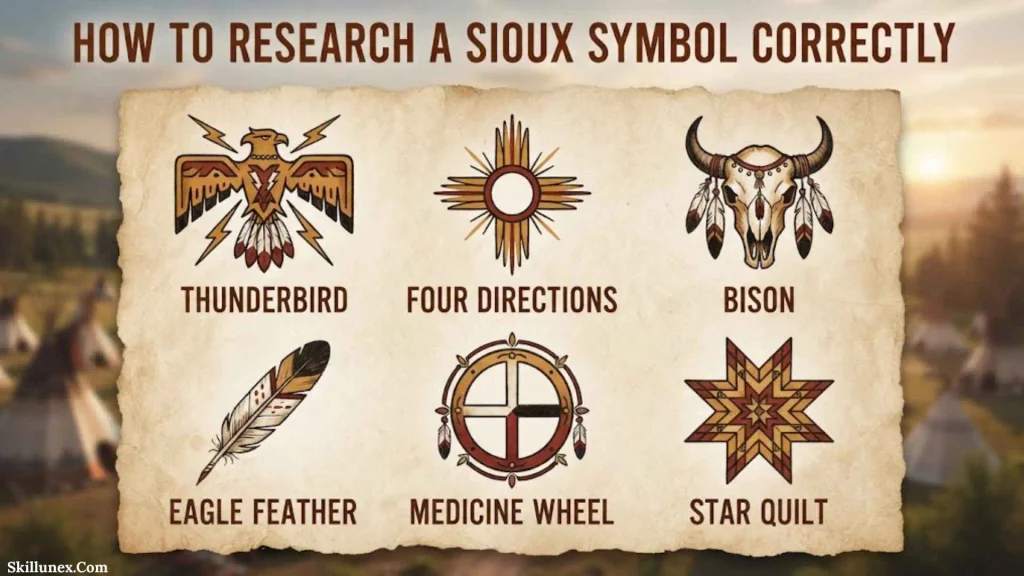
If you find a symbol online and want to understand it, you can use a few simple steps.
Identify the Community
First, try to determine whether the design is Lakota, Dakota, Nakota, or associated with another Indigenous nation.
Identify the Object
Next, look at what the design appears on. Is it beadwork, clothing, a tipi, bag, moccasin, painting, jewelry, or another object?
The object can provide valuable context.
Look for Reliable Sources
Museum collections, cultural institutions, tribal sources, and publications by Indigenous scholars and artists can provide stronger information than generic symbol websites.
Question Unsupported Claims
Be cautious when a website says:
“This symbol always means protection.”
“This ancient Sioux symbol means wealth.”
“This Native American shape represents love.”
Claims like these require evidence. If no community, historical source, artist, or cultural authority is identified, you should not automatically accept the interpretation.
Why Cultural Context Matters
If you only memorize a list of symbol meanings, you may miss the most important part of the subject.
A buffalo is connected to much more than the word “strength.” An eagle feather can carry significance beyond the word “freedom.” Beadwork can represent much more than a collection of geometric shapes.
When you understand the people, stories, objects, and traditions behind the imagery, you can appreciate Sioux and Plains Indigenous art in a much more meaningful way.
Frequently Asked Questions About Sioux Tribe Symbols
What are the most common Sioux tribe symbols?
Commonly discussed imagery includes buffalo, eagle, horse, bear, celestial elements, geometric patterns, beadwork, quillwork, and painted designs. However, there is no single official list representing every Lakota, Dakota, and Nakota community.
What does the buffalo symbolize in Sioux culture?
Buffalo imagery can be associated with nourishment, abundance, generosity, strength, spirituality, and relationships with the natural world. In Lakota tradition, the buffalo also has important connections to the sacred story of White Buffalo Calf Woman.
What does the eagle symbolize in Lakota culture?
Eagle imagery and eagle feathers can have important spiritual and cultural associations. Their significance depends on the specific cultural context and should not be reduced to a generic symbol of freedom.
What does a Sioux horse symbol mean?
Horse imagery may be associated with movement, mobility, travel, strength, and Plains history. The exact meaning depends on the artwork and cultural context.
What do Sioux geometric symbols mean?
Geometric patterns can be used in beadwork, quillwork, clothing, and other artistic traditions. Not every geometric shape has a single fixed symbolic meaning.
What do Sioux beadwork patterns represent?
Beadwork can express artistic skill, identity, cultural continuity, and personal or community traditions. Some patterns may have specific associations, while others are primarily part of the overall artistic design.
Are Sioux and Lakota symbols the same?
Not necessarily. Sioux is a broad historical term associated with Lakota, Dakota, and Nakota peoples. Lakota symbols specifically relate to Lakota cultural traditions.
Are Sioux symbols still used today?
Yes. Lakota, Dakota, and Nakota people are living communities, and Native artists continue to create contemporary artwork while maintaining and developing cultural traditions.
Can you use Sioux symbols for tattoos?
You can research Indigenous-inspired artwork, but you should first understand the origin and significance of the design. Some imagery may have cultural, spiritual, or ceremonial importance and should not be treated as generic decoration.
Are all Native American symbols Sioux symbols?
No. Indigenous nations have different cultures, histories, languages, and artistic traditions. You should identify the specific nation connected with a design whenever possible.
Conclusion
Sioux tribe symbols become much easier to understand when you stop looking at them as a simple collection of pictures and start looking at the cultural traditions behind them. Buffalo, eagle, horse, bear, geometric patterns, beadwork, quillwork, and tipi designs can all tell you something about Plains Indigenous history and artistic expression. But their meanings are not always fixed, and I think that is an important point to remember whenever you research this subject.
If you are exploring a Sioux symbol for a tattoo, artwork, school project, jewelry design, or simply out of curiosity, take time to identify its specific cultural origin. You can learn much more when you ask who created the design, where it was used, and what tradition it belongs to. By doing this, you not only get more accurate information you also develop a deeper respect for the living Lakota, Dakota, and Nakota cultures connected with these traditions.

Caleb Thornton
I’m Caleb Thornton, a researcher and content writer who loves exploring fascinating subjects and sharing what I learn with readers. My interests include natural places, lakes, symbols, culture, history, and the stories that make ordinary topics more meaningful.
When I write an article, I try to go beyond a basic answer. I look for useful facts, relevant context, and details that can help readers understand the subject more completely.
My purpose is simple: I want every article I contribute to provide genuine value, satisfy the reader’s curiosity, and make discovering new information enjoyable.
## Books by Caleb Thornton
* Symbols & Meanings: Exploring the Signs We See Every Day
* Lakes of the World: Nature, Beauty & Exploration