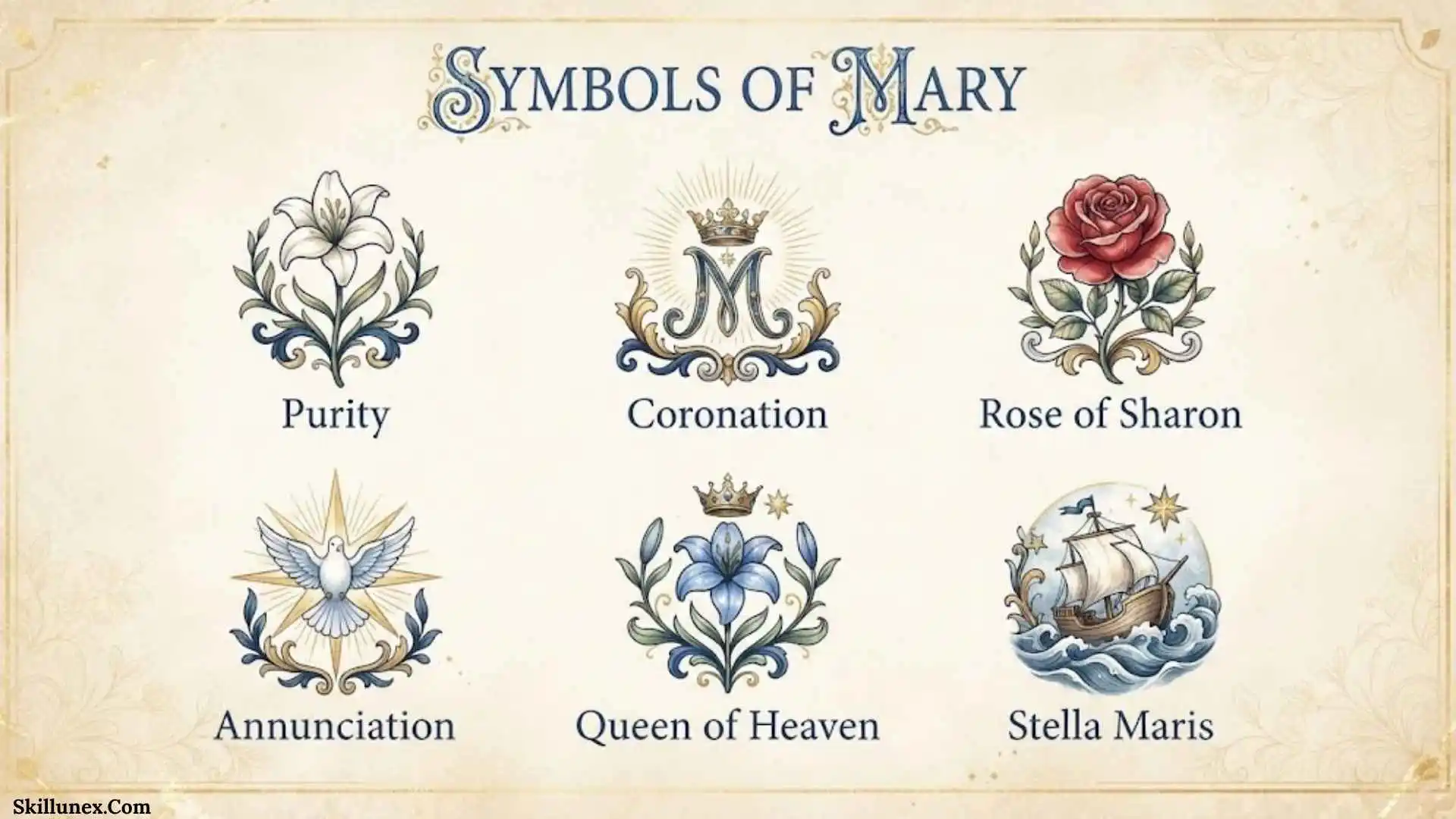
When you first look at a painting or statue of Mary, you may notice a blue mantle, a white lily, a crown, stars, or even a sword. But have you ever wondered why these particular objects appear around her? I want to help you understand the symbols of Mary so that when you see them in Christian artwork, you can recognize the deeper meaning behind them.
As you explore Marian symbolism, you will discover that these images tell different parts of Mary’s story. Some represent purity and love, while others point to sorrow, protection, queenship, or heavenly glory. In this guide, I’ll walk you through the most important symbols of Mary, explain what they traditionally mean, and show you how you can identify them in paintings, statues, churches, medals, and devotional artwork.
What Are The Symbols Of Mary?
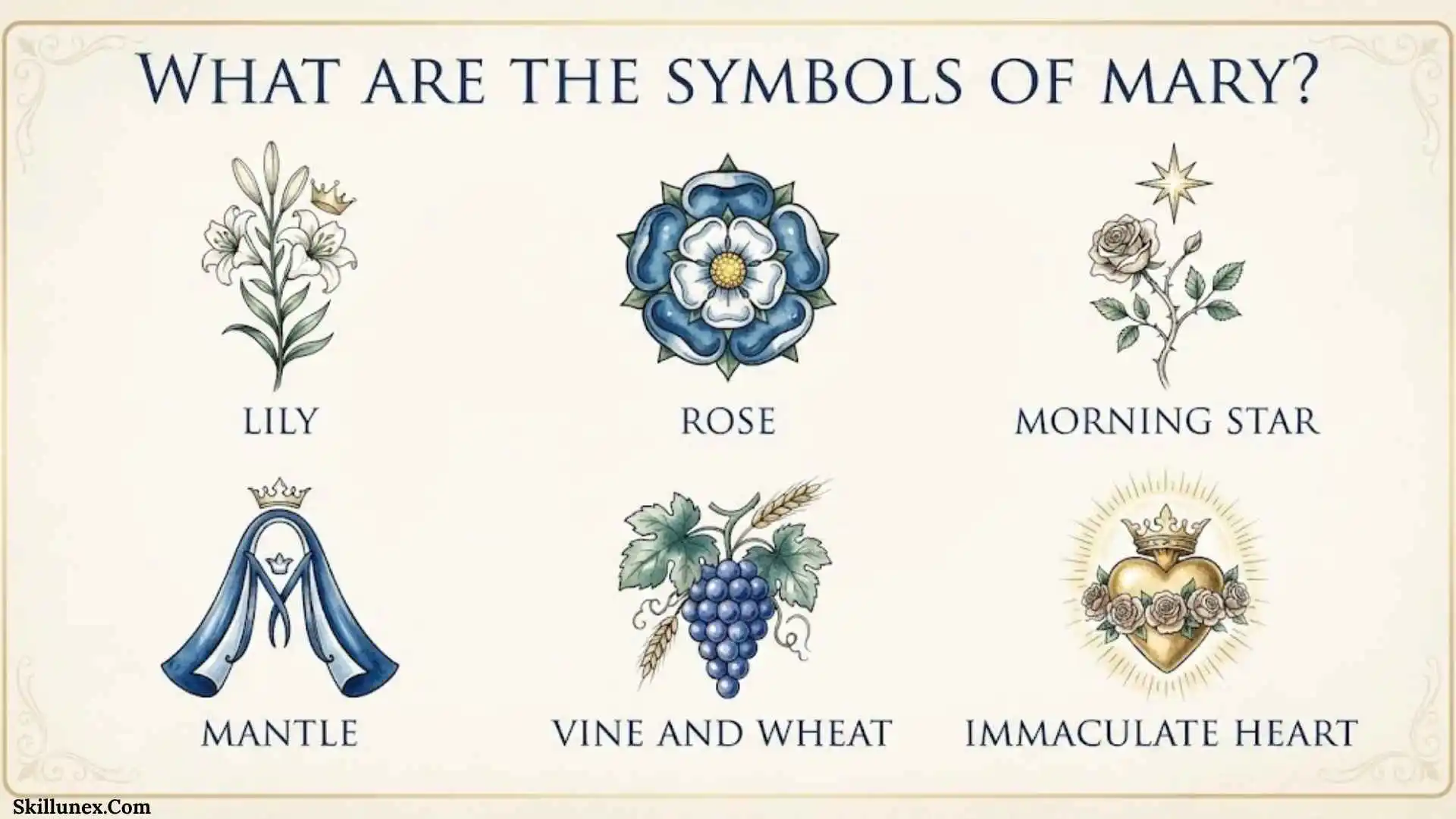
When you search for the symbols of Mary, you will find many different objects, flowers, colors, and images associated with the Virgin Mary. There is not one universal list because Marian symbolism developed across different centuries, cultures, Christian traditions, and forms of art.
The symbols you are most likely to encounter include:
- Lily — purity and virginity
- Rose — love, beauty, charity, and devotion
- Star — hope, guidance, and the Star of the Sea
- Twelve stars — biblical and heavenly imagery
- Crown — queenship and heavenly glory
- Heart — Mary’s love and devotion
- Sword — sorrow and suffering
- Blue mantle — Mary’s traditional visual identity
- White clothing — purity and holiness
- Crescent moon — traditional Immaculate Conception imagery
- Enclosed garden — virginity and purity
- Fountain — spiritual life and traditional Marian imagery
- Tower — strength and protection
- Mirror — purity
- Palm tree — biblical and traditional Marian imagery
- Serpent — traditional imagery connected with victory over evil
- Rosary — Marian prayer and devotion
If you are looking at an unfamiliar image of Mary, these details can give you useful clues about what the artist wanted you to notice.
Why Does Mary Have So Many Symbols?
You might wonder why Mary needs so many different symbols instead of just one recognizable image. The reason is that each symbol allows an artist to communicate a different quality or aspect of Marian tradition.
For example, when I see a lily beside Mary, I can understand that the artist may be emphasizing purity. If I see a crown, I can recognize imagery associated with Mary’s queenship. A pierced heart, on the other hand, points toward love and sorrow.
Many Marian symbols developed from Scripture, Christian interpretation, devotional traditions, and centuries of religious artwork. Some are connected with biblical passages, while others became established through later Christian tradition.
So, when you interpret a Marian painting, I recommend that you look at the whole composition rather than assuming that every object has only one fixed meaning.
Flowers That Symbolize Mary
Flowers are among the easiest Marian symbols for you to recognize. Christian artists have used flowers to express purity, beauty, love, virginity, and devotion.
The Lily
The white lily is probably the flower you will most often associate with Mary.
Traditionally, the lily represents purity, virginity, innocence, and holiness. You will often see it in paintings of the Annunciation, when the angel Gabriel announces to Mary that she will become the mother of Jesus.
If you see Mary standing beside a tall white lily, you can usually understand the flower as a visual reference to her purity.
The lily can represent:
- Purity
- Virginity
- Innocence
- Holiness
- Spiritual beauty
The National Trust identifies the lily as an attribute of the Virgin associated with purity.
The Rose
The rose gives Marian symbolism a different emotional quality.
While the lily emphasizes purity, the rose can represent love, beauty, charity, and devotion. You may find roses in Marian gardens, paintings, devotional images, and representations connected with Mary’s love.
When you see a rose alongside Mary, I would not automatically interpret it as having exactly one meaning. The surrounding imagery can tell you whether the artist is emphasizing love, beauty, purity, or another traditional association.
The Palm Tree
The palm tree is a less obvious symbol, so you might overlook it when examining older religious artwork.
In traditional Marian symbolism, the palm can connect Mary with biblical imagery and ideas of righteousness and exaltation. You may find it alongside other symbolic plants in complex medieval and Renaissance compositions.
If you are studying an old Marian painting, I recommend paying attention to trees and plants because they may have been deliberately included rather than simply added for decoration.
Colors Associated With Mary
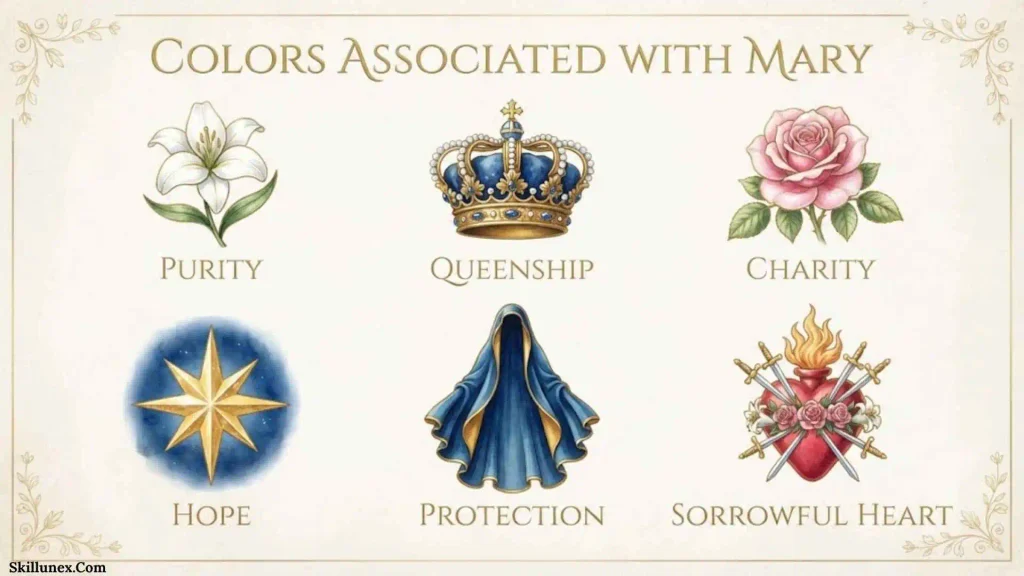
Colors can also help you understand what you are seeing.
Blue
When you think of Mary, blue is probably one of the first colors that comes to mind.
Mary is frequently represented wearing a blue mantle or robe. Over time, blue became strongly associated with her visual identity in Christian art.
You may see blue used in paintings, statues, stained-glass windows, medals, and devotional artwork.
The exact symbolism can vary by period and culture, so I would avoid assuming that every blue garment has exactly the same theological meaning.
White
White traditionally communicates purity, innocence, and holiness.
That is why you may see Mary wearing white clothing or surrounded by white lilies.
When white and lily imagery appear together, the artist is often reinforcing the theme of purity.
Red
Red can have several meanings in Christian art, including love, charity, sacrifice, or suffering.
If you see red around an image of Mary’s heart, for example, the color can contribute to the emotional symbolism of love and devotion.
Gold
Gold can suggest heavenly glory, honor, majesty, and divine splendor.
You may notice gold in Mary’s crown, halo, clothing, background, or decorative details. When it appears with stars and a crown, it can strengthen the heavenly character of the image.
The Star Of Mary
The star is another important Marian symbol.
Mary has traditionally been associated with the title Star of the Sea, and the star can therefore suggest hope and guidance.
When you see a star in Marian artwork, you should also look at how many stars appear and where they are positioned.
A single star may function differently from a crown of twelve stars.
What Do Twelve Stars Mean?
The twelve stars have an important biblical connection.
Revelation 12:1 describes a woman with a crown of twelve stars. This imagery became influential in Christian representations of Mary, particularly in traditional depictions of the Immaculate Virgin.
So, if you see Mary surrounded by twelve stars, you may be looking at an image that draws on this biblical and Marian tradition.
For you as a viewer, the twelve stars can suggest:
- Heavenly glory
- Biblical symbolism
- Queenship
- Hope
- Mary’s traditional heavenly role
The Crown Of Mary
The crown is one of the easiest symbols for you to understand.
It traditionally represents Mary’s queenship and heavenly glory.
In Christian art, you may see Mary wearing a crown, holding the Christ Child while crowned, or being crowned in a scene known as the Coronation of the Virgin.
If I were identifying a Marian artwork, a crown would immediately make me consider whether the image is presenting Mary as Queen of Heaven.
The crown can communicate:
- Queenship
- Honor
- Glory
- Heavenly status
- Royal dignity
When the crown is combined with twelve stars, the heavenly symbolism becomes even more prominent.
The Heart Of Mary
The heart is especially important when you encounter an image of the Immaculate Heart of Mary.
The heart represents Mary’s love, devotion, and maternal affection. You may see it surrounded by roses, flames, rays of light, or other symbols.
When you look at this type of image, I recommend paying attention to everything around the heart because each additional element can add another layer of meaning.
What Does The Pierced Heart Mean?
A heart pierced by a sword represents sorrow and suffering.
This imagery is particularly associated with Mary’s grief as the mother of Jesus. It can remind you that Marian symbolism does not focus only on glory and purity; it also recognizes suffering.
If you see a heart with a sword, you are likely looking at imagery connected with the Immaculate Heart of Mary or Our Lady of Sorrows.
The Sword And Mary’s Sorrow
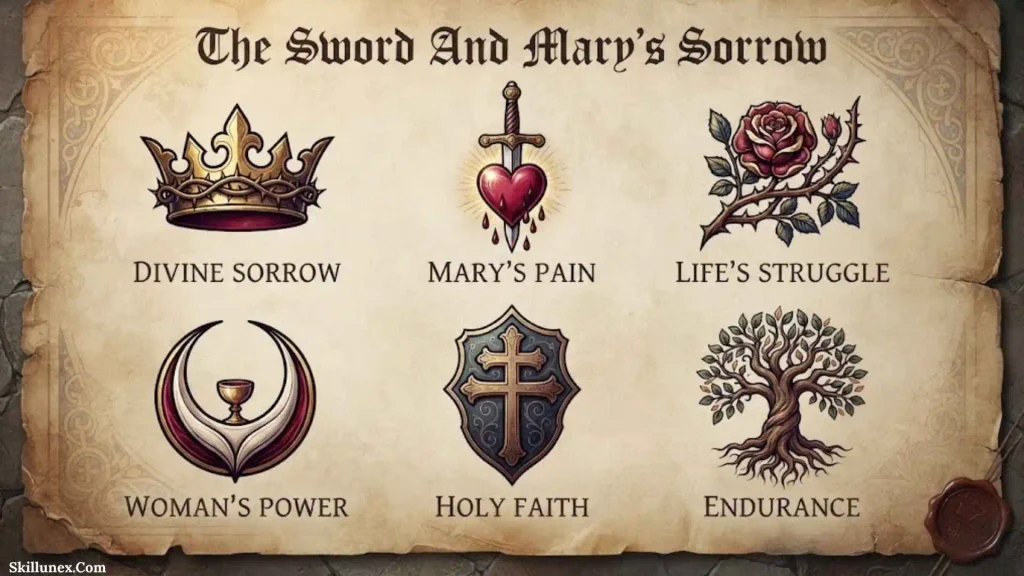
The sword is one of the more emotional symbols associated with Mary.
A sword piercing her heart can represent the deep sorrow Mary experienced in connection with the suffering of Jesus.
In representations of Our Lady of Sorrows, you may see seven swords piercing Mary’s heart. These traditionally represent the Seven Sorrows of Mary.
When you encounter this image, you can understand the sword as a symbol of:
- Sorrow
- Maternal grief
- Suffering
- Sacrifice
- Emotional pain
The number of swords matters. A single sword can emphasize Mary’s sorrow, while seven swords can specifically identify the traditional Seven Sorrows.
Mary’s Blue Mantle
Mary’s mantle is more than a piece of clothing in many devotional images.
You may see Mary extending a large mantle over people, saints, or groups of believers. This imagery is associated with the Virgin of Mercy, where the mantle communicates protection and shelter.
When you see Mary covering people with her mantle, you can interpret the image as expressing:
- Protection
- Shelter
- Maternal care
- Mercy
- Spiritual refuge
The University of Dayton’s Marian Library discusses the mantle as an important element in Marian symbolic traditions.
The Enclosed Garden
The enclosed garden, traditionally known as hortus conclusus, is one of the most beautiful Marian symbols.
If you see Mary sitting inside a peaceful enclosed garden surrounded by flowers, walls, or hedges, you may be looking at an image connected with her virginity and purity.
The imagery has roots in the Song of Songs, and medieval Christian interpretation connected the enclosed garden with Mary’s virginity.
When you see this symbol, you can think about:
- Virginity
- Purity
- Protection
- Spiritual beauty
- A sacred and protected space
This is one of those symbols that may not be obvious at first, but once you know it, you can recognize it much more easily.
The Fountain And Well
A fountain or well can also appear in Marian artwork.
This imagery has connections with biblical language and traditional Christian interpretations of the Song of Songs. Historical Marian artworks sometimes identify fountains and wells with inscriptions that connect them to Mary’s traditional titles and virtues.
For you as a viewer, a fountain may suggest:
- Purity
- Life
- Spiritual nourishment
- Grace
- A source of blessing
Again, context matters. I would always look at the other symbols surrounding the fountain before deciding exactly what the artist intended.
The Tower Of David
The Tower of David is another traditional Marian symbol that you may encounter in older artwork.
The imagery comes from the Song of Songs 4:4 and was incorporated into Christian Marian symbolism.
A tower can suggest:
- Strength
- Protection
- Stability
- Security
- A strong spiritual refuge
If you are studying medieval or Renaissance Marian artwork, a tower may be part of a much larger group of symbols rather than an isolated object.
The Mirror As A Symbol Of Mary
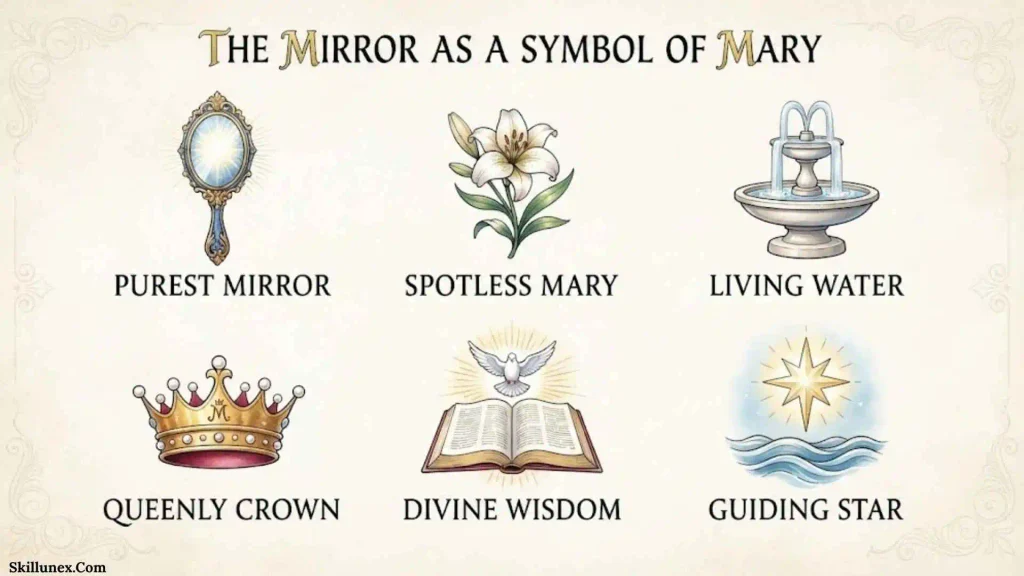
The mirror is probably one of the symbols you are least likely to recognize immediately.
In traditional Marian symbolism, a spotless mirror can represent Mary’s purity.
Older artworks may include the phrase “speculum sine macula,” meaning “spotless mirror.” The National Trust and Rijksmuseum both document this imagery in Marian works.
So, if you see a mirror in a Marian painting, don’t assume it is simply an everyday household object. It may have a carefully chosen symbolic purpose.
The mirror can represent:
- Purity
- Spiritual beauty
- Perfection
- Reflection
- Freedom from stain
The Crescent Moon
The crescent moon beneath Mary’s feet is especially associated with traditional representations of the Immaculate Conception.
You may see Mary standing above a crescent moon while surrounded by stars, rays of light, angels, or clouds.
If the moon appears together with twelve stars and a serpent, you are likely looking at a traditional Western Marian composition associated with the Immaculate Conception.
The meaning should still be interpreted in the context of the particular artwork rather than treated as a universal rule.
The Serpent Beneath Mary’s Feet
The serpent is another symbol you may notice in representations of the Immaculate Conception.
In Christian symbolism, the serpent can represent evil and is associated with the serpent in Genesis. When Mary is shown standing above it, the image traditionally communicates victory over evil.
You may therefore see a combination of:
- Mary
- Crescent moon
- Stars
- Heavenly rays
- Serpent
- Angels
Together, these elements create a recognizable visual language.
The Rosary
The rosary is strongly connected with Marian prayer and devotion.
If you see Mary holding a rosary, the object usually points toward prayer, meditation, and Marian devotion.
You may find rosaries in:
- Marian statues
- Devotional paintings
- Prayer cards
- Religious medals
- Personal devotional objects
The rosary differs from symbols such as the lily because it is primarily a devotional object associated with Mary, rather than an attribute that always identifies her in historical artwork.
Symbols Of The Immaculate Conception
When you see a traditional image of the Immaculate Conception, several Marian symbols may appear together.
You may notice:
- Blue mantle
- White clothing
- Twelve stars
- Crescent moon
- Heavenly rays
- Angels
- Serpent
- Flowers
- Clouds
The combination is important.
For example, if you see Mary standing on a crescent moon while surrounded by twelve stars, you should not interpret the moon and stars independently without considering the complete composition.
The National Trust documents several of these traditional Marian attributes, including the star, crown, lily, rose, enclosed garden, fountain, mirror, and Tower of David.
Symbols Of The Immaculate Heart Of Mary
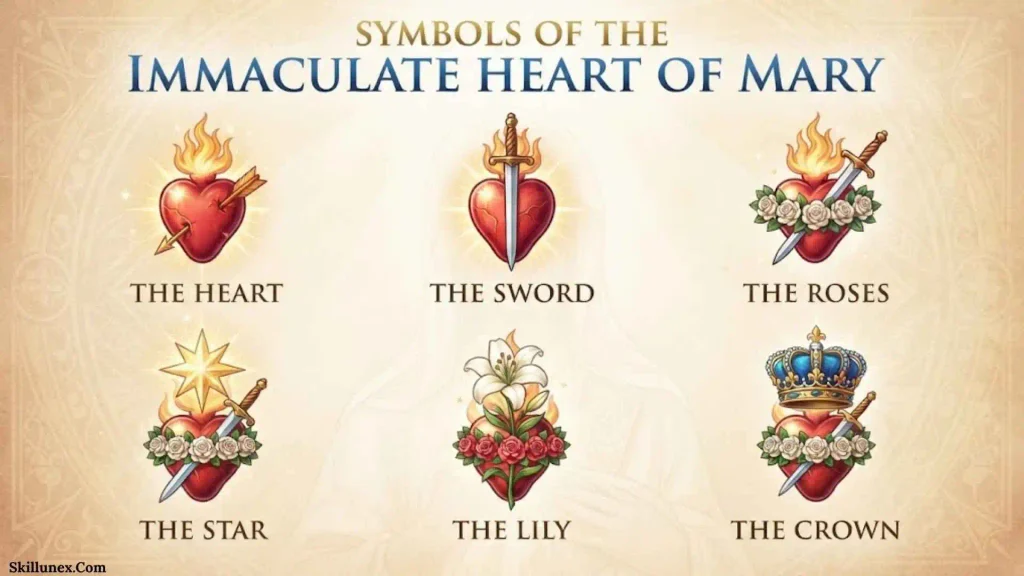
The Immaculate Heart of Mary has its own recognizable visual language.
The Heart
The heart represents Mary’s love and devotion.
The Roses
Roses around the heart can emphasize love and Marian devotion.
The Flames
Flames can represent passionate or burning love.
The Sword
The sword represents sorrow and suffering.
The Rays Of Light
Light can emphasize holiness and spiritual significance.
When you put these symbols together, you get an image that communicates both love and suffering.
That combination is important because it helps you understand why Marian symbolism can be emotionally powerful.
Symbols Of Our Lady Of Sorrows
When you see Our Lady of Sorrows, the imagery focuses on Mary’s suffering.
You may notice:
- Seven swords
- A sorrowful expression
- Tears
- A heart
- Darker clothing
- Scenes connected with Christ’s Passion
The seven swords are particularly important because they traditionally represent Mary’s Seven Sorrows.
If you see this image, I would interpret it differently from an image dominated by a crown, stars, and heavenly light. The symbols tell you what aspect of Mary’s story the artist wants you to contemplate.
Symbols Of The Virgin Of Guadalupe
The Virgin of Guadalupe has a distinctive set of symbols that developed within the cultural and religious context of Mexico.
You may recognize:
- Blue-green mantle
- Stars
- Rose-colored garment
- Crescent moon
- Rays of light
- Black sash
- Four-petal flower
- Cross
Some interpretations connect these elements with both Catholic symbolism and Indigenous Mexican cultural traditions.
If you are studying the Virgin of Guadalupe, I recommend avoiding interpretations that treat every detail as having one universally accepted meaning. Different scholars and traditions have explained the imagery in different ways.
How Can You Identify Symbols Of Mary In Artwork?
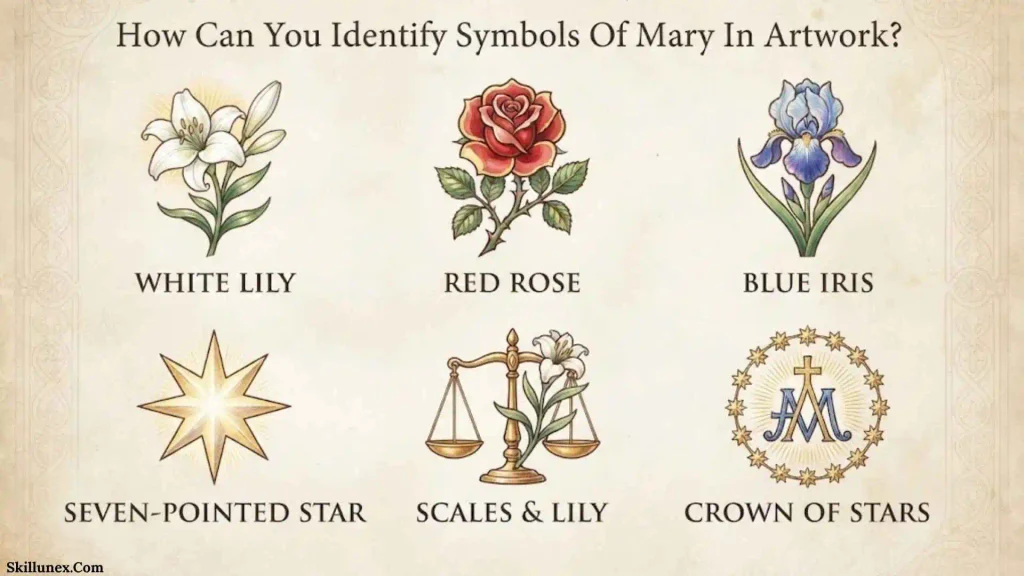
You do not need to be an art historian to start recognizing Marian symbols.
Look At Mary’s Clothing
First, look at what Mary is wearing.
A blue mantle is a strong visual clue, while white clothing can reinforce themes of purity.
Look At Her Hands
Next, check what she is holding.
Is it:
- A lily?
- A rose?
- A rosary?
- The Christ Child?
- A heart?
This can give you an important clue about the subject of the image.
Look At Her Head
Now look above or around her head.
You may see:
- Crown
- Halo
- Twelve stars
- Single star
- Heavenly light
A crown and stars can point toward Mary’s heavenly queenship.
Look At Her Feet
This is one of the most useful places to look.
You may find:
- Crescent moon
- Serpent
- Clouds
- Garden
- Angels
If you see a serpent beneath Mary and a crescent moon under her feet, you may be looking at a traditional Immaculate Conception composition.
Look At The Surrounding Environment
Finally, look at the entire scene.
You might find:
- Enclosed garden
- Fountain
- Tower
- Trees
- Flowers
- Birds
- Angels
- Biblical inscriptions
These details can help you understand the artist’s larger message.
How Different Symbols Work Together
One of the biggest mistakes you can make when studying Marian imagery is to look at each object separately.
Imagine you see:
Mary + blue mantle + twelve stars + crescent moon + serpent + lilies.
You can learn much more by reading these elements together than by treating each as an independent symbol.
The same is true for:
Mary + heart + roses + flames + sword.
This combination immediately creates a different emotional and devotional message.
When you learn to read symbols as a group, you can understand religious artwork much more confidently.
Symbols Of Mary And Their Meanings
| Symbol | Common Meaning | What You Can Look For |
| Lily | Purity and virginity | White flower beside Mary |
| Rose | Love, beauty, charity, devotion | Rose or Marian garden |
| Star | Hope and guidance | Star near Mary |
| Twelve Stars | Biblical and heavenly imagery | Crown or circle of twelve stars |
| Crown | Queenship and glory | Crown on Mary’s head |
| Heart | Love and devotion | Immaculate Heart imagery |
| Sword | Sorrow and suffering | Sword piercing the heart |
| Blue Mantle | Traditional Marian identity | Blue cloak or robe |
| White Clothing | Purity and holiness | White dress or tunic |
| Enclosed Garden | Virginity and purity | Walled or enclosed garden |
| Fountain | Spiritual life and traditional Marian imagery | Fountain or well |
| Tower | Strength and protection | Tower in Marian landscape |
| Mirror | Purity | Mirror near Mary |
| Crescent Moon | Traditional Immaculate Conception imagery | Moon beneath Mary’s feet |
| Serpent | Victory over evil in traditional imagery | Serpent beneath Mary |
| Rosary | Prayer and Marian devotion | Rosary in Mary’s hands |
| Palm Tree | Biblical and traditional imagery | Palm among Marian plants |
These are common traditional associations, so you should consider the artwork’s title, historical period, cultural background, and surrounding symbols before assigning a specific interpretation.
Why Do Artists Use Symbols Instead Of Words?
You might wonder why an artist would use a flower, star, or tower instead of simply writing what Mary represents.
The answer is that visual symbols allow an artist to communicate several ideas at once.
A single lily can suggest purity without requiring a written explanation. A crown can communicate queenship instantly. A sword through a heart can express grief and love in a single image.
For viewers like you, this creates an opportunity to discover additional meaning every time you look at the artwork.
The more symbols you recognize, the more details you can notice.
Are All Symbols Of Mary Biblical?
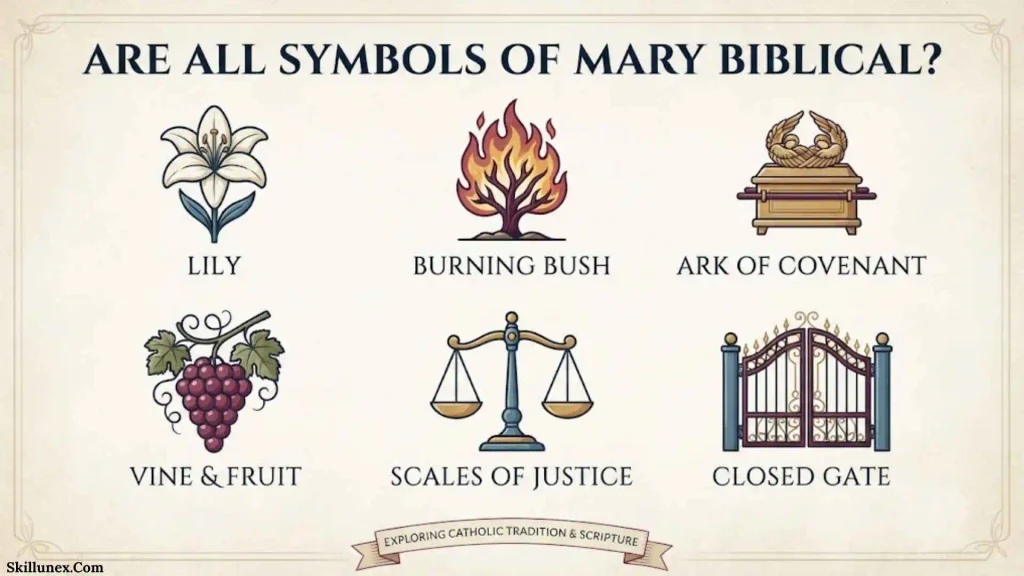
No. Some Marian symbols have strong biblical connections, while others developed through later Christian tradition, theology, devotion, and artistic practice.
The twelve stars have a connection with Revelation 12. The enclosed garden, fountain, and Tower of David draw on imagery from the Song of Songs that Christian tradition applied to Mary. Other symbols developed through centuries of Marian devotion and art.
So, when you research a symbol, I recommend checking its historical context rather than assuming that every traditional symbol comes directly from a biblical command or passage.
Frequently Asked Questions About Symbols Of Mary
What Is The Main Symbol Of Mary?
There is no single symbol that universally represents Mary. The lily, star, crown, blue mantle, rose, and heart are among the most recognizable symbols associated with her.
What Flower Represents Mary?
The lily is one of the strongest traditional floral symbols of Mary and commonly represents purity and virginity. The rose is also strongly associated with her and can represent love, beauty, charity, and devotion.
What Color Represents Mary?
Blue is the color most strongly associated with Mary in traditional Western Christian art. You will often see her wearing a blue mantle.
What Does A Lily Symbolize For Mary?
A lily traditionally symbolizes purity, virginity, innocence, and holiness. You will especially notice it in images of the Annunciation.
Why Does Mary Have 12 Stars?
The twelve stars are associated with the woman described in Revelation 12:1. This imagery became an important part of traditional Christian representations of Mary.
What Does Mary’s Crown Mean?
The crown represents Mary’s traditional queenship and heavenly glory. You may see it in images of Mary as Queen of Heaven or in Coronation of the Virgin scenes.
What Does The Sword In Mary’s Heart Mean?
The sword represents Mary’s sorrow and suffering. When seven swords appear, they traditionally represent the Seven Sorrows of Mary.
What Does The Blue Mantle Symbolize?
The blue mantle is a traditional visual association with Mary. In images where Mary spreads her mantle over people, it can also communicate protection, mercy, and maternal care.
What Does The Rose Symbolize?
The rose can represent love, beauty, charity, and Marian devotion. Its precise meaning can depend on the artwork and tradition.
What Does The Enclosed Garden Mean?
The enclosed garden traditionally represents Mary’s virginity and purity. It is associated with imagery from the Song of Songs and became important in medieval Marian art.
What Does The Crescent Moon Under Mary Mean?
The crescent moon is strongly associated with traditional representations of the Immaculate Conception, particularly when it appears with stars, heavenly light, and other Marian symbols.
Why Is Mary Standing On A Serpent?
The serpent is traditionally associated with evil. When Mary is shown standing above it, the image communicates a traditional Christian theme of victory over evil.
What Does Mary’s Heart Represent?
The heart represents Mary’s love, devotion, and maternal affection. When it is surrounded by roses, flames, or pierced by a sword, those additional elements add further meaning.
Is The Rosary A Symbol Of Mary?
The rosary is strongly associated with Marian prayer and devotion. You will often see Mary holding a rosary in statues and devotional artwork.
Conclusion
When you understand the symbols of Mary, you can look at Christian artwork in a completely different way. The next time you see a white lily, you can recognize its traditional connection with purity. When you notice a crown, you can think about Mary’s queenship, while twelve stars can point you toward biblical and heavenly imagery. A heart and sword can tell a story of love and sorrow, while a blue mantle can immediately help you recognize a familiar Marian tradition.
I hope this guide helps you look at Marian paintings, statues, churches, and devotional images with a more informed eye. You don’t need to memorize every symbol at once. Start with the lily, rose, star, crown, heart, sword, blue mantle, and crescent moon, and you will already be able to recognize many important elements. As you continue exploring, you will begin to notice how artists combine these symbols to tell deeper stories about Mary’s purity, love, suffering, protection, and heavenly role.

Isla Kensington
I’m Isla Kensington, a writer with a passion for research, culture, nature, and the fascinating meanings behind everyday things. I enjoy taking topics that may seem simple at first and discovering the history, facts, and ideas that make them more interesting.
I write with readers in mind. My aim is to provide clear explanations, useful information, and interesting details without making a topic unnecessarily complicated.
I believe learning should feel like discovering something rather than simply reading facts. That philosophy guides the content I create and the topics I choose to explore.
## Books by Isla Kensington
* Symbols Around the World: A Guide to Meaning & Culture
* Nature’s Beautiful Places: Lakes, Landscapes & Natural Treasures