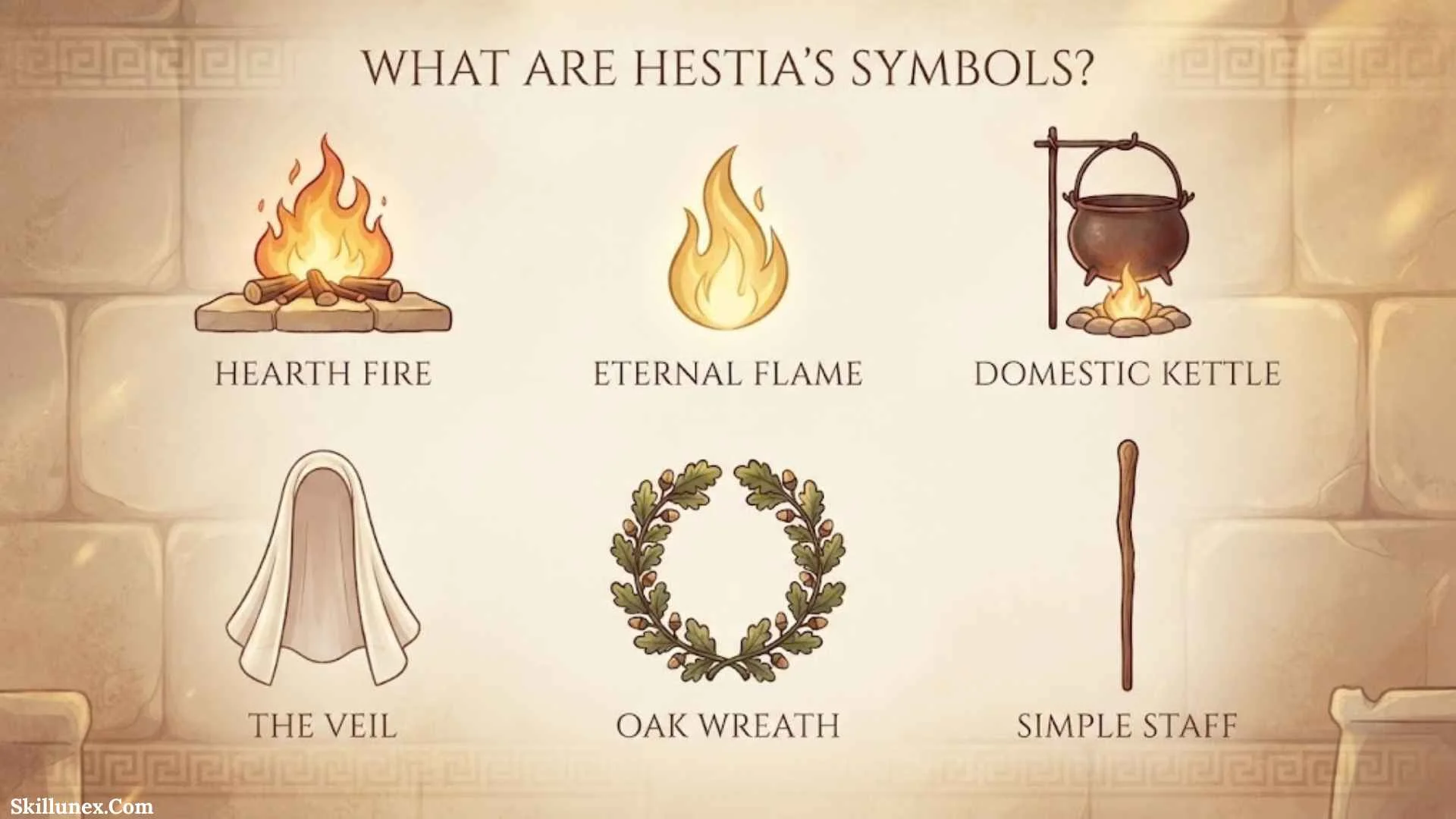
When you search for Hestia’s symbols, you will find that her symbolism is quite different from that of many other Greek gods and goddesses. Instead of being mainly connected with weapons, animals, or dramatic adventures, Hestia is closely associated with the hearth, sacred fire, home, family, and domestic life. If you want to understand her symbolism, I recommend starting with the hearth because it is the central idea behind most of her other associations.
You can think of Hestia as a goddess connected with the place where people gather, prepare food, maintain a fire, and create a sense of home. Her role was important in both private households and public religious life. When you look at her symbols together, you can see a common theme: warmth, stability, continuity, and the sacred importance of home.
In this guide, I’ll explain the major symbols associated with Hestia, what they mean, and which associations have stronger historical support. You will also learn about her sacred fire, hearth, household worship, civic hearth, cooking, hospitality, animals, plants, appearance, and connection with the Roman goddess Vesta.
Hestia’s Most Important Symbol
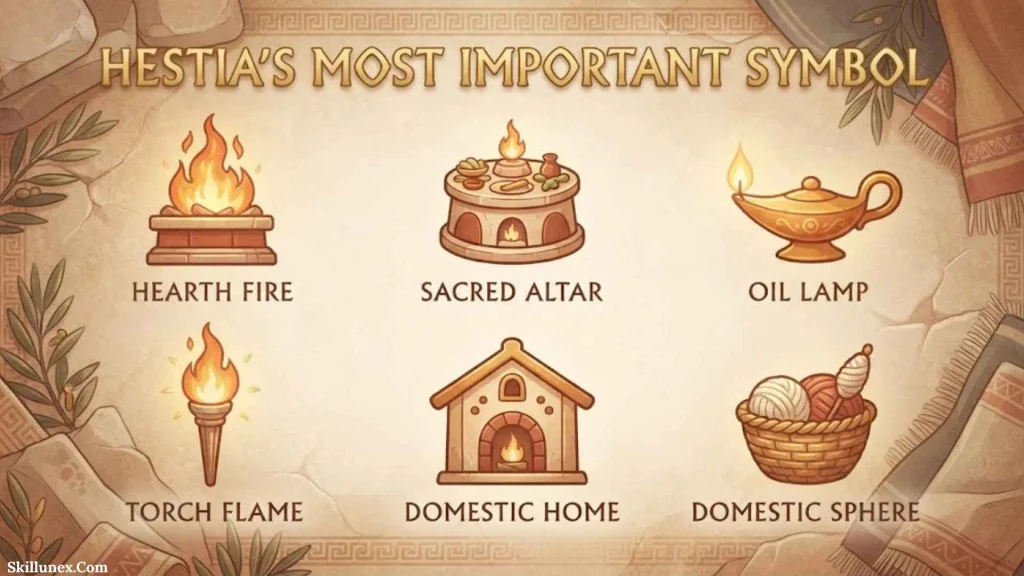
Why Is the Hearth Hestia’s Main Symbol?
The hearth is the clearest symbol of Hestia. In ancient Greek homes, the hearth was an important part of everyday life. It provided warmth, helped people prepare food, and could also serve a religious purpose.
If you imagine an ancient household, you can see why the hearth became such a powerful symbol. It was not simply a fireplace. It could represent the center of the household itself.
For you as a modern reader, the easiest way to understand this symbolism is to think about what a home means. A home can provide comfort, security, family connection, and a place where people return after being away. Hestia’s hearth represented many of these ideas.
What Does the Hearth Symbolize?
The hearth can represent:
- Home
- Family
- Warmth
- Stability
- Security
- Domestic harmony
- Continuity
- Religious devotion
When you see the hearth used as a symbol of Hestia, you are essentially seeing the heart of her traditional role.
Hestia’s Sacred Fire
What Does Hestia’s Fire Represent?
The sacred fire is closely connected with Hestia because her identity was tied to the hearth and its flame. Fire was useful for cooking and warmth, but it could also have a religious significance.
When I look at Hestia’s symbolism, the fire is especially interesting because it connects practical life with religious life. The same hearth that helped a family prepare its meal could also have a sacred role.
The fire can therefore symbolize:
- Warmth
- Continuity
- Devotion
- Protection
- Household life
- Sacred presence
Why Was Maintaining the Fire Important?
A maintained fire could represent the continued life of a household or community. As long as the hearth remained active, it could serve as a visible reminder of the home and its traditions.
If you think about this symbolically, you can understand why the flame became associated with continuity. One generation could maintain the household traditions and pass them to the next.
The Flame as a Symbol of Hestia
The flame is naturally connected with Hestia’s sacred hearth. Although the flame is simply part of the fire, it has its own symbolic meaning in modern discussions of Hestia.
You can think of the flame as representing something that continues to burn and provide warmth. This makes it useful as a symbol of:
- Endurance
- Warmth
- Life
- Continuity
- Family connection
- Spiritual devotion
I would, however, avoid treating every modern interpretation of the flame as an ancient Greek belief. Some meanings commonly found online are modern symbolic interpretations rather than directly documented ancient traditions.
Hestia and the Home
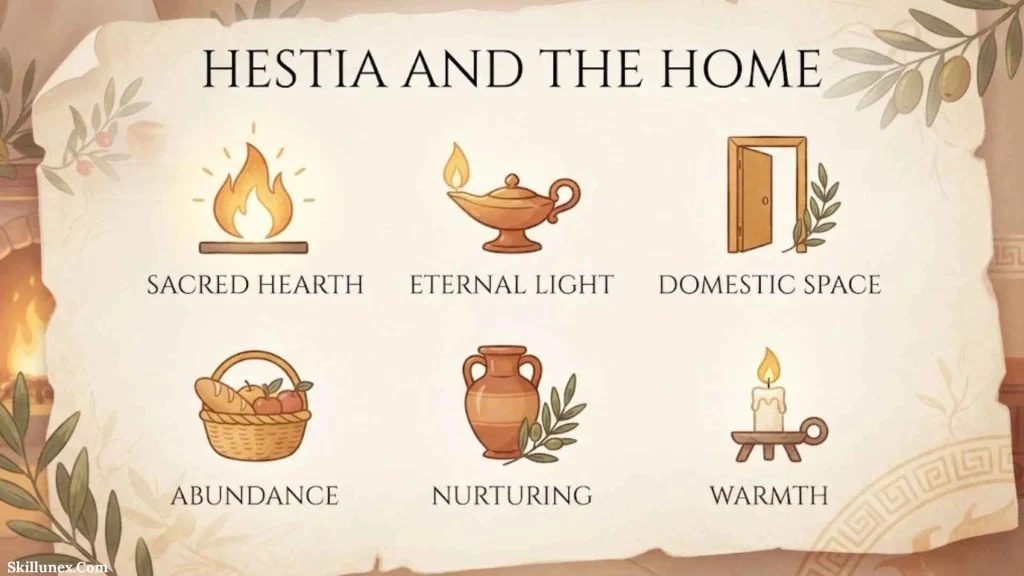
What Does the Home Symbolize?
The home is one of the most natural associations you will find when researching Hestia.
Hestia’s role was closely connected with the household and the hearth. Because the hearth was at the center of domestic life, the home became an important part of her wider symbolism.
For you, this makes Hestia easy to understand. When you think about your own idea of home, you might think about comfort, family, privacy, safety, meals, and memories. These concepts help explain why Hestia’s symbolism continues to feel relevant.
The home can represent:
- Belonging
- Family
- Comfort
- Safety
- Stability
- Peace
- Domestic life
Hestia’s Kettle
Why Is a Kettle Associated With Hestia?
A kettle is a lesser-known attribute associated with Hestia. Ancient artistic representations can show her with household objects connected with her domestic role.
The connection makes sense when you remember that the hearth was used for cooking and preparing food. A kettle therefore fits naturally into Hestia’s symbolism.
For you, the kettle can be understood as a secondary symbol representing:
- Cooking
- Food preparation
- Domestic life
- Family meals
- The household hearth
The kettle is not as important as the hearth itself, but it can help you recognize Hestia’s connection with everyday household activities.
Hestia and the Household Altar
Was the Hearth Used for Worship?
Yes. The hearth could have an important religious role within the household.
Hestia was associated with sacrifices, offerings, and religious ceremonies. This means that the household hearth was not simply a practical place for cooking and warmth. It could also be part of the family’s religious life.
When you think of the hearth as a household altar, you can see why Hestia had such a distinctive position among the Greek gods.
The household hearth could symbolize the connection between:
- Family life
- Religious practice
- Food
- Fire
- Home
- The divine
Hestia and the Civic Hearth
What Was the Civic Hearth?
Hestia’s symbolism went beyond individual homes. Ancient Greek communities also had public or civic hearths, which gave her role a wider community dimension.
The civic hearth could represent the sacred center of a community. This is important because it shows you that Hestia was not simply a goddess concerned with private houses.
Her symbolism could extend from:
Household hearth → family and home
Civic hearth → community and shared identity
This wider role makes Hestia more significant than the simple label “goddess of the home” might suggest.
Why Was the Civic Heart Important?
The civic hearth could serve as a symbolic focus for the community. It connected religious traditions with civic life.
When you look at Hestia from this perspective, her symbolism becomes broader. She could represent not only the place where your family gathers but also the place around which a community understood itself.
Hestia and Sacrifice
Hestia was closely connected with sacrificial rituals. Ancient traditions describe her as receiving offerings and being honored in connection with the beginning and ending of sacrifices.
This association is important because it shows you that her role was not limited to household comfort.
The sacred fire provided a connection between people and the gods. Hestia’s place within that system gave her a special religious significance.
Her sacrificial symbolism can therefore be connected with:
- Prayer
- Offerings
- Sacred fire
- Religious ceremonies
- Communication with the divine
Hestia and Cooking
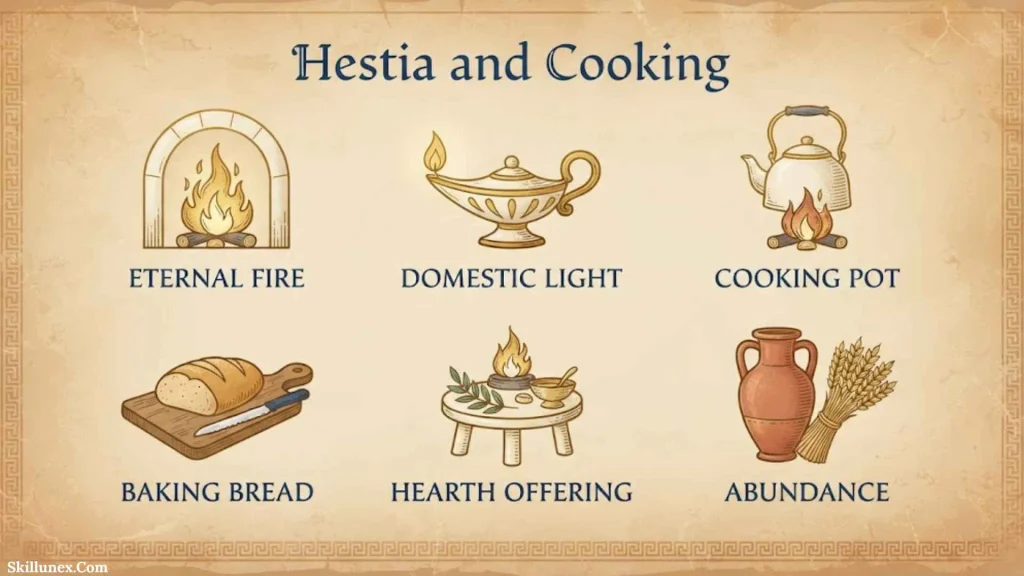
Why Is Cooking One of Her Associations?
Cooking is another natural association with Hestia because the ancient hearth was essential for preparing food.
The hearth brought people together around meals, making cooking part of domestic and social life. Hestia’s connection with this activity reflects her wider association with the household.
If you think about the role of food in your own life, you can see why this symbolism remains understandable today. Preparing and sharing food can create a feeling of family, care, and connection.
Hestia’s cooking symbolism can therefore represent:
- Nourishment
- Family meals
- Care
- Domestic work
- Community
- Sharing
Hestia and Hospitality
Why Is Hospitality Connected With Hestia?
Hospitality fits naturally into Hestia’s symbolism because the hearth was associated with warmth, food, shelter, and welcome.
When you welcome someone into your home, you are sharing a space that is normally private and protected. In ancient Greek culture, hospitality had an important social and religious dimension.
Hestia’s association with the hearth therefore makes hospitality a meaningful secondary concept.
It can represent:
- Welcoming others
- Generosity
- Peace
- Shelter
- Respect
- Community
Does Hestia Have an Animal Symbol?
What Animal Is Associated With Hestia?
Hestia does not have one universally recognized animal symbol comparable to Athena’s owl or Artemis’s deer.
Some sources mention swine as a possible association, but this is not nearly as central or certain as the hearth and sacred fire.
If you are creating a historically focused list of Hestia symbols, I would put the hearth and fire first rather than presenting an animal as her defining symbol.
This distinction is useful because many modern mythology lists contain symbolic associations that are not equally supported by ancient evidence.
Does Hestia Have a Sacred Plant or Flower?
What Flower Represents Hestia?
There is no single universally established ancient Greek flower that functions as Hestia’s primary symbol.
You may find modern websites assigning different flowers, herbs, or plants to her, but you should be careful about treating these as ancient Greek facts.
If your goal is historical accuracy, the safest associations are the ones directly connected with her traditional role: the hearth, fire, home, sacrifice, and household.
What Colors Are Associated With Hestia?
You may see modern sources associate Hestia with colors such as:
- Red
- Orange
- Gold
- White
- Warm earth tones
These colors make sense symbolically because red, orange, and gold can remind you of fire and the glowing hearth.
However, I would classify these as modern symbolic associations, not definitive ancient Greek attributes. Ancient evidence does not give us one universally accepted set of “Hestia colors.”
How Was Hestia Depicted?
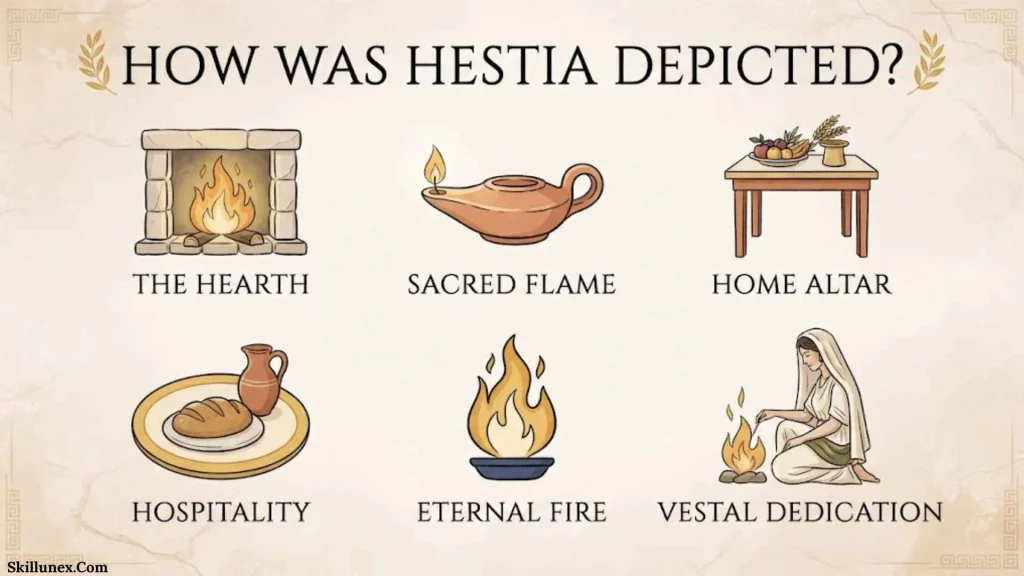
What Did Hestia Look Like?
Hestia was generally depicted as a modestly dressed or veiled woman. Her representations were less visually dramatic than those of many other Olympian gods.
You will sometimes find her represented with a kettle or other objects connected with the household.
This relatively simple appearance fits her character. She was not primarily represented through armor, weapons, or foreign animals. Instead, her identity was closely connected with the peaceful domestic world.
Hestia’s Symbols and Their Meanings
| Symbol | Meaning |
| Hearth | Home, family, stability, and domestic life |
| Sacred fire | Religious devotion and continuity |
| Flame | Warmth and enduring presence |
| Kettle | Cooking and household activity |
| Home | Security, belonging, and family |
| Household altar | Domestic worship |
| Civic hearth | Community and shared identity |
| Sacrificial fire | Offerings and religious ritual |
| Cooking | Nourishment and family meals |
| Hospitality | Welcome, warmth, and shelter |
As you can see, most of these symbols connect back to the hearth. That is why I would consider the hearth the central key to understanding Hestia.
What Does Hestia Symbolize?
Hestia symbolizes home, hearth, family, stability, sacred fire, hospitality, domestic life, and continuity.
What makes her symbolism different is that it focuses on maintaining rather than conquering. You do not usually associate Hestia with dramatic battles or heroic adventures. Instead, you associate her with the stable center that allows household and community life to continue.
If you want a simple way to remember her symbolism, think of this chain:
Hestia → Hearth → Fire → Home → Family → Stability
This connection explains most of the major symbols associated with her.
Hestia’s Family in Greek Mythology
Who Were Hestia’s Parents?
Hestia was traditionally the daughter of Cronus and Rhea. Her siblings included Zeus, Hera, Poseidon, Demeter, and Hades.
She therefore belonged to one of the central divine families in Greek mythology.
Despite her important position, her mythology contains fewer dramatic stories than those of many other Olympian gods. Her significance was strongly connected with her religious role and the importance of the hearth.
Was Hestia Married?
Hestia was traditionally regarded as a virgin goddess.
Ancient traditions describe her as rejecting marriage and maintaining her virgin status. Stories involving Apollo and Poseidon are connected with this part of her mythology.
Her unmarried status fits the traditional image of Hestia as a goddess devoted to the sacred hearth rather than to marriage.
Why Was Hestia Honored First?
One particularly interesting feature of Hestia’s worship is that she could receive the first and last portions of sacrifices or libations.
This gave her a distinctive place in Greek religious practice.
When you consider her role, the symbolism makes sense. Hestia represented the hearth, which was often the central point of the household and a place connected with offerings and meals.
Her position at the beginning and end of rituals reinforced her connection with the sacred center.
Was Hestia One of the Twelve Olympians?
Hestia is traditionally included among the Olympians in some accounts, but the exact list of twelve could vary.
Some traditions include Hestia, while others include Dionysus instead. So if you see different lists online, you should not automatically assume that one of them is incorrect.
This is an example of why it is useful to look at different ancient traditions rather than treating Greek mythology as one completely fixed system.
Hestia and Vesta
Is Hestia the Same as Vesta?
The Roman goddess Vesta is the Roman counterpart of the Greek Hestia. Both are strongly associated with the hearth and sacred fire.
You can therefore understand Vesta as the Roman equivalent of Hestia, although Roman religious traditions developed their own practices and institutions around Vesta.
The connection between the two goddesses is especially clear through their shared association with sacred hearth fire.
Ancient Symbols vs. Modern Hestia Symbolism
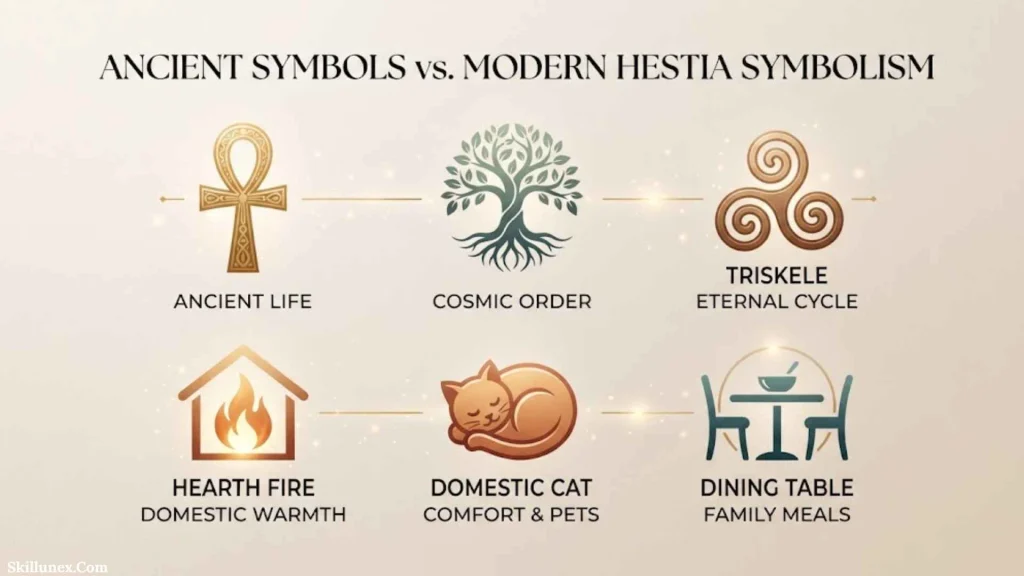
Which Hestia Symbols Are Historically Strong?
If you want historically grounded information, I would focus on:
- Hearth
- Sacred fire
- Flame
- Home
- Civic hearth
- Household worship
- Sacrifice
- Cooking
- Kettle
- Hospitality
These associations are closely connected with Hestia’s traditional role.
Which Associations Are Mostly Modern?
You may encounter modern lists that give Hestia specific:
- Crystals
- Zodiac signs
- Flowers
- Herbs
- Colors
- Candle correspondences
- Spiritual practices
Some people may find these modern associations meaningful, but you should not automatically treat them as ancient Greek traditions.
This distinction will help you separate historical mythology from modern spiritual interpretation.
Why Are Hestia’s Symbols Still Meaningful Today?
Hestia’s symbolism remains easy for you to understand because the ideas behind it are still familiar.
People still connect homes with safety. Families still gather around meals. Fire and candles can still create feelings of warmth and comfort. A welcoming home can still represent hospitality and belonging.
Of course, modern life is very different from ancient Greece. However, the basic ideas behind Hestia’s symbolism—home, warmth, family, stability, and gathering—remain recognizable.
Frequently Asked Questions About Hestia’s Symbols
What is Hestia’s main symbol?
Hestia’s main symbol is the hearth. It represents the home, family, domestic life, warmth, stability, and sacred household fire.
What does Hestia’s sacred fire symbolize?
Hestia’s sacred fire is associated with the hearth and its religious significance. Symbolically, you can connect it with warmth, continuity, devotion, and the ongoing life of the household.
What object is associated with Hestia?
The hearth is her primary object or symbol. A kettle is also associated with her in some ancient artistic representations.
What animal represents Hestia?
Hestia does not have one universally accepted animal symbol. Swine are mentioned as a possible association, but the hearth is much more strongly connected with her.
What flower represents Hestia?
There is no universally established ancient Greek flower that serves as Hestia’s defining symbol. Modern sources may provide additional flower associations, but these should not automatically be presented as ancient traditions.
What are Hestia’s colors?
Modern interpretations often use fire-related colors such as red, orange, gold, and white. These are better understood as modern symbolic associations rather than firmly established ancient Greek attributes.
What does Hestia symbolize spiritually?
In modern interpretation, Hestia can symbolize creating a peaceful home, protecting your personal space, maintaining family connections, and finding stability in everyday life.
Why is Hestia associated with the hearth?
Hestia’s divine role was closely connected with the hearth and its sacred fire. Because the hearth was central to household life, it became the primary symbol of her identity.
Was Hestia a goddess of fire?
Hestia was strongly associated with hearth fire and sacrificial fire. Her traditional role is more specifically connected with the sacred hearth than with every form of fire.
Was Hestia a goddess of family?
Hestia was closely associated with the family hearth and household. Her symbolism therefore includes family life, domestic stability, and the sacred nature of the home.
Why did Hestia remain unmarried?
Traditional mythology describes Hestia as choosing to remain a virgin goddess rather than marry. This became an important part of her identity.
Is Hestia the Greek version of Vesta?
Hestia and Vesta are the Greek and Roman counterparts of the hearth goddess. Both were associated with the sacred hearth and fire, although their respective religious traditions developed separately.
Conclusion
When you ask what Hestia’s symbols are, the most important answer is the hearth and sacred fire. From these central symbols, you can understand her connections with the home, family, cooking, hospitality, sacrifice, stability, and community. The civic hearth also shows you that her importance extended beyond individual households into wider Greek religious and civic life.
I think the easiest way for you to remember Hestia is to picture a warm hearth at the center of a home. Around that hearth, people can cook, eat, gather, worship, welcome guests, and maintain family traditions. While some modern sources give Hestia additional symbols such as specific colors, flowers, animals, or crystals, the most historically grounded associations remain the hearth, sacred fire, home, and civic flame.

Isla Kensington
I’m Isla Kensington, a writer with a passion for research, culture, nature, and the fascinating meanings behind everyday things. I enjoy taking topics that may seem simple at first and discovering the history, facts, and ideas that make them more interesting.
I write with readers in mind. My aim is to provide clear explanations, useful information, and interesting details without making a topic unnecessarily complicated.
I believe learning should feel like discovering something rather than simply reading facts. That philosophy guides the content I create and the topics I choose to explore.
## Books by Isla Kensington
* Symbols Around the World: A Guide to Meaning & Culture
* Nature’s Beautiful Places: Lakes, Landscapes & Natural Treasures