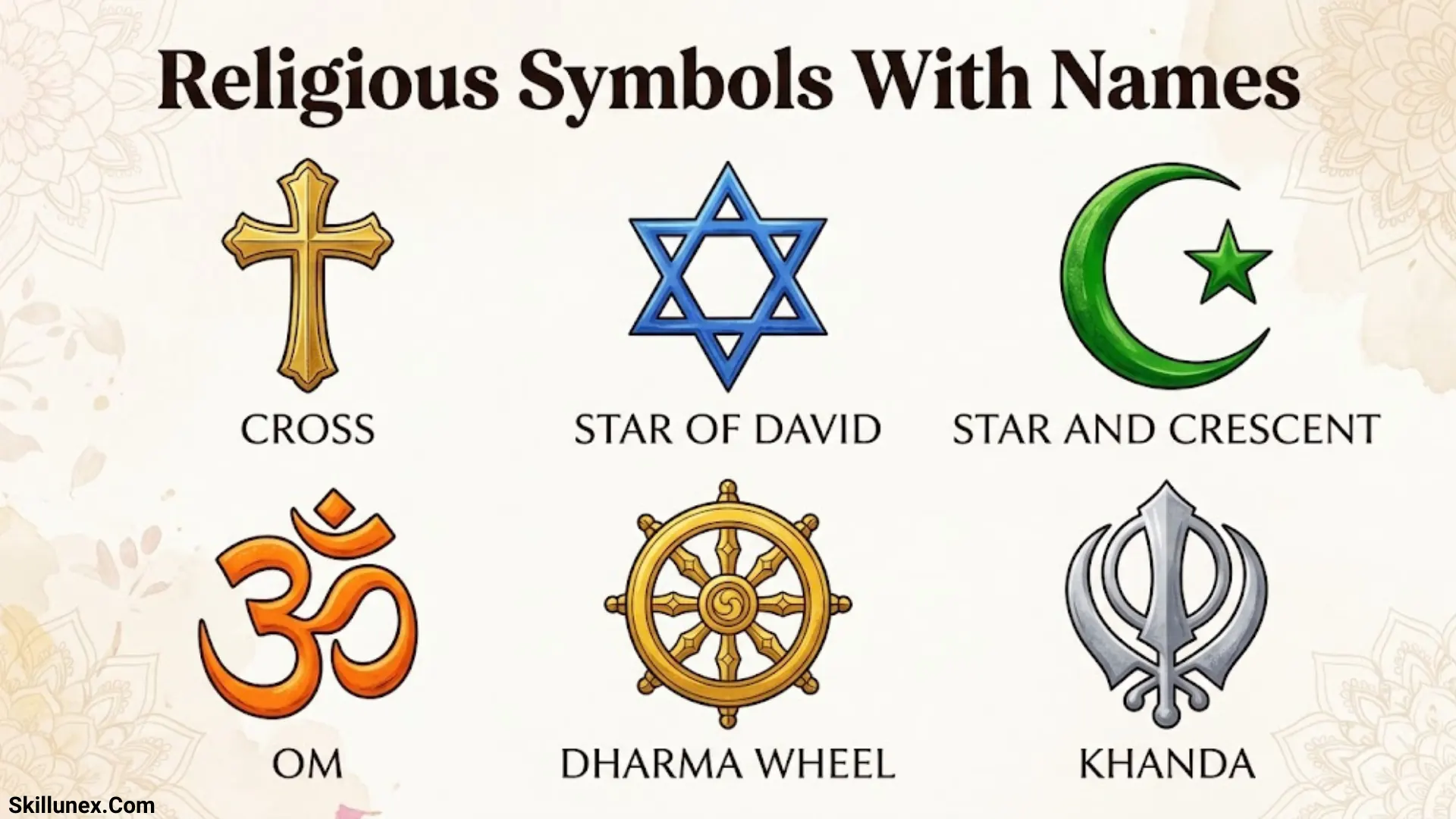
Religious symbols with names offer a fascinating way to understand the beliefs, values, and traditions of different religions around the world. From the Christian cross and the Jewish Star of David to the Hindu Om and the Buddhist Dharma Wheel, these symbols communicate ideas about faith, spirituality, worship, and cultural identity.
Some represent a specific religious teaching, while others connect people with sacred stories, historical events, or long standing traditions.If you want to identify religious symbols, learn their meanings, or find examples for an educational project, this guide will help you.
I’ll cover more than 30 important religious symbols, including their names, origins, uses, and significance across Christianity, Islam, Hinduism, Buddhism, Judaism, Sikhism, Jainism, and other spiritual traditions. You’ll also learn how to distinguish similar symbols, understand their cultural context, and use them respectfully.
What Are Religious Symbols?
Religious symbols are images, shapes, letters, objects, or designs that represent beliefs, sacred teachings, spiritual ideas, or religious communities. They can communicate complex concepts through a simple visual form, helping people recognize a tradition or understand an important part of its teachings.
For example, the cross represents the crucifixion and resurrection of Jesus Christ in Christianity. The Om symbol has deep significance in Hindu traditions, while the Dharma Wheel represents the Buddha’s teachings. Each symbol has its own history, and its meaning may change depending on the religion, community, and historical period.
Religious symbols can serve several purposes:
- Expressing faith: They communicate religious beliefs and spiritual commitments.
- Supporting worship: Some appear in ceremonies, temples, churches, mosques, and other sacred spaces.
- Preserving history: They connect modern communities with earlier generations and religious events.
- Teaching spiritual principles: They make abstract ideas easier to understand and remember.
- Representing identity: They help individuals and communities express their religious or cultural heritage.
- Inspiring reflection: They can encourage prayer, meditation, gratitude, compassion, and personal growth.
Not every religion relies on visual symbols in the same way. Some traditions emphasize sacred texts, spoken prayers, rituals, or ethical behavior more than a particular emblem. Therefore, understanding a symbol requires more than recognizing its appearance.
Religious Symbols With Names and Meanings
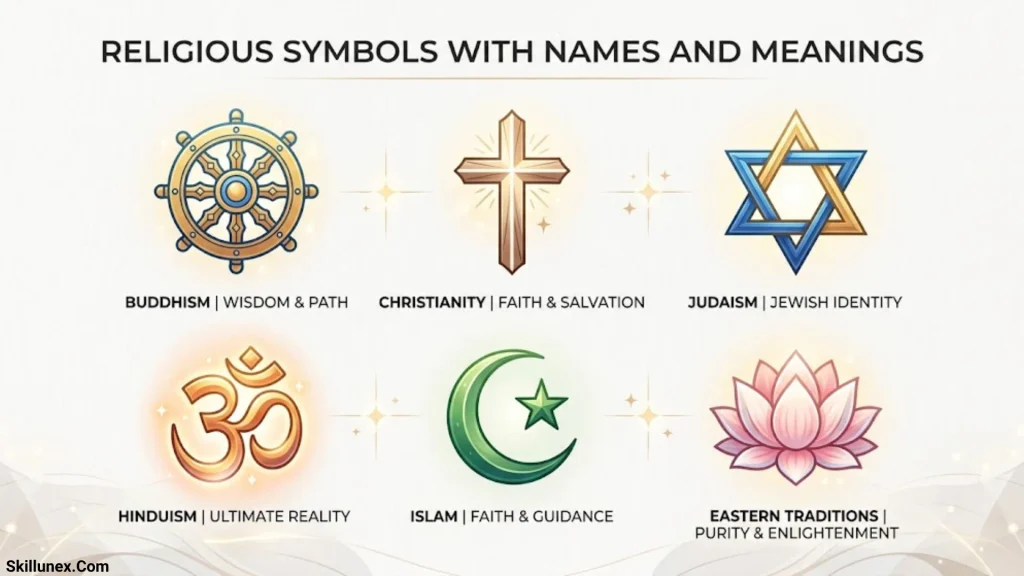
The following religious symbols are among the most recognizable across world religions. Each entry identifies the symbol, explains its religious association, and describes its common meaning.
Christian Cross (✝)
Religion: Christianity
Meaning: Sacrifice, redemption, forgiveness, and salvation.
The Christian cross is one of the most widely recognized religious symbols. It represents the crucifixion of Jesus Christ and, within Christian belief, connects his death with his resurrection and the promise of salvation.
Christians display the cross in churches, homes, jewelry, artwork, and places of worship. Different Christian traditions use different forms of the cross, but the central symbol remains closely connected with Jesus and the foundations of Christian faith.
Orthodox Cross (☦)
Religion: Eastern Orthodox Christianity and some related Christian traditions
Meaning: Christ’s crucifixion, redemption, and Christian faith.
The Orthodox Cross commonly features three horizontal bars. In a familiar version, the lower bar is slanted, while the upper bar represents the inscription associated with Jesus’s crucifixion.
This cross appears in Orthodox churches, icons, religious books, and devotional objects. Its precise details and interpretations can vary among Christian traditions, so not every Orthodox cross carries an identical explanation.
Ichthys or Jesus Fish (⟨><⟩)
Religion: Christianity
Meaning: Christian identity and belief in Jesus Christ.
The Ichthys is a simple fish-shaped design formed by two curved lines. The Greek word ichthys means “fish,” and the symbol became associated with early Christians.
Today, Christians may use the fish symbol on car decals, jewelry, clothing, and other personal items. Unlike the cross, which directly recalls the crucifixion, the Ichthys serves primarily as a recognizable expression of Christian identity.
Chi Rho (☧)
Religion: Christianity
Meaning: Jesus Christ and Christian faith.
The Chi-Rho combines two Greek letters, chi and rho, which begin the Greek word Christos, meaning Christ. The letters overlap to create a distinctive monogram.
The symbol appeared in early Christian art and became especially prominent during the Roman Empire. You may encounter it in historical churches, manuscripts, religious decorations, and Christian archaeological sites.
Dove (🕊)
Religion: Christianity and broader spiritual traditions
Meaning: Peace, hope, and the Holy Spirit in Christian contexts.
The dove appears in Christian art and scripture-related imagery, particularly in connection with the baptism of Jesus. It is commonly used to represent the Holy Spirit and is also widely recognized as a general symbol of peace.
Its meaning depends on the setting. In a church painting, it may have a specific theological significance, while in a public memorial it may simply communicate peace and hope.
Star and Crescent (☪)
Religion: Commonly associated with Islam and Muslim cultural identity
Meaning: Religious and cultural identity in many modern contexts.
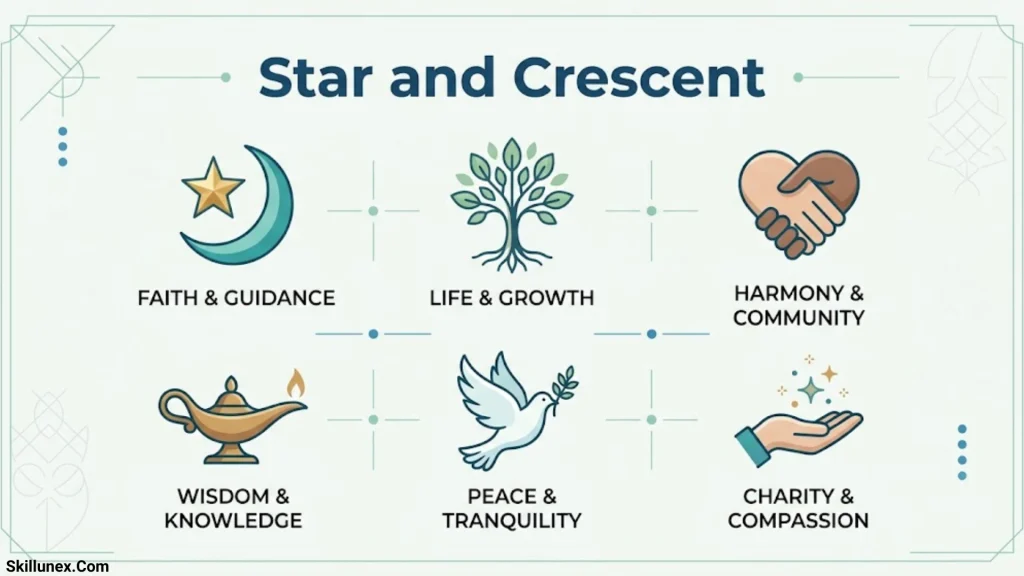
The crescent and star is frequently associated with Muslim-majority countries, flags, buildings, and cultural imagery. However, it is not a universal symbol prescribed by the Quran or required by Islamic teachings.
The design has a complex history, including associations with the Ottoman Empire. Its modern connection with Islam developed through historical and cultural use rather than through a single universal religious origin.
Shahada
Religion: Islam
Meaning: The declaration of faith in the oneness of Allah and the prophethood of Muhammad.
The Shahada is the Islamic declaration of faith. In English, its meaning is commonly expressed as: “There is no god but Allah, and Muhammad is the Messenger of Allah.”
It is a foundational expression of Islamic belief and may appear in Arabic calligraphy, religious settings, and historical designs. The Shahada is sacred text rather than simply a decorative emblem, so its use should reflect an understanding of its religious importance.
Allah in Arabic (الله)
Religion: Islam and Arabic-speaking religious contexts
Meaning: God.
Allah is the Arabic word for God. Muslims use it when referring to the one God, and Arabic-speaking Christians also use the word in prayer and religious writing.
The written form الله appears in Quranic calligraphy, religious artwork, and other contexts. It is important to distinguish the word itself from a standalone logo: its significance comes from its meaning and use in religious language.
Star of David (✡)
Religion: Judaism
Meaning: Jewish identity, heritage, and community.
The Star of David, known in Hebrew as Magen David, consists of two overlapping triangles that form a six-pointed star. It is one of the best-known symbols associated with Judaism and Jewish identity.
The star appears on synagogues, Jewish ceremonial objects, jewelry, and the flag of Israel. Its meaning today reflects a long history of Jewish communal and cultural identification, although its use and prominence have changed over time.
Menorah (🕎)
Religion: Judaism
Meaning: Jewish worship, sacred history, and religious tradition.
The traditional Jewish menorah is a seven-branched lampstand associated with the ancient Temple in Jerusalem. It remains an important emblem of Jewish history and religious heritage.
A nine-branched lamp called a hanukkiah is used during Hanukkah. It is related to the menorah but serves a different purpose. Distinguishing these objects helps avoid a common misunderstanding when identifying Jewish religious symbols.
Chai (חי)
Religion: Judaism
Meaning: Life.
Chai is a Hebrew word meaning “life.” Written with two Hebrew letters, it has an important place in Jewish culture and is commonly seen in jewelry, artwork, and personal gifts.
The symbol can express a wish for a long life, well-being, or a strong connection to Jewish identity. Its meaning is straightforward, but its cultural significance extends beyond the word’s literal translation.
Om or Aum (ॐ)
Religion: Hinduism, with significance in some Buddhist and Jain traditions
Meaning: Sacred sound, spiritual reality, and contemplation.
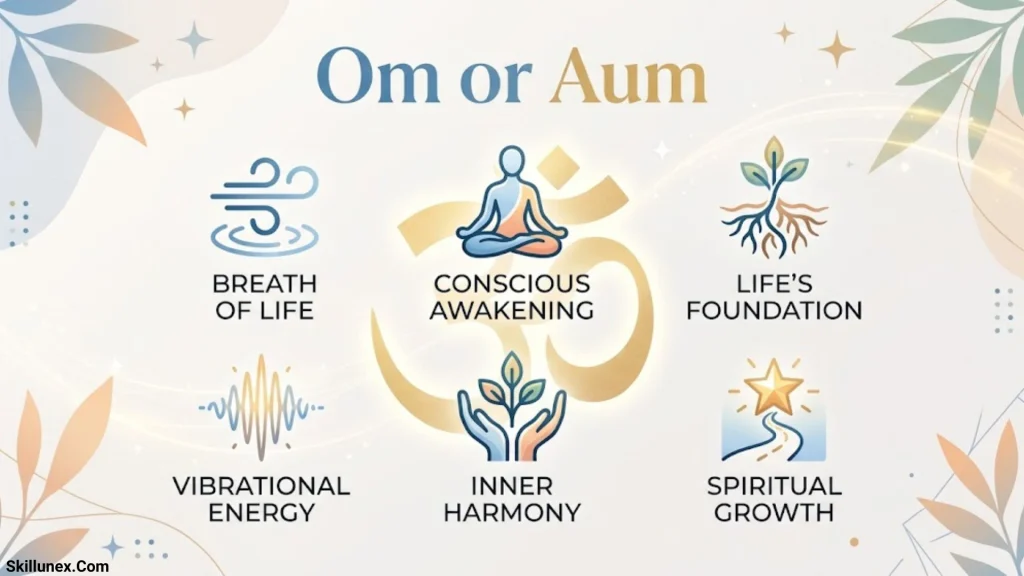
Om is one of the most important sacred syllables in Hindu traditions. It appears in prayers, mantras, meditation, and religious texts. Its sound is often understood as expressing a deep connection with ultimate reality.
The written symbol ॐ is also used in religious art, temple decorations, and personal devotional objects. Although Om is used in more than one Indian religious tradition, its precise interpretation varies.
Swastika (卐)
Religions: Hinduism, Jainism, and Buddhism
Meaning: Auspiciousness, well-being, and good fortune in many traditional Asian religious contexts.
The swastika is an ancient symbol with a long history across several cultures. In Hinduism, it is often associated with auspicious beginnings and prosperity. It also has significant uses in Jainism and Buddhism, although its specific meanings vary.
The symbol must be understood in its historical context. The Nazi regime appropriated a related form as an emblem of antisemitism, racial hatred, and genocide. As a result, its appearance in modern settings can be deeply sensitive. Traditional religious uses and Nazi imagery should not be treated as having the same meaning.
Trishula or Trident (🔱)
Religion: Hinduism
Meaning: Divine power and associations with Shiva.
The Trishula is a three-pronged trident closely associated with the Hindu deity Shiva. It appears in religious paintings, sculptures, temple decorations, and depictions of the deity.
Interpretations of its three prongs vary among traditions and teachers. The Trishula is best understood as a sacred attribute of Shiva rather than assigned one universal explanation.
Lotus Flower (🪷)
Religions: Hinduism and Buddhism
Meaning: Purity, spiritual growth, and sacred beauty.
The lotus grows in muddy water but rises above the surface to produce a beautiful flower. This natural process makes it a powerful image of spiritual development and the possibility of rising above difficulties.
In Buddhism, the lotus is often associated with awakening and freedom from ignorance. In Hindu traditions, it is connected with several deities and themes of purity, creation, and divine beauty.
Diya or Oil Lamp (🪔)
Religion: Hinduism and other South Asian religious traditions
Meaning: Light, devotion, knowledge, and the overcoming of darkness.
A diya is a small oil lamp traditionally used during worship, ceremonies, and festivals. It is especially prominent during Diwali, when lamps are lit in homes and public spaces.
The diya represents more than physical illumination. In many settings, its light expresses hope, spiritual understanding, and the triumph of good over evil.
Dharma Wheel (☸)
Religion: Buddhism
Meaning: The Buddha’s teachings and the path toward awakening.
The Dharma Wheel, also called the Dharmachakra, is a central Buddhist symbol. Its eight spokes are commonly associated with the Noble Eightfold Path, which guides practitioners toward wisdom, ethical conduct, and mental discipline.
The wheel represents the teaching and practice of Dharma. It is displayed in Buddhist temples, religious artwork, flags, and educational materials.
Bodhi Tree
Religion: Buddhism
Meaning: Enlightenment and the Buddha’s spiritual awakening.
The Bodhi Tree is associated with the tree under which Siddhartha Gautama attained enlightenment and became the Buddha, according to Buddhist tradition.
Images of the tree appear in Buddhist art, sacred sites, and meditation settings. The symbol reminds Buddhists of the possibility of awakening through insight, discipline, and understanding.
Endless Knot
Religion: Buddhism, particularly Tibetan Buddhism
Meaning: Interdependence and interconnectedness.
The Endless Knot is a geometric design made from interwoven lines without an obvious beginning or end. It is one of the Eight Auspicious Symbols in Tibetan Buddhist traditions.
Its connected pattern is commonly interpreted as expressing the relationships among causes and effects, wisdom and compassion, and different aspects of existence. Interpretations may vary across schools and cultural contexts.
Khanda (☬)
Religion: Sikhism
Meaning: Sikh identity, spiritual commitment, and justice.
The Khanda emblem includes a central double-edged sword, a circular chakkar, and two curved swords. Together, these elements represent important themes in Sikh history and religious identity.
The emblem appears in gurdwaras, Sikh educational materials, community displays, and religious decorations. It is a recognized visual representation of Sikhism, although its individual elements can receive different explanations.
Ik Onkar (ੴ)
Religion: Sikhism
Meaning: The oneness of God.
Ik Onkar expresses a foundational Sikh belief in one divine reality. The symbol appears at the beginning of the mastermind Granth Sahib, the central scripture of Sikhism.
It is used in Sikh religious settings and artwork as an expression of devotion and belief. Because it represents a central teaching, it should be understood as a sacred expression rather than a generic decorative character.
Ahimsa Hand
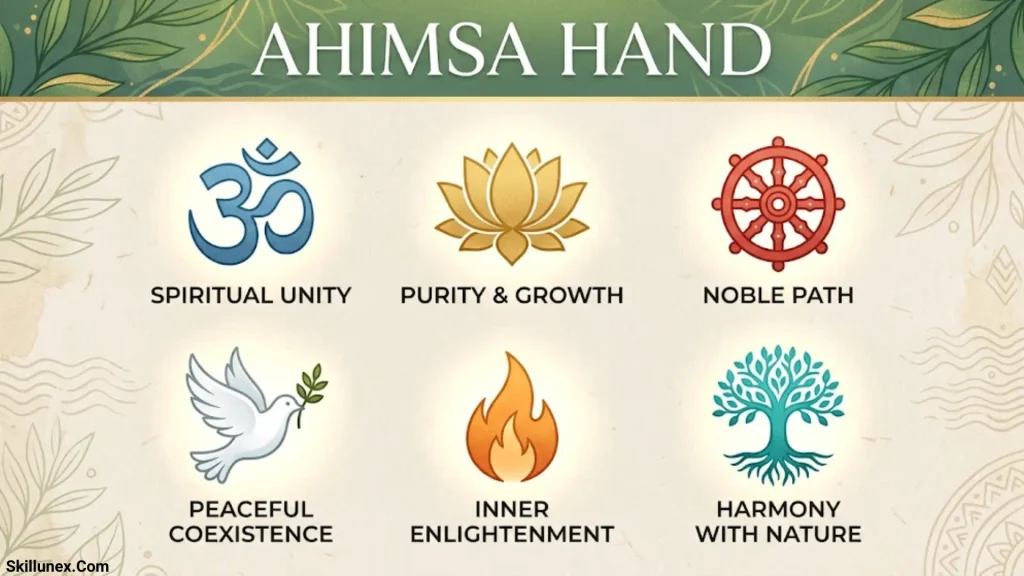
Religion: Jainism
Meaning: Nonviolence, compassion, and respect for living beings.
The Ahimsa Hand is commonly depicted as an open palm containing a wheel. It represents ahimsa, the principle of nonviolence that plays a central role in Jain ethics.
The symbol reminds followers of the importance of avoiding harm to living beings. It can also express restraint, responsibility, and compassion toward humans and other forms of life.
Jain Swastika
Religion: Jainism
Meaning: Important dimensions of existence and the spiritual journey.
In Jain religious settings, the swastika is associated with important teachings about existence and the cycle of rebirth. It is commonly shown alongside other elements in Jain devotional diagrams.
Its meaning is distinct from the Nazi appropriation of a related symbol. When discussing the Jain swastika, it is important to explain its religious context rather than assuming that every occurrence has the same historical meaning.
Yin Yang (☯)
Tradition: Taoist philosophy and Chinese cultural traditions
Meaning: Complementary forces and their relationship within the natural world.
The Yin-Yang symbol consists of two interlocking sections, one dark and one light, each containing a small circle of the opposite color. The design expresses the relationship between complementary aspects of existence.
Yin and yang are not simply symbols of good and evil. They describe how contrasting qualities can depend on and influence each other. The symbol is closely connected with Taoist thought and broader Chinese philosophy.
Torii Gate (⛩️)
Religion: Shinto
Meaning: Entrance to a sacred area associated with a shrine.
The torii is a traditional Japanese gate often found at the entrance to a Shinto shrine or along the approach to sacred grounds. Passing through it marks a transition into a space associated with the kami, or sacred presences, of Shinto belief.
Torii gates appear in a range of styles and colors, although red or vermilion gates are particularly familiar. The gate is an architectural structure with religious significance rather than simply a decorative icon.
Ankh (☥)
Tradition: Ancient Egyptian religion
Meaning: Life and vitality.
The ankh is an ancient Egyptian symbol shaped like a cross with a loop at the top. Egyptian religious artwork often depicts deities holding it or presenting it to a ruler.
The symbol represented life and became associated with divine power and continued existence. Today, it appears in historical illustrations, jewelry, and modern spiritual artwork, but its original meaning comes from ancient Egyptian culture.
Faravahar
Religion: Zoroastrianism and Persian cultural heritage
Meaning: Zoroastrian identity and spiritual tradition.
The Faravahar is a winged figure associated with ancient Persian art and modern Zoroastrian identity. It is one of the most recognizable emblems connected with Zoroastrian communities.
Modern interpretations often relate it to moral responsibility, spiritual development, and the importance of choosing the right path. However, its original historical interpretation remains debated, so specific explanations should be presented carefully.
Nine Pointed Star
Religion: Baháʼí Faith
Meaning: Baháʼí identity and associations with unity.
The nine-pointed star is a commonly used emblem of the Baháʼí Faith. The number nine has symbolic importance in the tradition and is often associated with completeness and unity.
The design appears in Baháʼí educational materials, community settings, and decorative artwork. It is a recognized symbol of the faith, although it is not the only design associated with Baháʼí communities.
Hamsa Hand (🪬)
Traditions: Jewish, Muslim, and wider Middle Eastern and North African cultural contexts
Meaning: Protection and good fortune in many popular interpretations.
The Hamsa is a hand-shaped design, sometimes featuring an eye in the center of the palm. It appears in jewelry, wall decorations, and other objects associated with protection against misfortune or the evil eye.
Its history crosses religious and cultural boundaries. The Hamsa should therefore not be described as exclusively Islamic or exclusively Jewish, and its meaning can differ according to the community using it.
Pentagram (☆)
Traditions: Several historical, religious, and spiritual traditions
Meaning: Varies according to context.
A pentagram is a five-pointed star drawn with five connected lines. It has appeared in different historical and spiritual contexts, including some modern Pagan and Wiccan traditions.
Its interpretation depends on how it is used. A pentagram should not automatically be labeled Satanic, because five-pointed stars have many unrelated meanings. An inverted pentagram can have different associations from an upright one, depending on the tradition.
Alpha and Omega (Α Ω)
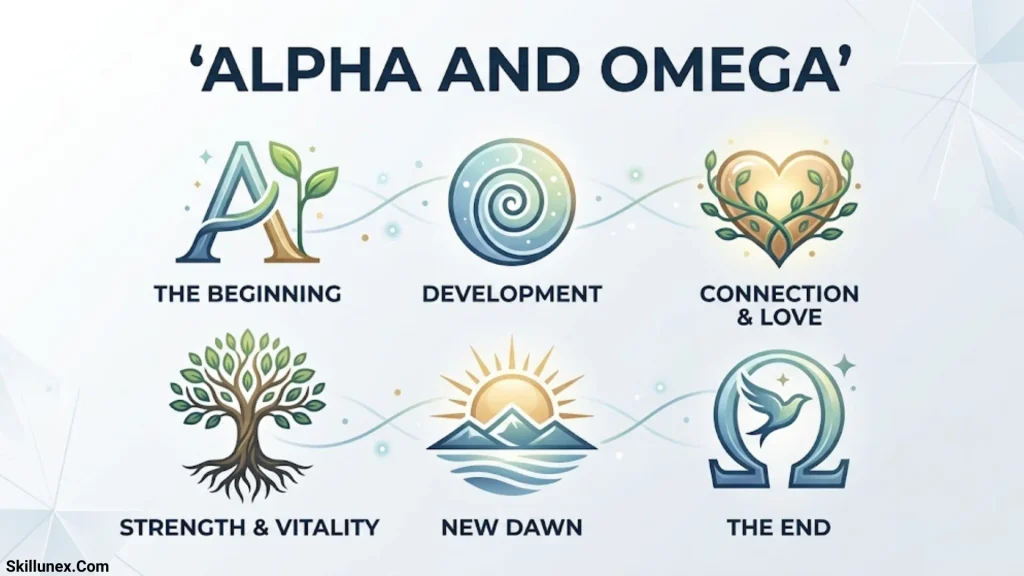
Religion: Christianity
Meaning: God as the beginning and the end.
Alpha and Omega are the first and last letters of the Greek alphabet. In Christian scripture and theology, they express the idea of God’s eternal nature and completeness.
The letters appear in church decorations, religious paintings, crosses, and other Christian designs. They are particularly useful for understanding how letters themselves can function as religious symbols.
Sacred Heart
Religion: Christianity, especially Catholic devotional tradition
Meaning: Jesus Christ’s love and compassion.
The Sacred Heart is a devotional image of the heart of Jesus, often shown with a crown of thorns, flames, or a cross. The design expresses divine love, mercy, and Christ’s suffering for humanity.
It is prominent in Catholic prayer, religious artwork, and devotional objects. Its specific significance comes from the history and theology of Sacred Heart devotion.
Prayer Beads
Religions: Multiple traditions, including Islam, Buddhism, Hinduism, and Christianity
Meaning: Prayer, remembrance, meditation, or devotional repetition.
Prayer beads are used in several religions, although their appearance and purpose differ. Muslims may use misbaha or tasbih beads for remembrance of God; Buddhists and Hindus may use mala beads for mantra recitation; Catholics may use the rosary in devotional prayer.
The beads themselves are not one universal religious symbol. Their meaning depends on the specific tradition, the prayers being recited, and the practices of the person using them.
Religious Symbols by Religion: Quick Comparison
This table summarizes major religious symbols and helps you compare their meanings at a glance.
| Religion or Tradition | Main Symbols | Common Themes |
| Christianity | Cross, Ichthys, Chi-Rho, Dove, Alpha and Omega | Jesus Christ, salvation, peace, and faith |
| Islam | Shahada, Arabic calligraphy, crescent in cultural contexts | Oneness of God, faith, and religious identity |
| Judaism | Star of David, Menorah, Chai | Jewish identity, life, worship, and heritage |
| Hinduism | Om, Trishula, Lotus, Diya, Swastika | Spiritual reality, divine power, auspiciousness, and devotion |
| Buddhism | Dharma Wheel, Lotus, Bodhi Tree, Endless Knot | Enlightenment, Dharma, and interdependence |
| Sikhism | Khanda, Ik Onkar | Oneness of God, justice, and Sikh identity |
| Jainism | Ahimsa Hand, Jain Swastika | Nonviolence, ethical conduct, and spiritual liberation |
| Taoism | Yin-Yang | Complementary forces and harmony |
| Shinto | Torii Gate | Sacred places and the kami |
| Zoroastrianism | Faravahar | Religious heritage and spiritual identity |
| Baháʼí Faith | Nine-Pointed Star | Unity and religious identity |
| Ancient Egyptian Religion | Ankh | Life and vitality |
These are representative examples, not exhaustive lists. Religious traditions contain many regional symbols, sacred objects, and visual styles that cannot be reduced to a single emblem.
Religious Symbols You Can Copy and Paste
If you need religious symbols for notes, educational content, messages, or social media, you can copy many Unicode characters directly from the list below.
| Symbol | Name | Associated Tradition |
| ✝ | Latin Cross | Christianity |
| ☦ | Orthodox Cross | Eastern Christianity |
| ☧ | Chi-Rho | Christianity |
| ☪ | Star and Crescent | Islamic cultural contexts |
| ✡ | Star of David | Judaism |
| 🕎 | Menorah | Judaism |
| חי | Chai | Judaism |
| ॐ | Om | Hinduism and other Indian traditions |
| 卐 | Traditional Swastika | Hinduism, Jainism, Buddhism |
| 🔱 | Trishula | Hinduism |
| 🪷 | Lotus | Hinduism and Buddhism |
| 🪔 | Diya | Hinduism and South Asian traditions |
| ☸ | Dharma Wheel | Buddhism |
| ☬ | Khanda emblem | Sikhism |
| ੴ | Ik Onkar | Sikhism |
| ☯ | Yin-Yang | Taoist philosophy |
| ☥ | Ankh | Ancient Egyptian religion |
| ⛩️ | Torii Gate | Shinto |
| 🪬 | Hamsa | Multiple cultural and religious contexts |
| ☆ | Five-Pointed Star | Multiple traditions |
Important: Unicode characters do not always look the same on every device. Some symbols may appear as colored emoji, while others may display as plain text or unsupported boxes. For sacred writing, detailed emblems, or historically accurate designs, use a reliable image or a specialist font when necessary.
The character 卐 is included to identify its traditional Asian religious uses, not to endorse Nazi imagery. If you use it in educational content, explain its context clearly.
What Is the Difference Between Religious Symbols and Spiritual Symbols?
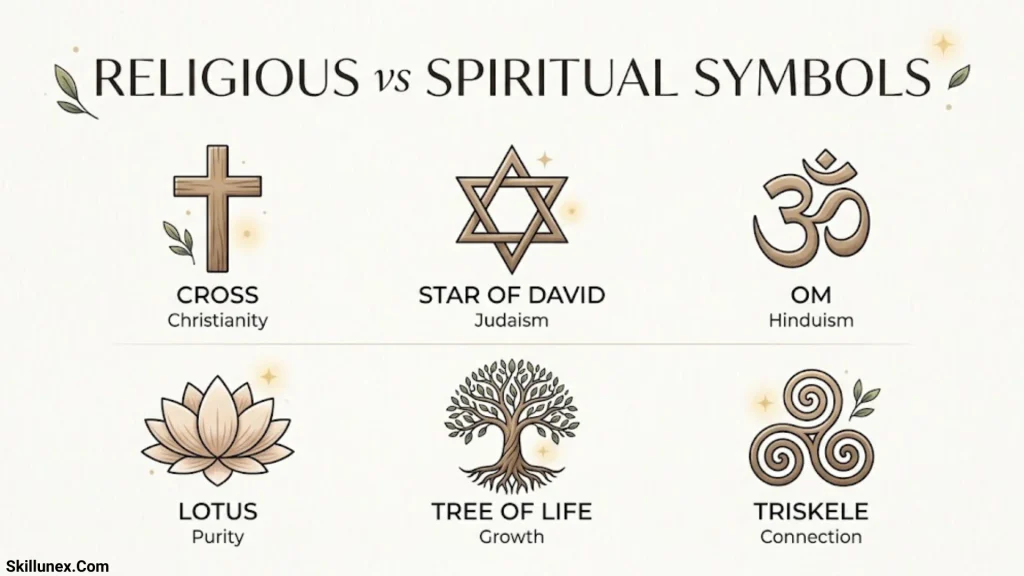
Religious symbols are generally associated with an established religion, its teachings, sacred objects, or community identity. Spiritual symbols can express broader ideas about personal growth, inner peace, harmony, or connection with something greater than oneself.
For example, the Khanda is closely associated with Sikhism, and the Star of David is strongly connected with Jewish identity. By comparison, a spiral may represent different ideas across different cultures and spiritual practices.
The distinction is not always strict. A lotus can be a religious symbol in Hinduism and Buddhism while also serving as a broader symbol of personal growth in contemporary settings. The same design may have different meanings depending on who uses it and why.
Why Are Religious Symbols Important?
Religious symbols can play an important role in worship, education, identity, and cultural preservation. Their significance often goes far beyond their visual appearance.
They Express Religious Beliefs
A symbol can communicate a central teaching in a form that people recognize immediately. The Christian cross, for example, connects believers with the story of Jesus Christ, while Ik Onkar expresses a foundational Sikh belief in the oneness of God.
They Preserve Cultural and Religious Heritage
Many symbols have been passed down through generations. Their continued use helps communities maintain connections with sacred history, traditional practices, and earlier generations.
They Support Worship and Reflection
Some symbols appear in prayer spaces, ceremonies, or meditation practices. They can help people focus their attention, recall religious teachings, or express devotion.
They Build a Sense of Community
Shared symbols can identify places of worship, religious organizations, and community events. They may help people feel connected to others who share their traditions and values.
They Communicate Complex Ideas
Concepts such as enlightenment, divine unity, and the relationship between opposing forces can be difficult to explain in a few words. Religious symbols offer visual ways to explore these ideas, although their meanings often require cultural and historical context.
How to Identify Religious Symbols Correctly
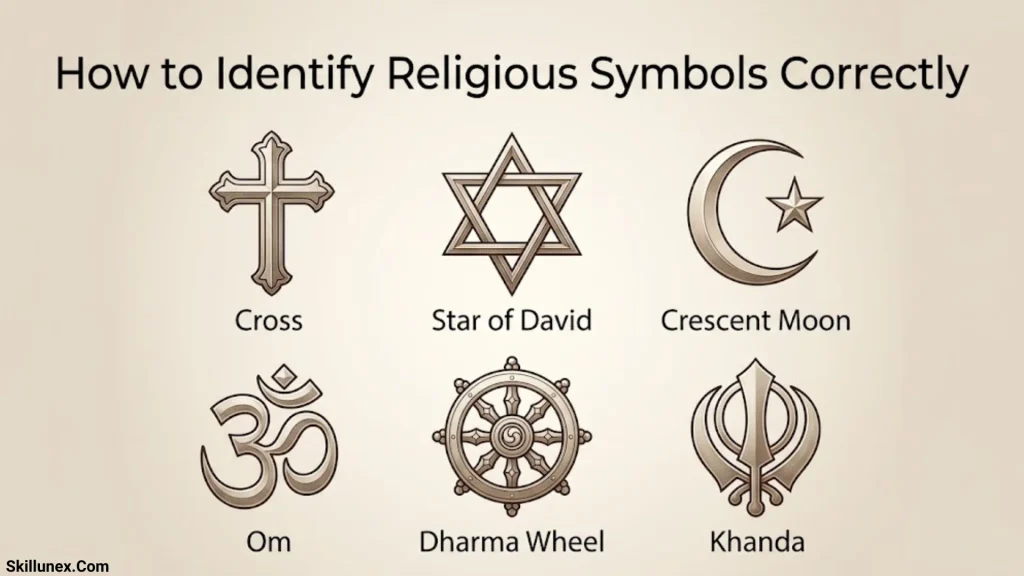
Not every symbol has one fixed meaning, and similar designs can appear in unrelated traditions. Follow these steps when researching an unfamiliar symbol.
- Examine the design. Identify its main shapes, lines, letters, colors, and distinctive details.
- Look at where it appears. A symbol found in a synagogue, temple, church, or historical monument may have a specific religious or cultural association.
- Check its historical background. Learn when it first appeared and how different communities have used it.
- Consult reliable sources. Museums, religious institutions, academic publications, and cultural organizations can help verify its meaning.
- Compare different interpretations. Some symbols have several meanings, even within the same religion.
- Avoid assumptions based on appearance alone. A star, circle, hand, or cross-like shape may have different meanings in different traditions.
- Respect sacred contexts. Before using a religious design in a tattoo, product, logo, or decorative project, learn whether its use may be sensitive or inappropriate to the community concerned.
For example, the crescent and star is commonly associated with Islam, but it is not a universal requirement of the faith. Similarly, the Hamsa appears in several cultural settings, and the pentagram has multiple religious and historical interpretations. Context is essential to understanding both correctly.
Frequently Asked Questions About Religious Symbols With Names
What Are the Most Common Religious Symbols With Names?
Some of the most recognized religious symbols are the Christian cross, Star of David, Om, Dharma Wheel, Khanda, Ik Onkar, Yin-Yang, and Ankh. The crescent and star is also widely associated with Muslim cultural identity. Each symbol has a distinct history and meaning, and not every symbol is used by all followers of a religion.
What Is the Oldest Religious Symbol?
There is no single symbol that scholars universally identify as the oldest religious symbol. Prehistoric markings and ancient artifacts may have had spiritual significance, but their original meanings are not always certain. The ankh and swastika are examples of symbols with very long documented histories, although their origins and uses differ.
Is There One Symbol That Represents All Religions?
No. There is no single visual symbol universally accepted by every religion. Some designs are used to express broad ideas such as unity, peace, or spirituality, but they do not represent all faiths. Religious traditions differ in their beliefs, practices, and approaches to sacred imagery.
What Is the Difference Between the Menorah and the Hanukkah Menorah?
The traditional menorah has seven branches and is associated with the ancient Temple in Jerusalem. The Hanukkah menorah, called a hanukkiah, has nine branches and is used during the eight-day festival of Hanukkah. The two are related but serve different purposes.
Is the Crescent and Star an Official Symbol of Islam?
The crescent and star is widely associated with Islam and appears in many Muslim cultural and historical contexts. However, it is not a universal symbol required by the Quran or Islamic teachings. Muslim communities use a range of cultural expressions and religious practices, and many do not rely on a single emblem.
What Does the Om Symbol Mean?
Om, also written Aum, is a sacred syllable with deep significance in Hinduism. It is associated with spiritual reality, sacred recitation, and meditation. The symbol also appears in some Buddhist and Jain contexts, although its meaning can vary by tradition.
Which Religious Symbols Represent Peace and Compassion?
The dove is widely associated with peace in Christian imagery. The Ahimsa Hand represents nonviolence in Jainism, while the lotus can represent spiritual purity and development in Hinduism and Buddhism. The meaning of any symbol depends on its religious and cultural context.
Can I Use Religious Symbols in Art, Jewelry, or Tattoos?
You can use many religious symbols in art and jewelry, but you should research their meaning and cultural significance first. Some designs are widely used in decorative contexts, while others represent sacred teachings, rituals, or objects that communities expect people to treat respectfully. Accurate context is especially important for symbols with sensitive historical associations.
Conclusion
Religious symbols with names help you explore the beliefs, histories, and traditions of communities around the world. The Christian cross, Islamic declaration of faith, Jewish Star of David, Hindu Om, Buddhist Dharma Wheel, Sikh Khanda, and Jain Ahimsa Hand all express different ideas about faith, identity, ethics, and spiritual life.
As you study these symbols, remember that their meanings come from the people and traditions that use them. Some represent specific religious teachings, while others have developed through centuries of cultural exchange. By learning their names, origins, and proper contexts, you can recognize religious symbols more accurately and appreciate the diversity of the world’s spiritual traditions.

I’m Adrian Holloway, a writer and researcher who enjoys exploring the stories, meanings, and interesting facts behind the subjects people search for every day. I’m especially interested in symbols, nature, lakes, places, and cultural topics that help readers understand the world from a different perspective.
I believe useful content should be simple, accurate, and enjoyable to read. When I research a topic, I focus on finding meaningful details and presenting them in a way that makes information easy to understand.
My goal is to create helpful articles that answer real questions while encouraging readers to discover something new with every visit.
Books by Adrian Holloway
The Language of Symbols: Meanings, Stories & Traditions
Hidden Wonders of Nature: Lakes, Landscapes & Discovery