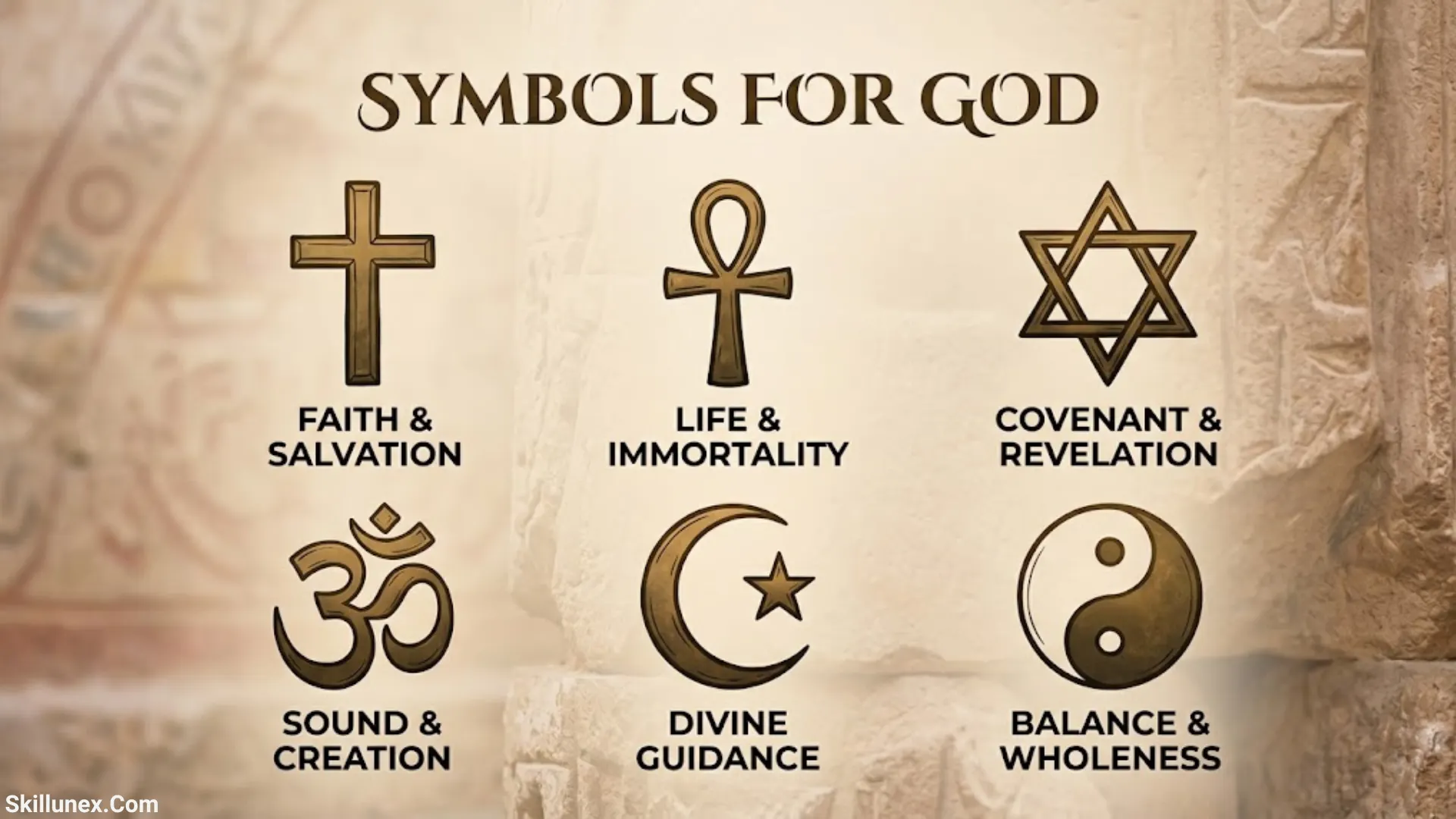
Symbols for God have helped people express faith, devotion, divine love, and spiritual connection for centuries. Across religions and cultures, sacred signs, names, shapes, and images communicate beliefs about the Creator, the nature of existence, and humanity’s relationship with the divine. Some symbols represent God directly through a sacred name, while others express divine qualities such as wisdom, mercy, eternity, and protection.
If you’re searching for symbols for God, you’ll find different meanings depending on your religious tradition. The Christian cross represents Jesus Christ’s sacrifice and salvation, the Arabic word Allah names God, and Om is a sacred sound and symbol associated with ultimate reality in Hindu traditions. Other signs, including the dove, the Eye of Providence, and the Alpha and Omega, communicate particular spiritual ideas.
I’ve brought together important symbols for God, their meanings, and their religious backgrounds so you can understand what each one represents. Whether you’re researching religious traditions, choosing a meaningful design, studying spiritual symbolism, or looking for a symbol that reflects your faith, this guide will help you distinguish sacred symbols from general spiritual imagery.
Symbols for God: (Quick Answer)
The most recognizable symbols associated with God include the Christian cross (✝), Allah written in Arabic (الله), Om (ॐ), the Eye of Providence, the dove, and the Alpha and Omega (Α Ω). The Jewish Tetragrammaton (יהוה) is a sacred four-letter divine name, while the Sikh Khanda (☬) and Bahá’í ringstone symbol express important religious beliefs.
However, there is no single symbol for God that every religion recognizes. Each symbol has a particular history, meaning, and place within its religious or cultural tradition.
Popular Symbols for God and Their Meanings
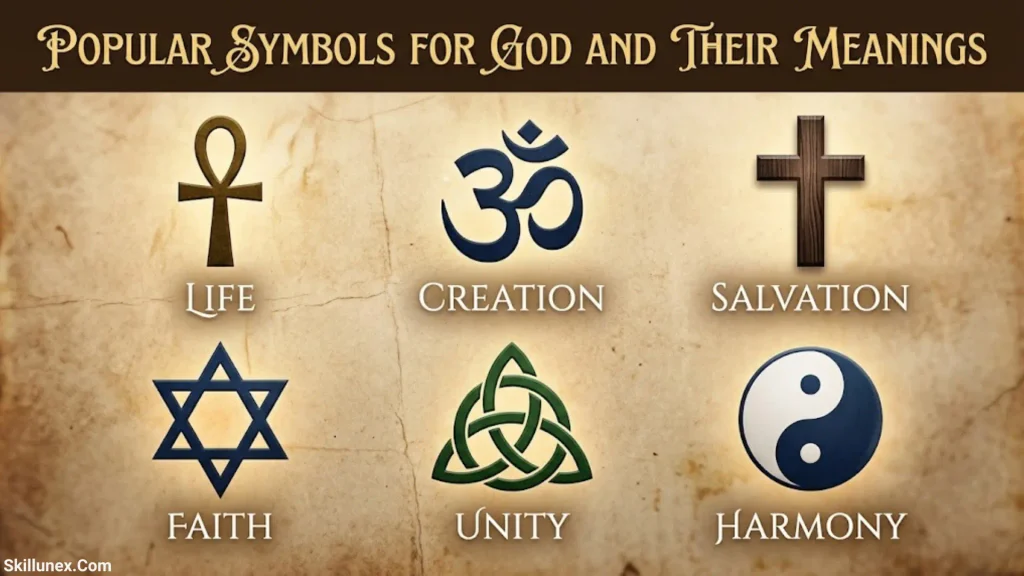
Several religious symbols are widely recognized because they represent divine qualities, sacred teachings, or a community’s understanding of God. The following examples explain their meanings and the traditions associated with them.
The Christian Cross (✝)
The cross is one of the best-known symbols of God in Christianity. It represents the crucifixion of Jesus Christ and the Christian belief that his sacrifice offers salvation and reconciliation with God.
For Christians, the cross can also represent divine love, forgiveness, hope, and victory over sin. It appears in churches, religious paintings, jewelry, personal devotional items, and cemeteries.
Although people sometimes describe the cross as a symbol of God, its most specific meaning is connected to Jesus Christ and the central Christian message of salvation.
The Arabic Name Allah (الله)
Allah is the Arabic word for God. It holds central importance in Islam, where it refers to the one, unique God who created and sustains everything.
The name frequently appears in Arabic calligraphy, religious manuscripts, mosque decoration, and Islamic artwork. Different calligraphic styles can make the name look like an elaborate design, but the underlying word remains the Arabic name for God.
Allah is not a name used exclusively by Muslims. Arabic-speaking Christians also use the word when referring to God. Its meaning comes from the Arabic language and religious context, rather than from a decorative symbol alone.
Om (ॐ)
Om, also written as Aum, is a sacred sound and symbol in Hindu traditions. It is associated with ultimate reality, consciousness, and the spiritual foundations of existence.
In many Hindu practices, Om is recited during meditation, prayer, and religious ceremonies. Its written form appears in sacred texts, temples, artwork, and personal devotional objects.
Om also appears in some Buddhist and Jain traditions, although its interpretation varies. It should not be treated as a universal symbol for God because different religions understand the divine and ultimate reality in different ways.
The Eye of Providence
The Eye of Providence usually appears as an eye surrounded by rays of light, sometimes placed inside a triangle. In certain Christian interpretations, it represents God’s watchful presence, divine knowledge, and providence.
The symbol is also known from historical artwork and the Great Seal of the United States, where it appears above a pyramid on the reverse. Its appearance in civic or historical imagery does not automatically give it a specifically Christian meaning in every context.
If you choose the Eye of Providence as a spiritual symbol, its association with divine awareness and guidance is more relevant than unsupported claims that it always represents a secret society or a single religious belief.
The Dove
The dove is an important symbol in Christianity, particularly in connection with the Holy Spirit. In the biblical account of Jesus’ baptism, the Spirit is described as descending like a dove.
Because of this association, the dove can represent divine presence, peace, purity, spiritual guidance, and renewal. It is common in Christian paintings, stained-glass windows, church decorations, and religious jewelry.
The dove does not directly represent God in every religious tradition. Its meaning depends on the story, artwork, or belief system in which it appears.
The Alpha and Omega (Α Ω)
Alpha and Omega are the first and last letters of the Greek alphabet. In Christian scripture, they are used to express the idea of being the beginning and the end.
The letters are often associated with God’s eternal nature and, in Christian contexts, with Christ. They may appear together on crosses, church decorations, religious books, and Christian jewelry.
The symbol offers a simple way to communicate eternity, completeness, and the belief that divine existence extends beyond the beginning and end of human life.
The Christian Ichthys (Fish Symbol)
The Ichthys is a fish-shaped symbol associated with early Christianity. It became a way for Christians to identify their faith and express their connection to Jesus Christ.
The symbol is sometimes formed by two curved lines that create the outline of a fish. It appears on car decals, jewelry, artwork, and other Christian items.
Unlike the cross, the Ichthys does not depict the crucifixion. Instead, it represents Christian identity and belief in Jesus. It is best understood as a symbol of Christianity rather than a universal representation of God.
The Star of David (✡)
The Star of David is a six-pointed star formed by two overlapping triangles. It is one of the most recognizable symbols of Jewish identity and is widely used in Jewish communities, synagogues, cultural artwork, and the flag of Israel.
The symbol represents Jewish heritage, identity, and communal belonging. Although Judaism is centered on belief in one God, the Star of David does not simply mean God or serve as a direct depiction of the divine.
Understanding this distinction is important when comparing religious symbols. A symbol may represent a faith community without representing God Himself.
The Sikh Khanda (☬)
The Khanda is a central symbol of Sikhism. Its design includes a double-edged sword, a circular chakkar, and two curved swords called kirpans.
The elements are associated with Sikh teachings about spiritual truth, justice, responsibility, and the relationship between spiritual life and worldly duties. The symbol appears in Sikh religious settings, on flags, and in cultural and community artwork.
The Khanda is not simply a picture of God. Rather, it communicates important Sikh principles and religious identity.
The Bahá’í Ringstone Symbol
The Bahá’í ringstone symbol is a distinctive design used in certain Bahá’í jewelry and religious contexts. Its three horizontal levels represent the world of God, the world of God’s Manifestations, and the world of humanity. A central vertical line connects these levels.
In Bahá’í explanations, the design expresses the relationship between God, the divine messengers, and human beings. It is a more specific symbol than a general geometric pattern because its parts have established meanings within the Bahá’í Faith.
The ringstone symbol is not interchangeable with the Bahá’í nine-pointed star, which is commonly used to identify the religion.
Symbols That Represent God’s Presence
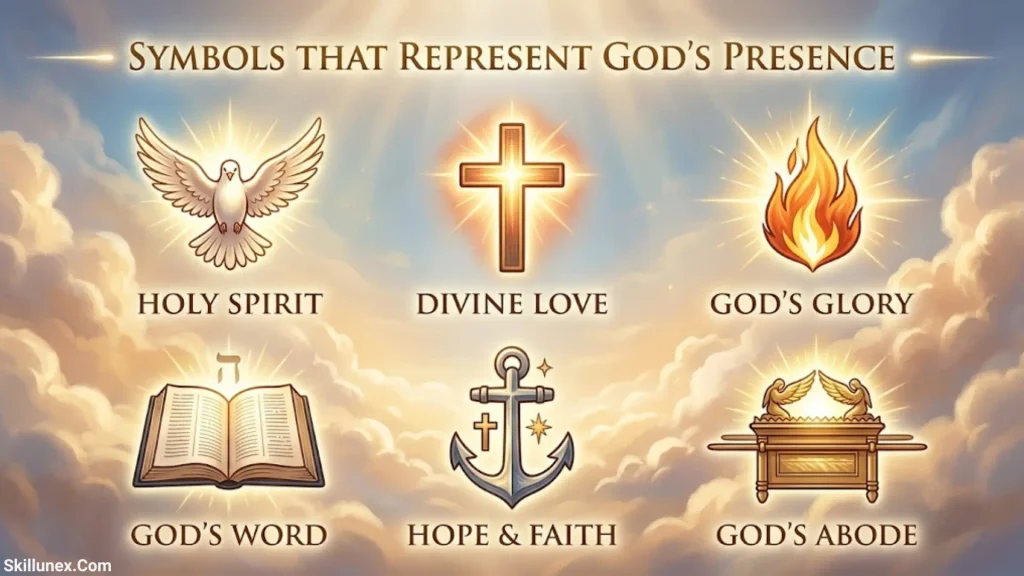
Not every symbol associated with God names or depicts the divine directly. Many use familiar elements from nature or geometry to communicate spiritual qualities.
Light and Rays of Light
Light often represents truth, wisdom, goodness, and divine guidance. Religious texts and artwork frequently use light to express the difference between understanding and confusion or between hope and despair.
Rays of light surrounding a sacred image may suggest divine glory or revelation. However, light is a broad spiritual motif, not a symbol exclusive to one religion.
The Sun
The sun provides warmth and supports life, making it a powerful image in many cultures and religious traditions. It may represent illumination, vitality, creation, or divine power.
Some traditions associate the sun with particular deities, while others use sunlight more generally as a metaphor for spiritual understanding. It is therefore important not to assume that every sun symbol represents the same god or religious belief.
The Flame
A flame can symbolize spiritual devotion, purification, divine presence, or the light of wisdom. Candles and lamps are used in many religious ceremonies, although their specific roles differ.
For some people, a flame serves as a reminder to maintain faith and seek truth. In other settings, it has a more formal ritual meaning. The symbol should be interpreted according to the tradition in which it is used.
The Circle
A circle has no beginning or end in its basic geometric form, so it is often used in spiritual artwork to suggest eternity, wholeness, unity, and completeness.
Some religious designs place a circle around a sacred image or use circular patterns to express harmony. Nevertheless, a plain circle is not automatically a symbol for God. Its meaning depends on the design and cultural context.
The Lotus
The lotus is particularly important in Hindu and Buddhist traditions. It is associated with purity, spiritual development, and the emergence of beauty from difficult conditions.
In Hinduism, the lotus is connected with several deities and can represent divine qualities. In Buddhism, it often symbolizes awakening and spiritual growth. These meanings overlap in some respects, but the lotus should not be described as a universal symbol for a creator God.
Symbols for God in Christianity
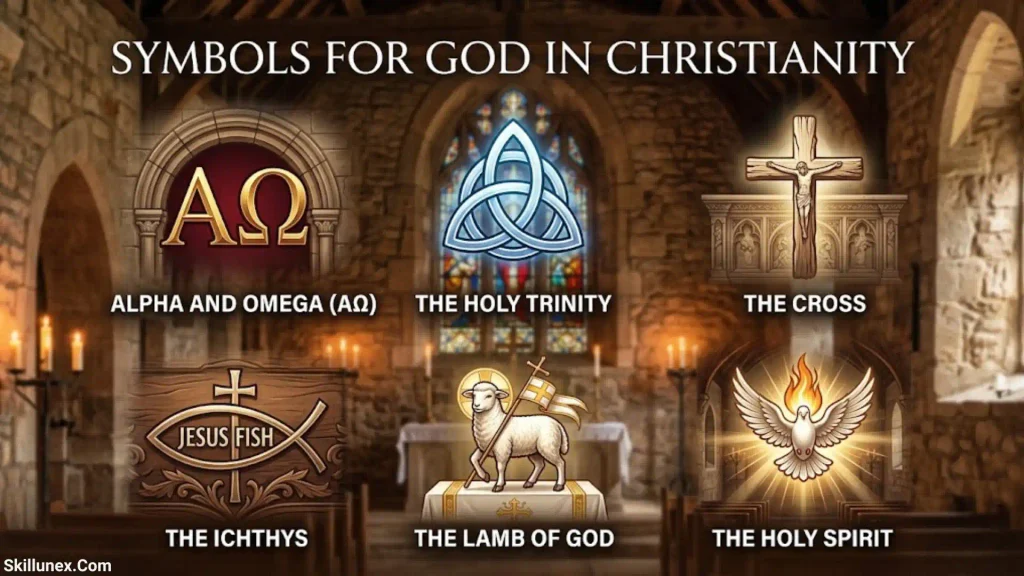
Christianity uses several symbols to communicate beliefs about God, Jesus Christ, and the Holy Spirit. Some focus on salvation, while others emphasize divine presence or the eternal nature of God.
The Chi-Rho (☧)
The Chi-Rho combines the Greek letters Chi and Rho, the first two letters of the Greek word Christos, meaning Christ. It became an important Christian emblem and appears in historical religious art, church decoration, and manuscripts.
The Chi-Rho represents Christ and Christian faith. It is especially relevant when studying early Christian history and the development of Christian visual traditions.
The Lamb of God
The lamb is a biblical image associated with sacrifice, innocence, redemption, and Jesus Christ. The expression “Lamb of God” has a central place in Christian theology and worship.
Artwork may show a lamb alone, carrying a cross, or standing with a banner. These details can reinforce its connection to Christ’s sacrifice and victory.
The Trinity Knot
The Trinity knot is an interlaced design with three connected sections. Some Christians use it to represent the Holy Trinity: the Father, the Son, and the Holy Spirit.
However, the design has broader historical associations, and not every example of an interlaced three-part knot is specifically Christian. Its intended meaning should be established from the context in which it appears.
The Crown
A crown can represent divine authority, sovereignty, kingship, or victory. In Christian art, it may be associated with Christ as King or with the promise of eternal life.
A crown does not necessarily represent God on its own. Its meaning becomes clearer when it appears alongside a cross, biblical imagery, or other Christian symbols.
Symbols for God in Islam
Islam emphasizes Tawhid, the oneness and uniqueness of God. Islamic religious expression gives particular importance to God’s names and attributes, prayer, and the remembrance of Allah.
The 99 Names of Allah
The 99 Names of Allah are associated with divine attributes, including mercy, knowledge, wisdom, and power. These names help Muslims reflect on different aspects of God’s greatness and perfection.
They are frequently presented in Arabic calligraphy, decorative panels, and religious artwork. The names are words with theological meaning, not merely decorative signs.
Bismillah (بسم الله)
Bismillah is the opening phrase meaning “In the name of Allah.” The fuller phrase Bismillah ir-Rahman ir-Rahim is commonly translated as “In the name of Allah, the Most Compassionate, the Most Merciful.”
Muslims use this phrase in many contexts to begin an action with remembrance of God. It appears in Quranic writing, calligraphy, and everyday religious practice.
Islamic Geometric Patterns
Islamic art is known for geometric patterns, floral designs, and calligraphy. Repeated shapes and carefully arranged patterns can express harmony, order, and the beauty of creation.
These patterns do not all have a fixed meaning, and they should not automatically be labeled symbols of Allah. Their significance depends on their artistic, architectural, and religious context.
The Crescent and Star (☪)
The crescent and star is widely associated with Islam in popular culture and appears on the flags of several countries with Muslim-majority populations.
However, it is not a universal or prescribed symbol of Islam, and it does not directly represent Allah. Its historical use developed over time, including through political and cultural associations. Some Muslims use it as an identity emblem, while others do not regard it as a religious symbol. See this discussion from Islam Question & Answer.
Symbols for God in Hinduism
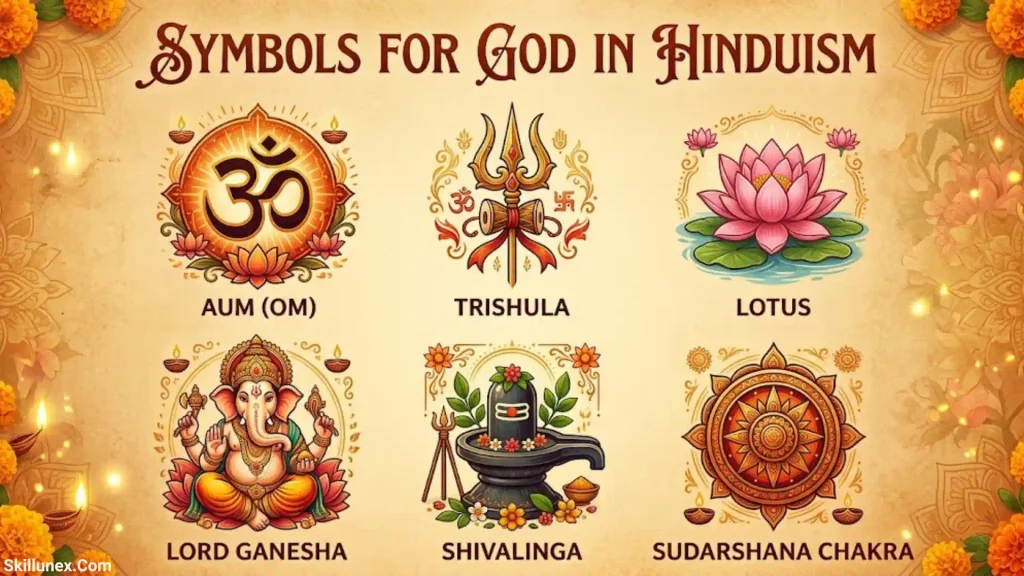
Hindu traditions include many ways of expressing the divine, ranging from sacred sounds and philosophical concepts to images associated with particular deities. Their meanings should be understood within the specific tradition.
The Shiva Lingam
The Shiva Lingam is a sacred form used in the worship of Shiva. It holds deep religious significance and is associated with Shiva’s divine presence and, in various interpretations, the nature of ultimate reality.
It is commonly found in Hindu temples and worship spaces. Its meaning is religious and symbolic, so it should not be reduced to a decorative object or treated as a generic symbol for every Hindu understanding of God.
The Trishula (Trident)
The Trishula is a three-pronged weapon associated especially with Shiva. It is an important attribute in Hindu iconography and has multiple interpretations within Hindu traditions.
Depending on the context, the three prongs may be explained in relation to different aspects of existence or divine power. There is no single interpretation that covers every use of the symbol.
The Sri Yantra
The Sri Yantra is a sacred geometric diagram used in particular Hindu traditions, especially in Shri Vidya practices. It consists of interlocking triangles arranged around a central point.
The design has specific ritual and philosophical meanings. It is associated with the divine feminine and with complex understandings of cosmic unity and manifestation. It is therefore more precise to describe it as a sacred yantra than as a universal symbol for God.
Symbols for God in Judaism
Judaism emphasizes belief in one God and has a rich tradition of sacred names, texts, and religious symbols. Some of its most significant expressions of the divine are written rather than pictorial.
The Tetragrammaton (יהוה)
The Tetragrammaton is the four-letter divine name written in Hebrew as יהוה, represented in English letters as YHWH or YHVH. It appears throughout the Hebrew Bible and holds a particularly sacred place in Jewish tradition.
Many Jewish communities avoid pronouncing this name as written and use alternatives such as Adonai or HaShem, meaning “the Name,” depending on the context. Its original pronunciation is a subject of historical and scholarly discussion. You can learn more from My Jewish Learning.
Because of its sacred status, the Tetragrammaton should not be treated as an ordinary decorative character. Anyone using it in artwork or jewelry should understand the relevant Jewish customs.
The Menorah
The menorah is a seven-branched lampstand with deep roots in Jewish religious history. It is associated with the ancient Temple in Jerusalem and remains an important symbol of Jewish heritage and identity.
The menorah is not a direct image of God. Rather, it connects Jewish communities with religious history, worship, and continuity.
The Star of David
The Star of David also has an important place in Jewish identity. While it is widely recognized around the world, its significance is more closely associated with the Jewish people and Judaism than with a direct representation of God.
Symbols That Represent God’s Protection, Wisdom, and Love
People often search for symbols of God because they want a visual reminder of a particular spiritual quality. The following examples can help you choose a symbol based on the meaning you want to communicate.
Symbols of God’s Protection
The Eye of Providence may represent divine watchfulness in certain Christian contexts. Religious names, prayers, and sacred emblems in other traditions can also remind believers of God’s care and protection.
A symbol can provide comfort or strengthen a person’s sense of faith, but it should not be presented as a guarantee that harm will be prevented. Its value lies in its religious meaning and the belief it represents.
Symbols of God’s Wisdom
Light is commonly associated with wisdom and understanding. In Christian contexts, the Alpha and Omega can communicate the eternal nature of God, while sacred teachings and divine names in other traditions may express knowledge and guidance.
When selecting a symbol of wisdom, consider whether you want to represent divine knowledge, personal spiritual growth, or the search for truth. These ideas are related but not identical.
Symbols of God’s Love
The cross is a central Christian symbol of divine love because of its connection with Jesus Christ’s sacrifice. The dove can represent peace and the Holy Spirit, while a heart may communicate love in religious artwork.
Other traditions express divine compassion through sacred names, teachings, and images associated with mercy. A heart or a light may be meaningful to you, but neither is a universal religious symbol for God’s love.
Symbols for God for Tattoos and Jewelry
If you’re choosing a symbol for a tattoo, necklace, bracelet, or personal keepsake, consider both its appearance and its religious significance. A symbol that looks attractive may carry meanings you did not expect.
| Symbol | Common Meaning | Possible Use |
| Cross (✝) | Christ’s sacrifice, salvation, and faith | Christian jewelry or tattoos |
| Allah (الله) | The Arabic name for God | Islamic calligraphy and devotional art |
| Om (ॐ) | Sacred sound and ultimate reality | Hindu-inspired spiritual artwork |
| Dove | Holy Spirit, peace, and renewal in Christianity | Religious artwork and jewelry |
| Alpha and Omega (Α Ω) | Beginning, end, and eternity | Christian pendants or tattoos |
| Ichthys | Christian identity and belief in Jesus | Minimalist Christian designs |
| Star of David (✡) | Jewish identity and heritage | Jewish jewelry and cultural designs |
| Khanda (☬) | Sikh faith, truth, and responsibility | Sikh cultural and religious designs |
| Bahá’í ringstone symbol | Relationship between God, divine messengers, and humanity | Bahá’í identity jewelry |
| Circle | Wholeness or eternity in some interpretations | General spiritual artwork |
Before choosing a design, ask yourself three questions:
- What does it mean? Learn the symbol’s history instead of relying only on social media descriptions.
- Does it fit your beliefs? A symbol associated with one faith may not reflect another faith’s teachings.
- Is it appropriate for the intended use? Some sacred names and designs are treated with particular reverence. For example, some believers may have concerns about placing sacred writing on objects that could be discarded or handled disrespectfully.
If you are unsure about a religious symbol, consult a knowledgeable person from the tradition it represents. This is especially helpful when the design contains a sacred name or has specific rules for religious use.
What Is the Most Powerful Symbol for God?
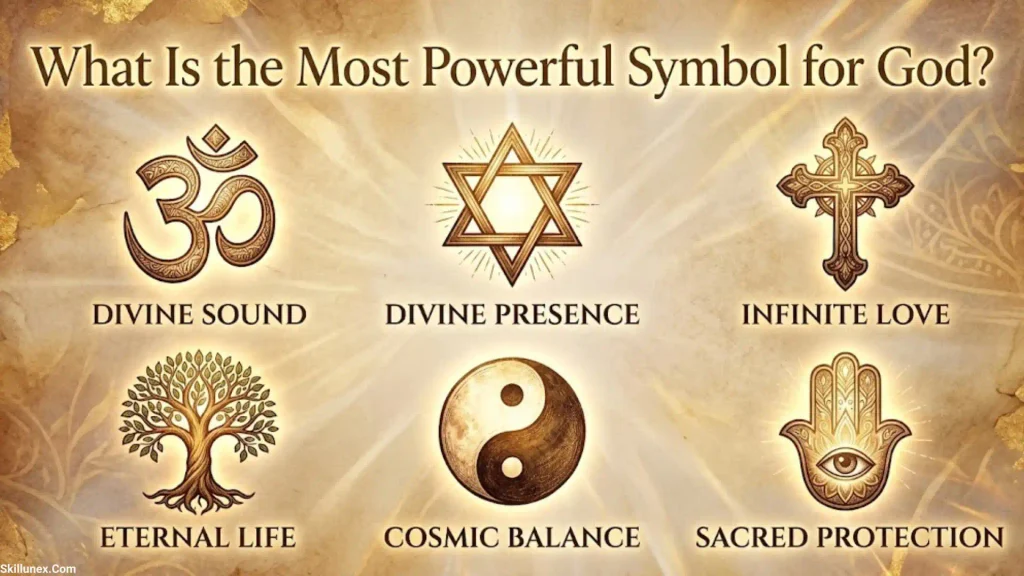
There is no single symbol that all religions consider the most powerful representation of God. Different traditions emphasize different beliefs, and some place greater importance on sacred words or teachings than on visual images.
For Christians, the cross is a central symbol of Christ’s sacrifice and salvation. In Islam, the name Allah expresses belief in the one God. In Hindu traditions, Om is associated with sacred sound and ultimate reality. In Judaism, the Tetragrammaton is a sacred divine name, while Sikhism uses the Khanda to express important principles of faith and responsibility.
A symbol may feel especially powerful to you because it reflects your beliefs, reminds you of a spiritual commitment, or provides comfort during difficult times. Its significance comes from the meaning you understand and the tradition in which it is rooted, rather than from a universal ranking of symbols.
Frequently Asked Questions About Symbols for God
What Is the Universal Symbol for God?
There is no universal symbol for God accepted by every religion. The cross is central to Christianity, Allah is the Arabic name for God, and Om has an important role in Hindu traditions. Each has a distinct meaning and religious context.
What Symbol Represents God’s Love?
The cross is a major symbol of God’s love in Christianity because it represents Jesus Christ’s sacrifice. The dove can represent the Holy Spirit and peace, while a heart is sometimes used in religious artwork to express love and compassion.
What Symbol Represents God’s Protection?
The Eye of Providence can represent God’s watchful presence in some Christian interpretations. Other religious traditions use sacred names, prayers, and emblems to express trust in divine protection. No symbol should be treated as a guaranteed source of supernatural safety.
What Is the Symbol for God in One Word?
There is no single answer across all religions. Allah is the Arabic word for God, Om is a sacred sound and symbol associated with ultimate reality in Hindu traditions, and the cross is a central Christian symbol associated with Jesus Christ.
Is Om a Symbol for God?
Om is a sacred sound and symbol in Hindu traditions, associated with ultimate reality and spiritual practice. It also appears in some Buddhist and Jain traditions, where its meaning can differ. It is not a universal symbol for God across all religions.
Is the Crescent and Star the Symbol of Allah?
No. The crescent and star is commonly associated with Islam and appears in various national and cultural settings, but it is not a universal symbol of Allah. The Arabic name Allah (الله) directly names God.
Can I Use a Symbol for God as a Tattoo?
You can choose a religious or spiritual symbol for a tattoo, but research its meaning and cultural context first. Sacred names and religious emblems may carry specific expectations about respectful use. When in doubt, ask someone knowledgeable about the tradition.
Are Symbols for God the Same as Symbols of Spirituality?
No. A symbol for God may directly name the divine or represent a specific religious belief. A spiritual symbol may instead represent meditation, personal growth, peace, or the search for meaning. Some symbols overlap, but they do not all have the same religious significance.
Conclusion
Symbols for God offer meaningful ways to express faith, divine love, wisdom, eternity, and spiritual connection. From the Christian cross and the Arabic name Allah to Om, the Eye of Providence, and the Jewish Tetragrammaton, each symbol carries a history that helps explain its significance.
If you want to choose a symbol for personal reflection, religious study, jewelry, or a tattoo, look beyond its appearance and learn what it means within its tradition. I recommend choosing a symbol that genuinely reflects your beliefs while respecting the people and communities for whom it is sacred. Understanding its origins will help you appreciate its deeper meaning.

Isla Kensington
I’m Isla Kensington, a writer with a passion for research, culture, nature, and the fascinating meanings behind everyday things. I enjoy taking topics that may seem simple at first and discovering the history, facts, and ideas that make them more interesting.
I write with readers in mind. My aim is to provide clear explanations, useful information, and interesting details without making a topic unnecessarily complicated.
I believe learning should feel like discovering something rather than simply reading facts. That philosophy guides the content I create and the topics I choose to explore.
## Books by Isla Kensington
* Symbols Around the World: A Guide to Meaning & Culture
* Nature’s Beautiful Places: Lakes, Landscapes & Natural Treasures