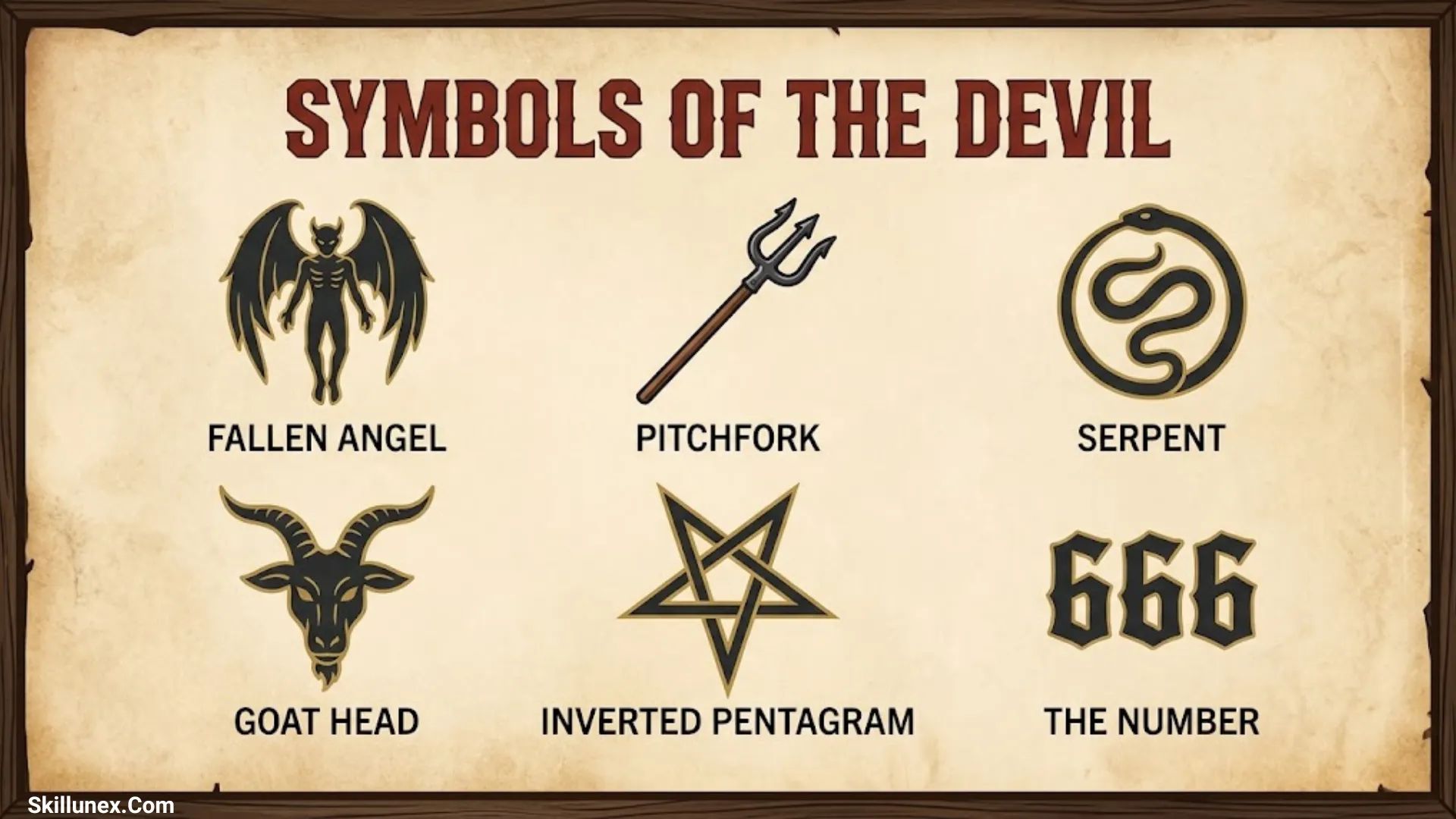
Symbols of the devil have fascinated people for centuries because of their mysterious meanings, dark history, and cultural significance. From the inverted pentagram to the Baphomet symbol, these images represent different beliefs, ideas, and traditions. If you are curious about dark symbolism, you can explore many interesting signs and their meanings.
When you look at symbols of the devil, you may discover that not every dark symbol represents evil or Satan. Some have historical, religious, or cultural origins, while others are associated with mythology, folklore, and popular culture. Understanding their background can help you learn what each symbol represents and why people use it.
In this guide, you will discover some of the most well-known symbols of the devil, along with their origins and meanings. If you are researching their history or simply exploring mysterious imagery, you can find useful information to understand these symbols better.
What Are the Symbols of the Devil?
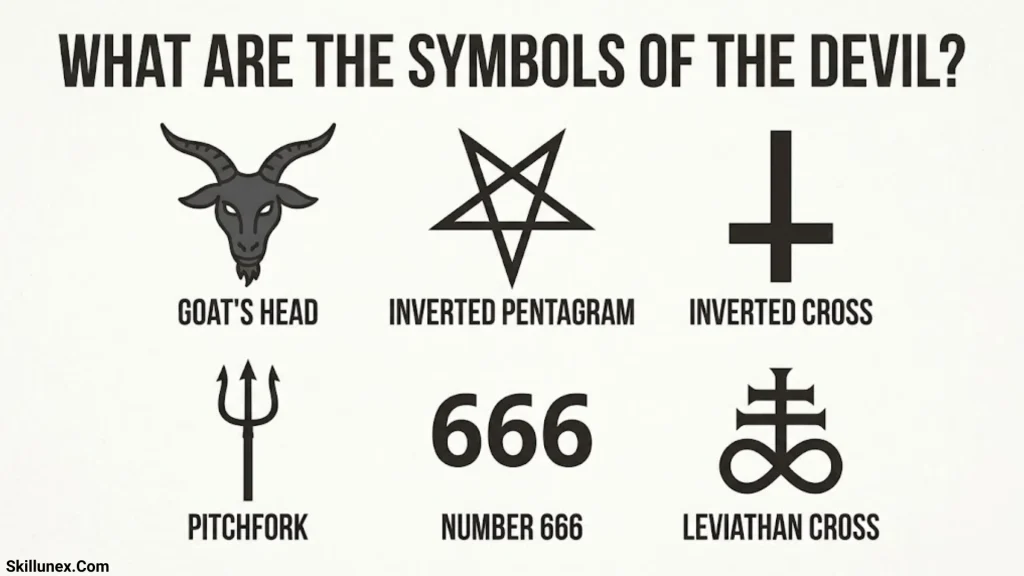
Symbols of the devil are images, numbers, signs, or objects that people associate with Satan, demonic forces, temptation, rebellion, or evil. They can originate from religious teachings, mythology, historical traditions, occult practices, and popular culture.
Some symbols have a direct connection with biblical descriptions of Satan or the forces of evil. Others became associated with the devil through centuries of religious artwork, folklore, and cultural storytelling.
For example, the number 666 is connected with the Beast in the Book of Revelation, while the serpent is associated with temptation in the biblical story of Adam and Eve. In contrast, the familiar image of a red devil carrying a pitchfork developed largely through European folklore and artistic traditions.
It is important to recognize that a symbol does not always have one universal meaning. The same image can represent evil in one tradition and wisdom, protection, fertility, or spiritual transformation in another.
15 Most Recognized Symbols of the Devil and Their Meanings
1. The Inverted Pentagram
The inverted pentagram is one of the most recognizable symbols associated with modern Satanic imagery. It consists of a five-pointed star positioned upside down, with two points facing upward and one point facing downward.
The pentagram has a long history that predates its association with Satanism. It appeared in ancient Greek and other historical traditions and was used for different symbolic and protective purposes.
Its association with the devil became particularly prominent through nineteenth-century occult literature and later twentieth-century Satanic imagery. In modern popular culture, the inverted pentagram is frequently used to represent rebellion against conventional religious beliefs, occult interests, and Satanism.
The symbol is also associated with the Sigil of Baphomet, an emblem adopted by the Church of Satan in the twentieth century. This connection helped establish the inverted pentagram as a recognizable element of modern Satanic iconography.
Meaning: In modern Satanic contexts, it can represent opposition to traditional religious authority, materialism, or an alternative spiritual philosophy. Its meaning depends on the group and context in which it appears.
2. The Number 666
The number 666 is commonly called the Number of the Beast and is among the most famous symbols associated with the devil.
Its origin comes from Revelation 13:18 in the New Testament, which describes the number of the Beast and invites readers to calculate it. Throughout Christian history, the passage has inspired numerous interpretations concerning evil, deception, corrupt authority, and opposition to God.
The number became widely recognized as a representation of Satan and the Antichrist. It frequently appears in horror movies, novels, music, tattoos, and other forms of popular culture.
Some historical scholars interpret the number through a practice known as gematria, in which letters correspond to numerical values. One influential historical interpretation connects 666 with the Roman emperor Nero, although interpretations of the passage remain debated.
Meaning: The number 666 traditionally represents the Beast, opposition to God, deception, and evil in Christian apocalyptic symbolism.
3. Baphomet
Baphomet is a symbolic figure commonly depicted with a human-like body, a goat’s head, wings, and other distinctive features.
Its historical background is complex. The name appeared in medieval accounts connected with accusations against the Knights Templar, although the precise origins and meaning remain disputed.
The modern image of Baphomet is strongly associated with a nineteenth-century illustration by French occultist Éliphas Lévi. His depiction included a horned figure with both masculine and feminine characteristics, a torch between its horns, and other symbolic details.
Baphomet later became an important image in modern occultism and Satanic symbolism. However, it is not simply another name for the biblical devil. Different traditions interpret the figure in different ways.
Meaning: Baphomet can represent duality, balance, the relationship between opposing forces, and occult philosophy. In some modern Satanic contexts, it also serves as a recognizable emblem.
4. The Serpent or Snake
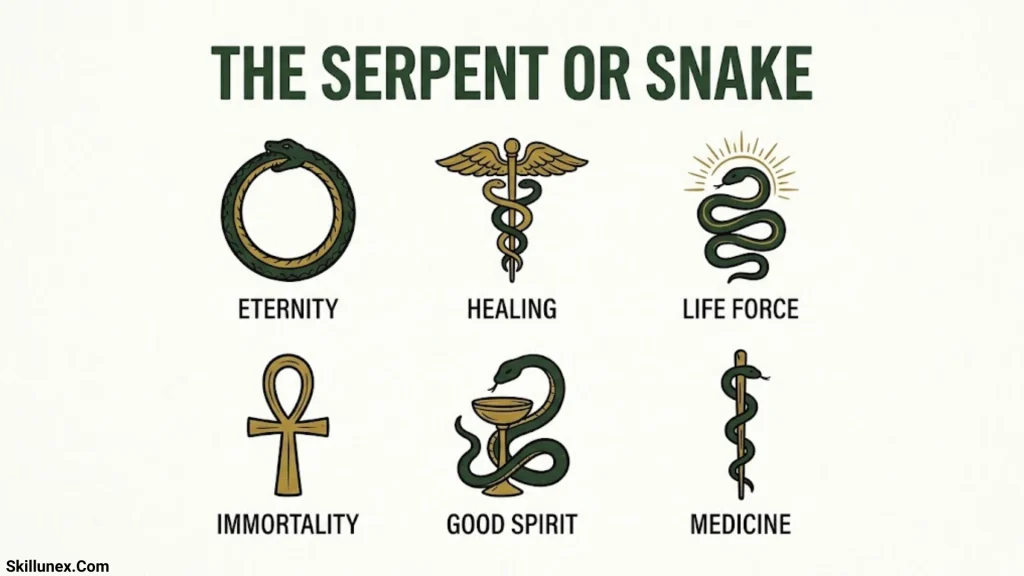
The serpent is one of the oldest and most widely recognized symbols associated with temptation and evil in Western religious tradition.
In Genesis 3, a serpent approaches Eve in the Garden of Eden and persuades her to eat the forbidden fruit. The story describes the introduction of temptation and disobedience into the biblical narrative.
Later Christian interpretation connects the serpent with Satan. Revelation 12:9 explicitly identifies the ancient serpent with the Devil and Satan.
However, snakes have many meanings outside Christian symbolism. Ancient cultures associated them with healing, fertility, wisdom, transformation, protection, and renewal.
For this reason, the serpent should not automatically be interpreted as a symbol of evil in every cultural or religious setting.
Meaning: In biblical symbolism, the serpent represents temptation, deception, and the influence of evil. In other traditions, it can represent wisdom, healing, and transformation.
5. The Goat’s Head
The goat’s head is another familiar image associated with the devil, particularly in European folklore, occult imagery, and modern horror culture.
Goat-like features became connected with demonic representations through the blending of religious interpretations, folklore, and artistic traditions. In some Christian-influenced artwork, horns and animal features were used to portray supernatural beings considered evil.
The goat’s head is also strongly associated with Baphomet, although the two should not always be treated as interchangeable symbols.
An important distinction is that goats themselves have no universal association with evil. In ancient mythology and other religious traditions, goats could represent fertility, nature, vitality, and abundance.
Meaning: In modern devil-related imagery, the goat’s head often represents occultism, rebellion, and demonic symbolism. Its wider historical meanings are more diverse.
6. The Upside-Down Cross
The upside-down cross is frequently used in horror movies, dark artwork, and modern entertainment to suggest Satanism or opposition to Christianity.
However, its original Christian association is different. The inverted cross is traditionally known as the Cross of Saint Peter.
According to Christian tradition, Saint Peter was crucified upside down because he considered himself unworthy of being executed in the same manner as Jesus Christ.
As a result, the inverted cross has an established place in Christian symbolism and is associated with humility and Saint Peter’s martyrdom.
Its use in modern horror and anti-Christian imagery has created confusion about its meaning. Context is essential when interpreting this symbol.
Meaning: Historically, it represents Saint Peter’s martyrdom and humility. In some modern entertainment and anti-Christian contexts, it is used to suggest rebellion or Satanic imagery.
7. The Devil’s Pitchfork
The devil’s pitchfork is a familiar object in Western illustrations, cartoons, folklore, and religious-inspired artwork.
It is usually represented as a three-pronged fork carried by a red figure with horns and a pointed tail. The object is often associated with the traditional popular image of the devil.
Unlike the number 666 or the serpent, the pitchfork does not have a direct biblical origin as Satan’s weapon. Its popularity developed through European visual traditions, theatrical representations, and later illustrations of hell.
The three-pronged design is recognizable and easy to reproduce, making it a common feature of Halloween decorations and fictional portrayals of the devil.
Meaning: The pitchfork represents the traditional folkloric image of the devil and his association with hell, punishment, and demonic power.
8. The Black Goat
The black goat appears in European folklore, supernatural stories, and modern occult-inspired artwork.
Its connection with the devil developed through historical associations between goats, horned supernatural beings, and certain pagan figures. Christian interpretations sometimes portrayed unfamiliar pagan imagery as demonic, contributing to the association between goats and evil.
The black goat also appears in modern horror literature and entertainment as a mysterious creature representing supernatural danger.
However, the animal itself has no inherently evil meaning. Black goats have also been ordinary symbols of agricultural life, nature, and traditional cultural practices.
Meaning: In devil-related folklore, the black goat can represent darkness, mystery, supernatural forces, and demonic imagery.
9. The Sigil of Lucifer
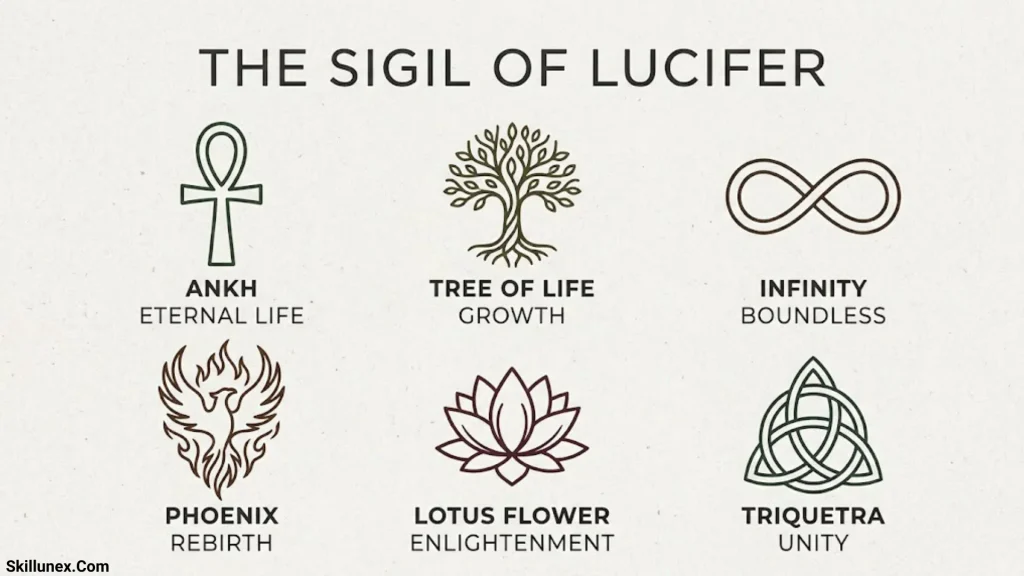
The Sigil of Lucifer is a symbol found in certain modern occult traditions. It is commonly presented as a geometric design made from lines and shapes arranged into a distinctive emblem.
The symbol is associated with Lucifer in some forms of occult literature and modern esoteric practice. Its exact historical development and use vary between sources and traditions.
The name Lucifer comes from a Latin term meaning light-bringer or morning star. Its association with Satan developed through particular Christian interpretations of biblical passages, especially the traditional interpretation of Isaiah 14.
Not every tradition interprets Lucifer in the same way. Some modern spiritual and literary interpretations portray Lucifer as a figure of knowledge, enlightenment, or rebellion rather than simply equating him with the devil.
Meaning: The sigil is associated with particular occult interpretations of Lucifer, although its meaning depends on the tradition using it.
10. The Eye of Providence
The Eye of Providence is an eye surrounded by rays of light, sometimes appearing within a triangle.
Some people associate this symbol with secret societies, occult practices, or supernatural powers. However, its historical meaning is more complicated.
The eye has appeared in Christian artwork as a representation of divine providence, meaning God’s awareness and protection. It is also recognizable from its appearance on the reverse side of the Great Seal of the United States.
Although conspiracy theories sometimes connect it with Satanism or hidden devil worship, there is no sound historical basis for treating the Eye of Providence as an inherently Satanic symbol.
Meaning: Historically, it represents divine watchfulness and providence. Its association with the devil is largely a modern misconception in some popular discussions.
11. The Horned Devil
The horned devil is a familiar representation of Satan in Western art, folklore, and popular entertainment.
The figure is often shown with horns, a red body, a pointed tail, and sometimes wings or animal-like features.
These visual characteristics developed over centuries through religious artwork, medieval representations of demons, theatrical traditions, and folklore.
The association between horns and evil was influenced by various cultural and religious developments. Some scholars also discuss the influence of pagan horned figures on later European depictions of demons, although the historical connections are not always straightforward.
Meaning: The horned devil represents the popular Western image of Satan and is commonly used to communicate evil, temptation, and supernatural danger.
12. The Skull and Crossbones
The skull and crossbones consists of a human skull placed above two crossed bones.
Historically, it has been used to represent death, mortality, danger, and poison. It also appeared in European artistic traditions known as memento mori, which reminded people of the temporary nature of human life.
Although the symbol is sometimes used in dark or Satanic-themed artwork, it is not inherently a symbol of the devil.
It has also been associated with piracy, hazardous substances, and warning signs.
Meaning: The skull and crossbones primarily represent death, danger, and mortality rather than Satan himself.
13. The Black Sun
The Black Sun is a complex symbol associated with certain modern esoteric and extremist movements.
Its most recognizable modern design features a circular arrangement of radial shapes. The symbol is particularly associated with the floor design found in the Wewelsburg Castle during the Nazi period.
Some modern occult and extremist groups have adopted variations of this image, giving it associations with esotericism, racial mythology, and extremist ideology.
Although it sometimes appears in Satanic-themed imagery, it should not be treated as a universal symbol of the devil.
Meaning: The Black Sun has several modern associations, including esoteric and extremist symbolism. Its meaning depends on its historical and ideological context.
14. The Dragon
The dragon appears in many ancient mythologies and religious traditions. Its meaning changes considerably across cultures.
In Christian apocalyptic literature, Revelation 12:9 describes a great dragon identified as the ancient serpent, the Devil, and Satan. This passage establishes an important connection between the dragon and Satan in Christian symbolism.
However, dragons are not universally evil. In Chinese culture, for example, dragons traditionally represent power, good fortune, wisdom, and protection.
European folklore often presents dragons as dangerous creatures that threaten communities and heroes.
Meaning: In Christian apocalyptic symbolism, the dragon represents Satan and opposition to God. In other cultures, dragons can symbolize strength, prosperity, wisdom, and protection.
15. The Flaming Infernal Image
Fire is one of the most familiar images associated with hell and the punishment of evil in Christian-inspired art and popular culture.
Religious descriptions of judgment and punishment have contributed to the visual association between flames and the devil. Artists, writers, and filmmakers have expanded this imagery into dramatic representations of hell, demons, and supernatural punishment.
However, fire has many other meanings in religious and cultural traditions. It can represent purification, transformation, divine presence, destruction, and renewal.
Meaning: In traditional devil-related imagery, flames represent hell, punishment, destruction, and the consequences of evil.
Historical Origins of Devil Symbols
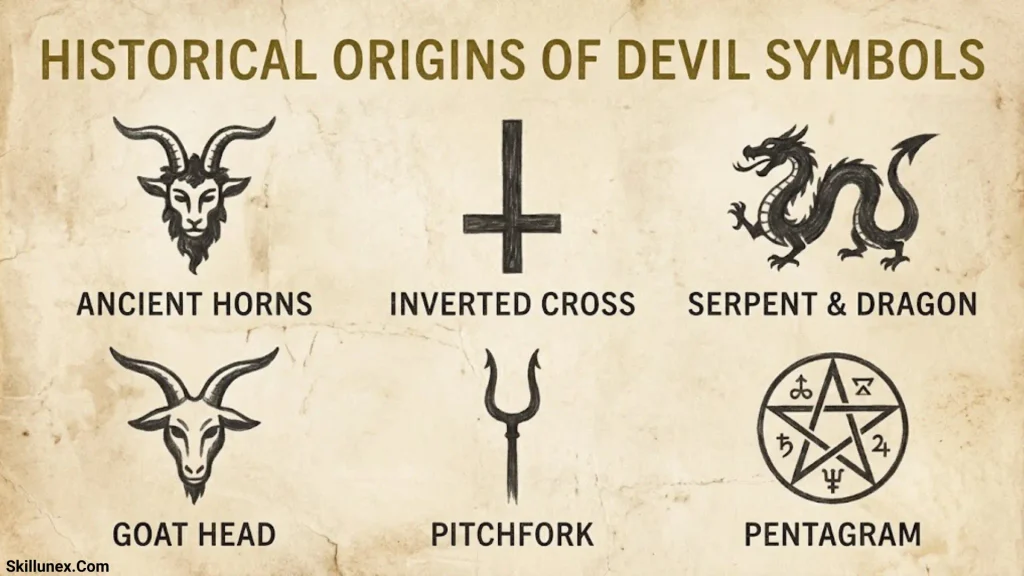
The symbols associated with the devil did not all emerge during the same period. Their development involved centuries of religious interpretation, folklore, mythology, art, and cultural exchange.
Ancient Civilizations and Mythological Influences
Ancient civilizations used animal figures, supernatural beings, and mysterious signs to represent forces of nature, spiritual power, and the unknown.
Some figures from ancient mythology were later compared with demons or the devil through religious interpretation. For example, Pan, a Greek deity commonly depicted with goat-like features, is sometimes discussed in relation to later Western depictions of the devil.
However, Pan was not originally a representation of Satan. The connection developed through later cultural and artistic interpretations.
Biblical and Early Christian Influences
The Bible provides several important foundations for symbols associated with Satan.
Genesis introduces the serpent in the Garden of Eden, while Revelation describes the Beast, the number 666, and the dragon identified with Satan.
Early Christian writers and artists gradually developed visual representations of evil, temptation, and demonic forces. These traditions influenced how the devil was portrayed in religious artwork and European culture.
Medieval Europe and Religious Artwork
During the medieval period, artists frequently portrayed demons with animal-like characteristics, including horns, claws, tails, and unusual faces.
These images helped communicate religious ideas about sin, judgment, temptation, and the dangers of evil.
Medieval literature and theatrical performances also contributed to the familiar image of a horned devil. Over time, these representations became deeply embedded in Western storytelling.
Modern Occultism and Popular Culture
During the nineteenth and twentieth centuries, occult literature and modern spiritual movements introduced new interpretations of older symbols.
The writings of Éliphas Lévi helped popularize the modern image of Baphomet, while later Satanic movements adopted specific emblems, including the Sigil of Baphomet.
Movies, television, music, fashion, and online culture further expanded the use of devil-related imagery.
Today, symbols such as 666, inverted pentagrams, and horned figures frequently appear in entertainment, although their use does not always indicate religious or Satanic belief.
Difference Between Satanic Symbols, Occult Symbols, and Religious Symbols
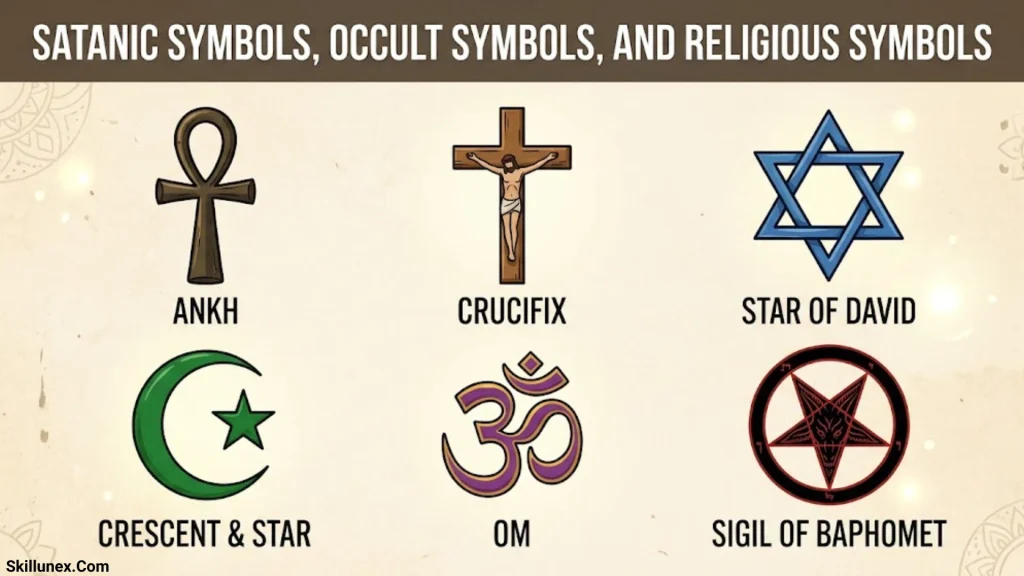
Not every mysterious or dark-looking image is a symbol of the devil. Understanding the difference between Satanic, occult, and religious symbols helps prevent incorrect interpretations.
Satanic Symbols
Satanic symbols are images intentionally associated with Satan, Satanism, or particular beliefs about the devil.
Examples include the Sigil of Baphomet, which is used by the Church of Satan, and the number 666 in Christian inspired Satanic imagery.
However, Satanism itself includes different philosophical and religious movements, and not all Satanists interpret Satan in the same way.
Occult Symbols
Occult symbols are associated with esoteric knowledge, hidden spiritual traditions, astrology, alchemy, ceremonial practices, and other systems of symbolic interpretation.
Examples include certain pentagrams, planetary signs, and historical alchemical symbols.
An occult symbol is not automatically Satanic. Many occult traditions have no direct connection with worship of Satan.
Religious Symbols
Religious symbols represent beliefs, spiritual teachings, sacred figures, and religious traditions.
For example, the inverted cross is historically associated with Saint Peter, while the Eye of Providence has been used to represent God’s watchfulness.
Some religious symbols may be interpreted differently by modern popular culture, but their historical meanings should not be ignored.
Are Devil Symbols Dangerous?
The appearance of a symbol alone does not establish that it is dangerous or connected with harmful activity.
A pentagram, serpent, skull, or inverted cross can have different meanings depending on the person, community, and context in which it appears.
Some symbols are used for artistic expression, historical study, fashion, religious identification, or entertainment. Others are deliberately adopted by specific ideological or spiritual movements.
It is therefore important to understand the origin and intended meaning of a symbol before drawing conclusions about it.
For parents, educators, and researchers, discussing these symbols through historical and cultural information is generally more useful than assuming that every unusual image represents a threat.
Frequently Asked Questions About Symbols of the Devil
What is the most famous symbol of the devil?
The number 666 is arguably the most widely recognized symbol associated with the devil. It comes from Revelation 13:18, where it is identified as the number of the Beast. The inverted pentagram and the Sigil of Baphomet are also widely recognized in modern Satanic imagery.
What does 666 mean in the Bible?
In Revelation 13:18, 666 is identified as the number of the Beast. Christian interpretations commonly associate it with evil, opposition to God, and corrupt worldly power. Some historical interpretations also connect the number with the Roman emperor Nero.
Is the inverted pentagram a symbol of Satan?
The inverted pentagram is associated with modern Satanic imagery, particularly through its use in the Sigil of Baphomet. However, pentagrams have existed in different cultures and spiritual traditions, and not every pentagram has a Satanic meaning.
Is Baphomet the devil?
Baphomet is not simply another name for the biblical devil. It is a symbolic figure with a complicated history involving medieval accusations, nineteenth-century occult literature, and modern religious and philosophical movements.
Is an upside-down cross a Satanic symbol?
Not inherently. The inverted cross is traditionally known as the Cross of Saint Peter and represents his martyrdom in Christian tradition. Some modern entertainment and anti-Christian movements use it as Satanic imagery, but this is a different interpretation.
What animal represents the devil?
The serpent and goat are among the animals most frequently associated with the devil in Western religious and cultural imagery. The dragon is also associated with Satan in the Book of Revelation. However, these animals have different meanings in other religious and cultural traditions.
Are all occult symbols connected to Satan?
No. Occult symbolism includes many different spiritual, philosophical, historical, and esoteric traditions. Some symbols have been adopted by Satanic movements, but others are completely unrelated to Satanism.
Why is the devil often shown with horns and a tail?
The familiar horned devil developed through centuries of European folklore, religious artwork, and theatrical representations. Artists used animal-like features to create recognizable images of supernatural evil. The exact development involved multiple cultural influences rather than one single historical source.
Conclusion
Symbols of the devil have different meanings, origins, and cultural associations. From the inverted pentagram to Baphomet, each symbol has its own history and significance. By exploring these symbols, you can better understand their connections to religion, mythology, folklore, and popular culture.
Remember that not every dark symbol represents evil or has the same meaning across different cultures. If you want to understand a particular symbol, always consider its history and context. Learning about these symbols can help you discover the fascinating stories and beliefs behind them.

Isla Kensington
I’m Isla Kensington, a writer with a passion for research, culture, nature, and the fascinating meanings behind everyday things. I enjoy taking topics that may seem simple at first and discovering the history, facts, and ideas that make them more interesting.
I write with readers in mind. My aim is to provide clear explanations, useful information, and interesting details without making a topic unnecessarily complicated.
I believe learning should feel like discovering something rather than simply reading facts. That philosophy guides the content I create and the topics I choose to explore.
## Books by Isla Kensington
* Symbols Around the World: A Guide to Meaning & Culture
* Nature’s Beautiful Places: Lakes, Landscapes & Natural Treasures