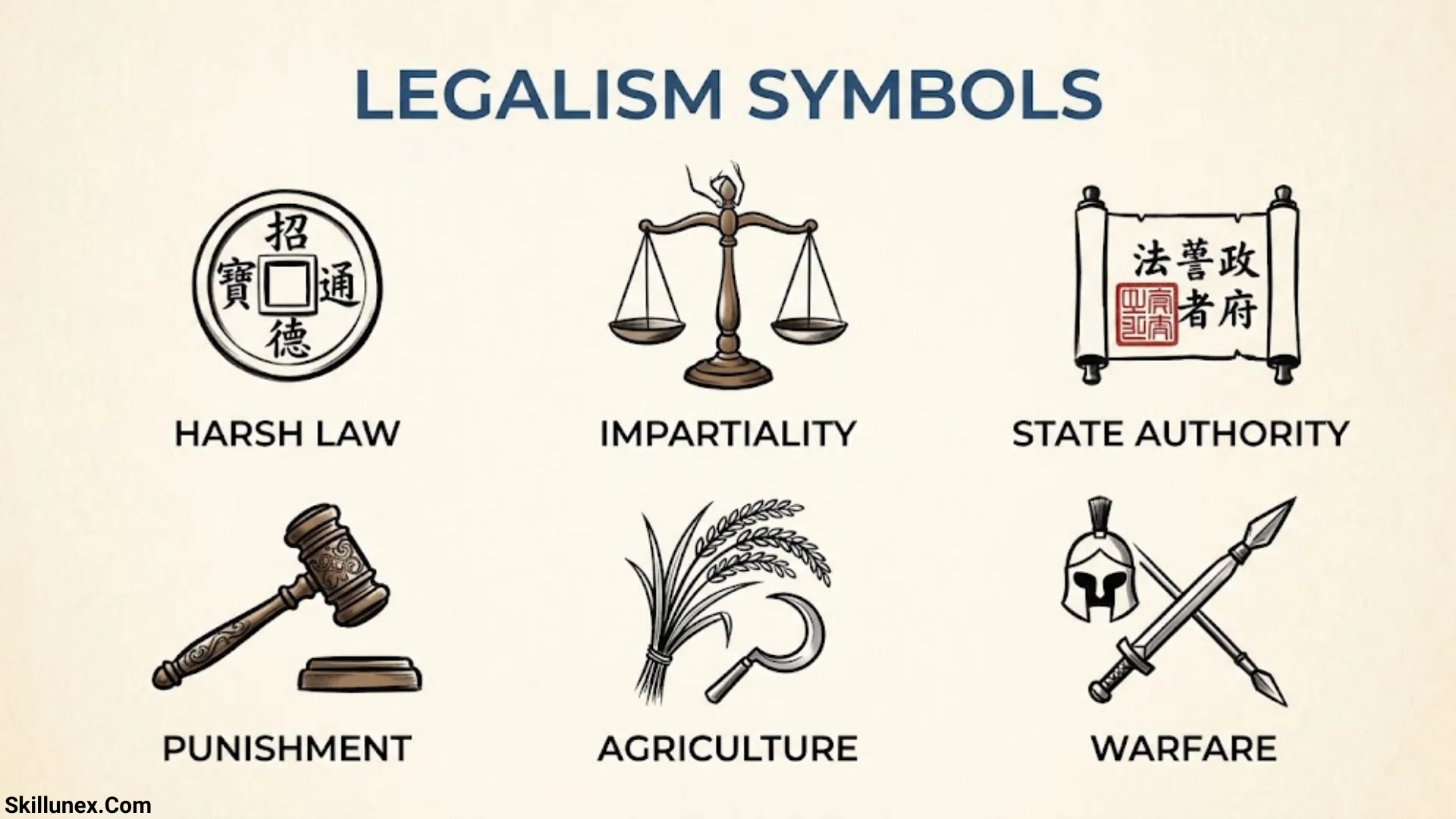
Legalism symbols represent the key beliefs, values, and ideas of ancient Chinese Legalism philosophy. This philosophy focused on strict laws, strong leadership, discipline, and maintaining order in society. If you want to understand Legalism better, learning about its important symbols and concepts can help you explore its history and meaning.
When you explore Legalism symbols, you will discover ideas connected to law, authority, power, and social control. Unlike some other Chinese philosophies, Legalism emphasized clear rules and strict punishments to maintain stability. You can understand its influence through important concepts associated with thinkers like Han Fei and Shang Yang.
In this guide, I will help you explore the meanings, history, and key concepts behind Legalism symbols. You will learn how these ideas shaped ancient Chinese society and why they remain important in understanding Chinese philosophy today. If you are a student or simply curious about ancient traditions, you will find useful information to deepen your knowledge.
What Is Legalism in Ancient Chinese Philosophy?
Legalism, known in Chinese as Fajia (法家), is a school of political philosophy that developed during the Warring States period. This was a time when several competing Chinese states fought for territory, influence, and political control. Frequent conflicts encouraged rulers and advisers to develop practical methods for strengthening governments, organizing armies, collecting resources, and maintaining social stability.
Legalist thinkers believed that a successful government needed clear laws, effective administration, and a ruler with sufficient authority to enforce regulations. Rather than depending primarily on the personal goodness of leaders or citizens, Legalism emphasized institutions and systems that could guide behavior through predictable rewards and punishments.
Legalism is particularly associated with three important principles: Fa, Shu, and Shi.
Fa: The Principle of Law and Standards
Fa (法) refers to laws, regulations, standards, and publicly established rules. It is one of the central concepts in Legalist philosophy.
Legalist thinkers argued that laws should be clearly communicated and consistently enforced. Government officials and ordinary citizens needed to understand which actions were permitted and what consequences would follow from breaking established rules.
The purpose of Fa was to create predictable standards of behavior and reduce dependence on personal preferences or arbitrary decisions.
Shu: The Principle of Administrative Methods
Shu (術) refers to administrative techniques and methods used by rulers to manage government officials.
Legalist thinkers recognized that government officials could pursue personal interests rather than public responsibilities. Therefore, rulers needed methods to supervise officials, evaluate their performance, assign responsibilities, and hold them accountable.
Shu emphasizes effective administration, monitoring, and control within government institutions.
Shi: The Principle of Political Authority
Shi (勢) refers to the authority, position, or institutional power attached to the ruler’s office.
According to Legalist thinking, political authority should not depend entirely on a ruler’s personality, intelligence, or moral qualities. The ruler’s position itself provides the power necessary to direct government institutions and enforce laws.
Together, Fa, Shu, and Shi explain the philosophical foundation behind many symbols associated with Legalism.
Major Legalism Symbols and Their Meanings
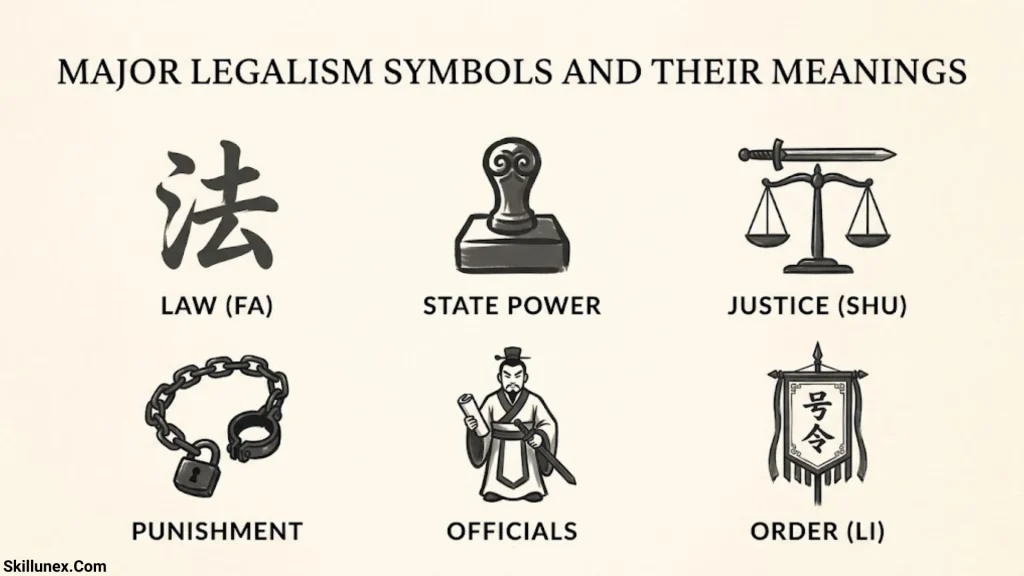
Legalism does not have an officially established symbolic system. However, several traditional objects, Chinese characters, and historical images can represent its most important ideas.
The Chinese Character 法 (Fa): The Symbol of Law
The Chinese character 法 is the most directly connected written symbol associated with Legalist philosophy. It means law, method, standard, or established regulation, depending on the context.
In Legalism, Fa represents the importance of clear and publicly communicated laws. It reflects the belief that government regulations should provide consistent standards for society rather than changing according to personal relationships or individual preferences.
The character is especially important because it connects directly to the philosophy’s central principle of governing through established rules.
Its symbolic meanings include:
- Clear laws and regulations.
- Consistent enforcement of rules.
- Government standards and accountability.
- Predictable rewards and punishments.
- Social discipline and public order.
The character 法 is not an exclusive Legalist emblem, but it is one of the most historically meaningful visual representations of the philosophy.
The Balance Scale: A Symbol of Legal Standards
Balance scales are commonly used in modern illustrations of justice and legal systems. They can represent the Legalist emphasis on consistent standards, objective administration, and predictable consequences.
In the context of Legalism, the scales illustrate the idea that laws should be applied according to established regulations rather than personal emotions, favoritism, or social relationships.
The two sides of a balance can also represent the relationship between rewards and punishments. Legalist thinkers believed that both were important tools for encouraging people to follow government rules.
However, balance scales were not an official symbol of ancient Chinese Legalism. Their use is an interpretive visual representation of legal consistency and fairness.
The Sword: A Symbol of Authority and Enforcement
The sword represents the government’s ability to enforce laws and maintain political control.
In ancient Chinese history, military strength was essential to protecting territory, defeating rival states, and establishing centralized authority. Legalist governments emphasized organized military institutions and strict discipline.
The sword therefore provides a visual representation of enforcement power and the consequences of violating government regulations.
Its symbolic meanings include:
- Enforcement of laws.
- Military discipline.
- Political authority.
- Government power.
- Punishment for breaking established rules.
The sword should not be understood as a unique Legalist emblem. Rather, it represents the enforcement mechanisms that helped Legalist rulers maintain their authority.
The Imperial Dragon: A Symbol of Centralized Authority

The dragon is one of the most recognizable symbols in traditional Chinese culture. Historically, it became closely associated with imperial power, authority, and the legitimacy of the emperor.
In discussions of Legalism, the dragon can represent the powerful ruler and centralized government associated with the philosophy.
Legalist thinkers emphasized that a ruler needed sufficient institutional authority to direct officials, enforce laws, and maintain control over the state. The imperial dragon provides a visual connection to these ideas.
Its symbolic associations include:
- Imperial authority.
- Centralized political power.
- Leadership and sovereignty.
- Government control.
- The strength of the state.
It is important to distinguish cultural symbolism from philosophical symbolism. The dragon existed in Chinese culture long before Legalism and was not created as a Legalist symbol.
The Imperial Throne: A Symbol of the Ruler’s Authority
The imperial throne represents the position and authority of the ruler.
Legalism places considerable importance on the institutional power of the ruler. The person occupying the throne holds the authority to establish regulations, supervise officials, organize government institutions, and enforce state policies.
This idea connects closely to Shi, the Legalist principle of political authority.
The throne can therefore symbolize:
- Centralized government.
- Institutional leadership.
- Political hierarchy.
- The authority of the state.
- The ruler’s position above competing political interests.
Unlike the dragon, which represents imperial authority more broadly, the throne specifically illustrates the institutional position from which political power is exercised.
Government Records and Written Laws: Symbols of Administration
Written laws, official documents, bamboo slips, and government records provide another meaningful way to represent Legalist philosophy.
Ancient Chinese governments used written records to communicate regulations, document administrative decisions, manage resources, and maintain control over officials.
Legalism emphasized the importance of established standards that could be communicated and enforced throughout the state.
Written documents therefore represent the practical side of Fa and Shu: laws that guide public behavior and administrative methods that help rulers supervise government institutions.
The Seal of Authority: A Symbol of Government Legitimacy
Traditional Chinese seals were important instruments of administration and official authorization.
Imperial seals and government credentials could represent the authority to issue commands, authenticate documents, and conduct official business.
Although seals were not exclusively associated with Legalism, they offer a useful visual representation of the relationship between political authority and administrative control.
In a Legalist context, the seal can symbolize the formal power attached to government offices rather than the personal qualities of individual officials.
The Three Main Principles of Legalism and Their Symbolic Representations
Understanding the relationship between Legalist principles and their visual representations makes it easier to interpret the philosophy accurately.
| Legalist principle | Meaning | Related symbolic representation |
| Fa (法) | Laws and established standards | Chinese character 法, written laws |
| Shu (術) | Administrative methods | Government records, official documents |
| Shi (勢) | Institutional authority | Imperial throne, dragon, seal |
These representations are explanatory rather than an official historical collection of Legalist symbols.
Together, the three principles describe a system in which laws establish standards, administrative techniques supervise government officials, and political authority gives the ruler the power to enforce the system.
Historical Origins of Legalism and Its Symbols
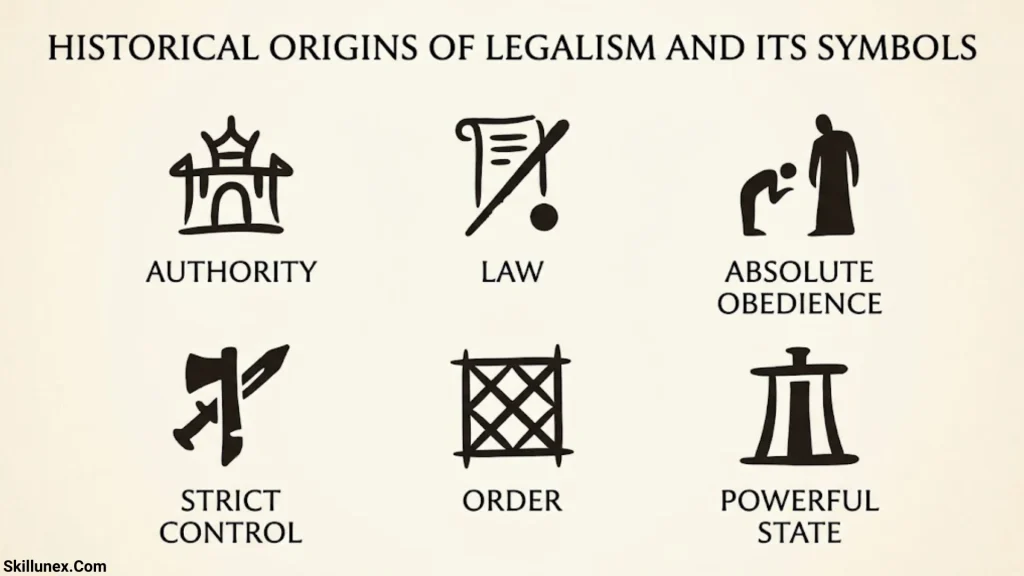
Legalism developed during the Warring States period, when political competition encouraged Chinese rulers to strengthen their governments and military institutions.
Several important thinkers contributed to the development of Legalist ideas. Their writings and reforms helped shape the philosophy’s approach to law, administration, and political authority.
Shang Yang and the Development of Legalist Reforms
Shang Yang (c. 390–338 BCE) was an important political reformer who served the state of Qin.
He introduced reforms that strengthened centralized government, reorganized military service, encouraged agricultural production, and established more systematic legal regulations.
His reforms demonstrated how clearly defined laws and administrative policies could help a state increase its political and military strength.
Shang Yang’s influence is particularly relevant to the symbolism of written laws, government authority, and enforcement.
Han Fei and the Philosophical Foundation of Legalism
Han Fei (c. 280–233 BCE) was one of the most important thinkers associated with Legalist philosophy.
His writings brought together major Legalist concepts, including Fa, Shu, and Shi. He argued that rulers should rely on established laws, administrative techniques, and institutional authority rather than depending entirely on personal morality.
The work commonly known as the Han Feizi remains an important source for understanding Legalist political thought.
Li Si and the Qin Dynasty
Li Si (c. 280–208 BCE) was a prominent Qin statesman who helped implement policies associated with the Legalist government.
He served under Qin Shi Huang, the ruler who unified China in 221 BCE.
The Qin government strengthened central administration, standardized important systems, and expanded the use of uniform regulations across the empire.
These developments demonstrate the historical connection between Legalist ideas and the formation of China’s first unified imperial government.
Legalism Symbols and Their Role in the Qin Dynasty

The Qin Dynasty (221–206 BCE) provides the clearest historical example of Legalist ideas influencing government.
After unifying China, Qin Shi Huang established a centralized imperial administration. The government introduced standardized systems of weights and measures, currency, and written script, helping improve communication and administration across different regions.
Legalist principles also influenced the government’s approach to law enforcement, official accountability, and political control.
Standardized Laws and Government Administration
The Qin government relied on regulations and administrative systems to manage a large and diverse empire.
Written laws and official records helped communicate government expectations and establish procedures for public administration.
These practices reflect the importance of Fa and Shu in Legalist philosophy.
Centralized Imperial Authority
The emperor held supreme political authority, while appointed officials administered different parts of the empire.
This arrangement reflects Shi, which emphasizes the power associated with the ruler’s institutional position.
The imperial throne and official seals therefore provide useful visual representations of the centralized political structure associated with the Qin state.
Military Strength and Law Enforcement
Military organization and strict discipline were important features of the Qin government.
The state used an organized military system to expand its territory and defend its political authority.
This historical context helps explain why swords and other military objects are sometimes used to represent Legalist enforcement and state power.
Legalism vs. Confucianism, Daoism, and Other Chinese Philosophies
Legalism is easier to understand when compared with other major Chinese philosophical traditions.
Although these schools sometimes addressed similar questions about social order and good government, they proposed different approaches.
| Philosophy | Central idea | Approach to social order |
| Legalism | Laws and political authority | Clear regulations, rewards, and punishments |
| Confucianism | Moral conduct and social relationships | Education, virtue, and ethical leadership |
| Daoism | Harmony with the natural way | Simplicity, balance, and reduced interference |
| Mohism | Impartial care and practical benefit | Cooperation, social welfare, and opposition to wasteful conflict |
Legalism and Confucianism
Legalism emphasizes laws, government institutions, and enforcement, whereas Confucianism gives greater attention to moral education, ethical leadership, and social relationships.
Confucian thinkers generally believed that rulers should cultivate virtue and encourage people to behave responsibly.
Legalist thinkers, by contrast, placed greater emphasis on systems of rewards, punishments, and administrative controls.
These differences influenced debates about the best way to govern society in ancient China.
Legalism and Daoism
Daoism emphasizes living in harmony with the Dao, or the natural way of the universe.
Its political ideas often favor simplicity and limited interference in people’s lives.
Legalism takes a different approach by emphasizing structured government, clear regulations, and strong political authority.
While both traditions can discuss the role of the ruler and the organization of society, their underlying assumptions and recommended methods differ considerably.
Why Are Legalism Symbols Important?
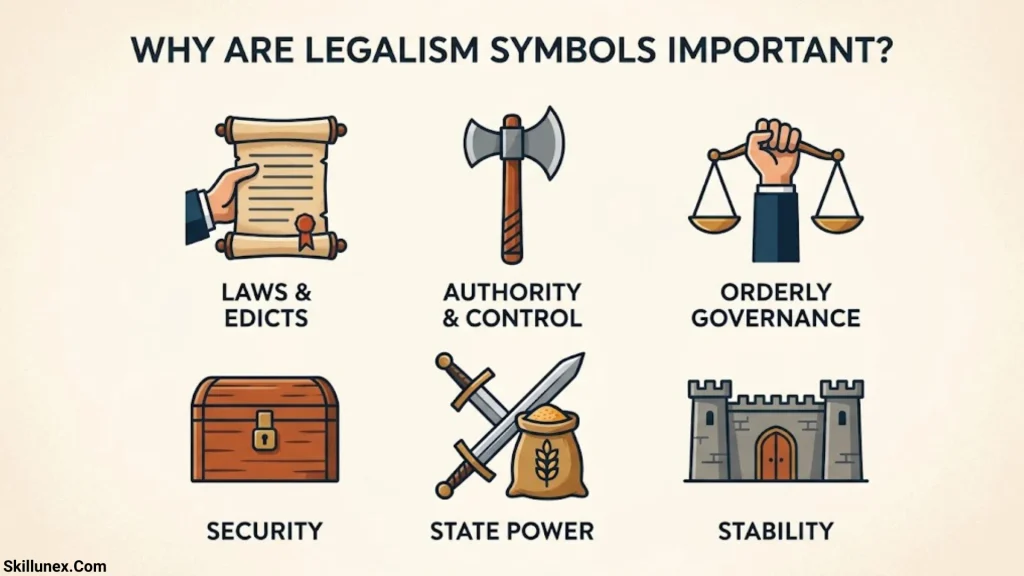
Legalism symbols are useful because they make abstract philosophical principles easier to understand.
They connect ideas about government, law, authority, and administration with recognizable historical objects and cultural imagery.
They Explain the Importance of Law
The character 法 and images of written legal documents represent the central role of regulations in Legalist thinking.
They demonstrate how established rules can guide behavior and provide standards for government decisions.
They Represent Political Authority
The throne, imperial dragon, and official seal illustrate the importance of centralized authority.
These symbols help explain how Legalist thinkers understood the ruler’s position within the political system.
They Illustrate Enforcement and Discipline
The sword represents the practical power required to enforce regulations and maintain government control.
It also reflects the importance of military organization and discipline in the historical development of the Qin state.
They Help Explain Ancient Chinese History
Legalism symbols provide a visual connection to the political changes that took place during the Warring States period and the Qin Dynasty.
They help readers understand how ideas about law and administration influenced the development of centralized government in China.
Are Legalism Symbols Still Relevant Today?
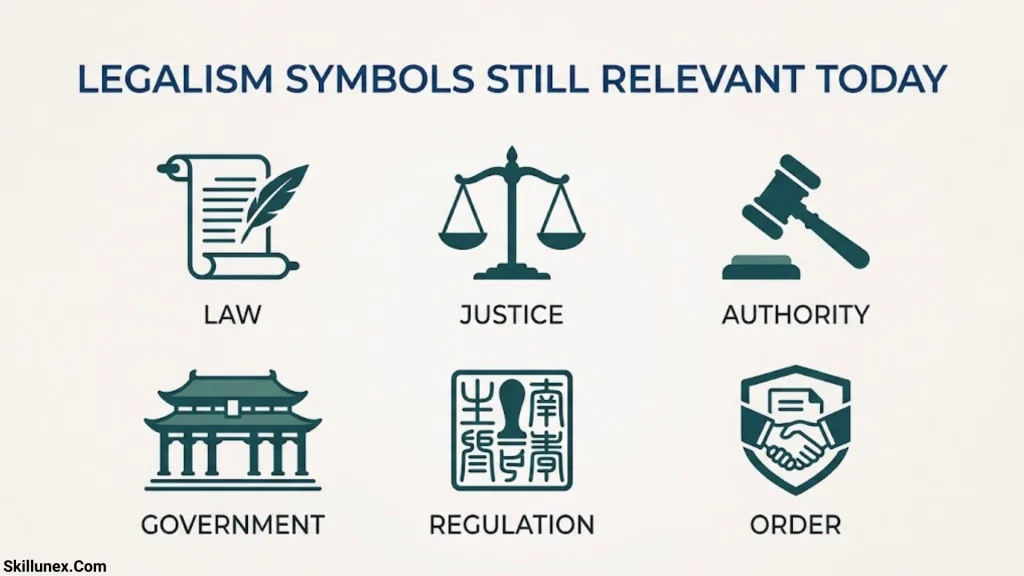
Legalism is an ancient philosophical tradition, but some of its central questions remain relevant to modern discussions about government and law.
Modern legal systems, for example, rely on written regulations, administrative institutions, official responsibilities, and mechanisms for enforcing rules.
However, modern constitutional governments generally include principles such as individual rights, judicial independence, and limits on political authority that should not be confused with ancient Legalist political theory.
Legalism can still provide historical insight into several important topics:
- The relationship between laws and political authority.
- The importance of accountability in public administration.
- The use of rewards and penalties to influence behavior.
- The advantages and risks of centralized government.
- The relationship between institutional power and individual rights.
Studying Legalism helps readers understand both the practical value and potential limitations of governing primarily through strict rules and enforcement.
Frequently Asked Questions About Legalism Symbols
What Is the Main Symbol of Legalism?
The Chinese character 法 (Fa), meaning law or established standard, is one of the most directly relevant written symbols associated with Legalist philosophy. It represents the importance of clear regulations and consistent enforcement. However, Legalism does not have one officially designated symbol.
What Does the Dragon Symbolize in Legalism?
The dragon can represent imperial authority, centralized leadership, and the power of the ruler. It is a traditional Chinese cultural symbol rather than an exclusive symbol of Legalism.
Why Is the Sword Associated With Legalism?
The sword represents law enforcement, military discipline, and the power of the government to maintain order. It is a modern interpretive representation of Legalist ideas rather than a historically established Legalist emblem.
What Are the Three Main Principles of Legalism?
The three central principles are Fa (law and standards), Shu (administrative methods), and Shi (institutional authority). Together, they explain how Legalist thinkers believed a government should establish rules, manage officials, and maintain political control.
Who Were the Most Important Legalist Thinkers?
Important Legalist thinkers and political figures include Shang Yang, Han Fei, and Li Si. Shang Yang contributed major political reforms, Han Fei developed influential Legalist writings, and Li Si helped implement policies associated with the Legalist government during the Qin Dynasty.
Did the Qin Dynasty Follow Legalism?
Yes. The Qin government adopted many Legalist principles, particularly centralized administration, standardized regulations, official accountability, and strict law enforcement. These ideas played an important role in the unification of China in 221 BCE.
Is Legalism a Religion?
No. Legalism is primarily an ancient Chinese school of political philosophy concerned with government, law, administration, and political authority. It does not have a religious system of worship or an official collection of sacred symbols.
Conclusion
Legalism symbols represent important ideas such as law, authority, discipline, and social order in ancient Chinese philosophy. By understanding these concepts, you can learn how Legalist thinkers believed strong leadership and strict rules could create a stable society. These ideas also help explain the role of law and government in ancient China.
I hope this guide has helped you understand the meaning and importance of Legalism symbols. Whether you are studying Chinese philosophy or exploring its history out of curiosity, these concepts offer valuable insights into ancient beliefs. Keep exploring their meanings to gain a better understanding of Legalism and its lasting influence.

Caleb Thornton
I’m Caleb Thornton, a researcher and content writer who loves exploring fascinating subjects and sharing what I learn with readers. My interests include natural places, lakes, symbols, culture, history, and the stories that make ordinary topics more meaningful.
When I write an article, I try to go beyond a basic answer. I look for useful facts, relevant context, and details that can help readers understand the subject more completely.
My purpose is simple: I want every article I contribute to provide genuine value, satisfy the reader’s curiosity, and make discovering new information enjoyable.
## Books by Caleb Thornton
* Symbols & Meanings: Exploring the Signs We See Every Day
* Lakes of the World: Nature, Beauty & Exploration