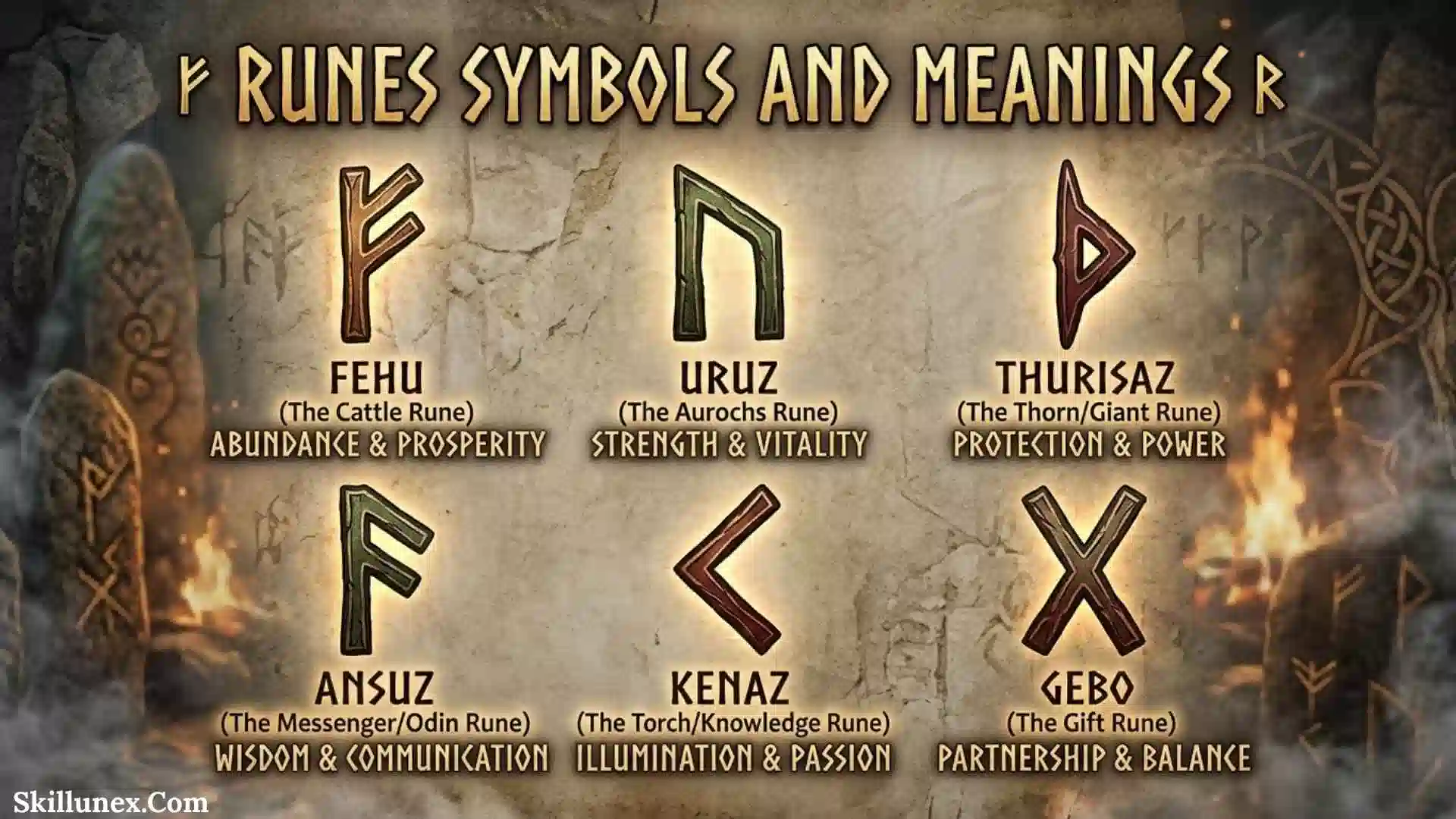
Runes are some of the most recognizable symbols associated with ancient Germanic and Norse cultures. They were used as letters for writing, but individual runes are also connected with words, sounds, objects, natural forces, people, and cultural ideas. Today, people search for runes symbols and meanings to learn about Norse history, Viking symbols, tattoos, jewelry, mythology, divination, and spiritual symbolism.
The Elder Futhark is the best-known early runic alphabet and contains 24 runes. Each rune has a distinctive shape, a sound value, and a traditional name. Some names have relatively clear meanings, such as Fehu, associated with cattle and wealth, or Isa, associated with ice. Other rune names and meanings are uncertain and remain subjects of scholarly debate.
It is also important to separate historical rune meanings from modern interpretations. Runes were originally writing characters rather than a fixed set of fortune-telling symbols. Modern rune readings, reversed meanings, and spiritual associations developed through later traditions and contemporary practice.
Runes Symbols and Meanings at a Glance
The 24 Elder Futhark runes provide the foundation for many modern rune charts. The table below gives a practical overview while distinguishing broad historical associations from common modern interpretations.
| Rune | Name | Sound | Historical Association | Common Modern Interpretation |
| ᚠ | Fehu | F | Cattle, wealth | Prosperity, abundance |
| ᚢ | Uruz | U | Aurochs | Strength, vitality |
| ᚦ | Thurisaz | TH | Þurs, giant, possibly thorn | Power, defense, challenge |
| ᚨ | Ansuz | A | God, deity | Communication, wisdom |
| ᚱ | Raidho | R | Riding, journey | Travel, progress |
| ᚲ | Kenaz | K | Torch or related concept | Knowledge, creativity |
| ᚷ | Gebo | G | Gift | Generosity, exchange |
| ᚹ | Wunjo | W | Joy | Happiness, harmony |
| ᚺ | Hagalaz | H | Hail | Disruption, change |
| ᚾ | Nauthiz | N | Need, necessity | Hardship, resilience |
| ᛁ | Isa | I | Ice | Stillness, focus |
| ᛃ | Jera | Y/J | Year, harvest | Reward, cycles |
| ᛇ | Eihwaz | EI | Yew | Endurance, transformation |
| ᛈ | Perthro | P | Uncertain | Mystery, fate |
| ᛉ | Algiz | Z/R | Uncertain | Protection, awareness |
| ᛊ | Sowilo | S | Sun | Success, victory |
| ᛏ | Tiwaz | T | Týr | Justice, courage |
| ᛒ | Berkano | B | Birch | Growth, fertility |
| ᛖ | Ehwaz | E | Horse | Movement, partnership |
| ᛗ | Mannaz | M | Human being | Humanity, identity |
| ᛚ | Laguz | L | Water, lake | Flow, intuition |
| ᛜ | Ingwaz | NG | Ing | Fertility, potential |
| ᛞ | Dagaz | D | Day | Transformation, breakthrough |
| ᛟ | Othala | O | Heritage, inheritance | Ancestry, home |
These meanings should not be treated as universal definitions. Some are based on historical rune names, linguistic evidence, and related Germanic traditions, while others are primarily modern interpretations.
What Are Runes?
Runes are characters belonging to several related writing systems used by Germanic-speaking peoples. The earliest runic inscriptions date to the early centuries of the Common Era.
Runes were carved or written on many different materials, including stone, wood, bone, metal, weapons, jewelry, and everyday objects.
What Does the Word Rune Mean?
The word rune is related to old Germanic words associated with concepts such as secret, mystery, or something whispered. The exact development of the word’s meaning is complex, but it reflects the distinctive cultural importance later attached to runic writing.
A rune itself, however, was fundamentally a written character.
Were Runes Originally Magical Symbols?
Runes were primarily used for writing. Historical evidence also shows that some inscriptions may have had ritual, commemorative, or magical purposes.
That does not mean that every rune originally had a fixed magical meaning.
Modern lists sometimes describe the Elder Futhark as though it were created specifically for divination. That is misleading. The historical evidence supports runes as writing systems first, with magical and symbolic uses occurring in particular contexts.
Elder Futhark Runes and Their Meanings
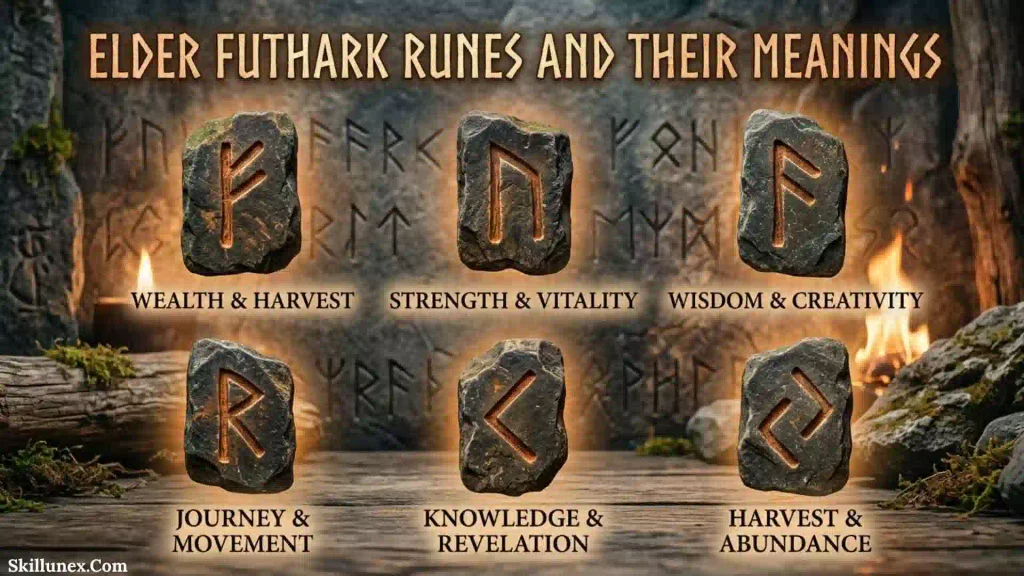
The Elder Futhark contains 24 characters. Their traditional names provide important clues about the ideas associated with them, although several names remain uncertain.
Fehu ᚠ — Wealth and Cattle
Fehu is the first rune of the Elder Futhark. Its name is traditionally associated with cattle or movable wealth.
In early Germanic societies, cattle represented an important form of economic wealth. This gives Fehu a natural connection with property and resources.
Historical association: Cattle, wealth, movable property
Common modern interpretation: Prosperity, abundance, financial success, resources
Fehu is frequently chosen in modern symbolic designs to represent wealth and material prosperity.
Uruz ᚢ — Strength and the Aurochs
Uruz is associated with the aurochs, a now-extinct wild ancestor of domestic cattle. The animal was large, powerful, and dangerous.
Its traditional association has contributed to modern interpretations involving physical strength and vitality.
Historical association: Aurochs
Common modern interpretation: Strength, endurance, vitality, courage, personal power
Uruz is often used symbolically when someone wants to represent resilience or inner strength.
Thurisaz ᚦ — Giant, Thorn, or Force
Thurisaz is traditionally connected with the Old Germanic word þurs, referring to a giant or supernatural being. The rune has also been associated with the concept of a thorn in some rune-name traditions.
Because its historical interpretation is not completely straightforward, modern meanings vary.
Historical association: Þurs or giant; possible thorn connection
Common modern interpretation: Power, defense, conflict, challenge, force
Thurisaz is often interpreted as representing the need to confront difficult forces or protect oneself from danger.
Ansuz ᚨ — God, Speech, and Communication
Ansuz is associated with a god or divine being. It is frequently connected in modern interpretations with Odin because of his importance in Norse mythology.
The rune also has strong associations with speech and communication in modern rune traditions.
Historical association: God or deity
Common modern interpretation: Communication, wisdom, inspiration, knowledge, divine guidance
Ansuz is often selected to symbolize communication, learning, or the spoken word.
Raidho ᚱ — Riding and Journey
Raidho is traditionally connected with riding or a journey.
Travel was an important part of ancient Germanic life, whether for trade, migration, warfare, or communication.
Historical association: Riding, journey, travel
Common modern interpretation: Journey, movement, progress, direction, personal development
Raidho is especially popular in modern symbolism for representing a physical or metaphorical journey.
Kenaz ᚲ — Torch and Illumination
Kenaz has traditionally been interpreted in connection with a torch, although its exact historical meaning has been debated.
The image of a torch naturally suggests light and knowledge, which has influenced modern interpretations.
Historical association: Traditionally connected with torch or related concepts
Common modern interpretation: Knowledge, illumination, creativity, learning, discovery
Kenaz is often used as a symbol of gaining understanding or bringing something hidden into the light.
Gebo ᚷ — Gift and Exchange
Gebo is one of the clearer rune names and is associated with a gift.
Gift-giving had major social importance in Germanic societies. Gifts could establish relationships, demonstrate generosity, and reinforce alliances.
Historical association: Gift
Common modern interpretation: Generosity, exchange, partnership, reciprocity, relationships
Gebo is particularly popular in modern designs representing mutual giving or balanced relationships.
Wunjo ᚹ — Joy and Well-Being
Wunjo is associated with joy, pleasure, or well-being.
Its positive meaning has made it one of the most popular runes in modern symbolic interpretations.
Historical association: Joy, pleasure, well-being
Common modern interpretation: Happiness, harmony, friendship, satisfaction, success
Wunjo can represent the feeling of reaching a satisfying or harmonious state.
Hagalaz ᚺ — Hail and Disruption
Hagalaz is associated with hail, a natural phenomenon capable of damaging crops and disrupting agricultural life.
This has influenced modern interpretations of Hagalaz as a symbol of sudden disruption or unavoidable change.
Historical association: Hail
Common modern interpretation: Disruption, challenge, change, destruction, transformation
Hagalaz does not necessarily have to mean something permanently negative. Modern interpretations sometimes view disruption as a catalyst for necessary change.
Nauthiz ᚾ — Need and Necessity
Nauthiz is connected with need, necessity, or constraint.
The rune can be understood through situations where circumstances create pressure or require difficult choices.
Historical association: Need, necessity
Common modern interpretation: Hardship, limitation, endurance, discipline, survival
Nauthiz can symbolize learning to work within limitations rather than simply representing misfortune.
Isa ᛁ — Ice and Stillness
Isa means ice in the relevant Germanic linguistic tradition.
Ice is naturally associated with coldness and stillness, making Isa one of the more recognizable rune-name associations.
Historical association: Ice
Common modern interpretation: Stillness, pause, concentration, delay, preservation
Modern rune readings often use Isa to represent a period when movement slows down and patience becomes important.
Jera ᛃ — Year and Harvest
Jera is connected with the year and the agricultural cycle.
The concept naturally relates to seasonal change and the eventual harvest produced by earlier work.
Historical association: Year, harvest, seasonal cycle
Common modern interpretation: Reward, harvest, patience, results, natural cycles
Jera is often interpreted as a reminder that results may require time.
Eihwaz ᛇ — Yew and Endurance
Eihwaz is traditionally associated with the yew tree.
Yew trees have unusual longevity and have held associations with life, death, and endurance in European traditions.
Historical association: Yew
Common modern interpretation: Endurance, resilience, protection, transformation, continuity
The exact historical symbolism of Eihwaz is more complicated than many modern rune guides suggest.
Perthro ᛈ — Mystery and the Unknown
Perthro is one of the Elder Futhark runes whose original name and meaning remain uncertain.
Because of this uncertainty, modern interpretations vary considerably.
Historical association: Uncertain
Common modern interpretation: Mystery, fate, chance, hidden knowledge, the unknown
Perthro is a good example of why modern rune meanings should not automatically be presented as historically proven facts.
Algiz ᛉ — Protection in Modern Interpretation
Algiz is one of the most recognizable Elder Futhark characters, but its original name and meaning are uncertain.
Modern rune traditions commonly associate it with protection.
Historical association: Uncertain
Common modern interpretation: Protection, defense, awareness, guardianship
The popular “protection rune” meaning is therefore best described as a modern interpretive tradition rather than an indisputable ancient definition.
Sowilo ᛊ — Sun and Victory
Sowilo is associated with the sun.
Light and the sun have obvious connections with energy, visibility, and success, contributing to its modern symbolic interpretations.
Historical association: Sun
Common modern interpretation: Light, success, victory, energy, clarity
Sowilo is frequently used to symbolize achievement and overcoming darkness or uncertainty.
Tiwaz ᛏ — Týr, Justice, and Courage
Tiwaz is associated with Týr, a Germanic god connected with law, courage, and warfare.
The rune’s name provides one of the clearest links between a runic character and a named Germanic deity.
Historical association: Týr
Common modern interpretation: Justice, courage, honor, duty, sacrifice, leadership
Tiwaz is often chosen to represent moral courage and commitment to a difficult responsibility.
Berkano ᛒ — Birch and Growth
Berkano is associated with the birch tree.
Birch imagery can naturally evoke growth, renewal, and new life.
Historical association: Birch
Common modern interpretation: Growth, fertility, renewal, nurturing, new beginnings
Berkano is frequently used symbolically to represent development and fresh starts.
Ehwaz ᛖ — Horse and Movement
Ehwaz is associated with the horse.
Horses were important for transportation and communication, and the association naturally connects the rune with movement.
Historical association: Horse
Common modern interpretation: Movement, progress, partnership, cooperation, trust
Ehwaz is particularly useful in modern symbolism for situations involving movement or working together with another person.
Mannaz ᛗ — Humanity
Mannaz is associated with the human being or person.
The rune therefore has an obvious connection with human identity and society.
Historical association: Human being, person
Common modern interpretation: Humanity, identity, self-awareness, community, relationships
Mannaz can be used to symbolize both the individual and humanity as a whole.
Laguz ᛚ — Water and Flow
Laguz is associated with water or a lake.
Water is naturally connected with movement, change, life, and adaptability.
Historical association: Water, lake
Common modern interpretation: Flow, emotion, adaptability, intuition, movement
The modern spiritual association with intuition is particularly common, although it should not be confused with a proven ancient definition.
Ingwaz ᛜ — Ing and Fertility
Ingwaz, sometimes written Inguz in modern sources, is associated with Ing, a Germanic divine or ancestral figure.
Its traditional associations have contributed to modern interpretations involving fertility and potential.
Historical association: Ing
Common modern interpretation: Fertility, potential, growth, completion, new beginnings
In modern symbolism, Ingwaz often represents something developing toward completion.
Dagaz ᛞ — Day and Transformation
Dagaz is associated with day or daylight.
The transition from darkness to daylight makes Dagaz especially suitable for modern interpretations involving change and awakening.
Historical association: Day
Common modern interpretation: Transformation, breakthrough, awakening, clarity, new beginnings
Dagaz is often used to represent a major turning point or movement from uncertainty into understanding.
Othala ᛟ — Heritage and Inheritance
Othala, also known as Odal in some traditions, is associated with inheritance, ancestral property, or inherited possessions.
Its meaning connects strongly with ideas of family, land, ancestry, and belonging.
Historical association: Inheritance, ancestral property, heritage
Common modern interpretation: Home, ancestry, family, heritage, belonging
Othala also requires additional context because versions of the symbol have been appropriated by some modern extremist groups. Its ancient runic history predates those modern political uses by many centuries, and the meaning of a symbol depends heavily on its historical and contemporary context.
What Do Rune Symbols Mean?
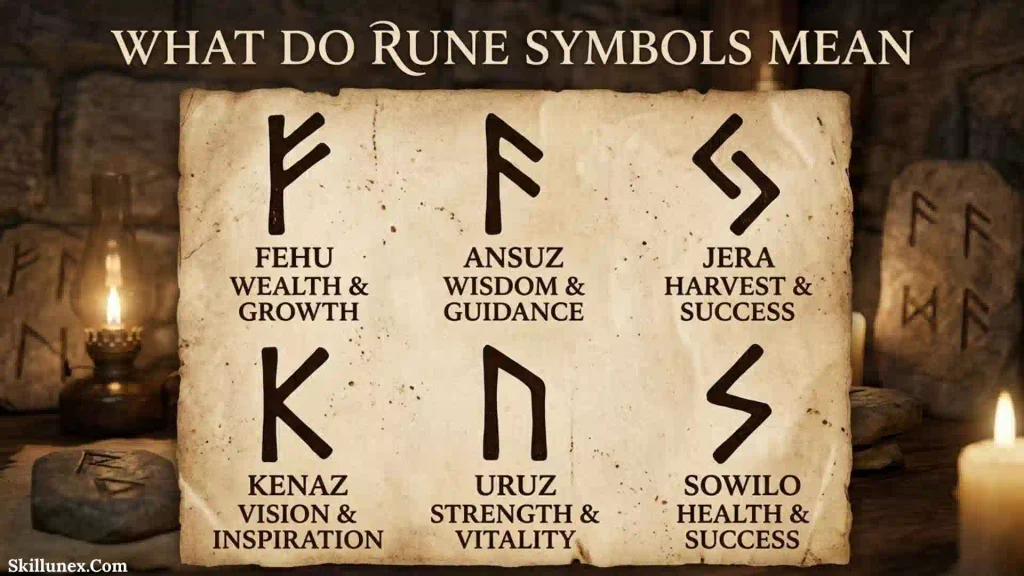
Rune meanings can be understood in two different ways: through historical evidence and through modern interpretation.
Historical Rune Meanings
Historical rune meanings are reconstructed from several kinds of evidence, including:
- Rune names preserved in later rune poems
- Linguistic comparisons
- Runic inscriptions
- Related Germanic languages
- Archaeological evidence
- Medieval manuscripts
Some meanings are relatively clear because related words survive in historical languages. Others are uncertain because the original rune names were not directly recorded.
Modern Rune Meanings
Modern rune guides often expand historical associations into broader concepts.
For example:
- Fehu → wealth and prosperity
- Uruz → strength
- Raidho → journey
- Gebo → relationships and exchange
- Algiz → protection
- Sowilo → success
- Berkano → growth
- Dagaz → transformation
These can be useful symbolic interpretations, but they should be identified as modern traditions rather than automatically attributed to the Vikings.
Elder Futhark vs. Younger Futhark
The term “Viking runes” can cause confusion because the Elder Futhark was not the primary runic alphabet throughout the Viking Age.
Elder Futhark
The Elder Futhark contains 24 runes and was used during the earlier period of runic writing, before the Viking Age.
It is the runic alphabet most commonly presented in modern lists of rune symbols and meanings.
Younger Futhark
The Younger Futhark developed later and was widely used during the Viking Age.
It contained only 16 primary rune characters, even though the languages being written had more sounds.
This means that one Younger Futhark rune could sometimes represent multiple sounds.
Anglo-Saxon Futhorc
The Anglo-Saxon Futhorc developed in England and expanded the number of runes used.
The existence of several runic systems demonstrates that runes evolved over time and were adapted to different languages and regions.
How Were Runes Used?
Runes were used for practical writing as well as for certain commemorative and ritual purposes.
Runes on Runestones
Large stones carrying runic inscriptions are among the most famous examples of runic writing.
Many runestones commemorate individuals, record events, mark ownership, or communicate messages.
They provide important evidence about historical languages and societies.
Runes on Wood, Bone, and Objects
Runic inscriptions have also been found on:
- Wood
- Bone
- Metal
- Weapons
- Jewelry
- Tools
- Everyday objects
These discoveries demonstrate that runic writing was not limited to monumental stones.
Names and Inscriptions
People used runes to write names, short messages, ownership marks, memorial texts, and other forms of communication.
Some inscriptions are extremely short, while others contain longer messages.
This practical use is an important reminder that runes were a writing technology before they became popular as modern symbolic designs.
Runes and Norse Mythology
Runes are closely connected with Norse mythology in modern culture, but historical mythology and later rune traditions should be separated carefully.
Odin and the Runes
The god Odin has a particularly important connection with runes in Norse mythology.
In the poem Hávamál, Odin describes a dramatic experience involving the world tree and gaining knowledge of the runes.
This story has helped create the modern association between Odin, wisdom, sacrifice, and runic knowledge.
Runes in Norse Literature
Medieval Norse literature sometimes describes runes in magical or powerful contexts.
These stories are valuable evidence for how later Scandinavian authors understood runes, but they should not be used to assume that every earlier runic inscription had the same magical purpose.
Rune Meanings in Modern Divination
Modern rune divination uses rune characters as tools for reflection or interpretation.
A person may select one rune or several runes and interpret them according to a particular symbolic system.
Upright and Reversed Runes
Some modern practices assign different meanings when a rune appears reversed or upside down.
This should not be presented as a universal Viking-age practice. Historical runic inscriptions do not provide evidence for one standardized system in which all 24 Elder Futhark runes had fixed upright and reversed divination meanings.
Modern practitioners may nevertheless use reversals as part of their own interpretive methods.
How Modern Rune Readings Work
A modern rune reading might involve:
- Choosing a question or theme.
- Selecting one or more rune pieces.
- Identifying the rune or runes.
- Considering traditional associations.
- Applying the symbols to the question.
- Reflecting on the interpretation.
The result depends on the particular modern tradition being followed.
Popular Rune Meanings by Purpose
Modern readers often search for a rune associated with a specific goal. These associations should be understood as modern symbolic interpretations.
Rune for Wealth
Fehu ᚠ is the rune most commonly associated with wealth and prosperity.
Its historical connection with cattle and movable wealth provides the foundation for its modern association with abundance.
Rune for Protection
Algiz ᛉ is widely interpreted in modern rune traditions as a symbol of protection and defense.
Because the historical meaning of Algiz is uncertain, “protection rune” is best described as a modern interpretation.
Rune for Strength
Uruz ᚢ is commonly associated with strength and vitality because of its connection with the powerful aurochs.
Rune for Love and Relationships
Gebo ᚷ is frequently used in modern symbolism for relationships because its historical association is the concept of a gift or exchange.
Wunjo ᚹ can also be connected with happiness, harmony, and positive relationships.
Rune for Travel
Raidho ᚱ is the most obvious choice for modern symbolic representations of travel because its traditional association is riding or journeying.
Rune for Success
Sowilo ᛊ is commonly interpreted as a symbol of success, victory, light, and achievement.
Wunjo ᚹ may also be used to represent happiness or successful outcomes.
Rune for Growth
Berkano ᛒ is commonly associated with growth, renewal, fertility, and new beginnings.
Jera ᛃ can also symbolize growth through time, cycles, and harvest.
What Is a Bind Rune?
A bind rune combines two or more runic characters into a single design.
Bind runes can be found in historical inscriptions, although modern bind-rune designs can differ substantially from historical examples.
Historical Bind Runes
Historical bind runes were sometimes created by joining rune forms together, potentially for practical reasons such as saving space or creating a particular inscription.
They should not automatically be assumed to have magical meanings.
Modern Bind Runes
Modern practitioners frequently create bind runes by combining characters associated with desired concepts.
For example, someone might combine runes traditionally associated with strength and protection into one modern design.
Because modern bind-rune practices vary widely, the intended meaning depends on the creator and tradition.
Runes for Tattoos and Jewelry
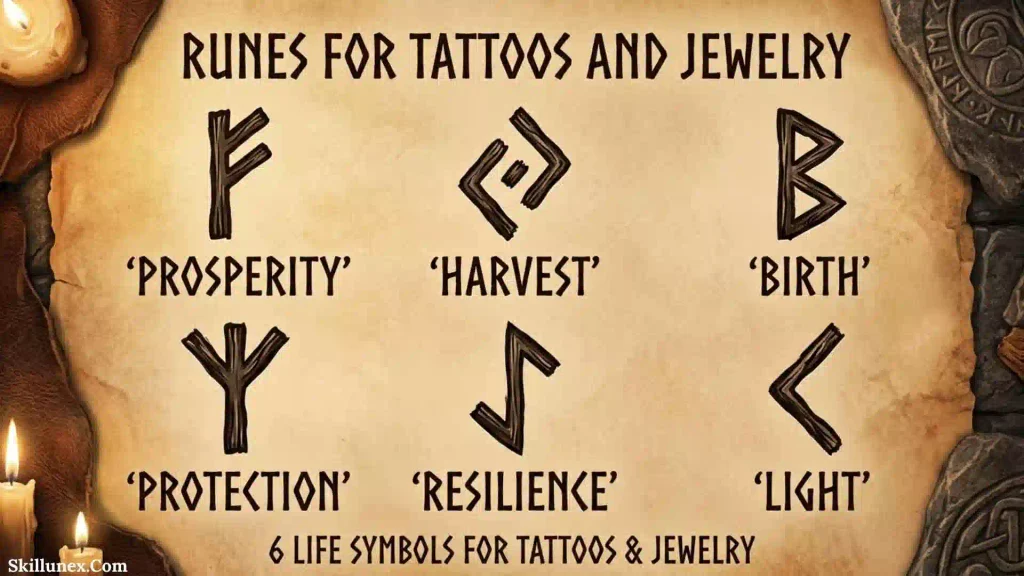
Runes are popular choices for tattoos, pendants, rings, artwork, and other symbolic designs.
Their simple shapes make them visually distinctive, while their historical names provide opportunities for personal symbolism.
Choosing a Rune Based on Meaning
Before choosing a rune, consider whether you want its:
- Historical association
- Linguistic meaning
- Norse mythological connection
- Modern spiritual interpretation
- Personal symbolic meaning
For example, someone interested in ancestry might choose Othala, while someone interested in strength might choose Uruz.
Historical Accuracy
If historical accuracy matters, identify the specific runic alphabet you are using.
A symbol from Elder Futhark is not automatically a “Viking rune,” because Viking-Age Scandinavians primarily used Younger Futhark.
Likewise, translating a modern English name directly into runes can produce historically inaccurate results if the sound system and historical period are ignored.
Symbols With Controversial Modern Associations
Some runes and runic-looking symbols have been adopted or altered by modern extremist movements.
This is particularly relevant when researching Othala/Odal and certain other symbols.
An ancient symbol’s historical meaning should not be confused with its later appropriation, but modern context is important when using such symbols publicly.
How Are Modern Words Written in Runes?
Writing a modern English word in runes is not always as simple as replacing every Latin letter with a rune.
Historical runic alphabets were designed for particular languages and sound systems.
Why Direct Letter Substitution Can Be Inaccurate
English contains sounds that did not correspond neatly to the sounds represented by every historical rune.
For this reason, an accurate historical transliteration should consider:
- The language
- The historical period
- The runic alphabet
- Pronunciation
- Sound values
- Regional variation
A modern “Viking alphabet” chart that simply gives one rune for every English letter can therefore be useful as a modern design tool but should not automatically be treated as historical writing.
Runes Symbols vs. Viking Symbols
Runes and Viking symbols are related but are not the same thing.
A rune is a character in a runic writing system. A Norse or Viking symbol may instead be an image, motif, weapon, object, or religious design.
Examples of symbols commonly discussed in connection with Norse culture include:
- Mjölnir
- Valknut
- Yggdrasil
- Animal motifs
- Ships
- Serpents
These are not simply additional letters of the runic alphabet.
Are Runes Norse or Viking?
Runes were used by various Germanic-speaking peoples, not exclusively by Vikings.
The Elder Futhark predates the Viking Age, while Younger Futhark became especially important in Scandinavia during the Viking Age.
Therefore, calling every rune a “Viking symbol” is historically too broad.
Are Rune Meanings Always the Same?
No. Rune meanings can change depending on the period, language, inscription, and interpretive tradition.
A rune can have:
- A historical sound value
- A reconstructed name
- A linguistic meaning
- A mythological association
- A modern spiritual interpretation
These categories should not be treated as identical.
For example, the modern interpretation of Algiz as protection is much more certain as a statement about modern rune traditions than as a direct translation of an ancient rune name.
What Is the Most Powerful Rune?
There is no historically established single “most powerful” rune.
Modern practitioners may consider different runes particularly significant depending on their purpose.
For example:
- Uruz may be considered powerful for strength.
- Algiz is commonly associated with protection.
- Fehu is associated with wealth.
- Sowilo is associated with victory and success.
- Tiwaz is associated with courage and justice.
These are modern symbolic interpretations rather than an ancient ranking of rune power.
Frequently Asked Questions About Runes Symbols and Meanings
What are the 24 runes and their meanings?
The 24 Elder Futhark runes are Fehu, Uruz, Thurisaz, Ansuz, Raidho, Kenaz, Gebo, Wunjo, Hagalaz, Nauthiz, Isa, Jera, Eihwaz, Perthro, Algiz, Sowilo, Tiwaz, Berkano, Ehwaz, Mannaz, Laguz, Ingwaz, Dagaz, and Othala. Their traditional associations range from cattle and wealth to sun, day, humanity, inheritance, and other concepts.
What is the oldest runic alphabet?
The Elder Futhark is the earliest widely recognized runic alphabet, containing 24 characters. It predates the later Younger Futhark used during the Viking Age.
What is the Viking alphabet called?
The runic alphabet most strongly associated with the Viking Age is the Younger Futhark, which contains 16 primary runes.
What rune means protection?
Algiz ᛉ is commonly interpreted as a protection rune in modern rune traditions. Its exact historical meaning, however, is uncertain.
What rune means love?
There is no single historically established “love rune.” In modern interpretations, Gebo ᚷ may represent relationships, exchange, and partnership, while Wunjo ᚹ can represent happiness and harmony.
What rune means wealth?
Fehu ᚠ is the rune most commonly associated with wealth because its traditional name is connected with cattle and movable property.
What rune means strength?
Uruz ᚢ is commonly associated with strength, vitality, and endurance because of its connection with the aurochs.
What rune means luck?
There is no universally accepted ancient “luck rune.” Modern practitioners may associate different runes with favorable outcomes, depending on the system they use.
Did Vikings use runes for magic?
Some historical and literary evidence connects runes with magical or ritual practices, but runes were primarily a writing system. It is inaccurate to assume that every rune was originally a magical symbol.
Can runes be reversed?
Modern rune divination sometimes assigns meanings to reversed runes. However, there was no universally standardized Viking-age system in which every rune had a fixed reversed divination meaning.
What is a bind rune?
A bind rune is a design that combines two or more runes into one connected form. Historical examples exist, while many modern bind runes are created for contemporary symbolic or decorative purposes.
Are Elder Futhark runes Viking runes?
Not exactly. The Elder Futhark predates the Viking Age. Younger Futhark is the runic system more directly associated with Viking-Age Scandinavia.
What does Othala mean?
Othala ᛟ is associated with inheritance, ancestral property, heritage, and belonging. The symbol also has controversial modern associations because of its appropriation by extremist groups.
Are modern rune meanings historically accurate?
Not always. Some modern meanings are based on historical rune names and linguistic evidence, while others come from modern spiritual and divination traditions. The two should be clearly distinguished.
Conclusion
Runes symbols and meanings bring together ancient writing, Germanic languages, Norse mythology, archaeology, and modern symbolism. The Elder Futhark contains 24 runes, each with a distinctive character, sound, and traditional name.Some associations are relatively clear. Fehu ᚠ is connected with cattle and wealth, Uruz ᚢ with the aurochs, Gebo ᚷ with gifts, Isa ᛁ with ice, Jera ᛃ with the year or harvest, Sowilo ᛊ with the sun, and Othala ᛟ with inheritance and heritage.
Other runes, such as Perthro and Algiz, have more uncertain historical meanings.The most important distinction is between historical rune evidence and modern interpretations. Runes were originally written characters used by Germanic speaking peoples. Although some inscriptions and literary sources connect them with magic or ritual, the modern practice of giving every rune a fixed divination meaning is not simply a direct continuation of Viking age writing.
Caleb Thornton
I’m Caleb Thornton, a researcher and content writer who loves exploring fascinating subjects and sharing what I learn with readers. My interests include natural places, lakes, symbols, culture, history, and the stories that make ordinary topics more meaningful.
When I write an article, I try to go beyond a basic answer. I look for useful facts, relevant context, and details that can help readers understand the subject more completely.
My purpose is simple: I want every article I contribute to provide genuine value, satisfy the reader’s curiosity, and make discovering new information enjoyable.
## Books by Caleb Thornton
* Symbols & Meanings: Exploring the Signs We See Every Day
* Lakes of the World: Nature, Beauty & Exploration