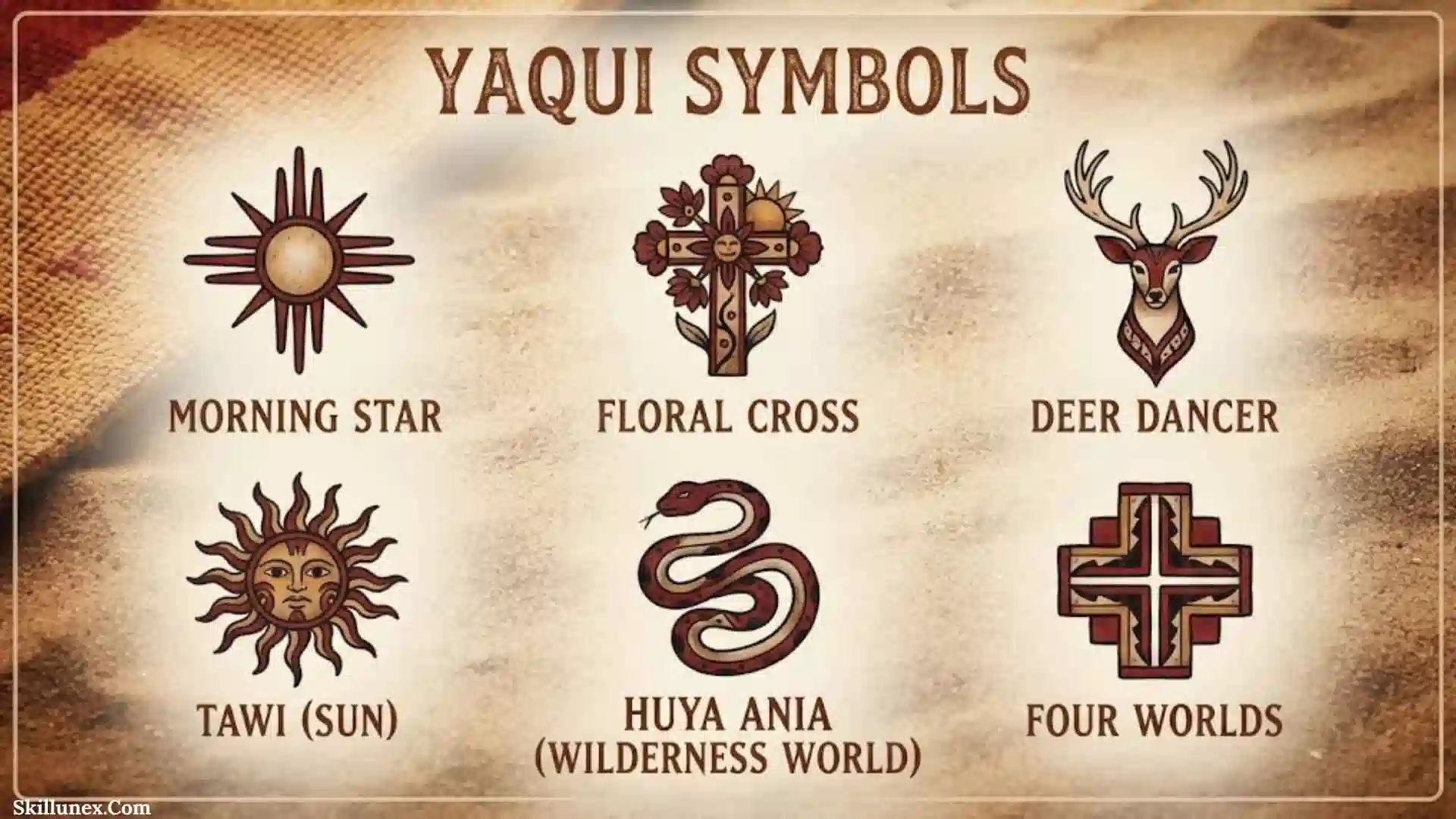
Yaqui symbols offer a fascinating window into the traditions, spirituality, ceremonies, and relationship with nature of the Yaqui people, also known as Yoeme or Hiaki. Rather than existing as a simple collection of isolated signs, Yaqui symbolism appears through animals, flowers, crosses, ceremonial objects, dances, music, clothing, and religious practices.
Many Yaqui traditions developed through the interaction of longstanding Indigenous practices with Catholic traditions introduced by Jesuit missionaries beginning in the seventeenth century. As a result, Yaqui ceremonial life can include both Indigenous and Christian elements.
It is also important to remember that Yaqui symbols do not always have one universal meaning. Interpretations can vary according to the ceremony, community, historical period, and person explaining the tradition.
What Are Yaqui Symbols?
Yaqui symbols are natural, visual, ceremonial, and religious elements that communicate ideas within Yaqui cultural life. Some are closely connected with animals and the environment, while others reflect Christian influences or specific ceremonial traditions.
Important examples of Yaqui symbolism include:
- Deer and deer imagery
- Flowers and floral designs
- Crosses
- Deer-hoof rattles
- Gourd rattles
- Water and ceremonial water drums
- Moth cocoons
- Ceremonial flags
- Pascola masks and clothing
- Traditional songs and dances
These elements should not always be considered symbols in the modern graphic-design sense. Their meaning often comes from how they are used within a ceremony or cultural practice.
Why Context Matters
A symbol can have different associations depending on where and how it appears. For example, a deer image used in relation to the Deer Dance has a much more specific cultural context than a generic deer illustration.
Likewise, flowers can appear in several Yaqui ceremonies and may have different associations depending on the tradition. The cross is another example because Christian symbolism became integrated with Yaqui ceremonial traditions in distinctive ways.
Yaqui Deer Symbol
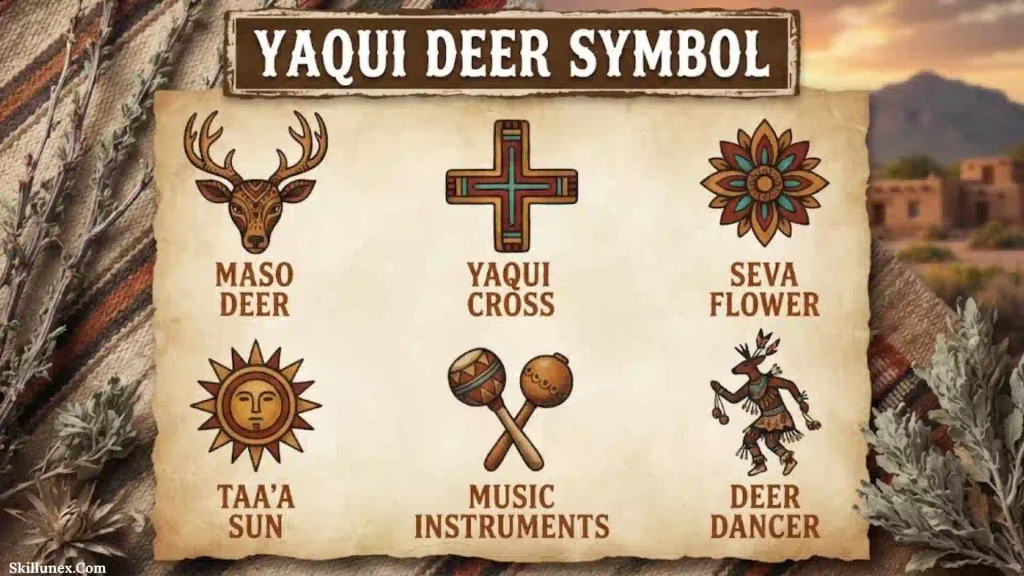
The deer is one of the most recognizable and important symbols associated with Yaqui ceremonial culture. Its significance is particularly visible in the Yaqui Deer Dance, in which a dancer represents the deer through movements, costume, rattles, and ceremonial performance.
The deer also has an important historical relationship with Yaqui communities because it provided food and materials. Over time, this relationship became expressed through songs, stories, dances, and ceremonial practices.
The Yaqui deer can therefore be associated with:
- Nature and the natural world
- Sustenance
- Respect for animals
- The relationship between people and nature
- Ceremonial traditions
- Spiritual relationships
- The natural landscape
It is important not to reduce the Yaqui deer symbol to generic meanings such as “strength” or “freedom.” Its cultural significance is more closely connected with Yaqui history, ceremony, ecology, and relationships with the natural world.
Yaqui Deer Dance
The Deer Dance is one of the best-known expressions of Yaqui symbolism. A Deer Dancer performs with traditional regalia while deer singers accompany the performance.
The dancer’s movements can imitate the behavior of a deer, creating a ceremonial representation of the animal. The performance brings together movement, music, costume, rattles, songs, and the surrounding ceremonial environment.
The Deer Dance therefore demonstrates that Yaqui symbolism is not limited to a static image. The meaning can exist through performance itself.
Deer Head Symbolism
A deer head is traditionally worn by the Deer Dancer during the performance. It is one of the most recognizable elements of the dancer’s regalia.
The deer head should be understood as part of the complete ceremonial performance rather than simply as decorative clothing. Together with the dancer’s movements, rattles, songs, and other objects, it helps create the representation of the deer.
Yaqui Flower Symbolism
Flowers are another important part of Yaqui ceremonial symbolism. Historical descriptions of the Deer Dance contain extensive floral imagery, including references to flowers, flower-filled landscapes, and flower water.
Flowers can be associated with sacredness, spiritual power, protection, nature, and ceremonial traditions. They also have an important role in Yaqui Easter ceremonies.
Possible associations include:
- Sacredness
- Spiritual power
- Protection
- Natural beauty
- Life and the environment
- Ceremonial traditions
- The Flower World
However, there is no need to assign one fixed meaning to every Yaqui flower design. Its significance depends on the particular cultural or ceremonial context.
Yaqui Flower World
The concept often described as the “Flower World” is especially significant in discussions of Yaqui Deer Dance traditions. Flowers appear repeatedly in deer songs and ceremonial imagery.
Historical research describes flowers as an important part of the symbolic world associated with the deer. Floral imagery can connect the deer with landscapes, water, plants, and spiritual experience.
This helps explain why flowers appear so frequently in descriptions of Yaqui ceremonial life.
Yaqui Cross Symbol
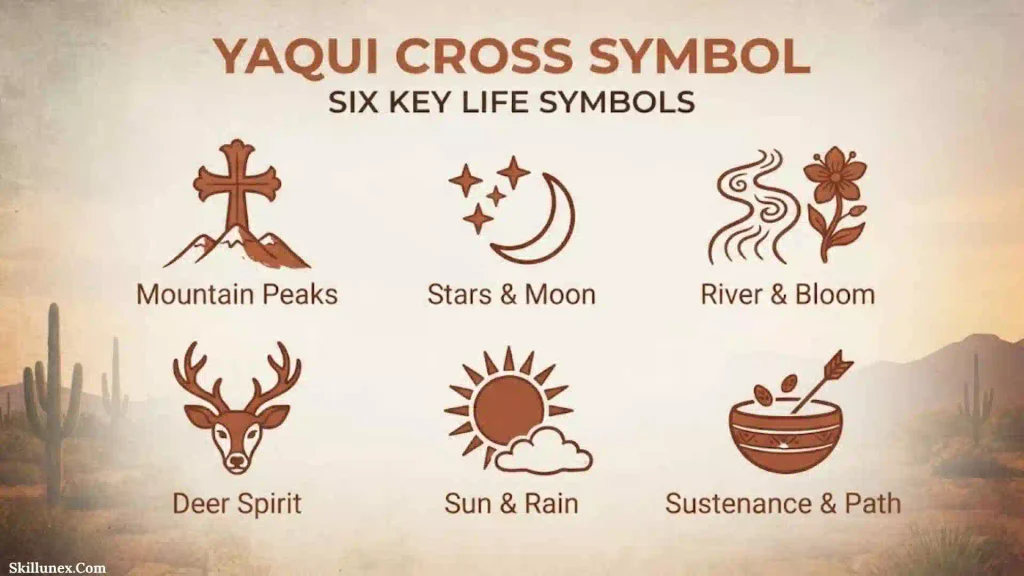
The cross is an important Christian symbol within Yaqui religious and ceremonial traditions. However, its meaning should be considered in the context of Yaqui history.
Catholic traditions became incorporated into Yaqui communities following the arrival of Jesuit missionaries in the early seventeenth century. Yaqui communities maintained Indigenous traditions while also incorporating Christian elements into their ceremonial life.
As a result, the cross can represent Christian faith while simultaneously existing within a broader Yaqui ceremonial system.
Yaqui Symbols and Christianity
Yaqui ceremonial traditions demonstrate a long history of interaction between Indigenous practices and Christianity. This can be seen in the presence of crosses, saints, churches, Christian ceremonies, and other Catholic elements alongside deer dances, traditional songs, natural imagery, and Indigenous ceremonial practices.
This combination should not be understood simply as the replacement of one tradition by another. Instead, it reflects cultural continuity, adaptation, and the development of a distinctive Yaqui religious tradition.
Yaqui Water Symbolism
Water is another important element in Yaqui ceremonial traditions, particularly those associated with the Deer Dance.
Historical accounts describe water drums and other ceremonial uses of water. Water can also be associated with the streams and lakes that form part of the deer’s environment.
This gives water several important associations:
- The deer’s habitat
- Nature
- Life
- Natural resources
- Ceremonial practice
- Sacredness
Water symbolism demonstrates how closely Yaqui ceremonial traditions can connect spirituality with the natural environment.
Water Drum
The water drum is associated with deer songs and ceremonial music. Its sound contributes to the atmosphere of the Deer Dance and connects musical performance with the natural and ceremonial world represented by the deer.
The instrument is therefore more than a musical object; it forms part of a larger cultural and ceremonial system.
Yaqui Rattles and Ceremonial Objects
Rattles are prominent elements of Deer Dance regalia. The dancer can use gourd rattles in the hands, while rattles made from deer hooves can be worn around the waist.
These objects contribute both sound and symbolism to the performance. Their materials connect the dancer’s regalia with plants and animals.
Deer-Hoof Rattles
Deer-hoof rattles have a particularly direct relationship with the deer. Historical interpretations connect them with the deer and with the animals that provided sustenance to Yaqui communities.
Their sound also becomes part of the movement of the Deer Dancer, reinforcing the relationship between the dancer and the animal being represented.
Gourd Rattles
Gourd rattles are another traditional element of Deer Dance regalia. Because gourds come from plants, some documented interpretations connect them with the plant world.
Their use illustrates how a single ceremonial costume can incorporate different elements of the natural environment.
Moth Cocoon Rattles
Moth cocoons can also be attached around the ankles of the Deer Dancer. They produce sound as the dancer moves.
Their presence adds another connection to the natural world, with documented interpretations associating them with the insect world.
Yaqui Pascola Symbols
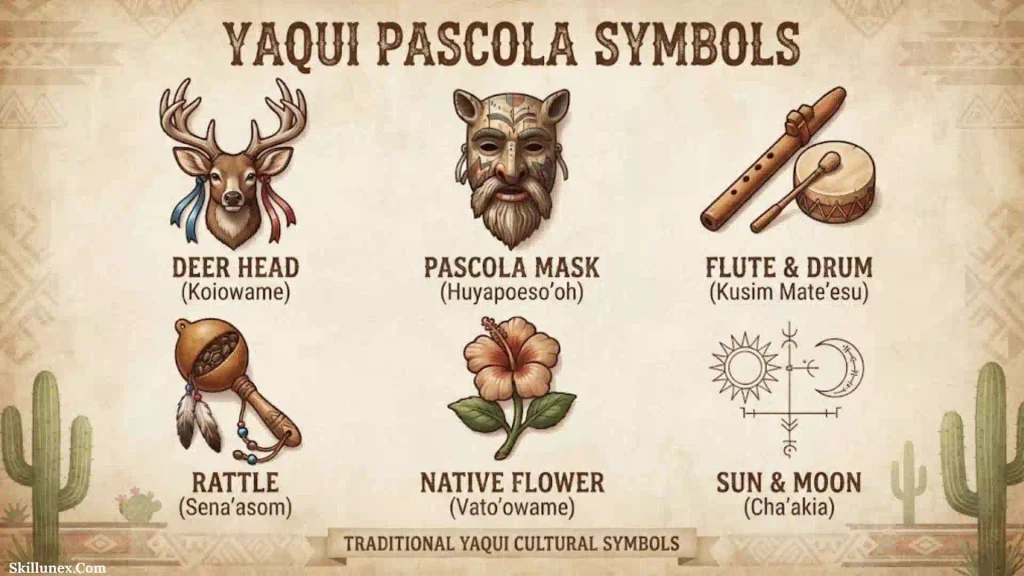
Pascola dancers have an important role in Yaqui ceremonial life and may perform alongside the Deer Dancer during certain ceremonies and fiestas.
Pascola regalia can include distinctive masks, clothing, movements, and ceremonial objects. Their symbolism is complex because historical explanations include both Indigenous and Christian interpretations.
This makes pascola traditions another example of why Yaqui symbols should be studied within their cultural context rather than assigned simplistic meanings.
Pascola Masks
The pascola mask is one of the most recognizable elements of pascola performance. The mask is part of a broader ceremonial identity that includes dance, music, storytelling, clothing, and interaction with other participants.
Its meaning is therefore connected with the entire performance rather than just its physical appearance.
Yaqui Ceremonial Flag
Ceremonial flags are another documented part of Yaqui cultural traditions. A fiesta flag can serve as an important ceremonial insignia during community celebrations.
Historical sources have recorded different explanations concerning the development and significance of particular Yaqui flags. Because these accounts are not always identical, it is better to describe the flag in relation to ceremony and community identity rather than assigning one universally accepted interpretation.
The ceremonial flag can therefore be understood in connection with:
- Community identity
- Ceremonial gatherings
- Fiestas
- Historical memory
- Yaqui cultural traditions
Yaqui Symbols and Nature
Nature is central to many Yaqui symbols. The Deer Dance brings together animals, plants, water, insects, mountains, landscapes, and human performers.
The deer is connected with its environment, while flowers, water, plants, and other natural materials appear in songs, costumes, and ceremonies.
This creates an ecological dimension to Yaqui symbolism. Nature is not simply a decorative background. It is part of the cultural relationship represented through ceremony.
Animals in Yaqui Symbolism
The deer receives the greatest attention in discussions of Yaqui ceremonial symbolism, but animals more broadly can appear within traditional stories, songs, dances, and relationships with the natural world.
The significance of an animal should always be considered within its particular Yaqui context rather than assumed to have the same meaning as it does in another Indigenous culture.
Common Yaqui Symbols and Their Meanings
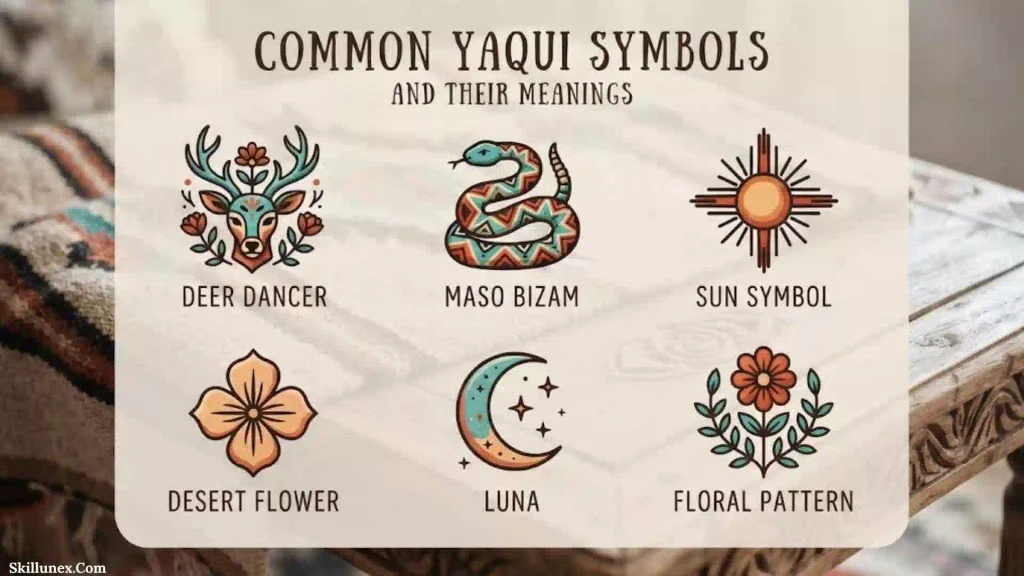
The following overview provides a simple way to understand several important Yaqui symbols and their documented associations:
- Deer: Nature, sustenance, ceremony, and the relationship between Yaqui people and deer.
- Deer head: Ceremonial representation of the deer during the Deer Dance.
- Flowers: Sacredness, spiritual power, protection, nature, and Flower World imagery.
- Cross: Christian faith within Yaqui religious and ceremonial traditions.
- Water: Nature, the deer’s environment, life, and ceremonial use.
- Gourd rattles: Deer Dance regalia and associations with the plant world.
- Deer-hoof rattles: Connection with deer and the animals that sustained Yaqui communities.
- Moth cocoons: An element associated with the insect world in Deer Dance regalia.
- Ceremonial flag: Fiesta, ceremony, community, and cultural identity.
- Pascola mask: Ceremonial performance and the distinctive role of the pascola dancer.
These meanings are best treated as general cultural associations rather than rigid definitions.
Are Yaqui Symbols the Same in Every Community?
Yaqui communities have a shared cultural heritage, but practices and interpretations can vary. Yaqui communities exist in both Sonora, Mexico, and Arizona, and ceremonial traditions have developed across different historical circumstances.
Historical researchers have also documented differing explanations of some objects and practices. This means that a single online definition should not automatically be treated as the final or universal interpretation.
Why Symbol Meanings Can Vary
Several factors can influence how a symbol is understood:
- The specific ceremony
- The community
- Historical period
- The particular object or design
- The person explaining its meaning
- The relationship between Indigenous and Christian traditions
Recognizing this variation produces a more accurate understanding of Yaqui culture.
Yaqui Symbols vs. Generic Native American Symbols
Yaqui symbols should not be treated as interchangeable with symbols from every other Indigenous nation.
The Yaqui people have their own history, language, ceremonies, traditions, and cultural practices. Although an animal such as the deer may have significance in several Indigenous cultures, its meaning is not necessarily identical from one nation to another.
The same applies to flowers, crosses, masks, rattles, and other objects.
If you are researching Yaqui symbols, focus on sources that specifically discuss Yaqui or Yoeme traditions instead of relying on generalized lists of “Native American symbols.”
Can You Use Yaqui Symbols as Tattoos or Designs?
People interested in Yaqui-inspired tattoos or artwork should learn about the cultural background of the specific symbol before using it.
Some Yaqui images are connected with living ceremonial and religious traditions. A ceremonial object or Deer Dance image may therefore have a deeper significance than its appearance suggests.
Instead of copying a design from a generic symbol website, research the specific tradition and understand its cultural context. This approach can help prevent inaccurate or disrespectful representations.
Why Cultural Context Matters
A design that looks decorative to an outside observer may have ceremonial significance to the people who use it.
This is particularly important with Deer Dance imagery, ceremonial regalia, crosses, masks, and other objects associated with specific Yaqui traditions.
Frequently Asked Questions About Yaqui Symbols
What is the most important Yaqui symbol?
The deer is one of the most prominent symbols associated with Yaqui ceremonial culture, especially through the Deer Dance. It represents a longstanding relationship between Yaqui communities, deer, nature, and ceremonial traditions.
What does the Yaqui deer symbolize?
The Yaqui deer is associated with nature, sustenance, ceremony, and the relationship between people and the natural environment. Its symbolism is expressed through dance, songs, costume, and ceremonial practices rather than one simple definition.
What do flowers symbolize in Yaqui culture?
Flowers can be associated with sacredness, spiritual power, protection, nature, the Flower World, and ceremonial traditions. Their exact significance depends on the context.
What does the Yaqui cross mean?
The cross represents the Christian component of Yaqui religious and ceremonial traditions. Its meaning is connected with the historical integration of Catholic practices into Yaqui cultural life.
What is the Yaqui Deer Dance?
The Yaqui Deer Dance is a ceremonial performance involving a Deer Dancer and deer singers. The dancer uses movements, traditional regalia, rattles, and other elements to represent and honor the deer within Yaqui ceremonial tradition.
Are Yaqui symbols religious?
Many Yaqui symbols are connected with religious or ceremonial practices, but their meanings can also involve nature, community, history, identity, and cultural continuity.
Are Yaqui symbols still used today?
Yes. Yaqui ceremonial traditions continue in contemporary Yaqui communities. Ceremonies, dances, songs, and cultural practices remain important expressions of Yaqui identity and cultural continuity.
Do all Yaqui symbols have one fixed meaning?
No. Interpretations can vary according to the ceremony, community, historical period, and individual explanation. Some symbols have well-documented associations, while others have multiple interpretations.
Conclusion
Yaqui symbols are best understood as parts of a living cultural tradition rather than as a simple collection of decorative images. The deer, flowers, water, rattles, crosses, pascola regalia, ceremonial flags, songs, and dances all become meaningful through their relationships with Yaqui history, nature, spirituality, ceremony, and community life.
Learning about Yaqui symbols with cultural context provides a more accurate and respectful understanding of their significance. The deer and Deer Dance are particularly important, but they are only part of a much broader symbolic world in which Indigenous traditions, Christian influences, the natural environment, and community identity continue to intersect.

I’m Adrian Holloway, a writer and researcher who enjoys exploring the stories, meanings, and interesting facts behind the subjects people search for every day. I’m especially interested in symbols, nature, lakes, places, and cultural topics that help readers understand the world from a different perspective.
I believe useful content should be simple, accurate, and enjoyable to read. When I research a topic, I focus on finding meaningful details and presenting them in a way that makes information easy to understand.
My goal is to create helpful articles that answer real questions while encouraging readers to discover something new with every visit.
Books by Adrian Holloway
The Language of Symbols: Meanings, Stories & Traditions
Hidden Wonders of Nature: Lakes, Landscapes & Discovery