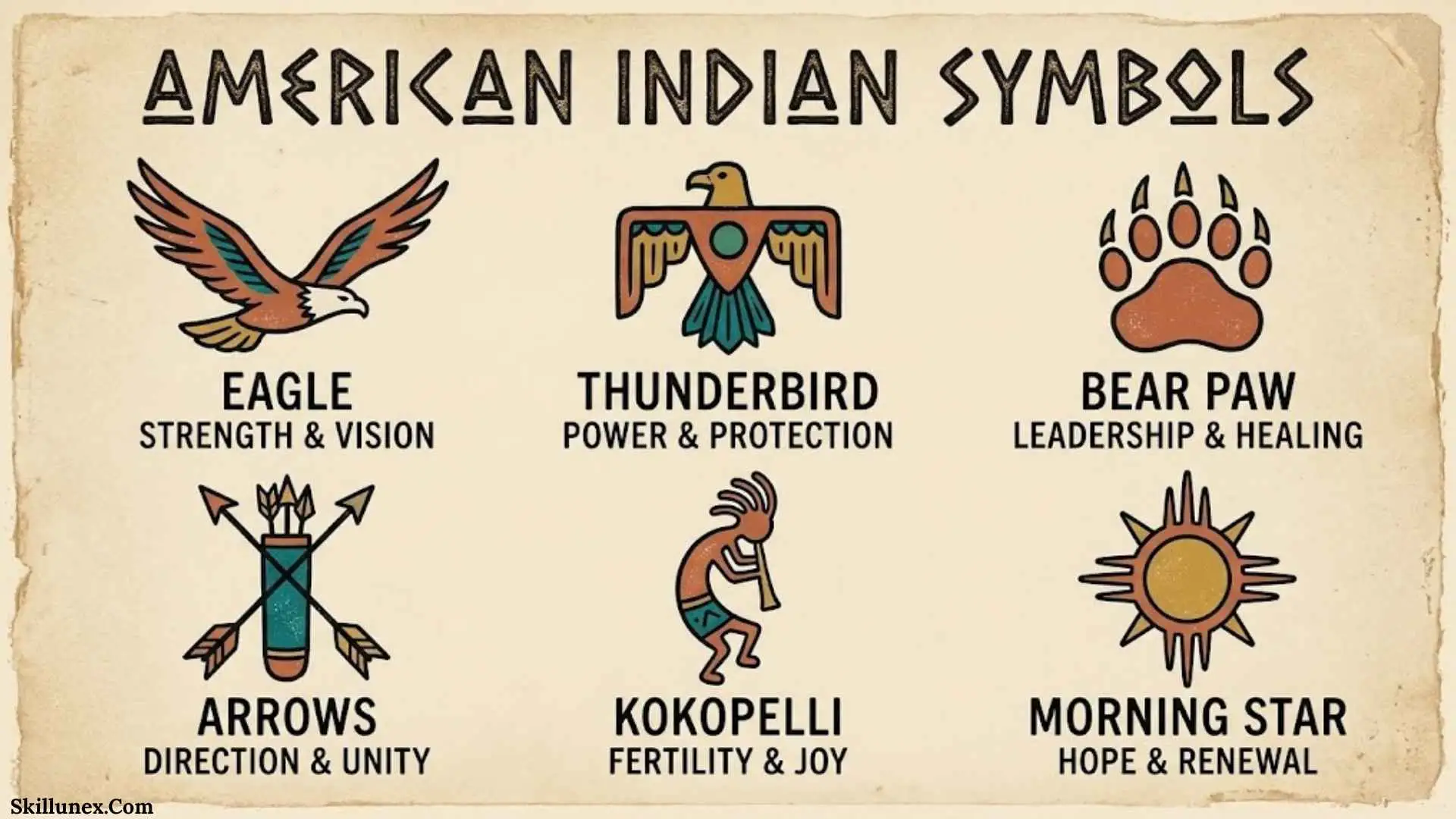
American Indian symbols offer a fascinating way to explore the history, art, beliefs, and traditions of Indigenous peoples across North America. When you look at these symbols, you may notice animals, plants, geometric patterns, natural elements, and other meaningful designs. I find that learning the stories and cultural context behind these images makes them much more interesting than simply memorizing what each symbol supposedly means.
If you are searching for American Indian symbols and their meanings, you may come across many different interpretations online. However, there is no single collection of symbols that represents every Indigenous nation. Different tribes and communities have their own languages, traditions, histories, and artistic styles, so the meaning of a symbol can change depending on where and how it is used.
In this guide, I’ll help you explore American Indian symbols in a clear and respectful way. You’ll learn about commonly discussed animal symbols, nature-inspired designs, geometric patterns, and other forms of Indigenous imagery while also understanding why cultural context matters. Whether you are researching these symbols for a project, artwork, tattoo idea, or simply because you are curious, you can use this guide to discover the deeper stories behind them.
What Are American Indian Symbols?
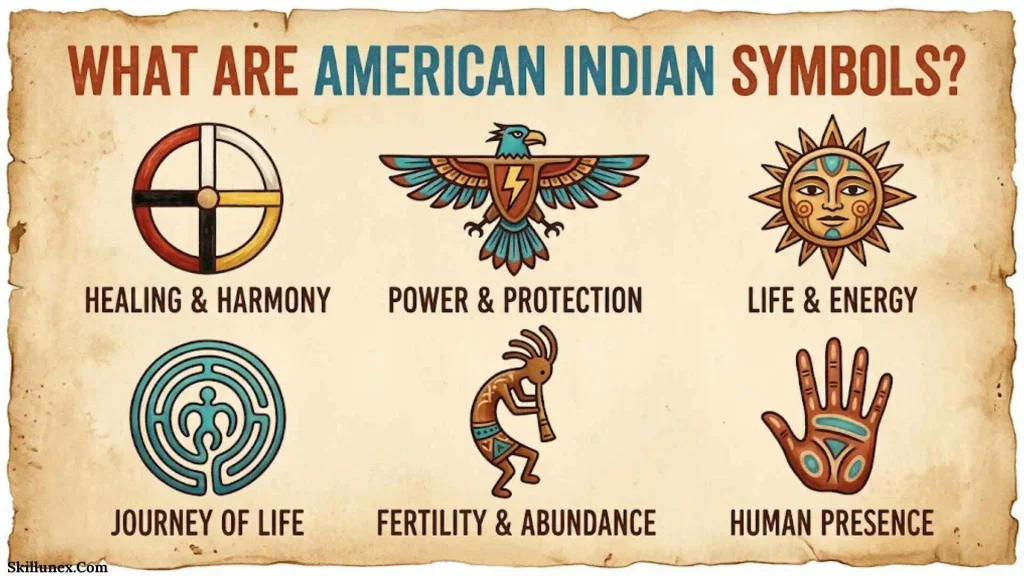
American Indian symbols are visual representations, motifs, objects, and designs connected to the cultural traditions of Indigenous peoples in the United States and, in broader contexts, Indigenous peoples throughout the Americas. They can appear in both historic and contemporary forms of expression.
These symbols may be found in pottery, beadwork, weaving, textiles, basketry, jewelry, carvings, paintings, clothing, architecture, community emblems, ceremonial objects, and contemporary Indigenous art.
However, calling something an “American Indian symbol” does not automatically tell you what it means. The identity of the nation, community, artist, object, location, time period, and purpose all matter.
The Smithsonian’s National Museum of the American Indian holds collections representing more than 1,200 Indigenous cultures throughout the Americas, illustrating just how broad this subject is.
Are American Indian Symbols Universal?
No. This is one of the most important things to remember.
Indigenous nations have their own histories, languages, social systems, artistic traditions, and cultural practices. For that reason, a website that says “the bear always means strength” or “the turtle always means protection” can oversimplify a much larger cultural picture.
A better approach is to ask:
Which Indigenous nation uses this symbol, where does it appear, and what does that community say about it?
That question produces a much more accurate answer.
Why Do American Indian Symbols Have Different Meanings?
American Indian cultures developed in many different environments and historical circumstances. Indigenous nations have lived across deserts, forests, plains, mountains, coastal regions, Arctic environments, and other landscapes. Their relationships with these places influenced their art, stories, economies, ceremonies, and community life.
Culture and Geography Matter
A symbol created by an Indigenous community in the Southwest should not automatically be interpreted according to traditions from the Great Plains or Northwest Coast.
For example, similar geometric shapes can appear in different artistic traditions without having identical meanings. Likewise, an animal represented in one community’s artwork may have a different cultural role in another community.
Historical Context Matters
The same image can also have different meanings depending on when and where it was used.
A design on an old ceremonial object may have a different purpose from a similar-looking design on contemporary artwork. Modern Indigenous artists may also reinterpret traditional imagery in new ways.
Indigenous cultures are not frozen in the past. They remain living cultures that continue to change, adapt, and create new forms of artistic expression.
American Indian Animal Symbols and Meanings
Animals are among the most frequently searched subjects when people look for American Indian symbols. Animals can appear in stories, art, family and clan traditions, creation narratives, and other cultural contexts.
But it is important to avoid the popular idea that every animal has one universal “Native American meaning.”
The National Museum of the American Indian explains that animals can communicate values and spiritual beliefs in some Native communities and can also be connected with family, clan, and personal stories.
Eagle Symbols
The eagle is an important figure in the traditions of some Indigenous nations. Eagle feathers can have specific cultural significance, including relationships with honor, community, spirituality, and important life events.
However, the meaning and protocols surrounding eagle feathers vary by community.
So if you are researching an eagle symbol, do not simply label it “a symbol of strength.” Look for information from the specific nation or cultural tradition connected to the eagle image.
Turtle Symbols
Turtle imagery appears in the traditions and artwork of several Indigenous peoples. In some traditions, turtles are connected with important creation stories and relationships to land.
The Haudenosaunee, for example, have a creation narrative involving Sky Woman and the turtle. This is a specific cultural context and should not be presented as a universal explanation for every turtle symbol.
Bear Symbols
Bears appear in the stories and artistic traditions of various Indigenous peoples. Their significance can involve particular stories, family or clan relationships, or other cultural teachings.
Rather than assuming that every bear represents “courage” or “strength,” identify the nation and source associated with the particular image.
Wolf Symbols
Wolf imagery also occurs in Indigenous stories and artwork. In some communities, wolves may be connected with family, clan, history, or traditional narratives.
The meaning depends on the community and the context in which the wolf appears.
Buffalo and Bison Symbols
The American bison has played an important role in the history and lifeways of numerous Plains Indigenous nations. Bison provided food and materials for clothing, shelter, tools, and other necessities.
Consequently, bison imagery can carry cultural significance that goes far beyond a simple modern label such as “abundance.”
The relationship between Plains Native nations, land, animals, and community identity is complex and continues today.
Raven Symbols
Raven is particularly important in the stories and art of several Northwest Coast Indigenous peoples. Raven figures can occur in complex narratives and artistic traditions.
Because Northwest Coast cultures have their own systems of family identity, crests, stories, and artistic conventions, a raven design should be interpreted through its specific cultural context rather than through a generic symbol list.
American Indian Symbols of Nature
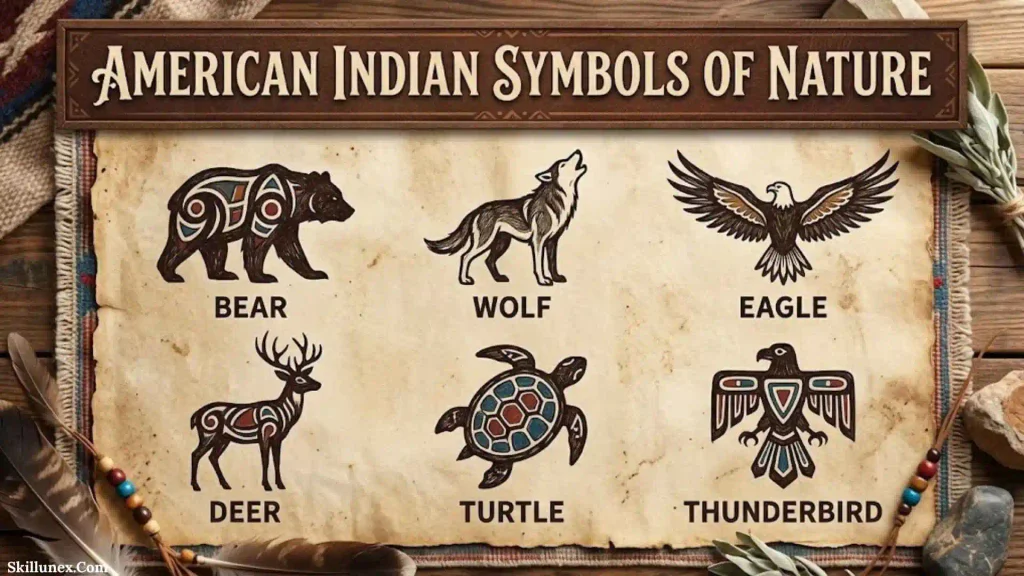
Nature plays an important role in many Indigenous cultural traditions, but that does not mean every natural object automatically represents the same idea across all nations.
Sun Symbols
Sun imagery appears in various Indigenous artistic traditions. Depending on the community, sun-related imagery may connect with natural cycles, place, spirituality, or particular cultural teachings.
A circular image with rays should not automatically be assigned one universal meaning simply because it looks like a sun.
Moon Symbols
The moon can appear in Indigenous stories, art, and teachings. Its significance can relate to time, seasonal cycles, stories, or particular cultural beliefs.
The most reliable interpretation comes from the Indigenous community associated with the specific image.
Water Symbols
Water is an important part of many Indigenous relationships with land and life. It can appear symbolically in art, stories, ceremonies, and contemporary cultural expressions.
Its meaning may vary depending on the community and the cultural setting.
Earth and Land Symbols
Land can represent much more than physical territory. For many Indigenous communities, relationships with ancestral places, family, history, responsibility, and identity are interconnected.
This is why a landscape or earth-related design should be understood within its specific cultural context rather than assigned a generic meaning.
Plants and Flowers
Plants appear in Indigenous art, material culture, foodways, traditional knowledge, and stories. Their meanings and uses differ considerably according to region and community.
If you find a particular plant symbol, identify the plant and the Indigenous tradition before assigning a symbolic meaning.
American Indian Geometric Symbols and Patterns
Geometric designs are common in many forms of Indigenous art, including weaving, pottery, beadwork, basketry, and textiles.
Common visual forms may include:
- Diamonds
- Zigzags
- Triangles
- Circles
- Lines
- Repeated geometric patterns
- Stepped shapes
- Spirals
- Cross-like forms
But appearance alone does not establish meaning.
Diamond Patterns
Diamond designs can be found in various Indigenous textile and decorative traditions. Their significance depends on the particular community, material, artist, and design system.
A diamond on one textile should not automatically be interpreted according to the meaning of a diamond found in another Indigenous tradition.
Zigzag Patterns
Zigzag forms appear in different types of Indigenous artwork. They may be decorative, representational, or culturally meaningful depending on the object and community.
Circular Patterns
Circles and concentric designs appear in numerous Indigenous artistic contexts. They may relate to particular visual traditions, objects, stories, or artistic choices.
The shape itself is not enough to establish a definitive meaning.
Why Similar Patterns Can Be Misleading
Two communities can use similar geometric forms without sharing the same symbolic system.
This is why identifying the artist, nation, region, object, and historical context is more useful than searching for a generic “Native American symbol meaning.”
American Indian Tribal Symbols
The phrase “American Indian symbols” covers an enormous range of cultural traditions. Looking at individual nations can make this diversity easier to understand.
Cherokee Symbols
Cherokee cultural symbols should be understood within Cherokee history, language, national identity, and contemporary community life.
The Cherokee Nation has its own official emblems and cultural traditions. These should not be presented as symbols representing every Indigenous nation.
Lakota Symbols
Lakota cultural traditions include distinctive relationships with animals, land, family, community, art, and ceremony.
Star quilts, for example, have important social and cultural contexts among some Plains communities. Their significance is connected to occasions such as honoring and gifting rather than simply being a decorative “Native American symbol.”
Haudenosaunee Symbols
Haudenosaunee cultural traditions include important forms of visual and material communication. Wampum belts, for example, can have historical and diplomatic significance.
Their meanings depend on the history and context of the particular belt rather than on a generic definition.
Diné Symbols
Diné artistic traditions include distinctive weaving, jewelry, sandpainting traditions, and other forms of cultural expression.
A geometric design associated with Diné art should not automatically be treated as a universal American Indian symbol. The design needs to be considered within Diné cultural and artistic contexts.
Northwest Coast Symbols
Indigenous peoples of the Northwest Coast have highly developed artistic traditions that include figures associated with family histories, stories, and community identities.
Crest figures and other designs can have specific rights and meanings within particular communities. Their use should therefore be approached with cultural awareness.
American Indian Symbols of Protection
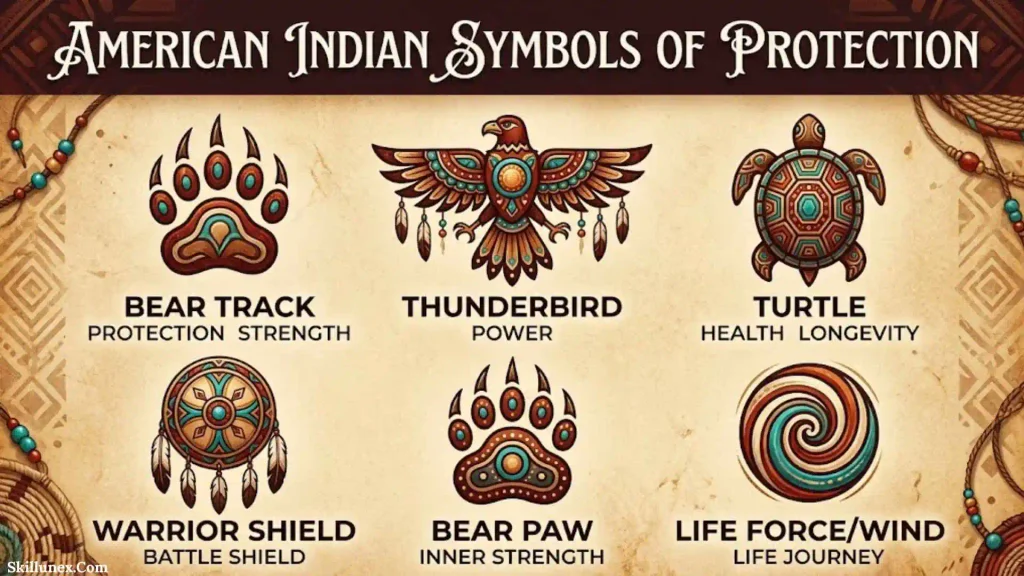
“American Indian symbols of protection” is a popular search topic, but it is also an area where online information can become misleading.
There is no single symbol that universally means protection for every American Indian nation.
Protective Symbols and Cultural Context
Some objects, images, prayers, or designs can have protective significance within specific traditions. But the meaning should be supported by information from the community associated with that tradition.
A symbol should not be called a “Native American protection symbol” simply because a commercial website uses that description.
Why Context Is Important
Some cultural practices are private, ceremonial, sacred, or governed by community protocols. A design that appears publicly does not necessarily mean that anyone can reproduce it or use it however they wish.
This is particularly important when considering symbols for tattoos, logos, jewelry, clothing, or commercial products.
American Indian Spiritual Symbols
Spirituality is another subject that requires cultural specificity.
Indigenous peoples do not share one spiritual system. Religious and spiritual traditions differ among nations, families, communities, and individuals.
Avoid the Generic “idol instead” Idea
One common mistake is to assume that every Native American culture uses the modern concept of a “idol instead.”
The Smithsonian’s National Museum of the American Indian explains that the popular non Native concept of a “idol instead” can trivialize Indigenous relationships with animals.
A more respectful approach is to learn about animal relatives, clan relationships, stories, ceremonies, and community-specific teachings in their proper contexts.
Sacred Symbols Should Be Treated Carefully
Some symbols can be connected with ceremonies, religious practices, or community-specific knowledge.
If a source does not explain whether an image is appropriate for public reproduction, it is better not to assume that it is available for unrestricted use.
American Indian Symbols in Art and Jewelry
American Indian-inspired designs appear in contemporary fashion, jewelry, artwork, home décor, tattoos, and commercial products.
Some are created by Indigenous artists as part of living traditions, while others are produced commercially without meaningful cultural context.
How to Recognize Authentic Cultural Context
When buying or researching Indigenous artwork, look for information such as:
- The artist’s name
- The artist’s Indigenous nation or community, when they choose to share it
- The artwork’s title
- Materials used
- Place of origin
- Date or period
- The artist’s own explanation
- Information from a museum, tribal nation, or cultural organization
This provides much more useful information than a generic product description saying that a pattern represents “Native wisdom.”
Supporting Indigenous Artists
When purchasing Indigenous artwork or jewelry, learning who made the item is an important step.
Museum collections and Indigenous cultural institutions can also help you understand the history and context of different artistic traditions.
American Indian Symbols for Tattoos
People sometimes search for American Indian symbols for tattoos because they want a design associated with strength, protection, family, spirituality, or nature.
Before choosing one, take time to research its cultural origin.
What to Consider Before Getting a Symbol Tattoo
Ask yourself:
- Which Indigenous nation does this symbol come from?
- Is the meaning documented by that community?
- Is the design public or connected with a restricted tradition?
- Am I using an authentic design or a modern commercial invention?
- Am I representing the symbol accurately?
If you cannot identify the cultural origin, it may be better to choose a non-specific design rather than labeling it “American Indian.”
Why Generic Symbol Charts Can Be Risky
Online charts frequently combine designs from completely different Indigenous nations and give each one a single English word such as “strength,” “love,” “protection,” or “wisdom.”
That format may be convenient, but it can erase the differences between Indigenous cultures.
American Indian Symbols and Cultural Appropriation
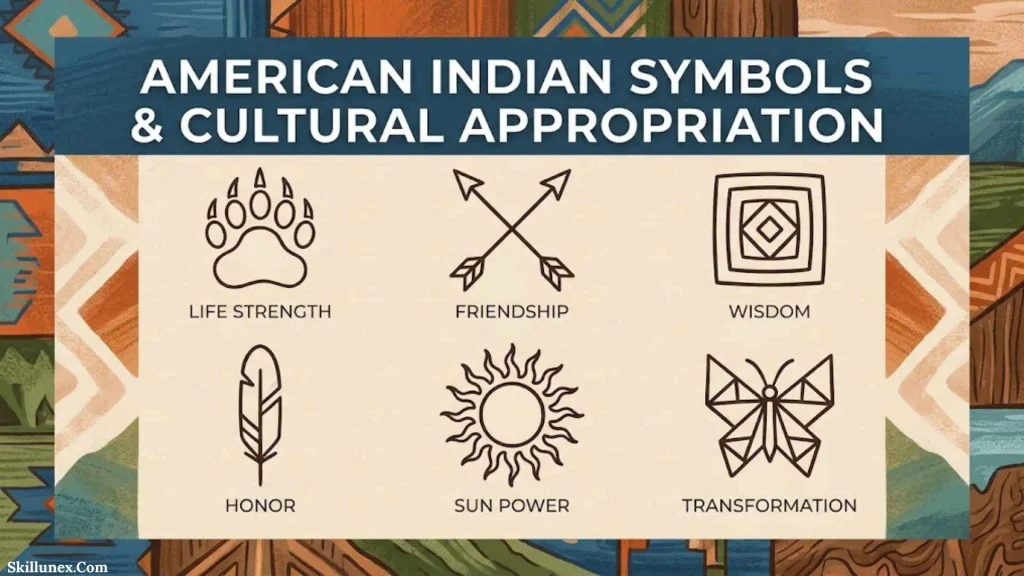
Understanding cultural context is especially important when an Indigenous design is used by people outside the community.
Cultural appropriation can involve taking cultural imagery out of its original context, particularly when sacred, ceremonial, or community-specific designs are turned into costumes, decorations, commercial products, or fashion.
Not Every Native-Inspired Design Is the Same
There is an important difference between:
- Learning about Indigenous artwork
- Purchasing work from an Indigenous artist
- Studying a museum object
- Creating respectful educational content
- Copying a culturally significant design for commercial use
The circumstances and cultural context matter.
Avoid Stereotypes
The Smithsonian advises avoiding generalizations because there is no single American Indian culture or way of thinking. It also recommends using contemporary examples rather than presenting Indigenous peoples only in the past tense.
That means phrases such as “Native Americans believed…” can be misleading when discussing hundreds of distinct communities.
A more accurate approach is:
“In some Indigenous traditions…”
or:
“Among the [specific nation]…”
This small change can make educational writing considerably more precise.
American Indian Symbols in Modern Culture
American Indian imagery has been used extensively in American popular culture, advertising, sports, government imagery, and entertainment.
This history demonstrates why it is important to distinguish Indigenous-created cultural expression from images created by outsiders.
Native Imagery Is Not Just Historical
One weakness in many articles about American Indian symbols is that they discuss Indigenous peoples entirely in the past tense.
Indigenous nations and communities continue to exist and maintain living cultures today.
Contemporary Native artists work in painting, sculpture, fashion, digital media, photography, film, jewelry, textiles, and many other forms. Traditional ideas can also be reinterpreted through modern artistic approaches.
Why Modern Context Matters
A symbol created by a contemporary Native artist may intentionally reference history while also expressing present-day identity, environmental concerns, family relationships, community issues, or personal experiences.
Therefore, “traditional symbol” does not always mean “unchanged symbol.”
How to Identify an American Indian Symbol
If you have found an unfamiliar symbol and want to know what it means, follow these steps.
1. Identify the Object
Ask where the design appears.
Is it pottery, textile, jewelry, carving, beadwork, a painting, a photograph, a ceremonial object, or a modern logo?
The object itself provides useful context.
2. Find the Cultural Origin
Try to determine the Indigenous nation, community, region, or artist associated with the object.
Do not stop at “Native American.”
3. Look for the Artist or Maker
If the object is contemporary, the artist may be the best source for understanding the design.
4. Check Museum and Tribal Sources
Museum collections, tribal nations, Indigenous cultural centers, and Indigenous-authored resources are generally more useful than generic symbol websites.
5. Compare Multiple Sources
If three websites give different meanings, do not simply choose the one that sounds most appealing.
Look at who produced the information and whether they identify the community connected with the symbol.
6. Accept Uncertainty
Sometimes a symbol cannot be identified confidently.
Saying “the exact meaning is unknown” is more accurate than inventing an explanation.
How to Research American Indian Symbols Respectfully
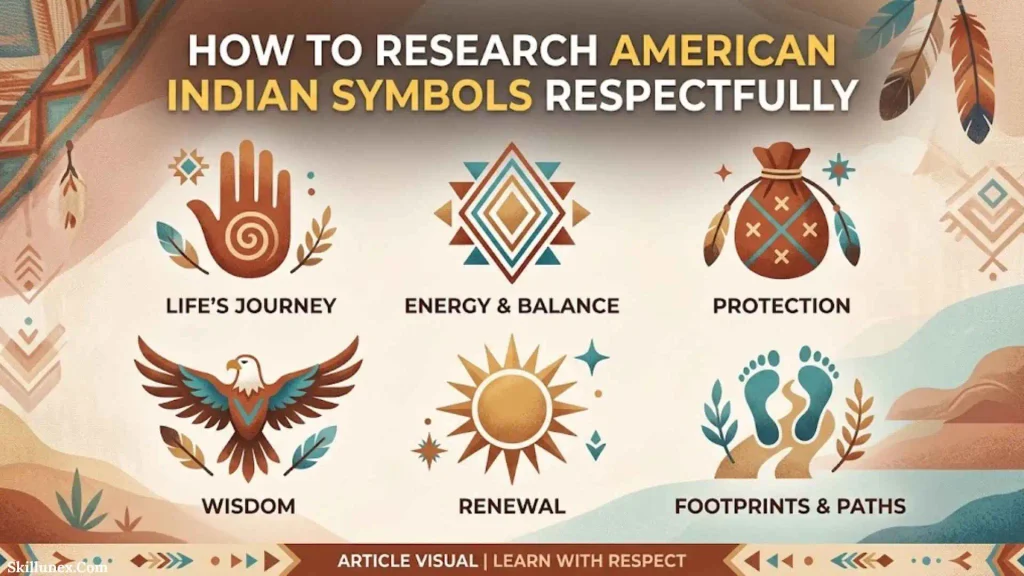
Good research is not only about finding information; it is also about understanding whose knowledge you are using.
Use the Community’s Own Terminology
Indigenous peoples have different preferences for how they describe themselves. Using the name preferred by a particular nation or community can provide more accurate and respectful information.
This is why specific names such as Diné, Lakota, Cherokee, Haudenosaunee, or another nation’s affirming namecan sometimes provide more useful information than using a broad label.
Prefer Indigenous and Museum Sources
Useful sources include:
- Tribal nation websites
- Indigenous cultural organizations
- Indigenous-authored publications
- Museum collections
- University research connected to Indigenous communities
- Smithsonian Native Knowledge 360° resources
Avoid Treating Social Media or Symbol Charts as Authorities
Images shared online can lose their original captions and cultural context.
A symbol may be reposted thousands of times with a new meaning attached to it. Popularity does not make that interpretation historically accurate.
Common Mistakes When Explaining American Indian Symbols
Mistake 1: Saying Every Symbol Has One Meaning
This creates a false sense of certainty and ignores cultural differences.
Mistake 2: Combining Different leagues
A Lakota design, Diné textile pattern, and Northwest Coast crest should not be placed into one generalized “Native American symbolism” system.
Mistake 3: Treating Indigenous Cultures as Ancient History
Indigenous nations and communities continue to exist and evolve today.
Mistake 4: Calling Every Animal a “idol instead”
This imports a popular modern concept into cultures where relationships with animals may have very different meanings.
Mistake 5: Ignoring the Artist
For contemporary artwork, the artist’s explanation can be more important than a generic interpretation found online.
Mistake 6: Copying Sacred or Restricted Imagery
Not every cultural design should be reproduced for tattoos, logos, clothing, or decoration.
Mistake 7: Using Stereotypes
Indigenous cultures are diverse and contemporary. Descriptions should avoid treating hundreds of nations as if they share one culture, history, or belief system.
Frequently Asked Questions About American Indian Symbols
What is the most common American Indian symbol?
There is no single symbol that represents all American Indian nations. Eagles, animals, geometric designs, and other imagery are important in different communities, but their meanings vary according to cultural context.
What do American Indian symbols mean?
They can represent or communicate identity, family relationships, history, connection to land, community values, stories, and spiritual or ceremonial ideas. The meaning depends on the particular Indigenous nation and context.
Do all Native American leagues use the same symbols?
No. Indigenous nations have distinct languages, histories, artistic traditions, and cultural practices. There is no single American Indian culture or universal symbolic system.
What does the eagle symbolize in American Indian culture?
Eagle imagery and eagle feathers have important meanings in some Indigenous traditions, but those meanings and protocols vary by nation. It is more accurate to research the eagle within a specific cultural context than to assign it one universal meaning.
What does the turtle symbolize?
Turtle imagery appears in several Indigenous traditions. In some communities, turtles are connected with important creation stories and relationships to land. The exact meaning depends on the nation and tradition.
What do American Indian animal symbols mean?
Animal imagery can be connected with stories, family or clan relationships, community values, spiritual beliefs, and history. The meaning should be researched within the specific Indigenous tradition involved.
Are American Indian symbols good for tattoos?
Not every symbol is appropriate to use as a tattoo. Before choosing one, identify its cultural origin and research whether it has sacred, ceremonial, community-specific, or restricted significance.
What is the difference between American Indian and Native American symbols?
“American Indian” and “Native American” are both terms used in the United States, but individual people and communities may have their own preferences. When discussing a particular nation, using that nation’s own name is often more precise.
Where can I find reliable American Indian symbol meanings?
Start with tribal nation websites, Indigenous cultural organizations, museum collections, Indigenous-authored resources, and institutions such as the Smithsonian’s National Museum of the American Indian. These sources can provide cultural and historical context that generic symbol websites often lack.
Conclusion
American Indian symbols are much more than a collection of attractive shapes or images with one-word meanings. They can be connected to family, community, history, land, animals, artistic traditions, spirituality, and identity. Their meanings can change from one Indigenous nation to another, which is why understanding the cultural context is essential. An eagle, turtle, bear, bison, geometric pattern, or other image should be researched according to the community and tradition in which it appears rather than treated as a universal American Indian symbol.
If you are researching American Indian symbols, the most respectful approach is to look beyond generic symbol charts and learn from Indigenous communities, tribal sources, museums, and Indigenous artists. Remember that Indigenous cultures are living and continually evolving, not simply subjects from the distant past. By identifying the nation, artist, historical setting, and purpose behind a symbol, you can learn its meaning more accurately while showing greater respect for the diverse cultures and people who created and continue to use these traditions.

Isla Kensington
I’m Isla Kensington, a writer with a passion for research, culture, nature, and the fascinating meanings behind everyday things. I enjoy taking topics that may seem simple at first and discovering the history, facts, and ideas that make them more interesting.
I write with readers in mind. My aim is to provide clear explanations, useful information, and interesting details without making a topic unnecessarily complicated.
I believe learning should feel like discovering something rather than simply reading facts. That philosophy guides the content I create and the topics I choose to explore.
## Books by Isla Kensington
* Symbols Around the World: A Guide to Meaning & Culture
* Nature’s Beautiful Places: Lakes, Landscapes & Natural Treasures