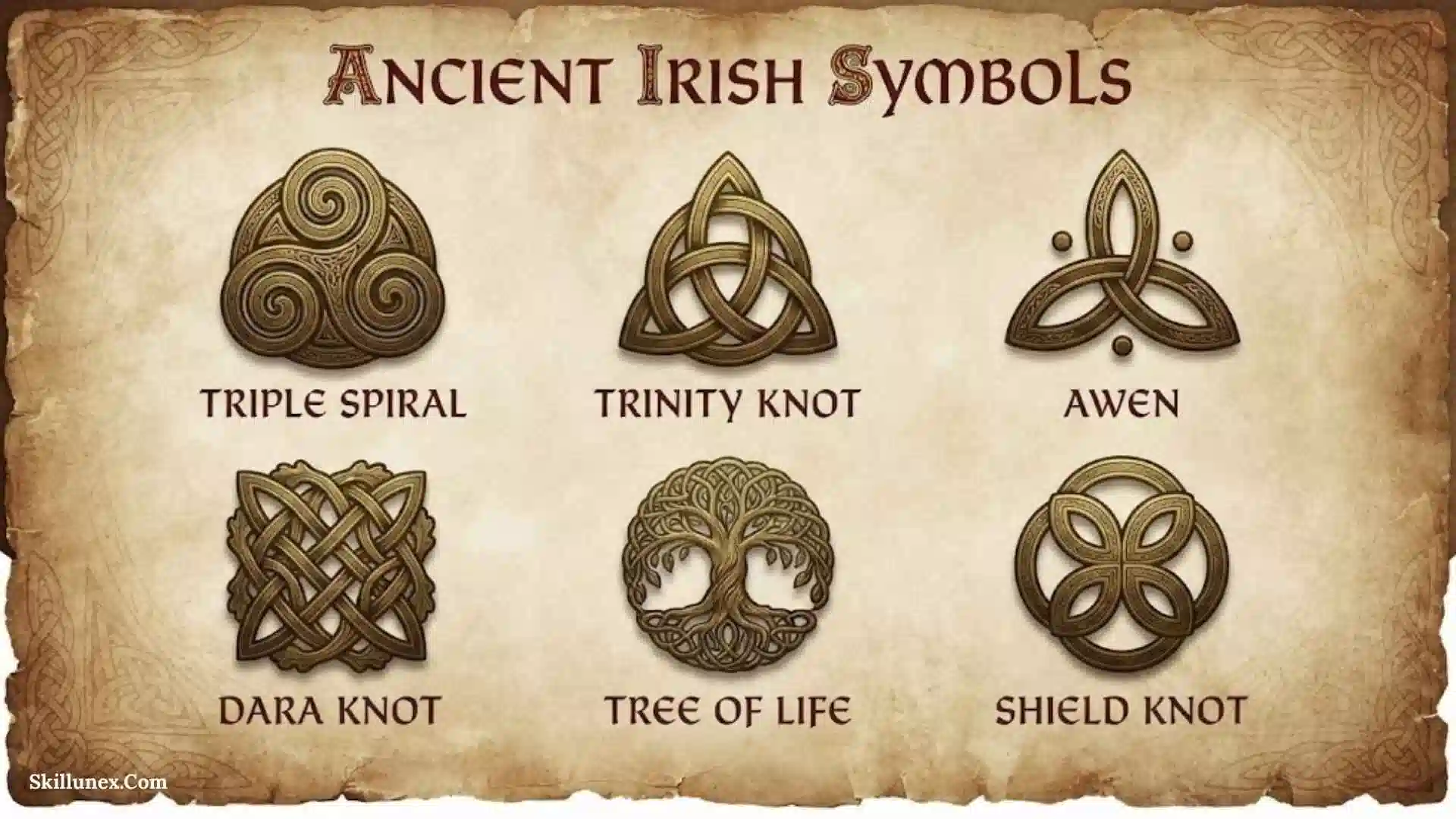
If you’re interested in Irish history, mythology, Celtic art, or meaningful symbols, ancient Irish symbols offer a fascinating way to explore Ireland’s past. From the mysterious spirals carved into prehistoric stones at Newgrange to the intricate knots found in medieval manuscripts, Irish symbolism developed across thousands of years.
Some symbols have clear archaeological or historical connections to Ireland. Others became associated with Irish identity much later. That distinction matters because the internet often describes modern Celtic designs as if they were all ancient symbols with fixed meanings.
In this guide, I’ll explain the history, meanings, origins, and cultural context of the most recognizable ancient Irish and Celtic symbols. You’ll also learn which symbols are genuinely prehistoric, which belong to medieval Ireland, and which are modern interpretations.
What Are Ancient Irish Symbols?
Ancient Irish symbols are visual motifs, designs, objects, and images connected with Ireland’s prehistoric, Celtic, early Christian, medieval, and mythological traditions.
They appear in many forms, including:
- Stone carvings
- Burial monuments
- High crosses
- Metalwork
- Manuscript decoration
- Jewelry
- Weapons
- Religious artwork
- Mythological stories
- Traditional Irish crafts
However, “ancient Irish symbol” is a broad modern term rather than a single historical category.
Ireland’s symbolic traditions developed over different periods. The spirals at Newgrange, for example, are thousands of years older than medieval Celtic crosses. A Claddagh ring is much more recent than both.
Understanding these differences makes Irish symbolism more interesting because each design tells a different story.
Why Irish Symbols Are So Important
Symbols allowed people to communicate ideas visually, especially during periods when written records were limited.
Irish art frequently used patterns connected with nature, Christianity, mythology, animals, and geometric forms. Some designs may have had religious or ceremonial purposes, while others were primarily decorative.
In some cases, we know what a symbol meant because historical texts explain it. In other cases, archaeologists can only study the design and its context.
That means some popular meanings are interpretations rather than proven facts.
A Brief History Of Irish Symbols
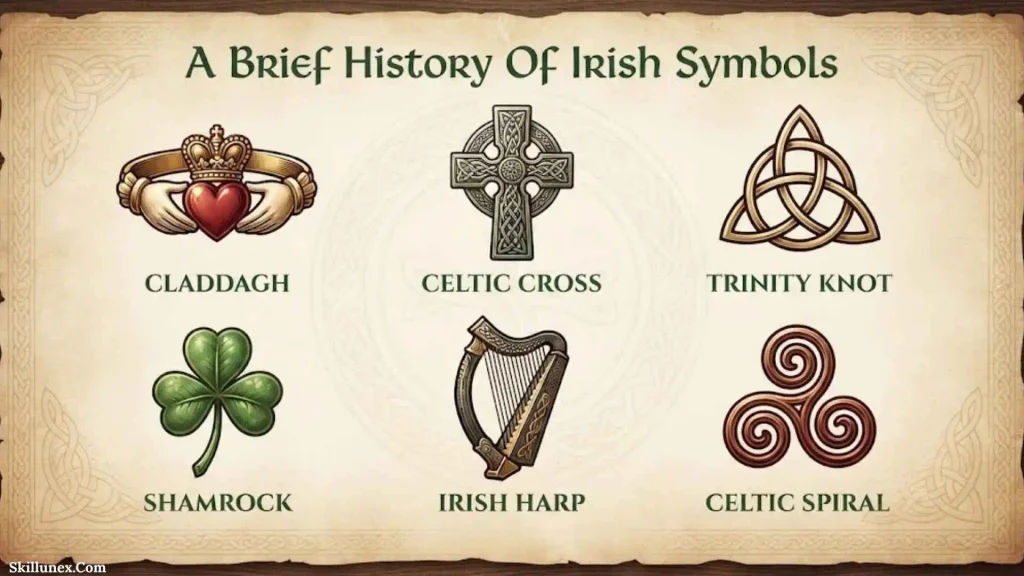
Irish symbolism did not appear during one particular historical period. It developed gradually through prehistoric, Celtic, Christian, and medieval traditions.
Prehistoric Ireland
Some of the oldest symbolic artwork in Ireland comes from the Neolithic period.
Newgrange, part of the Brú na Bóinne archaeological landscape, is especially important. Its stones contain spirals, circles, diamonds, zigzags, and other geometric designs.
These carvings were created thousands of years ago, long before Christianity arrived in Ireland.
The exact meaning of many prehistoric designs remains unknown.
Celtic And Iron Age Ireland
Later Irish traditions developed during the Iron Age and the period commonly associated with Celtic culture.
Animal imagery, weapons, geometric patterns, and artistic motifs appear in archaeological material from this broad period.
It is important, however, not to assume that every design described today as “Celtic” originated during this period. The term Celtic covers different peoples, languages, and cultural traditions across a large geographical area.
Early Christian Ireland
Christianity became established in Ireland during late antiquity and the early medieval period.
Irish Christian artists combined Christian imagery with existing artistic traditions. This helped produce the distinctive style now commonly called Insular art.
Decorated manuscripts, stone crosses, metalwork, and church objects contain elaborate interlacing, spirals, animals, and geometric patterns.
Medieval Ireland
During the medieval period, Christian symbolism became deeply connected with Irish art and religious monuments.
High crosses are among the most recognizable examples. Monasteries also became important centers for manuscript production, metalwork, stone carving, and education.
Many symbols that people now call “Celtic symbols” are therefore better understood as products of medieval Irish art rather than prehistoric Celtic religion.
Ancient Irish Symbols And Their Meanings
Different symbols have different levels of historical evidence behind them. The following designs are among the most commonly associated with Ireland and Celtic culture.
Celtic Knots
Celtic knots are made from interwoven lines that appear to continue through the design.
They became especially prominent in Insular art, which flourished in Ireland and Britain during the early medieval period.
Modern interpretations often describe Celtic knots as symbols of:
- Eternity
- Continuity
- Interconnection
- Friendship
- Family
- Love
- The cycle of life
The important historical point is that there is no single ancient text explaining that every Celtic knot meant “eternal love” or another specific concept.
Many knots were artistic and decorative. Their modern symbolic meanings have developed through later cultural interpretation.
The Triskelion And Triple Spiral
The triskelion, or triskele, is a three-part spiral design.
Ireland is particularly famous for the triple spiral carvings at Newgrange. These carvings belong to the Neolithic period and are therefore far older than the medieval Celtic designs commonly associated with Ireland today.
Modern interpretations connect the three spirals with ideas such as:
- Movement
- Cycles
- Transformation
- Continuity
- Past, present, and future
- Life, death, and rebirth
These interpretations are popular, but the original meaning of the Newgrange spiral is not known with certainty.
That uncertainty is part of what makes the design so fascinating.
Celtic Cross
The Celtic cross is one of the most recognizable symbols associated with Ireland.
Traditional Irish high crosses feature a Christian cross, often surrounded by a circular ring. Many examples date from the early medieval period.
The cross itself represents Christianity. The circle has been given different interpretations, including associations with eternity, unity, or the sun.
However, the idea that the circle simply represents an ancient pagan sun symbol is not something that can be universally established from historical evidence.
Irish high crosses also served practical religious and educational purposes. Their carved scenes could communicate biblical stories and Christian teachings to communities.
Shamrock
The shamrock is one of Ireland’s most famous national symbols.
According to traditional accounts, Saint Patrick used a three-leaf plant to explain the Christian Trinity. The story became an important part of Irish tradition, although historians cannot independently verify that Saint Patrick actually used a shamrock in this way.
The three leaves are commonly associated with:
- The Father
- The Son
- The Holy Spirit
Today, the shamrock represents Irish identity as well as Saint Patrick and Irish Christianity.
It is worth noting that the shamrock is not necessarily an ancient pre-Christian Celtic symbol. Its strongest documented association is with later Irish Christian tradition and national identity.
Claddagh Symbol
The Claddagh consists of three elements:
- Two hands
- A heart
- A crown
Its traditional meanings are:
Hands: friendship
Heart: love
Crown: loyalty
The Claddagh is strongly associated with Galway and Irish jewelry traditions.
Although it is often included in lists of “ancient Irish symbols,” the Claddagh is not an ancient prehistoric symbol. Its origins belong to a much later period.
Today, Claddagh rings are popular as symbols of love, friendship, family, Irish heritage, and commitment.
Celtic Tree Of Life
The Celtic Tree of Life is a popular modern design inspired by the importance of trees in Celtic and Irish cultural traditions.
Trees had practical, ecological, mythological, and cultural importance in Ireland. Certain trees, including oak, ash, and yew, appear in Irish traditions and place names.
Modern Tree of Life designs often represent:
- Growth
- Strength
- Family
- Roots
- Connection
- Balance
- Nature
However, the familiar circular Tree of Life artwork sold today should not automatically be described as an ancient Irish symbol. Many versions are modern interpretations inspired by broader Celtic themes.
Awen Symbol
The Awen is usually represented by three rays.
It is often included in modern collections of Celtic symbols, but its strongest historical association is with Welsh poetic and cultural tradition rather than ancient Ireland.
The word awen is associated with poetic inspiration.
Modern Celtic-inspired interpretations sometimes connect its three rays with:
- Inspiration
- Creativity
- Harmony
- Balance
- Spiritual awareness
Because of its Welsh origin, it is more accurate to describe the Awen as a Celtic cultural symbol with Welsh roots rather than an exclusively ancient Irish symbol.
Ancient Irish Symbols From Mythology
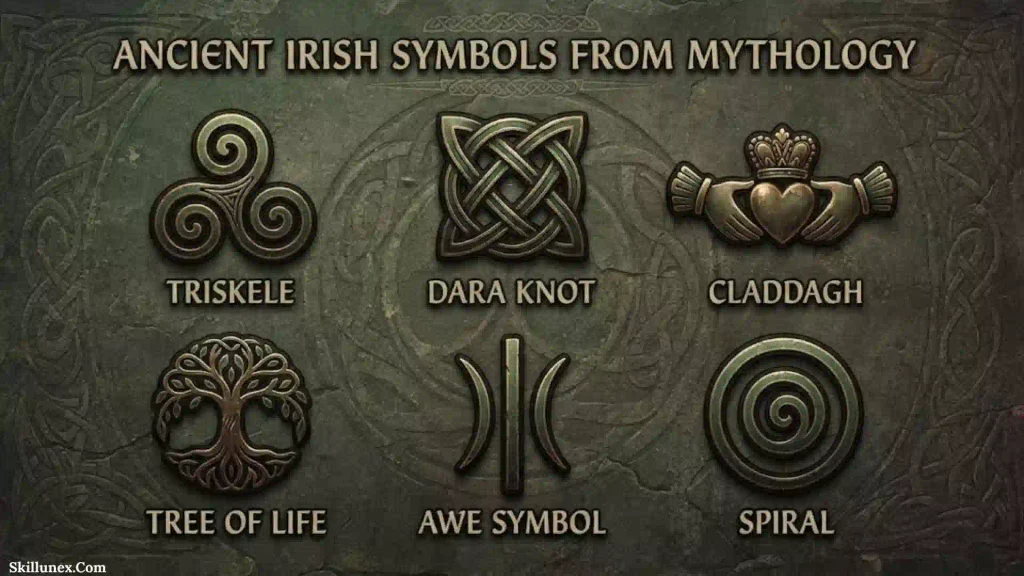
Not every Irish symbol is a geometric design. Irish mythology contains many characters, animals, objects, and stories that have become symbolic of Irish culture.
Salmon Of Knowledge
The Salmon of Knowledge is one of the best-known creatures in Irish mythology.
In the story, the salmon gains extraordinary knowledge by eating hazelnuts from the Well of Wisdom.
Fionn mac Cumhaill later gains the salmon’s knowledge after accidentally touching the fish while preparing it.
The salmon therefore represents ideas such as:
- Wisdom
- Knowledge
- Learning
- Discovery
- Inspiration
It is an excellent example of an Irish mythological symbol rather than an archaeological symbol.
The Morrígan
Morrígan is a complex figure in Irish mythology associated with war, sovereignty, fate, and transformation.
She is sometimes connected with the crow or raven in later interpretations and popular representations.
Because Irish mythology survives through medieval manuscripts and later textual traditions, interpretations of figures such as the Morrígan require careful attention to the specific source.
Modern Celtic artwork frequently uses the Morrígan as a symbol of:
- Power
- Transformation
- Sovereignty
- Protection
- War
The Celtic Harp
The harp has a particularly strong connection with Irish identity.
The Brian Boru harp, preserved at Trinity College Dublin, is one of the most famous historical harps associated with Ireland, although its connection with the medieval king Brian Boru is a later tradition rather than a proven fact.
The harp eventually became a national emblem of Ireland.
It can symbolize:
- Irish identity
- Music
- Tradition
- Cultural heritage
- Artistic expression
Irish Animal Symbols
Animals appear frequently in Irish mythology, artwork, folklore, and literature.
Raven And Crow
Ravens and crows appear in Irish mythology, particularly in stories connected with warfare, prophecy, and supernatural figures.
They can symbolize:
- Mystery
- Battle
- Death
- Transformation
- Prophecy
However, their meanings differ depending on the specific story or tradition.
Stag
The deer or stag appears in Irish mythology and folklore.
The animal is often associated with:
- The forest
- Nature
- Wilderness
- Nobility
- Spiritual journeys
The stag is also connected with stories of transformation and encounters with the Otherworld.
Wolfhound
The Irish wolfhound has become an important symbol of Ireland’s cultural heritage.
Historically, large hunting hounds were valued for hunting and guarding. The Irish wolfhound is now commonly associated with:
- Strength
- Loyalty
- Courage
- Irish heritage
Irish Symbols Connected With Nature
Nature plays an important role in Irish mythology and cultural traditions.
Oak
The oak has long been associated with strength and endurance.
In modern Celtic symbolism, oak imagery is often used to represent:
- Strength
- Stability
- Wisdom
- Protection
- Longevity
The modern Dara Knot is also inspired by oak imagery.
Rowan
The rowan tree appears in Irish and broader Celtic folklore.
It has often been associated with protection and supernatural traditions.
Modern interpretations may connect rowan imagery with:
- Protection
- Magic
- Life
- Resilience
- Spirituality
Yew Tree
The yew has a particularly strong association with longevity because of its remarkable lifespan.
Yew trees are also found in Irish churchyards and historic sites.
The tree can therefore evoke ideas of:
- Longevity
- Death
- Continuity
- Memory
- Rebirth
What Is The Dara Knot?
The Dara Knot is a popular modern Celtic knot design inspired by the oak tree.
The name is connected with the Irish word doire, meaning an oak grove.
The design is generally interpreted as representing the roots and strength of the oak.
Common modern meanings include:
- Strength
- Family roots
- Stability
- Resilience
- Protection
- Connection to nature
The Dara Knot is widely used in modern Irish jewelry, tattoos, logos, and artwork.
However, it is more accurate to call it a modern Celtic-inspired design than to claim that the exact knot pattern was used by ancient Irish people.
Ancient Irish Symbols For Love
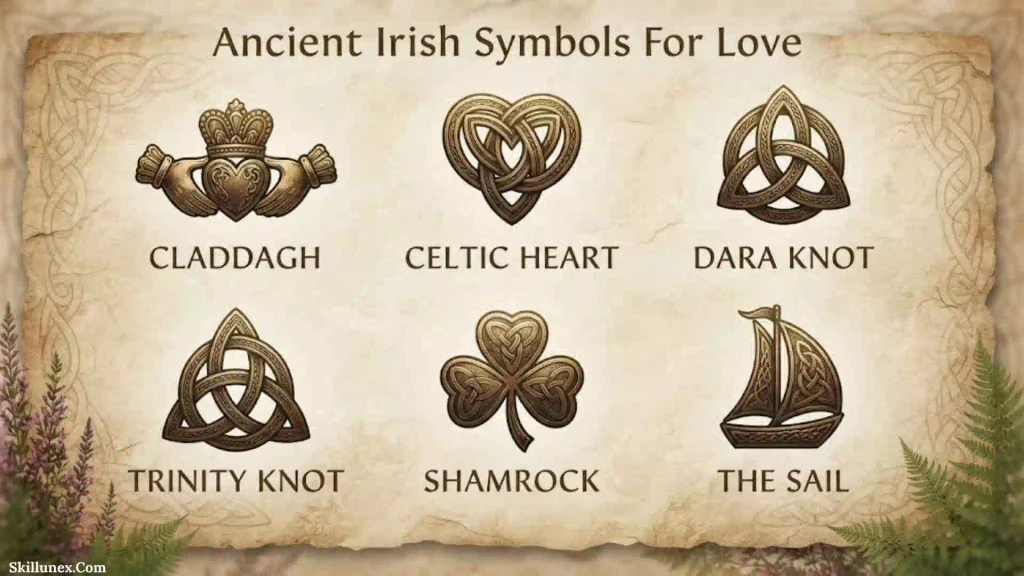
Several Irish symbols are associated with love today, although they come from different historical traditions.
The Claddagh is the clearest example. Its heart represents love, while the hands and crown represent friendship and loyalty.
Celtic knots are also frequently used in romantic jewelry because their continuous interwoven patterns can represent an enduring connection.
Other designs commonly associated with love include:
- Celtic hearts
- Interwoven knots
- Claddagh hearts
- Trinity knots
- Tree of Life designs
When choosing a symbol for a wedding, anniversary, or relationship tattoo, it is useful to distinguish traditional meanings from modern interpretations.
Ancient Irish Symbols For Protection
Protection is another common theme in modern interpretations of Irish and Celtic symbolism.
Some designs frequently associated with protection include:
- Celtic knots
- Oak imagery
- Rowan imagery
- Protective animal designs
- Crosses
- Celtic-inspired shields
However, there is no universal ancient Irish “protection symbol” that had one fixed meaning across all periods.
Many modern meanings have developed through contemporary Celtic-inspired art, jewelry, tattoos, and spiritual practices.
Ancient Irish Symbols For Strength
If you want an Irish-inspired symbol representing strength, oak imagery is one of the clearest choices.
The oak’s physical strength and longevity made it a natural symbol of endurance in later Celtic interpretations.
The Dara Knot is therefore often used today to represent:
- Inner strength
- Family
- Roots
- Resilience
- Stability
The Irish wolfhound can also represent physical strength, courage, and loyalty.
Ancient Irish Symbols For Family
Celtic knots are frequently used to represent family because their interwoven lines create a visual image of connection.
The Tree of Life is another popular choice because its roots and branches can symbolize family history and generations.
Modern family-themed Irish designs often combine:
- Celtic knots
- Trees
- Hearts
- Names
- Dates
- Claddagh elements
These combinations are especially common in jewelry and tattoos.
Ancient Irish Symbols For Tattoos
Irish and Celtic symbols remain popular tattoo designs because they can combine attractive patterns with personal meaning.
Celtic Knot Tattoos
A Celtic knot tattoo can represent connection, continuity, family, or an enduring relationship.
Because there are many knot patterns, you can choose a design based on appearance rather than relying on claims that every knot has a specific ancient meaning.
Triskelion Tattoos
A triskelion tattoo can represent movement, change, cycles, and personal transformation.
The connection with Newgrange also makes spiral imagery particularly interesting for people interested in prehistoric Ireland.
Celtic Cross Tattoos
A Celtic cross tattoo can express Christian faith, Irish heritage, or a connection with Irish history.
Claddagh Tattoos
A Claddagh tattoo is often chosen to represent love, friendship, loyalty, or Irish family heritage.
Tree Of Life Tattoos
A Celtic-inspired Tree of Life tattoo can symbolize growth, family, roots, strength, and connection with nature.
Ancient Irish Symbols For Jewelry
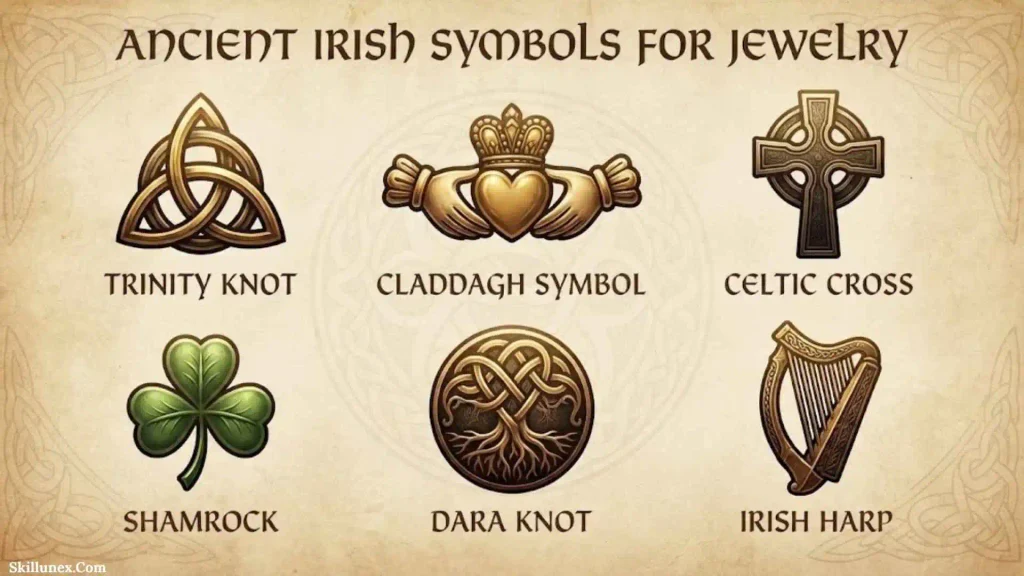
Irish symbols have a long and continuing relationship with jewelry.
Claddagh rings are perhaps the most recognizable Irish example, but Celtic knots and crosses are also widely used.
Popular choices include:
| Symbol | Common Modern Association |
| Claddagh | Love, friendship, loyalty |
| Celtic Knot | Connection and continuity |
| Celtic Cross | Christianity and Irish heritage |
| Triskelion | Cycles and transformation |
| Tree Of Life | Family and growth |
| Shamrock | Irish identity and Christianity |
| Oak-Inspired Designs | Strength and roots |
The historical origin of the design is worth checking before purchasing jewelry marketed as “ancient Celtic.”
Ancient Irish Symbols Vs Celtic Symbols
The terms Irish and Celtic are often used interchangeably online, but they are not exactly the same.
“Irish” refers specifically to Ireland and its cultural traditions.
“Celtic” is broader. Celtic languages and cultural traditions historically existed across parts of Ireland, Britain, and continental Europe.
As a result, a symbol can be Celtic-inspired without being specifically Irish.
For example, the Awen has Welsh roots, while the Newgrange spirals are specifically associated with prehistoric Ireland.
This distinction helps prevent common historical mistakes.
Which Irish Symbols Are Actually Ancient?
One of the biggest problems with online lists of ancient Irish symbols is that designs from completely different periods are often placed together.
A useful way to understand them is to separate them by historical context.
| Symbol | Ancient/Medieval/Modern Context |
| Newgrange Triple Spiral | Prehistoric |
| Prehistoric Irish Spirals | Neolithic |
| Celtic Knotwork | Mainly early medieval Insular art |
| Celtic High Cross | Medieval Christian Ireland |
| Shamrock | Later Irish Christian tradition |
| Claddagh | Later Irish tradition |
| Dara Knot | Modern Celtic-inspired design |
| Tree Of Life Designs | Mostly modern interpretations |
| Awen | Welsh cultural tradition |
| Salmon Of Knowledge | Irish mythology |
This does not make modern symbols less meaningful. It simply gives you a more accurate understanding of where they came from.
Common Misconceptions About Ancient Irish Symbols
Every Celtic Symbol Is Ancient
This is one of the most common misconceptions.
Many designs sold today as ancient Celtic symbols are modern creations or modern interpretations of older artistic traditions.
Every Symbol Has One Fixed Meaning
Ancient symbols rarely come with a universal dictionary of meanings.
A design may have been decorative, religious, ceremonial, political, or simply artistic.
Modern interpretations can be meaningful without necessarily being historically proven.
Celtic And Irish Mean Exactly The Same Thing
They do not.
Irish culture is part of the broader Celtic world, but Celtic traditions also developed in other regions.
The Claddagh Is Prehistoric
The Claddagh is an important Irish cultural symbol, but it is not a prehistoric symbol.
Its tradition is much more recent.
Newgrange Was Built By Medieval Celts
Newgrange is thousands of years older than the medieval period.
Its builders belonged to Neolithic communities. Calling them “medieval Celts” would be historically inaccurate.
Frequently Asked Questions About Ancient Irish Symbols
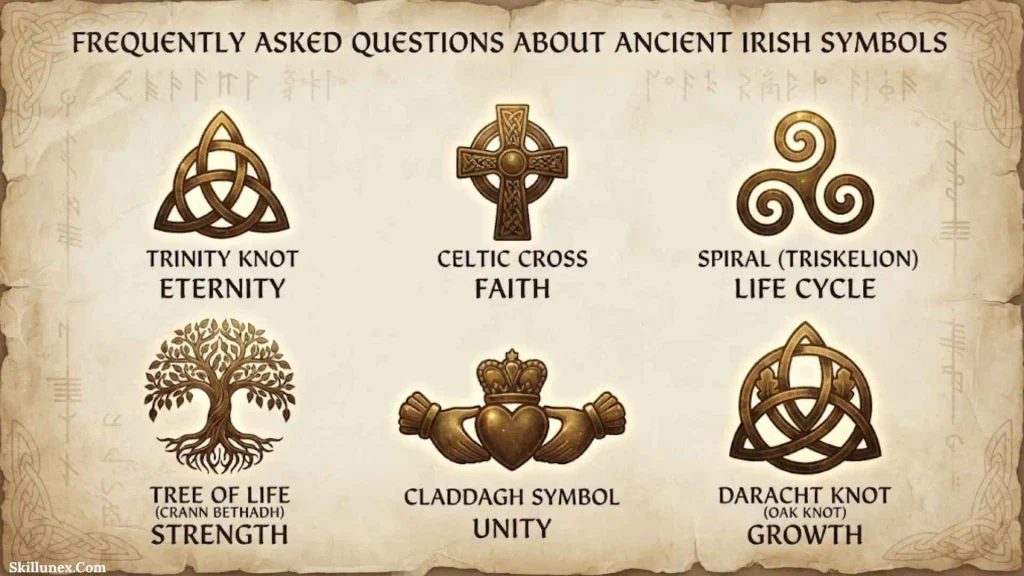
What Is The Oldest Irish Symbol?
Some of the oldest known symbolic designs in Ireland are prehistoric geometric carvings, particularly the spirals found at Neolithic monuments such as Newgrange. These designs are thousands of years older than medieval Celtic artwork.
What Does The Celtic Knot Mean?
Today, Celtic knots are commonly interpreted as symbols of eternity, continuity, connection, family, and enduring relationships. Historically, however, individual knot designs do not always have documented meanings.
What Irish Symbol Means Love?
The Claddagh is the most recognizable Irish symbol associated with love. Its heart represents love, while the hands and crown traditionally represent friendship and loyalty.
What Irish Symbol Means Strength?
Oak imagery is commonly associated with strength, endurance, and stability. The modern Dara Knot uses oak-inspired imagery and is frequently interpreted in these terms.
What Is The Irish Symbol For Family?
Celtic knots and Tree of Life designs are commonly used today to represent family, connection, roots, and generations. These meanings are largely modern interpretations rather than a single ancient Irish definition.
Is The Celtic Cross Irish?
The Celtic cross has a strong historical connection with Ireland, particularly through medieval Irish high crosses and Christian art. It is also found in other Celtic regions, so it is not exclusively Irish.
Is The Shamrock An Ancient Celtic Symbol?
The shamrock is strongly associated with Ireland and Saint Patrick. Its traditional connection with the Christian Trinity comes from later Irish Christian tradition. It should not automatically be classified as a prehistoric Celtic symbol.
What Does The Triskelion Mean In Irish Culture?
The triskelion is a three-part spiral design. Ireland’s Newgrange monument contains famous triple spirals from the Neolithic period. Modern interpretations associate the three-part design with cycles, movement, transformation, and continuity, but the original prehistoric meaning is unknown.
What Is The Irish Symbol For Protection?
There is no single universally documented ancient Irish protection symbol. Modern Celtic-inspired traditions commonly use knots, oak, rowan, crosses, and protective animals to express ideas of protection.
What Is The Irish Symbol For Wisdom?
The Salmon of Knowledge is one of the clearest symbols of wisdom in Irish mythology. Its story connects the salmon with supernatural knowledge and learning.
Is The Tree Of Life An Ancient Irish Symbol?
Trees were important in Irish and Celtic traditions, but the familiar modern circular Celtic Tree of Life design should not automatically be described as an ancient Irish symbol. Much of its present-day symbolism comes from modern Celtic-inspired art.
What Does The Claddagh Symbolize?
The Claddagh traditionally represents love, friendship, and loyalty through its heart, hands, and crown.
Conclusion
Ancient Irish symbols provide a fascinating connection to Ireland’s prehistoric monuments, medieval artwork, Christian traditions, mythology, and modern cultural identity.
The Newgrange triple spiral represents one of Ireland’s oldest surviving forms of symbolic art, while Celtic knotwork became particularly important in medieval Insular art. The Celtic cross reflects Ireland’s Christian heritage, while the Claddagh represents a much later Irish jewelry tradition.
Other popular designs, including the Tree of Life, Dara Knot, and Awen, require more careful historical explanation because their modern meanings do not always correspond to an ancient Irish source.
The best way to understand ancient Irish symbols is to appreciate both their beauty and their history. Some meanings are well documented, while others remain open to interpretation. That combination of evidence, mystery, mythology, and artistic tradition is what makes Irish symbolism so enduring.

I’m Adrian Holloway, a writer and researcher who enjoys exploring the stories, meanings, and interesting facts behind the subjects people search for every day. I’m especially interested in symbols, nature, lakes, places, and cultural topics that help readers understand the world from a different perspective.
I believe useful content should be simple, accurate, and enjoyable to read. When I research a topic, I focus on finding meaningful details and presenting them in a way that makes information easy to understand.
My goal is to create helpful articles that answer real questions while encouraging readers to discover something new with every visit.
Books by Adrian Holloway
The Language of Symbols: Meanings, Stories & Traditions
Hidden Wonders of Nature: Lakes, Landscapes & Discovery