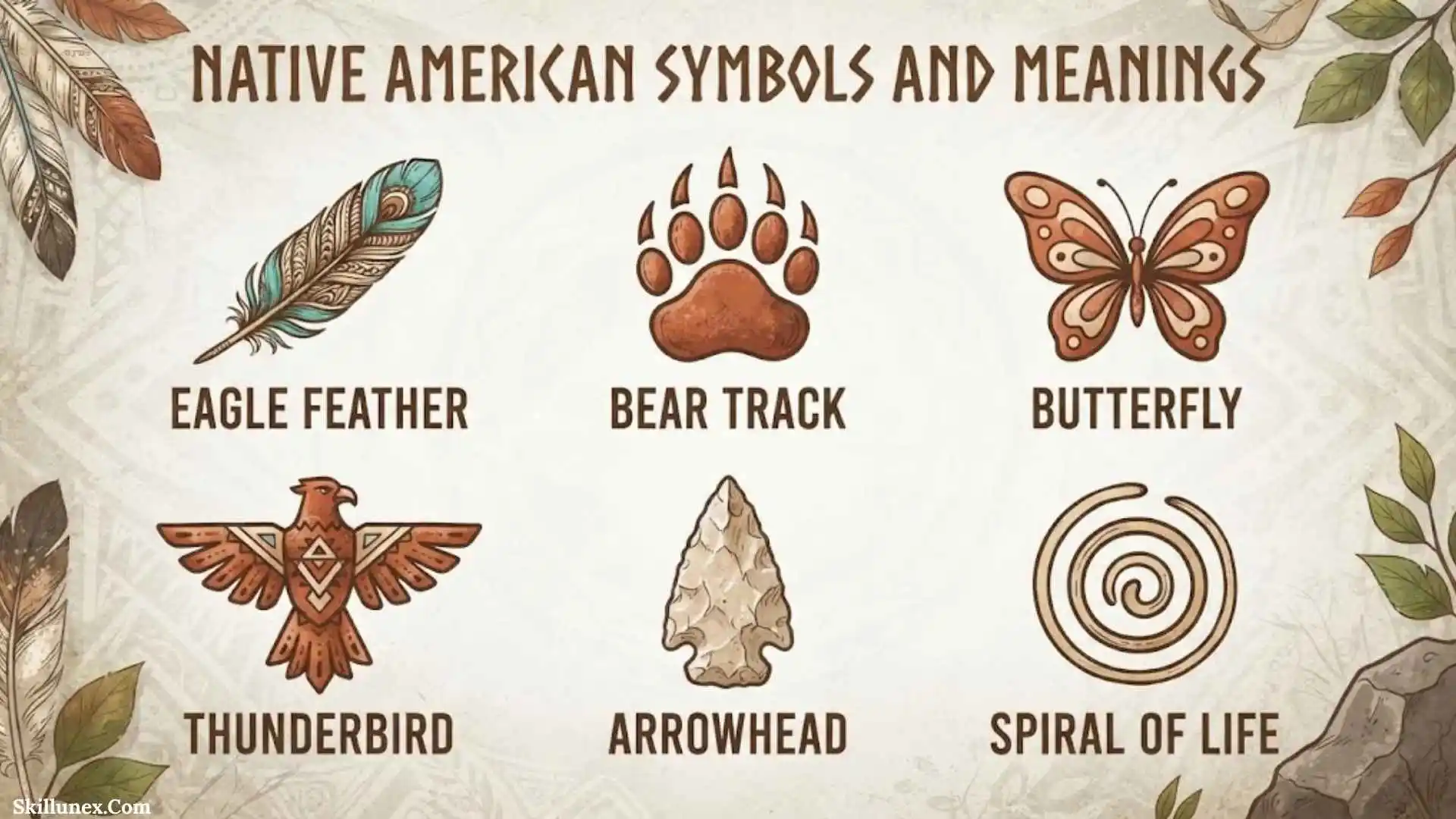
If you are searching for a Native American symbols and meanings PDF, you are probably looking for a clear reference that explains common Indigenous symbols, their cultural context, and the ideas associated with them. I can use a guide like this to learn about animal symbols, natural elements, geometric designs, and other forms of Indigenous visual expression.
One important point comes first: there is no single system of “Native American symbols.” Indigenous peoples across North America represent many distinct nations, communities, languages, histories, and cultural traditions. The Smithsonian’s National Museum of the Indigenous peoples of America emphasizes that there is no single Indigenous peoples of America culture or language and that tribal communities have their own distinct cultures and traditions.
That means you should treat the meanings in this article as a starting point rather than a universal dictionary. When I identify a symbol, I should ask which Indigenous nation or tradition it belongs to. If you are creating a PDF for school, research, writing, or personal learning, adding that cultural context will make your reference much more accurate and respectful.
Understanding Native American Symbols
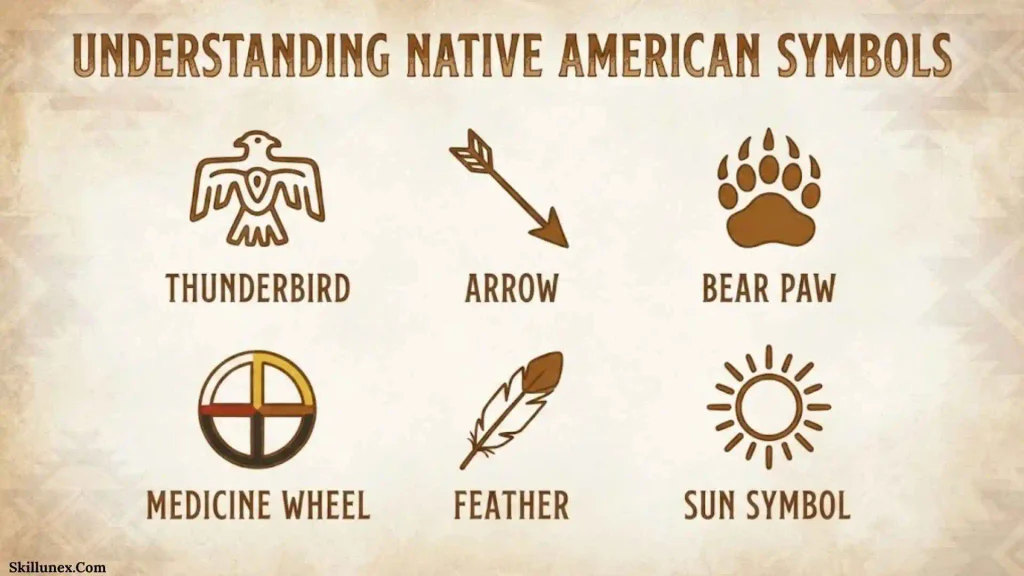
Native American symbols can appear in artwork, clothing, pottery, beadwork, carvings, storytelling traditions, objects, architecture, and other cultural expressions. Their meanings can relate to animals, land, family, community, spirituality, history, relationships, or particular places.
You may find the same animal or natural element represented by different Indigenous communities, but that does not mean the meaning is identical. Indigenous cultures have developed in different environments and have their own knowledge systems, traditions, languages, and histories. The Smithsonian notes that Native cultures are diverse and dynamic rather than a single, unchanging culture.
Why Context Matters
If you see an eagle, turtle, bear, sun, or geometric design on a website labeled “Native American,” you should not automatically assume that the listed meaning applies to every Indigenous nation.
I recommend recording three things whenever possible:
- The name of the Indigenous nation or community
- The cultural or historical context
- The source that explains the symbol
This simple approach can prevent you from turning a specific cultural teaching into a generalized claim.
Native American and Indigenous Are Not One Culture
You may see terms such as Native American, Indigenous peoples of America, Indigenous, or Native used in educational resources. The Smithsonian explains that terminology preferences can differ and that, when possible, it is best to use the name a particular Native community uses for itself.
For your PDF, you can therefore use the broader term Native American symbols when discussing the topic generally, while naming the specific nation whenever the source allows you to do so.
Native American Symbols and Meanings
There are many symbols and cultural motifs associated with Indigenous peoples, but their meanings are not universal. The following examples can help you understand how these symbols are commonly discussed while keeping cultural differences in view.
Eagle Symbol
The eagle has important cultural and spiritual significance in several Indigenous traditions. Because the eagle can fly high above the earth, it is sometimes associated with spiritual relationships, honor, vision, or communication with the Creator.
However, I would not describe one definition as the meaning of the eagle for all Native Americans. Specific teachings, responsibilities, and protocols surrounding eagles and eagle feathers can differ among nations.
If you include an eagle in your PDF, you should identify the community and source whenever possible.
Bear Symbol
The bear appears in the stories, art, and traditions of different Indigenous peoples. Depending on the community, bear imagery may be connected with strength, courage, protection, healing, leadership, or relationships with the natural world.
You should avoid reducing the bear to a single word such as “strength.” A cultural symbol can have a much richer meaning when you examine the stories and traditions surrounding it.
Wolf Symbol
The wolf is another animal frequently discussed in Native American symbolism. In some Indigenous traditions, wolves may be associated with family relationships, cooperation, loyalty, or survival.
If you are researching a wolf symbol, I recommend finding a source connected to a particular Indigenous community instead of relying on a generic “Native American wolf meaning” list.
Turtle Symbol
The turtle has important meanings in some Indigenous traditions and appears in different creation stories and cultural contexts. Depending on the community, turtle imagery may be connected with the earth, creation, stability, longevity, patience, or protection.
One well-known example is the association of Turtle Island with certain Indigenous creation traditions. You should still check the specific nation and story before treating the concept as universal.
Butterfly Symbol
Butterflies may be interpreted as symbols of change, transformation, renewal, or beauty in some modern discussions of Native American symbolism.
However, this is an area where online symbol lists can easily become too general. If you want your PDF to be historically reliable, you should distinguish documented cultural teachings from modern interpretations.
Thunderbird Symbol
The Thunderbird is an important supernatural being in the traditions of several Indigenous peoples of North America. It is associated with powerful forces such as thunder and storms in particular cultural traditions.
You should not treat the Thunderbird as merely a generic “Native American symbol.” Its stories and significance belong to particular Indigenous cultural traditions, and those traditions deserve to be identified.
Native American Nature Symbols
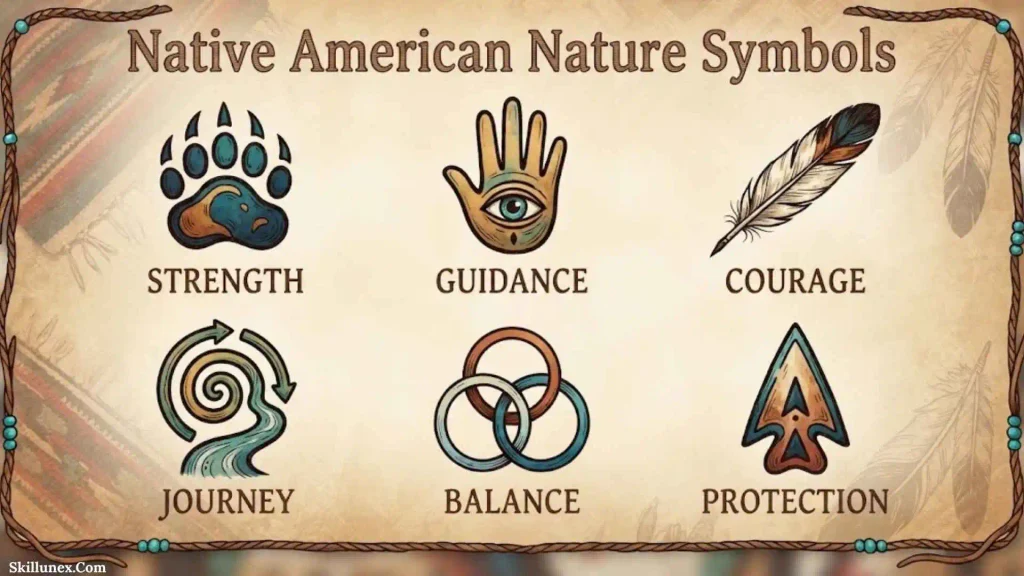
Nature plays an important role in many Indigenous knowledge systems, but you should not assume that every Indigenous community has the same understanding of nature or uses the same symbols.
The Smithsonian explains that Indigenous knowledge is closely connected to languages, cultural values, practices, and long-term relationships with particular environments.
Sun Symbol
The sun can have important cultural and spiritual significance in different Indigenous traditions. It may be connected with life, warmth, growth, time, or other ideas depending on the community.
If you are adding a sun symbol to your PDF, identify the tradition behind the interpretation rather than simply writing “the Native American meaning of the sun.”
Moon Symbol
The moon can be connected with cycles, time, seasons, and other cultural teachings in some Indigenous traditions.
Because lunar knowledge differs between communities, I would avoid claiming that one moon symbol represents the beliefs of all Native peoples.
Water Symbol
Water is essential to life and can hold important cultural significance for Indigenous communities. Depending on the tradition, water can be connected with life, renewal, relationships with place, or ceremonial practices.
For you, the important distinction is between a general statement about the importance of water and a specific cultural teaching about a particular water symbol.
Four Directions
The four directions are significant in some Indigenous traditions, but the associated colors, animals, elements, teachings, and ceremonies can vary.
This is one of the clearest examples of why a generalized “Native American symbols chart” can be misleading. If I write that every Indigenous culture assigns the same color and meaning to east, west, north, and south, I would be combining distinct traditions into one system.
Native American Animal Symbols Chart
You can use the following chart as a starting point for research, but it should not be treated as a universal Native American symbol dictionary.
| Symbol | Associations Found in Some Indigenous Traditions | What You Should Check |
| Eagle | Spiritual connection, honor, vision | Specific nation and cultural protocols |
| Bear | Strength, courage, protection | Community-specific stories and traditions |
| Wolf | Family, cooperation, loyalty | Specific cultural interpretation |
| Turtle | Earth, creation, stability | Nation and creation tradition |
| Butterfly | Change, renewal, transformation | Whether the interpretation is traditionally documented |
| Sun | Life, warmth, growth | Specific ceremonial or cultural context |
| Moon | Cycles, time, seasons | Nation-specific teachings |
| Water | Life, renewal, relationships with place | Local cultural context |
| Thunderbird | Power, storms, supernatural force | Specific Indigenous traditions |
| Four Directions | Orientation, relationships, balance | Community-specific meanings |
Native American Spiritual Symbols
When you search for Native American symbols, you will often find websites describing certain designs as “spiritual symbols.” You should be particularly careful with this category.
Not every Indigenous design is a religious symbol, and not every spiritual tradition is public. Some knowledge is passed through specific cultural, family, ceremonial, or community contexts.
The Smithsonian’s educational resources emphasize learning about Native cultures through accurate information and Native perspectives rather than relying on stereotypes or generalized representations.
Sacred Symbols and Cultural Protocols
Some objects, images, stories, feathers, dances, or ceremonial materials can have responsibilities and cultural protocols attached to them.
That means you should not assume that because you can find an image online, you can freely reproduce or use it as decoration.
If you are preparing a PDF, I recommend including a short note explaining that cultural significance and appropriate use may depend on the specific Indigenous community.
Symbols Should Not Be Separated From Their Stories
A symbol can lose important meaning when you remove it from the story, language, place, or community that gives it significance.
For example, if you simply label an image “bear = strength,” you may miss the relationships, stories, teachings, and historical context surrounding the bear in a particular tradition.
A better PDF gives you the symbol plus its source and cultural context.
Native American Symbols and Colors
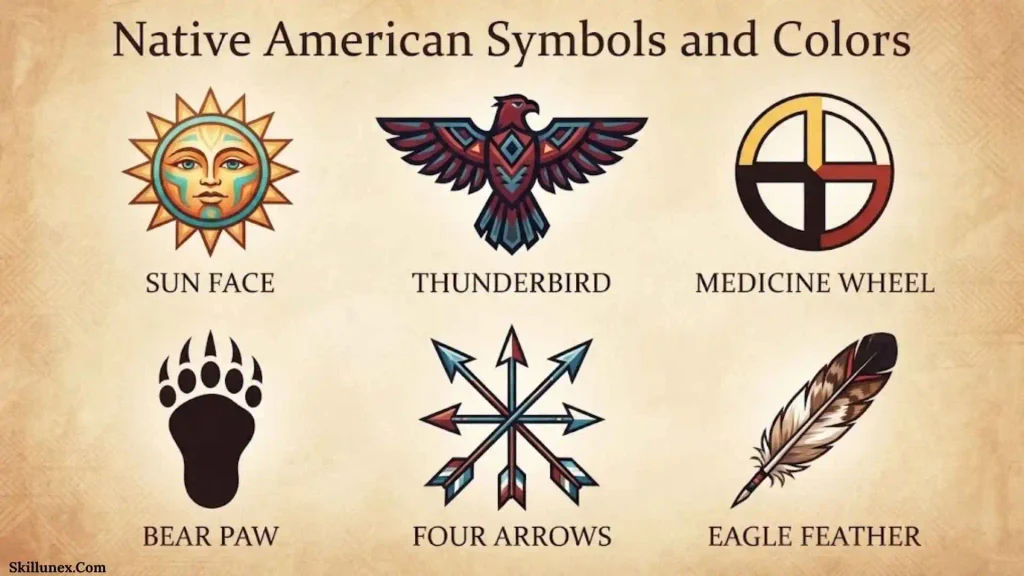
Color symbolism is another area where generic online lists can create confusion.
You may find websites claiming that particular colors always represent specific directions, elements, emotions, or spiritual concepts. These statements should not automatically be applied to all Indigenous nations.
Why Color Meanings Vary
Different communities have different traditions, materials, environments, histories, and symbolic systems. A color can have one meaning in one cultural context and another meaning somewhere else.
If you are creating a PDF, you can make your information stronger by writing:
“In this particular tradition, this color is associated with…”
rather than:
“Native Americans believe this color always means…”
The first wording gives you cultural context and avoids making a universal claim.
Native American Symbols and Meanings PDF Structure
If your goal is to create or download a useful Native American symbols and meanings PDF, I recommend using a research-based structure rather than a simple collection of pictures and one-word definitions.
What to Include in the PDF
For each symbol, you can include:
- Symbol name
- Indigenous nation or community
- Region or homeland, when relevant
- Cultural meaning or role
- Historical context
- Traditional story or source, when publicly documented
- Modern context
- Appropriate-use notes
- Source or reference
This structure gives you much more useful information than a generic list of “50 Native American symbols and meanings.”
Why Sources Matter
When I research a symbol, I should ask where the meaning came from. A commercial symbol website may repeat information from another website without identifying the Indigenous community behind it.
For educational work, museum collections, tribal sources, Indigenous authors, academic publications, and reputable cultural institutions can provide stronger starting points.
The National Museum of the Indigenous peoples of America Native Knowledge 360° resources are specifically designed to incorporate Native perspectives and more comprehensive histories into education.
Native American Symbols for Education and Research
If you are a student, teacher, writer, or researcher, a PDF can be especially useful when it helps you compare cultural contexts instead of presenting one universal list.
For Students
If you are researching Native American symbols for a school project, choose a specific Indigenous nation when possible.
For example, instead of researching only “Native American symbols,” you could research:
- Haudenosaunee cultural symbols
- Diné artistic traditions
- Ojibwe cultural traditions
- Lakota cultural traditions
- Pueblo artistic traditions
- Northwest Coast Indigenous art traditions
This approach can help you learn about a real community rather than an invented generic culture.
The Smithsonian provides educational resources developed with Native communities and scholars, including a Haudenosaunee guide created with consultation from representatives of the six nations of the Haudenosaunee Confederacy.
For Teachers
If you are creating classroom material, I recommend using sources that include Native perspectives and contemporary examples.
The Smithsonian specifically cautions against teaching Native cultures as if they existed only in the past. Native cultures are living and continue to change, adapt, and thrive today.
You can therefore include both historical and contemporary information in your PDF.
For Writers and Bloggers
If you are writing an article about Native American symbols, avoid creating a long list of unsupported meanings simply to target search keywords.
Instead, I would rather provide fewer symbols with stronger cultural context than dozens of generalized definitions.
That approach can also make your article more useful because you are answering the reader’s real question: What does this symbol mean, and where does that meaning come from?
Native American Symbols and Meanings for Modern Use
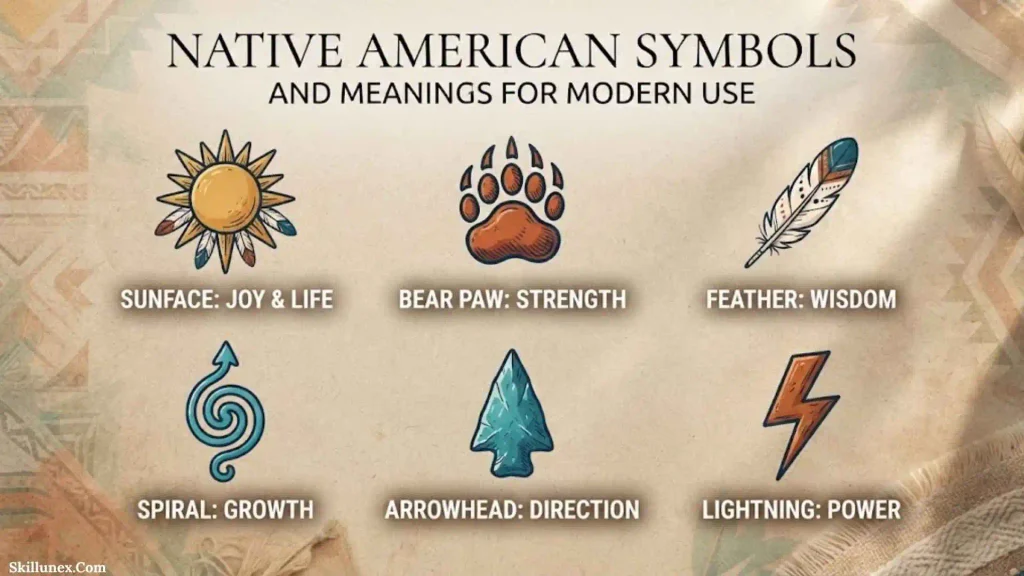
You may want to use Native American-inspired symbols in logos, tattoos, artwork, jewelry, clothing, educational materials, or social media graphics. Before doing so, you should consider whether the symbol is connected to a specific Indigenous community or sacred tradition.
Tattoos and Personal Artwork
If you are considering a tattoo based on an Indigenous symbol, research its cultural origin first.
You may discover that an image presented online as a generic Native American symbol actually belongs to a specific nation or has a meaning that is very different from the website’s description.
I recommend learning the origin before you use the design permanently.
Jewelry and Decorative Designs
Native-inspired designs are not automatically interchangeable with authentic Indigenous art.
If you want an authentic piece, consider learning about the artist, nation, community, and provenance rather than purchasing an item simply because its description says “Native American.”
Digital and Educational Use
For online articles, presentations, and PDFs, you should also check image rights. Cultural meaning and copyright are separate issues. A historically significant symbol may still be represented in artwork or photography that has usage restrictions.
Common Mistakes in Native American Symbol Lists
Many online symbol guides have similar weaknesses. If you are updating an existing article, correcting these problems can make your content much more useful.
Treating All Native Peoples as One Culture
This is the biggest problem.
The Smithsonian states that there is no single Indigenous peoples of America culture or language and that there is extensive cultural diversity among Indigenous peoples.
So I should not write as though every Native American nation shares one symbol system.
Giving Every Symbol One Fixed Meaning
A symbol may have different meanings in different communities, periods, or contexts.
You should therefore use phrases such as:
- “In some traditions…”
- “Among certain Indigenous communities…”
- “In this cultural tradition…”
- “This symbol is associated with…”
This language is more accurate than making universal claims.
Presenting Native Cultures Only in the Past
Native peoples and cultures are not historical artifacts. The Smithsonian specifically recommends using present-tense and contemporary examples when teaching about Native peoples.
If you are creating a PDF, include contemporary Native voices and living cultural traditions whenever appropriate.
Copying Meanings From Generic Websites
A long list does not automatically make a reference accurate.
If you find the same “Native American symbol meaning” repeated on several websites, that does not necessarily mean the claim has been independently verified.
I would trace the information back to a museum, tribal community, Indigenous author, academic publication, or another credible primary or institutional source.
Using Stereotypes as Symbols
Some popular imagery comes from stereotypes rather than authentic representations of Indigenous cultures. The Smithsonian’s educational resources specifically address common misconceptions and misinformation about Native cultures.
A strong PDF should help you distinguish cultural traditions from stereotypes.
How to Make a Reliable Native American Symbols and Meanings PDF
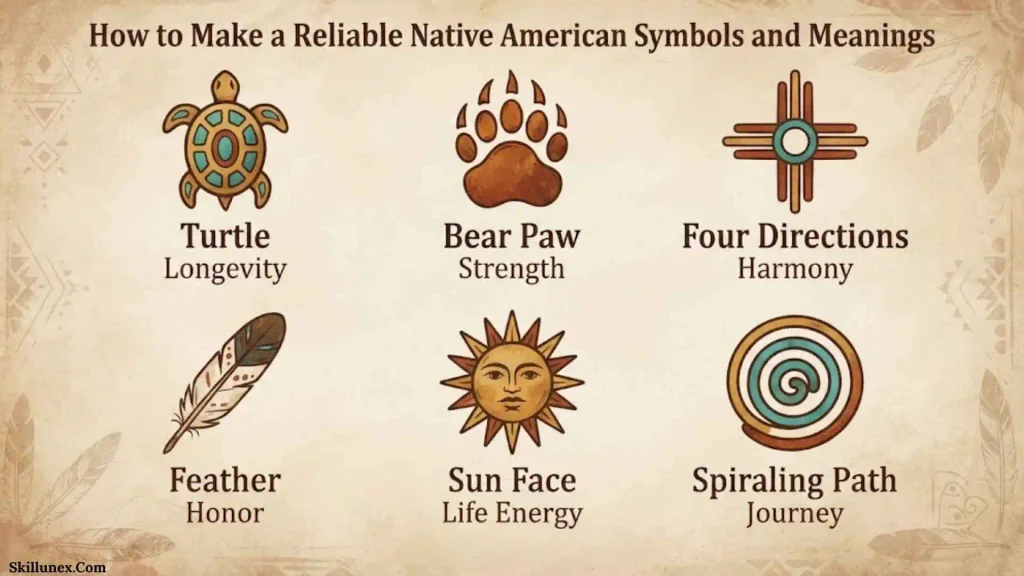
If you want to turn this topic into a downloadable PDF, you can follow a simple research process.
Step 1: Choose the Cultural Scope
Decide whether your PDF covers one specific Indigenous nation or multiple traditions.
If it covers multiple communities, clearly separate them.
Step 2: Research Each Symbol
For every symbol, identify where the information comes from.
Do not add a meaning simply because another symbol website lists it.
Step 3: Add Cultural Context
Explain the community, history, art form, story, or tradition associated with the symbol.
Step 4: Separate Traditional and Modern Interpretations
Some meanings circulating online are modern interpretations rather than documented traditional teachings.
I recommend clearly labeling that difference.
Step 5: Add References
At the end of your PDF, include your sources.
You can use museum resources, tribal websites, academic publications, Indigenous-authored material, and reputable educational institutions.
Step 6: Review for Generalizations
Before publishing, search your PDF for phrases such as:
- “All Native Americans…”
- “Native Americans believe…”
- “The Native American meaning is…”
Then ask whether the statement truly applies across the communities being discussed.
The Smithsonian recommends avoiding generalizations and using conditional language when discussing Indigenous cultures.
Frequently Asked Questions
What are Native American symbols?
Native American symbols are visual forms, motifs, objects, and representations associated with particular Indigenous cultures and traditions. Their meanings vary between nations and communities, so there is no single universal Native American symbol system.
Are there a Native American symbols and meanings PDF?
You can find educational guides and PDFs about specific Indigenous cultures and traditions, but a single PDF cannot accurately represent every Native American culture. For reliable research, I recommend using resources that identify the specific nation or community.
What does the eagle mean in Native American culture?
The eagle has important cultural and spiritual significance in several Indigenous traditions and may be associated with ideas such as honor, vision, spirituality, or communication with the Creator. The exact significance and protocols vary by nation.
What does the turtle symbolize in Native American culture?
Turtle symbolism varies among Indigenous traditions. In some contexts, turtles are associated with the earth, creation, stability, longevity, or protection. You should identify the specific cultural tradition before assigning one universal meaning.
What are the four directions in Native American culture?
The four directions are significant in some Indigenous traditions, but their associated colors, animals, elements, and teachings vary. I should not assume that one four-direction system applies to every Native American nation.
Why do Native American symbols have different meanings?
Native American peoples belong to many distinct nations and communities with their own languages, histories, environments, artistic traditions, and cultural teachings. The Smithsonian emphasizes that there is no single Indigenous peoples of Americaculture or language.
Can I use Native American symbols in my artwork?
You can research Indigenous symbols for educational purposes, but you should first understand their cultural origin and significance. Some symbols, objects, and ceremonial materials may have specific cultural protocols, and using a design without understanding its origin can create a misleading or disrespectful representation.
How can I research Native American symbols accurately?
Start with sources connected to specific Indigenous communities, museums, Indigenous authors, academic research, and educational resources such as the Smithsonian National Museum of theIndigenous peoples of America The Smithsonian’s Native Knowledge 360° program provides resources designed to present Native perspectives and more comprehensive histories.
Conclusion
When I search for Native American symbols and meanings PDF, I should look beyond a simple list of pictures and definitions. The most useful reference explains where each symbol comes from, which Indigenous community it is connected to, and what reliable sources say about its meaning.
You can learn about eagles, bears, wolves, turtles, the sun, moon, water, the four directions, and other cultural imagery, but you should avoid assuming that one interpretation represents every Native American nation. Indigenous cultures are diverse, living, and continually evolving.
If you are creating your own PDF, you can make it stronger by including cultural context, specific community names, reliable references, and notes about appropriate use. That way, you are not simply collecting symbols you are giving you and your readers a more accurate way to understand the people, histories, and traditions connected to them.

Caleb Thornton
I’m Caleb Thornton, a researcher and content writer who loves exploring fascinating subjects and sharing what I learn with readers. My interests include natural places, lakes, symbols, culture, history, and the stories that make ordinary topics more meaningful.
When I write an article, I try to go beyond a basic answer. I look for useful facts, relevant context, and details that can help readers understand the subject more completely.
My purpose is simple: I want every article I contribute to provide genuine value, satisfy the reader’s curiosity, and make discovering new information enjoyable.
## Books by Caleb Thornton
* Symbols & Meanings: Exploring the Signs We See Every Day
* Lakes of the World: Nature, Beauty & Exploration