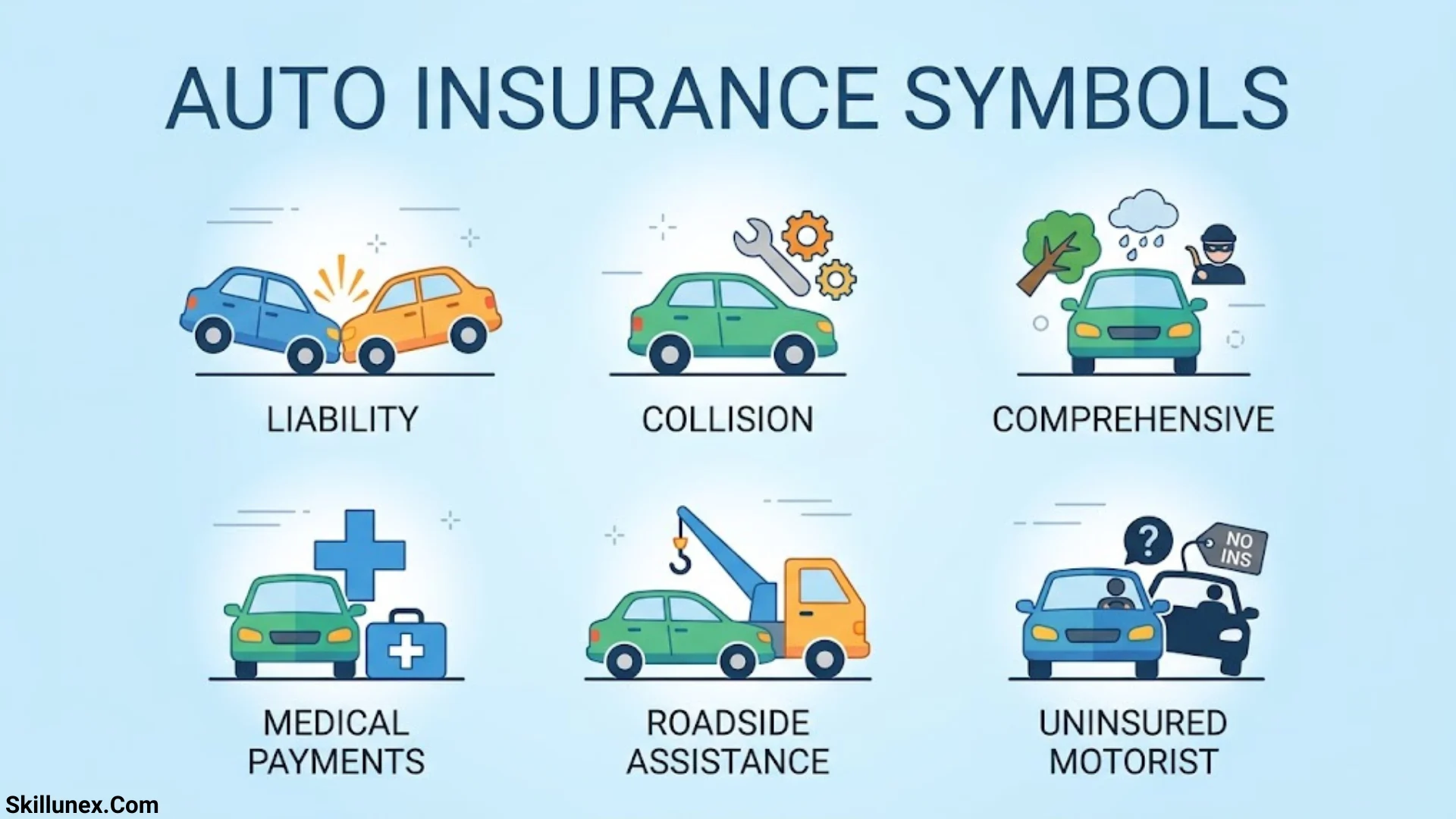
Auto insurance symbols are codes used in insurance policies to identify which vehicles are covered and what types of protection apply. If you have an auto insurance policy, understanding these symbols can help you know whether your car, truck, or other vehicle is properly insured. These codes may look confusing at first, but once you understand them, you can read your policy with greater confidence.
When you review your insurance documents, you may notice numbers or symbols listed beside different types of coverage. These codes help insurance companies explain which vehicles qualify for liability, comprehensive, collision, and other coverage options. By learning what each symbol means, you can better understand your policy and identify potential gaps in your protection before they become costly problems.
In this guide, you will learn what auto insurance symbols mean, how they work, and why they matter when choosing or reviewing coverage. Whether you are buying insurance for the first time or updating an existing policy, this information can help you ask the right questions and make smarter decisions. Understanding these symbols gives you a clearer picture of your coverage and helps you feel more confident about protecting your vehicle.
What Are Auto Insurance Symbols?
Auto insurance symbols are numerical codes used in many U.S. commercial auto insurance policies to identify the categories of vehicles covered under specific insurance coverages.
These symbols are commonly found on the declarations page of a commercial auto policy. Each symbol has a defined meaning under the applicable policy form, and the symbol shown beside a particular coverage helps establish which vehicles qualify for that coverage.
For example, a company may have liability coverage with Symbol 1 and physical damage coverage with Symbol 7. This arrangement generally means the liability coverage can apply to any auto that meets the policy’s definition, while physical damage coverage applies only to specifically described autos that qualify under the policy.
The standard ISO Business Auto Coverage Form, commonly identified as CA 00 01, uses symbols 1 through 9 and 19. Other commercial auto forms, including motor carrier forms, may use different symbol systems.
How Do Covered Auto Symbols Work?
Covered auto symbols connect a policy’s individual coverages to specific categories of vehicles. They do not automatically provide every type of insurance protection.
A commercial auto policy may include several coverages, such as:
- Auto liability insurance: Generally helps cover eligible bodily injury and property damage claims for which an insured is legally responsible.
- Collision coverage: Generally helps pay for covered damage to an insured vehicle caused by a collision.
- Comprehensive coverage: Generally helps pay for covered non-collision losses, subject to the policy’s terms.
- Medical payments coverage: May pay eligible medical expenses for covered individuals, depending on the policy.
- Uninsured or underinsured motorist coverage: May provide protection for qualifying injuries caused by drivers with insufficient or no insurance, subject to applicable law and policy terms.
Each coverage can have its own covered auto symbol. A vehicle might qualify for liability coverage but not physical damage coverage under the same policy.
Important: A symbol determines the category of vehicles eligible for a particular coverage. Policy limits, exclusions, deductibles, conditions, and applicable laws still determine the extent of protection.
Where Can You Find Auto Insurance Symbols?
You can usually find auto insurance symbols on the commercial auto insurance declarations page, often under a heading such as “Schedule of Coverages and Covered Autos.”
Look for a table that lists coverage types, covered auto symbols, limits, and premiums. Some policies also include a separate vehicle schedule identifying the vehicles covered under specific arrangements.
If you cannot identify a symbol or understand how it applies, ask your insurance agent to explain the relevant policy provision or endorsement.
Complete List of Auto Insurance Symbols
The standard U.S. Business Auto Coverage Form commonly uses ten covered auto designation symbols: 1 through 9 and 19. Each symbol has a different purpose, and the appropriate symbol depends on the vehicles a business owns or uses and the coverage it needs.
Symbol 1: Any Auto
Symbol 1 generally means any auto. It is the broadest covered-auto designation in the standard business auto form because it can include eligible owned, hired, borrowed, rented, and non-owned vehicles that meet the policy’s definitions.
Businesses may use this symbol for liability coverage when they need broad protection for vehicle-related risks across their operations.
For example, a company might own delivery vans, rent a car for an employee’s business trip, and occasionally use other vehicles in its operations. If Symbol 1 applies to its covered auto liability coverage, those vehicles may qualify for that coverage, subject to the policy’s terms and exclusions.
However, Symbol 1 does not automatically mean every vehicle is covered for collision, comprehensive, or every other available coverage. The symbol must be appropriate for the specific coverage under the policy form.
Symbol 2: Owned Autos Only
Symbol 2 generally covers autos owned by the named insured, including qualifying vehicles acquired after the policy begins.
This symbol is commonly relevant to businesses that own their vehicles and want coverage for that category rather than all vehicles they might use.
For example, a landscaping company owns three trucks and two vans. If Symbol 2 applies to the relevant coverage, those owned vehicles may qualify under the policy, subject to its terms.
A vehicle rented from an outside rental company would not generally qualify as an owned auto merely because the business uses it.
Before relying on Symbol 2 for a newly purchased vehicle, check the policy’s definitions and any applicable conditions.
Symbol 3: Owned Private Passenger Autos Only
Symbol 3 generally applies to private passenger autos owned by the named insured.
It is designed for passenger vehicles rather than all types of commercial vehicles. Depending on the policy’s definitions, a company-owned sedan or qualifying passenger car may fall within this category, while a commercial truck may not.
For example, a consulting business owns several passenger cars used by its employees for business travel. Symbol 3 may be relevant if the business wants coverage limited to its owned private passenger vehicles.
Businesses that also own trucks, specialized vehicles, or other non-passenger vehicles should check whether separate coverage designations are needed.
Symbol 4: Owned Autos Other Than Private Passenger Autos Only
Symbol 4 generally covers owned autos that are not classified as private passenger autos under the policy.
These vehicles may include qualifying commercial trucks, work vans, and other non-private-passenger vehicles.
For example, a construction company owns dump trucks and work vehicles used to transport tools and materials. Symbol 4 may be relevant to the coverage selected for those vehicles.
The exact classification depends on the policy form. Businesses should not assume that every van, pickup truck, or specialized vehicle automatically falls into the same category.
Symbol 5: Owned Autos Subject to No Fault Coverage
Symbol 5 generally applies to owned autos that are required to have no-fault benefits under the applicable state law where the vehicles are licensed or principally garaged.
No-fault insurance systems generally require certain benefits to be available for eligible injuries without first determining who caused an accident, although the rules and available benefits vary by jurisdiction.
For example, a business that owns vehicles registered in a state with applicable no-fault insurance requirements may encounter Symbol 5 in its policy.
This symbol does not mean every vehicle owned by the business automatically qualifies. The vehicle must meet the applicable policy definition and legal requirements.
Symbol 6: Owned Autos Subject to a Compulsory Uninsured Motorist Law
Symbol 6 generally applies to owned autos that are subject to a law requiring uninsured motorist coverage that cannot be rejected under the applicable rules.
Uninsured motorist coverage may help protect eligible insured individuals when they are injured in an accident involving an uninsured driver, depending on the coverage terms and state law.
For example, a business operating owned vehicles in a jurisdiction with mandatory uninsured motorist requirements may have Symbol 6 associated with the relevant coverage.
The symbol does not establish the coverage limit or guarantee payment for every accident. Those details depend on the policy and applicable law.
Symbol 7: Specifically Described Autos
Symbol 7 generally applies to autos specifically identified in the policy’s vehicle schedule for which the required premium is shown.
This symbol is especially important because coverage is tied to the described vehicles rather than every vehicle a business might own or use.
For example, a delivery company insures five vans listed on its commercial auto policy. If Symbol 7 applies to physical damage coverage, those scheduled vans may qualify for collision and comprehensive coverage under the policy terms.
A sixth van purchased later should not automatically be assumed to have the same coverage. The business should contact its insurer promptly to determine whether the new vehicle is covered and what reporting requirements apply.
Symbol 7 can be useful when a business wants to identify particular vehicles for specific coverages, but it requires careful attention to the vehicle schedule and policy conditions.
Symbol 8: Hired Autos Only
Symbol 8 generally applies to qualifying autos the named insured leases, hires, rents, or borrows.
It is relevant to businesses that occasionally use vehicles they do not own, such as rental cars for business trips or rented vehicles for temporary operations.
For example, a sales company rents a car for an employee attending a conference. Symbol 8 may provide coverage for that vehicle if the relevant coverage applies and the vehicle qualifies under the policy.
The standard business auto form excludes certain vehicles rented or borrowed from employees, partners, LLC members, or members of their households from the hired-auto definition. Check the actual policy wording before relying on Symbol 8 for those arrangements.
Hired auto liability coverage should also be distinguished from coverage for physical damage to the rented vehicle. Damage to the rental vehicle may require applicable physical damage coverage or other protection.
Symbol 9: Non Owned Autos Only
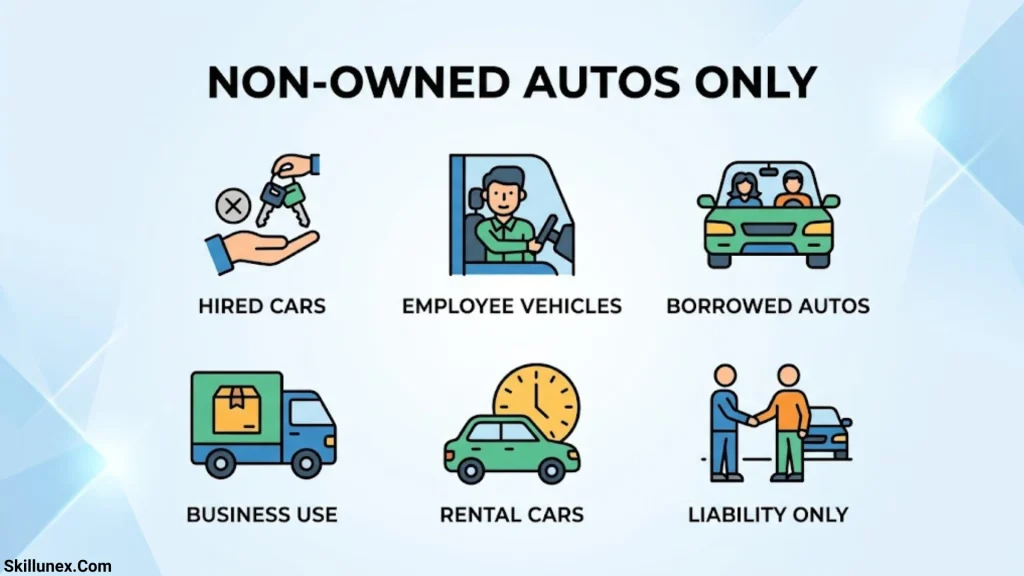
Symbol 9 generally applies to qualifying autos that the named insured does not own, lease, hire, rent, or borrow but that are used in connection with its business.
This category can include employees’ personal vehicles while they are being used for business activities.
For example, an employee uses a personal car to visit a customer, deliver business documents, or travel between work locations. Symbol 9 may be relevant to liability protection for the business, depending on the policy and circumstances.
Non-owned auto coverage generally protects the business against covered liability claims; it does not automatically insure an employee’s personal vehicle for collision damage or comprehensive losses.
Businesses should also understand that an employee’s personal auto insurance and the employer’s commercial auto policy may respond differently to an accident. The applicable policy language and insurance arrangements determine how coverage applies.
Symbol 10: Mobile Equipment Subject to Certain Motor Vehicle Insurance Laws
Symbol 19 generally applies to certain land vehicles that qualify as mobile equipment under the policy but are subject to compulsory insurance, financial responsibility, or other motor vehicle insurance laws.
This symbol can be relevant to specialized equipment that is not ordinarily treated as a standard road vehicle but becomes subject to vehicle insurance requirements under applicable law.
For example, certain types of construction or industrial equipment may need to meet motor vehicle insurance requirements when operated on public roads.
Whether a particular machine qualifies depends on the policy’s definition of mobile equipment and the applicable legal requirements. Symbol 19 should not be interpreted as automatic coverage for every piece of construction machinery.
Auto Insurance Symbols Comparison Table
The following table summarizes the common covered auto symbols used in the standard U.S. Business Auto Coverage Form.
| Symbol | General meaning | Example of a potentially eligible vehicle |
| 1 | Any auto | Owned, hired, or non-owned auto that meets the policy’s definition |
| 2 | Owned autos only | Company-owned truck or car |
| 3 | Owned private passenger autos only | Company-owned passenger car |
| 4 | Owned autos other than private passenger autos | Qualifying company-owned commercial truck |
| 5 | Owned autos subject to no-fault coverage | Owned vehicle subject to applicable no-fault requirements |
| 6 | Owned autos subject to compulsory uninsured motorist law | Owned vehicle subject to mandatory uninsured motorist rules |
| 7 | Specifically described autos | Vehicle identified in the policy schedule |
| 8 | Hired autos only | Qualifying rental or hired vehicle |
| 9 | Non-owned autos only | Employee-owned car used for business |
| 19 | Certain mobile equipment subject to motor vehicle insurance laws | Qualifying mobile equipment subject to applicable insurance requirements |
These examples are illustrative, not guarantees of coverage. The actual policy form, declarations, endorsements, and applicable laws control.
How to Read Auto Insurance Symbols on a Declarations Page
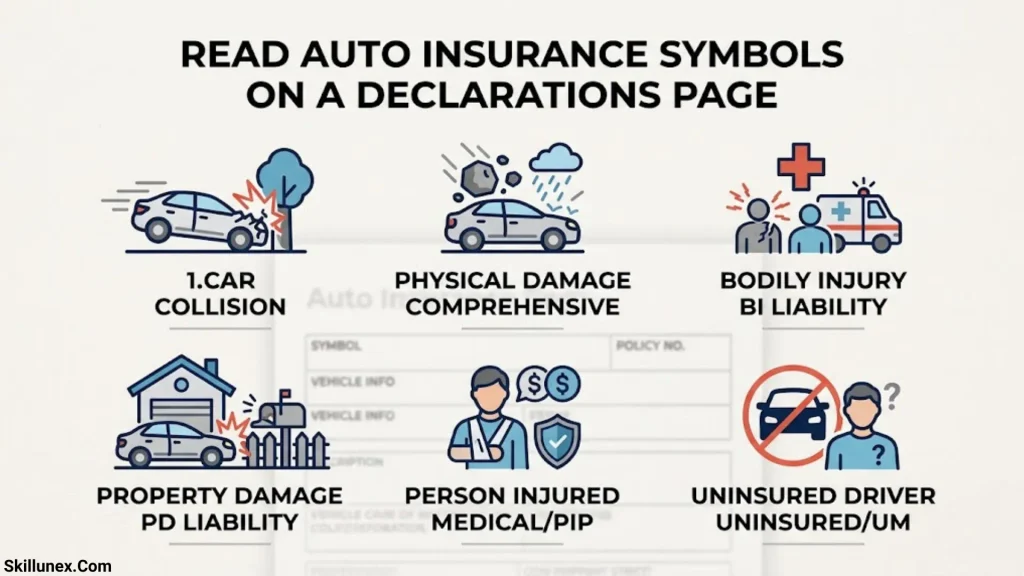
Understanding the covered auto symbols on your declarations page is an important step in checking whether your business has appropriate vehicle insurance.
Find the Declarations Page
Start by locating the declarations page in your commercial auto policy documents. It typically summarizes the named insured, policy period, selected coverages, covered auto symbols, limits, deductibles, and premiums.
Some insurers provide this information electronically through an online account or policy document portal.
Identify Each Coverage and Its Symbol
Find the section listing the coverages purchased and the symbols assigned to them.
For example, your policy might show:
| Coverage | Covered auto symbol |
| Covered autos liability | 1 |
| Comprehensive coverage | 7 |
| Collision coverage | 7 |
This example generally indicates broad auto eligibility for liability coverage and coverage tied to specifically described vehicles for comprehensive and collision, subject to the policy terms.
The symbols must be reviewed separately for each coverage. Never assume that a symbol listed for liability automatically applies to physical damage.
Compare the Symbols With Your Vehicles
Make a list of the vehicles your business owns, leases, rents, borrows, or uses for work.
Compare that list with the applicable symbol definitions and the vehicle schedule. Pay particular attention to newly purchased vehicles, employee-owned cars used for business, and temporary rental vehicles.
Review Limits, Deductibles, and Exclusions
The symbol is only one part of the policy. Review the liability limits, physical damage deductibles, exclusions, and any special conditions that may affect a claim.
For instance, a vehicle may fit the definition of a covered auto but still be subject to an exclusion or a restriction affecting the particular loss.
Ask Your Insurance Agent to Confirm Unclear Details
If you are unsure whether a vehicle qualifies, ask your agent to confirm the applicable symbol and coverage in writing.
This is especially important before buying a vehicle, renting a vehicle for extended business use, allowing employees to drive personal cars for work, or entering a contract that requires specific insurance coverage.
How Auto Insurance Symbols Affect Different Types of Coverage
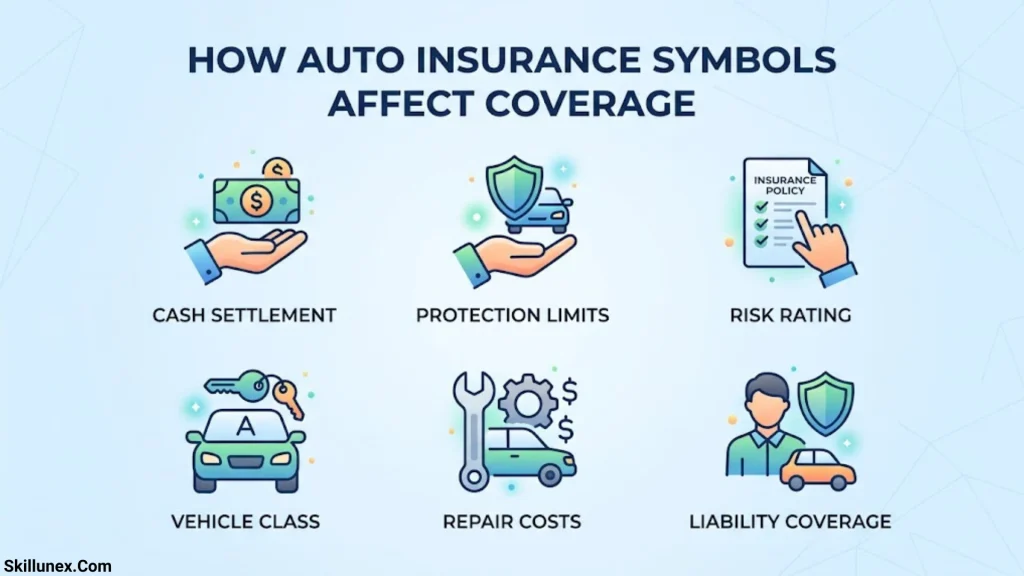
Covered auto symbols can affect liability, physical damage, and other commercial auto coverages in different ways.
Auto Insurance Symbols for Liability Coverage
Commercial auto liability insurance generally helps protect an insured business against covered bodily injury and property damage claims arising from accidents for which the insured is legally responsible.
The covered auto symbol listed beside liability coverage identifies the categories of vehicles eligible for that protection.
For example, Symbol 1 may provide broad liability eligibility, while Symbol 7 generally limits eligibility to specifically described vehicles. Symbols 8 and 9 may be relevant when a business needs liability protection involving hired or non-owned vehicles.
The symbol alone does not establish that every driver is insured. The policy’s definition of an insured, exclusions, limits, and other conditions must also be considered.
Auto Insurance Symbols for Collision and Comprehensive Coverage
Collision coverage generally addresses covered damage to a vehicle resulting from a collision, while comprehensive coverage generally addresses specified non-collision losses, such as theft, vandalism, or certain weather-related damage.
The symbols assigned to these coverages determine which vehicles may qualify for protection.
For example, a business could have liability coverage using Symbol 1 but comprehensive and collision coverage using Symbol 7. In that arrangement, liability may apply to a broader category of autos, while physical damage protection is tied to the vehicles that qualify under the scheduled-auto provisions.
Businesses should confirm that the vehicles they want to protect are eligible for physical damage coverage and that the appropriate deductibles and limits are shown in the policy.
Auto Insurance Symbols for Hired and Non-Owned Auto Coverage
Hired and non-owned auto coverage is particularly important for businesses that use vehicles they do not own.
Symbol 8 generally addresses qualifying hired vehicles, such as certain rented or borrowed cars. Symbol 9 generally addresses qualifying non-owned vehicles used in business operations, including employee-owned vehicles used for work.
These symbols do not necessarily provide the same protection. Hired auto physical damage coverage may require separate arrangements, and non-owned auto coverage generally does not insure the employee’s vehicle itself for physical damage.
Businesses should review their operations carefully to determine whether they need both hired and non-owned auto liability protection.
Symbol 1 vs. Symbol 7: What Is the Difference?
Symbol 1 and Symbol 7 are two commonly discussed covered auto symbols, but they serve different purposes.
| Feature | Symbol 1 | Symbol 7 |
| General meaning | Any auto | Specifically described autos |
| Vehicle eligibility | Broad, subject to the policy definition | Tied to vehicles identified in the policy |
| Hired autos | May qualify when the symbol applies to the relevant coverage | Not automatically included merely because they are hired |
| Non-owned autos | May qualify when the symbol applies to the relevant coverage | Not automatically included merely because they are used for business |
| Vehicle schedule | Not generally limited to a specific vehicle schedule in the same way as Symbol 7 | Vehicle descriptions and applicable premium entries are important |
| Coverage scope | Determined by the relevant coverage and policy terms | Determined by the schedule, relevant coverage, and policy terms |
Symbol 1 is broader in terms of vehicle eligibility, but that does not mean it automatically provides every type of coverage. Symbol 7 can be suitable for specifically scheduled vehicles, but the business must make sure the relevant vehicles are correctly listed.
The appropriate choice depends on the business’s operations, insurance requirements, and the terms offered by its insurer.
Common Mistakes to Avoid When Reading Auto Insurance Symbols
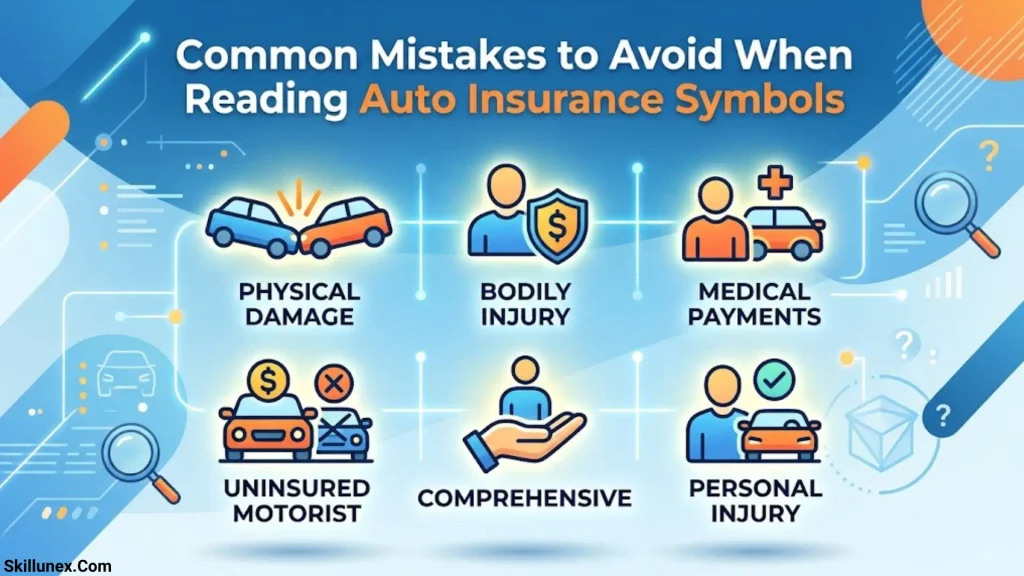
Misunderstanding covered auto symbols can create confusion about whether a vehicle qualifies for insurance protection. Avoid these common mistakes.
Assuming One Symbol Applies to Every Coverage
Each coverage may have a different symbol. Always review liability, comprehensive, collision, and other applicable coverage lines separately.
Confusing Hired Autos With Non-Owned Autos
Hired autos and non-owned autos are distinct categories under the standard business auto form. Review the definitions and exclusions instead of assuming all vehicles a business does not own are treated alike.
Forgetting to Report Newly Acquired Vehicles
A newly purchased vehicle does not always receive automatic coverage under every policy arrangement. The rules depend on the symbol, coverage, form, and applicable reporting conditions.
Contact your insurer promptly when acquiring a vehicle, particularly if coverage relies on Symbol 7.
Assuming Non Owned Auto Coverage Insures an Employee’s Car
Symbol 9 generally relates to the business’s liability exposure involving qualifying non-owned autos. It does not automatically provide collision or comprehensive coverage for an employee’s personal vehicle.
Ignoring Policy Exclusions and Endorsements
Symbols do not override exclusions, conditions, endorsements, or applicable legal requirements. Review the full policy rather than relying on a symbol alone.
Applying Commercial Auto Symbols to Every Personal Auto Policy
The symbols discussed in this guide primarily relate to U.S. commercial auto insurance. Personal auto policies may use different forms and rules to identify covered vehicles.
Frequently Asked Questions About Auto Insurance Symbols
What is the most comprehensive auto insurance symbol?
Symbol 1, which generally means any auto, is the broadest vehicle designation in the standard U.S. Business Auto Coverage Form. However, its scope depends on the coverage beside which it appears, as well as policy exclusions and conditions.
What does Symbol 7 mean in auto insurance?
Symbol 7 generally means specifically described autos. Coverage is tied to the vehicles identified in the policy’s schedule and the applicable policy requirements.
What is the difference between Symbol 8 and Symbol 9?
Symbol 8 generally applies to qualifying hired, rented, leased, or borrowed autos. Symbol 9 generally applies to qualifying non-owned autos used in connection with the business, including employee-owned cars used for work.
Does Symbol 1 cover physical damage to every vehicle?
No. Symbol 1 does not automatically provide physical damage coverage for every vehicle. Physical damage coverage must be included in the policy, and the applicable symbol, definitions, exclusions, and conditions determine which vehicles qualify.
Does Symbol 7 cover newly purchased vehicles?
Do not assume it does. Coverage for newly acquired vehicles depends on the policy form, applicable conditions, and any endorsements. Contact the insurer promptly to determine whether the vehicle is covered and whether it must be added to the schedule.
Are auto insurance symbols the same for every insurance company?
Not necessarily. Many U.S. commercial auto policies use standardized coverage forms, but insurers may use endorsements, modified wording, or other policy forms. The actual insurance documents control.
What is the difference between auto insurance symbols and policy limits?
Auto insurance symbols identify the categories of vehicles eligible for a particular coverage. Policy limits specify the maximum amount payable under that coverage, subject to the policy’s terms. Both are important when reviewing insurance protection.
Do personal auto insurance policies use Symbols 1 through 9?
The symbols explained in this article are primarily associated with U.S. commercial auto insurance forms. Personal auto insurance generally uses different policy wording and vehicle eligibility rules.
Conclusion
Auto insurance symbols help businesses understand which vehicles may qualify for specific coverages under a commercial auto insurance policy. Symbols 1 through 9 and Symbol 19 each serve a distinct purpose, from identifying any auto to specifying owned vehicles, scheduled vehicles, hired autos, non-owned autos, and certain mobile equipment.
Understanding these codes can help business owners review declaration pages, identify potential coverage gaps, and make more informed insurance decisions. However, a symbol alone does not guarantee payment for a claim or establish the full extent of protection.
Review the symbol assigned to each coverage, confirm that your vehicles qualify, and check your limits, deductibles, exclusions, and reporting requirements. If any detail is unclear, ask your insurance agent to confirm the applicable terms in writing.

I’m Adrian Holloway, a writer and researcher who enjoys exploring the stories, meanings, and interesting facts behind the subjects people search for every day. I’m especially interested in symbols, nature, lakes, places, and cultural topics that help readers understand the world from a different perspective.
I believe useful content should be simple, accurate, and enjoyable to read. When I research a topic, I focus on finding meaningful details and presenting them in a way that makes information easy to understand.
My goal is to create helpful articles that answer real questions while encouraging readers to discover something new with every visit.
Books by Adrian Holloway
The Language of Symbols: Meanings, Stories & Traditions
Hidden Wonders of Nature: Lakes, Landscapes & Discovery