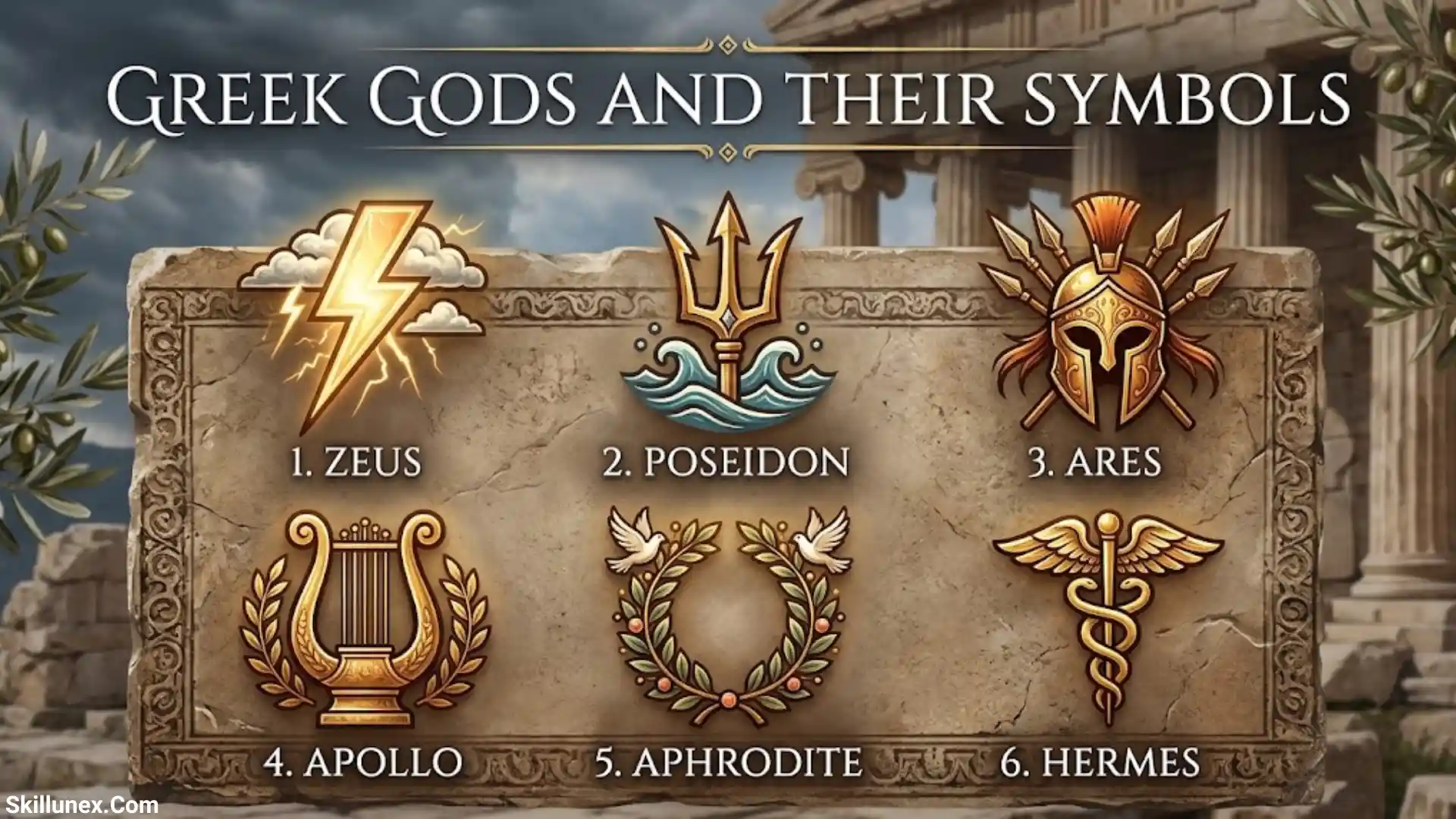
Greek gods and their symbols are an exciting part of ancient Greek mythology. Each god and goddess had special symbols that represented their powers, personalities, and roles. From Zeus’s lightning bolt to Poseidon’s trident, these symbols help you understand how the ancient Greeks explained the world around them.
If you love mythology, learning about Greek gods and their symbols can help you discover fascinating stories about power, wisdom, love, war, and the sea. You can recognize famous deities like Athena, Apollo, Aphrodite, and Hades by their unique symbols and learn what each one represents. These details make Greek mythology easier to understand and more interesting to explore.
In this guide, you will discover the most famous Greek gods and their symbols, along with their meanings and powers. Whether you are a student, a mythology fan, or simply curious about ancient legends, you can use this guide to identify each deity and understand the stories behind their symbols.
What Are Greek Gods and Their Symbols?
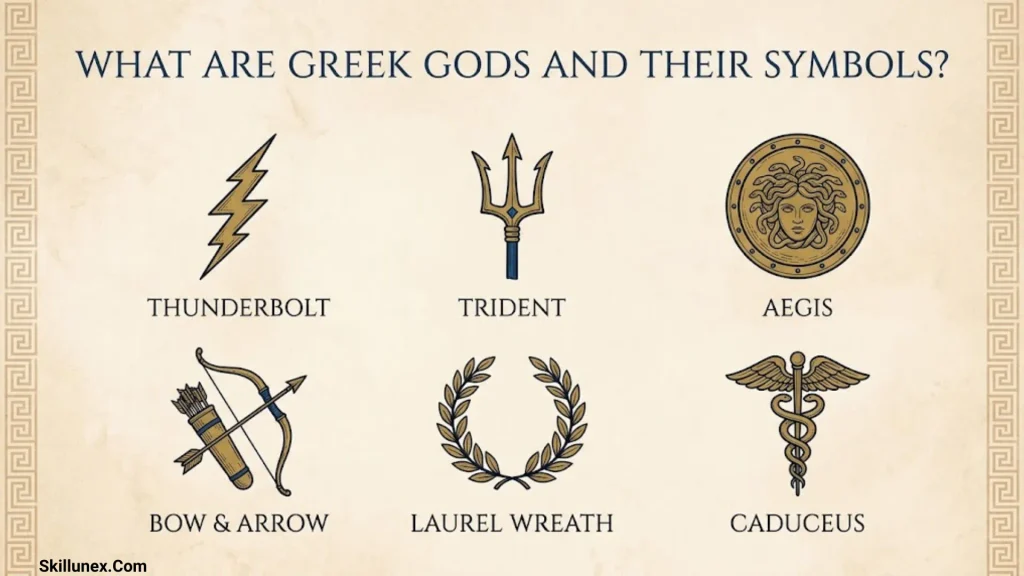
Greek gods and their symbols refer to the deities of ancient Greek mythology and the objects, animals, plants, and natural elements associated with them. The ancient Greeks believed that these gods and goddesses possessed extraordinary powers and influenced different aspects of life, including weather, agriculture, relationships, warfare, artistic creativity, and the afterlife.
Symbols helped people identify deities in ancient artwork and religious settings. For example, a thunderbolt often indicated Zeus, while a trident identified Poseidon. An owl was closely associated with Athena, and a lyre was a familiar attribute of Apollo.
These associations were not always exclusive. Several gods could share similar symbols, and a deity might have different attributes depending on the story or artistic tradition. Understanding these details makes Greek mythology easier to explore and helps explain why its imagery remains recognizable today.
Why Did Greek Gods Have Different Symbols?
Each deity represented particular powers, responsibilities, or natural forces. Their symbols communicated these connections in a visual form that people could recognize.
For example, the eagle represented Zeus’s authority and connection with the heavens, while the olive tree connected Athena with the agricultural prosperity and civic identity of Athens. Demeter’s wheat represented the importance of farming, and Aphrodite’s doves were associated with love and beauty.
Animals, plants, weapons, and sacred objects also appeared in myths about the gods. Over time, these associations became established in Greek art, religious traditions, and storytelling.
How Were Greek Symbols Used in Ancient Greece?
Symbols appeared throughout ancient Greek life. Artists painted them on pottery, sculptors included them in statues, and worshippers used religious imagery in sanctuaries and ceremonies.
Coins sometimes featured deities or their associated animals, while temples displayed images connected with the gods honored there. Writers also described divine attributes to help readers recognize characters in myths.
These symbols served religious and cultural purposes, although their exact meanings depended on context. A symbol could represent divine authority, protection, fertility, victory, wisdom, or a deity’s relationship with a particular city.
The 12 Olympian Gods and Their Symbols
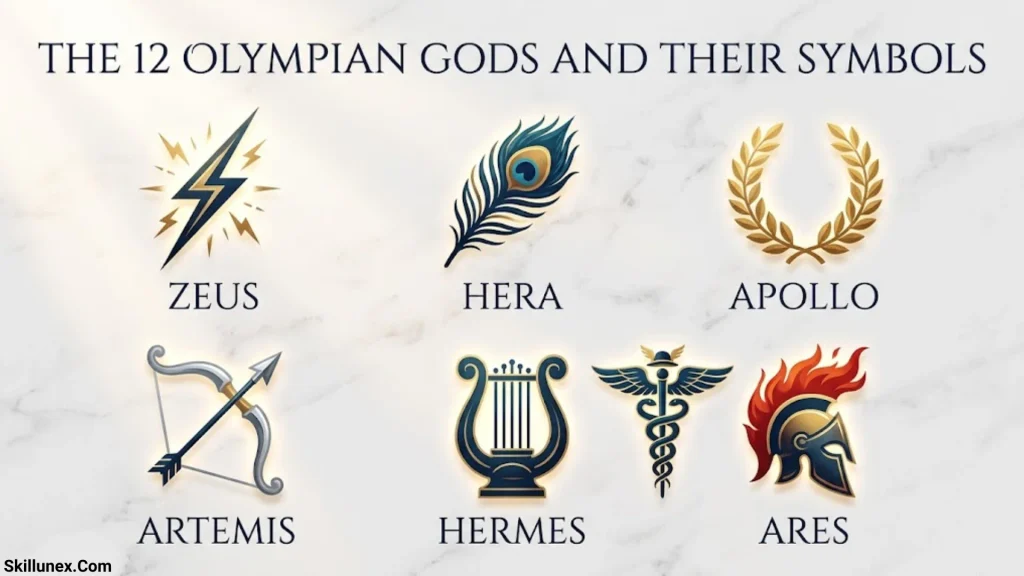
The Twelve Olympians are among the best-known deities in Greek mythology. They were traditionally associated with Mount Olympus, the divine home of the gods. Lists of the Twelve Olympians varied, particularly regarding whether Hestia or Dionysus occupied the final place.
Zeus God of the Sky and Thunder
Main symbols: Thunderbolt, eagle, oak tree, and scepter.
Zeus was the king of the Olympian gods and the ruler of the sky, thunder, and lightning. He played a central role in Greek mythology, maintaining divine authority and enforcing oaths and hospitality.
His thunderbolt represented his power over storms and his ability to punish those who challenged his authority. The eagle symbolized his connection with the heavens, while the oak tree was associated with his worship, particularly at the sanctuary of Dodona.
Zeus frequently appears in ancient art holding a thunderbolt or scepter. His myths also explore themes of power, justice, family relationships, and conflict among gods and mortals.
Hera Goddess of Marriage and Queenship
Main symbols: Peacock, crown, pomegranate, and scepter.
Hera was the queen of the gods and the wife of Zeus. She was associated with marriage, queenship, women, and the protection of legitimate family relationships.
The peacock became one of her most recognizable symbols, especially in later artistic traditions. The crown and scepter reflected her royal status, while the pomegranate was associated with fertility and marriage in broader ancient symbolism.
Hera appears in numerous myths involving Zeus, other gods, and mortal families. Although she was a powerful queen among the Olympians, many of her stories focus on marital conflict, jealousy, honor, and the consequences of divine relationships.
Poseidon God of the Sea and Earthquakes
Main symbols: Trident, horse, dolphin, and bull.
Poseidon ruled the sea and was also associated with earthquakes and horses. His influence was particularly important to coastal communities, sailors, and people whose livelihoods depended on maritime travel.
His trident, a three-pronged weapon, represented his divine authority over the sea. The horse was another important symbol because ancient Greek mythology connected Poseidon with horses and their creation or patronage. Dolphins reflected his maritime associations, while bulls also appeared in his cult and myths.
Ancient Greeks prayed to Poseidon for favorable sailing conditions and protection against dangerous waters. They also feared his power to unleash storms and earthquakes.
Demeter Goddess of Agriculture and Harvest
Main symbols: Wheat, grain, torch, and cornucopia.
Demeter was the goddess of agriculture, grain, fertility of the earth, and the harvest. Her importance reflected the central role farming played in ancient Greek society.
Wheat and grain represented nourishment and agricultural abundance. The torch was connected with her search for her daughter Persephone, while the cornucopia became a broader symbol of prosperity and plenty.
One of Demeter’s best-known myths concerns Persephone’s abduction by Hades and her eventual return for part of each year. The story was associated with the changing agricultural seasons and formed the mythological background of the Eleusinian Mysteries, important religious rites in ancient Greece.
Athena Goddess of Wisdom and Strategic Warfare
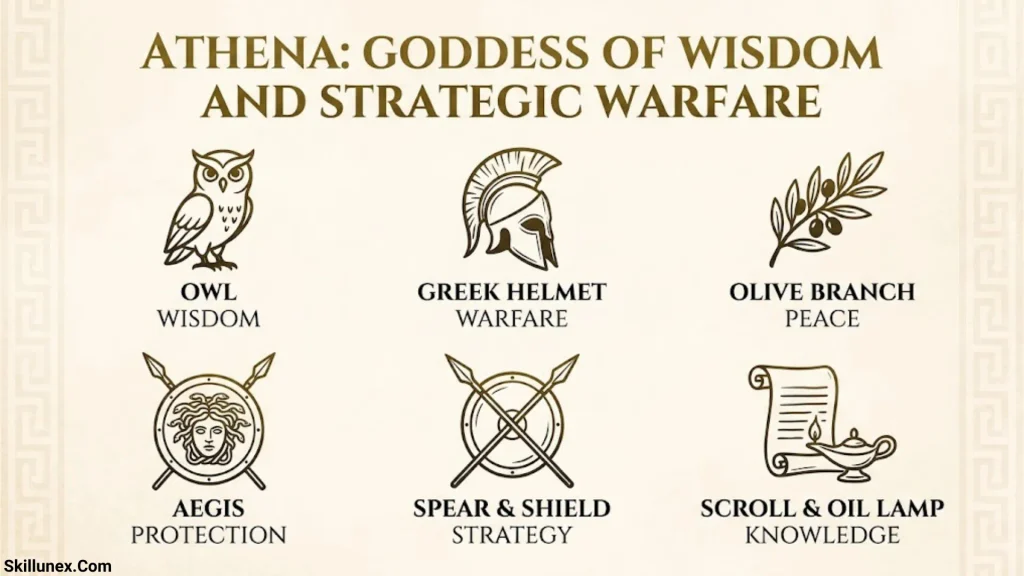
Main symbols: Owl, olive tree, helmet, spear, and shield.
Athena represented wisdom, strategic warfare, crafts, and practical intelligence. She was the patron goddess of Athens, where her worship played a central role in civic and religious life.
The owl became a widely recognized symbol of Athena because of its association with wisdom and its prominent appearance in Athenian imagery. The olive tree represented prosperity and was especially significant in the mythology surrounding Athens. Her helmet, spear, and shield reflected her role as a warrior goddess.
Unlike Ares, who was associated with the violence and chaos of battle, Athena represented disciplined strategy, planning, and military skill. She also helped heroes such as Odysseus and Perseus in various mythological traditions.
Apollo God of Music, Prophecy, and Healing
Main symbols: Lyre, laurel wreath, bow and arrow, and raven.
Apollo was associated with music, poetry, prophecy, archery, and healing. He was one of the most influential gods in Greek religious life, particularly through his sanctuary and oracle at Delphi.
The lyre represented music and artistic accomplishment. The laurel wreath was associated with Apollo through the myth of Daphne and became a symbol of honor and achievement. His bow and arrows reflected his power as an archer, while the raven was among the birds associated with him.
Apollo’s connection with prophecy made the Oracle of Delphi an important destination for people seeking guidance about personal, political, and military decisions. His mythology also reflects ancient Greek ideas about beauty, artistic excellence, health, and divine knowledge.
Artemis Goddess of the Hunt and Wilderness
Main symbols: Bow and arrow, deer, moon, and cypress tree.
Artemis was the goddess of hunting, wild animals, and wilderness. She was also associated with childbirth and the protection of young people, although her roles differed across regional traditions.
Her bow and arrows represented her skill as a huntress, while the deer reflected her relationship with wild animals and the natural world. Artemis was also connected with the moon in later and increasingly influential traditions, although lunar associations were not her only defining feature.
Artemis was commonly depicted carrying hunting equipment and accompanied by animals. Her mythology emphasizes independence, protection, nature, and the boundaries between human civilization and the wilderness.
Ares God of War
Main symbols: Spear, helmet, shield, and vulture.
Ares represented the violent, aggressive, and destructive aspects of warfare. He was the son of Zeus and Hera in the most familiar mythological tradition.
His spear, helmet, and shield reflected his role as a warrior, while the vulture was among the animals associated with him. Ares was often portrayed as fierce and impulsive, in contrast to Athena’s emphasis on strategy and disciplined military action.
Although Ares was an important member of the Olympian family, he was not universally admired in Greek literature. Stories involving him often explore the brutality of war, uncontrolled aggression, and the difficulties of balancing strength with wisdom.
Aphrodite Goddess of Love and Beauty
Main symbols: Dove, rose, myrtle, sparrow, and seashell.
Aphrodite was the goddess of love, beauty, sexual desire, and attraction. Her influence extended beyond romantic relationships, affecting the bonds and conflicts that shaped the lives of gods and mortals.
Doves and sparrows were associated with her, while roses and myrtle became important symbols of love and beauty. The seashell is especially familiar from later artistic representations of her birth, although it was not her only traditional attribute.
Aphrodite’s mythology includes her relationships with Ares, Hephaestus, and mortal figures such as Anchises. Her stories demonstrate how love and desire could inspire happiness, rivalry, deception, and even war.
Hephaestus God of Fire and Craftsmanship
Main symbols: Hammer, anvil, tongs, and forge.
Hephaestus was the divine craftsman responsible for creating weapons, armor, and extraordinary objects for the gods. He was associated with fire, metalworking, engineering, and skilled labor.
The hammer, anvil, and tongs represented the tools of his craft. His forge symbolized the transformation of raw materials into useful or magnificent creations.
In Greek myths, Hephaestus made remarkable objects, including armor for Achilles and other divine creations. His stories highlight craftsmanship and technical skill, showing that intelligence and expertise could be powerful even when a figure did not resemble the traditional image of a warrior.
Hermes Messenger of the Gods
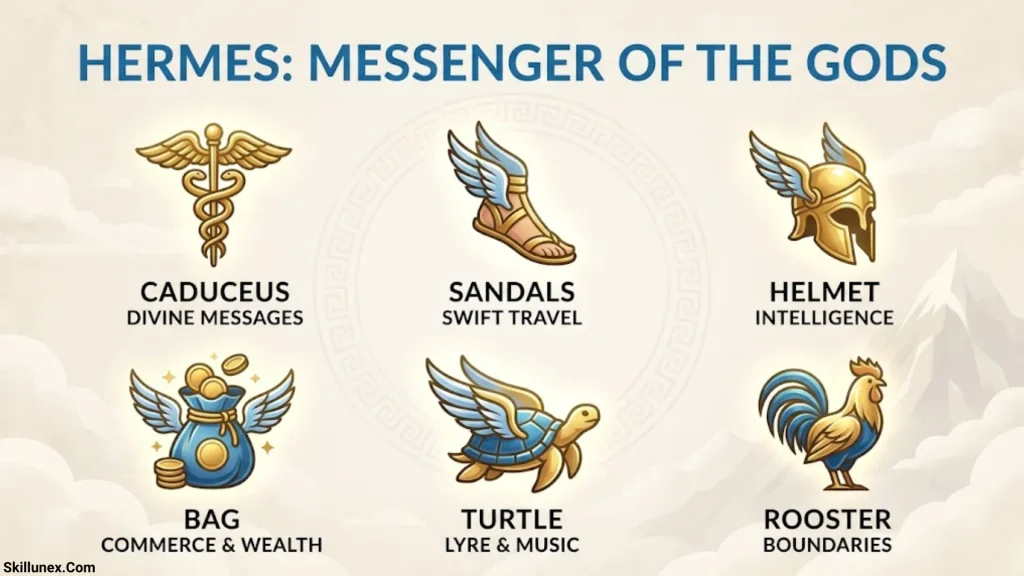
Main symbols: Winged sandals, winged hat, caduceus, and tortoise.
Hermes was the messenger of the gods and the patron of travelers, merchants, communication, and cunning. He also guided the souls of the dead toward the underworld.
His winged sandals and traveler’s hat represented speed and movement. The caduceus, a staff entwined with two serpents, was one of his most recognizable attributes. The tortoise was associated with Hermes through the myth explaining his invention of the lyre.
Hermes frequently appeared in stories as a clever negotiator, trickster, and helper. His mythology connected the divine world with the human world, emphasizing travel, trade, messages, and transitions between different realms.
Hestia Goddess of the Hearth and Home
Main symbols: Hearth fire, flame, and veil.
Hestia was the goddess of the hearth, domestic life, and the sacred fire maintained in homes and public spaces. Her worship emphasized stability, family unity, hospitality, and the importance of a shared household.
Unlike many Olympian gods, Hestia was not primarily identified through a distinctive animal or weapon. The hearth and its flame were her central symbols because they represented warmth, nourishment, and the center of domestic life.
Hestia received important religious honors in ancient Greek households and communities. Some traditional lists include her among the Twelve Olympians, while others replace her with Dionysus.
Other Important Greek Gods and Goddesses and Their Symbols
Greek mythology includes many important deities beyond the Twelve Olympians. These figures governed the underworld, love, victory, fertility, and other aspects of the world.
Hades God of the Underworld
Main symbols: Cerberus, bident, and Helm of Darkness.
Hades ruled the underworld, the realm of the dead. He was a brother of Zeus and Poseidon and governed the deceased rather than serving as a straightforward embodiment of evil.
Cerberus, the three-headed dog, guarded the entrance to the underworld. The bident, a two-pronged weapon, was associated with his authority, while the Helm of Darkness represented concealment and invisibility.
Hades appears prominently in the myth of Persephone, whose annual connection with the underworld was associated with the cycle of agricultural growth and dormancy. His myths reflect ancient Greek beliefs about death, burial, and the boundaries between the living and the dead.
Dionysus God of Wine and Theater
Main symbols: Grapes, grapevine, thyrsus, ivy, and leopard.
Dionysus was the god of wine, festivity, religious ecstasy, and theater. His worship was associated with celebration, transformation, and the release of ordinary social restrictions.
Grapes and grapevines represented wine production, while the thyrsus—a staff often decorated with ivy or a pine cone—was associated with Dionysus and his followers. Ivy and leopards also appeared in his imagery.
Dionysus played an important role in the development of Greek drama and religious festivals. His mythology explores the tension between order and spontaneity, civilization and wildness, and ordinary identity and transformation.
Eros God of Love and Desire
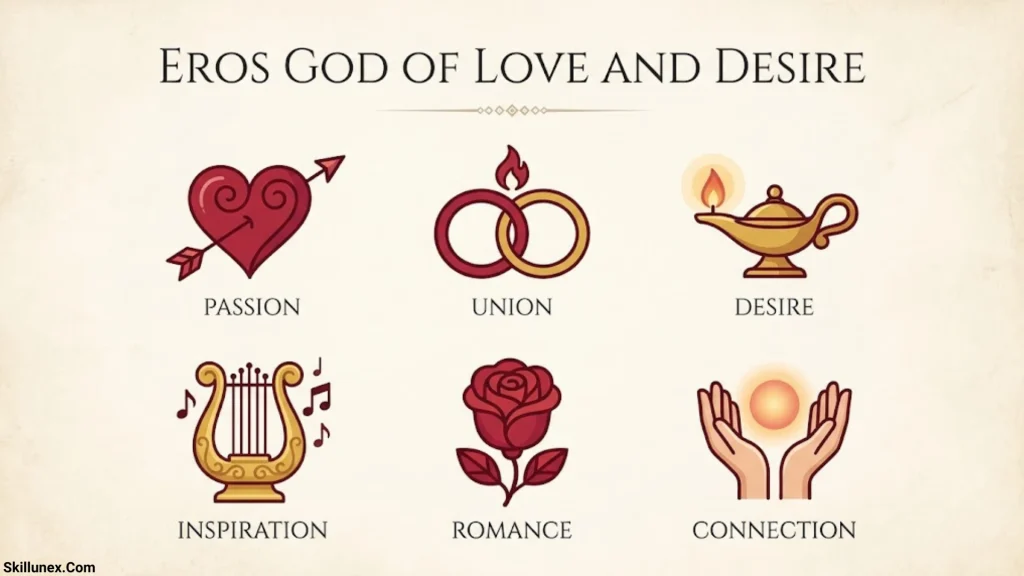
Main symbols: Bow and arrows, wings, and torch.
Eros personified love and desire. In early Greek traditions, he could appear as a powerful primordial force, while later artistic traditions increasingly depicted him as a youthful, winged figure.
His bow and arrows represented the ability of desire to affect both gods and mortals. Wings emphasized his swift and unpredictable influence, while the torch was associated with passion in later representations.
Eros is often compared with the Roman Cupid, although their identities and portrayals developed across different cultural traditions.
Persephone Goddess of Spring and Queen of the Underworld
Main symbols: Pomegranate, flowers, wheat, and torch.
Persephone was the daughter of Demeter and the queen of the underworld through her relationship with Hades. Her mythology connected the world of the living with the realm of the dead.
Flowers reflected her association with spring and new growth, while the pomegranate played a central role in the story of her time in the underworld. Wheat and torches connected her mythology with Demeter and the religious traditions surrounding the two goddesses.
The story of Persephone’s departure and return was used to explain the seasonal cycle in ancient Greek thought. It also played an important role in the Eleusinian Mysteries, which focused on Demeter and Persephone.
Nike Goddess of Victory
Main symbols: Wings, laurel wreath, and palm branch.
Nike personified victory in athletic competitions and warfare. She was often depicted as a winged figure, emphasizing the speed with which victory could arrive.
The laurel wreath and palm branch were associated with honor and triumph. Nike’s image appeared in ancient art and commemorative monuments, celebrating military success and athletic achievement.
Her name has also remained influential in modern culture, where the idea of victory continues to be represented through winged figures and classical imagery.
Pan God of the Wild and Shepherds
Main symbols: Panpipes, goat horns, and shepherd’s crook.
Pan was associated with shepherds, flocks, rustic music, and the wild countryside. He was commonly portrayed with the legs and horns of a goat.
The panpipes, also known as the syrinx, reflected his connection with music and pastoral life. Goat features represented his association with animals and untamed nature, while the shepherd’s crook connected him with the care of flocks.
Pan’s myths often take place in forests, mountains, and rural landscapes, offering a contrast to the civic and royal settings associated with many Olympian deities.
Helios Personification of the Sun
Main symbols: Sun chariot, radiant crown, and horses.
Helios personified the sun in Greek mythology. He was traditionally described as driving a radiant chariot across the sky, bringing daylight to the world.
His sun chariot and radiant crown represented his connection with sunlight and the daily movement of the heavens. Helios was distinct from Apollo in earlier Greek traditions, although their solar associations became increasingly connected in later periods.
The myth of Phaethon, who attempted to drive his father’s sun chariot, illustrates the danger of attempting to control divine power without sufficient skill.
Selene Goddess of the Moon
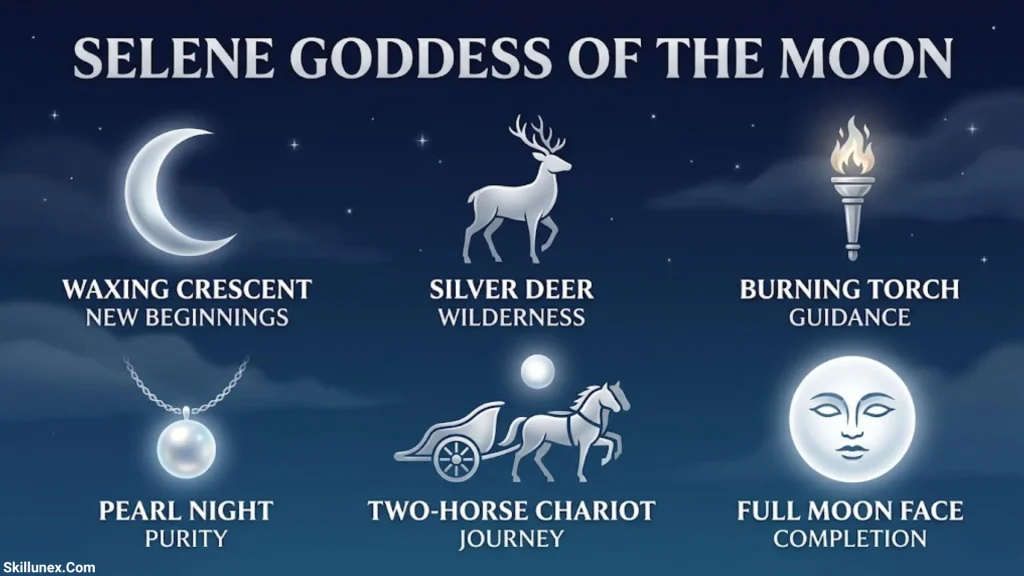
Main symbols: Crescent moon, lunar crown, and chariot.
Selene personified the moon and was often depicted traveling across the night sky in a chariot. Her imagery included the crescent moon and a radiant lunar crown.
She was distinct from Artemis in early Greek mythology, although Artemis also developed strong lunar associations in later traditions. Selene’s stories frequently emphasize the beauty, mystery, and recurring cycles of the moon.
Her mythological identity helps explain the different ways ancient Greeks personified the sun, moon, and other natural forces.
Greek Gods and Their Symbols: Quick Reference Table
The following table summarizes the major deities, their domains, and their most familiar symbols. Because mythological associations could change across traditions, the symbols listed are common examples rather than an exhaustive or universally fixed set.
| Greek God or Goddess | Domain | Main Symbols |
| Zeus | Sky and thunder | Thunderbolt, eagle, oak |
| Hera | Marriage and queenship | Peacock, crown, scepter |
| Poseidon | Sea and earthquakes | Trident, horse, dolphin |
| Demeter | Agriculture and harvest | Wheat, grain, torch |
| Athena | Wisdom and strategy | Owl, olive tree, helmet |
| Apollo | Music and prophecy | Lyre, laurel, bow |
| Artemis | Hunting and wilderness | Bow, deer, moon |
| Ares | War | Spear, helmet, shield |
| Aphrodite | Love and beauty | Dove, rose, myrtle |
| Hephaestus | Fire and craftsmanship | Hammer, anvil, tongs |
| Hermes | Travel and communication | Winged sandals, caduceus |
| Hestia | Hearth and home | Hearth fire, flame |
| Hades | Underworld | Cerberus, bident, Helm of Darkness |
| Dionysus | Wine and theater | Grapes, thyrsus, ivy |
| Eros | Love and desire | Bow, arrows, wings |
| Persephone | Spring and underworld | Pomegranate, flowers, torch |
| Nike | Victory | Wings, laurel wreath |
| Pan | Shepherds and wilderness | Panpipes, goat horns |
| Helios | Sun | Sun chariot, radiant crown |
| Selene | Moon | Crescent moon, lunar chariot |
What Do Greek Gods’ Symbols Mean?
Greek divine symbols communicated ideas about power, nature, human behavior, and religious belief. Their meanings become clearer when they are considered within the myths and communities in which they appeared.
Animals Associated With Greek Gods
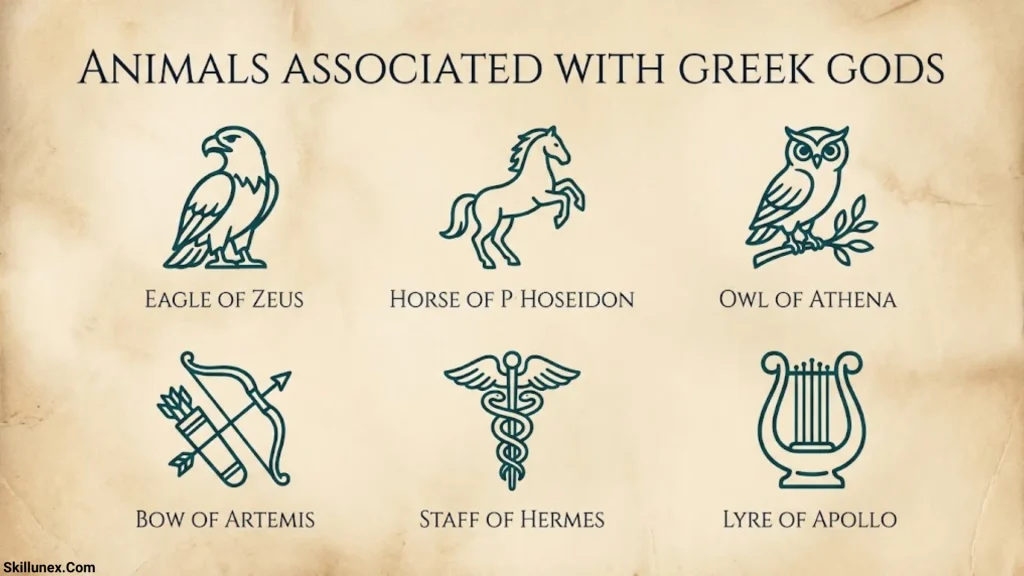
Animals were frequently connected with particular deities because of their appearance, behavior, or role in mythology.
- Eagle: Associated with Zeus and his authority over the sky.
- Owl: Closely associated with Athena and the city of Athens.
- Peacock: Associated with Hera, especially in later artistic traditions.
- Dolphin: Connected with Poseidon and the sea.
- Deer: Associated with Artemis and the wilderness.
- Dove: Associated with Aphrodite and love.
- Cerberus: The three-headed guardian of the underworld ruled by Hades.
- Goat: Associated with Pan and pastoral life.
These connections helped ancient artists and worshippers distinguish the gods and communicate their attributes through recognizable imagery.
Plants and Flowers Associated With Greek Gods
Plants also played a major role in Greek mythology. Some were connected with specific stories, while others reflected agricultural, religious, or cultural practices.
- Olive tree: Associated with Athena and the prosperity of Athens.
- Laurel: Connected with Apollo and the myth of Daphne.
- Wheat and grain: Associated with Demeter and agricultural fertility.
- Myrtle: Connected with Aphrodite and love.
- Grapevine and ivy: Associated with Dionysus and his worship.
- Pomegranate: Important in the mythology of Persephone and associated more broadly with fertility and abundance.
Plant symbols often reflected the importance of agriculture and the natural world in ancient Greek society.
Weapons and Sacred Objects Associated With Greek Gods
Weapons and divine objects communicated authority, skill, protection, and supernatural power.
- Thunderbolt: Zeus’s power over the sky and storms.
- Trident: Poseidon’s authority over the sea.
- Spear and shield: Athena’s strategic warfare and Ares’s martial identity.
- Hammer and anvil: Hephaestus’s craftsmanship.
- Lyre: Apollo’s musical and artistic associations.
- Caduceus: Hermes’s role as a divine messenger and his connections with travel and exchange.
- Thyrsus: Dionysus and the rituals associated with his worship.
These objects were often used in ancient art to identify a deity even when the figure’s name was not written nearby.
How Greek Gods and Their Symbols Influenced Modern Culture
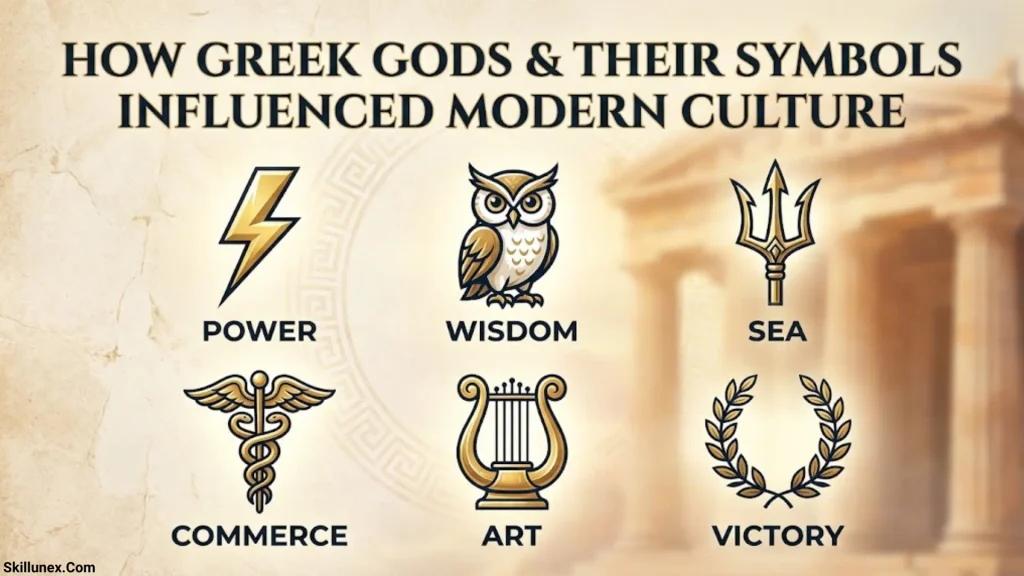
Greek mythology continues to influence contemporary literature, art, entertainment, education, and design. Its gods and symbols remain familiar because they communicate ideas that are still relevant, including wisdom, love, victory, power, creativity, and the natural world.
Greek Symbols in Art and Literature
Artists have drawn on Greek mythology for centuries, using divine figures and their attributes to explore human emotions, political authority, beauty, and morality.
Athena’s owl is often used to represent wisdom, while the laurel wreath remains associated with honor and achievement. Classical paintings and sculptures frequently depict Zeus with a thunderbolt, Poseidon with a trident, and Aphrodite in imagery connected with beauty and love.
Writers also reinterpret Greek myths to explore difficult choices, family relationships, ambition, justice, and the consequences of excessive pride.
Greek Gods in Movies, Games, and Popular Media
Greek deities appear in modern films, television programs, novels, comics, and video games. These adaptations often retain recognizable symbols while changing personalities, relationships, or mythological events to suit contemporary storytelling.
Characters inspired by Zeus, Athena, Poseidon, and Hades are particularly common. Their traditional attributes help audiences identify them even when a story presents a modern interpretation.
However, fictional portrayals should not always be treated as accurate descriptions of ancient Greek beliefs. Modern adaptations frequently combine different myths or introduce new details for dramatic effect.
Greek Symbols in Tattoos, Jewelry, and Design
Greek mythology also inspires tattoos, pendants, artwork, and decorative objects. People may choose particular symbols because of their historical associations or personal meanings.
For example, an owl may represent wisdom, an olive branch may suggest peace, a trident may evoke the sea, and a laurel wreath may symbolize achievement. A depiction of Hermes’s winged sandals can suggest travel or speed.
These modern interpretations can be meaningful, but they do not always match the precise religious significance of a symbol held in ancient Greece.
Frequently Asked Questions About Greek Gods and Their Symbols
Who Is the Most Powerful Greek God?
Zeus was generally recognized as the king of the Olympian gods and one of the most powerful deities in Greek mythology. His thunderbolt represented his authority over the sky and storms. However, individual myths sometimes portray other gods or primordial beings as possessing extraordinary powers in particular circumstances.
What Is Athena’s Main Symbol?
Athena’s most recognizable symbol is the owl, which is associated with wisdom and closely connected with the city of Athens. Other important attributes include the olive tree, helmet, spear, and shield.
What Is Poseidon’s Main Symbol?
Poseidon’s main symbol is the trident, a three-pronged weapon representing his authority over the sea. He is also associated with horses, dolphins, and earthquakes.
Which Greek Goddess Represents Love and Beauty?
Aphrodite is the Greek goddess most closely associated with love, beauty, and desire. Her familiar symbols include doves, roses, myrtle, and, in later artistic representations, seashells.
What Is the Difference Between Greek Gods and Goddesses?
The terms generally distinguish male deities, called gods, from female deities, called goddesses. Both could possess supernatural powers, receive worship, and govern aspects of nature, society, and human experience. Their roles were not always limited to a single domain.
Why Did Greek Gods Have Animal Symbols?
Animals helped communicate a deity’s identity, powers, and associations. The eagle was connected with Zeus, the owl with Athena, and the deer with Artemis. These connections appeared in myths, religious practices, and artwork, although the exact significance of an animal could vary across different traditions.
Are Greek Gods and Their Symbols Still Relevant Today?
Yes. Greek gods and their symbols continue to appear in books, movies, video games, art, education, architecture, and jewelry. They also help modern readers understand ancient Greek religion and recognize references to mythology in contemporary culture.
Conclusion
Greek gods and their symbols provide an engaging way to understand the mythology, religious traditions, and cultural values of ancient Greece. Zeus’s thunderbolt represents divine authority, Athena’s owl is associated with wisdom, Poseidon’s trident reflects his connection with the sea, and Aphrodite’s dove evokes love and beauty. Other deities, including Demeter, Apollo, Artemis, Hermes, and Dionysus, have their own distinctive attributes and stories.
These symbols were not simply decorative images. They helped ancient Greeks identify their deities, express religious beliefs, and connect the natural world with divine power. Although some associations changed across time and place, many remain recognizable in modern art, literature, entertainment, and design.
By exploring Greek gods and their symbols, readers can discover the stories behind familiar mythological images and gain a deeper appreciation of a tradition that continues to influence cultures around the world.

Caleb Thornton
I’m Caleb Thornton, a researcher and content writer who loves exploring fascinating subjects and sharing what I learn with readers. My interests include natural places, lakes, symbols, culture, history, and the stories that make ordinary topics more meaningful.
When I write an article, I try to go beyond a basic answer. I look for useful facts, relevant context, and details that can help readers understand the subject more completely.
My purpose is simple: I want every article I contribute to provide genuine value, satisfy the reader’s curiosity, and make discovering new information enjoyable.
## Books by Caleb Thornton
* Symbols & Meanings: Exploring the Signs We See Every Day
* Lakes of the World: Nature, Beauty & Exploration