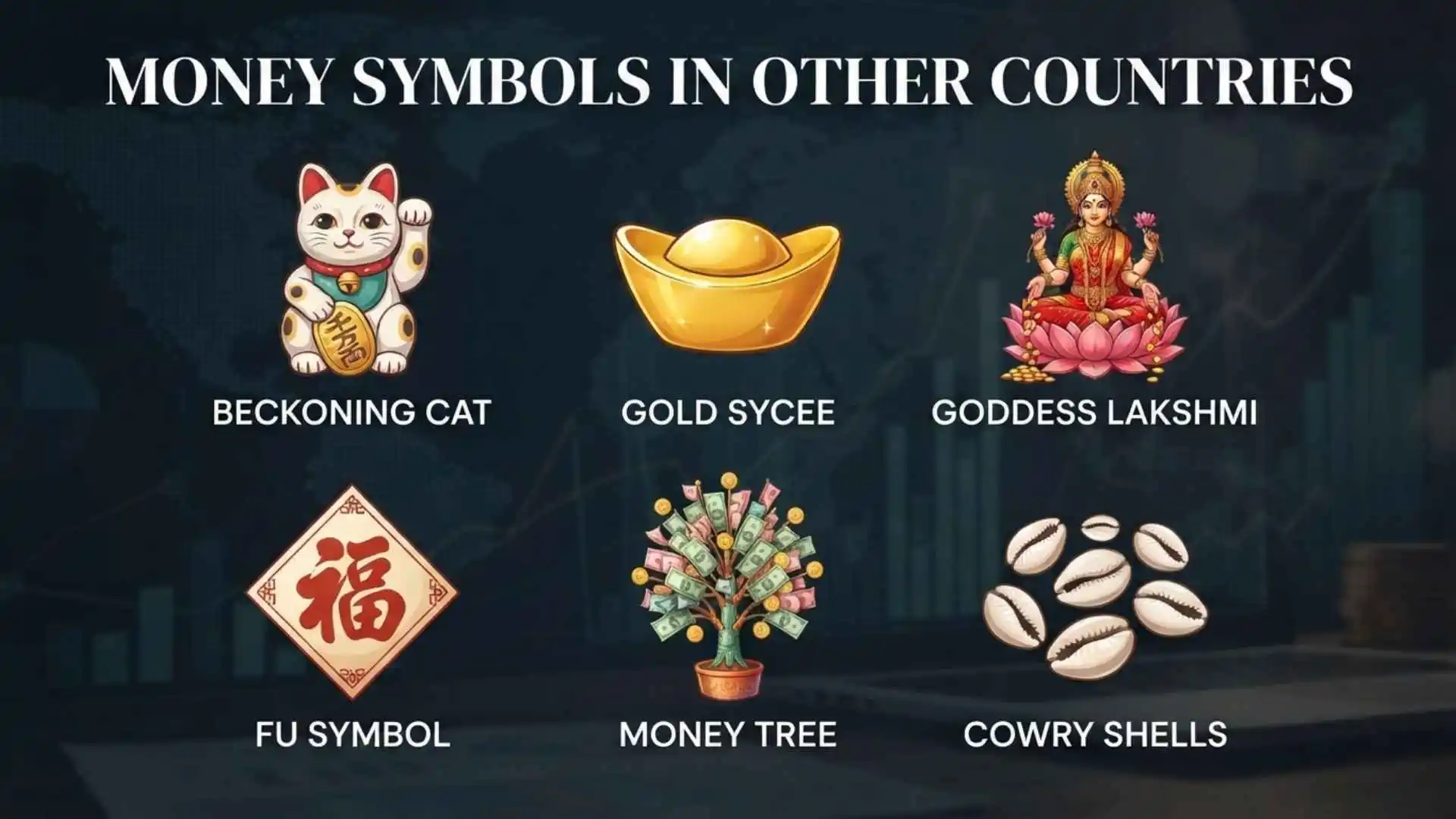
Money symbols help us quickly identify currencies when reading prices, invoices, bank statements, websites, travel information, and international payments. Some symbols are unique to one currency, while others are shared by several countries. For example, $ can represent different dollar or peso currencies, while ¥ can refer to the Japanese yen or Chinese yuan depending on the context.
If you are looking for money symbols in other countries, this guide provides a country-by-country reference showing the currency name, common symbol or abbreviation, and three-letter currency code. It also explains confusing symbols, international currency codes, symbol placement, and how to identify an unfamiliar currency sign.
Quick Answer: What Are Money Symbols?
A money symbol, or currency symbol, is a character used to represent a particular currency. Common examples include:
- $ — Dollar and some peso currencies
- € — Euro
- £ — Pound sterling
- ¥ — Japanese yen or Chinese yuan
- ₹ — Indian rupee
- ₨ — Rupee notation used in several South Asian contexts
- ₩ — South Korean won
- ₽ — Russian ruble
- ₺ — Turkish lira
- ₱ — Philippine peso
- ₦ — Nigerian naira
- ฿ — Thai baht
- ₫ — Vietnamese dong
- ₪ — Israeli new shekel
- ₴ — Ukrainian hryvnia
- ₲ — Paraguayan guaraní
- ₵ — Ghanaian cedi
- ₡ — Colón currencies
A currency symbol does not always identify a currency uniquely. For international transactions, the three-letter ISO currency code is often more precise.
For example:
- $100 may be ambiguous.
- US$100 identifies US dollars.
- USD 100 identifies the currency unambiguously.
- C$100 commonly identifies Canadian dollars.
Money Symbols by Country
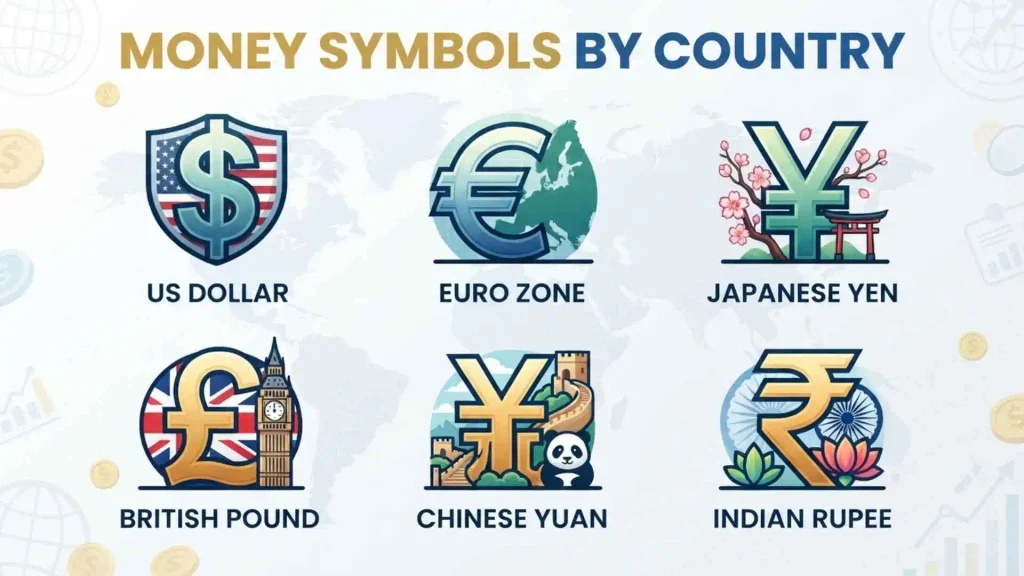
The following tables provide a practical reference to currencies used around the world. The symbol/notation column shows a commonly encountered symbol or abbreviation; local formatting can vary by country, language, and financial system.
North and Central America
| Country | Currency | Symbol / Common Notation | Code |
| Bahamas | Bahamian dollar | $ / B$ | BSD |
| Barbados | Barbadian dollar | $ / Bds$ | BBD |
| Belize | Belize dollar | BZ$ | BZD |
| Canada | Canadian dollar | $ / C$ | CAD |
| Costa Rica | Costa Rican colón | ₡ | CRC |
| Cuba | Cuban peso | $ / CUP | CUP |
| Dominica | East Caribbean dollar | $ / EC$ | XCD |
| Dominican Republic | Dominican peso | $ / RD$ | DOP |
| El Salvador | US dollar | $ | USD |
| Grenada | East Caribbean dollar | $ / EC$ | XCD |
| Guatemala | Guatemalan quetzal | Q | GTQ |
| Haiti | Haitian gourde | G / HTG | HTG |
| Honduras | Honduran lempira | L | HNL |
| Jamaica | Jamaican dollar | $ / J$ | JMD |
| Mexico | Mexican peso | $ / Mex$ | MXN |
| Nicaragua | Nicaraguan córdoba | C$ | NIO |
| Panama | Balboa / US dollar | B/. / $ | PAB / USD |
| Saint Kitts and Nevis | East Caribbean dollar | $ / EC$ | XCD |
| Saint Lucia | East Caribbean dollar | $ / EC$ | XCD |
| Saint Vincent and the Grenadines | East Caribbean dollar | $ / EC$ | XCD |
| Trinidad and Tobago | Trinidad and Tobago dollar | TT$ | TTD |
| United States | US dollar | $ / US$ | USD |
South America
| Country | Currency | Symbol / Common Notation | Code |
| Argentina | Argentine peso | $ / AR$ | ARS |
| Bolivia | Boliviano | Bs. | BOB |
| Brazil | Brazilian real | R$ | BRL |
| Chile | Chilean peso | $ / CLP$ | CLP |
| Colombia | Colombian peso | $ / COL$ | COP |
| Ecuador | US dollar | $ | USD |
| Guyana | Guyanese dollar | $ / G$ | GYD |
| Paraguay | Paraguayan guaraní | ₲ | PYG |
| Peru | Peruvian sol | S/ | PEN |
| Suriname | Surinamese dollar | $ / Sr$ | SRD |
| Uruguay | Uruguayan peso | $U / UYU$ | UYU |
| Venezuela | Venezuelan bolívar | Bs. | VES |
Europe
| Country | Currency | Symbol / Common Notation | Code |
| Albania | Albanian lek | Lek | ALL |
| Andorra | Euro | € | EUR |
| Austria | Euro | € | EUR |
| Belgium | Euro | € | EUR |
| Belarus | Belarusian ruble | Br | BYN |
| Bosnia and Herzegovina | Convertible mark | KM | BAM |
| Bulgaria | Euro | € | EUR |
| Croatia | Euro | € | EUR |
| Cyprus | Euro | € | EUR |
| Czechia | Czech koruna | Kč | CZK |
| Denmark | Danish krone | kr | DKK |
| Estonia | Euro | € | EUR |
| Finland | Euro | € | EUR |
| France | Euro | € | EUR |
| Germany | Euro | € | EUR |
| Greece | Euro | € | EUR |
| Hungary | Hungarian forint | Ft | HUF |
| Iceland | Icelandic króna | kr | ISK |
| Ireland | Euro | € | EUR |
| Italy | Euro | € | EUR |
| Kosovo | Euro | € | EUR |
| Latvia | Euro | € | EUR |
| Liechtenstein | Swiss franc | Fr | CHF |
| Lithuania | Euro | € | EUR |
| Luxembourg | Euro | € | EUR |
| Malta | Euro | € | EUR |
| Moldova | Moldovan leu | L | MDL |
| Monaco | Euro | € | EUR |
| Montenegro | Euro | € | EUR |
| Netherlands | Euro | € | EUR |
| North Macedonia | Macedonian denar | ден | MKD |
| Norway | Norwegian krone | kr | NOK |
| Poland | Polish złoty | zł | PLN |
| Portugal | Euro | € | EUR |
| Romania | Romanian leu | lei | RON |
| Russia | Russian ruble | ₽ | RUB |
| San Marino | Euro | € | EUR |
| Serbia | Serbian dinar | дин. / din | RSD |
| Slovakia | Euro | € | EUR |
| Slovenia | Euro | € | EUR |
| Spain | Euro | € | EUR |
| Sweden | Swedish krona | kr | SEK |
| Switzerland | Swiss franc | Fr / CHF | CHF |
| Ukraine | Ukrainian hryvnia | ₴ | UAH |
| United Kingdom | Pound sterling | £ | GBP |
| Vatican City | Euro | € | EUR |
Asia
| Country | Currency | Symbol / Common Notation | Code |
| Afghanistan | Afghani | ؋ / افغانی | AFN |
| Armenia | Armenian dram | ֏ | AMD |
| Azerbaijan | Azerbaijani manat | ₼ | AZN |
| Bangladesh | Bangladeshi taka | ৳ | BDT |
| Bhutan | Bhutanese ngultrum | Nu. | BTN |
| Brunei | Brunei dollar | $ / B$ | BND |
| Cambodia | Cambodian riel | ៛ | KHR |
| China | Renminbi/yuan | ¥ / CN¥ | CNY |
| Georgia | Georgian lari | ₾ | GEL |
| India | Indian rupee | ₹ | INR |
| Indonesia | Indonesian rupiah | Rp | IDR |
| Iran | Iranian rial | ﷼ | IRR |
| Iraq | Iraqi dinar | ع.د | IQD |
| Israel | Israeli new shekel | ₪ | ILS |
| Japan | Japanese yen | ¥ | JPY |
| Jordan | Jordanian dinar | د.ا | JOD |
| Kazakhstan | Kazakhstani tenge | ₸ | KZT |
| Kuwait | Kuwaiti dinar | د.ك | KWD |
| Kyrgyzstan | Kyrgyzstani som | с | KGS |
| Laos | Lao kip | ₭ | LAK |
| Lebanon | Lebanese pound | ل.ل | LBP |
| Malaysia | Malaysian ringgit | RM | MYR |
| Maldives | Maldivian rufiyaa | Rf / ރ. | MVR |
| Mongolia | Mongolian tögrög | ₮ | MNT |
| Myanmar | Myanmar kyat | K | MMK |
| Nepal | Nepalese rupee | Rs / रू | NPR |
| North Korea | North Korean won | ₩ | KPW |
| Oman | Omani rial | ر.ع. | OMR |
| Pakistan | Pakistani rupee | ₨ / Rs | PKR |
| Philippines | Philippine peso | ₱ | PHP |
| Qatar | Qatari riyal | ر.ق | QAR |
| Saudi Arabia | Saudi riyal | ر.س | SAR |
| Singapore | Singapore dollar | $ / S$ | SGD |
| South Korea | South Korean won | ₩ | KRW |
| Sri Lanka | Sri Lankan rupee | Rs / රු | LKR |
| Syria | Syrian pound | £S / ل.س | SYP |
| Taiwan | New Taiwan dollar | NT$ | TWD |
| Tajikistan | Somoni | SM / сомонӣ | TJS |
| Thailand | Thai baht | ฿ | THB |
| Timor-Leste | US dollar | $ | USD |
| Turkey | Turkish lira | ₺ | TRY |
| Turkmenistan | Turkmenistan manat | m | TMT |
| United Arab Emirates | UAE dirham | د.إ | AED |
| Uzbekistan | Uzbekistani soʻm | soʻm | UZS |
| Vietnam | Vietnamese đồng | ₫ | VND |
| Yemen | Yemeni rial | ﷼ | YER |
Africa
| Country | Currency | Symbol / Common Notation | Code |
| Algeria | Algerian dinar | دج | DZD |
| Angola | Angolan kwanza | Kz | AOA |
| Benin | West African CFA franc | CFA | XOF |
| Botswana | Botswana pula | P | BWP |
| Burkina Faso | West African CFA franc | CFA | XOF |
| Burundi | Burundian franc | FBu | BIF |
| Cameroon | Central African CFA franc | CFA | XAF |
| Cape Verde | Cape Verdean escudo | $ / Esc | CVE |
| Central African Republic | Central African CFA franc | CFA | XAF |
| Chad | Central African CFA franc | CFA | XAF |
| Comoros | Comorian franc | CF | KMF |
| Democratic Republic of the Congo | Congolese franc | FC | CDF |
| Djibouti | Djiboutian franc | Fdj | DJF |
| Egypt | Egyptian pound | E£ / ج.م | EGP |
| Equatorial Guinea | Central African CFA franc | CFA | XAF |
| Eritrea | Eritrean nakfa | Nfk | ERN |
| Eswatini | Lilangeni | E | SZL |
| Ethiopia | Ethiopian birr | Br | ETB |
| Gabon | Central African CFA franc | CFA | XAF |
| Gambia | Gambian dalasi | D | GMD |
| Ghana | Ghanaian cedi | ₵ | GHS |
| Guinea | Guinean franc | FG | GNF |
| Guinea-Bissau | West African CFA franc | CFA | XOF |
| Ivory Coast | West African CFA franc | CFA | XOF |
| Kenya | Kenyan shilling | KSh | KES |
| Lesotho | Lesotho loti | L | LSL |
| Liberia | Liberian dollar | $ / L$ | LRD |
| Libya | Libyan dinar | ل.د | LYD |
| Madagascar | Malagasy ariary | Ar | MGA |
| Malawi | Malawian kwacha | MK | MWK |
| Mali | West African CFA franc | CFA | XOF |
| Mauritania | Mauritanian ouguiya | UM | MRU |
| Mauritius | Mauritian rupee | ₨ / Rs | MUR |
| Morocco | Moroccan dirham | د.م. / DH | MAD |
| Mozambique | Mozambican metical | MT | MZN |
| Namibia | Namibian dollar | $ / N$ | NAD |
| Niger | West African CFA franc | CFA | XOF |
| Nigeria | Nigerian naira | ₦ | NGN |
| Republic of the Congo | Central African CFA franc | CFA | XAF |
| Rwanda | Rwandan franc | FRw | RWF |
| São Tomé and Príncipe | Dobra | Db | STN |
| Senegal | West African CFA franc | CFA | XOF |
| Seychelles | Seychellois rupee | ₨ / SR | SCR |
| Sierra Leone | Leone | Le | SLE |
| Somalia | Somali shilling | Sh | SOS |
| South Africa | South African rand | R | ZAR |
| South Sudan | South Sudanese pound | £ / SSP | SSP |
| Sudan | Sudanese pound | ج.س. | SDG |
| Tanzania | Tanzanian shilling | TSh | TZS |
| Togo | West African CFA franc | CFA | XOF |
| Tunisia | Tunisian dinar | د.ت | TND |
| Uganda | Ugandan shilling | USh | UGX |
| Zambia | Zambian kwacha | ZK | ZMW |
| Zimbabwe | Zimbabwe Gold | ZiG | ZWG |
Oceania
| Country | Currency | Symbol / Common Notation | Code |
| Australia | Australian dollar | $ / A$ | AUD |
| Fiji | Fijian dollar | $ / FJ$ | FJD |
| Kiribati | Australian dollar | $ / A$ | AUD |
| Marshall Islands | US dollar | $ | USD |
| Micronesia | US dollar | $ | USD |
| Nauru | Australian dollar | $ / A$ | AUD |
| New Zealand | New Zealand dollar | $ / NZ$ | NZD |
| Palau | US dollar | $ | USD |
| Papua New Guinea | Kina | K | PGK |
| Samoa | Samoan tālā | T | WST |
| Solomon Islands | Solomon Islands dollar | $ / SI$ | SBD |
| Tonga | Tongan paʻanga | T$ | TOP |
| Tuvalu | Australian dollar | $ / A$ | AUD |
| Vanuatu | Vatu | VT | VUV |
Most Common Currency Symbols Around the World
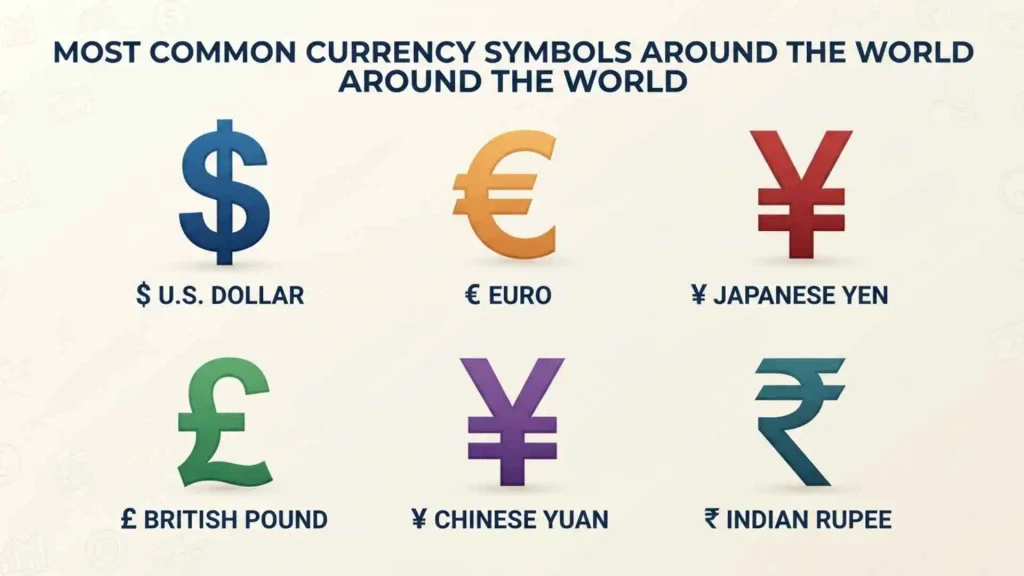
Some money symbols appear much more frequently in international commerce and everyday financial writing than others.
Dollar Symbol ($)
The $ is one of the world’s most recognizable currency symbols. It is associated with numerous currencies, including:
- US dollar — USD
- Canadian dollar — CAD
- Australian dollar — AUD
- New Zealand dollar — NZD
- Singapore dollar — SGD
- Hong Kong dollar — HKD
- Mexican peso — MXN
- Philippine peso — sometimes written with ₱ instead
- Several Caribbean and Latin American currencies
Because the same symbol can represent different currencies, $100 does not always mean 100 US dollars.
More specific forms include:
- US$100 — US dollars
- C$100 — Canadian dollars
- A$100 — Australian dollars
- NZ$100 — New Zealand dollars
- S$100 — Singapore dollars
- Mex$100 — Mexican pesos
Euro Symbol (€)
The € symbol represents the euro.
Examples:
- €10
- €50
- €1,000
The euro is used by many European countries, so the same symbol applies across the euro area.
The international currency code is EUR.
Pound Symbol (£)
The £ symbol is most strongly associated with pound sterling, the currency of the United Kingdom.
Examples:
- £10
- £100
- £1,500
The ISO currency code for pound sterling is GBP.
Other currencies can also be described as pounds, so the country and currency code provide important context.
Yen and Yuan Symbol (¥)
The ¥ symbol is associated with both the Japanese yen and Chinese yuan.
- Japan — Japanese yen — JPY
- China — Chinese yuan — CNY
For this reason, international financial writing may use JP¥ or CN¥, as well as the three-letter codes JPY and CNY, to eliminate ambiguity.
Rupee Symbols
Several countries use currencies called rupees, including India, Pakistan, Nepal, Sri Lanka, Mauritius, and Seychelles.
India has a distinctive modern symbol:
₹
Other rupee currencies are commonly represented using abbreviations such as Rs or local forms.
Because several countries use rupee-based currencies, the country or currency code should be included when precision matters.
Won Symbol (₩)
The ₩ symbol is commonly associated with the Korean won.
Both North Korea and South Korea have won currencies, but their international currency codes are different:
- North Korean won — KPW
- South Korean won — KRW
The country and currency code therefore provide important context.
Ruble Symbol (₽)
The ₽ symbol represents the Russian ruble.
Its ISO currency code is RUB.
An amount may therefore be written as:
₽5,000
or, in international financial contexts:
RUB 5,000
Turkish Lira Symbol (₺)
The Turkish lira uses the symbol:
₺
For example:
₺500
Its international currency code is TRY.
Peso Symbols
Several countries use currencies called pesos. Depending on the country, a peso may be represented using $, ₱, or a country-specific abbreviation.
Major examples include:
- Argentine peso — ARS
- Chilean peso — CLP
- Colombian peso — COP
- Mexican peso — MXN
- Dominican peso — DOP
- Philippine peso — PHP
- Uruguayan peso — UYU
This is another reason why the currency code is useful for international communication.
Currency Symbols Used by Multiple Countries
A common source of confusion is assuming that every currency has a unique symbol. In reality, many symbols are shared.
The Dollar Sign
The $ symbol is used for numerous currencies.
For example:
| Currency | Country | Code |
| US dollar | United States | USD |
| Canadian dollar | Canada | CAD |
| Australian dollar | Australia | AUD |
| New Zealand dollar | New Zealand | NZD |
| Singapore dollar | Singapore | SGD |
| Hong Kong dollar | Hong Kong | HKD |
| Jamaican dollar | Jamaica | JMD |
| Mexican peso | Mexico | MXN |
Therefore, $50 needs context before you can determine its exact currency.
The Yen/Yuan Sign
The ¥ symbol can refer to:
- Japanese yen — JPY
- Chinese yuan — CNY
A website serving an international audience may use JP¥, CN¥, JPY, or CNY to distinguish them.
The “kr” Symbol
The abbreviation kr is used for several Nordic currencies.
Examples include:
- Danish krone — DKK
- Norwegian krone — NOK
- Swedish krona — SEK
- Icelandic króna — ISK
The country must therefore be known before kr can be interpreted accurately.
Rupee Notation
Rupee-related notation such as Rs or similar forms can appear in multiple countries.
Examples include:
- Indian rupee — INR
- Pakistani rupee — PKR
- Nepalese rupee — NPR
- Sri Lankan rupee — LKR
- Mauritian rupee — MUR
- Seychellois rupee — SCR
India has the distinctive ₹ symbol, making it easier to identify in many contexts.
Currency Symbols vs. Currency Codes
A currency symbol and a currency code serve different purposes.
| Currency | Symbol | Code |
| US dollar | $ | USD |
| Euro | € | EUR |
| Pound sterling | £ | GBP |
| Japanese yen | ¥ | JPY |
| Chinese yuan | ¥ | CNY |
| Indian rupee | ₹ | INR |
| Pakistani rupee | ₨ / Rs | PKR |
| Canadian dollar | C$ / $ | CAD |
| Australian dollar | A$ / $ | AUD |
| South Korean won | ₩ | KRW |
| Russian ruble | ₽ | RUB |
| Turkish lira | ₺ | TRY |
What Is a Currency Symbol?
A currency symbol is designed for quick visual identification.
Examples:
$25
€25
£25
₹25
It is convenient for menus, advertisements, product pages, receipts, and everyday writing.
What Is a Currency Code?
A currency code is a standardized three-letter identifier used to distinguish currencies internationally.
Examples:
- USD
- EUR
- GBP
- JPY
- CNY
- INR
- PKR
- CAD
- AUD
Currency codes are especially useful when different currencies have the same or similar symbols.
Why Currency Codes Matter in International Transactions
Imagine seeing a price listed simply as:
$1,000
If you do not know the country or website location, you cannot be certain whether it means US dollars, Canadian dollars, Australian dollars, or another dollar-based currency.
Writing:
USD 1,000
removes that uncertainty.
Currency codes are commonly useful in:
- International banking
- Currency exchange
- Online shopping
- Accounting
- Invoices
- Financial reports
- Travel bookings
- International contracts
- E-commerce
- Foreign exchange markets
Where Does the Currency Symbol Go?
Currency-symbol placement varies between countries and languages.
Currency Symbol Before the Amount
Many currencies are commonly written before the number.
Examples:
- $100
- £100
- ₹100
- ₩100,000
- ₺500
- ₱1,000
Currency Symbol After the Amount
Some countries and language conventions place the currency symbol or abbreviation after the number.
Examples can include:
- 100 €
- 500 kr
- 1,000 Kč
- 100 zł
The correct format depends on local convention, language, and publishing style.
For international content, using the currency code can help avoid confusion.
How to Identify an Unknown Money Symbol
If you see an unfamiliar money symbol, follow a few simple steps.
Look at the Country
The surrounding website, receipt, store, bank, or travel destination may identify the country.
For example:
₺500 in a Turkish store almost certainly refers to Turkish lira.
Check the Currency Code
If a three-letter code appears next to the amount, it can provide a definitive identification.
For example:
- USD = US dollar
- GBP = pound sterling
- EUR = euro
- INR = Indian rupee
- PKR = Pakistani rupee
- JPY = Japanese yen
- CNY = Chinese yuan
Look for Country Prefixes
A symbol may be modified to make its meaning clearer.
Examples include:
- US$
- C$
- A$
- NZ$
- S$
- HK$
- NT$
These variations are especially useful when several currencies share the dollar sign.
Currency Symbols You May See Online
Online stores and financial websites may display currencies in several different formats.
For example, a product could be listed as:
$49.99
US$49.99
USD 49.99
All three may refer to US dollars, but the latter two make the currency more explicit.
Similarly, a European website may show:
€49.99
or:
49,99 €
The difference does not necessarily mean the currency is different. It may simply reflect local formatting conventions.
Money Symbols and International Travel
Knowing local currency symbols is particularly useful when traveling.
Before purchasing something abroad, check:
- The name of the local currency.
- Its symbol.
- Its three-letter currency code.
- The current exchange rate.
- Whether the displayed price includes taxes or fees.
For example, a traveler seeing ₩50,000 in South Korea should not confuse it with ¥50,000 in Japan.
Likewise, $100 can represent very different currencies depending on the country.
Money Symbols and Online Shopping
International shopping creates another common source of currency confusion.
A website may use a dollar sign without clearly displaying the country in the product price. Before paying, check whether the website identifies the currency as:
- USD
- CAD
- AUD
- NZD
- SGD
- HKD
- MXN
This is particularly important because the final amount charged by your bank or card provider may be converted into your home currency.
Why Some Countries Do Not Have a Unique Currency Symbol
Not every currency has a widely recognized dedicated symbol.
Some currencies are more commonly represented by abbreviations or currency codes.
Examples include:
- Swiss franc — CHF / Fr
- Botswana pula — P
- Kenyan shilling — KSh
- Malaysian ringgit — RM
- Romanian leu — lei
- Moroccan dirham — DH
- Papua New Guinean kina — K
This does not make these currencies less official. It simply means that everyday notation may rely more heavily on abbreviations than on a single Unicode currency character.
The Difference Between a Currency Name, Symbol, and Code
These three terms are related but not interchangeable.
For example, for India:
- Currency name: Indian rupee
- Symbol: ₹
- Code: INR
For the United Kingdom:
- Currency name: Pound sterling
- Symbol: £
- Code: GBP
For Japan:
- Currency name: Japanese yen
- Symbol: ¥
- Code: JPY
Knowing all three makes it much easier to understand international prices and financial information.
Frequently Asked Questions
What are the most common money symbols in the world?
Some of the most recognizable currency symbols include $, €, £, ¥, ₹, ₩, ₽, ₺, ₱, ₦, ฿, and ₫.
What is the symbol for the US dollar?
The US dollar is commonly represented by $. Its three-letter currency code is USD.
Which countries use the dollar symbol?
Many countries use the dollar sign or dollar-based notation, including the United States, Canada, Australia, New Zealand, Singapore, Hong Kong, Jamaica, Bahamas, Barbados, Belize, and others. The exact currency should be identified using the country or currency code.
Which country uses the € symbol?
The € symbol represents the euro, which is used by numerous European countries that have adopted the euro as their official currency.
What is the symbol for the British pound?
The British pound sterling is represented by £, and its international currency code is GBP.
What is the symbol for the Japanese yen?
The Japanese yen commonly uses ¥. Its international currency code is JPY.
What is the symbol for the Chinese yuan?
The Chinese yuan is commonly represented by ¥. Its international currency code is CNY. In international contexts, CN¥ may be used to distinguish it from the Japanese yen.
Why do China and Japan have the same currency symbol?
The Chinese yuan and Japanese yen use the same basic ¥ symbol because the currencies have historically been associated with the same character for “yuan/yen.” The international codes CNY and JPY distinguish them.
What is the Indian rupee symbol?
The Indian rupee uses the symbol ₹. Its international currency code is INR.
What is the Pakistani rupee symbol?
The Pakistani rupee is commonly written as ₨ or Rs, although local usage can vary. Its international currency code is PKR.
What currency uses the ₩ symbol?
The ₩ symbol is associated with the Korean won. South Korea uses the South Korean won, whose code is KRW, while North Korea uses the North Korean won, whose code is KPW.
What currency uses the ₱ symbol?
The ₱ symbol is commonly used for the Philippine peso. Its international currency code is PHP.
What currency uses the ₦ symbol?
The ₦ symbol represents the Nigerian naira. Its international currency code is NGN.
What currency uses the ฿ symbol?
The ฿ symbol is commonly used for the Thai baht. Its international currency code is THB.
What currency uses the ₫ symbol?
The ₫ symbol represents the Vietnamese đồng. Its international currency code is VND.
What currency uses the ₪ symbol?
The ₪ symbol represents the Israeli new shekel. Its international currency code is ILS.
What currency uses the ₴ symbol?
The ₴ symbol represents the Ukrainian hryvnia. Its international currency code is UAH.
What is the difference between a money symbol and a currency code?
A money symbol is a visual character used with a price, such as $, €, or £. A currency code is a standardized three-letter identifier, such as USD, EUR, or GBP.
Why can one money symbol represent several currencies?
Currency symbols developed through historical and local usage, and some currencies share similar names or monetary traditions. As a result, symbols such as $, ¥, and kr can refer to multiple currencies.
Is $ always the US dollar?
No. The $ symbol is not exclusive to the US dollar. It is also used or adapted for several other dollar currencies and, in some countries, peso currencies.
Is ¥ the Chinese yuan or Japanese yen?
It can represent either one. JPY means Japanese yen, while CNY means Chinese yuan. The country, currency code, or prefix such as JP¥ or CN¥ provides the necessary distinction.
Which currency symbol looks like an R?
Several currencies use symbols or abbreviations containing an R. The South African rand, for example, is commonly represented by R, while the Brazilian real uses R$.
Do all countries have a unique currency symbol?
No. Some currencies use symbols shared with other currencies, while others are primarily represented by abbreviations or currency codes.
What is the best way to identify a foreign currency?
The most reliable method is to use the country name and three-letter currency code together. Currency symbols are convenient, but they can sometimes be ambiguous.
Conclusion
Money symbols make prices and financial information easier to understand, but they do not always provide a unique identification for a currency. Symbols such as $, ¥, kr, and Rs can represent currencies used by different countries, which is why international currency codes are so important.
The most familiar symbols include $ for dollar-based currencies, € for the euro, £ for pound sterling, ¥ for yen or yuan, ₹ for the Indian rupee, ₩ for the Korean won, ₽ for the Russian ruble, ₺ for the Turkish lira, ₱ for the Philippine peso, and ₦ for the Nigerian naira.
When you need to identify money from another country, look at three things: the country, the currency name, and the currency code. Together, they provide a much clearer identification than a symbol alone.

I’m Adrian Holloway, a writer and researcher who enjoys exploring the stories, meanings, and interesting facts behind the subjects people search for every day. I’m especially interested in symbols, nature, lakes, places, and cultural topics that help readers understand the world from a different perspective.
I believe useful content should be simple, accurate, and enjoyable to read. When I research a topic, I focus on finding meaningful details and presenting them in a way that makes information easy to understand.
My goal is to create helpful articles that answer real questions while encouraging readers to discover something new with every visit.
Books by Adrian Holloway
The Language of Symbols: Meanings, Stories & Traditions
Hidden Wonders of Nature: Lakes, Landscapes & Discovery