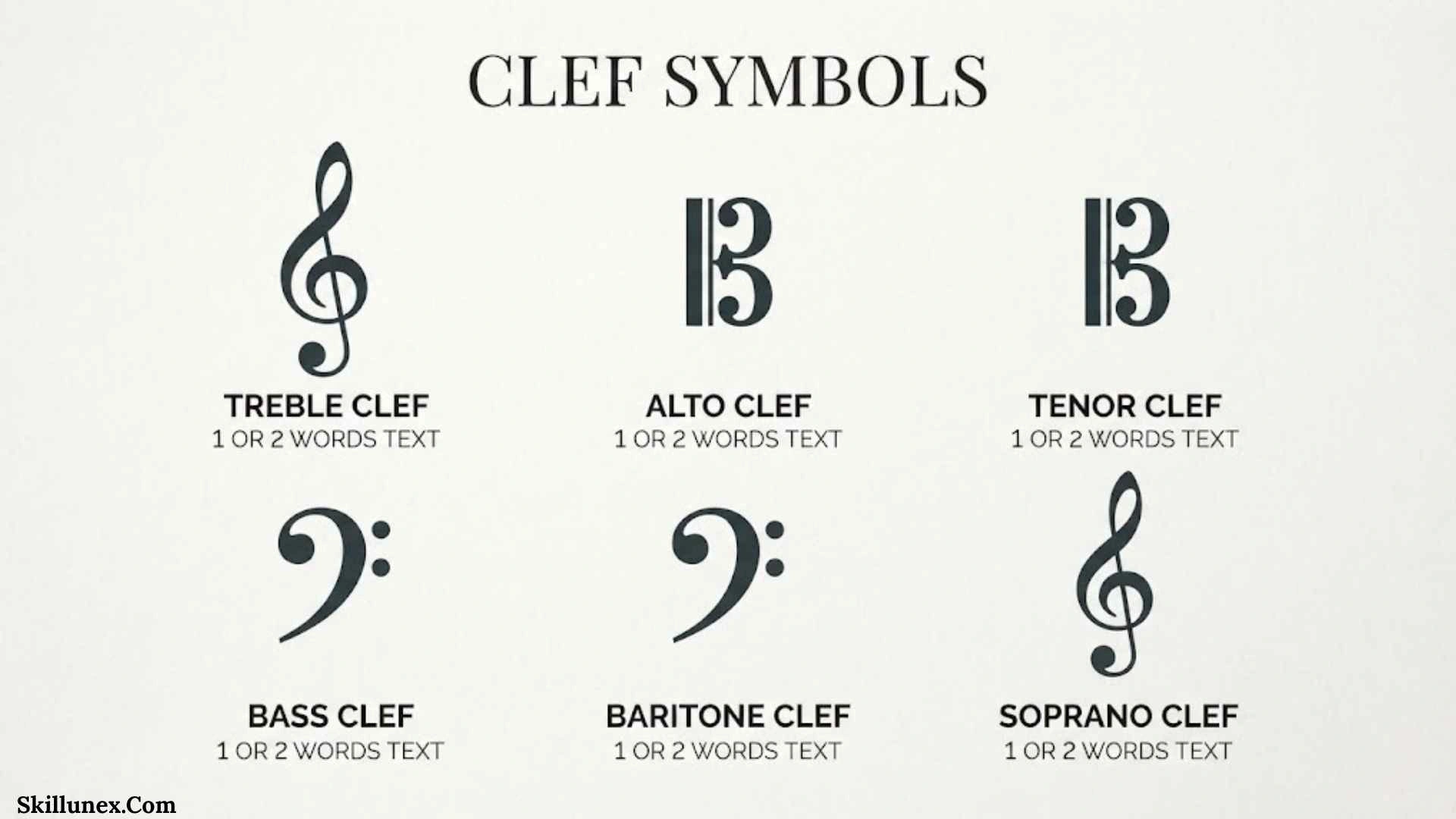
Clef symbols are the quiet starting point of written music, guiding musicians as they turn lines and spaces into meaningful sounds. From the familiar treble clef to the deep bass clef, these symbols have helped people read, teach, perform, and preserve music for centuries.
But clef symbols are more than marks on a musical staff. Their shapes carry a fascinating history rooted in the development of Western musical notation, while their modern use has made them powerful symbols of creativity, emotion, identity, and artistic expression.
Ifyou are a music student, musician, tattoo lover, or simply curious about the symbols behind sheet music, understanding clef symbols opens the door to a fascinating world where history, culture, psychology, and the universal language of music come together.
Clef Symbols: (Quick Answer)
Clef symbols are musical notation signs placed at the beginning of a staff to establish the pitch of its lines and spaces. The main clefs are treble, bass, alto, tenor, soprano, mezzo-soprano, baritone, and percussion clefs. Their shapes and positions developed from historical letter symbols used to identify musical pitches.
Quick Facts About Clef Symbols
| Aspect | Information |
| Origin | Developed from letter-based pitch signs used in medieval music notation |
| Historical Significance | Helped musicians represent vocal and instrumental pitch accurately |
| Main Meaning | A clef establishes which pitches the staff lines and spaces represent |
| Spiritual Meaning | Often associated symbolically with harmony, order, balance, and the human voice |
| Cultural Importance | Became a central part of Western musical notation and musical education |
| Modern Usage | Used in sheet music, music education, composition, arranging, orchestration, tattoos, jewelry, logos, and popular culture |
What Are Clef Symbols?
Clef symbols are signs used in written music to establish the pitch of notes on a musical staff.
A staff normally contains five horizontal lines and four spaces. By itself, however, the staff does not tell us exactly which pitch belongs to each line or space. The clef provides that missing information.
For example, the treble clef identifies the second line of the staff as G above middle C. The bass clef identifies the fourth line as F below middle C.
This simple idea is one of the foundations of Western music notation.
Where Did Clef Symbols Come From?
The history of clefs reaches back to medieval European music.
Early musical notation did not look like modern sheet music. Medieval musicians used various signs to help indicate the approximate pitch of melodies. Two particularly important pitch letters were F and C.
Over time, these letters became stylized and developed into the clef shapes we recognize today.
The modern treble clef ultimately developed from a stylized G, while the bass clef developed from a stylized F. The C clef family developed from the letter C.
This history explains something interesting: the shapes may appear abstract today, but they began as practical written indicators of pitch.
Why Did Clefs Become Important?
As music became more complex, musicians needed a reliable way to show different vocal and instrumental ranges.
A single staff system could not comfortably represent every voice and instrument without using many ledger lines. Clefs solved this problem by moving the reference point.
Instead of changing the entire musical system, composers could use different clefs to place a particular instrument or voice within a convenient range.
This made music easier to read and helped notation evolve alongside musical performance.
Deep Symbolic Meaning of Clef Symbols
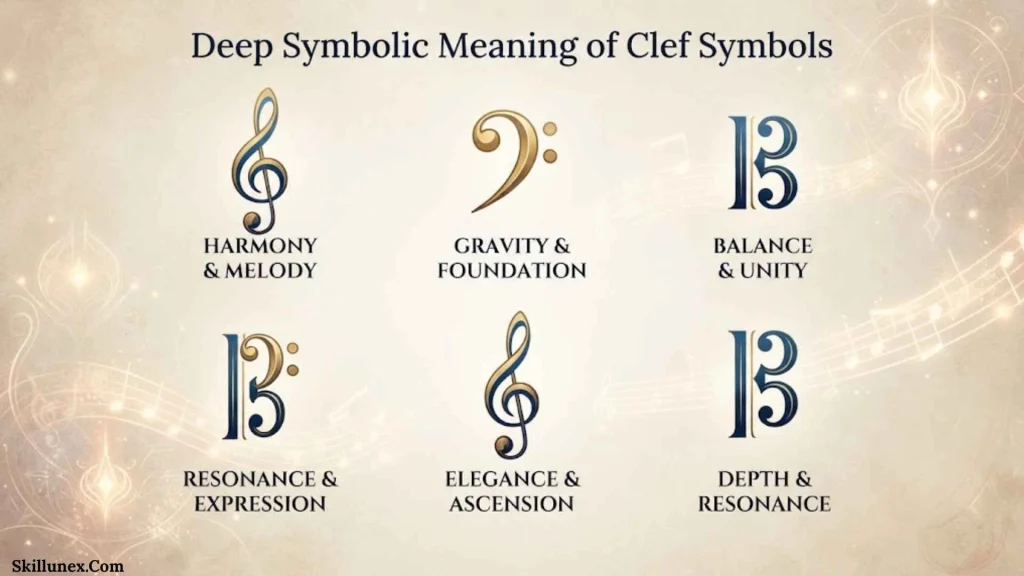
Although clefs have a precise technical function, people often give them symbolic meanings beyond music theory.
A clef can represent the connection between sound and vision, because it turns something invisible into a visible pattern.
Spiritual Meaning
Music has been connected with spiritual practice in cultures around the world. Chanting, singing, drumming, and instrumental music have all been used in religious and contemplative traditions.
Because clefs represent organized musical sound, they can symbolically suggest:
- Harmony
- Balance
- Order
- Unity
- Inner peace
- Expression
- Connection
- Transformation
- The human voice
A musical clef does not have one universal spiritual meaning. Its interpretation depends on the person and cultural context.
For someone who associates music with prayer, a clef might represent spiritual connection. For another person, it may simply symbolize creativity or a lifelong love of music.
Psychological Meaning
Music has a powerful relationship with memory and emotion.
A familiar melody can bring back a childhood memory within seconds. A song can remind someone of a person, place, celebration, loss, or important moment.
Clef symbols can therefore acquire personal emotional meaning.
From a psychological perspective, their attraction may also come from pattern recognition. Humans naturally look for meaningful patterns, and musical notation is a highly organized visual system.
The clef becomes the first visual clue in a larger pattern of notes, rhythm, melody, and harmony.
Jungian and Archetypal Interpretations
A Jungian reading of music symbols can treat them as images connected with universal human experiences rather than fixed definitions.
Music itself often represents emotional expression, communication, memory, and connection.
A clef can therefore be interpreted as a symbolic doorway into those experiences. It marks the beginning of a musical language and tells us how to understand what comes next.
This is an interpretation, not a scientific claim that clefs possess a universal psychological meaning.
Cultural Meaning
In modern culture, clefs are strongly associated with:
- Musicians
- Singing
- Creativity
- Artistic identity
- Music education
- Performance
- Emotional expression
- Classical music
- Contemporary music
A person wearing a treble clef necklace may simply be expressing their identity as a musician. Someone else may use the same symbol because music represents an important person or memory in their life.
Types and Variations of Clef Symbols
There are several clefs used in Western musical notation. Some are common today, while others are mainly encountered in historical scores or particular musical settings.
Treble Clef
The treble clef is also called the G clef.
It is one of the most recognizable musical symbols in the world. Its distinctive shape curls around the second line of the staff, identifying that line as G4, commonly called the G above middle C.
Meaning: Higher musical register.
Common uses: Violin, flute, oboe, clarinet, trumpet, guitar, piano right hand, and many higher vocal parts.
Symbolic association: Melody, brightness, high vocal range, youthfulness, and expressive movement.
The treble clef is especially common in popular culture, where it is often used as a general symbol for music.
Bass Clef
The bass clef is also called the F clef.
Its two dots surround the fourth line of the staff, identifying that line as F3.
Meaning: Lower musical register.
Common uses: Cello, double bass, bassoon, trombone, tuba, piano left hand, and low vocal parts.
Symbolic association: Depth, strength, grounding, resonance, and stability.
The bass clef reminds us that music is not only about high melodies. Low frequencies give music weight and foundation.
Alto Clef
The alto clef is a form of C clef.
Its center identifies the line representing middle C.
It is most strongly associated with the viola.
Meaning: Middle register.
Common use: Viola and some historical or specialized musical contexts.
Symbolic association: Balance and the space between high and low registers.
The alto clef is a useful reminder that musical identity exists between extremes.
Tenor Clef
The tenor clef is another form of C clef, but its position places middle C on the fourth line.
It is commonly encountered in music for instruments such as cello, bassoon, and trombone when the musical range moves higher.
Meaning: Upper-middle register.
Common uses: Cello, bassoon, trombone, and other instruments in particular passages.
Soprano Clef
The soprano clef is a historical form of C clef in which middle C is placed on the first line.
It was associated with higher vocal parts in older systems of notation.
Today, modern performers rarely encounter it in ordinary music reading, but it remains important for understanding the history of notation.
Mezzo-Soprano Clef
The mezzo-soprano clef places middle C on the second line.
It is another historical C clef associated with vocal ranges.
Although uncommon in modern practice, it demonstrates how flexible the older clef system was.
Baritone Clef
The baritone clef can refer to historical forms of C clef or F clef depending on the notation system.
It was used to represent a lower vocal range without requiring excessive ledger lines.
Percussion or Neutral Clef
The percussion clef, sometimes called the neutral clef, is different from pitch-based clefs.
Instead of assigning traditional pitches to the staff, it can indicate that the notation represents unpitched percussion instruments.
The exact placement of percussion sounds depends on the instrument and notation convention.
This clef shows that not all written music needs to function primarily as a map of definite pitches.
Clef Symbols Across Different Cultures
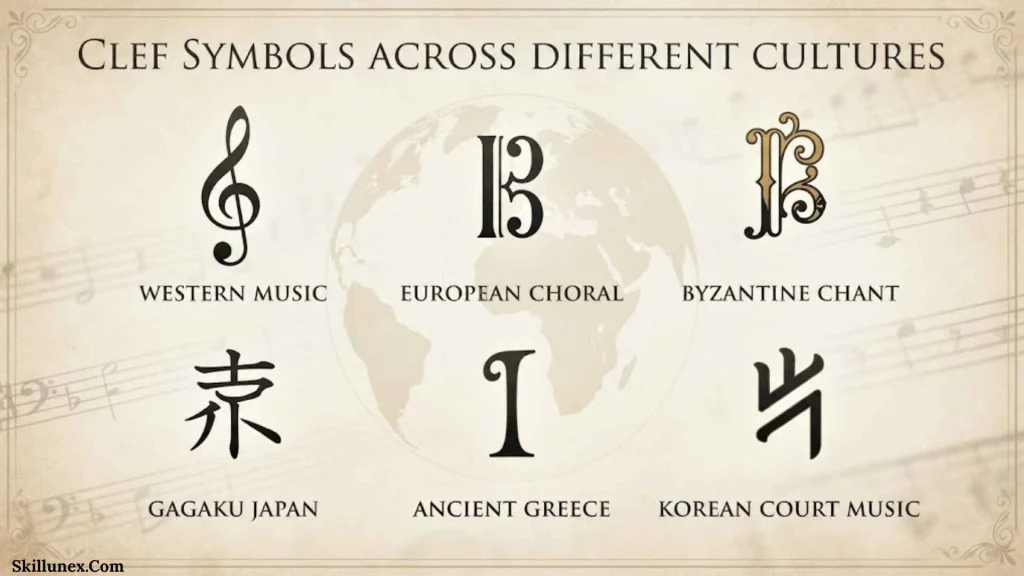
It is important to make a distinction here.
The modern treble, bass, and C clefs belong primarily to the tradition of Western staff notation. They should not be treated as universal musical symbols shared unchanged by every ancient civilization.
Other cultures developed sophisticated musical systems without using these clefs.
Ancient Egypt
Ancient Egyptian culture had rich traditions of music, dance, ritual, and instruments. Archaeological evidence shows the importance of musicians and musical instruments in Egyptian society.
However, ancient Egyptians did not use modern Western clef symbols.
Their connection to clef symbolism is therefore historical and comparative rather than direct.
This distinction matters because it prevents modern symbols from being incorrectly projected onto ancient cultures.
Ancient Greece
Ancient Greek culture developed influential ideas about music, mathematics, philosophy, and education.
Greek theorists such as Pythagoras became associated with ideas about numerical relationships and musical intervals, while writers such as Aristoxenus contributed to early music theory.
Ancient Greek musical notation existed, but it was not the same system as modern staff notation.
The Greek legacy is especially important because it helped shape later Western thinking about music, proportion, harmony, and education.
Roman Culture
Roman musical life included instruments, military music, theatre, religious ceremonies, and public entertainment.
Roman culture also transmitted and transformed elements of Greek intellectual and artistic traditions.
The modern clef system, however, developed much later within medieval European musical notation.
Eastern Traditions
Many Asian musical cultures developed their own systems for understanding and recording music.
For example, Indian classical music uses concepts such as raga, svara, and tala, while Chinese musical traditions have used several forms of notation across history.
These traditions demonstrate an important truth: music does not require one universal notation system.
The clef is one solution developed within a particular historical tradition.
Indigenous Traditions
Indigenous musical traditions around the world often rely heavily on oral transmission, performance, community memory, rhythm, dance, and ceremonial practice.
Some Indigenous communities later adopted staff notation for documentation or education, but this does not mean their traditional musical knowledge originated with Western notation.
This distinction is essential when discussing culture respectfully.
Modern Global Interpretation
Today, clef symbols have traveled far beyond their European origins.
They appear on:
- Posters
- Album artwork
- Clothing
- Tattoos
- Jewelry
- School materials
- Digital graphics
- Music apps
- Social media profiles
- Home decor
Their meaning has therefore expanded from a technical notation mark into a broad visual symbol of music.
Similar Symbols and Their Meanings
Clefs are often confused with other musical symbols because they appear together in written music.
| Symbol | Main Function | Common Association |
| Treble clef | Establishes high-register pitch | Melody and higher voices |
| Bass clef | Establishes low-register pitch | Foundation and low instruments |
| Alto clef | Establishes middle-register pitch | Viola and balanced range |
| Tenor clef | Establishes upper-middle pitch | Higher passages on lower instruments |
| Percussion clef | Indicates percussion notation | Rhythm and percussion |
| Time signature | Shows meter and beat structure | Rhythm |
| Key signature | Shows sharps or flats belonging to a key | Tonality |
| Rest | Indicates silence | Space and pause |
| Fermata | Indicates a held or extended moment | Musical suspension |
Clef vs Key Signature
A clef tells you which pitches the staff represents.
A key signature tells you which notes are sharpened or flattened within the key.
They perform completely different jobs.
Clef vs Time Signature
A clef deals primarily with pitch identification.
A time signature deals with rhythmic organization.
For example, a piece can use the treble clef and 4/4 time at the same time because these symbols answer different musical questions.
Clef Symbols in Mythology and Folklore
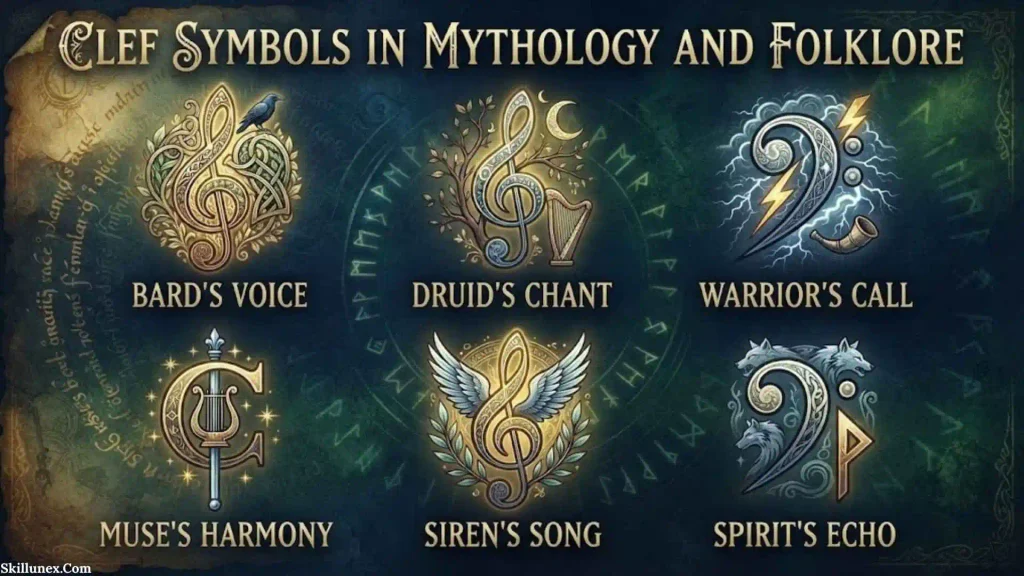
There are no ancient myths that directly describe the modern treble clef as a sacred symbol because the modern form developed much later.
However, the idea of music itself has deep roots in mythology and folklore.
Orpheus and the Power of Music
One of the most famous musical figures in Greek mythology is Orpheus.
According to the myth, his music was so powerful that animals, trees, and even stones responded to it.
His story helped create a lasting cultural image of music as a force capable of moving the human heart and crossing boundaries between the natural and supernatural worlds.
Modern clef symbols sometimes inherit this broader cultural association with the emotional power of music, even though the symbols themselves are not ancient Greek objects.
Music as a Bridge
Across many traditions, music has been used in ceremonies, celebrations, mourning, worship, storytelling, and courtship.
The clef can therefore be viewed symbolically as a gateway into a much older human experience: using sound to communicate what ordinary speech cannot fully express.
Clef Symbols in Art, Literature, Movies and Pop Culture
Clefs have become a powerful visual shorthand for music.
Paintings and Visual Art
Artists often use musical notation to suggest creativity, performance, memory, or emotional expression.
A page of music can also symbolize a life story, because a composition unfolds over time just as a person’s experiences do.
Literature and Poetry
Writers may use musical language as a metaphor for life.
Words such as harmony, rhythm, melody, silence, and discord are frequently used to describe relationships and emotions.
A clef fits naturally into this symbolic language because it represents the beginning of a system through which musical meaning can be read.
Movies and Television
Film posters, title sequences, school settings, concert scenes, and stories about musicians frequently use clef imagery to immediately signal a musical theme.
The symbol works quickly because audiences recognize its visual connection to music.
Tattoos
Clef tattoos are popular among musicians and music lovers.
A treble clef tattoo might represent:
- Love of music
- Musical training
- A career in performance
- A favorite instrument
- A meaningful song
- A family connection
- Personal creativity
- A major life chapter
Some people combine clefs with names, dates, lyrics, flowers, hearts, birds, notes, or instruments.
The meaning is personal rather than universal.
Fashion and Jewelry
Treble clef earrings, necklaces, bracelets, rings, and printed clothing allow people to display their connection with music without saying a word.
For musicians, the symbol can function almost like a visual identity badge.
Spiritual and Dream Meaning of Clef Symbols
Dream interpretation should always be treated as personal rather than as a fixed scientific dictionary.
Still, people often associate musical symbols with communication, emotion, creativity, and harmony.
What Does a Clef Mean in a Dream?
A clef appearing in a dream might personally represent:
- Creativity
- Self-expression
- A desire to be heard
- Emotional memory
- Harmony in relationships
- A connection with music
- A forgotten talent
- A need for balance
For a musician, the dream may simply reflect recent practice or performance.
For someone who rarely thinks about music, it might have a more personal association.
Spiritual Encounters
Some people interpret repeated musical symbols as meaningful spiritual signs.
Such interpretations belong to personal belief systems rather than established scientific evidence.
A useful approach is to ask:
What does music mean to me?
That question often reveals more than relying on a universal symbolic dictionary.
Positive Dream Interpretation
A clef may feel positive when it appears alongside:
- Beautiful music
- Singing
- Dancing
- Light
- Celebration
- Loved ones
- Calm surroundings
These associations may suggest creativity, connection, joy, or emotional release.
Cautionary Interpretation
If the clef appears with:
- Broken instruments
- Silence
- Fear
- Confusion
- Discordant sound
- Missing notes
the personal meaning may relate to blocked expression, conflict, frustration, or a feeling of being unheard.
Again, the emotional context matters more than the symbol alone.
Positive and Negative Meanings of Clef Symbols
| Positive Meaning | Negative Meaning |
| Harmony | Discord |
| Creativity | Blocked expression |
| Communication | Feeling unheard |
| Emotional connection | Emotional confusion |
| Artistic identity | Creative pressure |
| Balance | Lack of balance |
| Musical passion | Obsession with perfection |
| Memory | Painful memories |
The same symbol can represent both light and shadow.
A musician may see a clef and feel freedom, while another person may associate it with difficult lessons, performance anxiety, or a painful memory.
Symbols gain meaning through human experience.
Why Are Humans Attracted to Clef Symbols?
There is something fascinating about the visual appeal of clefs.
The treble clef, for example, has a flowing shape that resembles a spiral or elegant handwritten mark. It is visually distinctive even to people who cannot read music.
Pattern Recognition
Human brains are highly sensitive to patterns.
Musical notation contains repeated lines, spaces, curves, dots, and symbols. Once we learn the system, these visual patterns become meaningful.
A clef is the first major clue that tells us how to decode the pattern.
Emotional Connection
Music is deeply connected with emotion and memory.
A person may associate a clef with the first song they learned, a childhood piano lesson, a wedding, a concert, a parent who played an instrument, or a career.
That emotional association can make the symbol powerful.
Cultural Memory
For centuries, written music has been connected with composers, performers, churches, theatres, schools, orchestras, and families.
Clef symbols became part of this larger cultural memory.
Personal Identity
For some people, music is not merely a hobby.
It is who they are.
A singer may see a treble clef as part of their identity. A cellist may feel a stronger connection with the bass or tenor clef. A composer may see notation as the language through which ideas become real.
Modern Uses of Clef Symbols
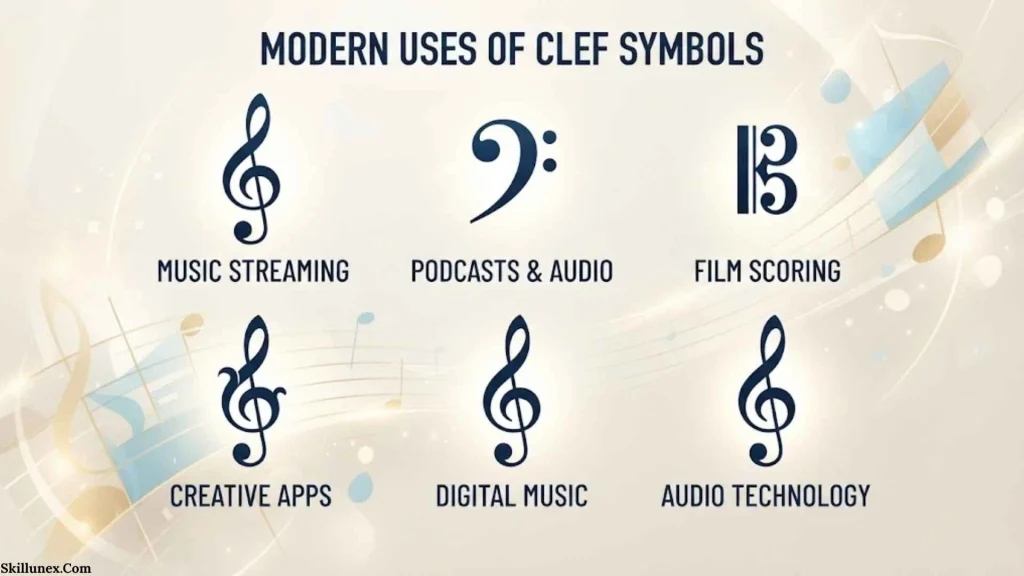
Clef symbols remain useful in modern music while also functioning as popular design elements.
Tattoos
Clefs are widely used in tattoo designs because they are recognizable and can be personalized.
Jewelry
Music-themed jewelry often uses treble clefs, bass clefs, notes, staffs, and instruments.
Fashion
Clothing designers use musical notation to create an artistic or rebellious visual style.
Branding
Music schools, recording studios, lesson services, orchestras, and entertainment businesses may use musical symbols in branding.
A clef instantly communicates a connection to music.
Social Media
Musicians sometimes use clef symbols in profile descriptions, usernames, posts, and promotional graphics.
They can quickly signal musical identity.
Contemporary Spirituality
Some people use musical symbols alongside other spiritual imagery to express ideas about harmony, vibration, consciousness, or inner balance.
These interpretations are personal and should not be confused with the technical meaning of a clef in music theory.
Home Decor
Clef wall art, posters, clocks, sculptures, and decorative prints are common in homes, studios, classrooms, and music rooms.
Interesting Facts About Clef Symbols
- The treble clef developed from a stylized G. Its historical connection with the letter G explains why it is called the G clef.
- The bass clef developed from an F sign. Its two dots help identify the line representing F.
- C clefs can move. Their position on the staff determines where middle C is located.
- Clefs reduce the need for ledger lines. This makes music more readable for different vocal and instrumental ranges.
- The treble clef is one of the world’s most recognizable music symbols. Even people with little musical training often recognize it.
- Ancient civilizations did not use the modern treble clef. Ancient Egyptian, Greek, and Roman musical traditions had their own approaches to music and notation.
- Not every clef identifies pitch. The percussion or neutral clef can be used for unpitched percussion notation.
- The same instrument can use more than one clef. This is particularly useful when an instrument has a wide range.
- Clef names are connected to vocal and pitch ranges. Words such as soprano, alto, tenor, and bass are closely tied to musical register.
- Clef symbols have become cultural icons. Their use now extends far beyond sheet music into tattoos, fashion, jewelry, logos, and digital design.
Frequently Asked Questions
What are clef symbols?
Clef symbols are signs placed at the beginning of a musical staff to establish the pitch represented by its lines and spaces. Common examples include the treble clef, bass clef, alto clef, tenor clef, and percussion clef.
What are the 4 main clef symbols?
The four clefs most commonly discussed in modern music are the treble clef, bass clef, alto clef, and tenor clef. Treble and bass are especially common, while alto and tenor are important for instruments such as the viola, cello, bassoon, and trombone.
What does the treble clef symbolize?
Technically, the treble clef identifies the position of G4 on the staff. Symbolically, it is widely associated with music, melody, creativity, higher vocal ranges, and musical identity.
What does the bass clef mean?
The bass clef identifies F3 on the fourth line of the staff. It is used for lower musical registers and is commonly associated with instruments and voices that produce deeper sounds.
Why are there different clef symbols?
Different clefs allow musicians to read different pitch ranges without relying on excessive ledger lines. They make notation more practical for voices and instruments with different registers.
Are clef symbols ancient?
The modern forms of clef symbols developed from medieval European notation. Their roots are older than their modern shapes, but the familiar treble and bass clefs are not symbols used unchanged by ancient Egyptian, Greek, or Roman civilizations.
Conclusion
Clef symbols may look like simple marks on a page, but they represent centuries of musical history and human creativity. They connect written symbols with invisible sound and help musicians turn ideas into melodies, harmonies, and memories.From medieval notation to modern tattoos and digital design, clefs have traveled far beyond their original technical purpose.
Perhaps that is their deepest appeal. A clef does not make music by itself, yet it opens the door to a world where a simple mark can become a voice, a memory, or a feeling.And sometimes, one small symbol is enough to remind us that what we cannot see can still move us deeply.

Isla Kensington
I’m Isla Kensington, a writer with a passion for research, culture, nature, and the fascinating meanings behind everyday things. I enjoy taking topics that may seem simple at first and discovering the history, facts, and ideas that make them more interesting.
I write with readers in mind. My aim is to provide clear explanations, useful information, and interesting details without making a topic unnecessarily complicated.
I believe learning should feel like discovering something rather than simply reading facts. That philosophy guides the content I create and the topics I choose to explore.
## Books by Isla Kensington
* Symbols Around the World: A Guide to Meaning & Culture
* Nature’s Beautiful Places: Lakes, Landscapes & Natural Treasures