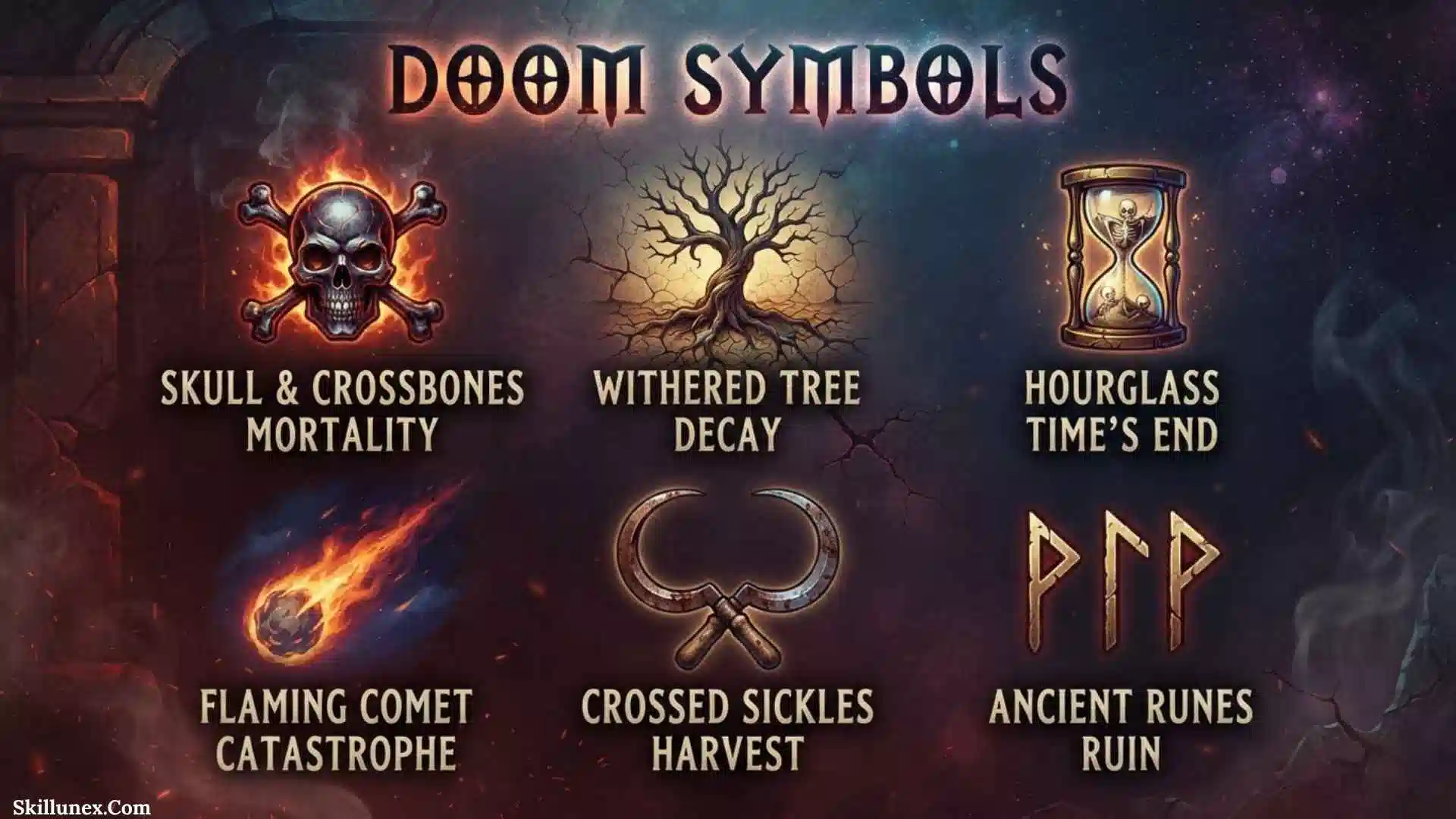
destruction, danger, darkness, fate, curses, or an approaching end. Some have historical roots, while others are fictional designs created for movies, games, books, and digital artwork.
The meaning of a doom symbol is not always as simple as it looks. A skull, for example, can represent death and danger, but it may also symbolize mortality, remembrance, rebellion, or a gothic aesthetic. Similarly, an unfamiliar rune or dark emblem may appear ancient or mysterious while actually being a modern fictional creation.
In this guide, we will explore doom symbols, their meanings, origins, different types, and uses in modern culture. You will also learn how these symbols are used in horror, gaming, fantasy, tattoos, art, and online communities, along with how to distinguish historical symbols from fictional and decorative designs.
What Are Doom Symbols?
Doom symbols are visual signs, characters, images, or emblems associated with ominous concepts such as death, destruction, danger, darkness, fate, curses, chaos, or the end of something.
There is no official collection of symbols known as “doom symbols.” Instead, the phrase is commonly used as a broad description for imagery that creates a sense of danger, darkness, destruction, or impending doom.
These symbols can come from very different sources. Some have historical or cultural origins, while others are entirely fictional.
Historical Doom Symbols
Historical symbols connected with death and mortality have appeared in many cultures. Skulls, bones, funerary imagery, and representations of death have been used to remind people of mortality or communicate ideas about the afterlife.
However, their original meanings should always be considered in context. A symbol associated with death does not necessarily mean evil or destruction.
Fictional Doom Symbols
Modern entertainment has created thousands of fictional symbols associated with curses, dark magic, supernatural forces, villains, and apocalyptic events.
Video games, fantasy novels, movies, comics, and anime frequently use fictional emblems to identify dangerous organizations, magical powers, ancient civilizations, or cursed objects.
Decorative Doom Symbols
Some symbols have no specific historical or religious meaning. They are designed simply to look mysterious, dark, dramatic, or intimidating.
These decorative symbols are especially common in graphic design, tattoos, usernames, social media profiles, album artwork, and gaming communities.
Common Doom Symbols and Their Meanings
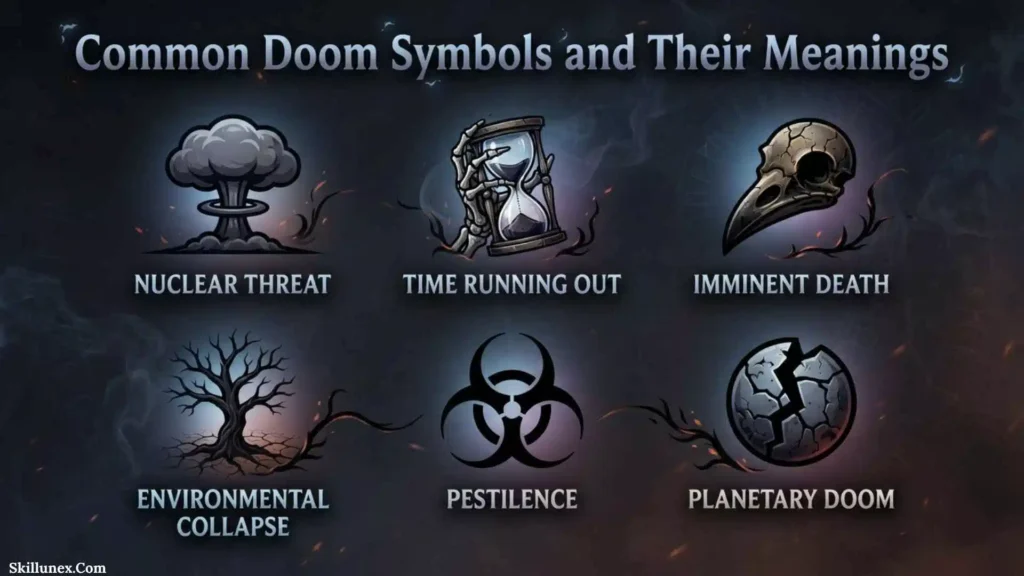
Different symbols can communicate different aspects of doom. Some represent death directly, while others suggest the passage of time, destruction, darkness, or an approaching threat.
Skull
The skull is one of the most recognizable symbols associated with death and mortality.
Because it represents the human body after death, it naturally evokes ideas of mortality and the end of life. In modern culture, however, the skull has developed many additional meanings.
It can represent:
- Death
- Danger
- Mortality
- Rebellion
- Fear
- Strength
- Remembrance
- Gothic aesthetics
The meaning depends heavily on the context. A skull on a chemical warning label has a practical meaning, while a skull in a fantasy illustration may simply establish a dark atmosphere.
Skull and Crossbones
The skull and crossbones is another widely recognized symbol associated with death and danger.
It has been used historically in warning contexts and is also strongly connected with pirate imagery in popular culture.
Today, the symbol can represent poison, hazardous materials, pirates, danger, or a deliberately dark aesthetic.
Hourglass
The hourglass is a powerful symbol of time.
In a doom-themed context, it can suggest that time is running out or that an unavoidable event is approaching.
It may symbolize:
- Mortality
- The passage of time
- An approaching deadline
- Fate
- The temporary nature of life
- An inevitable ending
The hourglass is particularly effective in horror and fantasy because it creates a sense of anticipation.
Grim Reaper
The Grim Reaper is one of the most recognizable personifications of death in Western popular culture.
Usually depicted as a skeletal figure wearing a dark cloak and carrying a scythe, the Grim Reaper represents the arrival or inevitability of death.
In fiction, the character can also symbolize judgment, fate, the unknown, or the boundary between life and death.
Scythe
The scythe is closely associated with the Grim Reaper.
A scythe is historically an agricultural tool used for harvesting crops. Its association with death developed through the metaphor of harvesting human lives.
In modern horror and fantasy, a scythe can therefore symbolize death, destruction, judgment, or an approaching supernatural threat.
Ravens and Crows
Ravens and crows are frequently used in dark artwork and literature.
Their associations with death and mystery have been reinforced by folklore, literature, and their real-world behavior as scavenging birds. However, their symbolism varies between cultures.
In gothic artwork, they commonly create an atmosphere of:
- Mystery
- Death
- Isolation
- Prophecy
- Darkness
- The supernatural
Dark Flames
Black or dark flames are especially common in fantasy, horror, anime-inspired artwork, and video games.
Unlike ordinary fire, which may symbolize warmth, life, energy, or destruction, a black flame often represents something unnatural or supernatural.
Depending on the fictional setting, it can symbolize forbidden power, corruption, dark magic, destruction, or supernatural energy.
Dark Sun
A dark or black sun can create a strong visual impression of an abnormal or threatening world.
Because the sun is traditionally associated with light, life, warmth, and energy, darkening it can symbolize the opposite: darkness, destruction, apocalypse, or the end of an era.
The exact meaning depends on the culture or fictional universe in which the image appears.
Doom Symbols in History and Culture
Symbols associated with death and destruction are not a modern invention. People have used visual imagery to communicate mortality, war, disaster, supernatural beliefs, and the afterlife for thousands of years.
At the same time, it is important not to describe every ancient symbol as a “doom symbol.” Historical symbols often had meanings that were much more complex than modern interpretations suggest.
Death and Mortality
Many cultures created imagery to represent death and the transition from life to whatever was believed to follow it.
Bones, skeletal figures, funerary objects, tomb imagery, and representations of death could communicate ideas about mortality and the afterlife.
These symbols were not always intended to frighten people. In some contexts, they encouraged reflection on the temporary nature of life.
Memento Mori
One important tradition is memento mori, a Latin expression generally understood as a reminder of mortality.
Memento mori artwork often includes objects such as skulls, bones, extinguished candles, flowers, or hourglasses.
The purpose was often philosophical rather than simply frightening. The imagery reminded viewers that life is temporary and encouraged them to reflect on how they used their time.
This tradition strongly influenced later Western representations of death and dark symbolism.
Doom Symbols in Horror and Gothic Culture
Horror relies heavily on symbols because symbols can create fear before an actual threat appears.
A mysterious mark on a wall, a recurring emblem, a skull, or a strange geometric design can make an audience feel that something is wrong.
Symbolism in Horror Stories
Authors and filmmakers often use symbols as clues or warnings.
A recurring symbol might represent:
- A curse
- A secret society
- A supernatural entity
- An ancient ritual
- A dangerous location
- An approaching catastrophe
The audience may not understand the symbol immediately. Its meaning can become clear as the story develops.
Gothic Aesthetics
Gothic culture frequently uses imagery associated with mortality, darkness, ruins, skeletons, ravens, candles, crosses, and other dramatic motifs.
In this context, dark symbols are not necessarily intended to represent literal evil. They can simply express a particular artistic style centered on mystery, melancholy, beauty, mortality, and darkness.
Doom Symbols in Video Games and Fantasy
Video games and fantasy fiction have dramatically expanded the use of doom symbols.
Creators can invent entire symbolic languages for fictional civilizations, magical systems, secret organizations, and supernatural forces.
Fictional Runes and Emblems
A fictional rune may represent a curse, spell, ancient god, magical order, or forbidden power.
Because these symbols are created specifically for a fictional setting, their meanings depend on the story or game rather than on historical tradition.
World-Building Through Symbols
Symbols are particularly useful for world-building.
A fictional kingdom might have its own emblem. A dark organization might use a specific mark. A cursed weapon might carry a unique symbol.
When the same symbol appears repeatedly, players and readers begin to recognize it without needing a lengthy explanation.
This makes visual symbolism an efficient storytelling technique.
Doom Symbols in Art, Music, and Fashion
Doom symbolism is also common outside traditional storytelling.
Artists and designers often use dark imagery because it creates an immediate emotional response and gives their work a recognizable visual identity.
Music and Album Artwork
Dark music genres frequently use skulls, skeletons, demons, dark landscapes, occult-inspired designs, and apocalyptic imagery.
These visuals can communicate the emotional atmosphere of the music before someone even hears it.
Clothing and Fashion
Skulls, dark symbols, gothic imagery, and fictional emblems are widely used in alternative fashion.
In many cases, wearing such imagery is an expression of personal style rather than an indication of a particular religious or spiritual belief.
Tattoos
Doom-inspired tattoo designs often include skulls, hourglasses, ravens, Grim Reaper figures, dark flames, and fictional symbols.
Before getting an unfamiliar symbol permanently tattooed, it is wise to research its history and associations. Some designs that appear decorative can have specific cultural, religious, or political meanings.
Doom Symbols and Unicode Characters
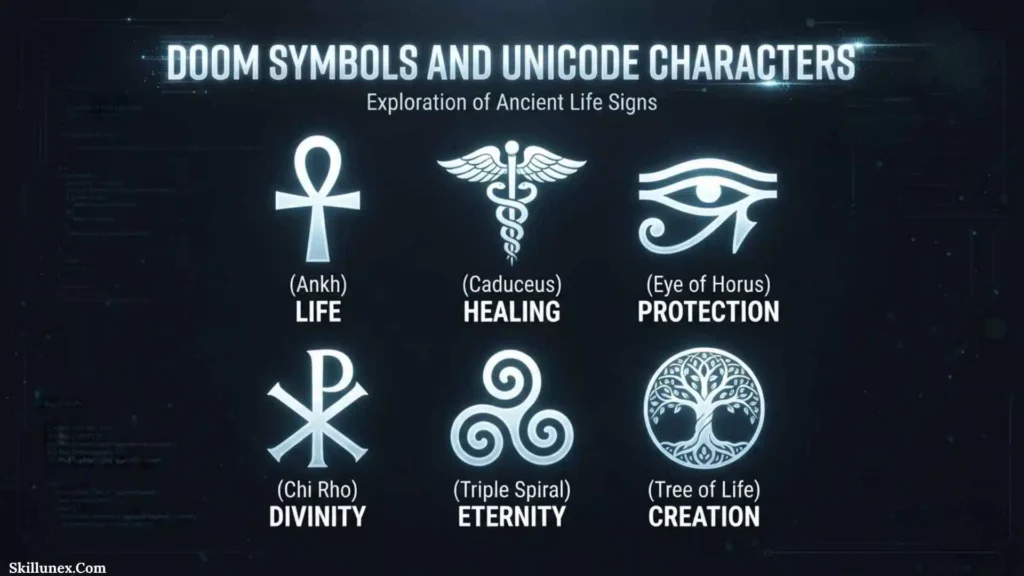
The phrase “doom symbols” is sometimes used online to refer to unusual Unicode characters that create a dark or mysterious appearance.
Unicode includes thousands of characters from many writing systems and symbolic categories.
Some may visually resemble:
- Ancient symbols
- Runes
- Crosses
- Weapons
- Stars
- Celestial objects
- Geometric shapes
- Warning signs
However, a symbol’s appearance does not necessarily tell you its actual meaning.
A Unicode character that looks ominous may simply be a mathematical, astronomical, linguistic, or decorative character.
This distinction is particularly important when using unusual symbols in usernames, social media bios, websites, or gaming profiles.
Doom Symbols vs. Occult Symbols
Doom symbols and occult symbols are related in some contexts, but they are not the same thing.
The term doom symbols is broad and usually describes imagery associated with darkness, death, destruction, danger, or an ominous atmosphere.
Occult symbols are generally associated with esoteric traditions, mysticism, magic, or systems of hidden knowledge.
Some symbols may overlap between the two categories, but many do not.
For example, a skull can function as a doom symbol without having an occult meaning. Likewise, a fictional rune in a fantasy game may look occult-inspired without being connected to a real-world occult tradition.
Doom Symbols vs. Warning Symbols
Another important distinction is between doom symbols and official warning symbols.
Warning symbols are created to communicate practical safety information. Their purpose is to alert people to a specific hazard.
Doom symbols are generally associated with art, storytelling, culture, aesthetics, or fictional worlds.
The skull and crossbones demonstrate how the same image can have different functions. On a hazardous substance label, it communicates a real safety warning. On a fictional poster, it may simply create a dramatic or frightening appearance.
Why Are Doom Symbols So Popular?
Doom symbols remain popular because they combine visual simplicity with powerful emotional associations.
They Create Mystery
An unfamiliar symbol makes people curious. People naturally want to know what a mysterious mark represents.
They Communicate Emotion Quickly
A skull or dark emblem can communicate danger or mortality without requiring an explanation.
They Work Well in Visual Design
Strong shapes, silhouettes, geometric patterns, and high-contrast imagery make doom symbols visually memorable.
They Support Storytelling
Fictional symbols can reveal information about characters, organizations, worlds, and threats.
They Fit Alternative Aesthetics
Gothic, horror, dark fantasy, metal, industrial, and related styles naturally use imagery associated with death and darkness.
Are Doom Symbols Always Negative?
No.
A dark-looking symbol does not automatically represent something evil or negative.
A skull may represent mortality or remembrance. A raven may represent mystery rather than death. An hourglass may simply represent time.
Meaning depends on the context in which the symbol appears.
This is especially important when interpreting symbols from different cultures. The same object can have very different meanings across societies.
How to Identify an Unknown Doom Symbol
If you discover an unfamiliar symbol and want to understand it, avoid relying solely on its appearance.
Check Where the Symbol Came From
A symbol from a video game may be fictional. A symbol from a historical document may have a completely different origin.
Look for Surrounding Symbols
Other images can provide clues about the intended meaning.
For example, a skull combined with crossed weapons may communicate something different from a skull surrounded by flowers.
Research the Original Source
If the symbol comes from a game, movie, book, or artwork, the creator’s original material is usually more useful than an unsourced list on social media.
Verify Historical Claims
Online symbol collections sometimes incorrectly describe modern designs as ancient, magical, Viking, Celtic, or occult.
A symbol being widely shared online does not prove that its claimed history is accurate.
How to Use Doom Symbols Responsibly
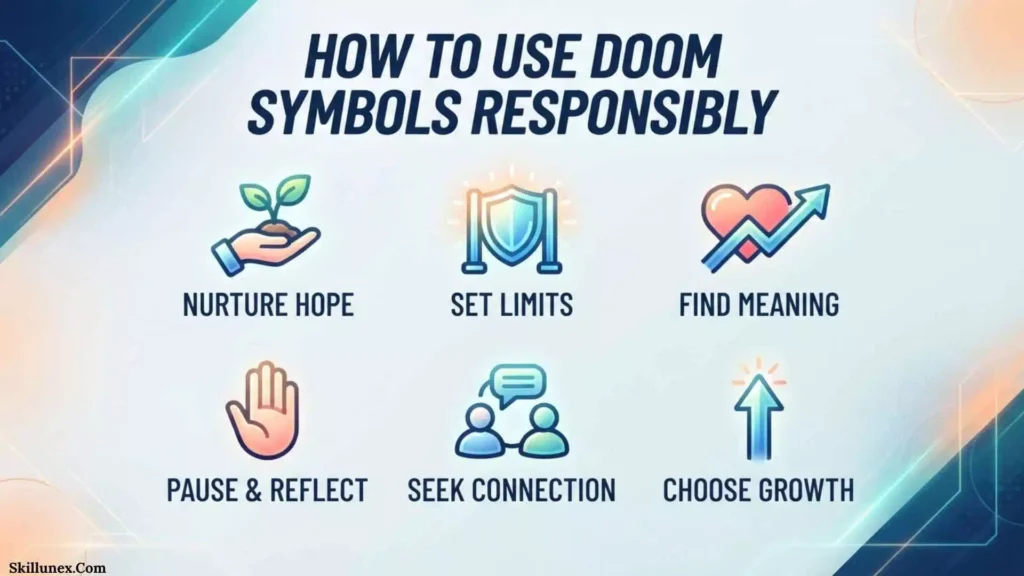
Dark symbolism can be used creatively, but context matters.
If you are designing a tattoo, logo, game character, website, or piece of artwork, research unfamiliar symbols before using them.
Consider:
- The symbol’s historical origin
- Cultural associations
- Religious significance
- Political associations
- Whether it has extremist associations
- Whether the intended audience might interpret it differently
This is particularly important when using symbols from cultures or traditions you are not familiar with.
Frequently Asked Questions About Doom Symbols
What are doom symbols?
Doom symbols are images, characters, signs, or emblems associated with concepts such as death, destruction, danger, darkness, fate, curses, apocalypse, or an ominous future. The term is broad and does not refer to one official set of symbols.
What is the most common doom symbol?
The skull is one of the most recognizable symbols associated with death, danger, and mortality. Other common examples include skull and crossbones, hourglasses, Grim Reaper imagery, scythes, ravens, and fictional dark emblems.
What symbol represents impending doom?
There is no universal symbol for impending doom. In fiction and artwork, creators commonly use hourglasses, skulls, eclipses, dark suns, broken symbols, ravens, and fictional warning marks to suggest an approaching disaster.
Are doom symbols real?
Some doom symbols have historical or cultural origins, while others are modern artistic creations. Fictional doom symbols are especially common in video games, fantasy stories, movies, and horror.
Are doom symbols connected to the occult?
Not necessarily. Some dark symbols overlap with occult imagery, but many doom symbols are simply associated with death, danger, horror, fantasy, or gothic aesthetics.
What does a skull symbolize?
A skull commonly represents death and mortality, but it can also symbolize danger, remembrance, rebellion, transformation, or a gothic aesthetic depending on the context.
What does an hourglass symbolize in dark art?
An hourglass can represent the passage of time, mortality, an approaching deadline, or the idea that time is running out. In horror and dark fantasy, it can create a sense of impending fate.
Can doom symbols be used for usernames?
Yes. People often use unusual Unicode characters, fictional-looking marks, and dark decorative symbols in usernames and online profiles. However, users should check the actual meaning of unfamiliar characters before using them.
Are all doom symbols evil?
No. A symbol associated with death or darkness does not automatically represent evil. Its meaning depends on its origin, cultural context, and intended use.
Why are doom symbols popular in gaming?
Games use symbols as efficient visual storytelling tools. A recurring emblem can represent a faction, curse, enemy, magical ability, artifact, or upcoming threat without requiring extensive dialogue or explanation.
Conclusion
Doom symbols are much broader than a simple collection of dark-looking characters. They include historical imagery associated with mortality, fictional emblems created for fantasy and horror, warning imagery, gothic designs, and modern digital symbols.
Skulls, skull and crossbones, hourglasses, Grim Reaper figures, scythes, ravens, dark flames, and fictional runes are among the most recognizable examples. However, their meanings are not always fixed. A symbol can represent death in one context, rebellion in another, and nothing more than an aesthetic choice somewhere else.
The best way to understand doom symbols is to consider their origin, context, and intended purpose. Whether they appear in ancient artwork, a horror movie, a video game, a tattoo, or a social media profile, these symbols continue to demonstrate how powerful a simple visual image can be.

Caleb Thornton
I’m Caleb Thornton, a researcher and content writer who loves exploring fascinating subjects and sharing what I learn with readers. My interests include natural places, lakes, symbols, culture, history, and the stories that make ordinary topics more meaningful.
When I write an article, I try to go beyond a basic answer. I look for useful facts, relevant context, and details that can help readers understand the subject more completely.
My purpose is simple: I want every article I contribute to provide genuine value, satisfy the reader’s curiosity, and make discovering new information enjoyable.
## Books by Caleb Thornton
* Symbols & Meanings: Exploring the Signs We See Every Day
* Lakes of the World: Nature, Beauty & Exploration