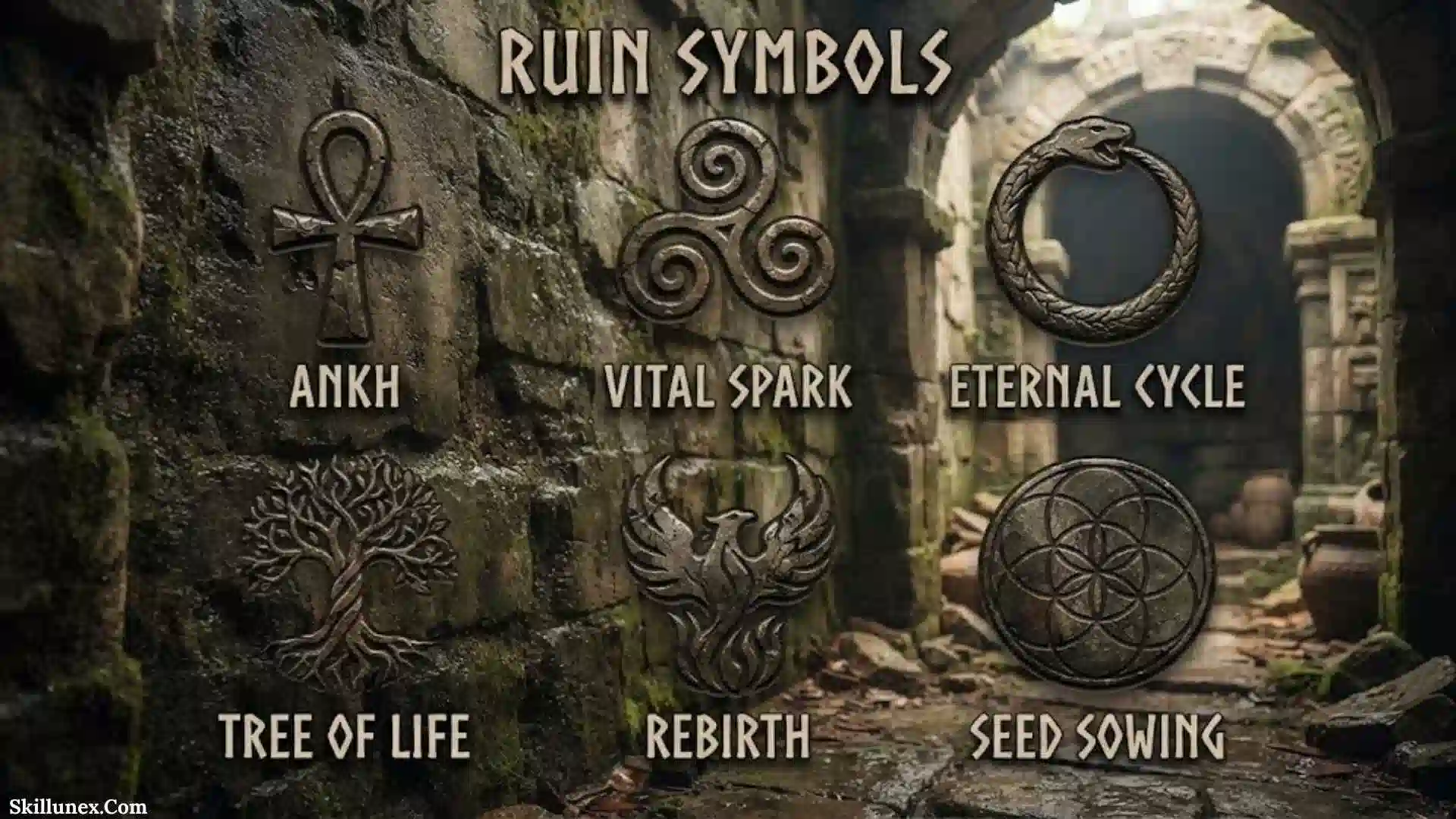
Have you ever looked at an abandoned building, a broken statue, or an ancient wall and felt that it was telling you a story? Ruin symbols can carry powerful meanings because they show you something that was once complete but has been changed by time, destruction, neglect, or nature. A ruin can make you think about the past, but it can also make you think about your own life, the things you have lost, and the things you can rebuild.
When I explore the meaning of ruins, I find that they are rarely only symbols of destruction. You can see a ruined castle as a reminder of fallen power, a broken column as a symbol of mortality, or an overgrown building as a sign of renewal. In this guide, I’ll explain the most important ruin symbols and their meanings, including their symbolism in art, literature, dreams, tattoos, history, mythology, and everyday life.
What Do Ruin Symbols Mean?
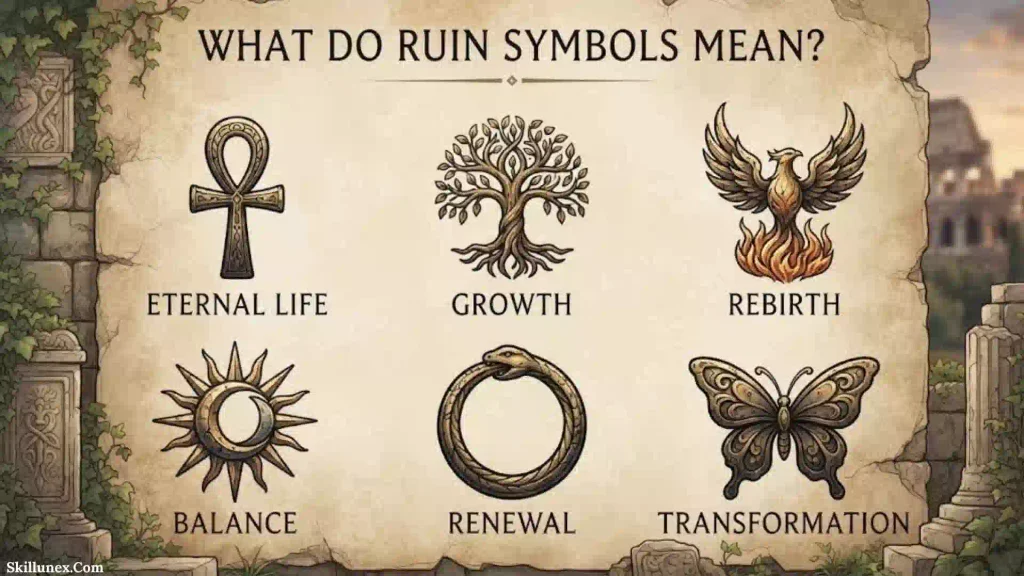
Ruin symbols generally represent something that has been damaged, abandoned, destroyed, or changed by time. However, the meaning does not stop there.
When you see a ruin, you may interpret it as a symbol of:
- Time and impermanence
- Loss and destruction
- Abandonment
- Fallen power
- Mortality
- Memory
- Forgotten history
- Failure
- Change
- Survival
- Resilience
- Renewal
- Rebirth
- Nature’s strength
The meaning can change depending on what you see around the ruin. If you see a dark and completely abandoned building, the symbolism may feel lonely or tragic. If you see flowers growing through the same building, you may see hope and renewal.
So, when you interpret ruin symbols, I recommend that you look at the entire image rather than one object alone.
Why Ruins Have Symbolic Meaning
A ruin creates a visual connection between the past and the present. You can look at a broken wall and imagine the complete building that once stood there.
That contrast ruins their emotional power.
A ruin can tell you:
- Something existed.
- Something changed.
- Something was lost.
- Something survived.
- Something new may eventually grow.
This is why ruins appear so often in paintings, poems, novels, movies, games, tattoos, and photography.
Ruins Do Not Always Mean Destruction
You may initially think that a ruin must represent something negative. However, that is only one interpretation.
A ruin can represent survival because something remains even after destruction.
It can also represent renewal when nature begins growing over the remains.
For me, this is one of the most interesting parts of ruin symbolism: the same broken structure can represent both an ending and a beginning.
The Most Common Ruin Symbols And Their Meanings
Different types of ruins communicate different ideas. If you learn these visual differences, you can understand ruin symbolism much more easily.
Broken Columns
A broken column is a classic symbol of collapse and mortality.
Columns traditionally support buildings, so when one is broken, the image can suggest that something once strong has fallen.
You may see a broken column used to represent:
- Fallen power
- Lost greatness
- Mortality
- Collapse
- The end of an era
- Broken ambitions
If you see a broken column on a grave monument, it may also communicate the idea of a life cut short.
Crumbling Walls
Crumbling walls usually represent the slow effects of time.
Unlike a building destroyed suddenly, a crumbling wall suggests gradual deterioration. When you see cracks, missing stones, moss, and weathered surfaces, you can read them as evidence that time has transformed the structure.
This symbolism can represent:
- Aging
- Impermanence
- Neglect
- Forgotten history
- Gradual change
Fallen Statues
A fallen statue can represent the loss of authority, fame, or status.
Imagine a statue that once stood proudly in a public square but now lies broken on the ground. You immediately understand that something has changed.
The fallen statue can symbolize:
- The fall of a ruler
- Lost reputation
- Political or cultural change
- The temporary nature of fame
- The collapse of an old order
If you see a recognizable figure lying among ruins, the symbolism becomes even stronger because you can compare the person’s former status with their present condition.
Abandoned Houses
An abandoned house can have a more personal meaning than an ancient temple or castle.
You may associate it with:
- Loneliness
- Family memories
- Forgotten lives
- Childhood
- Abandonment
- Lost dreams
- The passage of time
When I see an abandoned house in symbolic artwork, I often think about the people who once made the space feel alive. You can experience the same contrast between a home that once contained life and a structure that now sits empty.
Overgrown Ruins
An overgrown ruin is one of the most positive forms of ruin symbolism.
When trees, flowers, vines, moss, or grass grow over broken architecture, you can see nature creating new life around what humans abandoned.
This can symbolize:
- Renewal
- Rebirth
- Resilience
- Natural cycles
- Growth after destruction
- Life continuing after loss
The ruin remains, but it is no longer the whole story.
Ruins As A Symbol Of Time
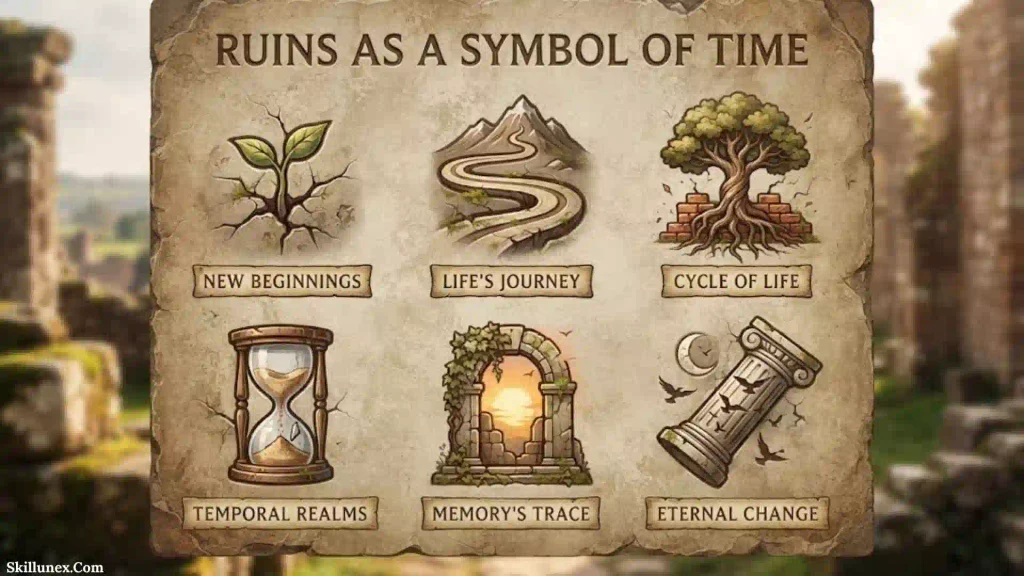
One of the strongest meanings of ruins is the passage of time.
When you look at an ancient structure, you can see physical evidence that generations have come and gone. The stones may have survived, but their original world has changed.
Ruins can remind you that:
- Buildings age.
- Civilizations change.
- Empires fall.
- People disappear.
- Memories evolve.
- Nothing material remains unchanged forever.
This is why ruins are often connected with the philosophical idea of impermanence.
The Passage Of Time In Ruin Imagery
Artists can emphasize time through visual details.
You may notice:
- Cracked stone
- Faded inscriptions
- Broken roofs
- Moss
- Vines
- Weathered statues
- Missing windows
- Trees growing through buildings
Each detail tells you that the structure has experienced time rather than simply being damaged yesterday.
Ruins And Impermanence
Impermanence means that things change rather than remaining permanently fixed.
A magnificent palace can eventually become a ruin. A powerful empire can disappear. A famous person’s monument can become forgotten.
When you see a ruin, you can therefore use it as a reminder to think about what lasts and what eventually changes.
Ruins As Symbols Of Loss And Grief
Ruins can represent loss because they show you what remains after something has disappeared.
A ruined building may make you think about:
- Lost homes
- Lost communities
- Lost relationships
- Lost civilizations
- Lost opportunities
- Forgotten people
This symbolism becomes especially strong when a ruin is shown as empty.
Empty Ruins
An empty ruin can create a feeling of absence.
You can imagine the voices, activities, and lives that once occupied the space. Now only the structure remains.
That contrast can make a ruin feel almost like a physical representation of grief.
Ruins And Forgotten Memories
A ruin can also represent memories that have become distant.
The building survives, but the details of the people who used it may have disappeared.
This makes ruins powerful symbols of memory and forgetting at the same time.
Ruins As Symbols Of Fallen Power
A ruined palace, fortress, castle, or government building can represent the fall of power.
When you see a magnificent structure reduced to broken stones, you are reminded that authority is not necessarily permanent.
This symbolism has appeared in literature for centuries. Percy Bysshe Shelley’s poem “Ozymandias” is a famous example in which the remains of a powerful ruler become a meditation on the temporary nature of power and ambition.
Ruined Castles
A ruined castle can symbolize:
- Fallen kingdoms
- Lost authority
- Failed ambitions
- Historical change
- The end of an era
- Forgotten rulers
You may also associate castle ruins with mystery and legend, which is why they appear frequently in fantasy and Gothic storytelling.
Ruined Palaces
A ruined palace can create an even stronger contrast between former wealth and present decay.
The larger and more impressive the original structure appears, the more dramatic its ruin can feel.
This can communicate the idea that wealth and status do not guarantee permanence.
Ruins As A Symbol Of Mortality
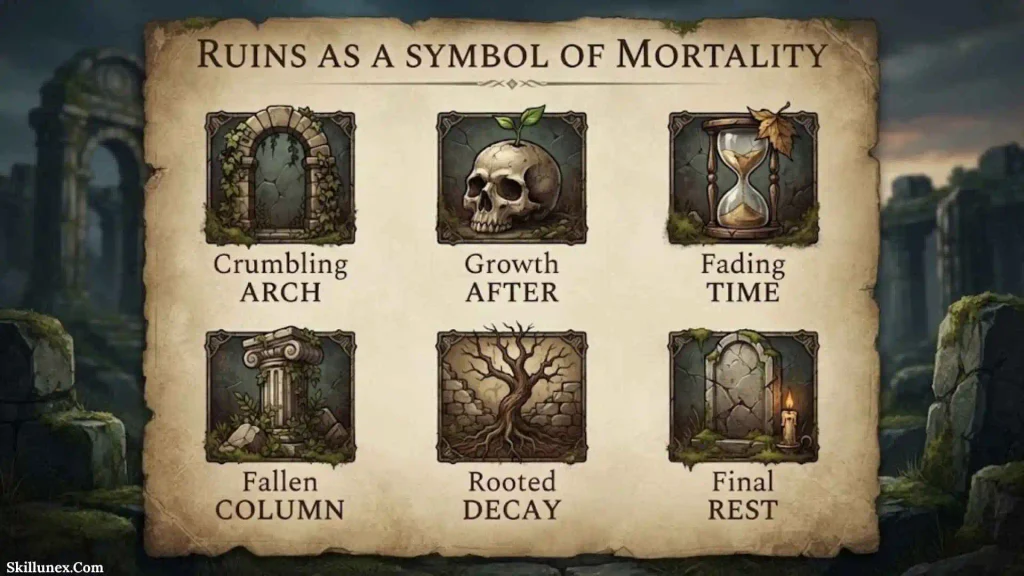
A ruin can function as a metaphor for human mortality.
Just as a building can be constructed, age, weaken, and eventually collapse, human life also has a beginning, a period of growth, and an ending.
You may therefore see ruins used to represent:
- Aging
- Death
- Human limitations
- The temporary nature of life
- What remains after someone is gone
Ruins And Human Life
The comparison between people and buildings is especially powerful because both can leave traces behind.
A person may leave:
- Memories
- Stories
- Art
- Family
- Monuments
- Ideas
A building may leave:
- Walls
- Foundations
- Objects
- Inscriptions
- Architecture
In both cases, something can remain after the original life has changed.
Ruins As Symbols Of Memory
Ruins can preserve history even when the original people and culture are gone.
When you visit an ancient ruin, you are seeing physical evidence of people who lived before you.
That makes ruins symbols of:
- History
- Cultural memory
- Ancestry
- Heritage
- Forgotten stories
- Human achievement
Ruins As Historical Evidence
A ruin can tell you about architecture, technology, religion, politics, and everyday life.
Even a broken wall may reveal something about the people who constructed it.
This is why ruins are not simply symbols of decay. They can also be records of human civilization.
Remembering What Was Lost
Sometimes a ruin exists because people deliberately preserve it.
In that situation, the ruin becomes a reminder rather than simply an abandoned structure.
You can look at it and remember what happened there, which gives the ruin a memorial quality.
Ruins As Symbols Of Resilience
Here is a meaning that you may not expect: ruins can symbolize resilience.
A structure may survive:
- War
- Earthquakes
- Fire
- Weather
- Neglect
- Abandonment
- Political change
Even if only part of the structure remains, its survival can be meaningful.
The Strength Of What Remains
A ruin does not have to be complete to have value.
If a wall remains after a city has been destroyed, that wall can become evidence of survival.
This can create a powerful personal metaphor for you: you can be changed without being completely destroyed.
Ruins And Recovery
When ruins are repaired or preserved, they can represent another stage of resilience.
The story becomes:
destruction → survival → preservation → renewal
That makes ruin symbolism useful when discussing recovery from difficult experiences.
Ruins And Rebirth
Ruins can also represent new beginnings.
You may see a ruined building surrounded by flowers or trees. The structure is damaged, but life continues around it.
This can symbolize:
- Rebirth
- Transformation
- Growth
- New opportunities
- Healing
- A new chapter
Nature Reclaiming Ruins
Nature is especially important in this symbolism.
When plants grow through concrete or stone, you can see that nature has continued despite human decline.
This creates a strong contrast:
Human structures decay, but life continues.
That is why photographs of abandoned buildings covered in greenery can feel peaceful rather than frightening.
Ruins In Different Historical Contexts
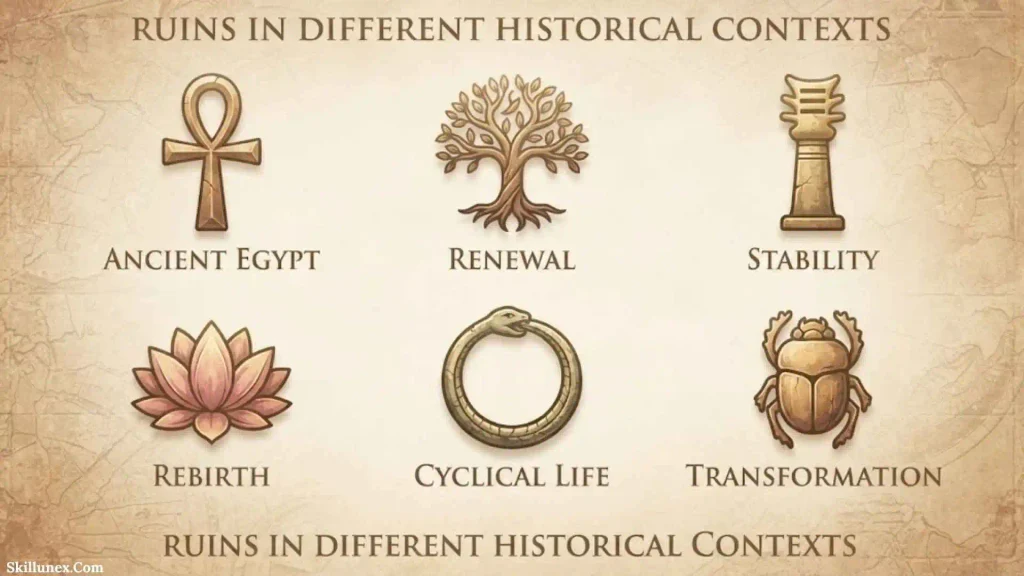
Not every ruin communicates the same message. The type of structure and the reason it became a ruin can change its symbolism.
Ancient Ruins
Ancient ruins often represent:
- Lost civilizations
- Human achievement
- Historical memory
- The rise and fall of empires
- The passage of thousands of years
When you look at ancient temples, amphitheaters, or cities, you can often see both human creativity and impermanence.
Medieval Ruins
Medieval castles, monasteries, churches, and fortresses can symbolize:
- Lost kingdoms
- Religion
- Conflict
- Romance
- Legends
- Historical change
You may also encounter these ruins in Gothic and fantasy settings.
Industrial Ruins
Old factories and warehouses represent a more recent kind of historical change.
They can symbolize:
- Economic decline
- Technological change
- Lost industries
- Unemployment
- Community change
- The end of an industrial era
An abandoned factory can therefore tell you something about modern society that an ancient temple cannot.
War Ruins
War ruins carry particularly serious meanings.
They may represent:
- Destruction
- Death
- Displacement
- Trauma
- Historical memory
- The consequences of conflict
When you encounter war ruins, the symbolism should not be reduced to aesthetic beauty. Such places may represent real suffering experienced by real communities.
Ruins In Art
Artists have long used ruins to communicate complex emotions.
A ruin can make a painting feel:
- Melancholic
- Peaceful
- Mysterious
- Romantic
- Tragic
- Hopeful
- Reflective
Romantic Ruin Symbolism
During the Romantic period, European artists frequently used ruins as subjects for reflecting on nature, history, mortality, and the limits of human power.
If you look at a Romantic ruin painting, you may notice that the artist is not simply documenting a broken building. The ruin may be used to create an emotional experience.
Ruins And Nature In Art
Artists often place ruins next to:
- Trees
- Mountains
- Rivers
- Sunsets
- Clouds
- Flowers
The contrast allows you to compare human construction with the larger natural world.
A tiny human ruin surrounded by enormous mountains can make you feel how temporary human structures are.
Ruins In Literature
Ruins are powerful literary symbols because writers can use them to represent much larger ideas.
Ruins And Fallen Civilizations
A ruined city can represent the collapse of an entire civilization.
The physical destruction becomes a metaphor for social, political, or moral decline.
Ruins And Broken Relationships
A writer can also use a ruined house or building to represent a broken relationship.
The structure becomes a metaphor:
- Once complete
- Once inhabited
- Gradually damaged
- No longer functioning as before
This allows you to understand emotional loss through a physical image.
Ruins And Ozymandias
Shelley’s Ozymandias is one of the best-known literary examples of ruin symbolism.
The ruined statue of a once-powerful ruler highlights the contrast between ambitious claims of permanence and the reality of time.
The lesson is not simply that the statue broke. The ruin demonstrates how even enormous human ambitions can eventually become fragments.
Ruin Symbols In Dreams
If you searched for ruin symbols because you dreamed about ruins, you should remember that dream symbolism is personal.
There is no single scientifically established meaning that applies to every person’s dream.
Still, ruins can commonly be associated with ideas such as:
- The past
- Change
- Loss
- Abandonment
- Forgotten memories
- Endings
- Rebuilding
- Personal transformation
Dreaming Of Exploring Ruins
If you are exploring ruins in a dream, you might connect the image with discovering something from your past.
Ask yourself:
- What was I looking for?
- Did I feel afraid?
- Did I feel curious?
- Was the ruin familiar?
- Did I discover anything?
Your emotions can be more informative than the ruin itself.
Dreaming Of A Collapsing Building
A collapsing building may represent a sense that something stable in your life is changing.
However, you should not automatically assume that the dream predicts something negative.
Think about your current circumstances and what the building represented to you personally.
Finding Something Valuable In Ruins
Finding something valuable inside a ruin can be interpreted as a metaphor for discovering something worthwhile in a difficult or forgotten part of your past.
For you, this might represent:
- A lesson
- A memory
- A talent
- A relationship
- A new opportunity
The symbolism depends heavily on your personal experience.
Ruin Symbols In Spiritual And Philosophical Contexts
Ruins can encourage you to think about impermanence, humility, mortality, and transformation.
When you see a structure that once seemed permanent but now stands broken, you may naturally reflect on how temporary material achievements can be.
Impermanence
Ruins provide a physical reminder that change is unavoidable.
You can build something beautiful, but time will eventually affect it.
Humility
A ruined monument can remind you that wealth, fame, and power do not necessarily last forever.
This is why ruins can carry a message of humility.
Transformation
At the same time, destruction does not necessarily mean the end of everything.
A ruin can become:
- A historical site
- A museum
- A memorial
- A tourist destination
- A work of art
- A place where nature grows
So, you can interpret transformation as another important meaning of ruin symbolism.
Ruins In Mythology And Folklore
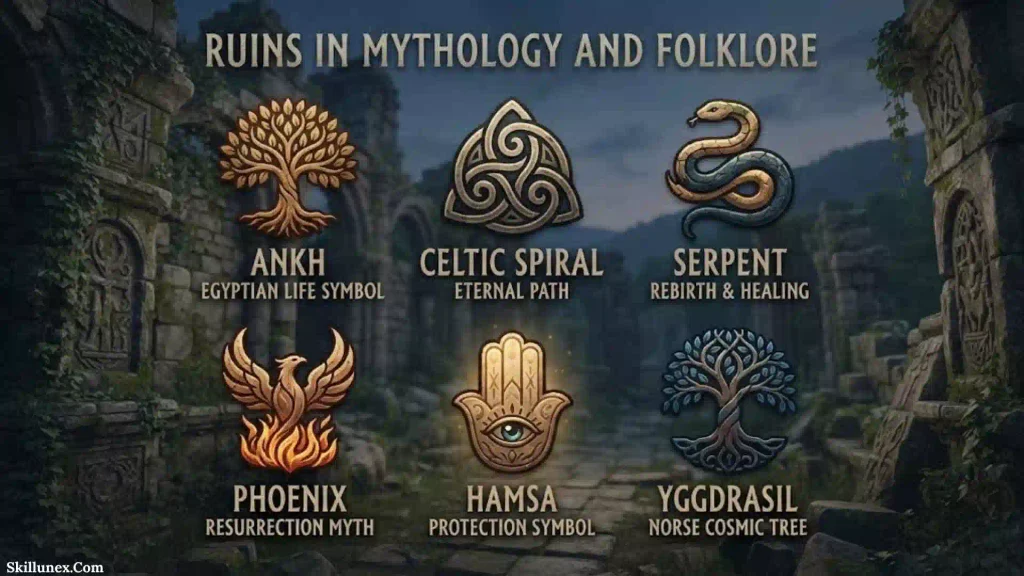
Ruins frequently appear in legends about lost cities, ancient kingdoms, hidden treasures, curses, and forgotten civilizations.
Lost Cities
A ruined city can symbolize a civilization that disappeared from ordinary memory.
This creates a sense of mystery because you can see evidence that something existed without knowing every detail about it.
Haunted Ruins
In folklore and horror stories, abandoned ruins are often associated with ghosts, curses, and supernatural events.
The reason is easy to understand: an empty structure already creates a sense of mystery.
When you add darkness, legends, and unexplained events, the ruin becomes a perfect setting for supernatural storytelling.
Hidden Knowledge
Ruins can also symbolize forgotten knowledge.
A character entering an ancient temple might discover:
- An inscription
- A forgotten language
- An ancient artifact
- A lost story
- A secret passage
This makes ruins powerful symbols of discovery.
Ruin Symbols In Tattoos
If you are considering a ruined tattoo, you can give the design a deeply personal meaning.
A ruined castle may represent a chapter of your life that has ended. An overgrown temple may symbolize healing and new growth. A broken column may represent mortality or a major turning point.
Popular Ruin Tattoo Ideas
You might consider:
- Ruined castle
- Broken column
- Ancient temple
- Abandoned house
- Fallen statue
- Overgrown building
- Broken arch
- Ruined city
- Crumbling monument
Adding Other Symbols
You can change the meaning by adding another image.
For example:
Ruin + flowers → growth after loss
Ruin + tree → resilience and renewal
Ruin + sunset → ending or transition
Ruin + sunrise → new beginning
Ruin + birds → freedom and release
Ruin + moon → mystery and reflection
This gives you many ways to create a tattoo that reflects your own story.
Positive And Negative Meanings Of Ruins
Ruin symbolism is especially interesting because it can communicate opposite ideas.
Positive Meanings
You can interpret ruins as symbols of:
- Survival
- Resilience
- Growth
- Renewal
- Transformation
- Wisdom
- History
- Memory
- Acceptance
- New beginnings
Negative Meanings
Ruins can also represent:
- Destruction
- Loss
- Failure
- Death
- Abandonment
- Loneliness
- Decline
- Forgotten memories
- Fallen power
The surrounding imagery helps you determine which meaning is strongest.
A dark, empty ruin may emphasize loss, while a sunlit ruin covered in flowers may emphasize renewal.
How To Interpret A Ruin Symbol
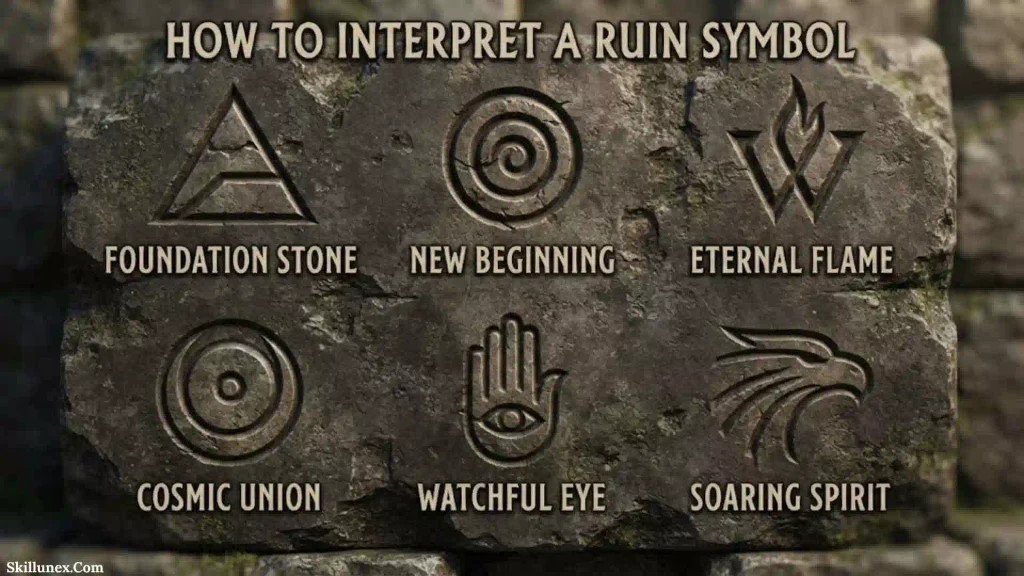
If you want to understand a ruin image yourself, I recommend following a few simple steps.
Look At The Structure
First, ask what kind of structure you are looking at.
Is it:
- A house?
- Castle?
- Temple?
- Factory?
- Monument?
- Church?
- Bridge?
The original purpose can tell you what the ruin once represented.
Look At The Condition
Next, examine how damaged it is.
A slightly weathered structure can symbolize aging, while a completely collapsed building can suggest destruction or finality.
Look At Nature
If plants are growing over the ruin, you can consider renewal and resilience.
If the landscape is completely barren, the symbolism may feel more connected with loss or isolation.
Look At The Light And Weather
Dark clouds, rain, and shadows can create a more tragic interpretation.
Sunlight, flowers, and clear skies can make the same ruin feel peaceful or hopeful.
Look At The People
A person standing alone among ruins may represent loneliness or reflection.
A group exploring ruins may represent discovery and historical curiosity.
Look At The Other Symbols
Always consider the complete composition.
A ruin with a skull has a different meaning from a ruin with flowers.
A ruined castle with a crown may suggest fallen power.
A ruined house with family photographs may suggest memory and loss.
Ruin Symbols And Their Meanings At A Glance
| Ruin Symbol | Common Meaning | Emotional Theme |
| Broken Column | Fallen power, mortality | Loss |
| Crumbling Wall | Passage of time | Impermanence |
| Fallen Statue | Lost authority | Decline |
| Abandoned House | Forgotten lives | Loneliness |
| Ruined Castle | Fallen kingdoms | History |
| Overgrown Ruin | Renewal and resilience | Hope |
| Ancient Temple | Lost civilization | Mystery |
| War Ruins | Destruction and trauma | Grief |
| Industrial Ruins | Social and economic change | Transformation |
| Broken Arch | Collapse and transition | Change |
| Ruined Bridge | Separation or broken connection | Loss |
| Collapsed Tower | Failed ambition | Decline |
| Ruined Garden | Lost beauty and renewal | Transformation |
| Ancient Stones | History and endurance | Memory |
| Fallen Monument | Lost fame or power | Mortality |
These are common symbolic associations rather than fixed rules. When you interpret a specific ruin, its historical and cultural context matters.
Ruins And The Idea Of Rebuilding
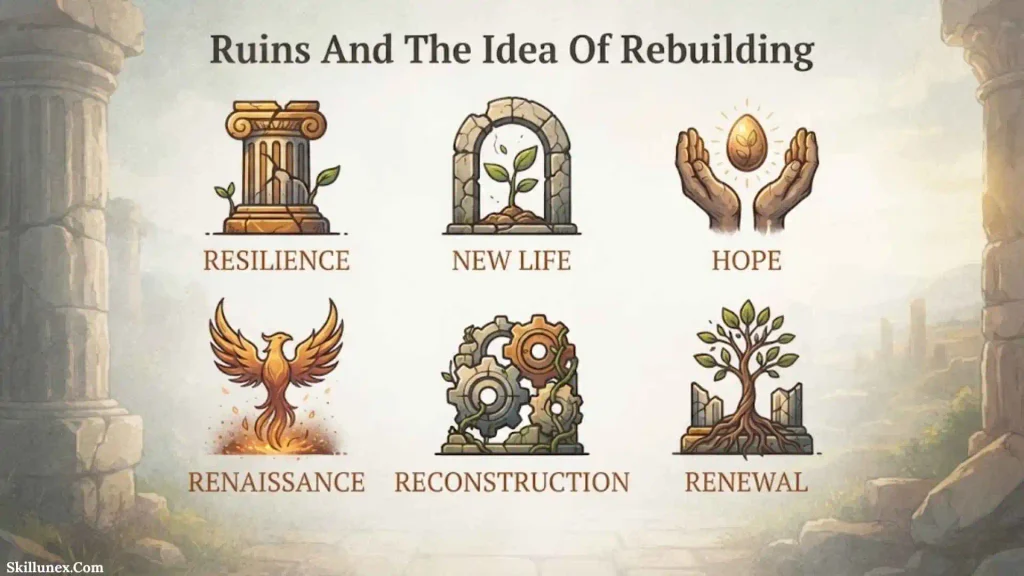
One of the most meaningful ways to understand ruins is through rebuilding.
A ruin tells you what was lost, but rebuilding tells you what can happen afterward.
You can think about the process as:
Complete → Damaged → Ruined → Remembered → Rebuilt → Transformed
This is why ruins can be powerful metaphors for personal growth.
If you have experienced failure, heartbreak, loss, or major change, a ruin can represent the part of your story that was damaged without suggesting that your story has ended.
What A Ruin Can Teach You
A ruin can remind you that:
- You can change without disappearing.
- The past can remain meaningful.
- Broken things can still have value.
- Growth can happen after loss.
- A new chapter can emerge from an old one.
For me, this is where ruin symbolism becomes more than an artistic concept. You can use it to think about change in a very human way.
Frequently Asked Questions About Ruin Symbols
What Do Ruin Symbols Represent?
Ruin symbols commonly represent time, impermanence, loss, destruction, memory, fallen power, mortality, survival, resilience, and renewal. The meaning changes according to the context.
What Does A Ruined Building Symbolize?
A ruined building can symbolize abandonment, loss, change, aging, or destruction. You can also interpret it as evidence that something survived despite being damaged.
What Does An Overgrown Ruin Symbolize?
An overgrown ruin commonly represents renewal, rebirth, resilience, and nature reclaiming human spaces. If you see flowers and trees growing through a ruin, the symbolism often feels more hopeful.
What Does A Broken Column Symbolize?
A broken column can represent fallen power, mortality, collapse, lost greatness, or the end of an era.
What Does A Ruined Castle Symbolize?
A ruined castle can symbolize fallen kingdoms, lost power, failed ambition, historical change, and the temporary nature of authority.
What Do Ruins Symbolize In Dreams?
Ruins in dreams may be associated with the past, change, loss, abandonment, forgotten memories, endings, or rebuilding. Your personal emotions and circumstances are important when interpreting such dreams.
What Does A Ruin Tattoo Symbolize?
A ruin tattoo can represent personal transformation, survival, loss, memory, the end of a chapter, or rebuilding. You can make the meaning more personal by adding flowers, trees, birds, sunlight, or other symbols.
Are Ruins A Positive Or Negative Symbol?
Ruins can be both positive and negative symbols. They can represent destruction and loss, but they can also represent resilience, history, renewal, survival, and new beginnings.
What Does Nature Growing Over A Ruin Mean?
Nature growing over ruins can symbolize renewal, resilience, rebirth, and the continuation of life. You can see the contrast between human decay and natural growth as a reminder that life continues through change.
Why Are Ruins Used In Art?
Artists use ruins to explore ideas about time, mortality, history, loss, beauty, memory, power, nature, and transformation. A ruin allows you to think about both what existed before and what remains now.
What Does A Ruined House Symbolize?
A ruined house can symbolize lost memories, abandonment, loneliness, family history, broken dreams, or the passage of time. Because a house is associated with personal life, its ruin can feel especially emotional.
What Does A Fallen Statue Symbolize?
A fallen statue can symbolize the loss of authority, fame, reputation, or political power. It can also remind you that public recognition and human status are not necessarily permanent.
Conclusion
Ruin symbols give you a powerful way to understand ideas that are difficult to express directly. A broken column can represent mortality and fallen power, while a ruined castle can remind you of forgotten kingdoms and changing history. An abandoned house can make you think about memory and loss, while an overgrown ruin can show you resilience, renewal, and the ability of life to continue after destruction. The meaning becomes even stronger when you consider the surrounding details, such as flowers, trees, weather, people, statues, and light.
I hope this guide helps you see ruins differently the next time you encounter them in art, literature, dreams, tattoos, history, or real life. You can look at a ruin and see an ending, but you can also see what survived and what might grow afterward. For me, that is the deepest part of ruin symbolism: something can be broken, changed, and weathered by time while still carrying memory, meaning, beauty, and the possibility of transformation.

Isla Kensington
I’m Isla Kensington, a writer with a passion for research, culture, nature, and the fascinating meanings behind everyday things. I enjoy taking topics that may seem simple at first and discovering the history, facts, and ideas that make them more interesting.
I write with readers in mind. My aim is to provide clear explanations, useful information, and interesting details without making a topic unnecessarily complicated.
I believe learning should feel like discovering something rather than simply reading facts. That philosophy guides the content I create and the topics I choose to explore.
## Books by Isla Kensington
* Symbols Around the World: A Guide to Meaning & Culture
* Nature’s Beautiful Places: Lakes, Landscapes & Natural Treasures