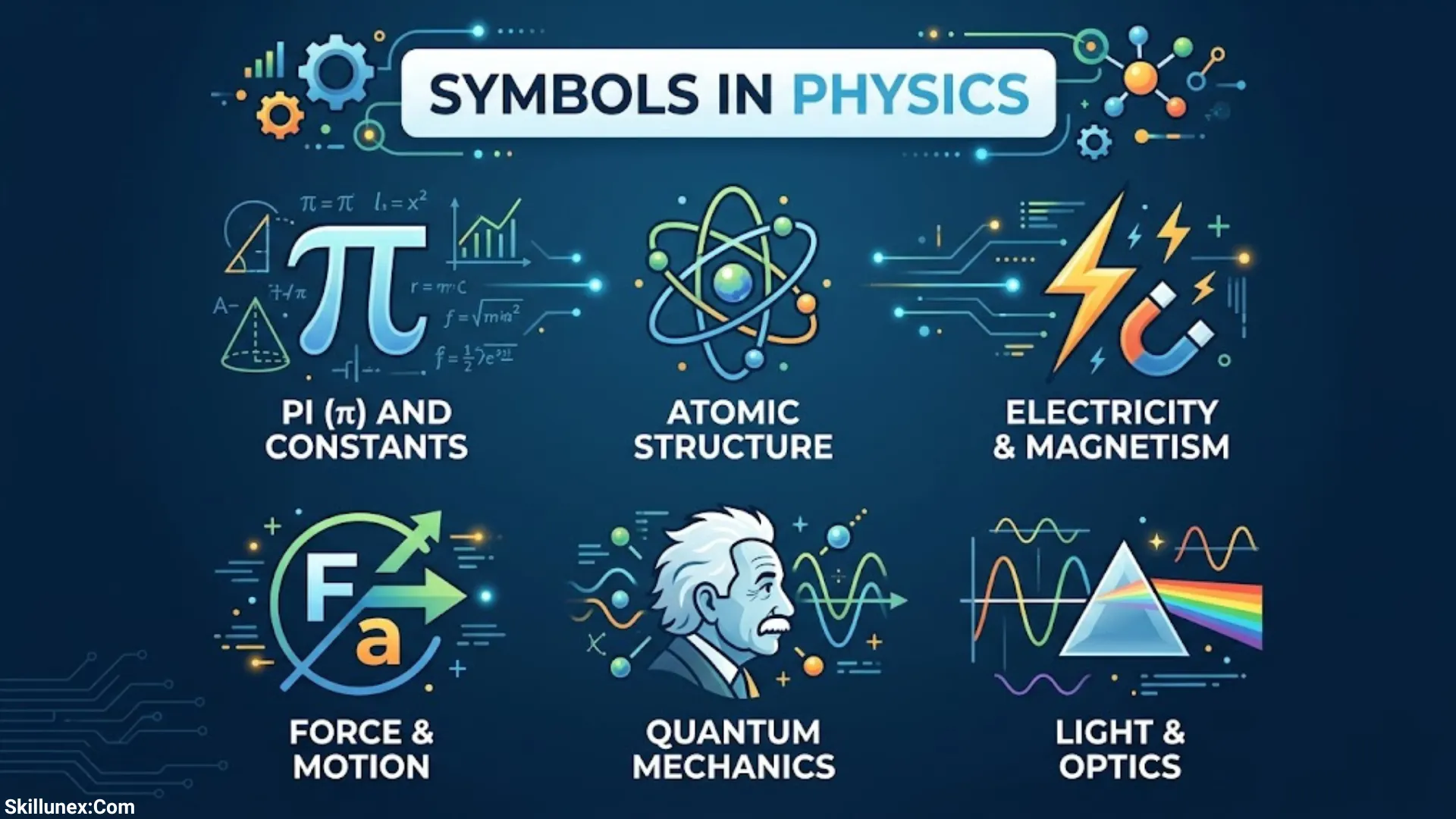
Physics helps you understand how the world works, from the motion of a moving car to the behavior of light, electricity, sound, and energy. To explain these ideas clearly, scientists use symbols in physics instead of writing long descriptions. These symbols represent physical quantities, scientific constants, mathematical operations, and measurement units. Once you understand them, you can read physics equations more confidently and solve numerical problems with greater accuracy.
When you study physics, you will encounter symbols such as (F) for force, (m) for mass, (v) for velocity, and (E) for energy. You will also see Greek letters such as (\lambda) for wavelength, (\theta) for an angle, and (\omega) for angular velocity. Each symbol has a specific meaning in a given context, although some letters represent different quantities in different branches of physics. For example, (T) can represent temperature, time period, or tension, depending on the equation.
In this complete guide, I’ll explain common physics symbols, their meanings, SI units, formulas, and practical uses. You’ll learn about symbols in mechanics, electricity, magnetism, thermodynamics, waves, optics, and modern physics. I’ll also cover Greek letters, mathematical signs, scientific constants, and common mistakes to avoid. Whether you are a school student, a college learner, or simply interested in science, this guide will help you understand physics symbols step by step.
What Are Symbols in Physics?
Symbols in physics are letters, Greek characters, and mathematical signs that represent physical quantities, scientific constants, relationships, and operations. They make equations easier to write, read, and understand.
For example, Newton’s second law is written as:
[
F_{\text{net}}=ma
]
In this equation, (F_{\text{net}}) represents the net force acting on an object, (m) represents its mass, and (a) represents its acceleration. Instead of describing the relationship in a full sentence, the equation expresses it in a short mathematical form.
Physics symbols generally belong to several categories.
- Physical quantity symbols: Represent measurable quantities such as mass, distance, time, velocity, and temperature.
- Mathematical symbols: Show operations or relationships, such as addition, equality, proportionality, and integration.
- Greek letters: Represent quantities such as wavelength, angular velocity, angular acceleration, and phase.
- Scientific constants: Represent established physical constants, such as the speed of light and Planck’s constant.
- Unit symbols: Identify measurement units, including meters, kilograms, seconds, and newtons.
- Subscripts and superscripts: Provide additional information about a quantity, such as its initial value, final value, direction, or component.
Understanding these categories helps you interpret equations without memorizing every formula separately.
Common Symbols in Physics and Their Meanings
Some symbols appear across several branches of physics. Learning these basic symbols first gives you a foundation for more advanced topics.
| Symbol | Meaning | SI Unit |
| (d) | Distance | Meter (m) |
| (s) | Displacement or distance, depending on context | Meter (m) |
| (t) | Time | Second (s) |
| (m) | Mass | Kilogram (kg) |
| (u) | Initial velocity in many introductory equations | Meter per second (m/s) |
| (v) | Velocity or final velocity, depending on context | Meter per second (m/s) |
| (a) | Acceleration | Meter per second squared (m/s²) |
| (F) | Force | Newton (N) |
| (p) | Momentum | Kilogram meter per second (kg·m/s) |
| (W) | Work | Joule (J) |
| (E) | Energy | Joule (J) |
| (P) | Power | Watt (W) |
| (K) | Kinetic energy | Joule (J) |
| (U) | Potential or internal energy, depending on context | Joule (J) |
| (T) | Temperature, period, or tension | Depends on the quantity |
| (f) | Frequency or frictional force, depending on context | Hertz (Hz) or newton (N) |
| (\lambda) | Wavelength | Meter (m) |
| (V) | Voltage or volume, depending on context | Volt (V) or cubic meter (m³) |
| (I) | Electric current | Ampere (A) |
| (R) | Electrical resistance | Ohm (Ω) |
| (Q) | Electric charge or heat transferred | Coulomb (C) or joule (J) |
Important: A symbol’s meaning depends on the equation and the subject. For example, (P) represents power in many formulas, but (P) can represent pressure in thermodynamics. Always check the definition given in your textbook or problem.
Symbols in Physics Mechanics
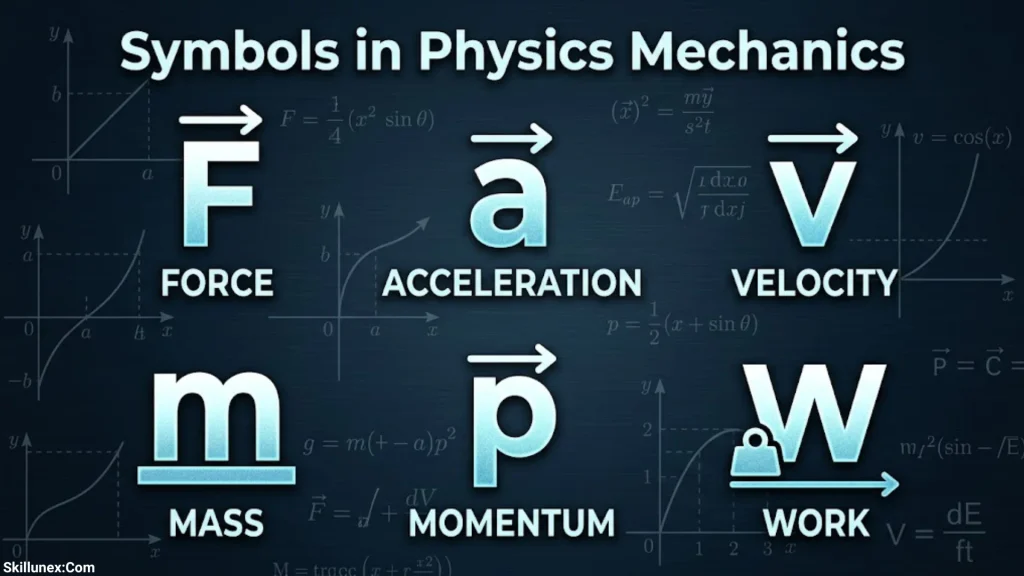
Mechanics is the branch of physics that studies motion, forces, energy, and the interactions between objects. Its symbols help you describe how objects move and explain why their motion changes.
Motion and Kinematics Symbols
Kinematics describes an object’s motion without directly examining the forces that cause it. These symbols are commonly used in equations involving displacement, velocity, acceleration, and time.
| Symbol | Meaning | SI Unit | Common Formula |
| (s) | Displacement | Meter (m) | (s=ut+\frac12at^2) |
| (d) | Distance | Meter (m) | Depends on the motion |
| (u) | Initial velocity | Meter per second (m/s) | (v=u+at) |
| (v) | Final velocity | Meter per second (m/s) | (v=u+at) |
| (a) | Acceleration | Meter per second squared (m/s²) | (a=(v-u)/t) |
| (t) | Elapsed time | Second (s) | (t=(v-u)/a), when (a\ne0) |
| (g) | Acceleration due to gravity | Meter per second squared (m/s²) | Approximately (9.81\text{ m/s}^2) near Earth’s surface |
For constant acceleration, three useful equations are:
[
v=u+at
]
[
s=ut+\frac12at^2
]
[
v^2=u^2+2as
]
These equations allow you to calculate unknown motion quantities when the required conditions are satisfied.
For example, imagine a bicycle starts from rest and accelerates at (2\text{ m/s}^2) for 5 seconds. Its initial velocity is zero, so:
[
v=0+(2\times5)=10\text{ m/s}
]
The bicycle reaches a velocity of 10 m/s after 5 seconds.
Remember that distance and displacement are different. Distance measures the total path traveled, while displacement measures the change in position, including direction. Speed is a scalar quantity, while velocity includes direction.
Force and Newton’s Laws Symbols
Force is a push or pull that can change an object’s motion or shape. Newton’s laws describe how forces affect objects.
| Symbol | Meaning | SI Unit |
| (F) | Force | Newton (N) |
| (F_{\text{net}}) | Net force | Newton (N) |
| (F_g) | Gravitational force | Newton (N) |
| (N) | Normal force | Newton (N) |
| (f) | Frictional force | Newton (N) |
| (T) | Tension force | Newton (N) |
| (k) | Spring constant | Newton per meter (N/m) |
| (g) | Acceleration due to gravity | Meter per second squared (m/s²) |
Newton’s second law is:
[
F_{\text{net}}=ma
]
Suppose you push a box with a mass of 5 kg and produce a net acceleration of (2\text{ m/s}^2). The net force is:
[
F_{\text{net}}=5\times2=10\text{ N}
]
The result is 10 newtons. Notice that the equation uses the net force, which accounts for all forces acting on the box.
Another useful equation describes the weight of an object near Earth’s surface:
[
F_g=mg
]
Here, (m) represents mass and (g) represents gravitational acceleration. A 2 kg object has a weight of approximately (19.62\text{ N}) near Earth’s surface.
Mass and weight are not the same. Mass measures the amount of matter in an object, while weight is a gravitational force.
Work, Energy, and Power Symbols
Work, energy, and power describe how forces transfer energy and how quickly energy is transferred or used.
| Symbol | Meaning | SI Unit | Formula |
| (W) | Work | Joule (J) | (W=Fd\cos\theta) |
| (K) | Kinetic energy | Joule (J) | (K=\frac12mv^2) |
| (U) | Gravitational potential energy near Earth’s surface | Joule (J) | (U=mgh) |
| (E) | Energy | Joule (J) | Depends on the type of energy |
| (P) | Power | Watt (W) | (P=W/t) for average power over an interval |
| (h) | Height | Meter (m) | Used in (U=mgh) |
The work equation is:
[
W=Fd\cos\theta
]
In this equation, (F) represents the force magnitude, (d) represents displacement, and (\theta) is the angle between the force and displacement directions.
If a force of 10 N moves a box 3 m in the same direction as the force, the work done is:
[
W=10\times3=30\text{ J}
]
Kinetic energy describes energy associated with motion. Gravitational potential energy describes energy associated with an object’s position in a gravitational field.
Power tells you how quickly work is done or energy is transferred. If a machine performs 100 J of work in 5 seconds, its average power is:
[
P=\frac{100}{5}=20\text{ W}
]
Symbols in Electricity and Magnetism
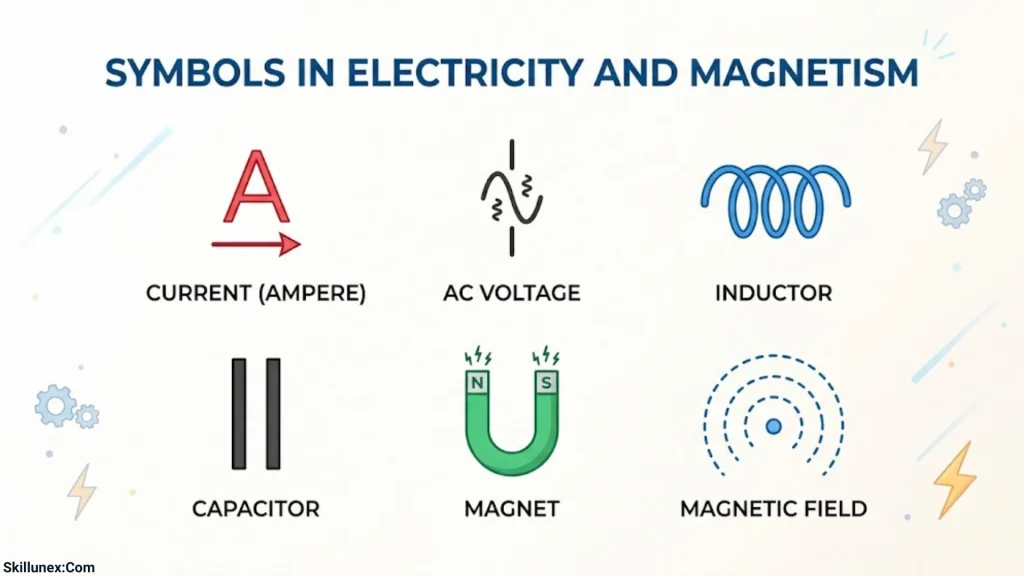
Electricity and magnetism explain electric charges, currents, fields, circuits, and electromagnetic interactions. Their symbols are essential when studying electrical devices, generators, motors, and electronic systems.
Electrical Symbols and Their Meanings
| Symbol | Meaning | SI Unit | Common Formula |
| (I) | Electric current | Ampere (A) | (I=Q/t) for constant current |
| (V) | Voltage or potential difference | Volt (V) | (V=IR) for an ohmic resistor |
| (R) | Electrical resistance | Ohm (Ω) | (R=V/I) |
| (Q) | Electric charge | Coulomb (C) | (Q=It) for constant current |
| (P) | Electrical power | Watt (W) | (P=VI) |
| (C) | Capacitance | Farad (F) | (C=Q/V) for a capacitor |
| (\rho) | Electrical resistivity | Ohm meter (Ω·m) | Depends on the conductor model |
| (q) | Charge of a particle or object | Coulomb (C) | Depends on the problem |
Electric current measures the rate at which electric charge passes a point. Voltage describes the electric potential difference between two points, while resistance describes how strongly a component opposes current.
Ohm’s law connects these three quantities:
[
V=IR
]
If a resistor has a resistance of 6 Ω and carries a current of 2 A, the voltage across it is:
[
V=2\times6=12\text{ V}
]
Electrical power can be calculated using:
[
P=VI
]
For a 12 V component carrying 2 A, the electrical power is 24 W.
These formulas are useful for understanding circuits, but remember that Ohm’s law applies to an ohmic component when its relevant physical conditions remain constant.
Magnetic Field Symbols
Magnetism is closely connected to electricity. Moving charges produce magnetic fields, and changing magnetic fields can induce electric voltages.
| Symbol | Meaning | SI Unit |
| (B) | Magnetic flux density | Tesla (T) |
| (H) | Magnetic field strength | Ampere per meter (A/m) |
| (\Phi_B) | Magnetic flux | Weber (Wb) |
| (\mu) | Magnetic permeability | Henry per meter (H/m) |
| (\varepsilon) | Electromotive force (EMF) | Volt (V) |
| (F) | Magnetic force or another force, depending on context | Newton (N) |
Magnetic flux measures the magnetic field passing through a surface. Its value depends on the field strength, the surface area, and the angle between the field and the surface normal.
Faraday’s law describes how changing magnetic flux induces an electromotive force. In a simple form for a coil with (N) turns:
[
\varepsilon=-N\frac{d\Phi_B}{dt}
]
Here, (N) represents the number of coil turns, and the minus sign expresses the direction described by Lenz’s law.
This principle helps explain how electrical generators convert mechanical energy into electrical energy.
Greek Symbols in Physics
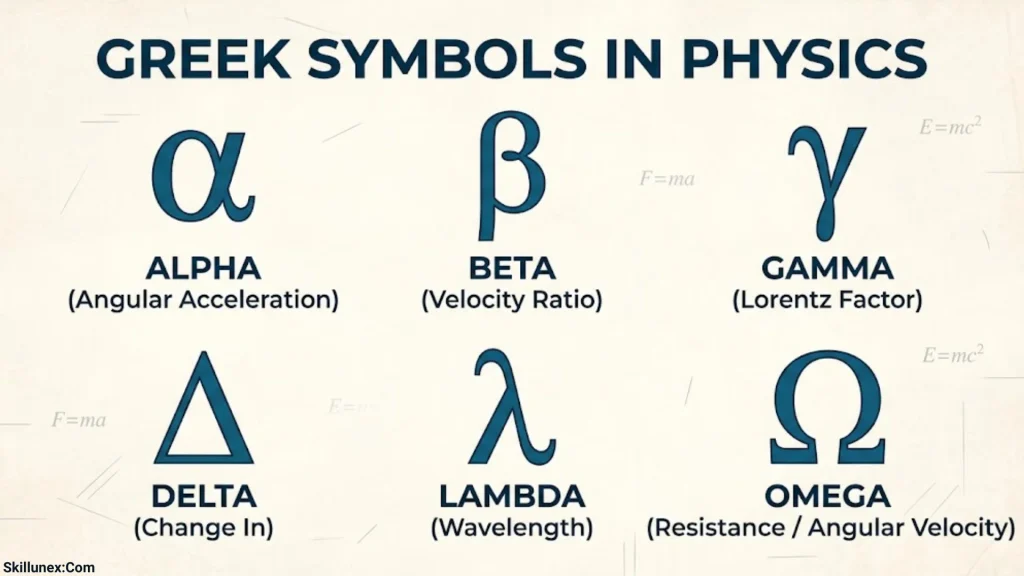
Greek letters are widely used because they provide additional symbols for representing physical quantities, constants, angles, and mathematical operations. You will find them in mechanics, thermodynamics, waves, electromagnetism, relativity, and quantum physics.
Common Greek Letters and Their Meanings
| Symbol | Name | Common Meaning |
| (\alpha) | Alpha | Angular acceleration or a coefficient |
| (\beta) | Beta | A coefficient or a velocity ratio in relativity |
| (\gamma) | Gamma | Lorentz factor or a coefficient |
| (\Delta) | Delta | Change in a quantity |
| (\theta) | Theta | Angle |
| (\lambda) | Lambda | Wavelength |
| (\mu) | Mu | Coefficient of friction or magnetic permeability |
| (\rho) | Rho | Density or electrical resistivity |
| (\sigma) | Sigma | Stress, conductivity, or charge density |
| (\tau) | Tau | Torque or time constant |
| (\omega) | Omega | Angular velocity or angular frequency |
| (\Omega) | Capital omega | Ohm, the unit of electrical resistance |
| (\phi) | Phi | Phase angle or electric potential in some conventions |
| (\psi) | Psi | Quantum wavefunction in common quantum notation |
| (\nu) | Nu | Frequency |
| (\pi) | Pi | Mathematical constant, approximately 3.14159 |
The same Greek letter can have different meanings in different contexts. For example, (\mu) may represent a coefficient of friction in mechanics or magnetic permeability in electromagnetism.
What Does Delta Mean in Physics?
The uppercase Greek letter (\Delta) represents a change in a quantity. It is commonly used in equations involving motion, temperature, energy, and pressure.
For example:
[
\Delta v=v_f-v_i
]
Here, (v_f) represents final velocity and (v_i) represents initial velocity. Their difference gives the change in velocity.
Similarly:
[
\Delta T=T_f-T_i
]
This expression represents the change in temperature between the final and initial states.
Delta does not automatically mean that a quantity increases. The change can be positive, negative, or zero, depending on the initial and final values.
What Is the Difference Between Omega and Ohm?
The Greek letter (\omega), written in lowercase, commonly represents angular velocity or angular frequency. Its SI unit is radians per second.
The uppercase Greek letter (\Omega) represents the ohm, which is the SI unit of electrical resistance.
Although these symbols look similar, they serve different purposes. For example, (\omega=2\pi f) relates angular frequency to ordinary frequency, while (R=10,\Omega) states that a resistor has a resistance of 10 ohms.
Symbols in Thermodynamics
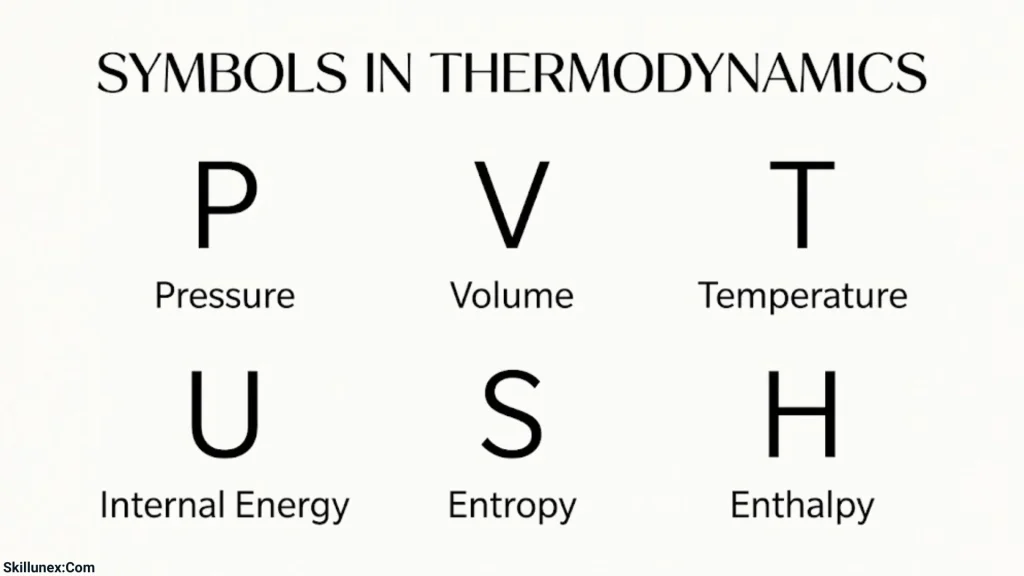
Thermodynamics studies heat, temperature, pressure, volume, and energy transfer. These symbols help explain how gases, engines, refrigerators, and other physical systems behave.
Common Thermodynamics Symbols
| Symbol | Meaning | SI Unit |
| (T) | Absolute temperature | Kelvin (K) |
| (Q) | Heat transferred | Joule (J) |
| (U) | Internal energy | Joule (J) |
| (S) | Entropy | Joule per kelvin (J/K) |
| (P) | Pressure | Pascal (Pa) |
| (V) | Volume | Cubic meter (m³) |
| (n) | Amount of substance | Mole (mol) |
| (R) | Universal gas constant | J/(mol·K) |
| (C_p) | Heat capacity at constant pressure | J/K for a specified system |
| (C_v) | Heat capacity at constant volume | J/K for a specified system |
The ideal gas law is one of the most common equations in thermodynamics:
[
PV=nRT
]
In this equation, (P) represents pressure, (V) represents volume, (n) represents the amount of gas in moles, (R) is the universal gas constant, and (T) is absolute temperature.
The equation describes an idealized gas. Real gases may behave differently, particularly at high pressures or low temperatures.
Another important relationship is the first law of thermodynamics. Using the convention that (W_{\text{by}}) represents work done by the system:
[
\Delta U=Q-W_{\text{by}}
]
This equation expresses energy conservation. The change in internal energy equals heat added to the system minus work done by the system.
When you study thermodynamics, always check the sign convention used by your textbook because some sources define work as work done on the system instead.
Symbols in Waves and Sound
Waves transfer energy from one location to another. They appear in sound, water waves, vibrations, and electromagnetic radiation.
Common Wave Symbols
| Symbol | Meaning | SI Unit |
| (f) | Frequency | Hertz (Hz) |
| (T) | Period | Second (s) |
| (\lambda) | Wavelength | Meter (m) |
| (v) | Wave speed | Meter per second (m/s) |
| (A) | Amplitude | Depends on the oscillating quantity |
| (\omega) | Angular frequency | Radian per second (rad/s) |
| (k) | Wave number | Radian per meter (rad/m) |
| (\phi) | Phase angle | Radian (rad) |
Frequency tells you how many complete oscillations occur per second. Period measures the time required for one complete oscillation.
Their relationship is:
[
T=\frac{1}{f}
]
The wave-speed equation is:
[
v=f\lambda
]
Suppose a wave has a frequency of 5 Hz and a wavelength of 4 m. Its speed is:
[
v=5\times4=20\text{ m/s}
]
The wave travels at 20 meters per second.
Angular frequency is related to frequency by:
[
\omega=2\pi f
]
These formulas help you understand the behavior of sound waves, vibrating strings, and other periodic systems.
Symbols in Optics and Light
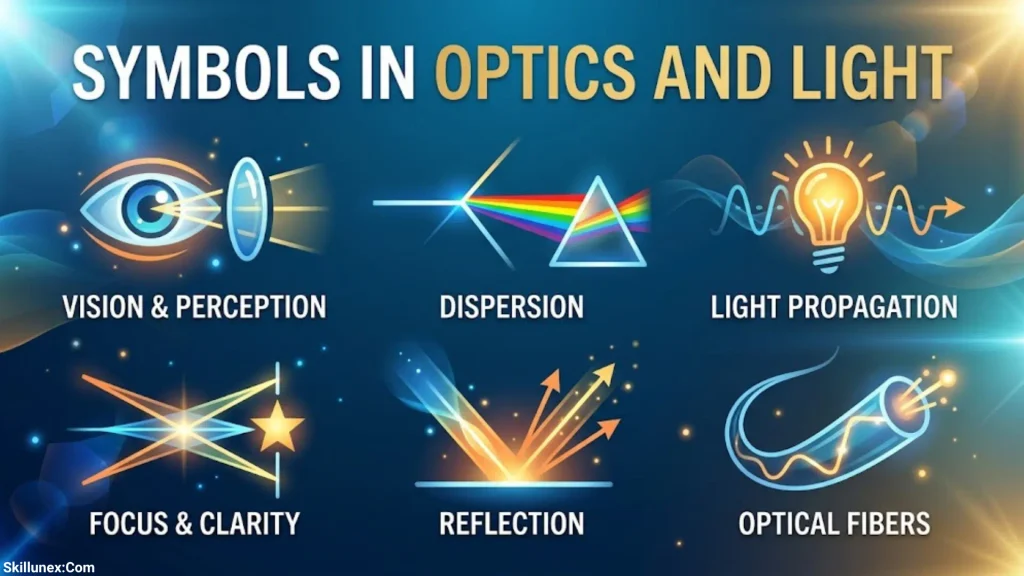
Optics studies the behavior of light, including reflection, refraction, lenses, mirrors, and image formation. Its symbols help you calculate how light travels and how optical instruments form images.
Common Optics Symbols
| Symbol | Meaning | SI Unit |
| (c) | Speed of light in a vacuum | Meter per second (m/s) |
| (n) | Refractive index | Dimensionless |
| (f) | Focal length or frequency, depending on context | Meter (m) or hertz (Hz) |
| (u) | Object distance in common lens and mirror notation | Meter (m) |
| (v) | Image distance in common lens and mirror notation | Meter (m) |
| (m) | Magnification | Dimensionless |
| (\theta_i) | Angle of incidence | Radian or degree |
| (\theta_r) | Angle of reflection | Radian or degree |
The speed of light in a vacuum is approximately:
[
c=3.00\times10^8\text{ m/s}
]
The refractive index of a transparent medium can be expressed as:
[
n=\frac{c}{v}
]
Here, (v) represents the phase velocity of light in the medium.
The law of reflection states that the angle of incidence equals the angle of reflection when both angles are measured from the normal to the surface:
[
\theta_i=\theta_r
]
The law of refraction, known as Snell’s law, is:
[
n_1\sin\theta_1=n_2\sin\theta_2
]
This relationship explains why light changes direction when it passes between materials with different refractive indices.
Symbols in Modern and Quantum Physics
Modern physics explores atomic structures, subatomic particles, quantum behavior, and the relationship between mass and energy. It uses several important symbols and constants.
Quantum Physics Symbols
| Symbol | Meaning | SI Unit |
| (h) | Planck’s constant | Joule second (J·s) |
| (\hbar) | Reduced Planck’s constant | Joule second (J·s) |
| (c) | Speed of light in a vacuum | Meter per second (m/s) |
| (E) | Energy | Joule (J) |
| (p) | Momentum | Kilogram meter per second (kg·m/s) |
| (\psi) | Quantum wavefunction | Depends on normalization and representation |
| (\nu) | Frequency | Hertz (Hz) |
| (m_e) | Electron mass | Kilogram (kg) |
| (e) | Elementary charge magnitude | Coulomb (C) |
Planck’s constant connects a photon’s energy to its frequency:
[
E=h\nu
]
The equation shows that higher-frequency photons have higher energy.
The reduced Planck constant is defined as:
[
\hbar=\frac{h}{2\pi}
]
It appears frequently in quantum mechanics, including equations describing angular momentum and wave behavior.
Important Symbols in Einstein’s Relativity
Einstein’s theory of relativity describes space, time, motion, gravity, and the relationship between mass and energy.
One of its best-known equations is:
[
E=mc^2
]
Here, (E) represents rest energy, (m) represents rest mass, and (c) represents the speed of light in a vacuum.
Another important expression is the Lorentz factor:
[
\gamma=\frac{1}{\sqrt{1-v^2/c^2}}
]
In this formula, (v) represents relative speed and (c) represents the speed of light. The factor (\gamma) becomes important when an object’s speed approaches the speed of light.
These equations show how physics symbols help describe relationships that are difficult to express in ordinary language.
Scientific Constants and Their Symbols
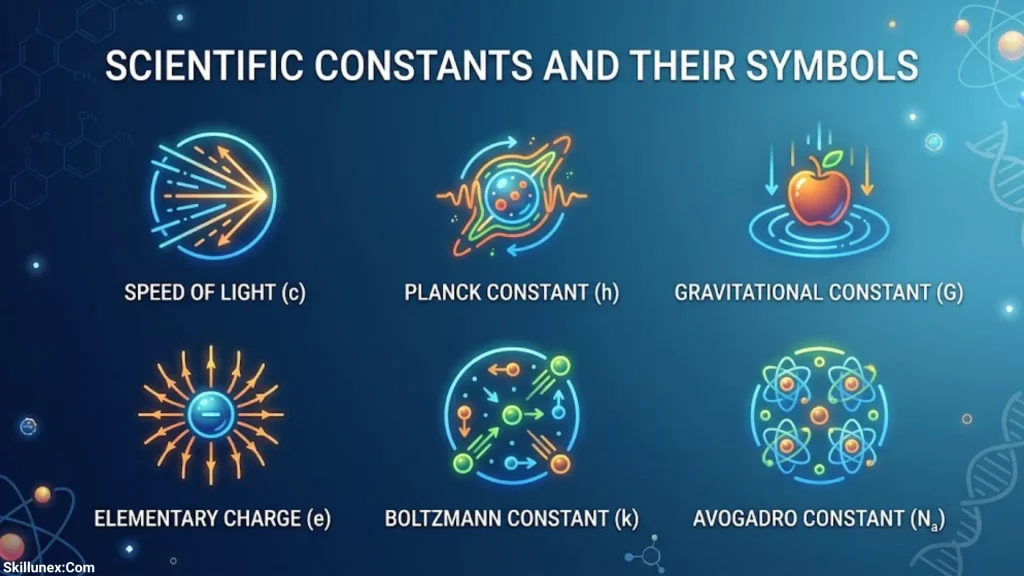
Physical constants appear in many formulas and help describe fundamental properties of nature. Some constants are exact by definition in the SI system, while others are measured experimentally.
| Symbol | Constant | Approximate Value |
| (c) | Speed of light in a vacuum | (2.998\times10^8\text{ m/s}) |
| (g) | Standard gravitational acceleration | (9.80665\text{ m/s}^2) |
| (G) | Newtonian gravitational constant | (6.6743\times10^{-11}\text{ m}^3\text{kg}^{-1}\text{s}^{-2}) |
| (h) | Planck’s constant | (6.62607015\times10^{-34}\text{ J·s}) |
| (e) | Elementary charge magnitude | (1.602176634\times10^{-19}\text{ C}) |
| (k_B) | Boltzmann constant | (1.380649\times10^{-23}\text{ J/K}) |
| (N_A) | Avogadro constant | (6.02214076\times10^{23}\text{ mol}^{-1}) |
| (\varepsilon_0) | Vacuum electric permittivity | Approximately (8.854\times10^{-12}\text{ F/m}) |
| (\mu_0) | Vacuum magnetic permeability | Approximately (1.257\times10^{-6}\text{ H/m}) |
The values of (h), (e), (k_B), and (N_A) shown above are exact in the current SI system. Other values, such as (G), are experimentally determined and carry measurement uncertainty.
Do not confuse the gravitational constant (G) with gravitational acceleration (g). The constant (G) appears in Newton’s law of universal gravitation, while (g) describes local gravitational acceleration.
Mathematical Symbols Used in Physics
Physics relies on mathematics to describe relationships, calculate values, and model natural processes. Mathematical symbols help you understand what an equation tells you to do.
Common Mathematical Signs
| Symbol | Meaning | Example |
| (+) | Addition | (a+b) |
| (-) | Subtraction or negative sign | (a-b) |
| (\times) | Multiplication | (F=ma) |
| (/) | Division | (v=d/t) |
| (=) | Equal to | (F=ma) |
| (\approx) | Approximately equal to | (g\approx9.81\text{ m/s}^2) |
| (\propto) | Proportional to | (F\propto a) for constant mass under Newton’s second law |
| (\neq) | Not equal to | (a\neq b) |
| (\leq) | Less than or equal to | (x\leq5) |
| (\geq) | Greater than or equal to | (x\geq0) |
| (\pm) | Plus or minus | (x=5\pm1) |
| (\sqrt{\phantom{x}}) | Square root | (v=\sqrt{u^2+2as}), when applicable |
These signs appear in basic calculations and more advanced mathematical models.
Summation, Integration, and Vector Symbols
Advanced physics uses additional mathematical notation to describe many quantities at once, calculate accumulated changes, and represent direction.
| Symbol | Meaning | Common Use | ||
| (\sum) | Summation | Adding several forces or energies | ||
| (\int) | Integral | Calculating accumulated quantities | ||
| (\frac{d}{dt}) | Derivative with respect to time | Finding a rate of change | ||
| (\nabla) | Del or nabla operator | Vector calculus and field equations | ||
| (\vec{F}) | Force vector | Force with magnitude and direction | ||
| ( | \vec{v} | ) | Magnitude of a vector | Speed when (\vec{v}) is velocity |
| (\cdot) | Dot product | Work and vector projections | ||
| (\times) | Cross product in vector notation | Torque and magnetic force |
For example, velocity is the rate of change of position:
[
v=\frac{dx}{dt}
]
Acceleration is the rate of change of velocity:
[
a=\frac{dv}{dt}
]
These expressions show why calculus becomes important in advanced mechanics and other branches of physics.
SI Units and Their Symbols in Physics
The International System of Units, commonly called SI, provides a consistent standard for scientific measurements. Every physical quantity should be expressed using appropriate units when a numerical value is given.
Seven SI Base Units
| Base Quantity | SI Unit | Unit Symbol |
| Length | Meter | m |
| Mass | Kilogram | kg |
| Time | Second | s |
| Electric current | Ampere | A |
| Thermodynamic temperature | Kelvin | K |
| Amount of substance | Mole | mol |
| Luminous intensity | Candela | cd |
These seven base units form the foundation of the SI system. Many other units are derived from them.
Common Derived SI Units
| Physical Quantity | SI Unit | Unit Symbol |
| Area | Square meter | m² |
| Volume | Cubic meter | m³ |
| Speed or velocity | Meter per second | m/s |
| Acceleration | Meter per second squared | m/s² |
| Force | Newton | N |
| Energy and work | Joule | J |
| Power | Watt | W |
| Pressure | Pascal | Pa |
| Electric charge | Coulomb | C |
| Voltage | Volt | V |
| Resistance | Ohm | Ω |
| Capacitance | Farad | F |
| Magnetic flux density | Tesla | T |
| Frequency | Hertz | Hz |
Unit symbols follow standard writing conventions. For example, the symbol for a newton is uppercase (N), while the symbol for a meter is lowercase (m). Unit symbols are generally not pluralized, and a space is placed between a numerical value and its unit, as in (5\text{ m}).
How to Read and Use Physics Symbols Correctly
Learning the names of symbols is only the first step. You also need to understand how they work in equations and how to select the correct formula for a problem.
Follow These Steps When Solving a Physics Problem
- Identify the topic. Determine whether the question concerns motion, forces, electricity, heat, waves, or another area.
- List the known quantities. Write down the values supplied in the question with their units.
- Identify the unknown quantity. Decide what the question asks you to calculate.
- Define each symbol. Check whether a letter represents a quantity, constant, unit, or mathematical operation.
- Choose the correct formula. Make sure its assumptions match the problem.
- Convert units when necessary. For example, convert kilometers per hour to meters per second before using an SI-based calculation.
- Substitute the values. Replace the relevant symbols with the given numerical values.
- Calculate and check the answer. Include the correct unit and consider whether the result is physically reasonable.
Example: Calculating Distance
Suppose a runner travels at a constant speed of 3 m/s for 4 seconds. You want to calculate the distance traveled.
The formula is:
[
d=vt
]
The known values are:
- (v=3\text{ m/s})
- (t=4\text{ s})
Substitute the values:
[
d=3\times4=12\text{ m}
]
The runner travels 12 meters.
Notice that the units also work correctly:
[
\frac{\text{m}}{\text{s}}\times\text{s}=\text{m}
]
This process is called dimensional analysis, and it helps you check whether an equation or answer is consistent.
Common Mistakes When Learning Physics Symbols
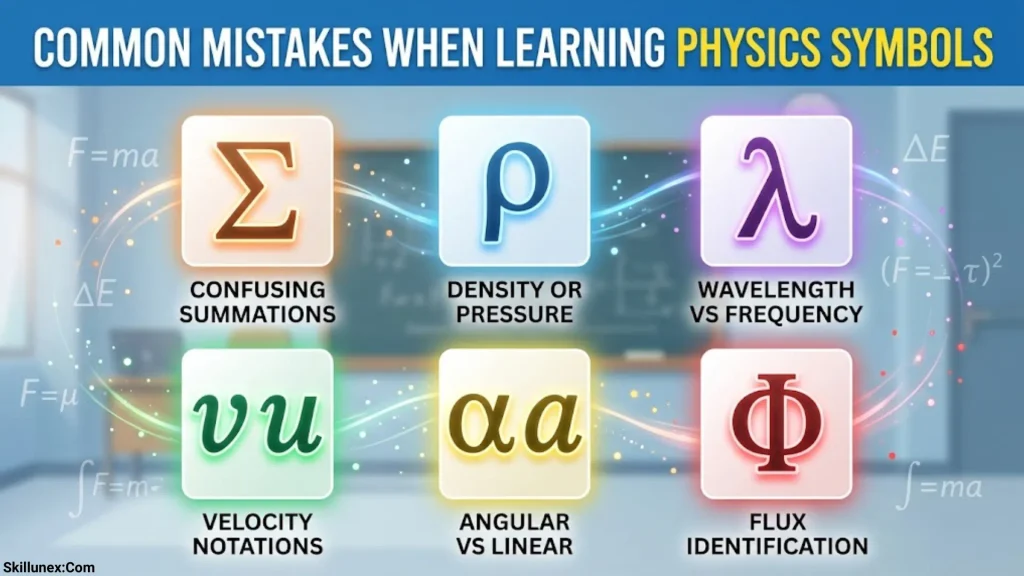
Students often confuse physics symbols because the same letter may represent different quantities in different contexts. Recognizing these differences can prevent errors.
Confusing Quantity Symbols With Unit Symbols
A quantity symbol represents what you are measuring, while a unit symbol tells you how you measure it.
For example, (m) can represent mass in an equation, but in (5\text{ m}), it represents meters, the unit of length.
Similarly, (W) can represent work, while (W) as a unit symbol represents watts when used after a numerical value. Context and notation help you distinguish them.
Mixing Up Uppercase and Lowercase Letters
Uppercase and lowercase letters can represent different quantities.
- (V) commonly represents voltage.
- (v) commonly represents velocity.
- (P) may represent power or pressure.
- (p) commonly represents momentum.
- (\Omega) represents ohms, while (\omega) often represents angular velocity or angular frequency.
Pay attention to the exact form of each symbol instead of treating similar letters as interchangeable.
Ignoring Subscripts and Superscripts
Subscripts often identify different states or components of a quantity. For example, (v_i) may represent initial velocity, while (v_f) represents final velocity.
Superscripts can represent powers, as in (v^2), or identify particular mathematical operations and components in other contexts.
Always read the complete symbol, including its subscripts and superscripts.
Forgetting Units in Calculations
A numerical answer without its unit may be incomplete or misleading.
If you calculate a force, the answer should normally be expressed in newtons. If you calculate energy, use joules. Units also help reveal mistakes because an equation must be dimensionally consistent.
Assuming Every Formula Works in Every Situation
Physics equations often rely on specific assumptions. For example, the introductory kinematics equation (v=u+at) assumes constant acceleration.
Likewise, (PV=nRT) describes an ideal gas, while real gases can deviate from this model under some conditions.
Before applying a formula, check the conditions under which it is valid.
Frequently Asked Questions About Symbols in Physics
What Are the Most Common Symbols in Physics?
Common physics symbols include (m) for mass, (t) for time, (v) for velocity, (a) for acceleration, (F) for force, (E) for energy, (P) for power, and (I) for electric current. Greek letters such as (\lambda), (\theta), and (\omega) are also widely used.
What Does F Mean in Physics?
The symbol (F) usually represents force. Force is measured in newtons (N), and Newton’s second law expresses the relationship between net force, mass, and acceleration as (F_{\text{net}}=ma).
What Does Delta Mean in Physics?
The uppercase Greek letter (\Delta) represents a change in a quantity. For example, (\Delta v) means change in velocity, and (\Delta T) means change in temperature. The change can be positive, negative, or zero.
What Is the Difference Between Speed and Velocity Symbols?
Speed and velocity are both measured in meters per second, but they are different physical quantities. Speed is a scalar that describes how fast an object moves, while velocity is a vector that includes direction. In many introductory formulas, (v) represents velocity, and speed is its magnitude.
Why Does Physics Use Greek Letters?
Greek letters provide additional notation for physical quantities and constants. For example, (\lambda) commonly represents wavelength, (\theta) represents an angle, and (\omega) represents angular velocity or angular frequency. Their precise meanings depend on the topic.
How Can I Memorize Physics Symbols Easily?
Group symbols by topic, create flashcards, practice writing formulas, and learn each symbol with its SI unit. Solving numerical problems is more effective than memorizing isolated letters because it helps you understand how symbols work together.
Conclusion
Symbols in physics make it easier to describe motion, forces, energy, electricity, magnetism, heat, waves, light, and the behavior of matter. Basic symbols such as (m), (t), (v), (a), and (F) help you understand introductory physics, while Greek letters, scientific constants, and mathematical operators become useful as you explore more advanced topics.
To master physics symbols, learn their meanings, units, formulas, and contexts together. Pay attention to uppercase and lowercase letters, subscripts, and the assumptions behind each equation. With regular practice, you will become more confident when reading formulas, solving numerical questions, and understanding the scientific principles that explain the world around you.

I’m Adrian Holloway, a writer and researcher who enjoys exploring the stories, meanings, and interesting facts behind the subjects people search for every day. I’m especially interested in symbols, nature, lakes, places, and cultural topics that help readers understand the world from a different perspective.
I believe useful content should be simple, accurate, and enjoyable to read. When I research a topic, I focus on finding meaningful details and presenting them in a way that makes information easy to understand.
My goal is to create helpful articles that answer real questions while encouraging readers to discover something new with every visit.
Books by Adrian Holloway
The Language of Symbols: Meanings, Stories & Traditions
Hidden Wonders of Nature: Lakes, Landscapes & Discovery