Inanna was one of the most important goddesses of ancient Mesopotamia. Worshipped by the Sumerians and later closely associated with the Akkadian goddess Ishtar, she was connected with love, sexuality, fertility, warfare, political authority, and the planet Venus.
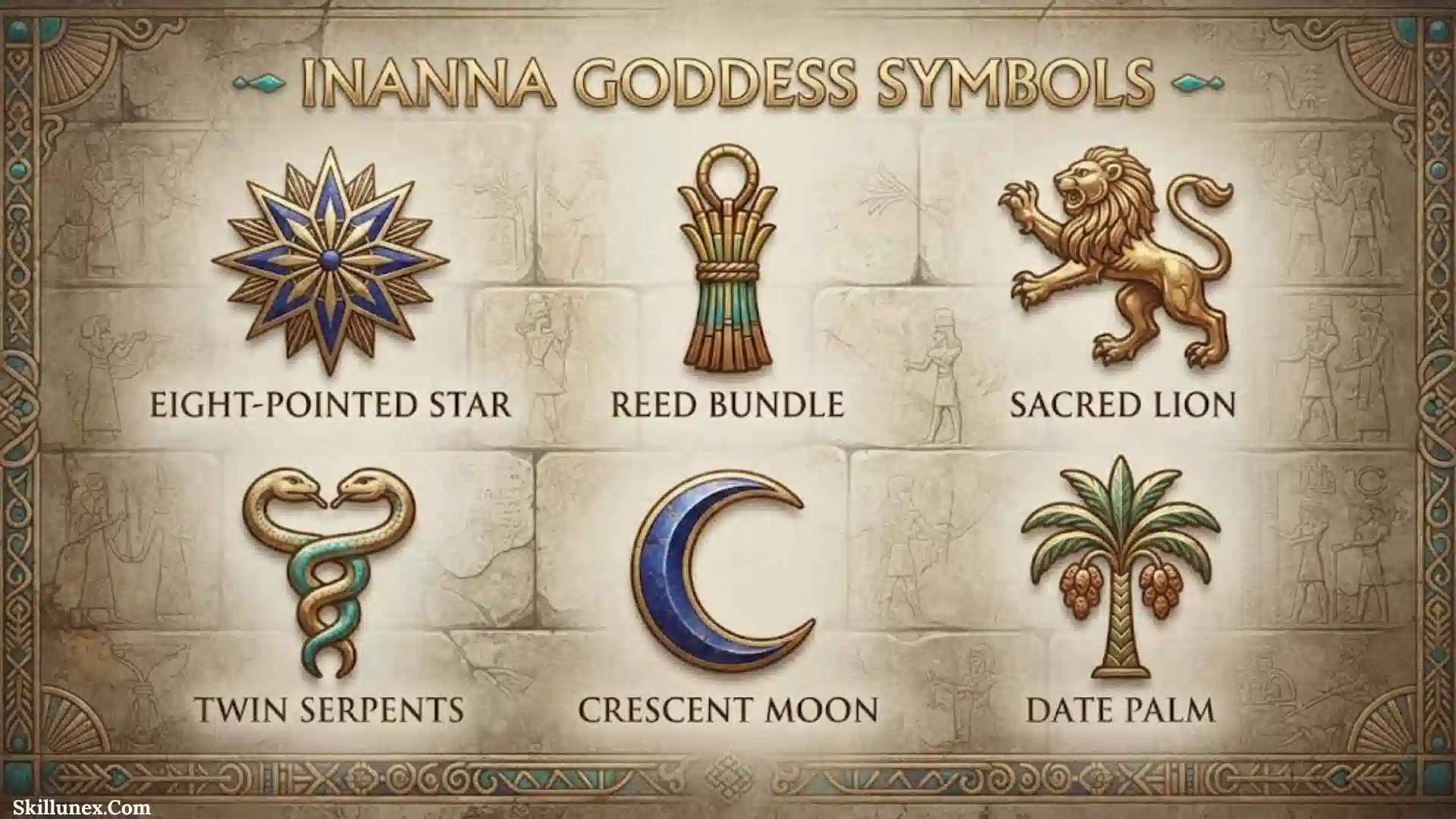
Because Inanna represented many different and sometimes contrasting aspects of life, the Inanna goddess symbols associated with her are equally diverse. The eight-pointed star, lion, Venus, rosette, weapons, reeds, and other motifs all help reveal different parts of her identity.
Understanding these symbols requires some historical care. Not every symbol commonly attributed to Inanna today functioned as a fixed emblem of the goddess in ancient Sumer. Some are strongly supported by ancient evidence, while others are broader Mesopotamian motifs that later became associated with Inanna or Ishtar.
This guide explores the major Inanna symbols, their meanings, their relationship to ancient Mesopotamian mythology, and the reasons they continue to attract attention today.
Who Was Inanna?
Inanna was a major Sumerian goddess whose worship was particularly important in the ancient city of Uruk. She appears in numerous Sumerian hymns, myths, royal texts, and other literary works.
Her character was remarkably complex. Inanna could represent passionate love and sexuality, but she was also associated with warfare, political power, kingship, fertility, and destruction.
This combination makes her different from the simplified idea of a goddess who represents only love or fertility.
Inanna’s major associations include:
- Love and erotic sexuality
- Fertility and abundance
- Warfare and victory
- Political authority
- Kingship
- The planet Venus
- Transformation
- Death and return
- Divine power
Inanna and Ishtar
In later Mesopotamian traditions, Inanna became closely identified with Ishtar, the major goddess of Akkadian-speaking peoples.
The two goddesses share many characteristics, including connections with Venus, sexuality, warfare, lions, and political authority. However, Inanna and Ishtar belong to different linguistic and historical traditions, so the names should not automatically be treated as identical in every context.
This distinction is important when interpreting ancient artifacts and texts.
Major Inanna Goddess Symbols
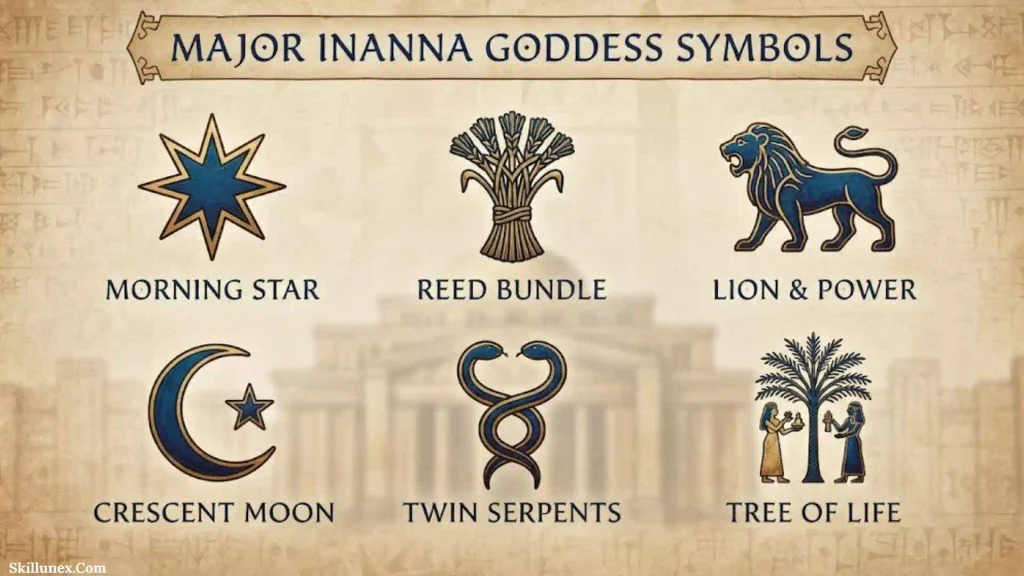
The symbols associated with Inanna represent different dimensions of her divine identity. Some, such as Venus and the star, are particularly well established, while others need to be interpreted according to their artistic and historical context.
The Eight-Pointed Star
The eight-pointed star is probably the most recognizable symbol associated with Inanna.
The star is strongly connected with the planet Venus, which was closely associated with Inanna in Mesopotamian religious and astronomical traditions.
The symbol appears in Mesopotamian art and is also associated with the later goddess Ishtar. Its exact significance can vary according to the period and object on which it appears.
The eight-pointed star can therefore represent:
- Venus
- Celestial power
- Divine authority
- Inanna’s heavenly identity
- Transformation and cyclical change
Modern interpretations sometimes give the symbol additional meanings, such as feminine power, rebirth, balance, and spiritual transformation. These ideas can be useful in modern contexts, but they should not automatically be presented as beliefs held by ancient Sumerians.
The Planet Venus
Venus is central to understanding Inanna’s symbolism.
Ancient Mesopotamian observers carefully followed the movements of Venus because of its exceptional brightness and unusual appearance. Venus can appear as a morning star and an evening star, giving it a distinctive dual nature.
This made the planet an appropriate celestial association for a goddess whose identity also contained opposing qualities.
Inanna could be associated with:
- Love and warfare
- Beauty and destruction
- Fertility and death
- Power and vulnerability
- Appearance and disappearance
Her connection with Venus therefore provides an important key to understanding her complex character.
The Lion
The lion is another important symbol associated with Inanna and, especially in later traditions, Ishtar.
In ancient Mesopotamia, lions represented strength, courage, royal authority, ferocity, and military power. Their association with Inanna emphasizes her role as a powerful and sometimes fearsome goddess.
Artistic representations may show the goddess standing on or accompanied by lions.
The lion can therefore represent:
- Strength
- Courage
- Warfare
- Royal power
- Divine authority
- Fearlessness
- Dominance
The lion is particularly useful for understanding the warrior side of Inanna that is sometimes overlooked in modern descriptions of her.
The Rosette
The rosette is a flower-like decorative motif frequently found in Mesopotamian religious and royal art.
It is often discussed in connection with Inanna and Ishtar. Because of its floral form, modern interpretations sometimes associate it with beauty, fertility, sexuality, and abundance.
Historically, however, the rosette should not be treated as having one universally fixed meaning.
Its significance depends on the artifact, artistic period, and surrounding imagery. It can be understood as part of the broader visual language associated with divine beauty, fertility, abundance, and sacred authority.
Weapons
Weapons represent another important dimension of Inanna’s identity.
Ancient Sumerian literature portrays Inanna as a powerful goddess capable of violence, conflict, and destruction. Her later identification with Ishtar further strengthened her association with warfare.
Weapons can therefore symbolize:
- War
- Victory
- Destruction
- Protection
- Military authority
- Divine power
This aspect of Inanna is important because she was not simply a goddess of romance or fertility. Her power could also be dangerous and destructive.
Reeds
Reeds were an essential part of life in ancient southern Mesopotamia.
The wetlands and waterways of the region provided large quantities of reeds, which people used to construct buildings, boats, baskets, mats, and writing implements.
Reeds appear in Mesopotamian religious and artistic contexts, including traditions associated with Inanna.
However, reeds should not be treated as an exclusive emblem of Inanna. Their importance is better understood within the environmental and cultural setting in which her worship developed.
The Date Palm
The date palm was one of the most important plants in ancient Mesopotamia.
Dates provided food, while palm trees supplied shade and useful materials. As a result, the date palm naturally became connected with prosperity, agriculture, fertility, and abundance.
Because Inanna’s traditions include themes of fertility and abundance, the date palm can sometimes be discussed alongside her symbolism.
Nevertheless, a palm tree in Mesopotamian art does not automatically represent Inanna. It may have agricultural, decorative, royal, or general fertility-related significance.
Royal and Divine Authority
Inanna was also connected with kingship and political authority.
Mesopotamian rulers sought divine legitimacy for their power, and Inanna’s relationship with kings could therefore have significant political and religious meaning.
Royal imagery associated with Inanna can communicate:
- Sovereignty
- Political authority
- Divine approval
- Kingship
- Victory
- Legitimacy
This helps explain why Inanna’s symbolism extends far beyond sexuality and fertility.
Inanna’s Symbols in Her Mythology
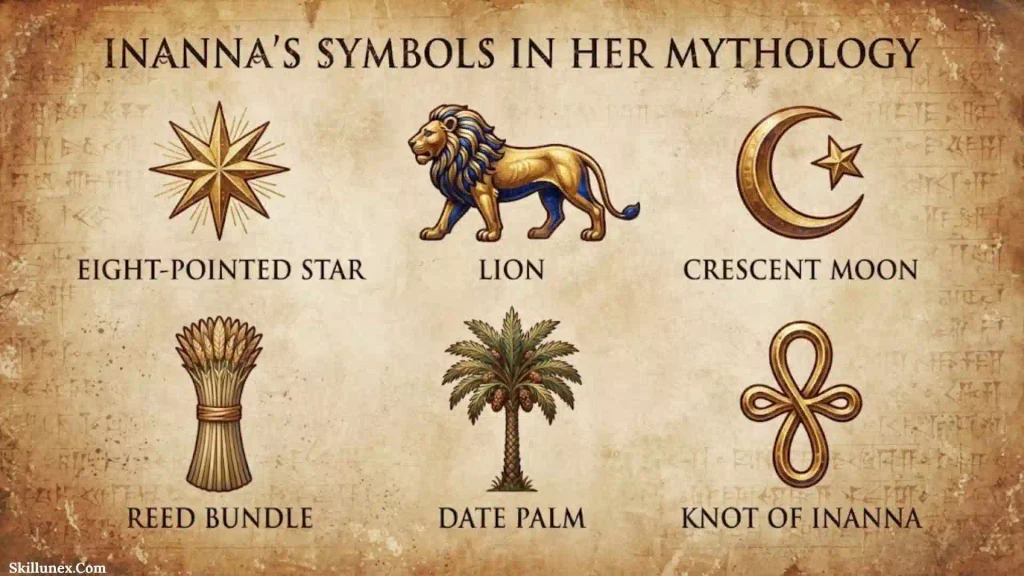
Inanna’s symbols become even more meaningful when examined alongside her myths.
Her stories repeatedly explore power, desire, death, transformation, and return.
Inanna’s Descent to the Underworld
One of the best-known stories about Inanna is Inanna’s Descent to the Underworld.
In the story, Inanna descends into the realm ruled by her sister Ereshkigal. As she passes through the gates of the underworld, she is progressively stripped of her possessions and symbols of authority.
She eventually reaches the realm of the dead and loses her power.
Later, Inanna is able to return to the upper world, although her return has serious consequences.
The story has become particularly important in modern discussions of transformation because it contains themes of:
- Descent
- Loss
- Death
- Transformation
- Renewal
- Return
- Power and vulnerability
Modern readers may interpret the story psychologically or spiritually, but these interpretations should be distinguished from the evidence for how ancient Mesopotamians themselves understood the myth.
Inanna and Dumuzi
Inanna’s relationship with Dumuzi is another major part of her mythology.
Dumuzi was associated with fertility, vegetation, and kingship, and numerous Sumerian compositions describe his relationship with Inanna.
Their stories connect sexuality and fertility with kingship, prosperity, and religious ritual.
The mythology surrounding Dumuzi also introduces themes of death and return, adding to the broader symbolism of fertility, loss, and renewal found in Inanna’s tradition.
What Do Inanna’s Symbols Mean?
The meaning of Inanna’s symbols depends on the particular symbol and historical context.
Love and Sexuality
Inanna was strongly associated with erotic love and sexuality.
Her sexuality was not simply a private or romantic concept. In ancient Mesopotamian culture, sexual imagery could also be connected with fertility, prosperity, kingship, and divine power.
Fertility and Abundance
Inanna’s relationship with Dumuzi and the traditions surrounding sacred marriage connect her with fertility and prosperity.
This aspect of her identity reflects the importance of agricultural abundance in Mesopotamian society.
Warfare and Strength
The lion and weapons emphasize Inanna’s fierce side.
She could be portrayed as a warrior goddess associated with conflict, victory, and destruction. This makes her a particularly complex female deity in ancient mythology.
Political Power
Inanna’s connection with kingship demonstrates the importance of divine authority in Mesopotamian political thought.
Her favor could be associated with legitimacy, victory, and royal power.
Transformation
Her descent into the underworld and eventual return provide a powerful mythological framework for discussing transformation and renewal.
Celestial Power
Her connection with Venus places Inanna within the celestial world and links her mythology to ancient Mesopotamian observations of the sky.
Inanna Goddess Symbols: Ancient Meanings vs. Modern Interpretations
Inanna has become increasingly popular in modern spirituality, literature, art, and discussions of feminine power.
Modern writers may use her symbols to represent:
- Feminine independence
- Sexual freedom
- Personal transformation
- Courage
- Rebirth
- Empowerment
- Spiritual growth
- Inner strength
These interpretations can be meaningful, but they should be clearly separated from historical claims.
For example, the ancient evidence strongly supports the connection between Inanna and Venus. It is less accurate to claim that ancient Sumerians specifically understood the eight-pointed star as a modern symbol of “female empowerment.”
A historically responsible interpretation distinguishes between what ancient sources tell us and what modern readers have chosen to find meaningful in Inanna.
Inanna Goddess Symbols at a Glance
| Symbol | Main association | Historical context |
| Eight-pointed star | Venus and divine power | Strongly associated with Inanna/Ishtar |
| Venus | Celestial identity | One of Inanna’s most important associations |
| Lion | Strength and warfare | Reflects her powerful warrior aspect |
| Rosette | Beauty and divine imagery | Meaning varies according to context |
| Weapons | War and victory | Highlights her destructive and warrior qualities |
| Reeds | Mesopotamian environment | Not an exclusive emblem of Inanna |
| Date palm | Fertility and abundance | Broader Mesopotamian symbolism |
| Royal imagery | Kingship and authority | Reflects her political significance |
Why Are Inanna’s Symbols Still Popular?
Inanna remains fascinating because she challenges simple ideas about ancient goddesses.
She was not merely a mother goddess or a goddess of romantic love. She could be passionate, powerful, destructive, sexually autonomous, politically important, and associated with warfare.
Her mythology also deals with experiences that remain familiar to modern readers: loss, ambition, desire, vulnerability, transformation, and renewal.
For this reason, her symbols continue to appear in:
- Contemporary artwork
- Jewelry
- Tattoos
- Literature
- Mythology studies
- Modern spiritual practices
- Feminist interpretations
- Popular culture
The eight-pointed star is especially popular because it provides a recognizable visual connection to Inanna and Ishtar.
Frequently Asked Questions About Inanna Goddess Symbols
What is the main symbol of Inanna?
The eight-pointed star is one of the most recognizable symbols associated with Inanna. It is closely connected with her association with the planet Venus.
What animal represents Inanna?
The lion is strongly associated with Inanna and later with Ishtar. It represents strength, courage, warfare, royal authority, and divine power.
What planet is associated with Inanna?
Venus is the planet most strongly associated with Inanna. Her celestial identity is one of the central features of her symbolism.
What does Inanna’s eight-pointed star mean?
The eight-pointed star is primarily associated with Venus and divine celestial power. Modern interpretations sometimes connect it with transformation, feminine power, and rebirth.
Was Inanna a goddess of love or war?
Inanna was associated with both love and warfare. Her ability to embody seemingly opposing qualities is one of the defining characteristics of her mythology.
Is Inanna the same as Ishtar?
Inanna was a major Sumerian goddess, while Ishtar was the corresponding goddess in Akkadian traditions. They became closely identified over time and share many symbols and attributes.
What does Inanna symbolize?
Inanna can represent love, sexuality, fertility, warfare, political authority, celestial power, transformation, and the complex relationship between life and death.
What does the lion symbolize in Inanna’s mythology?
The lion represents strength, courage, ferocity, authority, and warfare. Its association with Inanna emphasizes her status as a powerful and sometimes dangerous goddess.
What does Inanna’s descent into the underworld mean?
The ancient myth describes Inanna’s journey into the underworld and her eventual return. Modern interpretations often understand it as a story of death, transformation, loss, and renewal, although those interpretations should not be confused with established ancient beliefs.
Conclusion
The Inanna goddess symbols provide a fascinating way to understand one of ancient Mesopotamia’s most complex deities.
The eight-pointed star connects her with Venus and the heavens. The lion represents strength and warrior power, while weapons emphasize her association with warfare and victory. The rosette, fertility imagery, and agricultural motifs reflect other aspects of the religious world surrounding her.
Yet no single symbol completely defines Inanna.
Her true significance emerges from the combination of her symbols, myths, temples, hymns, and relationship with kingship and other deities. She could embody love and warfare, sexuality and political authority, fertility and destruction, vulnerability and extraordinary power.
That complexity is what makes Inanna’s mythology so enduring. Her symbols are not simply decorative images from the ancient world; together, they provide insight into how Mesopotamian cultures understood divinity, power, sexuality, nature, kingship, and transformation.

Caleb Thornton
I’m Caleb Thornton, a researcher and content writer who loves exploring fascinating subjects and sharing what I learn with readers. My interests include natural places, lakes, symbols, culture, history, and the stories that make ordinary topics more meaningful.
When I write an article, I try to go beyond a basic answer. I look for useful facts, relevant context, and details that can help readers understand the subject more completely.
My purpose is simple: I want every article I contribute to provide genuine value, satisfy the reader’s curiosity, and make discovering new information enjoyable.
## Books by Caleb Thornton
* Symbols & Meanings: Exploring the Signs We See Every Day
* Lakes of the World: Nature, Beauty & Exploration