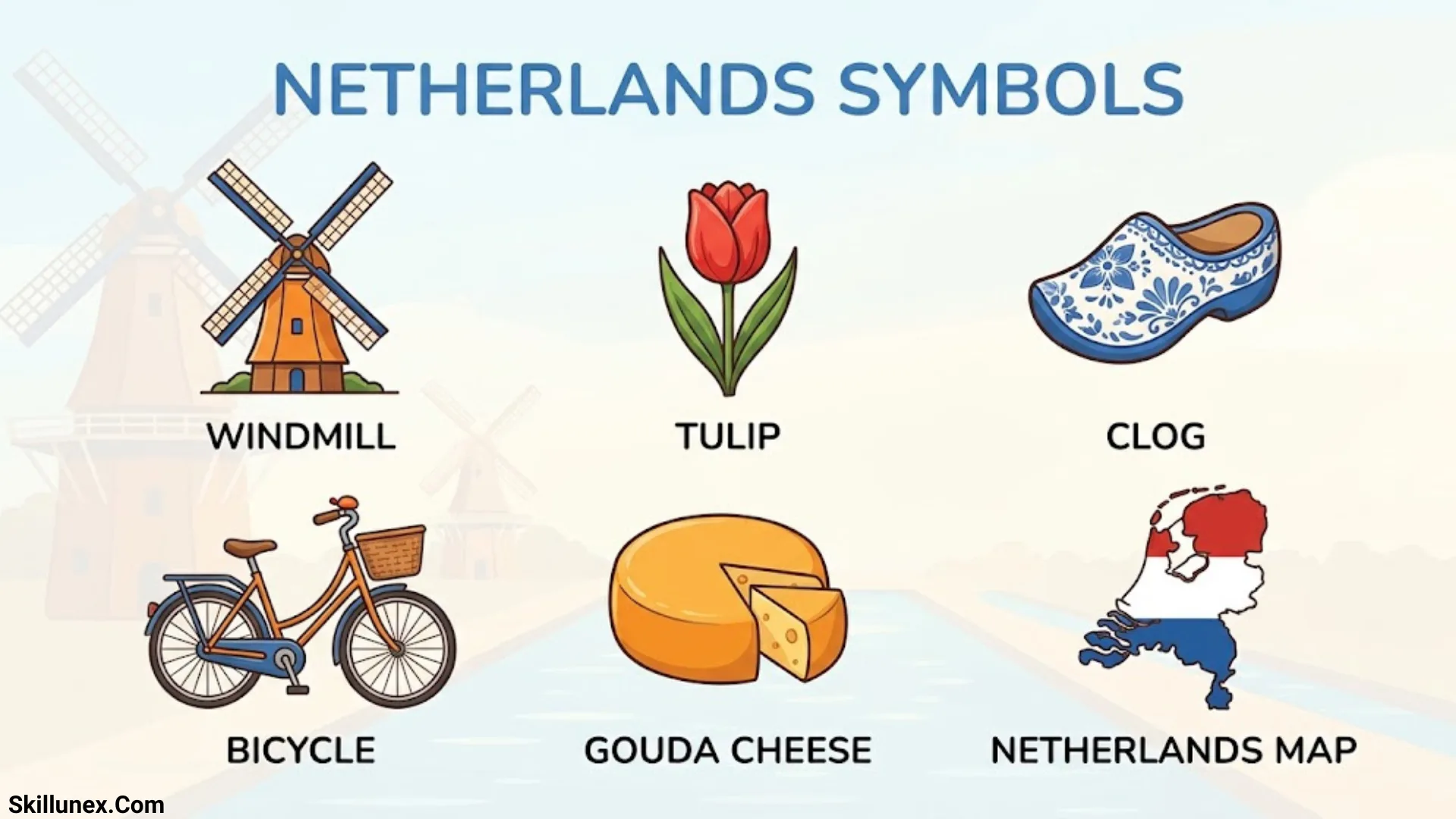
Netherlands symbols represent the country’s rich history, culture, and national identity. From the famous Dutch flag to the royal coat of arms, each symbol tells a unique story about the Netherlands. If you want to learn more about this beautiful European country, these symbols will help you understand its traditions and heritage.
When you explore Netherlands symbols, you will discover the importance of the national colors, the lion emblem, tulips, windmills, and other iconic features. Each symbol reflects a different part of Dutch life, from royal history to the country’s famous landscapes. You can learn what these symbols mean and why they are recognized around the world.
In this guide, you will discover the most important Netherlands symbols and their meanings in simple words. Whether you are a student, a traveler, or simply curious about Dutch culture, you can use this collection to explore the country’s identity. By understanding these symbols, you will gain a better appreciation of the Netherlands and its fascinating traditions.
Official Netherlands Symbols and Their Meanings
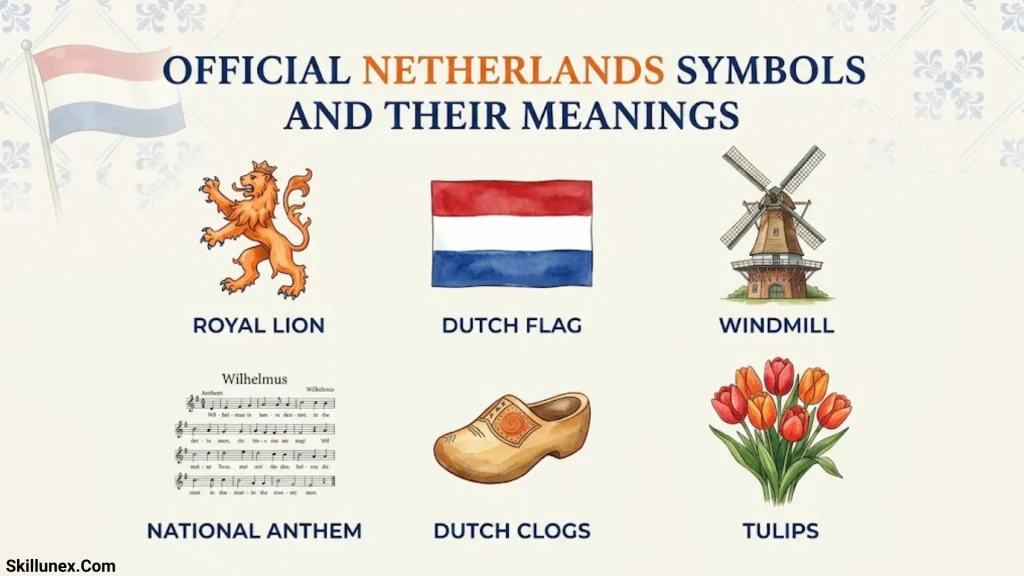
The Netherlands has several official symbols connected to its government, monarchy, and national identity. The national flag, royal coat of arms, and national anthem are among the most important.
Dutch Flag Symbol
The Dutch flag is one of the most recognizable symbols of the Netherlands. It features three horizontal stripes of equal size: red on top, white in the middle, and blue at the bottom.
The flag’s history dates back to the 16th century, when an orange, white, and blue banner was associated with William of Orange and the Dutch struggle for independence. Over time, red replaced orange in the national tricolor.
In 1937, Queen Wilhelmina formally established the red, white, and blue colors by royal decree. The flag now represents the Netherlands and its national identity. <Cite refs={[“turn609146search2″,”turn609146search15”]}/>
The colors are sometimes associated with courage, peace, and loyalty in popular explanations, but these meanings are not a single officially prescribed interpretation of each stripe.
Dutch Coat of Arms Symbol
The coat of arms of the Netherlands is an official emblem of the kingdom and its monarchy. It features a golden lion on a blue shield decorated with golden rectangles. The lion holds a silver sword and a bundle of seven arrows.
Each element has a historical connection. The lion is associated with the House of Nassau, while the sword and arrows connect to the historical symbols of the Dutch Republic. The seven arrows represent the seven provinces of the former Dutch Republic’s union.
A royal crown sits above the shield, and two lions support it. Below the shield is a ribbon bearing the French motto Je Maintiendrai, meaning “I will maintain.”
The coat of arms represents royal heritage, authority, unity, and the country’s historical continuity. Its design was established in 1815 and later revised. <Cite refs={[“turn609146search5″,”turn609146search17”]}/>
Dutch Lion Symbol
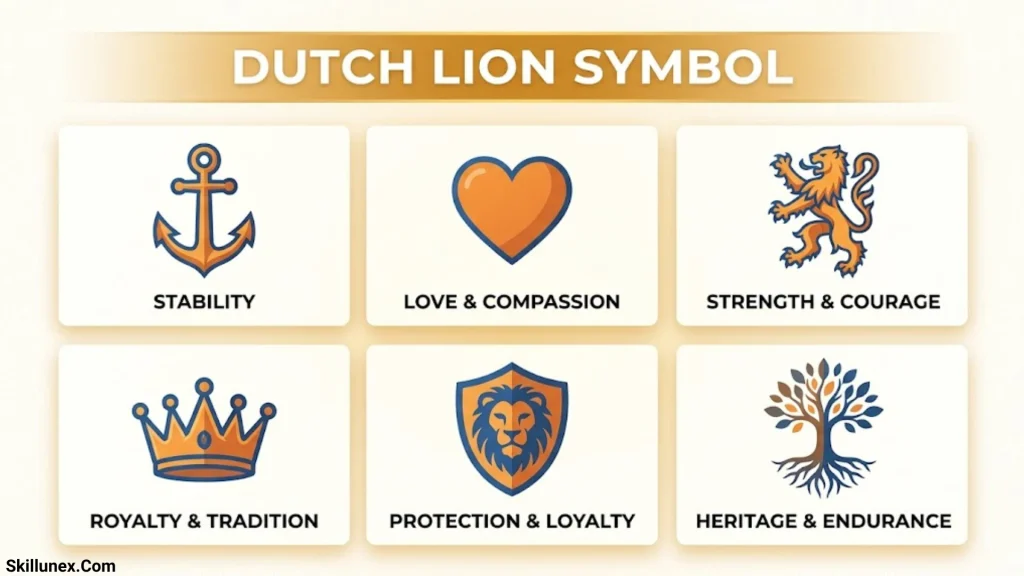
The Dutch lion is a symbol of strength, courage, and national pride. It appears prominently in the national coat of arms and has historical links to the House of Nassau and the Dutch Republic.
In the royal coat of arms, the golden lion holds a sword and seven arrows. These objects connect the image to authority, defense, and unity.
The lion is also popular in Dutch sports culture. Supporters frequently display lion emblems alongside orange clothing during international competitions. Although the lion is not a separate national animal designation in the same sense as an official emblem, it remains one of the country’s most recognizable national symbols.
Dutch National Anthem: Wilhelmus
The Wilhelmus, also known as Het Wilhelmus, is the national anthem of the Netherlands. It became the official anthem in 1932 and has a history associated with William of Orange and the Dutch struggle for independence. <Cite refs={[“turn609146search18”]}/>
The song reflects historical loyalty, personal conviction, and the relationship between William of Orange and the Netherlands. Its lyrics are written as a first-person statement from William’s perspective.
Today, the anthem is performed at official ceremonies and important sporting events. It represents the country’s history and shared national identity.
Dutch Royal Crown
The royal crown is an important emblem of the Dutch monarchy. It appears above the shield in the royal coat of arms and on other royal insignia.
The crown represents the monarchy, royal authority, and the continuity of the Dutch state. It is also associated with official ceremonies and the country’s constitutional traditions.
The crown is a symbol of the institution of monarchy rather than a representation of every aspect of Dutch society.
House of Orange Nassau Symbol
The House of Orange-Nassau is the Dutch royal house, and its name explains why orange is so closely associated with the Netherlands.
The connection dates to William of Orange, a central figure in the Dutch revolt against Spanish rule. The color orange became an enduring sign of loyalty to the royal house.
Today, oranges appear during King’s Day, national celebrations, and major sporting competitions. The royal family’s coat of arms and other insignia also reflect this historical heritage.
Famous Cultural Symbols of the Netherlands
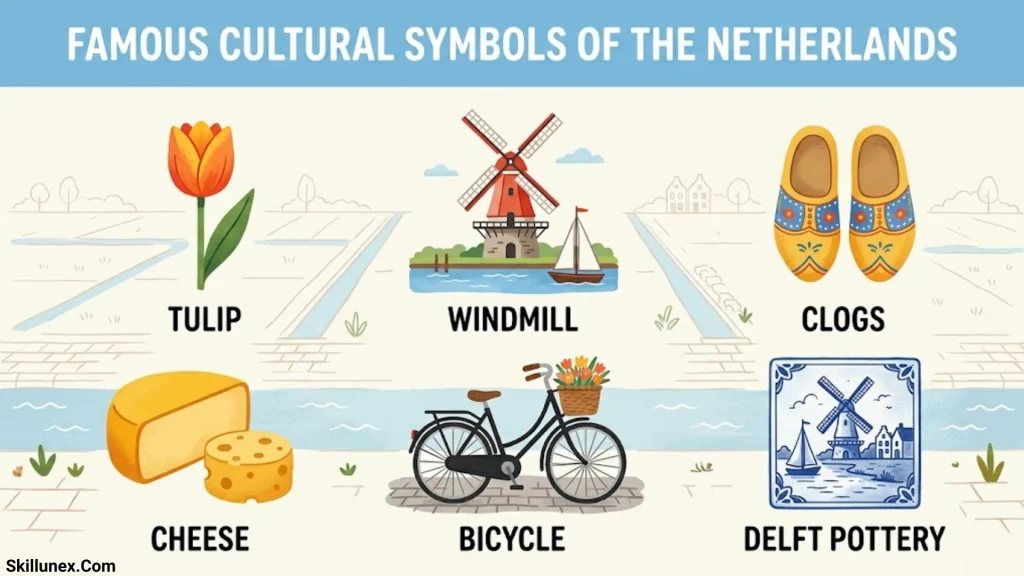
Beyond official emblems, many everyday objects, landscapes, and traditions have become recognizable symbols of Dutch culture. These icons reflect the country’s relationship with nature, farming, trade, engineering, and community life. <Cite refs={[“turn609146search1″,”turn609146search10”]}/>
Orange Color Symbol
Orange is one of the strongest cultural symbols of the Netherlands. Its connection to the House of Orange-Nassau has made it a familiar color at national celebrations.
Every year, people dress in orange for King’s Day, a celebration of the reigning monarch’s birthday. Orange clothing, flags, decorations, and accessories also appear during international football matches and other sporting events.
Unlike red, white, and blue, orange is not part of the modern national flag. Instead, it represents royal heritage, national pride, and celebration.
Tulip Symbol in the Netherlands
The tulip is one of the most famous cultural symbols of the Netherlands. Its bright colors and springtime blooms are associated with beauty, renewal, gardening, and the Dutch flower industry.
Tulips originated farther east and were introduced to Western Europe in the 16th century. They became especially popular in the Netherlands during the 17th century, when the trading of tulip bulbs attracted widespread attention.
Today, Dutch flower fields and bulb production make the tulip an internationally recognized symbol of the country. Visitors often associate the flower with spring festivals, gardens, and colorful landscapes.
Tulips do not have one official national meaning, but they commonly symbolize beauty, growth, and new beginnings. <Cite refs={[“turn609146search13″,”turn609146search11”]}/>
Windmill Symbol in the Netherlands
Windmills are iconic symbols of Dutch engineering and history. For centuries, they helped communities grind grain, saw timber, process materials, and pump water.
Water management has been particularly important because much of the Netherlands lies at low elevations. Wind-powered pumping systems helped drain land and support the development of polders, which are areas of reclaimed land protected by water-control structures.
Historic windmills now represent ingenuity, perseverance, and the country’s long relationship with wind and water. Sites such as Kinderdijk preserve examples of the traditional windmill systems used in Dutch water management. <Cite refs={[“turn609146search10″,”turn609146search11”]}/>
Wooden Clogs Symbol
Wooden clogs, called klompen in Dutch, are traditional shoes associated with rural life and Dutch craftsmanship.
Historically, wooden footwear was useful for agricultural workers and others who needed sturdy protection in muddy or wet conditions. Different styles developed according to local needs and working environments.
Today, clogs appear in museums, souvenirs, traditional displays, and folk art. They symbolize rural heritage, practical craftsmanship, and older ways of life.
Although clogs are internationally associated with the Netherlands, not everyone in the country wears them in everyday life.
Dutch Bicycle Symbol
The bicycle is a familiar symbol of modern Dutch life. Cycling is a practical way to travel to work, school, shops, and public transportation.
The Netherlands is known for its extensive cycling routes, dedicated bike lanes, and bicycle-friendly urban planning. People use bicycles for everyday transportation as well as exercise and recreation.
Unlike the national flag or coat of arms, the bicycle is a cultural symbol rather than an official state emblem. It represents mobility, sustainability, convenience, and an active lifestyle. <Cite refs={[“turn609146search3″,”turn609146search7”]}/>
Dutch Cheese Symbol
Dutch cheese is a well-known symbol of the country’s food heritage and agricultural traditions. Gouda and Edam are among the best-known varieties associated with the Netherlands.
Cheese production and trade have played important roles in Dutch farming and commerce. Traditional markets, dairy farms, and established cheese-making techniques continue to attract visitors and preserve regional customs.
As a cultural symbol, Dutch cheese represents craftsmanship, agricultural production, local food traditions, and international trade.
Gouda and Edam are named after Dutch towns associated with their history and trade. The names do not mean that all cheese of those varieties must be produced within the towns today.
Dutch Canal Symbol
Canals are defining features of many Dutch towns and cities, including Amsterdam, Utrecht, and Leiden. They have historically supported transportation, trade, drainage, and urban development.
In a country shaped by water management, canals also reflect the practical relationship between people and their environment. They helped move goods and connect communities before modern road and rail networks became widespread.
Today, historic canals symbolize Dutch engineering, commercial history, distinctive architecture, and the country’s close relationship with waterways.
Delft Blue Pottery Symbol
Delft Blue, known in Dutch as Delfts blauw, is a traditional style of blue-and-white pottery associated with the city of Delft.
Dutch potters developed this distinctive ceramic tradition during the 17th century. The designs often feature flowers, landscapes, ships, and scenes from everyday life.
Delft Blue became famous partly because Dutch artisans adapted the appearance of Chinese blue-and-white porcelain to local tastes and production methods.
Today, the pottery represents Dutch decorative arts, craftsmanship, and historical trade connections. It is also a popular souvenir and a recognizable element of the country’s cultural heritage. <Cite refs={[“turn609146search10″,”turn609146search1”]}/>
Dutch Wooden Windmill and Water Symbols
Wind and water are central themes in the Netherlands’ history. Windmills, canals, dikes, dams, and pumping stations all reflect generations of work to manage water and protect communities.
Dikes help prevent flooding, while pumping systems move excess water away from low-lying land. These structures show how engineering has shaped the country’s landscape and development.
Together, wind and water symbols represent adaptation, innovation, cooperation, and resilience. They also explain why water management remains an important part of Dutch identity.
Netherlands Symbols and Their Meanings at a Glance
The following table summarizes the main symbols and their commonly associated meanings.
| Netherlands Symbol | Meaning or Association |
| Red, white, and blue flag | National identity and history |
| Royal coat of arms | Monarchy, authority, and heritage |
| Golden Dutch lion | Strength, courage, and unity |
| Wilhelmus | National history and identity |
| Royal crown | Monarchy and royal authority |
| Orange color | House of Orange-Nassau and celebration |
| Tulip | Beauty, spring, and flower production |
| Windmill | Engineering and water management |
| Wooden clogs | Rural traditions and craftsmanship |
| Bicycle | Everyday mobility and sustainability |
| Dutch cheese | Food heritage and agricultural traditions |
| Canals | Trade, engineering, and water management |
| Delft Blue pottery | Decorative arts and craftsmanship |
| Dikes and pumping stations | Flood protection and land management |
Netherlands Symbols Tattoo
Netherlands symbols tattoos can be a meaningful way to express your connection to Dutch culture, heritage, history, or national identity. You might choose a small tulip, a detailed Dutch lion, or the national flag, depending on the message you want your tattoo to communicate.
Before selecting a design, consider the meaning behind it. A national symbol may express pride in the Netherlands, while a flower or traditional object can represent personal memories, family connections, or an appreciation for Dutch culture.
Here are some popular Netherlands-inspired tattoo ideas:
- Netherlands Flag Tattoo: A simple design featuring red, white, and blue horizontal stripes to express national pride.
- Dutch Lion Tattoo: Represents strength, courage, and a connection to Dutch national heraldry.
- Tulip Tattoo: A floral design associated with Dutch horticulture, beauty, and springtime.
- Windmill Tattoo: Reflects Dutch engineering traditions and the country’s historic relationship with water.
- Orange-Nassau Inspired Tattoo: An orange-themed design inspired by the Dutch royal house and its connection to national celebrations.
- Dutch Coat of Arms Tattoo: A detailed option for people interested in Dutch history and heraldic imagery.
- Wooden Clogs Tattoo: A playful design inspired by traditional Dutch footwear and craftsmanship.
You can choose a minimalist outline for your wrist or ankle, or a larger design featuring a windmill, tulips, and the Netherlands flag. If you prefer something subtle, a single tulip or a small red, white, and blue design may be enough.
Keep in mind that cultural symbols can carry different meanings for different people. Choose a design that reflects your own connection to the Netherlands rather than relying only on its appearance.
Ancient Dutch Symbols
Ancient Dutch symbols are best understood through the region’s historical cultures, archaeological discoveries, medieval heraldry, and traditional beliefs. The Netherlands has a long history that includes prehistoric communities, Roman influence, Germanic peoples, and later medieval societies.
Unlike the modern national flag, many ancient and early historical symbols were not official symbols of a unified Dutch nation. Instead, they appeared in religious objects, decorative artwork, weapons, coins, and local heraldic designs.
Here are several historical symbols and traditions connected to the region.
- Germanic Runes: Runes were used by Germanic peoples in parts of northern Europe, including areas connected to the early history of the Low Countries. Their meanings depend on the individual rune and historical context.
- Roman-Era Symbols: Roman military standards, inscriptions, and religious imagery appeared in parts of the Netherlands during Roman rule, especially in the southern and central regions.
- Medieval Lions: Lions became important in European heraldry, including the coats of arms of Dutch provinces, cities, and noble families.
- Frisian Symbols: Historical Frisian identity is reflected in regional heraldry and traditional designs. The exact meaning of a symbol depends on its specific historical use.
- Medieval Seals: Towns, guilds, and authorities used seals featuring recognizable images to identify documents and communicate legal authority.
- Religious Symbols: Christian crosses and other religious imagery appeared in churches, manuscripts, and religious objects as Christianity spread through the region.
When researching ancient Dutch symbols, it is important to distinguish historical evidence from modern interpretations. A symbol used by a Germanic community, for example, should not automatically be described as an official symbol of the present-day Netherlands.
Likewise, medieval heraldic lions may have specific regional or family associations rather than one universal meaning. Studying the period and location helps you understand what each symbol represented to the people who used it.
Frequently Asked Questions About Netherlands Symbols
What Is the National Symbol of the Netherlands?
The Netherlands has several important national symbols rather than just one. The red, white, and blue flag, the royal coat of arms, and the national anthem, Wilhelmus, have official national significance. Tulips, windmills, and oranges are widely recognized cultural symbols.
What Do the Colors of the Netherlands Flag Mean?
The Dutch flag has three horizontal stripes: red, white, and blue. Its colors developed from the earlier orange, white, and blue flag associated with William of Orange. Although the colors are often given symbolic meanings in popular explanations, there is no single official interpretation assigning a specific meaning to each stripe.
Why Is Orange a Symbol of the Netherlands?
Orange represents the House of Orange-Nassau, the Dutch royal house. The association dates back to William of Orange and the Dutch struggle for independence. Today, people wear orange during King’s Day and major sporting events to express celebration and national pride.
Why Is the Tulip Associated With the Netherlands?
Tulips are associated with the Netherlands because the country developed a major flower-bulb industry and became internationally famous for its tulip fields and horticulture. Although tulips originated elsewhere, they have become enduring symbols of Dutch springtime and flower production.
What Does the Dutch Lion Represent?
The Dutch lion is associated with strength, courage, royal heritage, and national identity. It appears in the country’s coat of arms, where it holds a sword and seven arrows. The arrows historically represent the seven provinces of the Dutch Republic’s union.
Are Windmills Official Symbols of the Netherlands?
Windmills are cultural and historical symbols, not official national emblems in the same way as the flag or coat of arms. They represent Dutch engineering, traditional industry, and the country’s long history of managing water and reclaiming land.
What Is the National Flower of the Netherlands?
The tulip is widely regarded as the Netherlands’ best-known national flower in popular culture. However, it is more accurate to describe it as the country’s iconic flower rather than assume that it has the same formal legal status as the national flag.
Conclusion
Netherlands symbols reflect the country’s royal history, national identity, cultural traditions, and distinctive landscape. The flag, coat of arms, and Wilhelmus represent official national heritage, while orange, tulips, windmills, clogs, bicycles, cheese, canals, and Delft Blue pottery reveal other sides of Dutch life.
Understanding these symbols helps you see how the Netherlands combines historical traditions with modern living. Together, they tell the story of a country shaped by its people, its relationship with water, its craftsmanship, and its lasting cultural influence.

I’m Adrian Holloway, a writer and researcher who enjoys exploring the stories, meanings, and interesting facts behind the subjects people search for every day. I’m especially interested in symbols, nature, lakes, places, and cultural topics that help readers understand the world from a different perspective.
I believe useful content should be simple, accurate, and enjoyable to read. When I research a topic, I focus on finding meaningful details and presenting them in a way that makes information easy to understand.
My goal is to create helpful articles that answer real questions while encouraging readers to discover something new with every visit.
Books by Adrian Holloway
The Language of Symbols: Meanings, Stories & Traditions
Hidden Wonders of Nature: Lakes, Landscapes & Discovery