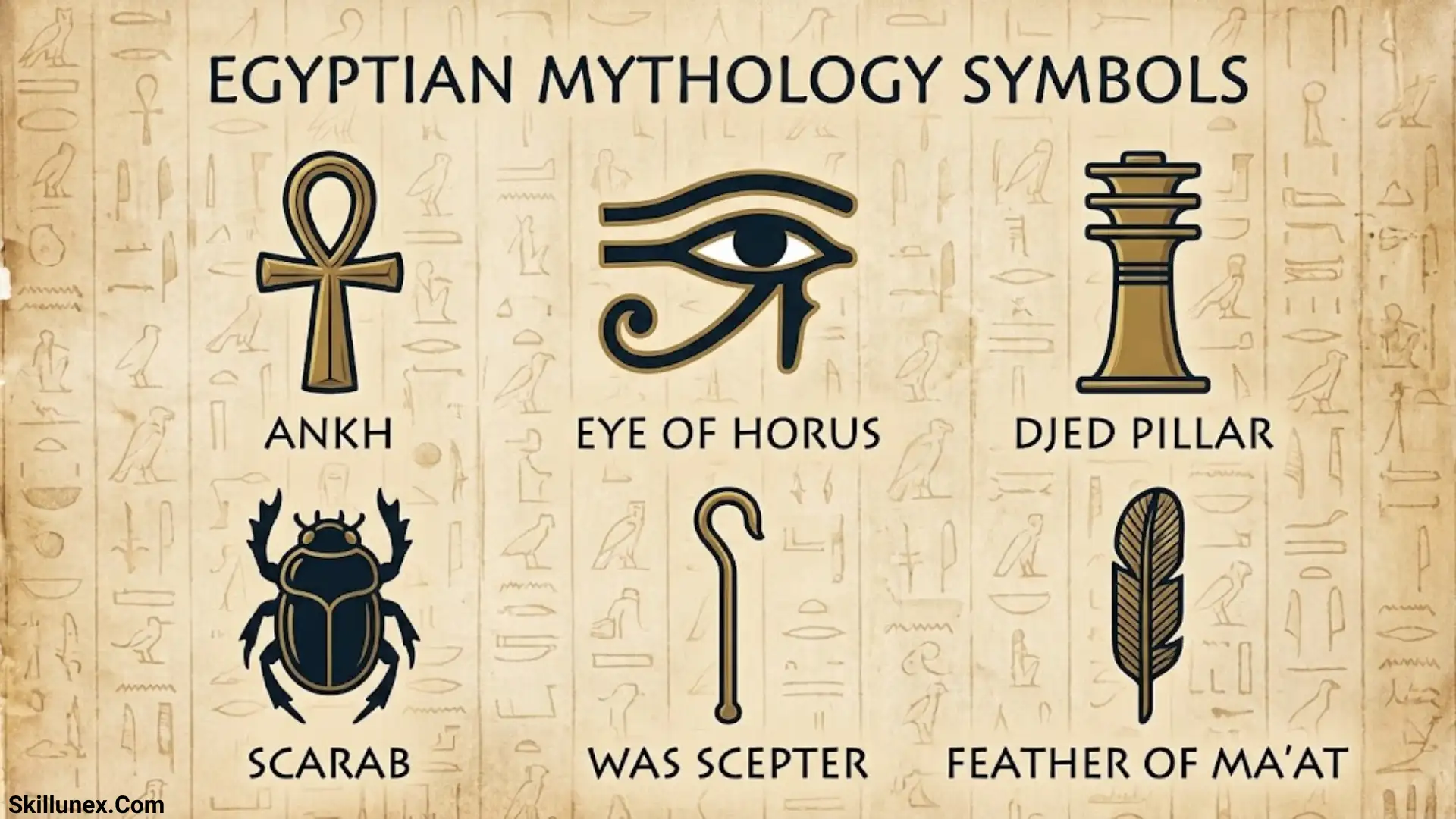
Egyptian mythology symbols reveal the fascinating beliefs, mysteries, and spiritual traditions of ancient Egypt. From the powerful Eye of Horus to the iconic Ankh, these symbols represented protection, life, wisdom, and divine power. If you are curious about ancient Egyptian culture, you can explore these symbols to discover the deeper meanings behind their shapes and connections to the gods.
When you explore Egyptian mythology symbols, you will find that each sign has its own story and significance. Some were believed to protect people from evil, while others represented eternal life, rebirth, and strength. You can also learn how ancient Egyptians used these symbols in temples, tombs, jewelry, and religious ceremonies to express their beliefs and honor their deities.
In this guide, you will discover the most famous Egyptian mythology symbols and their meanings in simple, easy to understand language. Whether you are researching ancient history, looking for tattoo inspiration, or simply interested in mythology, you can use this guide to understand these fascinating symbols and the stories that make them memorable.
What Are Egyptian Mythology Symbols?
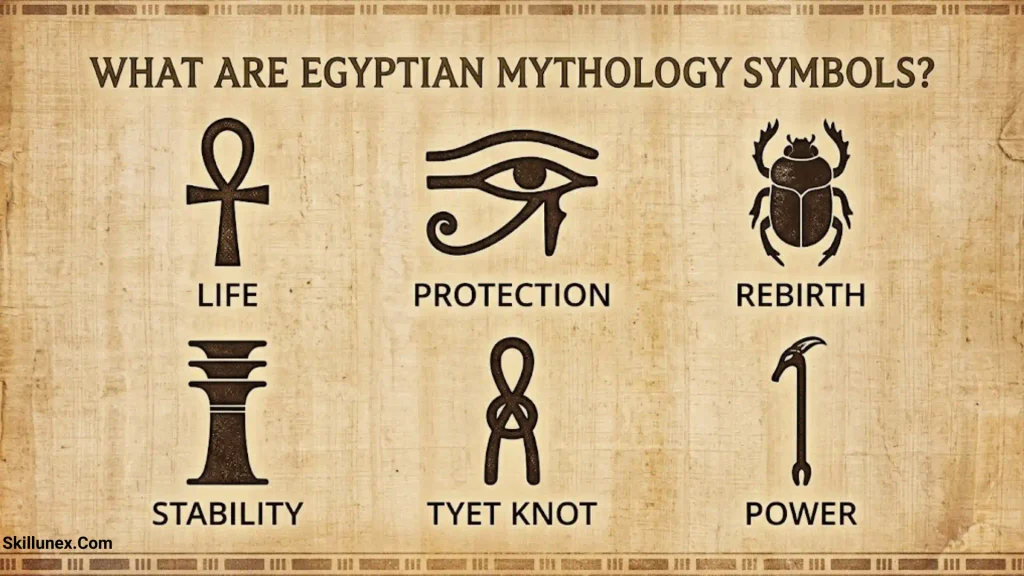
Egyptian mythology symbols are images, objects, and hieroglyphic signs associated with the religious beliefs, gods, rituals, and royal traditions of ancient Egypt. They helped communicate ideas that were central to Egyptian life, including creation, cosmic order, protection, fertility, and existence after death.
These symbols appeared in several forms. A temple carving might show a god holding an Ankh, while a funerary amulet might carry the Eye of Horus to provide symbolic protection. Pharaohs wore crowns decorated with divine symbols, and tomb paintings depicted scenes intended to help the deceased reach the afterlife.
Not every Egyptian symbol had a single fixed meaning. Its interpretation could depend on the historical period, the deity involved, and the setting in which it appeared. Understanding that context makes these symbols more meaningful than simply memorizing a list of definitions.
20 Egyptian Mythology Symbols and Their Meanings
1. Ankh Symbol (☥)
Meaning: Life, vitality, and eternal existence
The Ankh is one of the most recognizable symbols in ancient Egyptian mythology. It resembles a cross with an oval loop at the top and represents life and the continuation of existence.
The ancient Egyptian word ankh means “life.” Gods frequently appear holding the Ankh in temple reliefs and tomb paintings, sometimes presenting it to a pharaoh as a sign of divine life. The symbol also appeared on amulets, jewelry, and religious objects.
The Ankh’s connection to life made it important in religious beliefs about both the living and the dead. Today, people also use it in jewelry, tattoos, and artwork to represent life, spirituality, and a connection to ancient Egyptian culture.
2. Eye of Horus (𓂀)
Meaning: Protection, healing, restoration, and well-being
The Eye of Horus is also known as the Wedjat Eye. It combines human-like features with markings associated with a falcon’s eye, reflecting Horus’s connection to the falcon.
According to Egyptian mythology, Horus’s eye was injured during his conflict with Seth. The god Thoth restored it, turning the healed eye into a symbol of wholeness and regeneration. The ancient Egyptian term wedjat is associated with being sound or restored.
Ancient Egyptians wore Eye of Horus amulets to seek protection from harm. They also placed these objects in funerary settings, where the symbol was associated with healing and the restoration of the deceased.
What makes it important: The Eye of Horus represents the idea that something damaged can be restored. It is commonly associated with healing, safety, and recovery.
3. Eye of Ra
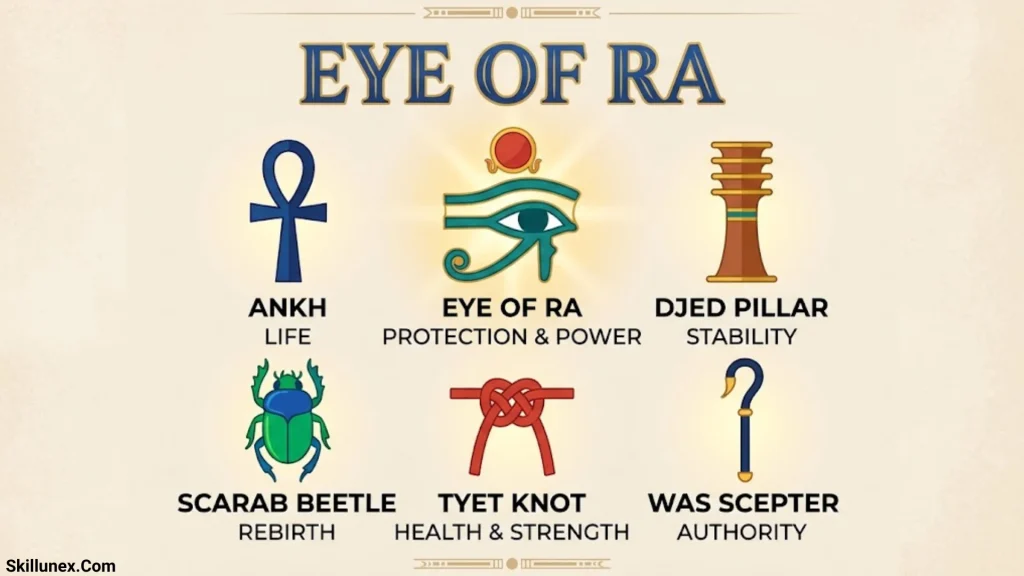
Meaning: Solar power, divine protection, and destructive force
The Eye of Ra represents the active power of Ra, the Egyptian sun god. It is associated with the sun’s strength, the defense of divine order, and the punishment of enemies.
In Egyptian mythology, the Eye of Ra could take the form of a powerful goddess. Sekhmet, Hathor, and other goddesses were associated with different versions of this solar power in particular myths and religious traditions.
The Eye of Ra and the Eye of Horus are sometimes confused because both are connected to protection. However, their mythological roles differ. The Eye of Horus is especially associated with healing and restoration, while the Eye of Ra often emphasizes the sun god’s force and ability to defend his authority.
What makes it important: The Eye of Ra expresses the sun’s life-giving power as well as its potentially destructive force.
4. Djed Pillar (𓊽)
Meaning: Stability, endurance, and resurrection
The Djed Pillar is a column-like symbol with several horizontal bars near its upper section. It is closely associated with Osiris, the god of the afterlife, regeneration, and the dead.
Its precise original form remains uncertain. However, Egyptian religious texts connect the Djed with the backbone of Osiris, and the symbol became associated with stability and endurance. The ritual of raising the Djed Pillar represented renewal and resurrection.
Djed amulets were used in funerary practices, and the symbol appeared on tombs, temple walls, and other religious objects.
What makes it important: The Djed Pillar represents the strength needed to endure, the restoration of life, and the victory over death.
5. Scarab Beetle (𓆣)
Meaning: Transformation, renewal, creation, and rebirth
The Scarab Beetle was one of the most significant creatures in ancient Egyptian symbolism. Its connection to the sun made it a natural symbol of renewal and the repeating cycles of life.
The scarab was associated with Khepri, a deity connected to the rising sun. Egyptians linked the beetle’s behavior of rolling a ball across the ground with the sun’s movement across the sky. They also connected the emergence of young beetles with ideas of new life and regeneration.
Scarab-shaped amulets were popular in ancient Egypt. Some carried protective inscriptions, while others bore royal names. Heart scarabs were also placed with mummies and used in funerary practices related to judgment in the afterlife.
What makes it important: The Scarab Beetle symbolizes new beginnings, personal transformation, and the renewal of life.
6. Was Scepter
Meaning: Divine authority, power, and dominion
The Was Scepter is a long staff with a distinctive forked base and an animal-shaped head. Egyptian gods frequently hold it in religious art, and it also appears in royal imagery.
The scepter represents authority and the power to maintain control. Its association with deities reflects the belief that divine forces upheld the order of the world. Pharaohs used related royal imagery to communicate their authority and their role in maintaining stability.
The Was Scepter also appears alongside other Egyptian symbols, including the Ankh and Djed Pillar. When combined, these objects can express ideas of life, stability, and power.
What makes it important: The Was Scepter represents the authority of gods and rulers, rather than simply physical strength.
7. Tyet Knot (Knot of Isis)
Meaning: Protection, magical power, and regeneration
The Tyet, often called the Knot of Isis or the Blood of Isis, resembles a knotted loop with two hanging ends. It is closely associated with Isis, a goddess known for motherhood, magic, healing, and protection.
The symbol appeared in amulets and funerary objects. Its association with Isis made it especially relevant to beliefs about divine assistance and protection after death.
Although the Tyet is sometimes compared with the Ankh because both have a looped form, they are distinct symbols. The Ankh represents life, while the Tyet is particularly associated with Isis and her protective powers.
What makes it important: The Tyet Knot represents protection through the power and care associated with Isis.
8. Feather of Ma’at
Meaning: Truth, justice, balance, and cosmic order
The Feather of Ma’at is one of the most meaningful symbols in Egyptian beliefs about morality and the afterlife. Ma’at was both a goddess and the personification of truth, justice, balance, and the proper order of the universe.
In scenes depicting the judgment of the dead, the deceased person’s heart was weighed against the Feather of Ma’at. This process represented whether the person’s actions had aligned with the principles of truth and justice.
The feather also appeared in religious inscriptions and images of gods and pharaohs. Its significance extended beyond personal morality because Ma’at represented the order that kept the world functioning.
What makes it important: The Feather of Ma’at symbolizes the responsibility to live according to truth, fairness, and balance.
9. Shen Ring
Meaning: Eternity, completeness, and protection
The Shen Ring is a loop of rope formed into a circular shape, often with a short extension at the bottom. Its closed circle represents something without a visible beginning or end.
Ancient Egyptian artists used the Shen Ring in religious and royal imagery. It could appear near a ruler or deity and was associated with protection and lasting existence. An elongated form of the ring also contributed to the development of the cartouche, which enclosed royal names.
The Shen Ring is particularly useful for understanding how ancient Egyptians represented abstract concepts through simple shapes.
What makes it important: The Shen Ring represents enduring protection and the idea of eternity.
10. Crook and Flail
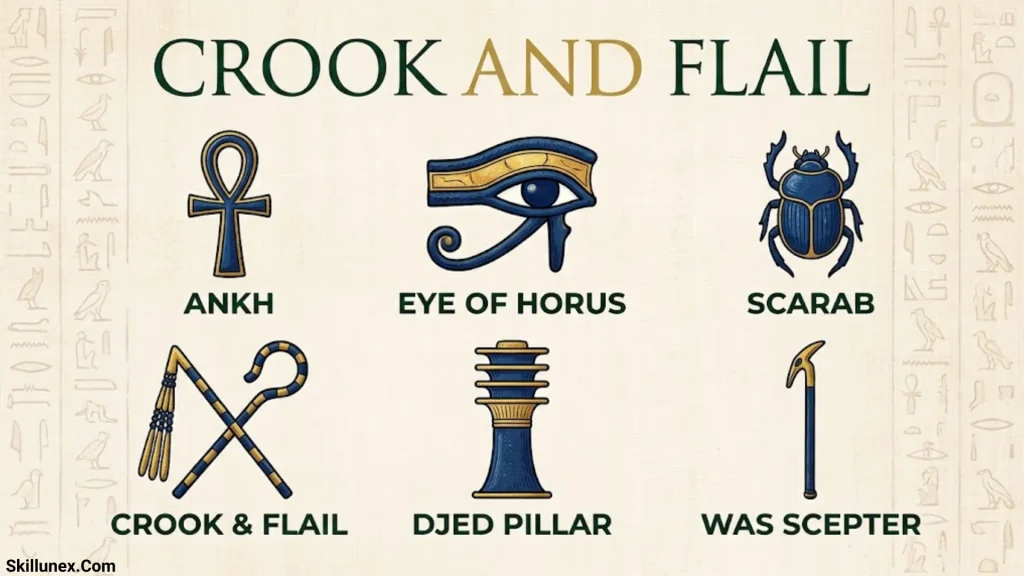
Meaning: Kingship, leadership, and royal authority
The crook and flail are two objects commonly depicted crossed over the chest of Osiris. They also became important symbols of Egyptian kingship.
The crook resembles a shepherd’s staff and is often interpreted as a sign of guidance and care. The flail is associated with royal authority and agricultural imagery. Together, they express the ruler’s role in governing and maintaining order.
Pharaohs used these objects in royal representations to connect their position with divine authority. Their appearance in depictions of Osiris also links kingship with death, regeneration, and the afterlife.
What makes it important: The crook and flail represent leadership and the responsibility that comes with power.
11. Uraeus Cobra
Meaning: Royal protection, authority, and defense
The Uraeus is an upright cobra commonly shown on the crowns and headdresses of Egyptian rulers. It is closely associated with Wadjet, a protective goddess linked to Lower Egypt.
In royal imagery, the cobra represented the ruler’s divine protection and ability to defend the kingdom. The raised cobra’s threatening posture made it an appropriate image for a guardian that could repel enemies.
The Uraeus also appears in depictions of Egyptian deities, particularly those associated with the sun and kingship.
What makes it important: The Uraeus Cobra represents a ruler’s protected status and the power to defend royal authority.
12. Lotus Flower (Sesen)
Meaning: Creation, renewal, rebirth, and the sun
The lotus flower appears frequently in ancient Egyptian art. It was associated with the emergence of life, renewal, and the daily cycle of the sun.
The blue water lily, commonly called the Egyptian blue lotus, held particular significance. Its opening and closing patterns provided a natural image of daily renewal. Some Egyptian creation traditions also connected a flower emerging from the primordial waters with the appearance of the sun.
Lotus designs decorated columns, jewelry, pottery, and temple scenes. The flower also appeared in artistic compositions involving gods, rulers, and ceremonial gatherings.
What makes it important: The Lotus Flower symbolizes the emergence of life, fresh beginnings, and the recurring cycle of renewal.
13. Bennu Bird
Meaning: Creation, renewal, and regeneration
The Bennu Bird is a mythological bird connected to Egyptian creation traditions and solar worship. It is sometimes compared with the Greek phoenix because both are associated with renewal, although their stories and historical backgrounds are not identical.
The Bennu was linked to the religious traditions of Heliopolis and to solar deities. Its imagery reflected the idea that life could emerge, renew itself, and continue through repeating cycles.
The bird also became associated with the beginning of creation and the restoration of life.
What makes it important: The Bennu Bird represents the possibility of renewal and the continuing cycle of creation.
14. Benben Stone
Meaning: Primordial creation and the emergence of life
The Benben Stone is associated with ancient Egyptian creation beliefs, particularly those connected to Heliopolis. It represented the first mound of land to emerge from the primordial waters.
In these traditions, the emergence of the mound marked the beginning of an ordered world. The Benben therefore became connected with creation and solar religion.
The pointed tops of obelisks and pyramid-shaped monuments are sometimes compared with the Benben Stone. However, the Benben was a specific religious concept and object, so it should not be treated as identical to every pyramidion or obelisk.
What makes it important: The Benben Stone represents the transition from the primordial waters to an ordered world.
15. Ka Symbol
Meaning: Vital life force and spiritual essence
The Ka was an important part of ancient Egyptian ideas about human existence. It is often represented by two raised arms and is commonly described as a person’s vital life force.
Egyptians believed that the Ka continued to matter after death. This helps explain the importance of funerary offerings, tombs, and statues, which supported the deceased within the religious understanding of continued existence.
The Ka was not exactly the same as the modern idea of a soul. Ancient Egyptian beliefs described several connected aspects of a person, each with its own role.
What makes it important: The Ka represents the vital essence that sustains a person and remains significant after death.
16. Ba Symbol
Meaning: Individual identity and spiritual personality
The Ba is commonly depicted as a bird with a human head. It represented an aspect of a person’s individuality and spiritual identity.
In Egyptian beliefs about death, the Ba could move between the tomb and the world beyond it. This movement helped express how the deceased could remain connected to places, people, and aspects of existence after physical death.
The Ba worked alongside other parts of the person, including the Ka. These concepts formed a complex religious understanding of identity rather than a simple division between body and soul.
What makes it important: The Ba represents the distinctive personality and continuing identity of an individual.
17. Cartouche
Meaning: Royal identity, protection, and lasting remembrance
A cartouche is an elongated oval that surrounds a royal name written in Egyptian hieroglyphs. It is one of the most useful symbols for identifying ancient Egyptian rulers in inscriptions and monuments.
The enclosed name could appear on temple walls, statues, jewelry, and other royal objects. The cartouche was associated with the protection of the ruler’s name and the preservation of royal identity.
Historians use cartouches to identify pharaohs and study royal titles. They are particularly helpful when interpreting inscriptions that contain several names or titles.
What makes it important: The cartouche connects royal identity with the desire for protection and remembrance.
18. Atef Crown
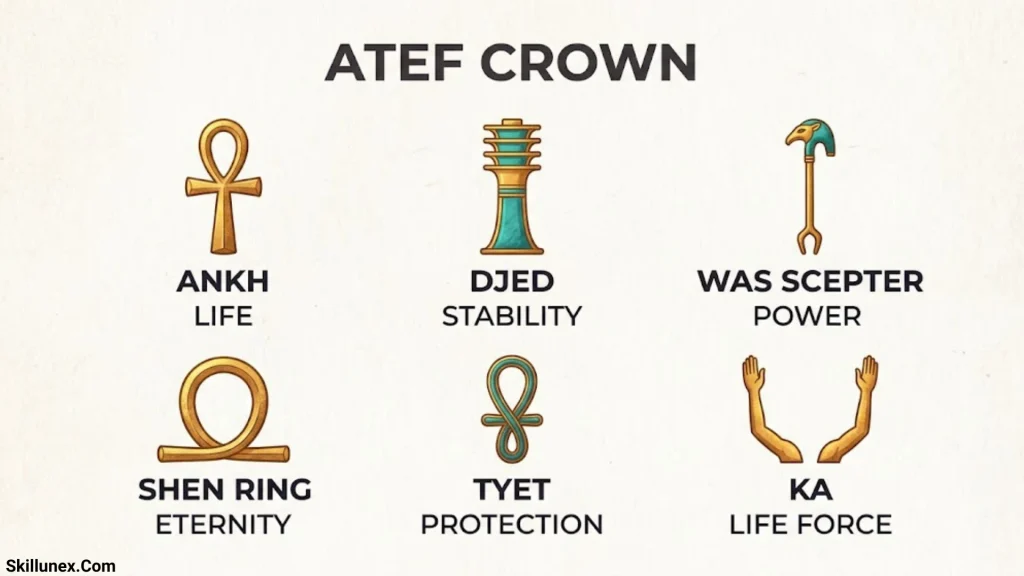
Meaning: Osiris, divine kingship, and the afterlife
The Atef Crown is a distinctive crown associated with Osiris. It usually features a tall central white crown flanked by ostrich feathers, sometimes with additional decorative elements.
Osiris was a major deity associated with the dead, regeneration, and the afterlife. The Atef Crown helped identify him in religious art and connected his image with divine authority.
The crown also appeared in some representations of other deities and rulers, depending on the period and context.
What makes it important: The Atef Crown represents the divine authority of Osiris and his role in the afterlife.
19. Sun Disk
Meaning: Solar power, light, creation, and life
The Sun Disk is a circular image representing the sun and its connection to divine power. It is strongly associated with Ra, one of ancient Egypt’s principal solar gods.
The sun played a central role in Egyptian religious thought because its daily journey across the sky offered a powerful image of recurring life and renewal. Solar symbols also appeared in the worship of other deities, including forms associated with the combined god Amun-Ra.
A sun disk could appear alone or with other features, such as a cobra. Those additional details could change the meaning of the complete image.
What makes it important: The Sun Disk represents the sun’s role in creation, daily renewal, and divine authority.
20. Amenta
Meaning: The western horizon, death, and the afterlife
Amenta is a term associated with the western region and the realm of the dead in ancient Egyptian religious thought. It is better understood as a concept connected to the afterlife than as one universally standardized symbol.
The west held special significance because the sun appeared to disappear beyond the horizon each evening. This daily event offered a natural connection between the setting sun, death, and the journey into another realm.
Amenta is therefore associated with burial, transition, and the world of the deceased. Its meaning depends on the religious text or context in which it appears.
What makes it important: Amenta reflects the ancient Egyptian connection between the setting sun, the western horizon, and existence after death.
Egyptian Mythology Symbols and Their Meanings Chart
The following chart provides a quick reference to the 20 symbols, their main meanings, and their connections to Egyptian mythology.
| Egyptian Symbol | Main Meaning | Associated Deity or Concept |
| Ankh (☥) | Life and eternity | Life and divine power |
| Eye of Horus | Healing and protection | Horus |
| Eye of Ra | Solar power and defense | Ra |
| Djed Pillar | Stability and resurrection | Osiris |
| Scarab Beetle | Renewal and transformation | Khepri |
| Was Scepter | Authority and power | Egyptian gods and rulers |
| Tyet Knot | Protection and magic | Isis |
| Feather of Ma’at | Truth and justice | Ma’at |
| Shen Ring | Eternity and protection | Royal and divine imagery |
| Crook and Flail | Kingship and leadership | Osiris and pharaohs |
| Uraeus Cobra | Royal protection | Wadjet |
| Lotus Flower | Creation and rebirth | Solar and creation traditions |
| Bennu Bird | Creation and renewal | Solar mythology |
| Benben Stone | Primordial creation | Heliopolis creation traditions |
| Ka | Vital life force | Human spiritual existence |
| Ba | Individual identity | Beliefs about the afterlife |
| Cartouche | Royal identity | Pharaohs |
| Atef Crown | Divine kingship and afterlife | Osiris |
| Sun Disk | Light and solar power | Ra and other solar deities |
| Amenta | Death and the western realm | Afterlife traditions |
Egyptian Mythology Symbols Associated With Gods and Goddesses
Many Egyptian symbols become easier to understand when you know which deities they represent. These connections were not always exclusive, and some symbols appeared with multiple gods across different periods.
| God or Goddess | Important Symbol or Association | Main Theme |
| Ra | Sun Disk and Eye of Ra | Solar power and creation |
| Horus | Eye of Horus | Protection and restoration |
| Osiris | Djed Pillar and Atef Crown | Resurrection and the afterlife |
| Isis | Tyet Knot | Magic and protection |
| Khepri | Scarab Beetle | Renewal and the rising sun |
| Ma’at | Ostrich Feather | Truth, justice, and balance |
| Wadjet | Uraeus Cobra | Royal protection |
| Thoth | Ibis and baboon imagery | Wisdom, writing, and knowledge |
These associations help explain why Egyptian religious art often combines symbols, animals, crowns, and objects. The imagery communicates a deity’s role or power rather than serving only as decoration. The Metropolitan Museum of Art and the British Museum provide examples of these traditions in their collections and educational resources.
Egyptian Mythology Symbols Tattoos
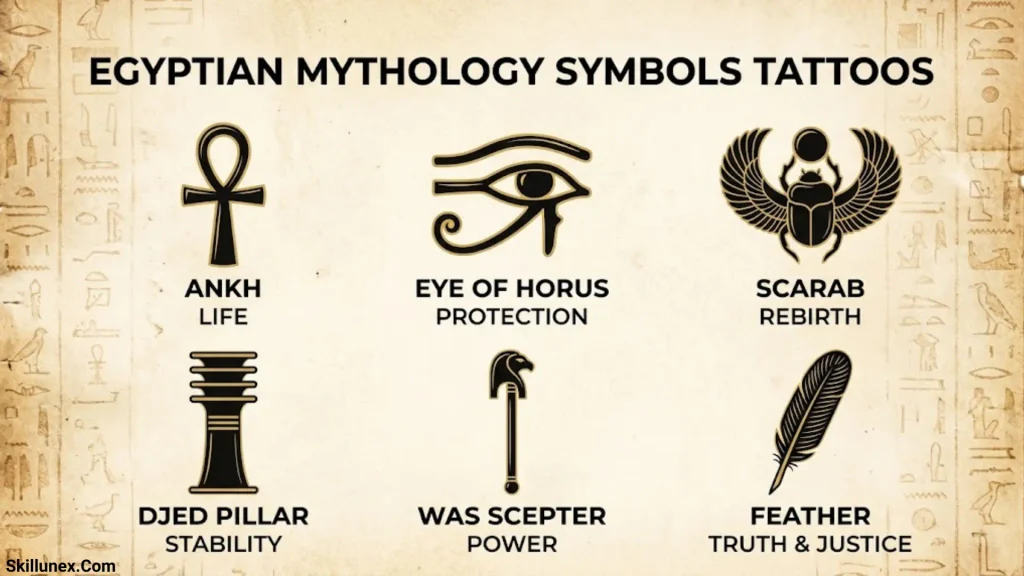
Egyptian mythology symbols tattoos appeal to people who want body art with historical meaning, spiritual associations, or a distinctive ancient design. Some people choose these tattoos to represent strength and protection, while others prefer symbols connected with life, transformation, wisdom, or eternity.
Before choosing a design, I recommend learning what the symbol represents and how it was used in ancient Egyptian culture. This helps you select a tattoo that reflects your personal meaning rather than choosing a design based only on its appearance.
Here are popular Egyptian mythology symbols you can consider for a tattoo.
- Ankh Tattoo: A meaningful choice for people who associate life with hope, vitality, and eternity.
- Eye of Horus Tattoo: Often chosen to represent protection, healing, and spiritual awareness.
- Eye of Ra Tattoo: A bold design associated with solar power, authority, and divine strength.
- Scarab Beetle Tattoo: Suitable for representing personal growth, renewal, and new beginnings.
- Anubis Tattoo: Features the jackal-headed god associated with mummification and the protection of the dead.
- Isis Tattoo: Can represent motherhood, devotion, magic, and protection through its association with the goddess Isis.
- Osiris Tattoo: Connected with resurrection, regeneration, and the afterlife.
- Djed Pillar Tattoo: A design associated with stability, endurance, and strength.
- Lotus Flower Tattoo: Represents renewal and creation in Egyptian religious imagery.
- Ankh and Eye of Horus Combination: Combines symbols associated with life and protection in a single design.
You can choose a small symbol for your wrist, forearm, ankle, or behind your ear. Larger designs can incorporate hieroglyphs, Egyptian gods, pyramids, or detailed temple-inspired artwork.
However, remember that Egyptian hieroglyphs are a writing system, not simply decorative symbols. If you want to include Egyptian writing in your tattoo, verify the intended wording and its historical interpretation before getting the design permanently inked.
Egyptian Symbols Text
Egyptian symbols text generally refers to Egyptian-inspired symbols, hieroglyphic characters, and decorative designs that people want to copy into messages, social media bios, usernames, or digital artwork.
Ancient Egyptian hieroglyphs used pictures and signs to represent sounds, words, and ideas. They were carved into monuments and tombs and written on materials such as papyrus. Modern digital text, however, does not support every ancient Egyptian sign in the same way, so not every symbol you see online is an authentic hieroglyph.
If you want Egyptian-style text for your content, these are useful symbols and their traditional associations:
| Symbol or sign | Common meaning or association |
| Ankh (☥) | Life and eternity |
| Eye of Horus | Protection and healing |
| Scarab Beetle | Renewal and rebirth |
| Djed Pillar | Stability and endurance |
| Was Scepter | Power and authority |
| Shen Ring | Protection and eternity |
| Tyet Knot | Protection and the goddess Isis |
| Lotus Flower | Creation and renewal |
The Ankh character (☥) is a recognizable Egyptian symbol that you can copy and use in compatible digital applications. Other Egyptian signs may require a specialized font, an image, or a Unicode character that your device supports.
If your goal is to write a name in ancient Egyptian hieroglyphs, you should know that hieroglyphic writing does not always translate modern names letter by letter. The result depends on the sounds of the name, the transcription method, and the historical conventions being followed.
For accurate results, distinguish between authentic hieroglyphs, modern decorative icons, and symbols inspired by Egyptian mythology.
Egyptian Symbols Name
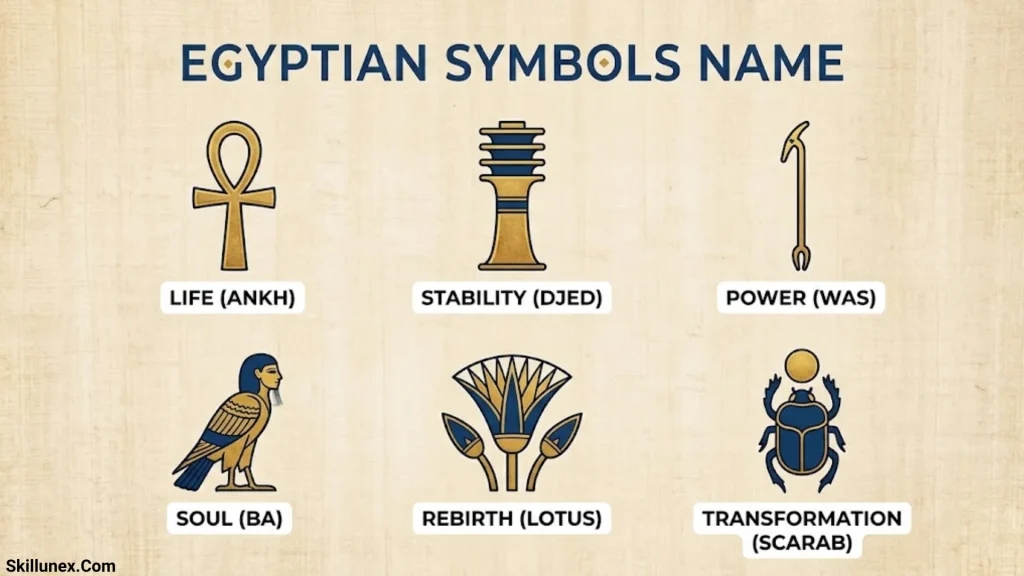
Egyptian symbols have different names, shapes, and cultural associations. Some are connected to specific gods, while others represent broader ideas such as life, balance, protection, and rebirth. Learning their names makes it easier to identify them in ancient Egyptian art, jewelry, tattoos, and historical illustrations.
Below is a list of well known Egyptian symbols and the ideas associated with them.
| Egyptian symbol name | Meaning or association |
| Ankh | Life and eternal existence |
| Eye of Horus | Protection, healing, and restoration |
| Eye of Ra | Solar power and divine authority |
| Scarab Beetle | Rebirth and renewal |
| Djed Pillar | Stability and endurance |
| Was Scepter | Power and authority |
| Shen Ring | Protection and eternity |
| Tyet Knot | Protection and Isis |
| Feather of Ma’at | Truth, justice, and balance |
| Lotus Flower | Creation and renewal |
| Crook and Flail | Kingship and royal authority |
| Bennu Bird | Renewal and creation |
| Uraeus | Royal power and protection |
| Sesen | The lotus flower and its symbolic associations |
| Cartouche | An oval enclosure around a royal name |
| Solar Disk | The sun and solar divinity |
| Ba Bird | An aspect of the individual associated with personality and movement between worlds |
| Ka | A vital aspect of a person in ancient Egyptian belief |
| Akh | A transformed, effective spirit in Egyptian religious belief |
| Canopic Jar | Funerary practices and the preservation of internal organs |
Some names refer to objects, such as the Djed Pillar and Was Scepter, while others refer to religious concepts or figures, such as the Ka, Akh, and Bennu Bird. A cartouche is different from a symbol representing a single idea because it encloses the name of a king or another royal figure.
When researching Egyptian symbols, pay attention to spelling variations. For example, Sesen is a term used for the lotus flower, while Tyet may also be called the Knot of Isis. These names can help you find more detailed historical information and understand how the symbols were used in ancient Egyptian religion and culture.
Frequently Asked Questions About Egyptian Mythology Symbols
What Is the Most Famous Egyptian Mythology Symbol?
The Ankh is among the most recognizable Egyptian mythology symbols. Its looped cross shape represents life and continued existence. The Eye of Horus and Scarab Beetle are also widely recognized because of their associations with protection, healing, and rebirth.
What Is the Egyptian Symbol for Protection?
The Eye of Horus is one of the best-known Egyptian symbols of protection. Ancient Egyptians used its image on amulets and funerary objects. The Uraeus Cobra and Tyet Knot also have important protective associations.
What Is the Egyptian Symbol for Eternal Life?
The Ankh is the principal Egyptian hieroglyph for life and is commonly associated with eternal life. Other symbols, including the Djed Pillar and Shen Ring, connect with endurance, resurrection, or eternity.
What Is the Difference Between the Eye of Horus and the Eye of Ra?
The Eye of Horus is particularly associated with healing, restoration, wholeness, and protection. The Eye of Ra represents the sun god’s active power, including protection and the ability to defeat enemies. Both can be protective, but their mythological roles differ.
What Does the Scarab Beetle Symbolize in Egyptian Mythology?
The Scarab Beetle symbolizes renewal, transformation, creation, and rebirth. It is associated with Khepri, a deity connected to the rising sun. Scarab amulets were also used in protective and funerary contexts.
What Is the Egyptian Symbol for Strength and Stability?
The Djed Pillar represents stability, endurance, and resurrection. Its association with Osiris made it especially important in ancient Egyptian religious traditions concerning death and the afterlife.
What Does the Feather of Ma’at Represent?
The Feather of Ma’at represents truth, justice, balance, and cosmic order. In Egyptian beliefs about the afterlife, it was used in the symbolic weighing of the deceased person’s heart.
Are Egyptian Mythology Symbols Still Used Today?
Yes. People use Egyptian symbols in jewelry, tattoos, art, fashion, and cultural designs. Their modern interpretations can differ from their ancient religious meanings, so it helps to understand the historical context before choosing a symbol for personal use.
Conclusion
Egyptian mythology symbols reveal how ancient Egyptians understood life, creation, protection, royal authority, and the afterlife. The Ankh represents life, the Eye of Horus symbolizes healing and protection, the Djed Pillar stands for stability and resurrection, and the Scarab Beetle reflects renewal and transformation. Other symbols, including the Feather of Ma’at, Uraeus Cobra, and Benben Stone, offer further insight into Egyptian beliefs about justice, divine power, and creation.
Understanding these symbols involves more than memorizing their meanings. Their connections to gods, religious practices, tombs, and royal traditions help explain why they mattered to ancient Egyptians. Whether you’re researching Egyptian mythology, studying ancient art, or exploring a symbol for a tattoo or design, its historical context can give you a deeper appreciation of this remarkable civilization.

Isla Kensington
I’m Isla Kensington, a writer with a passion for research, culture, nature, and the fascinating meanings behind everyday things. I enjoy taking topics that may seem simple at first and discovering the history, facts, and ideas that make them more interesting.
I write with readers in mind. My aim is to provide clear explanations, useful information, and interesting details without making a topic unnecessarily complicated.
I believe learning should feel like discovering something rather than simply reading facts. That philosophy guides the content I create and the topics I choose to explore.
## Books by Isla Kensington
* Symbols Around the World: A Guide to Meaning & Culture
* Nature’s Beautiful Places: Lakes, Landscapes & Natural Treasures