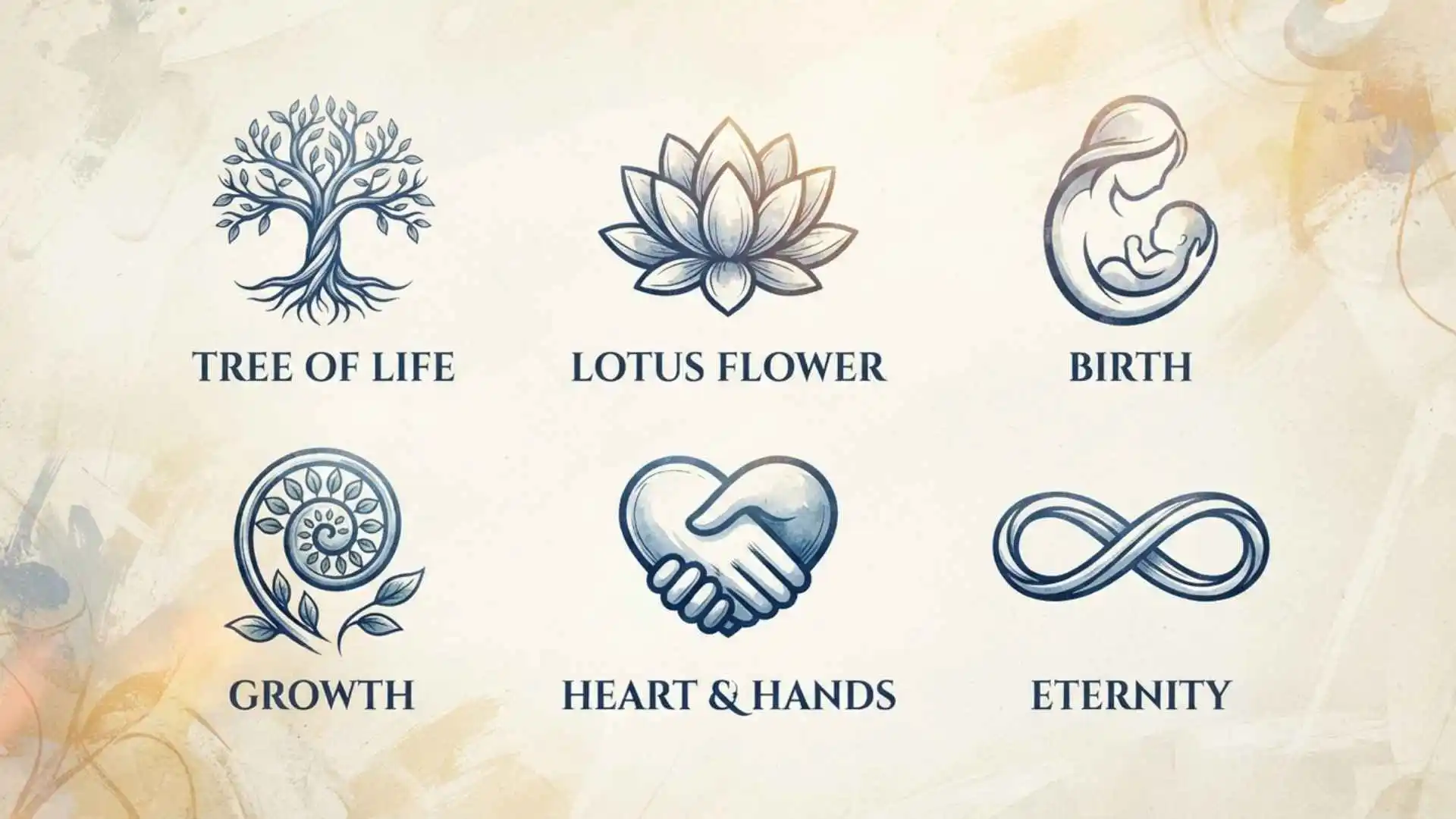
Art has always been more than shapes, colors, and beautiful images. Across different cultures and historical periods, artists have used symbols in art to communicate ideas that may not be obvious at first glance. A flower can represent love or mortality, a dove can suggest peace, and a skull can remind viewers of death and the passage of time.
Understanding symbols of art can make paintings, sculptures, religious artworks, and modern visual art much easier to interpret. Some symbols have meanings that are widely recognized, while others depend on the culture, time period, artist, and context in which they appear.
This guide explores the most common symbols in art, what they traditionally represent, how their meanings developed, and why artists continue to use symbolism today.
What Are Symbols in Art?
A symbol in art is an object, figure, color, gesture, or visual element that represents an idea beyond its literal appearance.
How Do Art Symbols Work?
Artists use symbols to communicate concepts that may be difficult to express directly. Instead of simply writing “this person represents wisdom,” an artist might place a book, owl, lamp, or other culturally meaningful object nearby.
The same object can also have different meanings depending on its context. A rose may represent romantic love in one artwork but mortality or secrecy in another.
This is why interpreting symbolism requires more than memorizing a list of meanings. Viewers should consider:
- The artist and their intentions
- The historical period
- The culture in which the artwork was created
- Religious or mythological traditions
- The objects surrounding the symbol
- The colors and composition
- The title and subject of the artwork
Why Do Artists Use Symbols?
Symbols allow artists to communicate several layers of meaning at once.
A painting can tell a literal story while also making a philosophical, religious, political, or emotional statement. Symbolism can also invite viewers to look more carefully and discover meanings gradually.
In historical art, symbols were especially useful because many viewers understood established visual conventions. Religious paintings, for example, frequently used recognizable objects to identify saints, communicate virtues, or illustrate biblical stories.
The Most Common Symbols in Art and Their Meanings
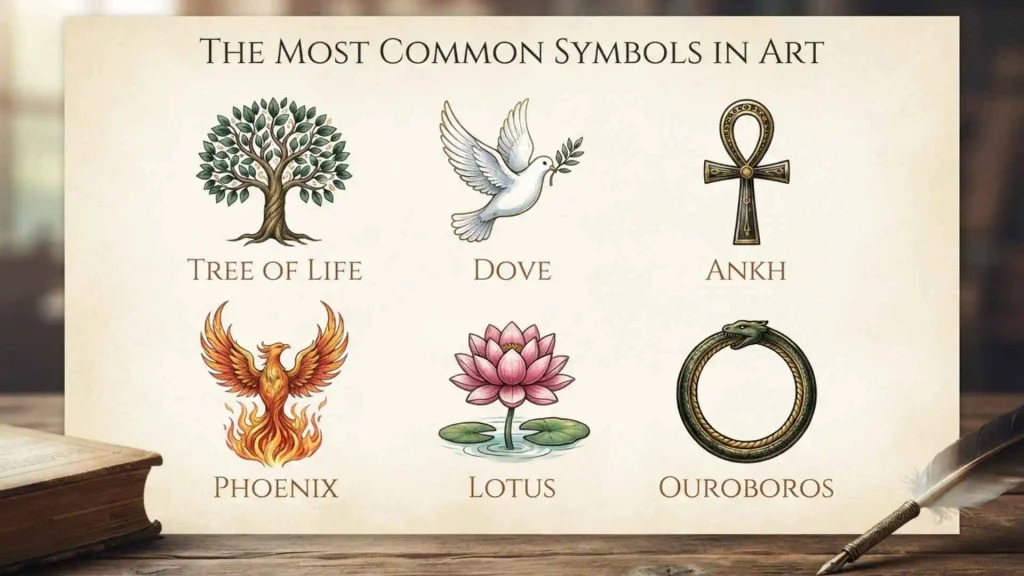
There is no universal dictionary of artistic symbols, but certain images appear repeatedly throughout the history of art.
The Rose
The rose is one of the most recognizable symbols in art.
It commonly represents:
- Love and romance
- Beauty
- Passion
- Purity
- Mortality
- Secrecy
Its meaning depends heavily on context. A fresh red rose can suggest romantic love, while a fading or dying rose may emphasize the temporary nature of beauty.
In Christian art, the rose has also acquired religious meanings, particularly in connection with the Virgin Mary and spiritual love.
The Dove
The dove is widely associated with peace, but its symbolism is broader.
In Christian art, a dove can represent the Holy Spirit, particularly in depictions of the Baptism of Christ. In other contexts, it can represent peace, innocence, purity, hope, or reconciliation.
The meaning becomes clearer when the dove is considered alongside other elements in the artwork.
The Skull
A skull is a powerful symbol of mortality and death.
It frequently appears in vanitas and memento mori artworks, particularly in European art. These traditions encourage viewers to remember that human life is temporary.
A skull may symbolize:
- Death
- Mortality
- The passage of time
- The temporary nature of worldly possessions
- Human equality in death
In contemporary art, skull imagery can also represent rebellion, danger, identity, or popular culture rather than mortality alone.
The Hourglass
An hourglass commonly represents the passage of time.
When paired with a skull, extinguished candle, wilting flower, or other vanitas imagery, it can reinforce the idea that human life is temporary.
The hourglass reminds viewers that time continuously moves forward and cannot be recovered.
The Candle
A candle can have several symbolic meanings in art.
A burning candle may represent:
- Life
- Hope
- Faith
- Spiritual illumination
- Knowledge
An extinguished candle, on the other hand, can suggest death or the end of life.
The surrounding imagery matters. A candle shining in darkness might emphasize hope or spiritual enlightenment, while a candle going out may reinforce themes of mortality.
The Mirror
The mirror is a particularly interesting artistic symbol because it can represent both truth and illusion.
Depending on the artwork, a mirror may suggest:
- Self-knowledge
- Vanity
- Beauty
- Identity
- Truth
- Illusion
- Self-reflection
In European art, mirrors frequently appeared in works concerned with vanity and the temporary nature of physical beauty.
The Book
A book often represents knowledge, learning, wisdom, or religious teaching.
In religious paintings, a book may identify a particular saint or represent scripture. In portraits, it can suggest that the person depicted is educated or intellectually accomplished.
However, the exact meaning depends on what book is shown and who is holding it.
The Apple
The apple has a particularly complicated history of symbolism.
In Western Christian art, an apple may be associated with the Fall of Man and the story of Adam and Eve. The association became widespread in Western tradition even though the biblical Book of Genesis does not specifically identify the forbidden fruit as an apple.
An apple can therefore represent:
- Temptation
- Knowledge
- Sin
- The Fall
- Desire
In other contexts, however, the apple can have completely different meanings.
The Serpent or Snake
The snake can represent both positive and negative concepts.
Depending on cultural and religious context, it may symbolize:
- Temptation
- Evil
- Rebirth
- Transformation
- Healing
- Wisdom
- Eternity
The snake’s ability to shed its skin has made it a powerful image of renewal and transformation. In other traditions, however, snakes are connected with danger or temptation.
The Lion
The lion is commonly associated with strength, courage, power, and royalty.
Artists have used lions in religious, political, and heraldic imagery for centuries.
A lion may represent:
- Courage
- Authority
- Strength
- Leadership
- Nobility
- Protection
Its meaning can change depending on whether it appears beside a ruler, saint, deity, or mythical figure.
Symbols of Nature in Art
Nature has provided artists with a huge vocabulary of symbolic imagery.
Flowers
Flowers can symbolize different emotions and ideas depending on their type, color, condition, and cultural context.
Common associations include:
- Rose — love or beauty
- Lily — purity
- Sunflower — devotion or vitality
- Poppy — remembrance or sleep
- Iris — faith, wisdom, or royalty in certain traditions
- Chrysanthemum — meanings that vary significantly across cultures
These associations are not universal. A flower’s meaning should always be interpreted within the specific artwork.
Trees
Trees frequently symbolize life, growth, strength, knowledge, and the connection between earth and heaven.
A tree with deep roots can suggest stability and ancestry, while a bare or dead tree may represent loss, winter, or mortality.
The Tree of Life is one of the most widespread symbolic concepts in world art and mythology, although its precise meaning varies among traditions.
Water
Water is often used to symbolize cleansing, renewal, transformation, life, and spirituality.
Calm water can suggest peace or reflection, while turbulent water may represent emotional conflict, danger, or uncertainty.
Water can also have important religious meanings. In Christian art, for example, water can be associated with baptism and spiritual renewal.
Mountains
Mountains often represent strength, permanence, spiritual elevation, or a journey toward enlightenment.
In religious and mythological art, mountains can serve as places where humans encounter the divine.
A mountain’s height can also symbolize ambition, challenge, or the difficult path toward a goal.
Symbols of Color in Art
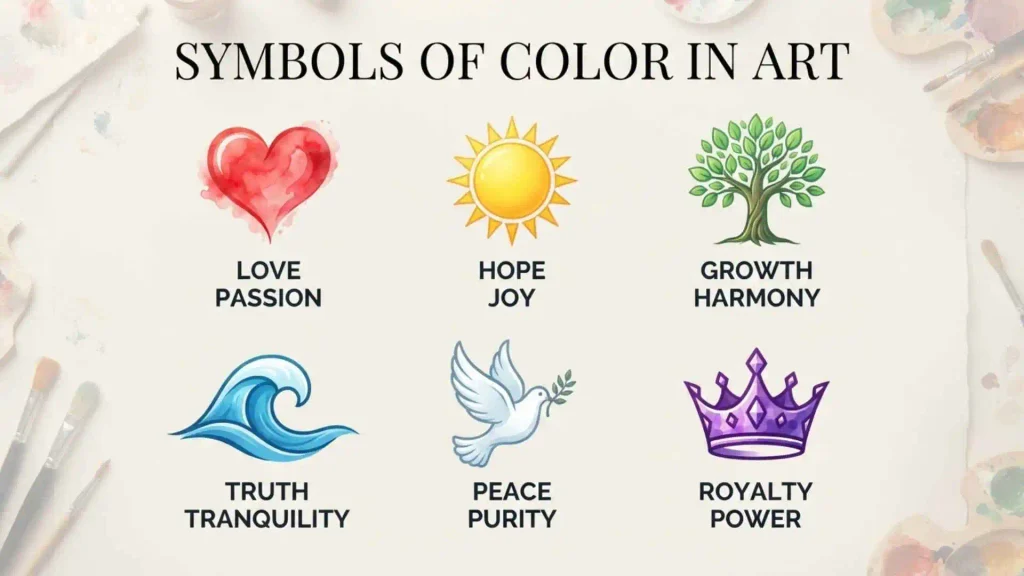
Color symbolism can add another layer of meaning to an artwork, but color meanings are not universal.
Red
Red is frequently associated with:
- Love
- Passion
- Power
- Violence
- Blood
- Sacrifice
- Danger
Its meaning depends heavily on the subject and cultural context.
Blue
Blue can suggest:
- Calm
- Spirituality
- Sadness
- Loyalty
- Distance
- Tranquility
Blue has also had particular significance in religious art. In Western Christian painting, blue became strongly associated with the Virgin Mary.
White
White can represent:
- Purity
- Innocence
- Peace
- Spirituality
- Light
- Death or mourning in some cultures
This is a good example of why viewers should avoid treating symbolism as universal. In some cultures, white is associated with mourning rather than celebration.
Black
Black can represent:
- Death
- Mystery
- Power
- Mourning
- Darkness
- Elegance
- The unknown
Artists can also use black simply for compositional or realistic purposes, so its presence does not automatically indicate symbolic meaning.
Gold
Gold has traditionally been associated with:
- Wealth
- Power
- Divinity
- Glory
- Eternity
- Sacredness
Gold backgrounds were particularly important in Byzantine and medieval religious art, where they could create a sense of an otherworldly or divine space.
Religious Symbols in Art
Religion has played a major role in the development of artistic symbolism.
The Cross
The cross is one of the most recognizable symbols in Christian art.
It represents the crucifixion of Jesus Christ and, within Christianity, is closely connected with salvation, sacrifice, resurrection, and faith.
Its appearance can vary significantly across Christian traditions.
The Halo
A halo or aureole is a circular or luminous element surrounding the head of a sacred figure.
It generally represents holiness, spiritual illumination, or divine status.
Halos appear in many traditions of religious art, although their designs and meanings vary across cultures and periods.
The Fish
The fish has an important place in Christian symbolism.
The early Christian ichthys became a recognizable symbol associated with Christ and Christian faith. Fish also appear in biblical stories involving Jesus and his disciples.
The Lamb
The lamb can represent innocence, sacrifice, and Christ in Christian art.
The phrase “Lamb of God” is particularly important to Christian symbolism and theology.
Symbols of Love, Life, and Death
Artists have long used symbols to explore the biggest human experiences.
Symbols of Love
Common artistic symbols of love include:
- Hearts
- Roses
- Doves
- Paired birds
- Rings
- Cupid
- Hands joined together
But context matters. A broken heart, wilted flower, or separated pair of figures can transform an image of love into one of loss.
Symbols of Life
Life can be represented through:
- Newborn children
- Spring
- Growing plants
- Eggs
- Rising suns
- Water
- Trees
These symbols often emphasize renewal, fertility, growth, and continuation.
Symbols of Death
Death is frequently represented through:
- Skulls
- Skeletons
- Withered flowers
- Extinguished candles
- Fallen leaves
- Clocks and hourglasses
- Graves
- Black clothing
These images are especially prominent in memento mori and vanitas traditions.
Symbols in Famous Artworks
Symbolism becomes easier to understand when examined in actual works of art.
The Arnolfini Portrait
Jan van Eyck’s Arnolfini Portrait is famous for the number of objects that have inspired symbolic interpretations.
The chandelier, mirror, clothing, dog, fruit, and other details have all been examined by art historians for their possible meanings.
The painting demonstrates an important point: objects in art may have several possible interpretations, and scholars sometimes disagree about exactly what an artist intended.
The Last Supper
Leonardo da Vinci’s The Last Supper contains numerous visual and religious elements that contribute to its meaning.
The central position of Christ, the arrangement of the apostles, gestures, architectural space, and objects on the table all contribute to the narrative.
Rather than interpreting one object in isolation, viewers can understand the symbolism by considering the entire composition.
Vanitas Paintings
Seventeenth-century European vanitas paintings provide some of the clearest examples of deliberate symbolism.
Artists combined objects such as:
- Skulls
- Books
- Musical instruments
- Flowers
- Watches
- Hourglasses
- Candles
- Jewelry
These objects encouraged viewers to consider mortality, time, knowledge, wealth, and the temporary nature of worldly pleasures.
How to Interpret Symbols in Art
Learning art symbolism is not simply about memorizing what each object supposedly means.
Start With the Historical Context
First ask:
When and where was the artwork created?
A symbol used in Renaissance Italy may have a very different meaning from a similar image in Japanese, Egyptian, Islamic, African, or contemporary art.
Identify the Subject
Ask what is actually happening in the artwork.
Is it:
- A religious scene?
- A portrait?
- A funeral image?
- A mythological story?
- A political statement?
- A landscape?
- A still life?
The subject provides clues about the symbolism.
Look at Multiple Symbols Together
Individual objects rarely tell the whole story.
A skull by itself might represent death. A skull next to an hourglass, dying flower, and extinguished candle creates a much stronger message about the passage of time and mortality.
Consider the Artist
An artist’s biography, writings, commissions, and other works can provide important clues.
However, it is important not to assume that every detail was deliberately encoded with a hidden meaning. Sometimes an object is simply part of the scene.
Avoid Treating Symbolism as a Universal Code
Perhaps the most important rule is this:
There is no universal dictionary of art symbols.
The same image can mean different things in different cultures and periods.
A snake may represent evil in one work and healing or renewal in another. White may symbolize purity in one culture and mourning in another.
Good interpretation combines established historical knowledge with careful observation of the individual artwork.
Why Symbols Still Matter in Modern Art

Symbolism did not disappear when traditional religious and historical painting became less dominant.
Symbols in Contemporary Art
Modern and contemporary artists continue to use recognizable objects, colors, bodies, animals, and cultural references to discuss:
- Politics
- Identity
- Gender
- Race and society
- Environmental issues
- Consumer culture
- War
- Memory
- Personal experience
The difference is that contemporary artists often deliberately challenge traditional meanings.
An artist might use a familiar symbol and change its meaning by placing it in an unexpected context.
Symbols in Popular Culture
Symbolic imagery is also everywhere in modern visual culture.
Logos, advertisements, films, tattoos, album artwork, video games, photography, and social media graphics all rely on symbols to communicate ideas quickly.
This shows that symbolism is not merely an old artistic technique. It remains a fundamental part of visual communication.
Frequently Asked Questions
What are symbols in art?
Symbols in art are visual elements that represent ideas beyond their literal appearance. They can include objects, animals, colors, gestures, plants, religious imagery, and figures.
What is the most common symbol in art?
There is no single universal symbol, but images such as the cross, heart, dove, rose, skull, tree, and serpent have appeared frequently across different artistic traditions.
What does a rose symbolize in art?
A rose commonly symbolizes love, beauty, passion, purity, or mortality. Its meaning depends on its color, condition, surrounding imagery, and cultural context.
What does a skull symbolize in art?
A skull commonly represents death, mortality, and the temporary nature of life. In vanitas and memento mori art, it often reminds viewers that worldly possessions and human life do not last forever.
What does a dove symbolize in art?
A dove can represent peace, innocence, purity, hope, or the Holy Spirit. Its precise meaning depends on the cultural and religious context of the artwork.
What do colors symbolize in art?
Colors can communicate emotions and ideas, but their meanings vary by culture and context. Red may suggest love, passion, blood, or danger, while blue can suggest calm, spirituality, sadness, or loyalty.
Why is symbolism important in art?
Symbolism allows artists to communicate complex ideas without stating them directly. It adds depth to artworks and encourages viewers to look beyond the literal subject.
Can one symbol have multiple meanings?
Yes. A single symbol can have completely different meanings depending on the culture, historical period, artist, and artwork. The snake, for example, can represent evil, temptation, healing, transformation, or renewal.
How can I identify symbols in a painting?
Start by identifying the artwork’s subject, historical period, culture, and artist. Then examine unusual objects, colors, gestures, animals, plants, and religious imagery. Finally, consider how the different elements work together rather than interpreting each symbol separately.
Conclusion
The symbols of art give artists a powerful way to communicate ideas about love, death, faith, nature, power, identity, time, and human experience. From the rose and dove to the skull, serpent, tree, cross, mirror, and hourglass, symbolic imagery has appeared across centuries of artistic traditions.
But the most important lesson is that art symbols do not have one fixed meaning. Their interpretation depends on historical context, cultural traditions, the artist’s intentions, and the other elements within the artwork.
Instead of simply memorizing that a rose means love or a skull means death, look at the entire composition and ask what the artist is trying to communicate. That approach makes symbolism more than a list of definitions—it becomes a way of seeing and understanding art.

Isla Kensington
I’m Isla Kensington, a writer with a passion for research, culture, nature, and the fascinating meanings behind everyday things. I enjoy taking topics that may seem simple at first and discovering the history, facts, and ideas that make them more interesting.
I write with readers in mind. My aim is to provide clear explanations, useful information, and interesting details without making a topic unnecessarily complicated.
I believe learning should feel like discovering something rather than simply reading facts. That philosophy guides the content I create and the topics I choose to explore.
## Books by Isla Kensington
* Symbols Around the World: A Guide to Meaning & Culture
* Nature’s Beautiful Places: Lakes, Landscapes & Natural Treasures