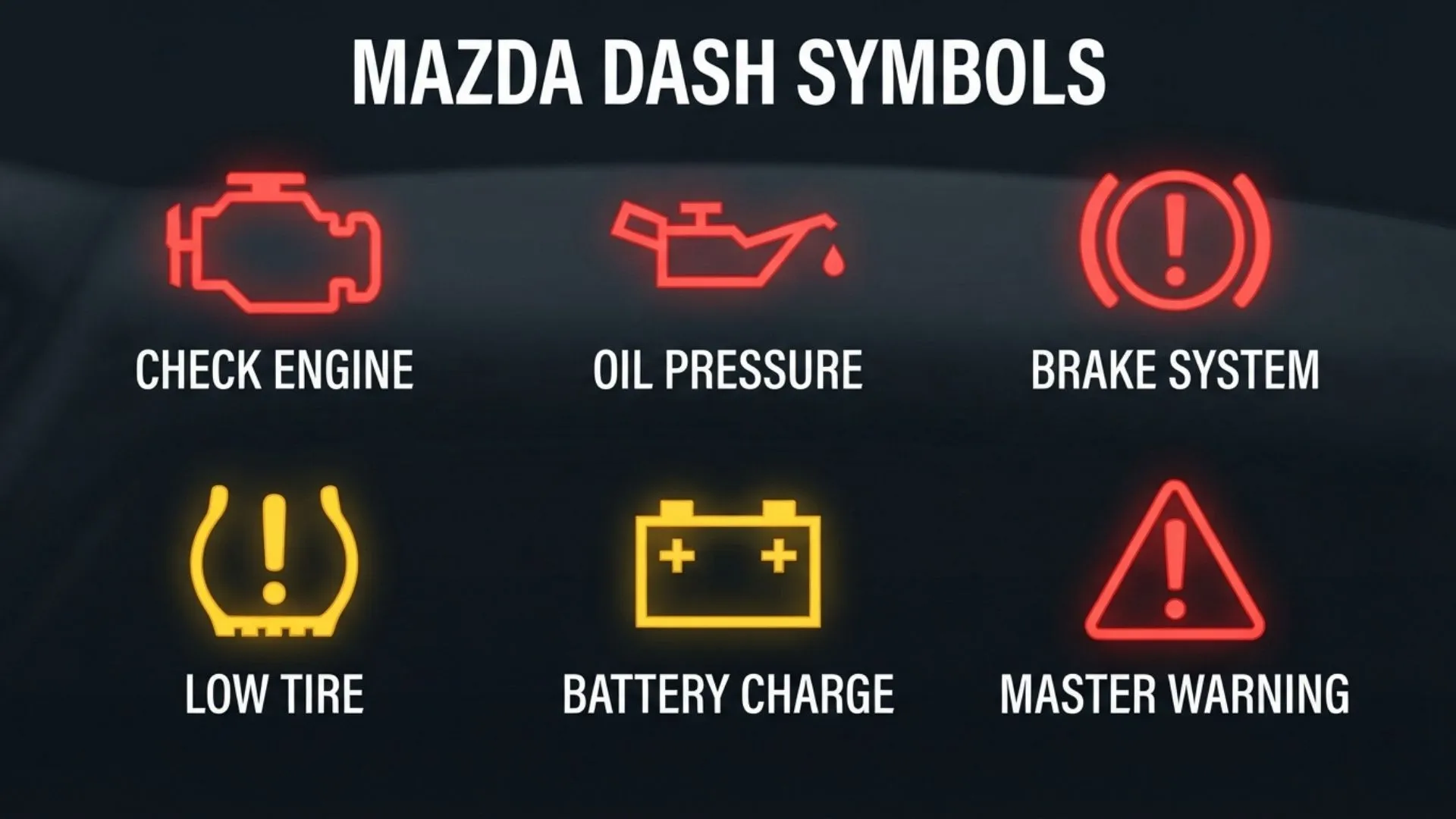
Mazda dash symbols are designed to give drivers important information about the vehicle’s systems, from routine indicators such as turn signals and high beams to urgent warnings involving the engine, brakes, oil pressure, or charging system. Understanding what each Mazda dashboard symbol means can help you decide whether you can continue driving, need to schedule service, or should stop the vehicle immediately.
The exact symbols and their appearance can vary by Mazda model and model year. A Mazda CX-5, Mazda3, CX-30, CX-50, CX-90, MX-5 Miata, and other models may not use exactly the same dashboard lights or warning messages. When a warning appears, the owner’s manual for your specific vehicle remains the best source for model-specific instructions.
This guide explains the most common Mazda dash symbols, what their colors mean, what causes them to appear, and what you should do when they come on.
What Do Mazda Dashboard Symbols Mean?
Mazda dashboard symbols are visual warnings and indicators that communicate information about your vehicle. They can tell you that a system is operating normally, that maintenance may be needed, or that a potentially serious problem requires immediate attention.
What Do the Different Mazda Dash Light Colors Mean?
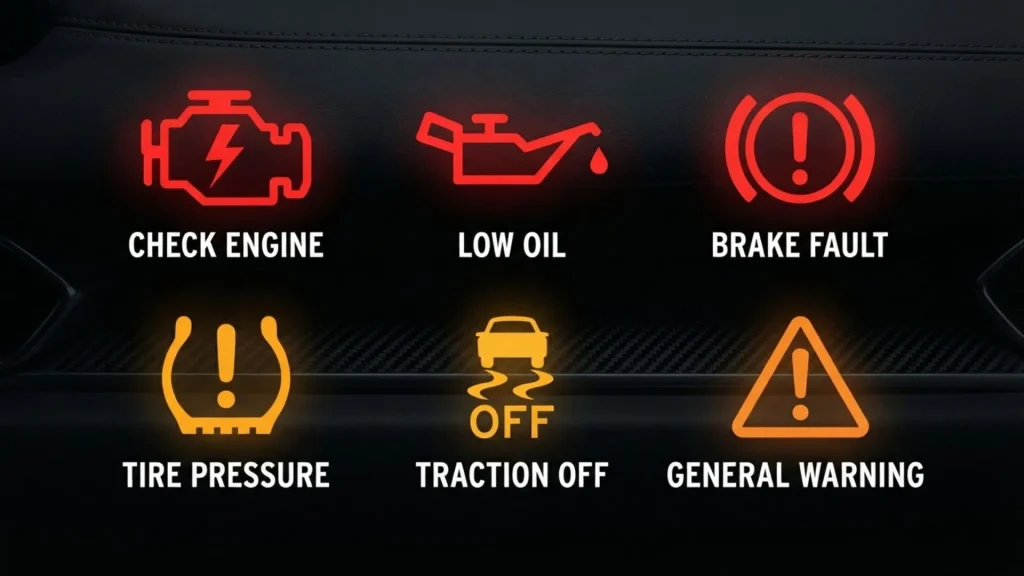
The color of a Mazda dashboard light is an important clue about its urgency, although the exact meaning depends on the symbol.
Red lights generally indicate a warning that may require immediate attention. Examples include certain brake, oil pressure, charging-system, and door-related warnings.
Amber or yellow lights generally indicate a warning, malfunction, or system that requires attention. An amber check-engine light, ABS light, tire-pressure warning, or traction-control warning should not be ignored.
Green and blue lights are generally informational indicators showing that a feature is active. Examples include turn signals, headlights, or high beams.
A flashing warning light can be more urgent than a steady light. Always check the owner’s manual when a symbol appears unexpectedly.
Why Should You Learn Mazda Dash Symbols?
Knowing the meaning of dashboard lights can help you respond appropriately instead of guessing.
For example, a blue high-beam indicator is usually normal, while a red oil-pressure warning can indicate a potentially serious engine problem. Treating both lights the same way could lead to an unnecessary concern—or, more importantly, delayed action when a serious warning appears.
Common Mazda Warning Lights
The following are some of the most important Mazda dash symbols drivers may encounter. Symbol designs can vary between models and years, so use this list as a general guide rather than a replacement for your vehicle’s manual.
Check Engine Light
The check engine light is typically shown as an engine-shaped symbol.
It can illuminate when the vehicle’s engine or emissions-control system detects a problem. A loose fuel cap, sensor problem, ignition issue, emissions fault, or another engine-related malfunction can trigger the light.
A steady check-engine light does not necessarily mean you need to stop immediately, but it should be diagnosed as soon as practical.
A flashing check-engine light can indicate a more serious problem, such as an active misfire that could damage the catalytic converter. If the light is flashing or the vehicle is running poorly, reduce driving and seek professional assistance.
Oil Pressure Warning Light
The oil-pressure warning symbol usually looks like an oil can.
This is one of the dashboard warnings that should be taken seriously. If the oil-pressure warning illuminates while the engine is running, it may indicate insufficient engine oil pressure.
Safely pull over and turn off the engine as soon as possible. Continuing to operate an engine with inadequate oil pressure can cause severe engine damage.
Do not assume that adding oil will always solve the problem. If the correct oil level is present and the warning remains illuminated, the vehicle should be inspected.
Charging System Warning Light
The charging-system warning commonly appears as a battery-shaped symbol.
Despite its appearance, this warning does not necessarily mean that the battery itself is defective. It can indicate a problem with the vehicle’s charging system, including the alternator, battery, wiring, or related components.
If this warning appears while driving, electrical systems may eventually stop working once available battery power is depleted. Have the vehicle checked promptly and avoid unnecessary driving if the warning is accompanied by other problems.
Brake Warning Light
A brake warning symbol may appear as an exclamation mark inside a circle or another brake-related symbol, depending on the Mazda model.
It can indicate that the parking brake is engaged, but it may also indicate low brake fluid or another braking-system issue.
If the light remains illuminated after releasing the parking brake, check your owner’s manual and have the braking system inspected. If braking performance changes, stop driving when it is safe to do so and seek professional assistance.
ABS Warning Light
The ABS warning light indicates a possible problem with the anti-lock braking system.
If the ABS light comes on, the conventional braking system may still operate, but the anti-lock function may not work as intended during hard braking.
Drive cautiously and arrange for the system to be inspected. If the ABS warning appears together with a red brake warning or braking performance is affected, treat the situation as more urgent.
Tire Pressure Monitoring System Light
The tire-pressure warning light usually resembles a tire with an exclamation mark inside it.
It can illuminate when one or more tires have insufficient air pressure. Temperature changes can also affect tire pressure and trigger the warning.
Check the tire pressures when the tires are cold and inflate them to the pressure specified for your Mazda, rather than the maximum pressure printed on the tire sidewall.
If the light flashes and then remains illuminated, the vehicle may be indicating a TPMS malfunction rather than simply low tire pressure.
Airbag Warning Light
The airbag warning symbol commonly depicts a seated person with an airbag in front of them.
This warning can indicate a problem with the airbag or supplemental restraint system. Because airbags and seat-belt pretensioners are important safety equipment, the warning should not be ignored.
Have the system inspected by a qualified technician as soon as possible.
Seat Belt Warning Light
The seat-belt warning symbol usually shows a person wearing a seat belt.
It illuminates when the vehicle detects that a seat belt is not fastened. Depending on the Mazda model, the system may also provide an audible warning and may detect occupants in certain seating positions.
Fastening the seat belt normally turns the warning off once the system recognizes that it is secured.
Door or Liftgate Open Warning
A door-related warning indicates that a door, liftgate, or trunk may not be fully closed.
Do not ignore this warning while driving. Stop safely and check that all doors and the liftgate are properly secured.
Depending on the model, the dashboard may display a vehicle graphic showing which door is open.
Mazda Safety and Driver-Assist Symbols
Modern Mazda vehicles can display numerous symbols associated with driver-assistance and safety systems.
Dynamic Stability Control and Traction Control
A vehicle with wavy lines underneath it generally represents stability or traction control.
A flashing symbol can indicate that the system is actively helping maintain traction. This can happen when the tires lose grip on a slippery surface.
A symbol that remains illuminated may indicate that the system has been switched off or that a malfunction has been detected, depending on the vehicle.
Smart Brake Support Warning
Mazda vehicles equipped with Smart Brake Support (SBS) can display warnings related to the system.
Smart Brake Support is part of Mazda’s suite of driver-assistance technologies. Depending on the vehicle and situation, the system can provide warnings and braking assistance when a potential collision is detected.
If a system warning remains on, consult the vehicle’s instructions and have the system checked if necessary.
Lane Departure Warning
A lane-related dashboard symbol can indicate that a lane-departure or lane-keeping system is active, unavailable, or generating a warning.
These systems use cameras and other sensors, depending on the model, and their operation can be affected by poor weather, dirty sensors, road conditions, or unclear lane markings.
Do not rely on driver-assistance systems as a substitute for paying attention to the road.
Blind Spot Monitoring Warning
A blind-spot symbol can appear when the vehicle’s blind-spot monitoring system detects another vehicle in a monitored area or when the system has a fault.
The exact display varies by Mazda model. Some systems provide warnings through the side mirrors as well as dashboard or instrument-cluster messages.
Drivers should still check mirrors and blind spots manually before changing lanes.
Mazda Lighting and Driving Indicator Symbols
Not every Mazda dash symbol means something is wrong. Many are simply telling you that a particular feature is operating.
Turn Signal Indicators
Green arrows generally flash when the left or right turn signal is activated.
If the indicator flashes unusually quickly, a bulb or lighting-system problem may be present on some vehicles.
High Beam Indicator
The blue high-beam symbol indicates that the high-beam headlights are switched on.
Remember to switch to low beams when approaching other vehicles or when required by road conditions.
Headlight Indicator
A green or other illuminated headlight symbol can indicate that the vehicle’s headlights or a specific exterior-lighting mode is active.
The exact icon depends on the Mazda model and lighting system.
Fog Light Indicator
A fog-light symbol indicates that the front or rear fog lights are switched on, depending on the symbol and vehicle configuration.
Fog lights should generally be used when visibility conditions justify them and according to local driving regulations.
Cruise Control Indicator
A cruise-control symbol indicates that cruise control or a related driving-assistance feature has been activated or is ready for use.
On Mazda vehicles equipped with Mazda Radar Cruise Control, the dashboard may display additional symbols or status information related to the radar-based system.
Mazda i-ACTIV AWD and Drivetrain Symbols
Some Mazda models are equipped with i-ACTIV AWD, and the instrument cluster may display drivetrain-related warnings or indicators.
AWD Warning Light
An AWD-related warning can indicate that the all-wheel-drive system has detected a problem or has temporarily limited operation.
The appropriate response depends on the specific warning and the conditions under which it appeared.
If the warning remains illuminated, consult the owner’s manual and have the vehicle inspected.
Transmission or Drivetrain Warning
A drivetrain-related warning can indicate a problem affecting the transmission or another component responsible for delivering power to the wheels.
Because the exact symbol varies by Mazda model, do not rely solely on the appearance of the icon. Check the owner’s manual and any accompanying message on the instrument display.
Mazda Engine Temperature and Maintenance Symbols
Some dashboard warnings relate directly to vehicle fluids, engine temperature, and maintenance.
High Engine Coolant Temperature Warning
A temperature warning may appear as a thermometer over waves.
It can indicate that the engine coolant temperature is too high.
If the warning indicates overheating, stop the vehicle in a safe location and allow the engine to cool. Do not open a hot cooling-system cap because pressurized coolant can cause severe burns.
If the engine repeatedly overheats, the vehicle needs professional diagnosis.
Maintenance Due or Wrench Light
The wrench symbol on many Mazda vehicles is associated with scheduled maintenance or maintenance-related information.
It does not necessarily mean that the vehicle has suffered a mechanical failure.
Depending on the model, the maintenance monitor may be programmed for oil changes and other scheduled service.
Check the vehicle’s maintenance information to determine what service is due.
What Should You Do When a Mazda Dash Symbol Appears?
The correct response depends on the symbol, its color, whether it is flashing, and whether the vehicle is behaving normally.
Red Warning Light
If a red warning light appears, determine what it means immediately. For serious warnings involving oil pressure, brakes, overheating, or another critical system, safely stop the vehicle and follow the instructions in the owner’s manual.
Amber or Yellow Warning Light
An amber warning generally means the vehicle has detected a problem or that a system requires attention.
You may sometimes be able to continue driving, but do not assume that every amber light is harmless. Check the symbol and arrange service when appropriate.
Green or Blue Indicator
Green and blue symbols generally indicate that a vehicle function is operating.
These lights are usually informational rather than warnings.
Flashing Dashboard Light
A flashing warning can indicate a more immediate problem than a steady light. The exact meaning depends on the symbol.
If a flashing light is accompanied by unusual engine behavior, loss of power, smoke, overheating, or changes in braking, stop safely and seek professional assistance.
Why Mazda Dashboard Lights Come On
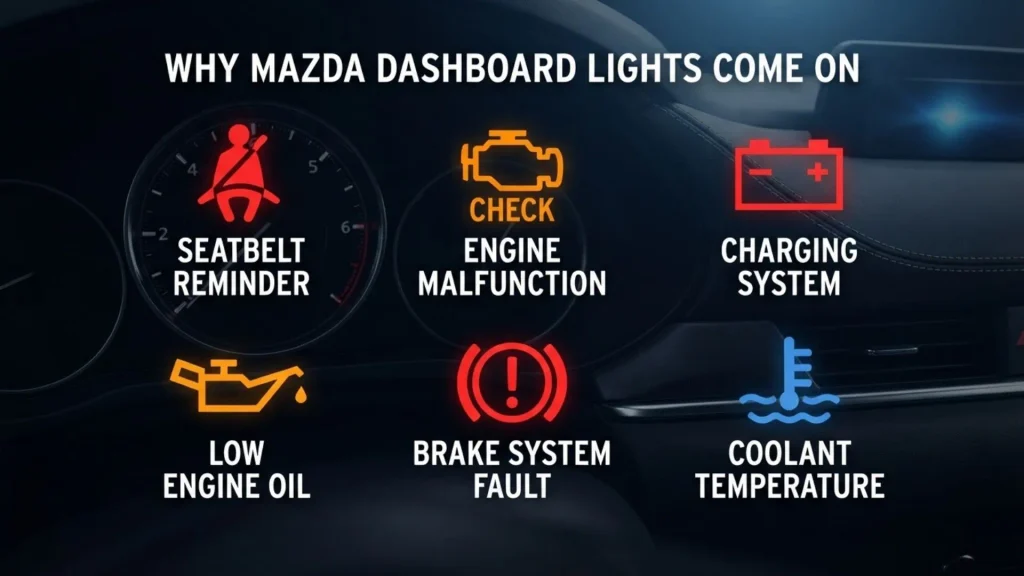
A dashboard light can appear for many different reasons. Some are simple, while others require diagnosis.
Normal Operating Conditions
Some lights appear whenever you start the vehicle and then disappear after the system completes its checks.
This is normal for many dashboard indicators.
Low Fluids or Incorrect Tire Pressure
Warnings can result from low engine oil, low brake fluid, low coolant, or incorrect tire pressure, depending on the system.
Never add a fluid without confirming the correct type and procedure for your Mazda.
Sensor or Electrical Problems
Modern Mazda vehicles rely on numerous electronic sensors and control modules. A malfunctioning sensor, wiring problem, or communication fault can cause a warning light to appear.
The dashboard symbol alone may not identify the exact failed component.
System Malfunction
Some warnings indicate that a vehicle system has detected a fault.
In these situations, diagnostic equipment may be required to identify the underlying cause.
Mazda Dash Symbols by Color: Quick Reference
| Light color | General meaning | Typical response |
| Red | Serious warning or important alert | Check immediately; stop safely when required |
| Amber/Yellow | Warning, malfunction, or system requiring attention | Investigate and arrange service |
| Green | System or feature operating | Usually informational |
| Blue | Specific function active, often high beams | Usually informational |
| Flashing | Potentially more urgent condition | Check the symbol and act promptly |
This is a general guide. Mazda uses different symbols and warning strategies across models and model years, so the owner’s manual takes priority.
Mazda Dash Symbols by Model
Mazda does not use an identical dashboard layout across its entire vehicle range. The symbols available can depend on the model, trim level, equipment, and model year.
Mazda CX-5 Dash Symbols
The Mazda CX-5 can display warning and indicator lights for systems such as engine management, tire pressure, ABS, airbags, stability control, and driver-assistance features.
The exact symbols can differ between model years, so owners should consult the manual for their specific CX-5.
Mazda3 Dash Symbols
Mazda3 models use a combination of warning lights and information displays. Depending on the model year and equipment, drivers may see indicators for safety systems, tire pressure, engine functions, lighting, and maintenance.
Mazda CX-30 Dash Symbols
The CX-30 includes numerous electronic driver-assistance and safety systems, so its dashboard can display more symbols than older Mazda vehicles.
Warnings may be accompanied by text messages that provide additional information.
Mazda CX-50 Dash Symbols
The CX-50 uses modern electronic systems and may display symbols related to AWD, driver assistance, tire pressure, engine operation, braking, and other vehicle functions.
Always use the manual for the exact CX-50 model year when a warning appears.
Mazda CX-90 Dash Symbols
The CX-90 features a broad range of modern safety and vehicle-control systems. Dashboard warnings may therefore include system-status indicators and messages related to driver assistance, powertrain functions, and vehicle safety.
For unfamiliar warnings, read the accompanying message and consult the owner’s manual.
Mazda MX-5 Miata Dash Symbols
The MX-5 Miata has its own instrument-cluster layout and warning-light configuration. Common symbols can include engine, oil pressure, charging system, ABS, tire pressure, stability control, and lighting indicators.
The exact configuration depends on the model year.
Common Mazda Dash Symbol Questions
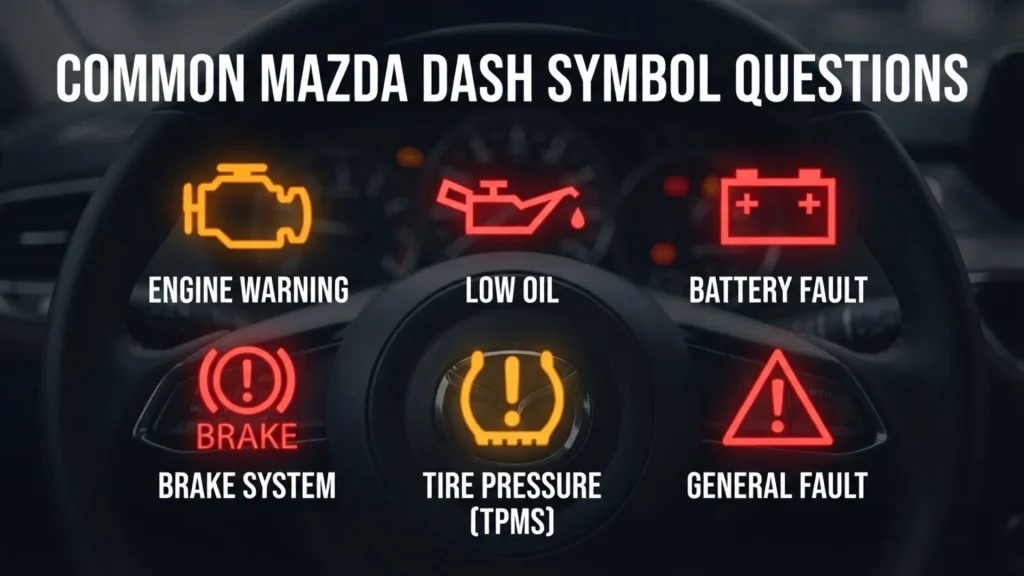
Why is my Mazda dashboard light on but the car seems fine?
A warning light can appear even when the vehicle feels normal because some faults are detected electronically before they cause noticeable driving symptoms.
Do not assume the light can be ignored. Identify the symbol first and follow the appropriate instructions.
Can I drive my Mazda with a yellow warning light?
Sometimes, but it depends on the symbol and the vehicle’s behavior.
A steady amber light may allow you to drive to a repair facility, while another warning could indicate a problem that requires immediate attention. Check the specific symbol rather than judging urgency by color alone.
Can I drive with a red Mazda warning light?
Some red warnings require you to stop as soon as it is safe. Oil-pressure, overheating, or serious brake warnings can potentially lead to vehicle damage or create a safety hazard.
Identify the warning and follow the owner’s manual instructions.
Why does my Mazda show a wrench symbol?
The wrench symbol commonly indicates that scheduled maintenance is due or that maintenance information needs attention. The exact meaning can vary by model and model year.
Why is my Mazda tire-pressure light on?
The tire-pressure warning usually means that one or more tires have insufficient pressure, although a flashing warning can indicate a TPMS system problem.
Check the tire pressures when cold and inflate them according to the vehicle’s specified pressure.
Why is my Mazda check-engine light flashing?
A flashing check-engine light can indicate a serious engine problem, commonly associated with an active misfire. Continued driving may cause additional damage.
If the light is flashing, especially if the engine is shaking, losing power, or running roughly, reduce driving and seek professional assistance.
Do Mazda dashboard lights turn off automatically?
Some indicators turn off automatically once the underlying condition is corrected. Others may remain illuminated until a fault is repaired or the system is reset.
Do not reset a warning without understanding why it appeared.
Where can I find the exact meaning of my Mazda dashboard symbol?
The most reliable source is the owner’s manual for your specific Mazda model and model year. The manual provides the exact symbol, warning message, operating conditions, and recommended response for that vehicle.
Frequently Asked Questions
What is the most serious Mazda dashboard warning?
There is no single warning that is always the most serious, but red warnings involving oil pressure, braking, overheating, or other critical vehicle systems can require immediate action. The exact meaning of the warning and the vehicle’s symptoms should determine what you do next.
What does the red exclamation mark mean on a Mazda?
A red exclamation mark can be associated with the brake system or another warning depending on the Mazda model. If it remains illuminated after releasing the parking brake, check the owner’s manual and have the vehicle inspected.
What does the yellow engine symbol mean on a Mazda?
The yellow engine-shaped symbol is generally the check-engine light. It indicates that the vehicle’s engine or emissions-control system has detected a fault. A steady light and a flashing light can have different levels of urgency.
What does the car with squiggly lines mean on a Mazda?
The car with wavy or squiggly lines generally represents the vehicle’s traction control or Dynamic Stability Control system. It may flash when the system is actively correcting wheel slip or remain illuminated when the system has been switched off or detects a fault.
What does the blue light mean on a Mazda dashboard?
A blue headlight-shaped indicator generally means the vehicle’s high-beam headlights are on. It is normally an informational indicator rather than a fault warning.
What does the wrench symbol mean on a Mazda dashboard?
The wrench commonly indicates scheduled maintenance or maintenance information. The exact maintenance requirements depend on the Mazda model and model year.
What does the tire symbol with an exclamation mark mean?
It generally indicates that one or more tires have low pressure. Check and adjust tire pressure according to the specifications listed for your Mazda. If the warning flashes or does not clear after correcting the pressure, the TPMS may require inspection.
Why are multiple Mazda warning lights coming on at once?
Multiple warning lights can appear when one fault affects several vehicle systems, when the battery or charging system has a problem, or when the vehicle detects several related faults. When multiple warnings appear together—especially red warnings—consult the owner’s manual and avoid unnecessary driving until the cause is understood.
Final Thoughts on Mazda Dash Symbols
Understanding Mazda dash symbols makes it easier to distinguish normal vehicle indicators from warnings that require attention. Green and blue lights are generally informational, while amber warnings usually indicate a condition that should be investigated. Red warnings can require immediate action, particularly when they involve brakes, oil pressure, overheating, or other critical systems.
The most important point is that the symbol’s exact meaning depends on your Mazda model and model year. A dashboard icon should never be interpreted solely from its shape or color when a serious warning is involved.
If an unfamiliar warning appears, safely check the owner’s manual, pay attention to any accompanying message, and consider the vehicle’s behavior. When a warning involves a critical safety or mechanical system, professional inspection is the safest choice.

I’m Adrian Holloway, a writer and researcher who enjoys exploring the stories, meanings, and interesting facts behind the subjects people search for every day. I’m especially interested in symbols, nature, lakes, places, and cultural topics that help readers understand the world from a different perspective.
I believe useful content should be simple, accurate, and enjoyable to read. When I research a topic, I focus on finding meaningful details and presenting them in a way that makes information easy to understand.
My goal is to create helpful articles that answer real questions while encouraging readers to discover something new with every visit.
Books by Adrian Holloway
The Language of Symbols: Meanings, Stories & Traditions
Hidden Wonders of Nature: Lakes, Landscapes & Discovery