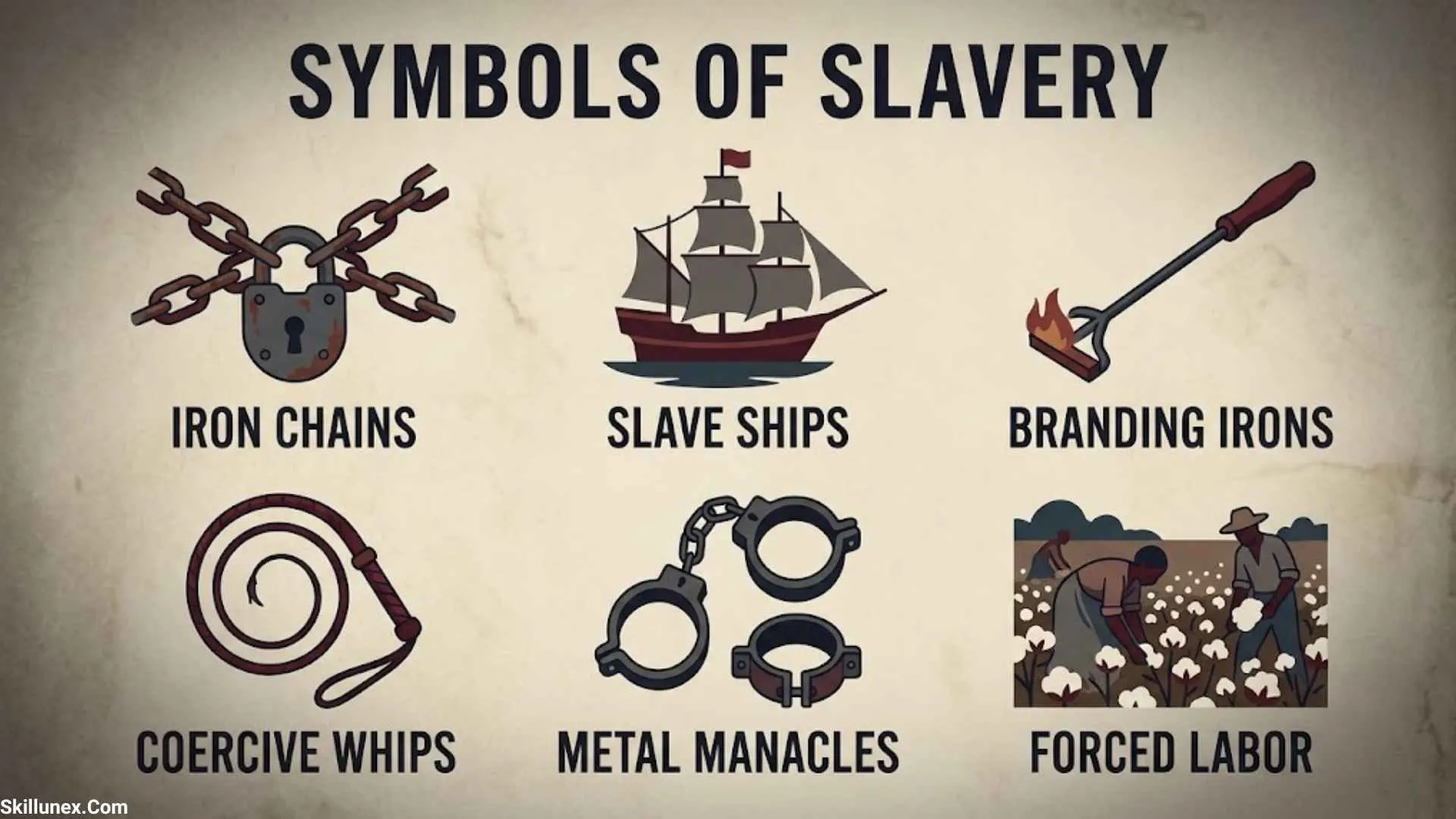
Symbols of slavery reveal the history of human bondage, forced labor, racial oppression, and the struggle for freedom. Throughout history, objects such as chains, shackles, whips, slave ships, and auction blocks have represented the systems used to control and exploit enslaved people. Other symbols, including broken chains, abolitionist medals, and emancipation documents, represent resistance, hope, and the pursuit of human rights.
When I explore the symbols of slavery, I look beyond their physical appearance to understand the experiences and historical events they represent. A chain, for example, can symbolize physical captivity, while a broken chain often represents liberation. Similarly, a slave ship represents forced transportation and the suffering endured by millions of Africans during the transatlantic slave trade.
In this guide, you’ll discover the most important symbols of slavery, their historical backgrounds, their meanings in art and literature, and their continuing relevance today. I’ll also explain the difference between symbols of oppression and symbols of freedom so you can understand how these images communicate the complex history of slavery.
What Are Symbols of Slavery?
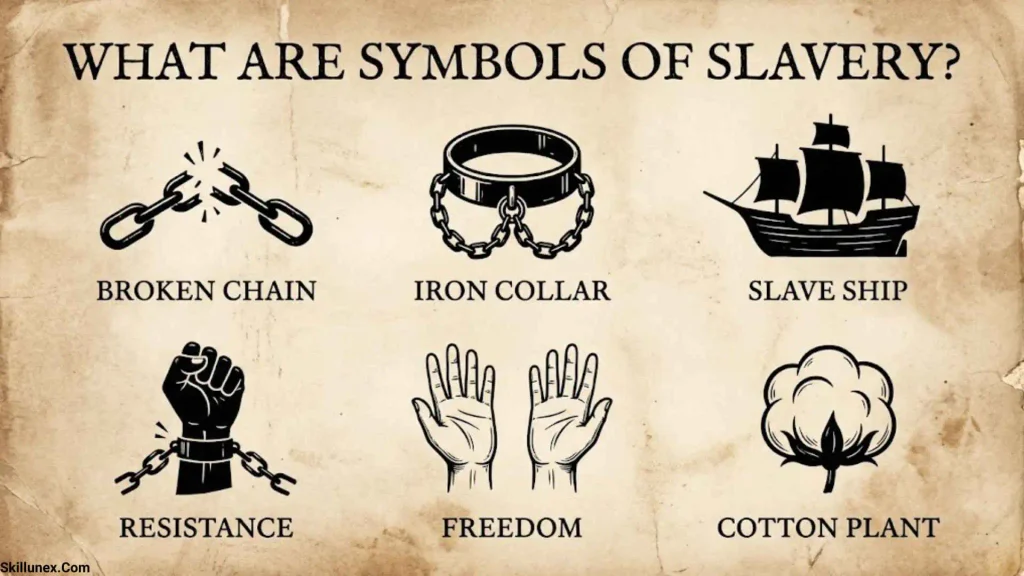
Symbols of slavery are objects, images, documents, monuments, and artistic representations associated with enslavement, forced labor, human trafficking, and the denial of personal freedom. Some symbols were directly connected to the historical practices of slavery, while others developed later to commemorate emancipation or represent resistance.
These symbols appear in historical museums, memorials, paintings, books, educational materials, and public monuments. Their meanings depend on the historical period, geographical location, and circumstances in which they were used.
For example, iron shackles were physical instruments of confinement, whereas an abolitionist medal communicated opposition to slavery. Both are connected to the history of enslavement, but they represent different sides of that history.
Why Were Symbols of Slavery Used?
Some objects associated with slavery served practical purposes within slaveholding systems. Enslavers used restraints to restrict movement, auction notices to advertise sales, and written records to document ownership claims.
Other symbols were created or adopted to challenge slavery. Abolitionists used illustrations, medals, publications, and public campaigns to communicate the cruelty of enslavement and encourage opposition to it.
Today, historians and educators use these objects and images to help people understand how slavery operated, how enslaved people resisted it, and how abolition movements developed.
What Do Symbols of Slavery Represent?
Depending on their context, these symbols can represent several important themes:
- Captivity: The restriction of movement and personal freedom.
- Exploitation: The use of forced labor to generate wealth.
- Dehumanization: Treating people as property rather than individuals with rights.
- Resistance: Efforts by enslaved people and their supporters to challenge slavery.
- Emancipation: The legal and social processes through which enslaved people gained freedom.
- Remembrance: Preserving the experiences of enslaved people and acknowledging historical injustice.
Understanding these themes helps you interpret symbols accurately instead of assuming that every historical object associated with slavery has the same meaning.
20 Important Symbols of Slavery and Their Meanings
The following examples cover physical restraints, economic institutions, historical documents, cultural representations, and symbols of resistance. Some are direct artifacts of slavery, while others represent the broader historical struggle against it.
1. Chains
<text color=”secondary” size=”sm”>Meaning: Captivity, oppression, and restricted freedom</text>
Chains are among the most recognizable symbols of slavery. Historically, enslavers used metal chains to restrain people, restrict movement, and sometimes prevent escape during transportation or confinement.
Chains also developed a broader symbolic meaning. In literature, paintings, and political speeches, they often represent the loss of freedom and the power of an unjust system over individuals.
When I interpret chains in a historical illustration, I consider whether they depict literal physical restraints or represent a wider form of oppression. The surrounding image often provides important clues.
2. Shackles
<text color=”secondary” size=”sm”>Meaning: Physical confinement and forced control</text>
Shackles are restraints fitted around the wrists or ankles. They were used in various slaveholding societies to limit movement and control enslaved people.
Unlike chains, which can connect people or objects, shackles specifically describe devices designed to restrain the body. Surviving examples in museums provide material evidence of the physical restrictions imposed on enslaved individuals.
Shackles remind us that slavery was not simply an economic arrangement. It also depended on coercion, violence, and the denial of personal autonomy.
3. Whips
<text color=”secondary” size=”sm”>Meaning: Violence, punishment, and intimidation</text>
Whips symbolize the physical violence used to enforce slavery. In many slaveholding societies, enslavers and overseers used whipping to punish enslaved people, intimidate workers, and attempt to suppress resistance.
In historical paintings and written accounts, the whip often represents the unequal power relationship between enslavers and enslaved people.
Its symbolic importance comes from the violence it represents and the fear that violence was intended to create. When you encounter this image in historical material, it should be understood within the wider system of coercion that sustained slavery.
4. Auction Blocks
<text color=”secondary” size=”sm”>Meaning: Human commodification and family separation</text>
Auction blocks represent the public buying and selling of enslaved people. In many slaveholding societies, auctions allowed enslavers and traders to profit from the forced sale of human beings.
People could be sold separately from their spouses, children, parents, and other relatives. As a result, the auction block represents both economic exploitation and the destruction of family relationships.
This symbol exposes a central injustice of slavery: human beings were treated as property, and their personal relationships and wishes could be disregarded for financial gain.
5. Broken Chains
<text color=”secondary” size=”sm”>Meaning: Liberation, emancipation, and resistance</text>
Broken chains are commonly used to symbolize freedom from oppression. Whereas intact chains suggest captivity, broken chains communicate the end of restraint and the possibility of a different future.
The image appears in abolitionist art, emancipation memorials, and modern human rights campaigns. It can represent legal freedom, personal independence, or collective resistance to injustice.
However, the symbol is not proof that freedom came easily. The end of slavery required resistance, political action, social change, and the efforts of enslaved and formerly enslaved people.
6. Slave Ships
<text color=”secondary” size=”sm”>Meaning: Forced transportation and the transatlantic slave trade</text>
Slave ships symbolize the forced transportation of Africans across the Atlantic Ocean during the transatlantic slave trade. Millions of Africans were forcibly transported to the Americas, where many were sold into slavery.
The Middle Passage refers specifically to the voyage from Africa to the Americas. Captive Africans endured overcrowding, disease, inadequate food and water, violence, and appalling conditions. Many died during the journey.
Images of slave ships help communicate the scale of this forced migration and the suffering experienced by those who survived it. They also reveal how maritime trade and commercial networks contributed to the expansion of slavery.
7. The Branding Iron
<text color=”secondary” size=”sm”>Meaning: Dehumanization and claims of ownership</text>
Branding irons were used in some historical slaveholding contexts to mark enslaved people. Practices varied across regions and periods, and branding was not universal.
The branding iron represents the attempt to treat a human body as an object that could be marked to indicate ownership or control. It also illustrates the physical abuse and dehumanization associated with certain forms of enslavement.
When studying this symbol, you should distinguish documented historical practices from generalized portrayals that may overlook regional differences.
8. Cotton Fields
<text color=”secondary” size=”sm”>Meaning: Forced agricultural labor and economic exploitation</text>
Cotton fields are strongly associated with slavery in the American South, particularly during the nineteenth century. Enslaved African Americans performed exhausting agricultural labor under coercive conditions to produce cotton for domestic and international markets.
The growth of cotton production helped strengthen slavery in the United States before the Civil War. Profits from cotton connected plantation labor to merchants, manufacturers, financial institutions, and international trade.
A cotton field may appear peaceful in a landscape painting, but its historical meaning changes when you consider the people who were forced to work there and the system that denied them freedom.
9. Slave Collars
<text color=”secondary” size=”sm”>Meaning: Confinement, intimidation, and control</text>
Slave collars were metal restraints used in some historical settings to control enslaved people. Certain designs made movement difficult or helped enslavers identify and restrain individuals who were considered likely to escape.
These objects demonstrate how physical devices could be used to intimidate people and restrict their autonomy.
Slave collars are less universally recognized than chains or shackles, but they provide important evidence of the different methods used to enforce captivity.
10. The Underground Railroad
<text color=”secondary” size=”sm”>Meaning: Resistance, escape, and solidarity</text>
The Underground Railroad was a network of people, routes, and safe places that helped enslaved individuals escape, particularly in the United States during the nineteenth century. It was not an actual railway.
The network involved formerly enslaved people, free Black communities, abolitionists, and other supporters. Harriet Tubman became one of its most celebrated figures through her work helping enslaved people reach freedom.
As a symbol, the Underground Railroad represents courage, cooperation, determination, and organized resistance. It also reminds us that enslaved people actively sought freedom rather than simply accepting their circumstances.
11. Quilts Associated With the Underground Railroad
<text color=”secondary” size=”sm”>Meaning: Cultural heritage, resilience, and contested escape-code traditions</text>
Quilts have an important place in African American cultural history. They can represent family traditions, artistic creativity, community relationships, and the preservation of cultural knowledge.
Some popular accounts claim that particular quilt patterns communicated coded instructions to people escaping slavery through the Underground Railroad. However, historians have debated the evidence for a widespread, organized system of coded quilts, and the claim should not be presented as conclusively established.
When you encounter a quilt described as an Underground Railroad artifact, examine its documented history rather than assuming that every traditional quilt carried a secret message.
12. Slave Auction Notices
<text color=”secondary” size=”sm”>Meaning: Commercial exploitation and dehumanization</text>
Slave auction notices appeared in newspapers and public announcements in various slaveholding societies. These notices advertised people for sale and sometimes described their ages, skills, physical characteristics, or family relationships.
Such documents show how slavery was supported by commercial practices and social institutions. They also provide historians with evidence about individual lives, forced family separations, and the business of buying and selling human beings.
For modern readers, these notices are disturbing records of a system that reduced people to descriptions intended to establish their market value.
13. Freedom Flags and Abolitionist Banners
<text color=”secondary” size=”sm”>Meaning: Emancipation, equality, and collective action</text>
Flags and banners have been used by different abolitionist, emancipation, and civil rights movements to communicate opposition to oppression. Their meanings depend on the particular design, organization, and historical setting.
There is no single universal flag that represents every movement against slavery. Instead, various groups used visual symbols, slogans, and banners to express their commitment to liberty and equality.
When interpreting a particular flag, consider who created it, which movement it represented, and the political circumstances in which it appeared.
14. Lanterns in Escape Narratives
<text color=”secondary” size=”sm”>Meaning: Hope, guidance, and safety</text>
Lanterns sometimes appear in illustrations and artistic depictions of escape from slavery. Their light can symbolize guidance through danger and the hope of reaching a place of safety.
However, a lantern should not automatically be described as a standardized secret signal used by the Underground Railroad. Such a claim requires evidence from a specific historical source.
As a general artistic symbol, a lantern communicates direction, protection, knowledge, and the possibility of finding a path toward freedom.
15. The Raised Fist
<text color=”secondary” size=”sm”>Meaning: Resistance, solidarity, and empowerment</text>
The raised fist is a widely recognized symbol of resistance and collective action. Different political, labor, racial justice, and human rights movements have used it to communicate determination and solidarity.
Although the raised fist is not exclusively associated with slavery, it can represent resistance to racial oppression and the continuing struggle for equality after emancipation.
In modern artwork and memorials, the image may express the strength of communities working together to challenge injustice.
16. Broken Shackles in Monuments
<text color=”secondary” size=”sm”>Meaning: Emancipation and historical remembrance</text>
Monuments featuring broken shackles often commemorate emancipation or resistance to oppression. They may appear alongside statues, inscriptions, or representations of people who fought against slavery.
The broken shackle combines the historical reality of physical restraint with the symbolic idea of liberation. It also encourages viewers to remember the people whose lives were affected by enslavement.
Such monuments can serve educational purposes, especially when their inscriptions explain the local history and the individuals or events being commemorated.
17. Slave Markets
<text color=”secondary” size=”sm”>Meaning: Human trafficking and the commodification of people</text>
Slave markets represent the organized buying and selling of human beings. Slavery existed in different forms across many societies, and markets operated in various regions and historical periods.
The transatlantic slave trade was one particularly devastating system, involving the forced transportation of millions of Africans to the Americas. Other systems of slavery also developed in different regions, each with its own legal, economic, and social structures.
A slave market symbolizes the transformation of human lives into commodities and the institutions that enabled this exploitation.
18. Plantation Houses
<text color=”secondary” size=”sm”>Meaning: Wealth, social hierarchy, and forced labor</text>
Plantation houses are associated with the wealth and status of plantation owners in slaveholding societies. Some surviving buildings are preserved as historic sites, museums, or educational spaces.
Their architecture can appear elegant, but the historical context may include forced labor, racial inequality, and the concentration of wealth in the hands of enslavers.
When you study a plantation house, it is important to consider the lives of the enslaved people who cultivated the land, maintained the property, and performed domestic and agricultural work.
19. Abolitionist Medals
<text color=”secondary” size=”sm”>Meaning: Opposition to slavery and recognition of human dignity</text>
Abolitionist medals were used to spread messages opposing slavery. A notable example is the medallion associated with British potter and abolitionist Josiah Wedgwood in the late eighteenth century.
The medallion depicts a kneeling enslaved man in chains and asks, “Am I Not a Man and a Brother?” It became an influential image in British abolitionist campaigning.
This object shows how visual art could challenge the idea that one person had the right to own another. It also illustrates how abolitionists used portable objects to spread political and moral messages.
20. The Emancipation Proclamation
<text color=”secondary” size=”sm”>Meaning: Emancipation and a turning point in American history</text>
The Emancipation Proclamation was issued by President Abraham Lincoln during the American Civil War. It took effect on January 1, 1863, and declared enslaved people in designated areas then in rebellion against the United States to be free.
The proclamation did not immediately abolish slavery throughout the entire country. Its scope was limited, and its implementation depended on Union military advances. The Thirteenth Amendment, ratified in December 1865, abolished slavery throughout the United States, except as punishment for a crime under the amendment’s language.
Although it is a historical document rather than a conventional visual symbol, the proclamation has become a powerful representation of emancipation, political change, and the struggle to end slavery.
Symbols of Slavery and Their Meanings at a Glance
The following table summarizes the symbols and their principal historical or symbolic associations.
| Symbol | Main meaning | Historical context |
| Chains | Captivity and oppression | Physical restraints and symbolic representations of bondage |
| Shackles | Restricted movement | Restraints used to confine enslaved people |
| Whip | Violence and intimidation | Punishment and coercive control |
| Auction block | Human commodification | Buying and selling enslaved people |
| Broken chains | Liberation | Abolitionist imagery and emancipation memorials |
| Slave ships | Forced transportation | Transatlantic slave trade |
| Branding iron | Dehumanization | Branding in some slaveholding contexts |
| Cotton fields | Forced labor | Plantation agriculture, particularly in the American South |
| Slave collar | Confinement | Restraints used in some historical settings |
| Underground Railroad | Resistance and escape | Networks helping enslaved people reach freedom |
| Quilts | Cultural heritage and resilience | African American textile traditions; escape-code claims are debated |
| Auction notices | Commercial exploitation | Advertisements for the sale of enslaved people |
| Freedom flags | Collective action | Different abolitionist and emancipation movements |
| Lanterns | Hope and guidance | Artistic representations of escape and freedom |
| Raised fist | Resistance and solidarity | Wider movements against oppression |
| Broken-shackle monuments | Emancipation | Public remembrance and memorial art |
| Slave markets | Human trafficking | Markets operating within different systems of slavery |
| Plantation houses | Wealth and inequality | Plantation economies and slaveholding societies |
| Abolitionist medals | Opposition to slavery | Campaigns promoting abolition |
| Emancipation Proclamation | A major step toward emancipation | American Civil War and the ending of slavery |
Symbols of Slavery vs. Symbols of Freedom
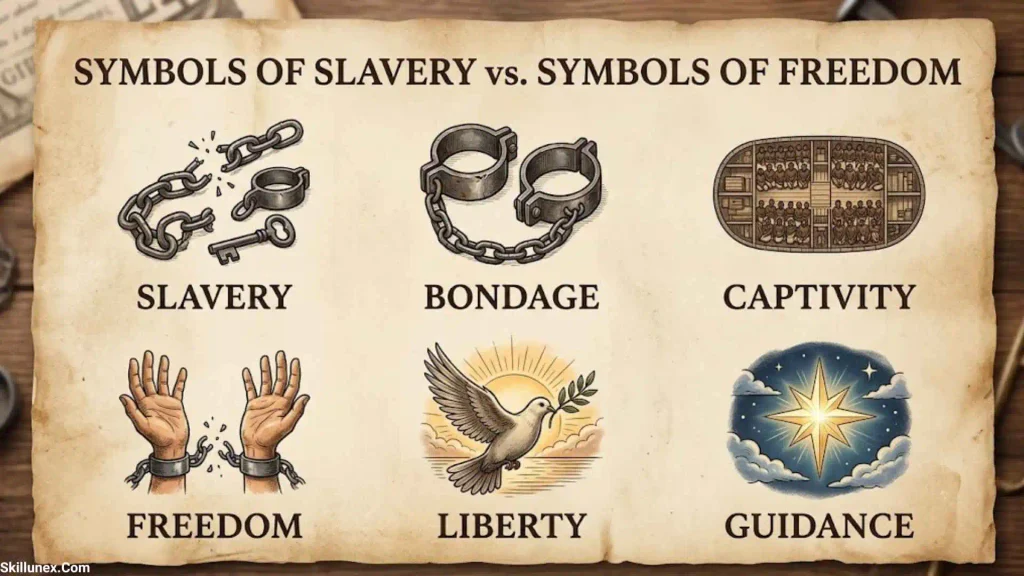
Symbols of slavery and symbols of freedom are closely connected, but they communicate different ideas. Symbols of slavery generally emphasize captivity, exploitation, and the denial of human rights. Symbols of freedom focus on liberation, resistance, equality, and the restoration of autonomy.
Symbols That Represent Oppression
Several historical objects directly illustrate the systems used to maintain slavery.
- Chains and shackles: Represent physical captivity and restricted movement.
- Whips: Represent violence and coercive punishment.
- Auction blocks: Represent the sale of human beings and the destruction of family relationships.
- Slave ships: Represent forced transportation and the suffering of enslaved Africans.
- Auction notices: Reveal the commercial systems that treated people as property.
These symbols are important because they make the realities of slavery more understandable. They show that enslavement involved physical force, economic exploitation, and the denial of personal freedom.
Symbols That Represent Freedom
Other symbols emphasize the resistance to slavery and the pursuit of emancipation.
- Broken chains: Represent the end of captivity.
- The Underground Railroad: Represents escape networks and cooperation.
- Abolitionist medals: Represent campaigns challenging the legitimacy of slavery.
- Emancipation documents: Represent legal and political steps toward freedom.
- The raised fist: Represents broader struggles for equality and resistance to oppression.
When you compare these symbols, you can see how the visual language of slavery also became a language of resistance and remembrance.
Can One Symbol Represent Both Slavery and Freedom?
Yes. A chain is a clear example. An intact chain can represent captivity, while a broken chain can represent liberation. The physical object remains similar, but its condition changes the message.
The same principle applies to some historical documents and monuments. A record of a slave auction may document the operation of an oppressive institution, but its preservation in a museum can help expose that injustice and educate future generations.
For this reason, you should interpret symbols by examining their historical setting, visual details, and intended message rather than relying on the object alone.
Historical Background of Slavery and Its Symbols
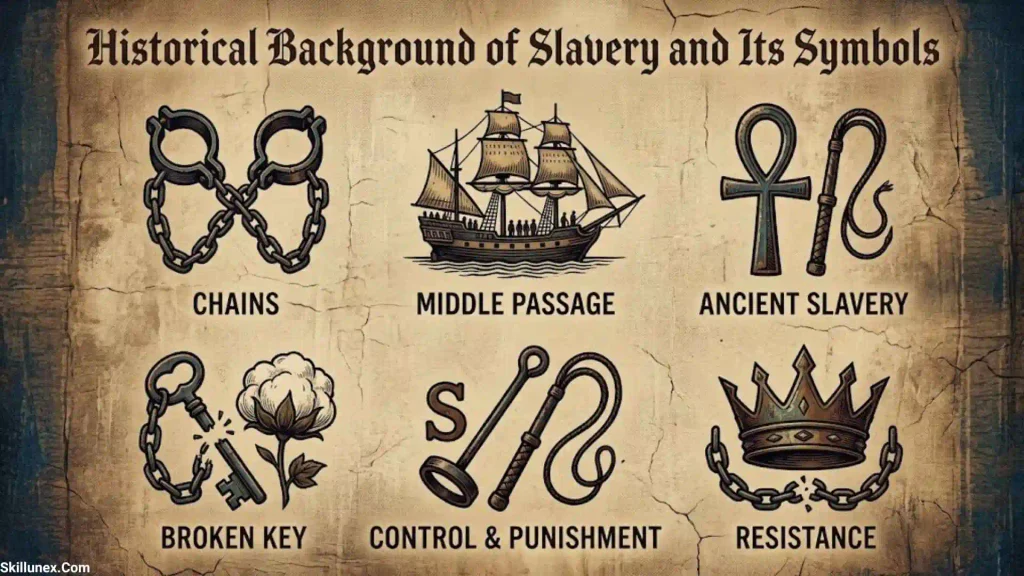
Slavery existed in many societies over thousands of years. Its forms, legal structures, and economic roles varied considerably, so no single set of symbols explains every historical experience of enslavement.
Slavery in the Ancient World
Slavery existed in ancient civilizations, including Greece, Rome, and several ancient Near Eastern societies. Enslaved people could be forced to perform agricultural labor, domestic work, mining, construction, or other tasks.
Restraints, ownership records, and depictions of subordinate status can provide evidence about these systems. However, historians must interpret ancient artifacts carefully because their meanings may differ from those associated with modern racialized slavery.
The Transatlantic Slave Trade
From the fifteenth through the nineteenth centuries, European colonial powers and commercial networks participated in the forced transportation of millions of Africans across the Atlantic. Enslaved Africans were transported to colonies and territories in the Americas, where they were subjected to forced labor.
Slave ships, auction records, plantation buildings, and chains are among the objects and images associated with this history. They help explain how slavery became connected to colonial expansion, agricultural production, trade, and racial hierarchies.
The trade also devastated African communities and separated countless people from their families and homelands.
Abolition and Emancipation
Abolition movements developed in different places and at different times. Enslaved people resisted through escape, rebellion, preserving family and cultural connections, and other acts of opposition. Abolitionists organized campaigns, circulated publications, and challenged laws that protected slavery.
The legal abolition of slavery occurred through different processes in different countries. In the United States, the Civil War, the Emancipation Proclamation, and the Thirteenth Amendment were major parts of that history.
As a result, broken chains, abolitionist medals, emancipation documents, and memorials became important representations of the struggle to end slavery.
Why Are Symbols of Slavery Important Today?
Symbols of slavery remain important because they preserve historical evidence, support education, and encourage thoughtful discussions about freedom and human dignity.
They Preserve Historical Memory
Physical artifacts, newspaper notices, letters, and monuments help historians reconstruct the experiences of enslaved people. These sources also show how slavery was organized and how different institutions supported it.
When you examine a historical object, its provenance and documented background matter. Reliable historical interpretation separates evidence from later legends and unsupported assumptions.
They Explain the Human Cost of Slavery
A chain or auction notice may appear simple, but its historical context can reveal violence, family separation, and the loss of personal autonomy. These symbols help people understand the consequences of treating human beings as property.
They also encourage us to recognize the individuals behind historical statistics and economic records.
They Recognize Resistance and Resilience
Symbols associated with the Underground Railroad, abolitionist campaigns, and emancipation emphasize that enslaved people and their allies challenged slavery in many ways.
Resistance included escaping, organizing rebellions, protecting families and communities, preserving cultural traditions, and supporting movements for abolition. These actions are essential to understanding slavery as a history of both oppression and human agency.
They Encourage Education About Human Rights
Museums, memorials, schools, and historical sites use symbols of slavery to discuss human dignity, racism, exploitation, and freedom. Studying these subjects helps you recognize how unjust systems can become embedded in laws, economic practices, and social attitudes.
It also provides historical context for understanding the continued importance of equality and protection against forced labor and human trafficking.
How Are Symbols of Slavery Used in Art and Literature?
Artists and writers use symbols of slavery to communicate historical experiences, explore the effects of oppression, and represent the pursuit of freedom.
Symbols in Historical Paintings
Paintings may depict chains, shackles, slave ships, plantation landscapes, or scenes of resistance. These images can help viewers understand particular historical events, although the artist’s perspective and the circumstances of the work should also be considered.
For example, an image of a broken chain may communicate emancipation, while a painting of an auction may expose the treatment of enslaved people as property.
Symbols in Literature
Writers often use chains, darkness, locked doors, and journeys to explore themes of captivity and liberation. These symbols may describe literal historical conditions or represent wider experiences of oppression.
When reading a novel or poem about slavery, look at how a symbol changes throughout the work. An object that initially represents control may later become a reminder of resistance or survival.
Symbols in Museums and Memorials
Museums and memorials may display historical restraints, documents, portraits, and commemorative sculptures. These objects can connect visitors with documented events and individual experiences.
The strongest educational displays explain where an artifact came from, how it was used, and what historians know about its history. This context helps visitors distinguish evidence from artistic interpretation.
Common Misconceptions About Symbols of Slavery
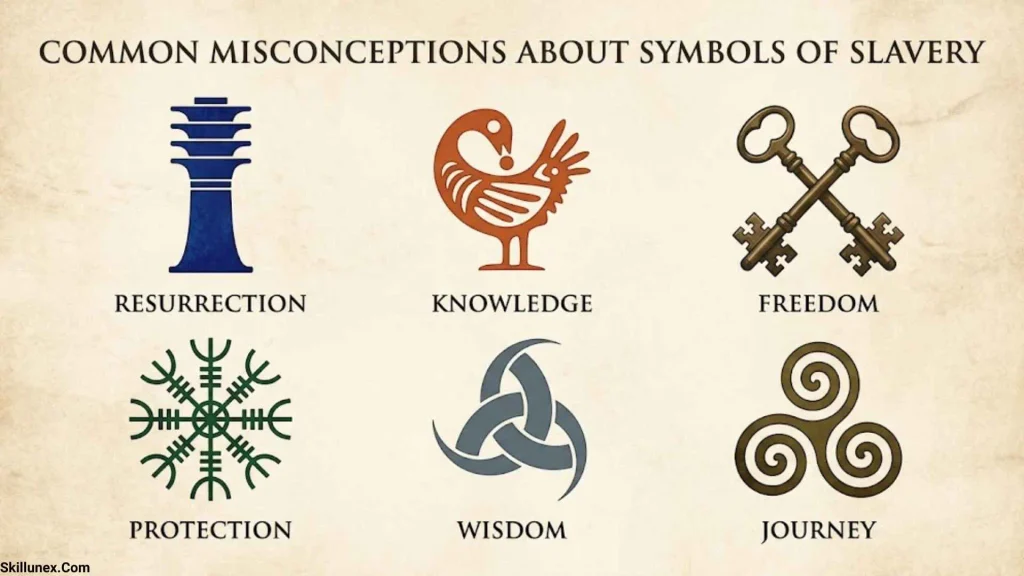
Not every object associated with slavery has a universal meaning. Historical context is essential to understanding these symbols accurately.
Every Chain Is a Symbol of Slavery
Chains have served many purposes throughout history, including securing cargo, restraining prisoners, and fastening objects. A chain may symbolize slavery when its context connects it to captivity or oppression, but that meaning should not automatically be assigned to every chain.
Every Quilt Contained Secret Escape Instructions
Popular stories associate certain quilt patterns with coded messages used by the Underground Railroad. However, the evidence for a widespread, standardized system remains debated. Quilts are important cultural artifacts, but specific claims about secret messages require reliable historical support.
The Underground Railroad Was a Physical Railway
The Underground Railroad was a network of people, routes, and safe locations that assisted escape from slavery. Its name used railway terminology metaphorically; it was not an actual underground train system.
The Emancipation Proclamation Ended Slavery Everywhere in the United States
The proclamation took effect in 1863 and applied to designated areas in rebellion against the United States. It did not immediately free every enslaved person in the country. The Thirteenth Amendment, ratified in 1865, abolished slavery throughout the United States, subject to its exception for punishment after conviction of a crime.
All Symbols of Slavery Have Negative Meanings
Many symbols associated with slavery represent violence and oppression, but some also communicate resistance, remembrance, or emancipation. Broken chains and abolitionist medals, for example, can symbolize the struggle to end slavery rather than slavery itself.
Frequently Asked Questions
What Is the Most Recognized Symbol of Slavery?
Chains are among the most recognized symbols of slavery because they represent captivity, forced control, and the denial of freedom. Shackles, whips, and slave ships are also widely used to represent the historical realities of enslavement.
What Do Broken Chains Symbolize?
Broken chains generally symbolize liberation, emancipation, independence, and resistance to oppression. Their meaning contrasts with intact chains, which commonly represent captivity and restricted freedom.
What Objects Were Used to Restrain Enslaved People?
Historical examples include chains, shackles, and certain types of collars. Whips were also used as instruments of punishment and intimidation. The specific objects and practices varied across societies and historical periods.
Is the Underground Railroad a Symbol of Slavery or Freedom?
The Underground Railroad is primarily a symbol of resistance to slavery and the pursuit of freedom. It represents the people and networks that helped enslaved individuals escape toward safer places.
What Does a Slave Ship Represent?
A slave ship represents forced transportation, human trafficking, and the transatlantic slave trade. It also recalls the dangerous conditions and suffering endured by Africans who were forcibly transported across the Atlantic.
What Is the Difference Between Slavery Symbols and Abolition Symbols?
Symbols of slavery often represent captivity, forced labor, and exploitation. Abolition symbols represent opposition to slavery and the effort to end it. Chains and auction blocks are examples of the former, while abolitionist medals and broken chains are examples of the latter.
Why Are Symbols of Slavery Studied Today?
They help preserve historical memory, explain the human cost of slavery, recognize resistance, and educate people about human rights. They also help historians and the public examine the institutions and economic systems that supported enslavement.
Are Symbols of Slavery the Same in Every Culture?
No. Slavery existed in many societies, and its forms varied across time and place. Some symbols, such as chains, have become widely recognizable, but other objects and images have meanings specific to particular cultures, legal systems, or historical movements.
Conclusion
Symbols of slavery help us understand the history of captivity, forced labor, human trafficking, racial oppression, and the struggle for freedom. Chains, shackles, whips, slave ships, and auction blocks reveal the methods and institutions used to exploit enslaved people. Broken chains, abolitionist medals, and Underground Railroad imagery highlight resistance, resilience, and the pursuit of emancipation.
When I examine these symbols, I see more than historical objects. I see evidence of the suffering experienced by enslaved people, the systems that denied them freedom, and the courage of those who resisted. By learning their meanings and examining their historical context, you can develop a deeper understanding of slavery and why human dignity, equality, and freedom remain essential today.

Isla Kensington
I’m Isla Kensington, a writer with a passion for research, culture, nature, and the fascinating meanings behind everyday things. I enjoy taking topics that may seem simple at first and discovering the history, facts, and ideas that make them more interesting.
I write with readers in mind. My aim is to provide clear explanations, useful information, and interesting details without making a topic unnecessarily complicated.
I believe learning should feel like discovering something rather than simply reading facts. That philosophy guides the content I create and the topics I choose to explore.
## Books by Isla Kensington
* Symbols Around the World: A Guide to Meaning & Culture
* Nature’s Beautiful Places: Lakes, Landscapes & Natural Treasures