St. Patrick’s Day is celebrated every year on March 17 with parades, music, green clothing, Irish-themed decorations, and gatherings around the world. But behind the familiar green hats, shamrocks, rainbows, and leprechauns are symbols with different connections to Irish history, Christian tradition, Celtic culture, and folklore. Understanding these meanings can make the celebration more interesting and help you choose symbols that fit the occasion.
The most recognizable symbols of St. Patrick’s Day include the shamrock, green color, leprechaun, pot of gold, rainbow, Irish harp, Celtic cross, Claddagh, Irish flag, and Celtic knot. Some are directly connected with Ireland or St. Patrick, while others became popular through folklore and modern celebrations.
If you are researching Irish traditions, prepare a St. Patrick’s Day party, creating classroom activities, choosing decorations, or looking for meaningful symbols, this guide explains the most important St. Patrick’s Day symbols and the stories and meanings associated with them.
What Are The Main Symbols Of St. Patrick’s Day
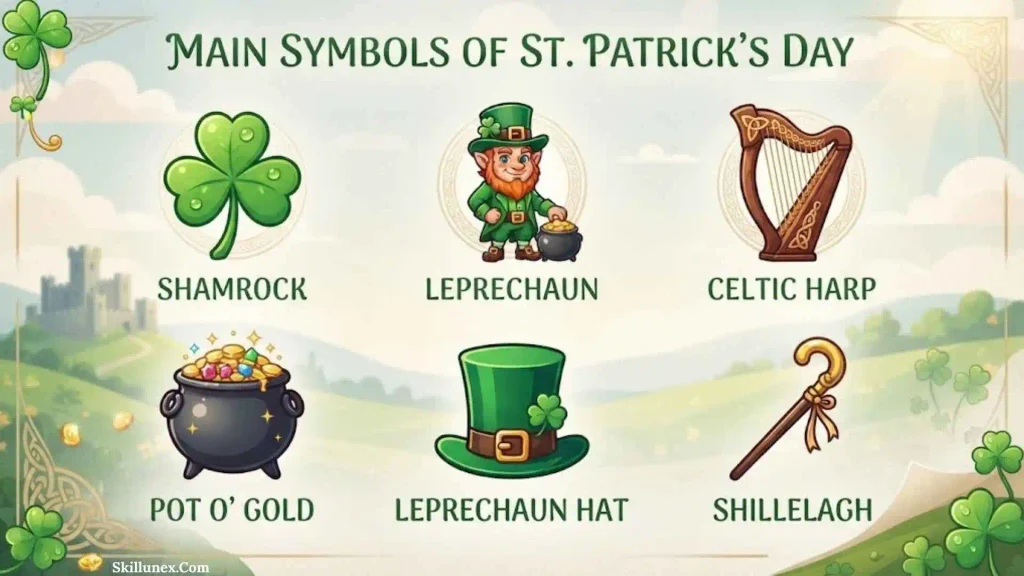
St. Patrick’s Day has many symbols, but they do not all have the same historical origin. Some have religious connections, some represent Irish national or cultural identity, and others come from folklore that became associated with the holiday over time.
Shamrock
The shamrock is one of the most important and recognizable symbols of St. Patrick’s Day. It is traditionally associated with St. Patrick and the Christian teaching of the Holy Trinity.
According to traditional accounts, St. Patrick used the three leaves of a shamrock as a simple way to explain the concept of the Father, Son, and Holy Spirit. Whether every detail of this story can be historically verified is less important to its cultural role today; the shamrock has remained strongly connected with St. Patrick and Irish identity.
The three-leaf design also makes the shamrock visually different from the four-leaf clover. During St. Patrick’s Day, shamrocks appear on clothing, greeting cards, jewelry, decorations, posters, and social media graphics.
Green Color
Green is the dominant color of modern St. Patrick’s Day celebrations. People often wear green shirts, hats, socks, accessories, and costumes, while buildings and public spaces may also be decorated in green.
Green has strong associations with Ireland and its landscape. It also became increasingly connected with Irish national identity and St. Patrick’s Day celebrations.
Today, green represents the festive side of the holiday for many people. It is commonly combined with shamrocks, Irish flags, Celtic designs, and other St. Patrick’s Day imagery.
Leprechaun
The leprechaun is one of the most recognizable figures in Irish folklore and modern St. Patrick’s Day celebrations. Traditionally, leprechauns belong to Irish fairy folklore and were associated with shoemaking and hidden treasure.
Modern popular culture often portrays a leprechaun as a small character wearing green clothing, a hat, and sometimes a beard. This modern image is more playful and colorful than older descriptions found in Irish folklore.
Leprechauns are now commonly used in St. Patrick’s Day decorations, costumes, children’s activities, advertisements, greeting cards, and party themes.
Pot Of Gold
The pot of gold is closely connected to the modern legend of the leprechaun. Popular stories often describe a hidden treasure that can be found at the end of a rainbow.
Because of this connection, a pot filled with gold coins has become a popular St. Patrick’s Day image. It is particularly common in children’s crafts, classroom decorations, party supplies, illustrations, and holiday graphics.
The symbol generally represents luck, treasure, prosperity, and the playful side of Irish folklore.
Rainbow
The rainbow is another familiar St. Patrick’s Day symbol. Its popularity comes largely from the traditional story connecting a rainbow with the leprechaun’s hidden pot of gold.
Rainbow designs add bright colors to St. Patrick’s Day decorations and are often paired with shamrocks, clouds, leprechauns, and gold coins.
Although the rainbow is not an exclusively Irish symbol, its association with the leprechaun and pot of gold has made it a familiar part of modern St. Patrick’s Day imagery.
Irish And Celtic Symbols Of St. Patrick’s Day
Not every meaningful St. Patrick’s Day symbol comes from modern holiday traditions. Several symbols connect the celebration with Irish history, Christian heritage, and Celtic artistic traditions.
Irish Harp
The harp is an important symbol of Ireland and is strongly associated with Irish national and cultural identity. It has a long history in Irish tradition and is used as a national emblem.
The harp is different from many playful St. Patrick’s Day symbols because its significance extends beyond the holiday itself. It can represent Irish heritage, music, history, and national identity.
Harp imagery can be used in St. Patrick’s Day artwork, invitations, cultural displays, educational materials, and Irish-themed decorations.
Celtic Cross
The Celtic cross is a well-known design associated with Celtic and Christian traditions in Ireland. It combines the form of a Christian cross with a circular ring.
Historical examples of Celtic crosses can be found in Ireland, particularly among early medieval monuments and high crosses. Their designs often contain intricate patterns and carved artwork.
Today, Celtic crosses may be used in religious contexts as well as in artwork and cultural representations of Irish heritage.
Celtic Knot
Celtic knots are intricate patterns formed by interwoven lines. They are widely associated with Celtic art and have become popular symbols of Irish and Celtic heritage.
Their continuous, interlaced appearance is often interpreted in modern contexts as representing ideas such as connection, continuity, eternity, or interconnectedness. However, meanings can vary depending on the specific design and context.
Celtic knots are especially popular for jewelry, tattoos, invitations, artwork, borders, and St. Patrick’s Day decorations.
Celtic Spirals
Spiral patterns are another important feature of ancient Celtic-inspired artwork. Some ancient Irish monuments contain spiral and geometric designs that predate modern St. Patrick’s Day celebrations by many centuries.
Today, Celtic spirals are often used to create an ancient or traditional Irish atmosphere. They can appear on artwork, jewelry, decorations, tattoos, and cultural designs.
It is important to distinguish these historical artistic motifs from modern claims that assign one fixed meaning to every Celtic symbol. Their meanings and interpretations can vary according to their historical context.
Traditional Irish Symbols Used On St. Patrick’s Day
Several symbols associated with Ireland have become part of St. Patrick’s Day celebrations even though they are not exclusive to the holiday.
Irish Flag
The Irish tricolor consists of three vertical bands of green, white, and orange. It is an important national symbol of Ireland.
The flag is commonly displayed during Irish cultural events, parades, festivals, and St. Patrick’s Day celebrations. Using the Irish flag can emphasize the connection between the holiday and Irish national identity.
The colors have historical and political significance, so the flag carries a deeper meaning than simply being a green-and-white holiday decoration.
Claddagh
The Claddagh is a traditional Irish symbol featuring two hands holding a heart topped with a crown. The design is commonly associated with friendship, loyalty, and love.
Claddagh rings are particularly well known. They have become a popular Irish cultural symbol and may be given as gifts or worn as jewelry.
Because of its connection with relationships and Irish heritage, the Claddagh is often included in St. Patrick’s Day jewelry, cards, artwork, and romantic designs.
Celtic Jewelry
Celtic-inspired jewelry frequently appears during St. Patrick’s Day celebrations. Common designs include shamrocks, Celtic knots, crosses, Claddagh symbols, harps, and other Irish motifs.
Jewelry provides a subtle way to celebrate Irish heritage without wearing an entire holiday costume. Necklaces, rings, bracelets, earrings, and pendants can all feature traditional Irish-inspired designs.
Folklore Symbols Associated With St. Patrick’s Day
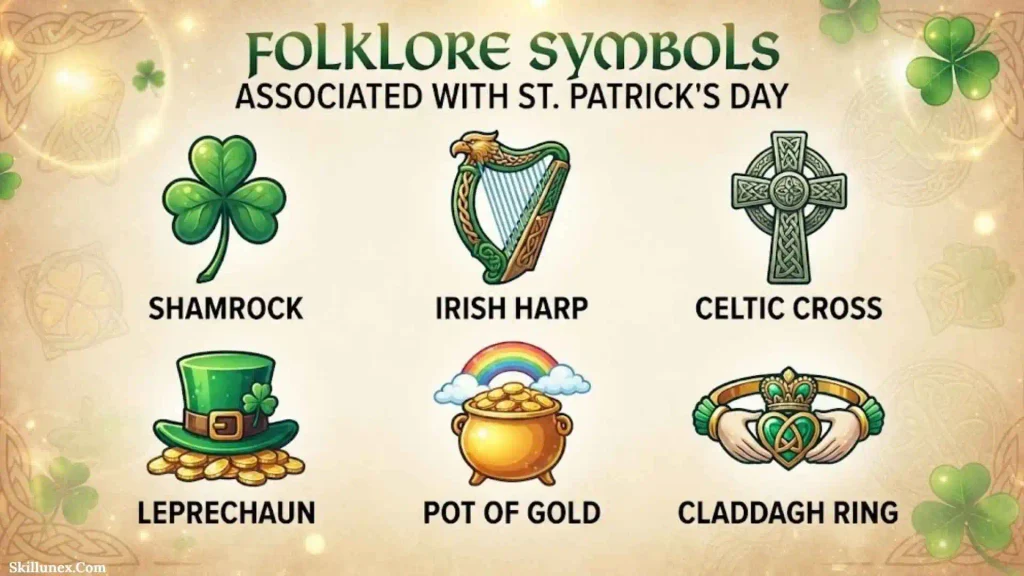
St. Patrick’s Day is not only connected with historical and religious traditions. Irish folklore also plays a major role in the way the holiday is represented today.
Horseshoe
The horseshoe is commonly associated with good luck and sometimes appears alongside St. Patrick’s Day imagery.
It is not an exclusively Irish symbol, and its connection with St. Patrick’s Day is more closely related to the broader theme of luck than to St. Patrick himself.
Horshoes may be combined with four-leaf clovers, gold coins, rainbows, and other lucky imagery in holiday decorations.
Gold Coins
Gold coins represent the treasure traditionally associated with leprechaun stories. They are often placed inside or around a decorative pot of gold.
In modern St. Patrick’s Day celebrations, gold coins can symbolize good fortune, prosperity, treasure, and celebration. Chocolate coins and decorative gold coins are especially popular for children’s parties and holiday games.
Green Hat
The green hat is a modern and playful St. Patrick’s Day symbol. It is strongly associated with the popular image of the leprechaun.
People may wear green top hats, leprechaun hats, novelty hats, or hats decorated with shamrocks during parades and parties.
Green hats are primarily a festive tradition rather than an ancient Irish symbol.
Religious Symbols Connected With St. Patrick’s Day
St. Patrick’s Day has Christian roots, and some symbols associated with the holiday reflect this religious background.
St. Patrick
St. Patrick is the central historical figure connected with the holiday. March 17 is traditionally observed as his feast day and is associated with his death.
St. Patrick is remembered as a Christian missionary associated with Ireland. Much of what is popularly told about his life comes from later traditions and stories, so it is useful to distinguish historical evidence from legends that developed around him.
His image may appear in religious artwork, historical displays, educational materials, and St. Patrick’s Day celebrations.
Trinity Symbolism
The number three has an important connection with the traditional story of St. Patrick and the shamrock.
According to the familiar Christian tradition, the three leaves were used to illustrate the idea of the Holy Trinity. This is why the shamrock has a particularly strong religious connection within St. Patrick’s Day traditions.
Saint Patrick’s Cross
Saint Patrick’s Cross is another symbol associated with St. Patrick’s historical and cultural tradition. It is generally represented as a red saltire, or diagonal cross, on a white background.
It is different from the shamrock and Celtic cross, and it has a specific historical association with St. Patrick rather than simply representing Irish culture in general.
Four-Leaf Clover Vs Shamrock
One common source of confusion is the difference between a shamrock and a four-leaf clover.
What Is A Shamrock
A shamrock traditionally refers to a three-leafed plant associated with Ireland and St. Patrick. Its three leaves are especially important because of the traditional connection with the Holy Trinity.
What Is A Four-Leaf Clover
A four-leaf clover is a rare variation of clover with four leaflets rather than three. It is widely considered a symbol of good luck.
Both plants appear in modern St. Patrick’s Day imagery, but their traditional associations are different. The shamrock is more directly connected with St. Patrick and Ireland, while the four-leaf clover is primarily associated with luck.
What Does The Shamrock Symbolize
The shamrock can have several layers of meaning depending on the context in which it is used.
Religious Meaning
The traditional Christian story connects the three leaves with the Holy Trinity. This gives the shamrock a religious meaning within St. Patrick’s Day traditions.
Irish Identity
The shamrock is also widely recognized as a symbol of Ireland and Irish heritage. It is often used to represent Irish culture in a simple and immediately recognizable way.
St. Patrick’s Day Celebration
In modern celebrations, the shamrock represents the holiday itself. It appears on clothing, decorations, food packaging, party invitations, accessories, and digital graphics.
What Does Green Symbolize On St. Patrick’s Day
Green can represent different ideas depending on the historical or modern context.
Connection With Ireland
Ireland is famously associated with green landscapes, which helped strengthen the color’s cultural connection with the country.
Irish Heritage
Green became an important color in expressions of Irish identity and is now strongly associated with Ireland around the world.
Modern Celebration
Today, green is also simply the signature color of St. Patrick’s Day. Wearing green is one of the easiest ways people participate in the celebration.
Why Are Leprechauns A Symbol Of St. Patrick’s Day
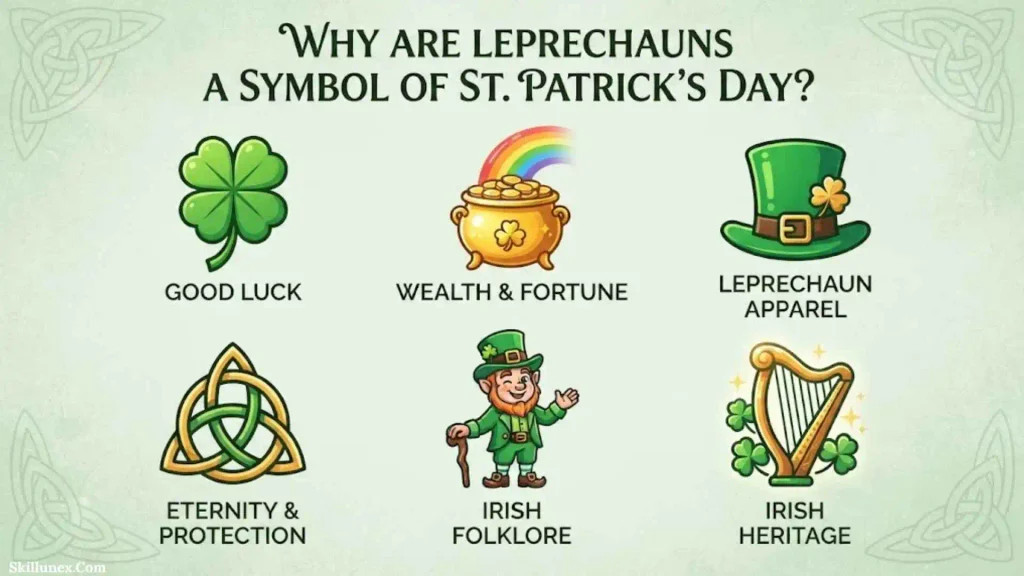
Leprechauns are part of Irish folklore rather than a historical symbol directly connected to St. Patrick.
Their association with the holiday grew through popular culture and modern celebrations. The familiar image of a green-clothed leprechaun, often accompanied by a rainbow and pot of gold, has become one of the most recognizable St. Patrick’s Day themes.
This makes the leprechaun an important folklore symbol, while the shamrock, Irish harp, and Irish flag have stronger connections to Irish cultural or historical identity.
Why Are Rainbows And Pots Of Gold St. Patrick’s Day Symbols
Rainbows and pots of gold are mainly connected with popular leprechaun folklore.
The familiar story says that a leprechaun’s treasure can be found at the end of a rainbow. This creates a simple visual combination: rainbow + leprechaun + pot of gold.
Although this imagery is not a direct representation of St. Patrick’s historical life, it has become a major part of modern St. Patrick’s Day celebrations.
Why Is The Harp A Symbol Of Ireland
The harp has a much deeper connection with Irish national identity than many modern St. Patrick’s Day decorations.
It has been associated with Irish music and culture for centuries and is used as an important national emblem. The harp therefore represents Irish heritage, music, history, and national identity.
Its use during St. Patrick’s Day can add a more culturally focused element to decorations and educational displays.
Symbols Of St. Patrick’s Day And Their Meanings
| Symbol | Common Meaning Or Association |
| Shamrock | St. Patrick, Ireland, Holy Trinity |
| Green | Ireland, Irish identity, celebration |
| Leprechaun | Irish folklore, magic, treasure |
| Four-Leaf Clover | Good luck |
| Rainbow | Folklore, treasure, leprechaun stories |
| Pot Of Gold | Treasure, luck, prosperity |
| Irish Harp | Irish culture, music, national identity |
| Celtic Cross | Christian and Celtic heritage |
| Celtic Knot | Celtic art, connection, continuity |
| Claddagh | Love, loyalty, friendship |
| Irish Flag | Ireland and national identity |
| Gold Coins | Treasure and good fortune |
| Green Hat | Modern St. Patrick’s Day celebration |
| Horseshoe | Luck and good fortune |
| Saint Patrick | Religious and historical connection to the holiday |
How To Use St. Patrick’s Day Symbols
These symbols can be used in many creative ways depending on the type of celebration or project you are preparing.
St. Patrick’s Day Decorations
Shamrocks, green banners, Irish flags, rainbows, gold coins, leprechauns, and Celtic patterns can create a recognizable holiday theme.
For a more traditional look, Irish flags, harps, Celtic knots, and shamrocks can emphasize Irish heritage. For a playful children’s party, leprechauns, rainbows, and pots of gold may be more suitable.
St. Patrick’s Day Crafts
Children can create shamrock drawings, paper rainbows, leprechaun hats, pots of gold, and Celtic-inspired patterns.
Craft activities can also be used as opportunities to explain the difference between historical Irish symbols and modern folklore.
St. Patrick’s Day Invitations
A shamrock, green color palette, Celtic knot, Irish harp, or Claddagh can make an invitation immediately recognizable as Irish-themed.
The symbol you choose can also communicate the style of the event. For example, Celtic patterns can create a traditional appearance, while leprechauns and rainbows create a more playful mood.
St. Patrick’s Day Social Media Posts
Shamrocks, green graphics, rainbows, leprechauns, and short Irish-themed messages work well for social media designs.
Using a small number of recognizable symbols can make a post visually clear without making the design feel crowded.
St. Patrick’s Day Symbols For Kids
Children often learn about St. Patrick’s Day through colorful symbols and simple stories.
Some of the easiest symbols for children to recognize include:
- Shamrock
- Four-leaf clover
- Leprechaun
- Rainbow
- Pot of gold
- Green hat
- Gold coins
- Irish flag
These symbols can be incorporated into coloring pages, classroom crafts, scavenger hunts, decorations, and educational activities.
Teachers and parents can also explain that some symbols have historical or religious roots while others come primarily from folklore.
St. Patrick’s Day Symbols For Decorations
If you are decorating a home, classroom, office, or party space, you can combine several symbols to create a complete theme.
A traditional Irish theme could include shamrocks, Irish flags, Celtic knots, and harp designs. A playful theme could combine leprechauns, rainbows, gold coins, and pots of gold.
Green does not have to be the only color used. Adding white, orange, gold, rainbow colors, or natural Celtic-inspired patterns can create more visual variety while keeping the St. Patrick’s Day theme recognizable.
Historical Symbols Vs Modern St. Patrick’s Day Symbols
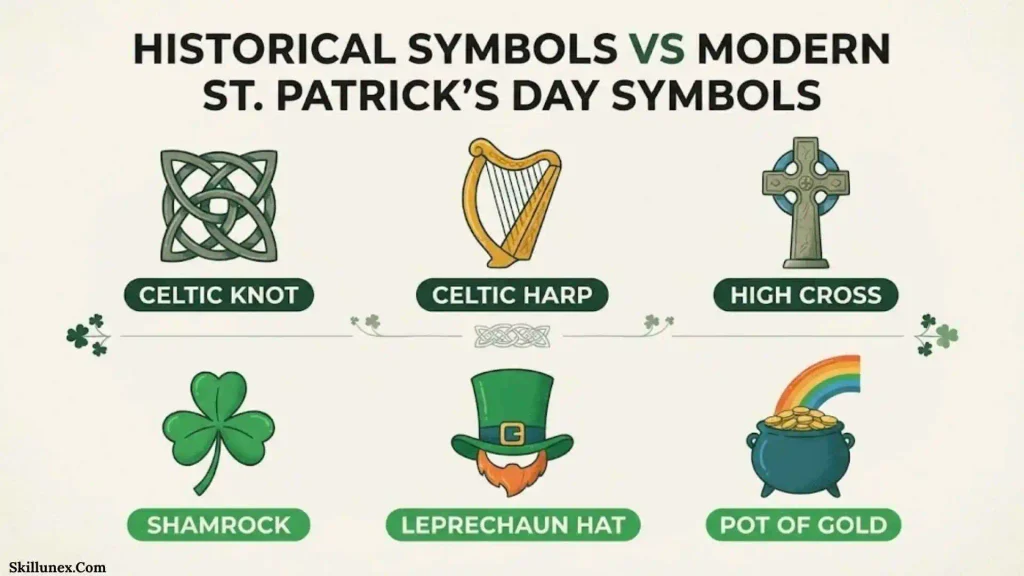
One of the most important things to understand about St. Patrick’s Day symbolism is that not every popular image has the same historical connection.
The shamrock has a traditional connection with St. Patrick and Christian teaching. The harp and Irish flag are connected with Irish cultural and national identity. Celtic crosses and Celtic artistic patterns connect with aspects of Ireland’s Christian and Celtic heritage.
By comparison, leprechauns, rainbows, pots of gold, and green novelty hats are largely part of modern popular representations and folklore surrounding the celebration.
Knowing this difference makes it easier to use these symbols accurately rather than treating every St. Patrick’s Day image as an ancient Irish tradition.
Frequently Asked Questions About Symbols Of St. Patrick’s Day
What Is The Most Famous Symbol Of St. Patrick’s Day
The shamrock is one of the most famous symbols of St. Patrick’s Day. It has a traditional association with St. Patrick and the Christian concept of the Holy Trinity, and it is also widely recognized as a symbol of Ireland.
What Does The Shamrock Symbolize
The shamrock is traditionally associated with St. Patrick’s explanation of the Holy Trinity. It also represents Irish identity and has become a general symbol of St. Patrick’s Day.
Why Is Green Associated With St. Patrick’s Day
Green became strongly associated with Ireland and Irish identity and is now the signature color of modern St. Patrick’s Day celebrations. People commonly wear green and use it in holiday decorations.
Is The Four-Leaf Clover A St. Patrick’s Day Symbol
Yes, the four-leaf clover is commonly used in St. Patrick’s Day imagery, particularly because it represents good luck. However, it is different from the three-leaf shamrock traditionally associated with St. Patrick.
What Does The Leprechaun Represent
The leprechaun represents Irish folklore and is traditionally connected with stories of fairy-like beings and hidden treasure. Its modern green-clothed appearance has become a popular part of St. Patrick’s Day celebrations.
What Does The Pot Of Gold Represent
The pot of gold represents the treasure associated with popular leprechaun folklore. It is commonly shown at the end of a rainbow and can symbolize luck, wealth, or prosperity in modern St. Patrick’s Day imagery.
Why Is The Irish Harp A St. Patrick’s Day Symbol
The harp is an important symbol of Irish cultural and national identity. It has a long association with Irish music and history and is therefore often used to represent Ireland during St. Patrick’s Day celebrations.
What Does The Claddagh Symbol Mean
The Claddagh features two hands holding a heart beneath a crown. It is commonly associated with friendship, love, and loyalty and is one of the most recognizable traditional Irish designs.
Are Celtic Knots St. Patrick’s Day Symbols
Celtic knots are commonly used in St. Patrick’s Day artwork because they are associated with Celtic artistic traditions and Irish heritage. Their meanings can vary depending on the particular design and historical context.
What Are The Religious Symbols Of St. Patrick’s Day
Religious symbols associated with St. Patrick’s Day include the shamrock through its traditional connection with the Holy Trinity, Christian crosses, Celtic crosses, and imagery representing St. Patrick himself.
Conclusion
The symbols of St. Patrick’s Day tell several different stories about Ireland, Christianity, folklore, and modern celebration. The shamrock connects strongly with the traditional story of St. Patrick and the Holy Trinity, while the Irish harp, Irish flag, Claddagh, and Celtic designs highlight different aspects of Irish cultural heritage. Green has become the signature color of the modern holiday, making it one of the easiest ways to recognize St. Patrick’s Day.
Other familiar images, including leprechauns, rainbows, pots of gold, gold coins, and green hats, add a fun folkloric element to the celebration. Knowing the difference between historical, religious, cultural, and modern symbols helps you understand why these images appear together every March 17. Whether you use them for decorations, crafts, social media, classroom activities, or a festive gathering, each symbol can add its own meaning to your St. Patrick’s Day celebration.

Caleb Thornton
I’m Caleb Thornton, a researcher and content writer who loves exploring fascinating subjects and sharing what I learn with readers. My interests include natural places, lakes, symbols, culture, history, and the stories that make ordinary topics more meaningful.
When I write an article, I try to go beyond a basic answer. I look for useful facts, relevant context, and details that can help readers understand the subject more completely.
My purpose is simple: I want every article I contribute to provide genuine value, satisfy the reader’s curiosity, and make discovering new information enjoyable.
## Books by Caleb Thornton
* Symbols & Meanings: Exploring the Signs We See Every Day
* Lakes of the World: Nature, Beauty & Exploration