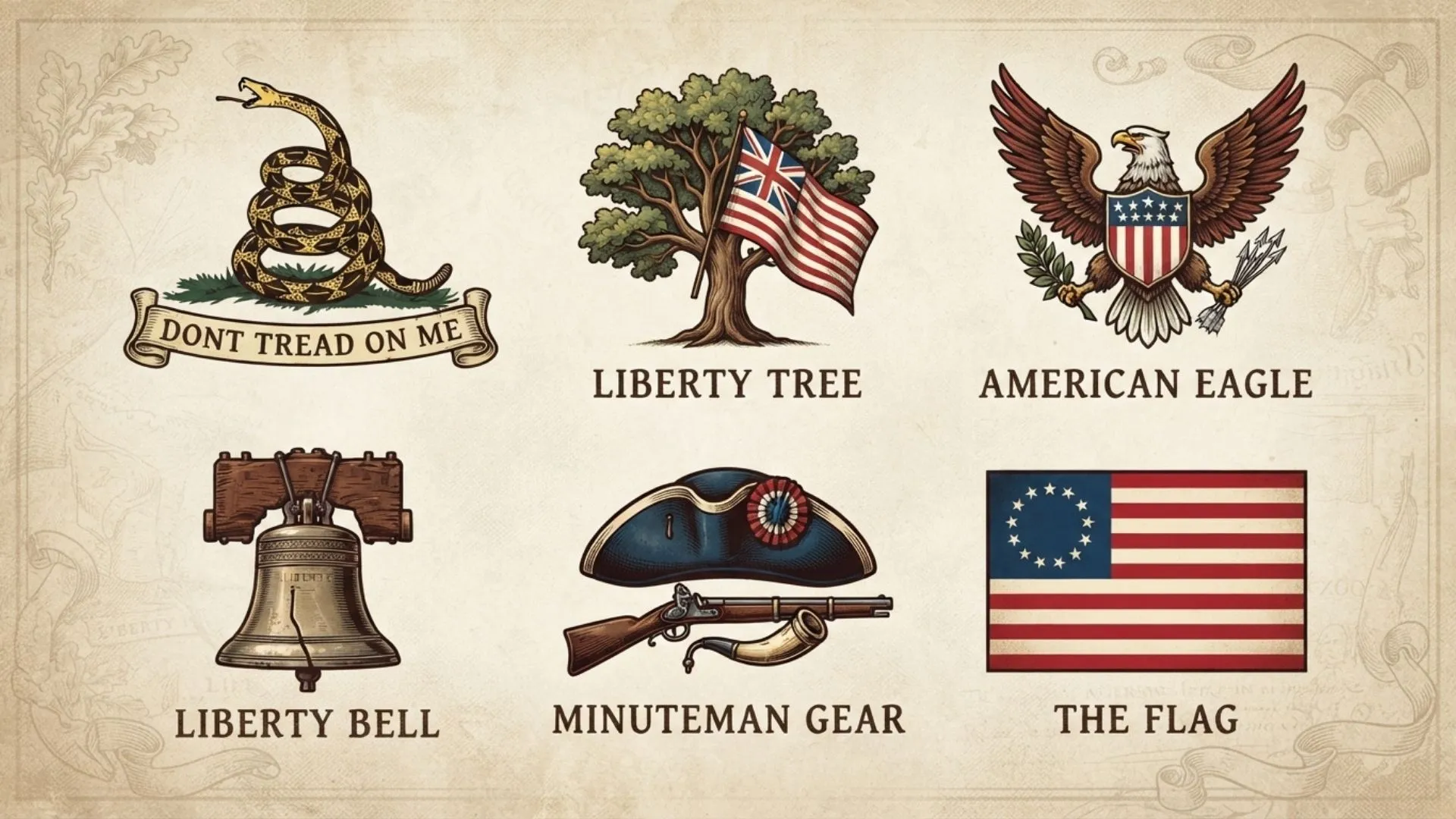
The symbols of the American Revolution helped colonists communicate ideas of liberty, resistance, unity, and independence at a time when newspapers, pamphlets, flags, public gatherings, and political images were among the most powerful forms of mass communication. Some symbols were created specifically to encourage colonial unity, while others became associated with the Revolution through protests, military service, or the declaration of independence.
The most important symbols include the Liberty Tree, Liberty Pole, rattlesnake, “Join, or Die” cartoon, Liberty Cap, Revolutionary flags, Minuteman, Declaration of Independence, and thirteen-colony imagery. Other famous objects, such as the Liberty Bell and bald eagle, are closely associated with the Revolution today but require some historical qualification because their symbolic importance developed mainly after independence.
Understanding these distinctions makes the history of Revolutionary symbols much more interesting—and more accurate.
Why Were Symbols Important During the American Revolution?
The American Revolution was fought with armies and weapons, but it was also a battle over ideas. Colonists needed ways to spread political messages, persuade undecided neighbors, organize resistance, and demonstrate opposition to British policies.
Symbols were particularly effective because they could communicate complicated political ideas quickly.
Symbols Created a Common Political Language
A picture of a rattlesnake, a tree decorated with protest messages, or a flag with thirteen elements could communicate ideas without requiring a long political argument.
Benjamin Franklin’s “Join, or Die” image is an excellent example. First published in The Pennsylvania Gazette in 1754, the woodcut showed a snake divided into sections representing colonies. Franklin originally used it to encourage colonial unity during the French and Indian War. During the Revolutionary period, however, the image was reused as a call for the colonies to unite against British rule.
Symbols Helped Turn Protest Into a Movement
Resistance to British taxation and authority involved thousands of people who lived in different colonies and communities. Symbols gave those people recognizable ways to identify with a broader cause.
Newspapers reproduced political cartoons, protesters displayed liberty poles, and flags appeared in military and political settings. The result was a visual language that helped transform separate local disputes into a larger movement for American independence.
The Liberty Tree: A Symbol of Colonial Resistance
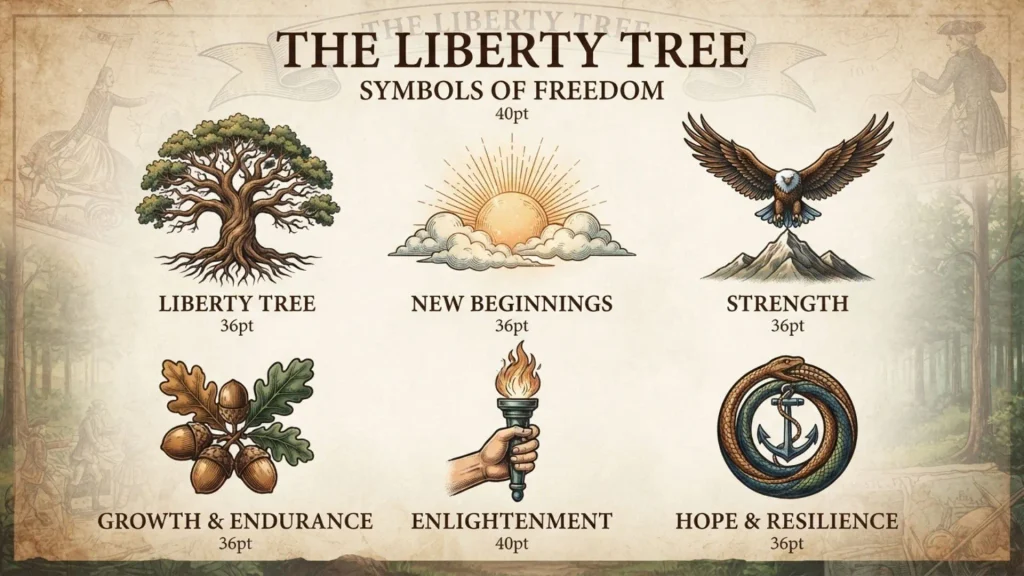
The Liberty Tree was one of the most important physical symbols of resistance before the Revolutionary War.
What Was the Liberty Tree?
The most famous Liberty Tree stood in Boston, where opponents of British policies gathered and organized protests. The tree became associated with resistance to the Stamp Act and other measures imposed by Parliament.
The idea spread beyond Boston. Other communities adopted liberty trees and similar gathering places, turning ordinary public spaces into symbols of political freedom.
What Did the Liberty Tree Represent?
The Liberty Tree represented:
- Resistance to British authority
- Freedom and political rights
- Community organization
- Opposition to taxation without representation
- Colonial solidarity
Its importance came partly from the fact that it was a real gathering place. It was not simply an image on a page. People could meet beneath it, display messages, organize protests, and make their opposition visible to the community.
The Liberty Pole: A Visible Sign of Freedom
The Liberty Pole was another important symbol of Revolutionary-era resistance.
Why Were Liberty Poles Erected?
Colonists often erected liberty poles in town commons and public squares as expressions of patriotism and opposition to British government policies. The poles became visible signs that a community supported the patriot cause. The Library of Congress describes erecting a Liberty Pole as one of the favorite Revolutionary-era ways Americans demonstrated patriotism and opposition to the British government.
What Did the Liberty Pole Symbolize?
A liberty pole could represent:
- Political freedom
- Resistance to British rule
- Patriotism
- Community solidarity
- The right to self-government
Because liberty poles were highly visible, they could also become sources of conflict between Patriots and Loyalists. Their physical presence demonstrated that political disagreement had moved beyond private conversation and into public life.
The Rattlesnake: A Warning to Britain’s Opponents
The rattlesnake became one of the most recognizable Revolutionary symbols.
Why Did Americans Use a Rattlesnake?
Benjamin Franklin helped establish the rattlesnake as a symbol associated with the American colonies. His famous Join, or Die image showed a divided snake, while later Revolutionary imagery used the rattlesnake to represent American unity and resistance.
The National Park Service notes that Franklin’s earlier snake imagery helped launch the rattlesnake as a symbol of the American colonies.
The snake was particularly effective as a political image because it suggested a warning: Americans might not seek conflict, but they would respond when threatened.
What Does “Don’t Tread on Me” Mean?
During the Revolutionary period, the rattlesnake became associated with the message “Don’t Tread on Me.”
The Library of Congress records that by December 1775, a writer reported seeing the rattlesnake symbol on a Marine drum with the motto “Don’t Tread on Me.”
The message was straightforward: do not threaten or oppress us, because we are prepared to defend ourselves.
“Join, or Die”: The Symbol of Colonial Unity
The “Join, or Die” cartoon is one of the most important political symbols connected to the American Revolution.
What Did the Snake Represent?
The original woodcut showed a snake divided into sections representing different colonies. Franklin published it in 1754 as an argument for colonial cooperation.
Its meaning changed during the Revolutionary era. Newspapers reused the image and its message as tensions with Britain increased. The phrase became a powerful call for Americans to unite.
Why Was “Join, or Die” So Powerful?
The message reduced a complicated political argument to three words.
It suggested that the colonies had two choices:
Unite—or face defeat separately.
During the 1770s, versions of the image appeared in newspapers in places including Boston, New York, and Philadelphia. The National Park Service notes that “Join or Die” and similar messages became part of newspaper mastheads during the resistance to British policies.
This makes the symbol particularly important because it demonstrates how print media helped spread Revolutionary ideas.
The Liberty Cap: An Ancient Symbol of Freedom
The Liberty Cap, also known as the Phrygian cap, became associated with freedom during the Revolutionary era.
What Did the Liberty Cap Represent?
The cap had older historical associations with freedom and emancipation. American revolutionaries adopted the imagery because it communicated a familiar political idea: liberty from oppression.
It appeared in political art, seals, medals, and other forms of Revolutionary imagery.
Why Did Revolutionaries Use Ancient Symbols?
American political thinkers frequently drew upon symbols from ancient Rome, Greece, and classical political traditions.
Using established imagery allowed revolutionaries to connect their struggle with older ideas about republican government, civic virtue, and resistance to tyranny.
The Liberty Cap therefore represented more than clothing. It became a visual shorthand for freedom and independence.
Revolutionary Flags: Symbols of the New American Identity
Flags were especially important because they could identify military forces, ships, communities, and the emerging American cause.
However, it is important not to assume that the modern American flag appeared fully formed at the beginning of the Revolution.
The Grand Union Flag
The Grand Union Flag was an important early American flag.
It featured thirteen red-and-white stripes combined with a British Union design in the canton. The Smithsonian explains that the flag reflected the fact that the colonists were still British subjects at the beginning of the Revolutionary conflict.
The flag therefore represents an important transitional moment: Americans were increasingly resisting British policies while their political relationship with Britain was still being transformed.
The Pine Tree Flag
The Pine Tree Flag is another Revolutionary-era flag associated with New England and American resistance.
The pine tree had already appeared in colonial imagery, particularly in New England. It became associated with independence, resistance, and the maritime traditions of the colonies.
The Smithsonian’s National Museum of American History maintains a Revolutionary-era collection record for a Pine Tree Flag, demonstrating the enduring place of pine-tree imagery in American historical symbolism.
The Stars and Stripes
The Stars and Stripes became the enduring national flag of the United States, but its early history is more complicated than the familiar modern design suggests.
The flag adopted in 1777 established the basic pattern of thirteen stripes and a field containing stars, but the appearance and arrangement of early flags varied.
The thirteen stripes became an especially powerful representation of the original thirteen colonies and their union.
The Number Thirteen: A Symbol of Colonial Unity
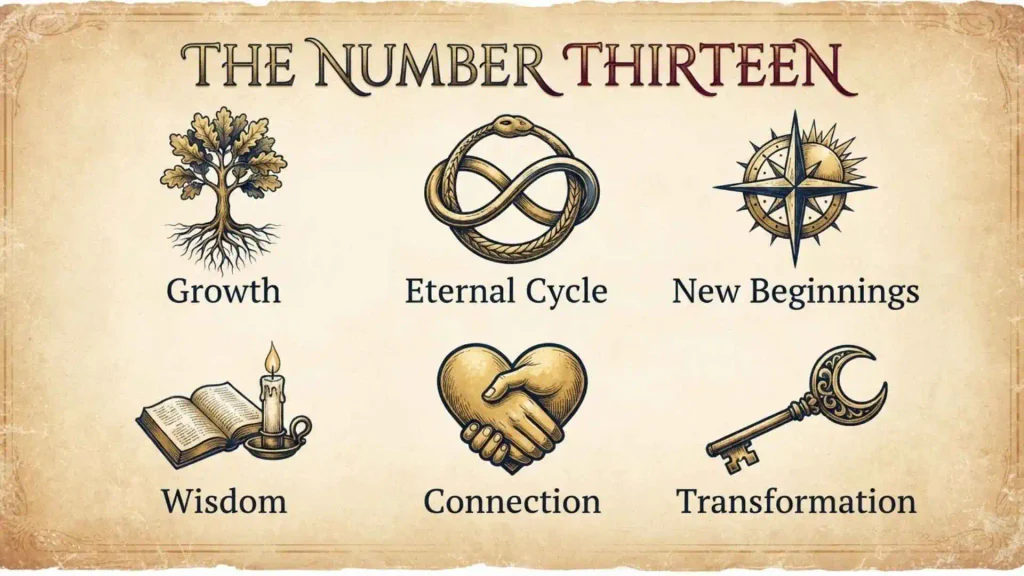
The number thirteen appears repeatedly in American Revolutionary symbolism.
Why Was Thirteen Important?
The thirteen colonies were politically separate but increasingly viewed as members of a common cause.
As a result, thirteen became a visual representation of:
- Colonial unity
- The original states
- Cooperation
- Independence
- The creation of a new nation
Thirteen stripes, thirteen stars, and other groups of thirteen elements became ways of expressing the idea that separate colonies could form one political community.
The Library of Congress notes that Revolutionary and early national imagery repeatedly used groups of thirteen to represent union.
The Minuteman: The Citizen-Soldier
The Minuteman became one of the most enduring human symbols of the American Revolution.
Who Were the Minutemen?
Minutemen were members of colonial militias who were expected to be ready to respond quickly when needed.
The image of an ordinary farmer or townsman taking up arms became powerful because the Revolutionary struggle was presented not simply as a war between professional armies, but also as a defense of local communities and political rights.
What Does the Minuteman Symbolize?
The Minuteman represents:
- Courage
- Military readiness
- Citizen participation
- Defense of one’s community
- Resistance to oppression
The image became particularly associated with the fighting at Lexington and Concord in April 1775, when armed conflict between colonial forces and British troops marked a major escalation of the crisis.
The Declaration of Independence: The Ultimate Symbol of Independence
The Declaration of Independence is perhaps the most important written symbol of the American Revolution.
Why Is the Declaration So Important?
On July 4, 1776, the Continental Congress adopted the Declaration of Independence. The document formally announced that the thirteen colonies regarded themselves as independent states rather than subjects of Britain.
Its importance goes beyond the announcement of separation.
The Declaration articulated ideas about natural rights and the purpose of government that became central to American political identity.
What Does the Declaration Symbolize?
The Declaration represents:
- Independence
- Natural rights
- Self-government
- Resistance to tyranny
- Political equality as an ideal
- The creation of a new nation
Unlike a flag or political cartoon, the Declaration communicated the Revolution’s political philosophy directly.
The Boston Tea Party: A Symbol of Defiance
The Boston Tea Party is both a historical event and a lasting symbol of resistance.
What Happened at the Boston Tea Party?
In December 1773, colonists in Boston protested British tea policies by throwing tea into Boston Harbor.
The action was dramatic because it turned opposition to British taxation and authority into a highly visible act of defiance.
The National Park Service identifies the tea tax and the East India Company’s monopoly as important parts of the crisis that intensified resistance in Boston.
What Did the Boston Tea Party Symbolize?
The event came to represent:
- Resistance to taxation
- Direct political action
- Colonial protest
- Defiance of British authority
- The willingness to take risks for political principles
Its importance lies partly in its theatrical quality. The destruction of the tea was a political message that could not easily be ignored.
The Sons of Liberty: A Symbol of Organized Resistance
The Sons of Liberty were a network of colonial activists who opposed British taxation and government policies.
Why Were the Sons of Liberty Important?
They helped organize resistance, protests, boycotts, and public demonstrations.
Their activities demonstrated that the American Revolution did not begin with armies. It developed through years of political organizing and public resistance.
What Did the Sons of Liberty Represent?
The group became associated with:
- Resistance to taxation
- Grassroots political organization
- Colonial rights
- Protest
- Opposition to British authority
Their importance also helps explain why symbols such as liberty trees and liberty poles became so powerful. Political movements needed both organizations and recognizable public symbols.
The Liberty Bell: A Symbol That Became Important Later
The Liberty Bell is one of the most famous symbols associated with American independence, but its history requires an important qualification.
Was the Liberty Bell a Revolutionary Symbol?
Not in the way many modern readers assume.
The bell existed during the Revolutionary period and was housed in the Pennsylvania State House, now Independence Hall. It may have rung in connection with the public reading of the Declaration of Independence on July 8, 1776, but the famous name “Liberty Bell” was not used during the Revolution.
The National Park Service explains that the bell’s inscription went largely unnoticed during the Revolutionary War and that abolitionists later helped transform it into a major symbol of liberty.
Why Is the Liberty Bell Associated With the Revolution Today?
Its connection to Independence Hall, the Declaration of Independence, and the founding of the United States gradually made it a powerful national symbol.
Its later use by abolitionists, women’s suffrage activists, and civil rights movements gave the bell an even broader meaning.
Therefore, it is more accurate to describe the Liberty Bell as a Revolutionary-era object that became a major symbol of liberty after the Revolution.
The Bald Eagle: A Post-Revolution National Symbol
The bald eagle is another symbol frequently included in discussions about the American Revolution, but it should not be confused with the political imagery that directly fueled the Revolution.
Why Did the United States Choose the Bald Eagle?
The bald eagle became an important national emblem after independence and appeared on the Great Seal of the United States.
The bird came to symbolize strength, independence, and the new American nation.
Was the Bald Eagle a Major Revolutionary Symbol?
It is better described as an early national symbol of the United States rather than one of the primary symbols used to organize resistance before independence.
This distinction matters because many modern patriotic symbols are often projected backward onto the Revolutionary period.
Revolutionary Symbols vs. Later American Symbols
One of the most important things to understand about the symbols of the American Revolution is that not every symbol associated with the Revolution was equally important during the Revolution itself.
Symbols Used During the Revolutionary Era
Some symbols were actively used to communicate resistance and unity:
- “Join, or Die”
- The rattlesnake
- Liberty Tree
- Liberty Pole
- Liberty Cap
- Revolutionary flags
- Thirteen-colony imagery
- Minuteman imagery
- Patriot newspapers and political cartoons
Symbols That Became More Important Later
Other symbols developed their strongest patriotic meaning after independence:
- Liberty Bell
- Bald eagle
- Some later versions of the American flag
- The Great Seal as a national emblem
This distinction gives a more accurate picture of Revolutionary history. Symbols are not fixed forever; their meanings can change as later generations reinterpret them.
What These Symbols Tell Us About the American Revolution
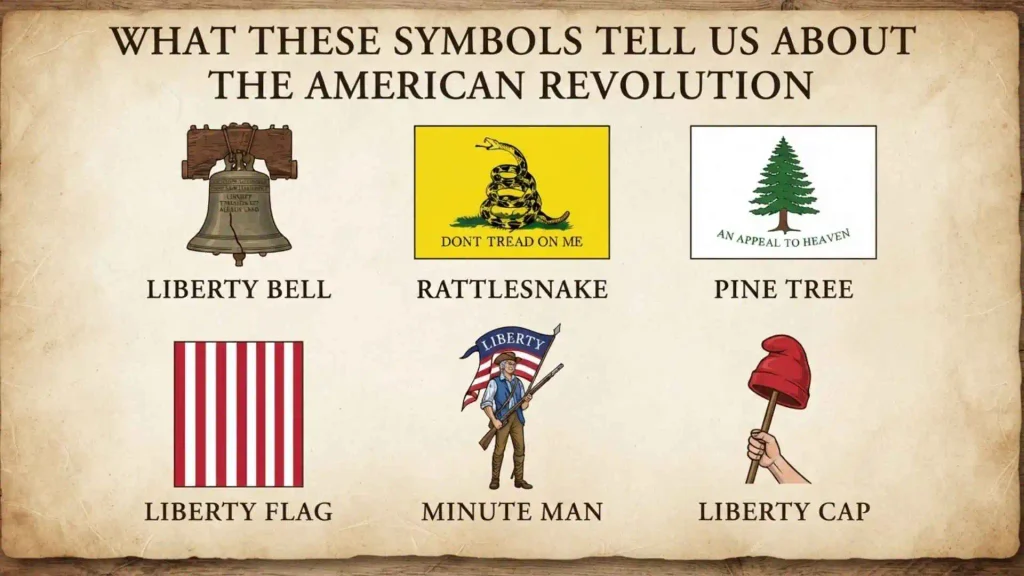
The symbols of the American Revolution reveal that the conflict was about more than military battles.
The Revolution Was a Battle Over Ideas
Words such as liberty, independence, representation, and self-government were repeatedly translated into visual forms.
A liberty pole could turn a town square into a political statement. A rattlesnake could communicate a warning. A divided snake could call for unity. A flag could represent thirteen colonies becoming one political community.
Printing Helped Spread Revolutionary Symbols
Newspapers and printed images were especially important.
Franklin’s “Join, or Die” image is a powerful example of how political symbolism could move from one historical crisis to another. The image was first created in 1754 but was revived during the conflict with Britain.
This demonstrates that Revolutionary symbols were not always created specifically for independence. Existing images could be reinterpreted when political circumstances changed.
Symbols Also Created a Sense of Belonging
A revolution requires more than political arguments. People must feel that they belong to a common cause.
Flags, slogans, trees, poles, animals, and political cartoons gave colonists ways to identify with that cause.
That is one reason Revolutionary symbols remain powerful today: they helped turn an abstract political movement into something people could see, display, gather around, and recognize.
Frequently Asked Questions
What were the main symbols of the American Revolution?
The major symbols included the Liberty Tree, Liberty Pole, rattlesnake, “Join, or Die” cartoon, Liberty Cap, Revolutionary flags, thirteen-colony imagery, Minuteman, Declaration of Independence, and Sons of Liberty imagery. The Liberty Bell and bald eagle are also strongly associated with the Revolution today, although their symbolic importance developed largely after independence.
What did the rattlesnake symbolize during the American Revolution?
The rattlesnake represented American unity, vigilance, and resistance. Its association with the phrase “Don’t Tread on Me” communicated a warning that Americans would defend themselves when threatened.
What did “Join, or Die” mean?
“Join, or Die” was a call for the colonies to unite. Benjamin Franklin originally published the image in 1754 to encourage colonial cooperation. During the Revolutionary era, the image was reused as a call for the colonies to unite against British rule.
What did the Liberty Tree symbolize?
The Liberty Tree symbolized resistance to British policies, political freedom, and community organization. In places such as Boston, it became a gathering point for colonists protesting British authority.
What did the Liberty Pole represent?
The Liberty Pole was a visible expression of patriotism and opposition to British rule. Communities erected liberty poles in public places as symbols of political freedom and resistance.
Was the Liberty Bell used during the American Revolution?
The bell existed and was used during the Revolutionary period, but it was not known as the Liberty Bell at that time. The famous name and broader symbolism developed later, particularly through nineteenth-century abolitionist movements.
What did the thirteen stars and stripes represent?
The number thirteen represented the original thirteen colonies and their union. Groups of thirteen appeared frequently in Revolutionary and early American imagery because they communicated the idea that separate colonies could form one political community.
Was the American flag used during the American Revolution?
Yes, several flags were used during the Revolutionary era. The Grand Union Flag was an important early American flag, while the Stars and Stripes was adopted in 1777. The design and use of Revolutionary flags evolved as the colonies moved from resistance to independence.
What did the Minuteman symbolize?
The Minuteman symbolized the citizen-soldier: an ordinary member of the community prepared to defend local rights and liberty. The image became strongly associated with the opening battles of the Revolutionary War.
Why are symbols of the American Revolution still important?
They continue to shape how Americans understand ideas such as liberty, independence, resistance, unity, and self-government. Many have also been adopted by later movements, giving them meanings that extend beyond the eighteenth century.
Conclusion
The symbols of the American Revolution were powerful tools for communicating political ideas in an era before modern mass media. The Liberty Tree and Liberty Pole turned public spaces into centers of resistance.
The rattlesnake and “Join, or Die” cartoon communicated warnings and calls for unity. Revolutionary flags and thirteen-colony imagery helped create a shared American identity, while the Minuteman represented ordinary citizens prepared to defend their communities.

Caleb Thornton
I’m Caleb Thornton, a researcher and content writer who loves exploring fascinating subjects and sharing what I learn with readers. My interests include natural places, lakes, symbols, culture, history, and the stories that make ordinary topics more meaningful.
When I write an article, I try to go beyond a basic answer. I look for useful facts, relevant context, and details that can help readers understand the subject more completely.
My purpose is simple: I want every article I contribute to provide genuine value, satisfy the reader’s curiosity, and make discovering new information enjoyable.
## Books by Caleb Thornton
* Symbols & Meanings: Exploring the Signs We See Every Day
* Lakes of the World: Nature, Beauty & Exploration